

ISO 10256-5:2026
(Main)Protective equipment for use in ice hockey — Part 5: Neck laceration protectors for use in ice hockey
- Abstract
This document specifies performance requirements and test methods for neck laceration protectors for use in ice hockey. This document is applicable to neck laceration protectors worn by ice hockey players, including goalkeepers, and referees. This document does not address protection of the neck from the impact of pucks, sticks or other objects.
- Status
- Published
- Publication Date
- 23-Jul-2026
- Technical Committee
- ISO/TC 83/SC 5 - Ice hockey equipment and facilities
- Drafting Committee
- ISO/TC 83/SC 5 - Ice hockey equipment and facilities
- Current Stage
- 6060 - International Standard published
- Start Date
- 24-Jul-2026
- Due Date
- 11-Apr-2026
- Completion Date
- 24-Jul-2026
Buy Documents
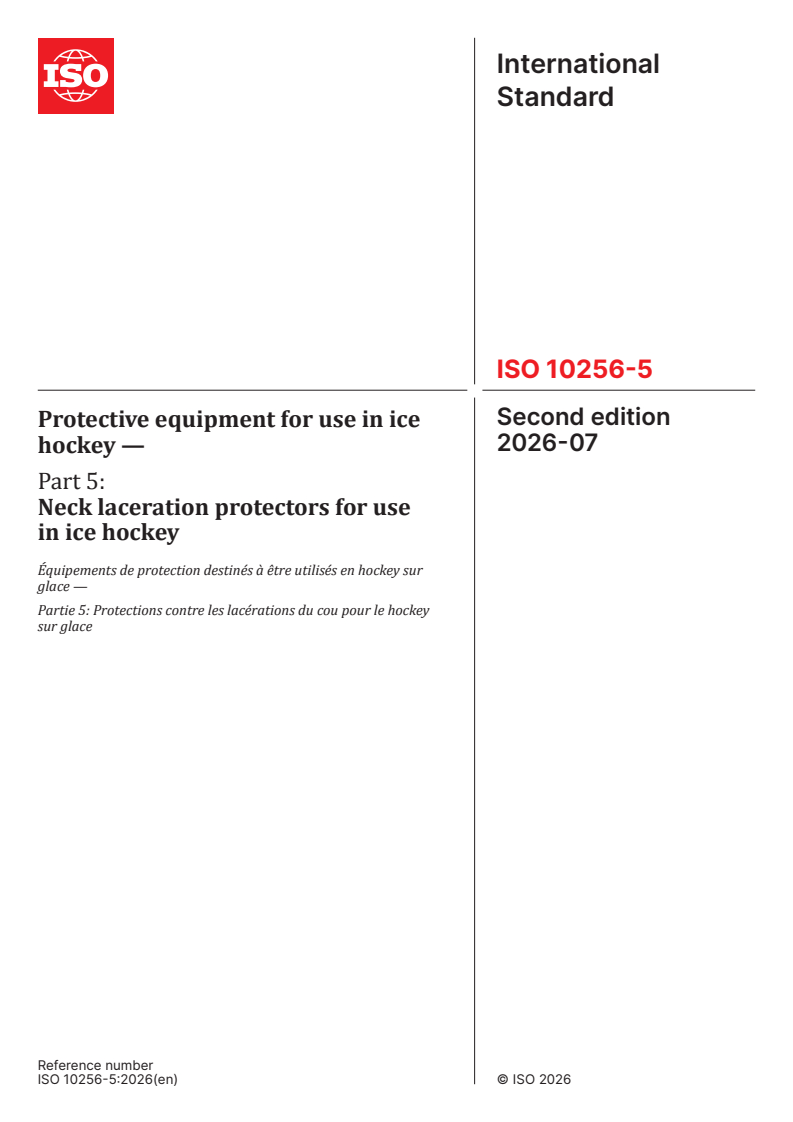
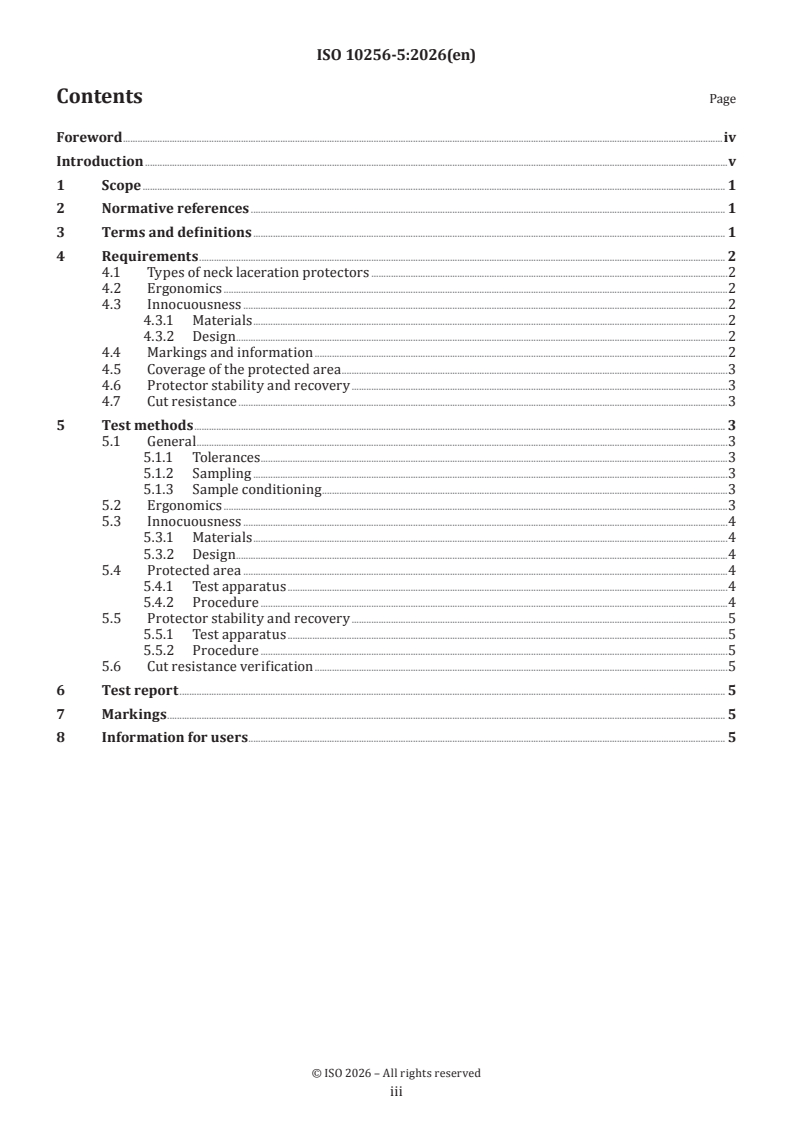
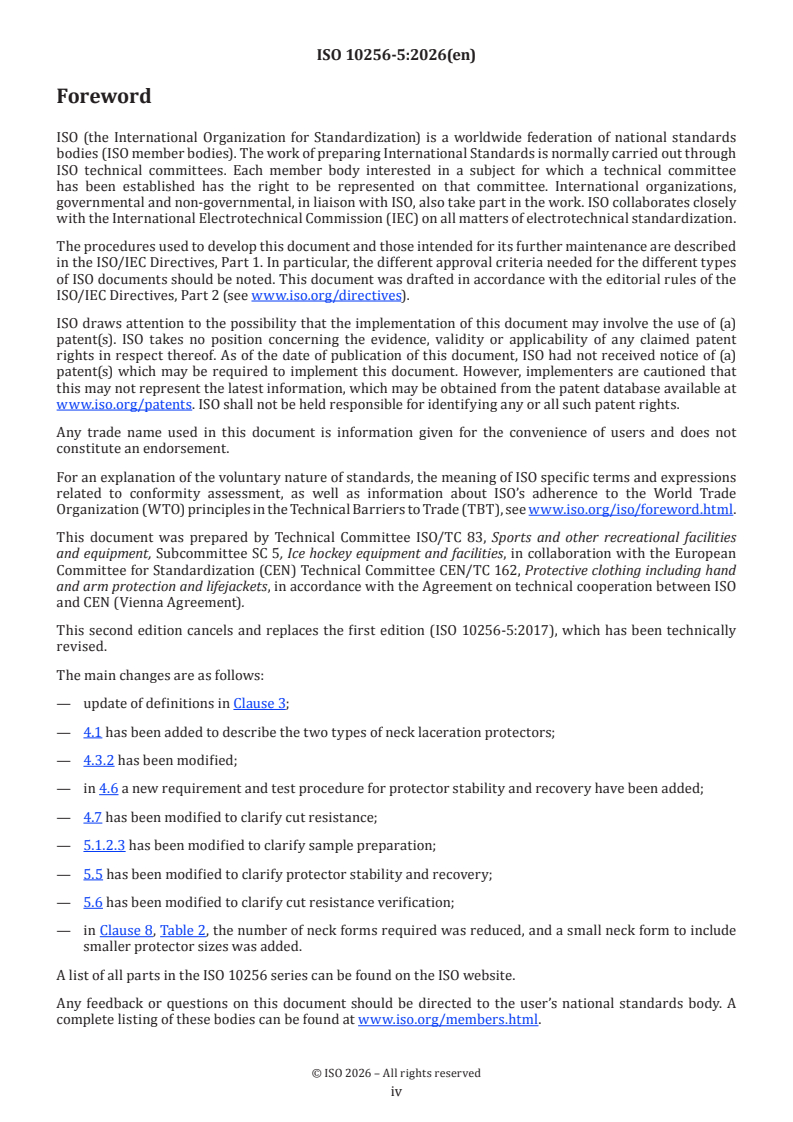
ISO 10256-5:2026 - Protective equipment for use in ice hockey — Part 5: Neck laceration protectors for use in ice hockey
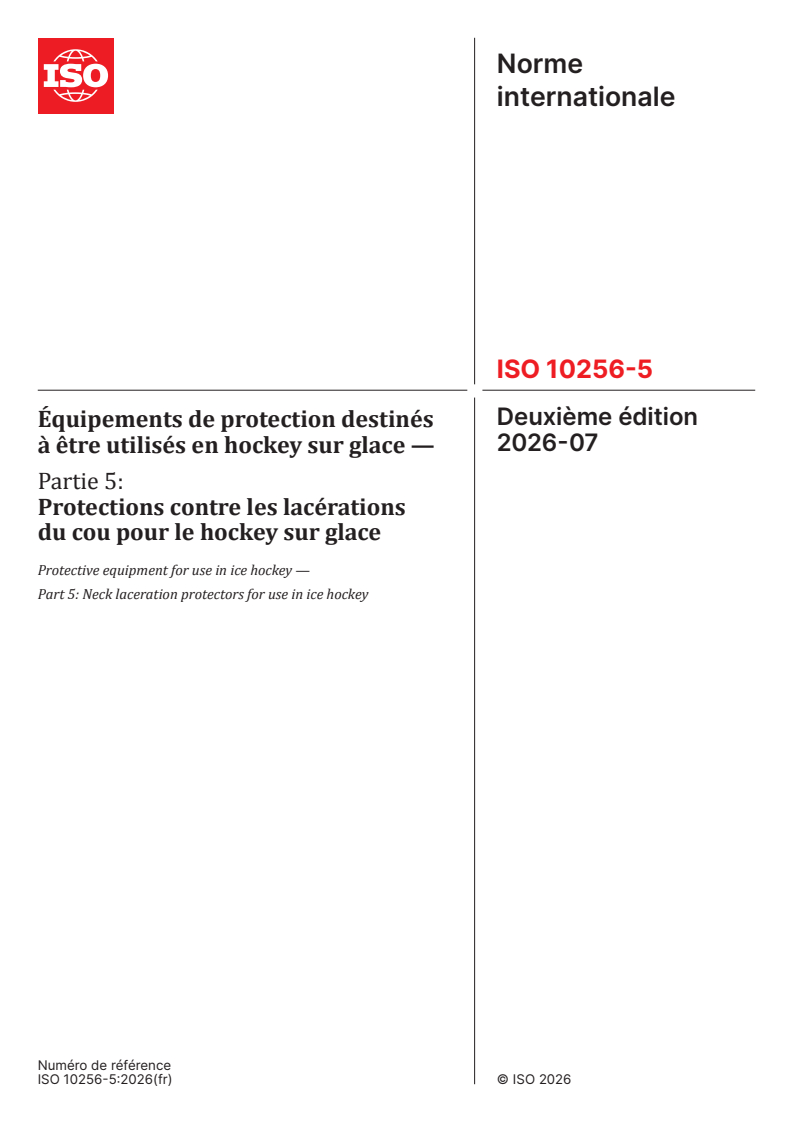
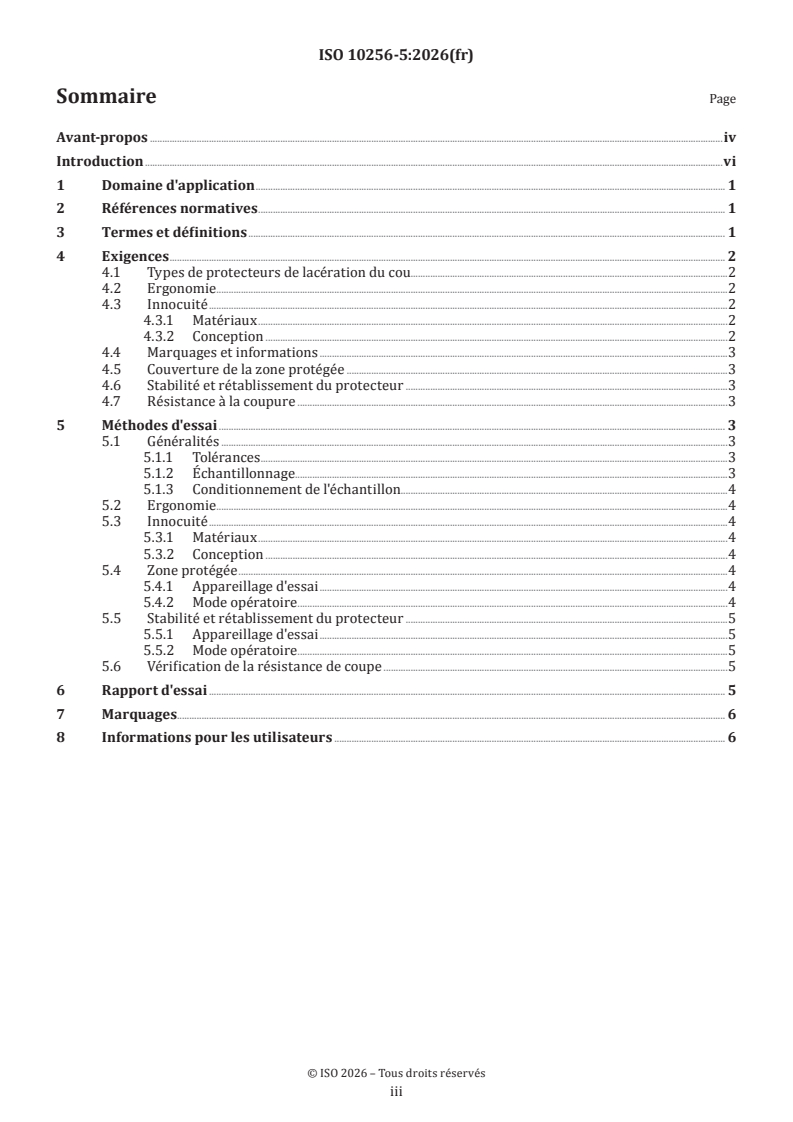
ISO 10256-5:2026 - Équipements de protection destinés à être utilisés en hockey sur glace — Partie 5: Protections contre les lacérations du cou pour le hockey sur glace
ISO 10256-5:2026 is an International Standard from ISO for neck laceration protectors used in ice hockey. It specifies performance requirements and test methods for protectors worn by ice hockey players, including goalkeepers, and referees. The focus is reduction of laceration injury from skate blades in the protected area, not impact protection from pucks, sticks or other objects.
What does ISO 10256-5:2026 specify?
ISO 10256-5:2026 specifies the requirements and tests for neck laceration protectors used in ice hockey. It is written for equipment that reduces the risk of neck laceration in the protected area and is organized into eight clauses covering scope, references, terms, requirements, test methods, the test report, markings, and information for users.
The scope is limited to protectors worn by players and referees. In practice, that means the document is about cut-resistant neck protection and not about broader helmet, body, or impact protection.
What are the key requirements of ISO 10256-5:2026?
Product types and fit
ISO 10256-5:2026 defines two protector types. Type E1 includes a bib that covers the protected area, while Type E2 covers the protected area without that bib. This matters because the type affects coverage, user information, and how the protector is positioned during testing.
The document requires the protector to be ergonomic and to meet the general requirements taken from ISO 10256-1:2024. It also requires the product to fit throughout any marked size range. For a buyer or quality manager, this means size marking is not just descriptive - the stated range has to work across the whole range.
Safety, materials, and marking
ISO 10256-5:2026 reuses the inocuousness requirements from ISO 10256-1:2024 for materials and adds design rules for safe use. The protector must not harm the wearer or other players in normal use, must allow access to the protected area without tools in an emergency, and must have no removable parts in the protected area.
Markings and user information are mandatory parts of the standard. The product has to identify itself as a neck laceration protector for ice hockey players and state its size and size range as neck circumference limits. Users also have to receive warnings about the limits of protection, the effect of poor fit or alteration, and, for Type E2, that it offers only partial protection and that Type E1 with a bib is recommended to reduce injury risk.
Test methods and pass criteria
ISO 10256-5:2026 requires testing on new and complete products in every size and model, with specimen preparation and conditioning controlled before test. Some specimens are washed three times using the manufacturer’s instructions mapped to ISO 6330:2021 processes, then line dried, which matters because durability after cleaning is part of real use.
Coverage is checked on a neck form using defined forms, spacer foam, and alignment of the median plane. Stability and recovery are checked by lowering the upper edge by 10 mm at selected points and confirming that the cut-resistant material still covers the protected area after release. Cut resistance is verified using ISO 13997 with modifications, including nine cuts in the least protected area and a fixed cutting force of 10 N; all cuts must meet the stated stroke-length requirement.
What terms does ISO 10256-5:2026 define?
- Neck laceration protector - a cut-resistant device worn to reduce the risk of laceration injury from skate blades in the protected area.
- Neck form - a solid or hollow object with a defined shape and size that supports the protector during testing.
- Bib - the part of the protector that lies over the anterior thoracic region.
- Median plane - the vertical plane passing through the centre of the neck form from front to back.
- Model - a category of protector with the same essential characteristics, available in multiple sizes.
- Neck part - the part of the protector that surrounds the cylindrical portion of the neck form.
Who uses ISO 10256-5:2026?
ISO 10256-5:2026 is used by manufacturers of ice hockey protective equipment, test laboratories, and conformity assessment teams that evaluate product performance. It is also useful to quality managers and buyers who need to specify cut-resistant neck protection for teams, clubs, or leagues.
Because the document covers players, goalkeepers, and referees, it is relevant wherever ice hockey protective gear is selected, tested, marked, or checked for consistent fit and safety information.
What changed in ISO 10256-5:2026 from the previous edition?
ISO 10256-5:2026 cancels and replaces ISO 10256-5:2017 and is technically revised. The changes stated in the document are:
- updated definitions in Clause 3
- added Clause 4.1 to describe the two types of neck laceration protectors
- modified Clause 4.3.2
- added a new requirement and test procedure in Clause 4.6 for protector stability and recovery
- modified Clause 4.7 to clarify cut resistance
- modified Clause 5.1.2.3 to clarify sample preparation
- modified Clause 5.5 to clarify stability and recovery
- modified Clause 5.6 to clarify cut resistance verification
- reduced the number of neck forms in Clause 8, Table 2, and added a small neck form for smaller protector sizes
Which standards are used with ISO 10256-5:2026?
- ISO 6330:2021 - provides the domestic washing and drying procedures used for specimen preparation.
- ISO 13997 - provides the cut resistance method that is adapted for neck laceration protectors.
- ISO 10256-1:2024 - provides the general requirements, terminology, tolerances, conditioning, markings, user information, and report framework reused by this part.
What does the ISO 10256-5:2026 document contain?
ISO 10256-5:2026 contains the full set of test-oriented requirements for neck laceration protectors, including fit, innocuousness, coverage, stability, recovery, and cut resistance. It also includes the reporting, marking, and user-information obligations needed to place the product on the market or assess it against the standard.
The document gives the test specimen allocation in Table 1 and the neck form dimensions plus protected-area dimensions in Table 2. Figures 1 and 2 show the protected areas for Type E1 and Type E2, and the test clauses describe the apparatus and procedures used to verify coverage and recovery in practice.
Relations
- Effective Date
- 12-Feb-2026
- Effective Date
- 06-Jun-2022
Buy Documents
ISO 10256-5:2026 - Protective equipment for use in ice hockey — Part 5: Neck laceration protectors for use in ice hockey
ISO 10256-5:2026 - Équipements de protection destinés à être utilisés en hockey sur glace — Partie 5: Protections contre les lacérations du cou pour le hockey sur glace
Get Certified
Connect with accredited certification bodies for this standard

CIS Institut d.o.o.
Personal Protective Equipment (PPE) certification body. Notified Body NB-2890 for EU Regulation 2016/425 PPE.

Kiwa BDA Testing
Building and construction product certification.
Kmetijski inštitut Slovenije
Agricultural Institute of Slovenia. Soil testing, plant health, agricultural product analysis.
Sponsored listings
Frequently Asked Questions
ISO 10256-5:2026 is a standard published by the International Organization for Standardization (ISO). Its full title is "Protective equipment for use in ice hockey — Part 5: Neck laceration protectors for use in ice hockey". This standard covers: This document specifies performance requirements and test methods for neck laceration protectors for use in ice hockey. This document is applicable to neck laceration protectors worn by ice hockey players, including goalkeepers, and referees. This document does not address protection of the neck from the impact of pucks, sticks or other objects.
This document specifies performance requirements and test methods for neck laceration protectors for use in ice hockey. This document is applicable to neck laceration protectors worn by ice hockey players, including goalkeepers, and referees. This document does not address protection of the neck from the impact of pucks, sticks or other objects.
ISO 10256-5:2026 is classified under the following ICS (International Classification for Standards) categories: 13.340.20 - Head protective equipment; 97.220.20 - Winter sports equipment. The ICS classification helps identify the subject area and facilitates finding related standards.
ISO 10256-5:2026 has the following relationships with other standards: It is inter standard links to EN ISO 10256-5:2026, ISO 10256-5:2017. Understanding these relationships helps ensure you are using the most current and applicable version of the standard.
ISO 10256-5:2026 is available in PDF format for immediate download after purchase. The document can be added to your cart and obtained through the secure checkout process. Digital delivery ensures instant access to the complete standard document.
Standards Content (Sample)
International
Standard
ISO 10256-5
Second edition
Protective equipment for use in ice
2026-07
hockey —
Part 5:
Neck laceration protectors for use
in ice hockey
Équipements de protection destinés à être utilisés en hockey sur
glace —
Partie 5: Protections contre les lacérations du cou pour le hockey
sur glace
Reference number
© ISO 2026
All rights reserved. Unless otherwise specified, or required in the context of its implementation, no part of this publication may
be reproduced or utilized otherwise in any form or by any means, electronic or mechanical, including photocopying, or posting on
the internet or an intranet, without prior written permission. Permission can be requested from either ISO at the address below
or ISO’s member body in the country of the requester.
ISO copyright office
CP 401 • Ch. de Blandonnet 8
CH-1214 Vernier, Geneva
Phone: +41 22 749 01 11
Email: copyright@iso.org
Website: www.iso.org
Published in Switzerland
ii
Contents Page
Foreword .iv
Introduction .v
1 Scope . 1
2 Normative references . 1
3 Terms and definitions . 1
4 Requirements . 2
4.1 Types of neck laceration protectors .2
4.2 Ergonomics .2
4.3 Innocuousness .2
4.3.1 Materials .2
4.3.2 Design . .2
4.4 Markings and information .2
4.5 Coverage of the protected area .3
4.6 Protector stability and recovery .3
4.7 Cut resistance .3
5 Test methods . 3
5.1 General .3
5.1.1 Tolerances .3
5.1.2 Sampling .3
5.1.3 Sample conditioning .3
5.2 Ergonomics .3
5.3 Innocuousness .4
5.3.1 Materials .4
5.3.2 Design .4
5.4 Protected area .4
5.4.1 Test apparatus .4
5.4.2 Procedure .4
5.5 Protector stability and recovery .5
5.5.1 Test apparatus .5
5.5.2 Procedure .5
5.6 Cut resistance verification .5
6 Test report . 5
7 Markings . 5
8 Information for users . 5
iii
Foreword
ISO (the International Organization for Standardization) is a worldwide federation of national standards
bodies (ISO member bodies). The work of preparing International Standards is normally carried out through
ISO technical committees. Each member body interested in a subject for which a technical committee
has been established has the right to be represented on that committee. International organizations,
governmental and non-governmental, in liaison with ISO, also take part in the work. ISO collaborates closely
with the International Electrotechnical Commission (IEC) on all matters of electrotechnical standardization.
The procedures used to develop this document and those intended for its further maintenance are described
in the ISO/IEC Directives, Part 1. In particular, the different approval criteria needed for the different types
of ISO documents should be noted. This document was drafted in accordance with the editorial rules of the
ISO/IEC Directives, Part 2 (see www.iso.org/directives).
ISO draws attention to the possibility that the implementation of this document may involve the use of (a)
patent(s). ISO takes no position concerning the evidence, validity or applicability of any claimed patent
rights in respect thereof. As of the date of publication of this document, ISO had not received notice of (a)
patent(s) which may be required to implement this document. However, implementers are cautioned that
this may not represent the latest information, which may be obtained from the patent database available at
www.iso.org/patents. ISO shall not be held responsible for identifying any or all such patent rights.
Any trade name used in this document is information given for the convenience of users and does not
constitute an endorsement.
For an explanation of the voluntary nature of standards, the meaning of ISO specific terms and expressions
related to conformity assessment, as well as information about ISO’s adherence to the World Trade
Organization (WTO) principles in the Technical Barriers to Trade (TBT), see www.iso.org/iso/foreword.html.
This document was prepared by Technical Committee ISO/TC 83, Sports and other recreational facilities
and equipment, Subcommittee SC 5, Ice hockey equipment and facilities, in collaboration with the European
Committee for Standardization (CEN) Technical Committee CEN/TC 162, Protective clothing including hand
and arm protection and lifejackets, in accordance with the Agreement on technical cooperation between ISO
and CEN (Vienna Agreement).
This second edition cancels and replaces the first edition (ISO 10256-5:2017), which has been technically
revised.
The main changes are as follows:
— update of definitions in Clause 3;
— 4.1 has been added to describe the two types of neck laceration protectors;
— 4.3.2 has been modified;
— in 4.6 a new requirement and test procedure for protector stability and recovery have been added;
— 4.7 has been modified to clarify cut resistance;
— 5.1.2.3 has been modified to clarify sample preparation;
— 5.5 has been modified to clarify protector stability and recovery;
— 5.6 has been modified to clarify cut resistance verification;
— in Clause 8, Table 2, the number of neck forms required was reduced, and a small neck form to include
smaller protector sizes was added.
A list of all parts in the ISO 10256 series can be found on the ISO website.
Any feedback or questions on this document should be directed to the user’s national standards body. A
complete listing of these bodies can be found at www.iso.org/members.html.
iv
Introduction
Ice hockey is a high-speed, collision sport in which there is a risk of injury.
By playing this sport, participants accept the risk of serious injury, paralysis or death.
The intention of neck protection used in ice hockey is to reduce the frequency and severity of lacerations to
the neck. The protective function is such that the penetration of a skate blade is counteracted.
v
International Standard ISO 10256-5:2026(en)
Protective equipment for use in ice hockey —
Part 5:
Neck laceration protectors for use in ice hockey
1 Scope
This document specifies performance requirements and test methods for neck laceration protectors for use
in ice hockey.
This document is applicable to neck laceration protectors worn by
— ice hockey players, including goalkeepers, and
— referees.
This document does not address protection of the neck from the impact of pucks, sticks or other objects.
2 Normative references
The following documents are referred to in the text in such a way that some or all of their content constit
...
Norme
internationale
ISO 10256-5
Deuxième édition
Équipements de protection destinés
2026-07
à être utilisés en hockey sur glace —
Partie 5:
Protections contre les lacérations
du cou pour le hockey sur glace
Protective equipment for use in ice hockey —
Part 5: Neck laceration protectors for use in ice hockey
Numéro de référence
DOCUMENT PROTÉGÉ PAR COPYRIGHT
© ISO 2026
Tous droits réservés. Sauf prescription différente ou nécessité dans le contexte de sa mise en œuvre, aucune partie de cette
publication ne peut être reproduite ni utilisée sous quelque forme que ce soit et par aucun procédé, électronique ou mécanique,
y compris la photocopie, ou la diffusion sur l’internet ou sur un intranet, sans autorisation écrite préalable. Une autorisation peut
être demandée à l’ISO à l’adresse ci-après ou au comité membre de l’ISO dans le pays du demandeur.
ISO copyright office
Case postale 401 • Ch. de Blandonnet 8
CH-1214 Vernier, Genève
Tél.: +41 22 749 01 11
E-mail: copyright@iso.org
Web: www.iso.org
Publié en Suisse
ii
Sommaire Page
Avant-propos .iv
Introduction .vi
1 Domaine d'application . 1
2 Références normatives . 1
3 Termes et définitions . 1
4 Exigences . 2
4.1 Types de protecteurs de lacération du cou.2
4.2 Ergonomie .2
4.3 Innocuité .2
4.3.1 Matériaux .2
4.3.2 Conception .2
4.4 Marquages et informations .3
4.5 Couverture de la zone protégée .3
4.6 Stabilité et rétablissement du protecteur .3
4.7 Résistance à la coupure .3
5 Méthodes d'essai . 3
5.1 Généralités .3
5.1.1 Tolérances .3
5.1.2 Échantillonnage.3
5.1.3 Conditionnement de l'échantillon.4
5.2 Ergonomie .4
5.3 Innocuité .4
5.3.1 Matériaux .4
5.3.2 Conception .4
5.4 Zone protégée .4
5.4.1 Appareillage d'essai .4
5.4.2 Mode opératoire . .4
5.5 Stabilité et rétablissement du protecteur .5
5.5.1 Appareillage d'essai .5
5.5.2 Mode opératoire .5
5.6 Vérification de la résistance de coupe .5
6 Rapport d'essai . 5
7 Marquages. 6
8 Informations pour les utilisateurs . 6
iii
Avant-propos
L'ISO (Organisation internationale de normalisation) est une fédération mondiale d'organismes nationaux
de normalisation (comités membres de l'ISO). L'élaboration des Normes internationales est en général
confiée aux comités techniques de l'ISO. Chaque comité membre intéressé par une étude a le droit de faire
partie du comité technique créé à cet effet. Les organisations internationales, gouvernementales et non
gouvernementales, en liaison avec l'ISO participent également aux travaux. L'ISO collabore étroitement avec
la Commission électrotechnique internationale (IEC) en ce qui concerne la normalisation électrotechnique.
Les procédures utilisées pour élaborer le présent document et celles destinées à sa mise à jour sont
décrites dans les Directives ISO/IEC, Partie 1. Il convient, en particulier, de prendre note des différents
critères d'approbation requis pour les différents types de documents ISO. Le présent document a
été rédigé conformément aux règles de rédaction données dans les Directives ISO/IEC, Partie 2 (voir
www.iso.org/directives).
L’ISO attire l’attention sur le fait que la mise en application du présent document peut entraîner l’utilisation
d’un ou de plusieurs brevets. L’ISO ne prend pas position quant à la preuve, à la validité et à l’applicabilité de
tout droit de brevet revendiqué à cet égard. À la date de publication du présent document, l’ISO n’avait pas
reçu notification qu’un ou plusieurs brevets pouvaient être nécessaires à sa mise en application. Toutefois,
il y a lieu d’avertir les responsables de la mise en application du présent document que des informations
plus récentes sont susceptibles de figurer dans la base de données de brevets, disponible à l'adresse
www.iso.org/brevets. L’ISO ne saurait être tenue pour responsable de ne pas avoir identifié tout ou partie de
tels droits de propriété.
Les appellations commerciales éventuellement mentionnées dans le présent document sont données pour
information, par souci de commodité, à l’intention des utilisateurs et ne sauraient constituer un engagement.
Pour une explication de la nature volontaire des normes, la signification des termes et expressions
spécifiques de l'ISO liés à l'évaluation de la conformité, ou pour toute information au sujet de l'adhésion de
l'ISO aux principes de l’Organisation mondiale du commerce (OMC) concernant les obstacles techniques au
commerce (OTC), voir www.iso.org/avant-propos.
Le présent document a été élaboré par le comité technique ISO/TC 83, Matériel et équipements de sports
et autres activités de loisirs, sous-comité SC 5, Matériel pour hockey sur glace et équipements connexes, en
collaboration avec le comité technique CEN/TC 162, Vêtements de protection, y compris la protection de la main
et du bras et y compris les gilets de sauvetage, du Comité européen de normalisation (CEN), conformément à
l'Accord de coopération technique entre l'ISO et le CEN (Accord de Vienne).
Cette deuxième édition annule et remplace la première édition (ISO 10256-5:2017), qui a fait l'objet d'une
révision technique.
Les principales modifications sont les suivantes:
— mise à jour des définitions de l'Article 3;
— 4.1 a été ajouté pour décrire les deux types de protecteurs de lacération du cou;
— 4.3.2 a été modifié;
— 4.6 ajout d'une nouvelle exigence et d'une nouvelle procédure d'essai pour la stabilité et le rétablissement
du protecteur;
— 4.7 a été modifié pour clarifier la résistance à la coupure;
— 5.1.2.3 a été modifié pour clarifier la préparation des échantillons;
— 5.5 a été modifié pour clarifier la stabilité et la récupération du protecteur;
— 5.6 a été modifié pour clarifier la vérification de la résistance à la coupure;
— Article 8, Tableau 2 le nombre de formes de cou requises a été réduit et une petite forme de cou a été
ajoutée pour inclure des tailles de protecteurs plus petites.
iv
Une liste de toutes les parties de la série ISO 10256 est disponible sur le site web de l'ISO.
Il convient que l’utilisateur adresse tout retour d’information ou toute question concernant le présent
document à l’organisme national de normalisation de son pays. Une liste exhaustive desdits organismes se
trouve à l’adresse www.iso.org/fr/members.html.
v
Introduction
Le hockey sur glace est un sport de collision à grande vitesse dans lequel il y a un risque de blessure.
En pratiquant ce sport, les participants acceptent le risque de blessures graves, de paralysie ou de mort.
Le but de la protection du cou utilisée dans le hockey sur glace est de réduire la fréquence et la gravité des
lacérations au cou. La fonction de protection est telle que la pénétration d'une lame de patin est neutralisée.
vi
Norme internationale ISO 10256-5:2026(fr)
Équipements de protection destinés à être utilisés en hockey
sur glace —
Partie 5:
Protections contre les lacérations du cou pour le hockey sur
glace
1 Domaine d'application
Le présent document spécifie les exigences de performance et les méthodes d'essai relatives aux protections
contre les lacérations du cou utilisées dans le hockey sur glace.
Le présent document est applicable aux protecteurs de lacération du cou portés par
— les joueurs de hockey sur glace, y compris les gardiens de but, et
— les arbitres.
Le présent document ne traite pas de la protection du cou contre l'impact des rondelles, des bâtons ou
d'autres objets.
2 Références normatives
Les documents suivants sont cités dans le texte de telle sorte qu'ils constituent, pour tout ou partie de leur
contenu, des exigences du présent document. Pour les références datées, seule l'édition citée s'applique. Pour
les références non datées, la dernière édition du document de référence s'applique (y compris les éventuels
amendements).
ISO 6330:2021, Textiles — Méthodes de lavage et de séchage domestiques en vue des essais des textiles
ISO 13997, Habillement de protection — Propriétés mécaniques — Détermination de la résistance à la coupure
par des objets tranchants
ISO 10256-1:2024, Équipement
...