

ISO 10345-2:1992
(Main)Glass — Determination of stress-optical coefficient — Part 2: Bending test
General Information
- Abstract
Describes the bending test for isotropic glass. The wavelength-dependent stress-optical coefficient is a characteristic value of materials and it is necessary for determining the stress from results of measurement of stress birefringence.
- Status
- Published
- Publication Date
- 06-May-1992
- Technical Committee
- ISO/TC 48 - Laboratory equipment
- Drafting Committee
- ISO/TC 48 - Laboratory equipment
- Current Stage
- 9093 - International Standard confirmed
- Start Date
- 26-Feb-2026
- Completion Date
- 29-Aug-2026
Buy Documents
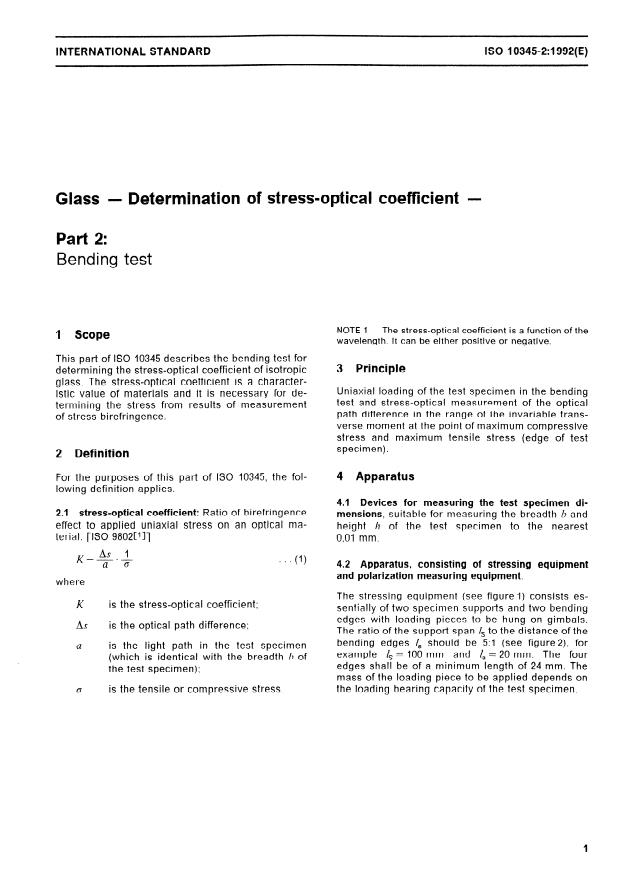
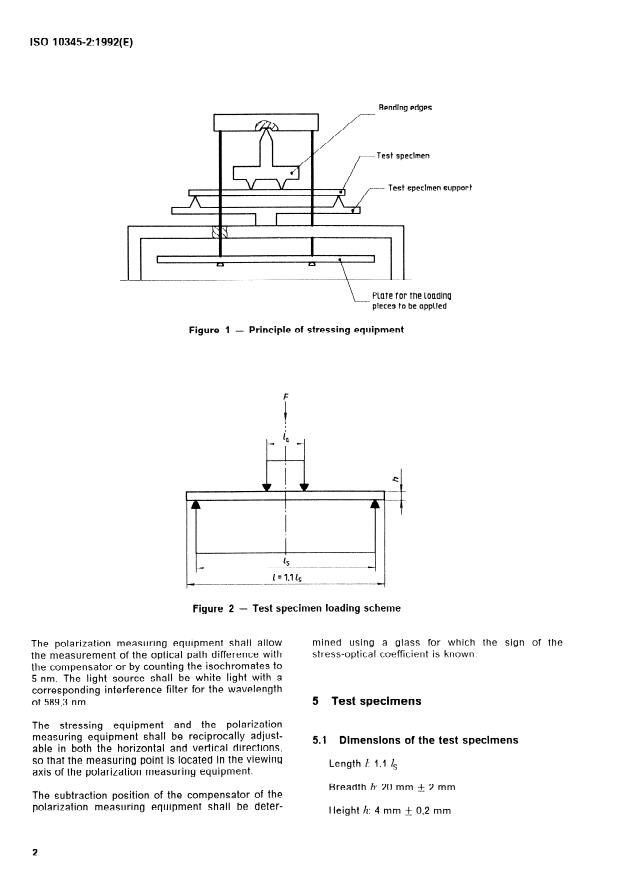
ISO 10345-2:1992 - Glass — Determination of stress-optical coefficient — Part 2: Bending test Released:5/7/1992
ISO 10345-2:1992 - Verre — Détermination du coefficient photo-élastique — Partie 2: Essai de flexion Released:5/7/1992
ISO 10345-2:1992 - Verre — Détermination du coefficient photo-élastique — Partie 2: Essai de flexion Released:5/7/1992
Overview
ISO 10345-2:1992 is an international standard developed by the International Organization for Standardization (ISO). This document outlines the method for determining the stress-optical coefficient of isotropic glass using a bending test. The stress-optical coefficient is a material characteristic that is essential for interpreting measurements of stress-induced birefringence in glass products. The standard is particularly relevant in laboratory settings, quality assurance, and the production of optical glass materials.
Key Topics
- Stress-Optical Coefficient: The standard defines the stress-optical coefficient as the ratio of birefringence effect to the applied uniaxial stress on an optical material. This value is wavelength-dependent and can be positive or negative.
- Bending Test Method: ISO 10345-2 focuses on the bending test procedure to determine the stress-optical coefficient of isotropic glass specimens. The method involves uniaxial loading of the test specimen to induce stress and measure resulting optical path differences.
- Measurement Apparatus: The standard specifies the use of polarization measuring equipment, compensators, and stressing equipment for accurate measurement of optical path differences under bending stress.
- Test Specimen Preparation: It details the required dimensions, surface quality, and conditioning of test specimens to ensure reliable and repeatable results.
- Calculation and Reporting: Procedures are provided for calculating the stress and the stress-optical coefficient, along with requirements for comprehensive test reporting.
Applications
ISO 10345-2:1992 is applied in several practical contexts, including:
- Material Characterization: Manufacturers and researchers utilize this standard to characterize the stress-optical properties of glass, which is critical in optical component production and development.
- Quality Control: Routine use in laboratory glassware and optical glass industries for quality assurance and to verify that glass products meet specified optical performance criteria.
- Birefringence Analysis: The standard is essential for accurately determining internal stresses via birefringence measurements, a key consideration in safety and durability analysis of glass components.
- Design and Process Optimization: Knowledge of the stress-optical coefficient helps engineers design glass products with minimal residual stresses, improving product performance and lifespan.
Related Standards
For comprehensive glass testing and stress measurement, the following standards are closely related:
- ISO 10345-1: Glass - Determination of stress-optical coefficient - Part 1: Tensile test. Provides an alternative method using tensile loading.
- ISO 9802: Raw optical glass - Vocabulary. Defines key terminology relevant to optical glass testing.
- General ASTM and ISO Glass Testing Standards: These address additional glass properties, tests, and terminology important for industry professionals.
Practical Value
Implementing ISO 10345-2:1992 strengthens material verification processes by ensuring that the mechanical and optical properties of glass are reliably quantified. Compliance with this standard:
- Facilitates consistent and accurate assessment of glass stress characteristics
- Enhances product safety and quality by ensuring accurate birefringence measurements
- Promotes international compatibility and standardization in optical glass testing
By following ISO 10345-2, organizations gain confidence in glass material performance, supporting innovation and competitiveness in the global glass and optical industries.
Buy Documents
ISO 10345-2:1992 - Glass — Determination of stress-optical coefficient — Part 2: Bending test Released:5/7/1992
ISO 10345-2:1992 - Verre — Détermination du coefficient photo-élastique — Partie 2: Essai de flexion Released:5/7/1992
ISO 10345-2:1992 - Verre — Détermination du coefficient photo-élastique — Partie 2: Essai de flexion Released:5/7/1992
Frequently Asked Questions
ISO 10345-2:1992 is a standard published by the International Organization for Standardization (ISO). Its full title is "Glass — Determination of stress-optical coefficient — Part 2: Bending test". This standard covers: Describes the bending test for isotropic glass. The wavelength-dependent stress-optical coefficient is a characteristic value of materials and it is necessary for determining the stress from results of measurement of stress birefringence.
Describes the bending test for isotropic glass. The wavelength-dependent stress-optical coefficient is a characteristic value of materials and it is necessary for determining the stress from results of measurement of stress birefringence.
ISO 10345-2:1992 is classified under the following ICS (International Classification for Standards) categories: 81.040.01 - Glass in general. The ICS classification helps identify the subject area and facilitates finding related standards.
ISO 10345-2:1992 is available in PDF format for immediate download after purchase. The document can be added to your cart and obtained through the secure checkout process. Digital delivery ensures instant access to the complete standard document.
Standards Content (Sample)
INTERNATIONAL
STANDARD
First edition
1992-05-O 1
-- ----l_l__--_____-~
Glass - Determination of stress-optical
coefficient -
Part 2:
Bending test
Verre - DHermination du coefficient photo4lastique -
Partie 2: Essai de f7exion
-.111--_-_I___
---____ -__----_-----_-_- _-_- --___--.*---------. -.-- .-.-
~.-- --
-_-_- _.______
--. . - - --
-. ---
Reference number
-.----- ---
. -. __ -_ ._ IS0 10345-2: 1992(E)
IS0 10345-2:1992(E)
Foreword
IS0 (the International Organization for Standardization) is a worldwide
federation of national standards bodies (IS0 member bodies). The work
of preparing International Standards is normally carried out through IS0
technical committees. Each member body interested in a subject for
which a technical committee has been established has the right to be
represented on that committee. International organizations, govern-
mental and non-governmental, in liaison with ISO, also take part in the
work. IS0 collaborates closely with the International Electrotechnical
Commission (IEC) on all matters of electrotechnical standardization.
Draft International Standards adopted by the technical committees are
circulated to the member bodies for voting. Publication as an lnter-
national Standard requires approval by at least 75 % of the member
bodies casting a vote.
International Standard IS0 10345-2 was prepared by Technical Com-
mittee ISO/TC 48, Laboratory glassware and related apparatus, Sub-
Committee SC 5, Quality of glassware.
IS0 10345 consists of the following parts, under the general title
Glass - Determination of stress-optical coefficient:
- Part I: Tensile test
- Part 2: Bending test
Annex A of this part of IS0 10345 is for information only.
0 IS0 1992
All rights reserved. No part of this publication may be reproduced or utilized in any form
or by any means, electronic or mechanical, including photocopying and microfilm, without
permission in writing from the publisher.
International Organization for Standardization
Case Postale 56 l CH-1211 Geneve 20 l Switzerland
Printed in Switzerland
ii
IS0 103452:1992(E)
INTERNATIONAL STANDARD
- Determination of stress-optical coefficient -
Glass
Part 2:
Bending test
NOTE 1 The stress-optical coefficient is a function of the
1 Scope
wavelength, It can be either positive or negative.
This part of IS0 10345 describes the bending test for
3 Principle
determining the stress-optical coefficient of isotropic
glass. The stress-optical coefficient is a character-
Uniaxial loading of the test specimen in the bending
istic value of materials and it is necessary for de-
test and stress-optical measurement of the optical
termining the stress from results of measurement
path difference in the range of ihe invariable trans-
of stress birefringence.
verse moment at the point of maximum compressive
stress and maximum tensile stress (edge of test
specimen).
2 Definition
4 Apparatus
For the purposes of this part of IS0 10345, the fol-
lowing definition applies.
4.1 Devices for measuring the test specimen di-
2.1 stress-optical coefficient: Ratio of birefringence
mensions, suitable for measuring the breadth h and
effect to applied uniaxial stress on an optical ma-
height /I of the test specimen to the nearest
terial. [ISO 9802[11]
0,Ol mm.
As 1
--.-
-
K . . .
(1)
a 0 4.2 Apparatus, consisting of stressing equipment
and polarization measuring equipment.
where
The stressing equipment (see figure I) consists es-
K is the stress-optical coefficient;
sentially of two specimen supports and two bending
edges with loading pieces to be hung on gimbals.
AT I is the optical path difference;
The ratio of the support span 6, to the distance of the
bending edges /’ should be 5:l (see figure2), for
a is the light path in the test specimen
example Is = 100 mm and 1’. = 20 mm. The four
(which is identical with the breadth I) of
edges shall be of a minimum length of 24 mm. The
the test specimen);
mass of the loading piece to be applied depends on
(T is the tensile or compressive stress. the loading bearing capacity of the test specimen.
.
I SO 103452: 1992(E)
Rending edges
~ Test specimen support
Plate for the loading
- pieces to be applied
Figure 1 - Principle of stressing equipment
Test specimen loading scheme
Figure 2 -
mined using a glass for which the sign of the
The polarization measuring equipment shall allow
stress-optical coefficient is known.
the measurement of the optical path difference with
the compensator or by counting the isochromates to
5 nm. The light source shall be white light with a
corresponding interference filter for the wavelength
of 589,3 nm. 5 Test specimens
The stressing equipment and the polarization
measuring equipment shall be reciprocally adjust-
5.1 Dimensions of the test specimens
able in both the horizontal and vertical directions,
so that the measuring point is located in the viewing
Leng
...
IS0
NORME
I NTE R NAT1 O NALE 10345-2
Première édition
1992-05-01
Verre - Détermination du coefficient
photo-élastique -
Partie 2:
Essai de flexion
Glass - Determinatiori of stress-optical coefficient -
Part 2: Bending test
IS0 10345-2:1992(F)
Avant-propos
L’ISO (Organisation internationale de normalisation) est une fédération
mondiale d’organismes nationaux de normalisation (comités membres
de I‘ISO). L’élaboration des Normes internationales est en général
confiée aux comités techniques de I’ISO. Chaque comité membre inté-
ressé par une étude a le droit de faire partie du comité technique créé
à cet effet. Les organisations internationales, gouvernementales et non
gouvernementales, en liaison avec I’ISO participent également aux tra-
vaux. L‘ISO collabore étroitement avec la Commission électrotechnique
internationale (CEI) en ce qui concerne la normalisation électrotech-
n iq U e.
Les projets de Normes internationales adoptés par les comités techni-
ques sont soumis aux comités membres pour vote. Leur publication
comme Normes internationales requiert l’approbation de 75 Oh au moins
des comités membres votants.
La Norme internationale IS0 10345-2 a été élaborée par le comité tech-
nique ISO/TC 48, Verrerie de laboratoire et appareils connexes, sous-
comité SC 5, Qualité de la verrerie.
L’ISO 10345 comprend les parties suivantes, présentées sous le titre
général Verre - Détermination du coefficient photo-élastique:
-. Partie 1: Essai de traction
- Partie 2: Essai de flexion
L’annexe A de la présente partie de I’ISO 10345 est donnée uniquement
à titre d‘information.
8 IS0 1992
Droits de reproduction réservés. Aucune partie de cette publication ne peut être repro-
duite ni utilisée sous quelque forme que ce soit et par aucun procede, electronique ou
mécanique, y compris la photocopie et les microfilms, sans l’accord ecrit de I’editeur.
Organisation internationale de normalisation
Case Postale 56 CH-I21 1 Genève 20 Suisse
Imprimé en Suisse
ii
NORME INTERNATIONALE IS0 10345-2:1992(F)
Verre - Détermination du coefficient photo-élastique -
Partie 2:
Essai de flexion
3 Principe
1 Domaine d’application
La présente partie de I’ISO 10345 prescrit un essai Chargement uniaxe de I‘éprouvette lors de l’essai
de flexion permettant de determiner le coefficient de flexion et mesure photo-élastique de la différence
photo-élastique d’un verre isotrope. Le coefficient du chemin optique dans le domaine où le moment
photo-élastique est une valeur caractéristique des transversal ne varie pas au point où les contraintes
matériaux, nécessaire pour déterminer la contrainte de compression et de traction sont maximales (bord
à partir des résultats de mesure de la biréfringence de I ‘ép rouve tt e).
induite par la contrainte.
4 Appareillage
2 Définition
Pour les besoins de la présente partie de I’ISO
4.1 Dispositifs permettant de mesurer les dimen-
10345, la définition suivante s’applique.
sions de I’éprouvette, convenables pour mesurer la
h. et la hauteur h. de I’éprouvetle à
largeur,
2.1 coefficient photo-élastique: Rapport de la biré-
0.01 mm près.
fringence à la contrainte uniaxe appliquée ail maté-
riau optique. [IS0 9802[11]
4.2 Appareillage comprenant un appareil de me-
sure des contraintes et un dispositif de mesure de la
polarisation
O il
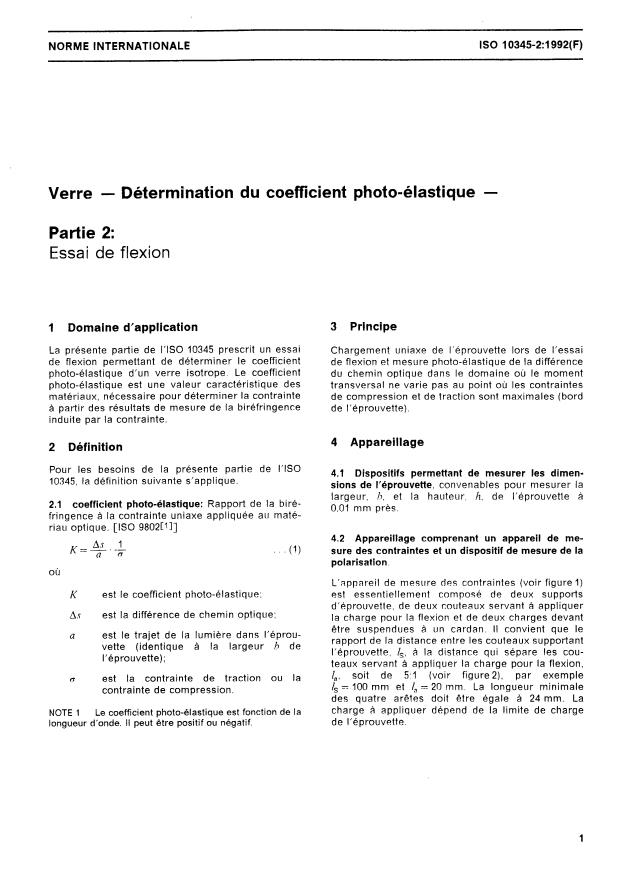
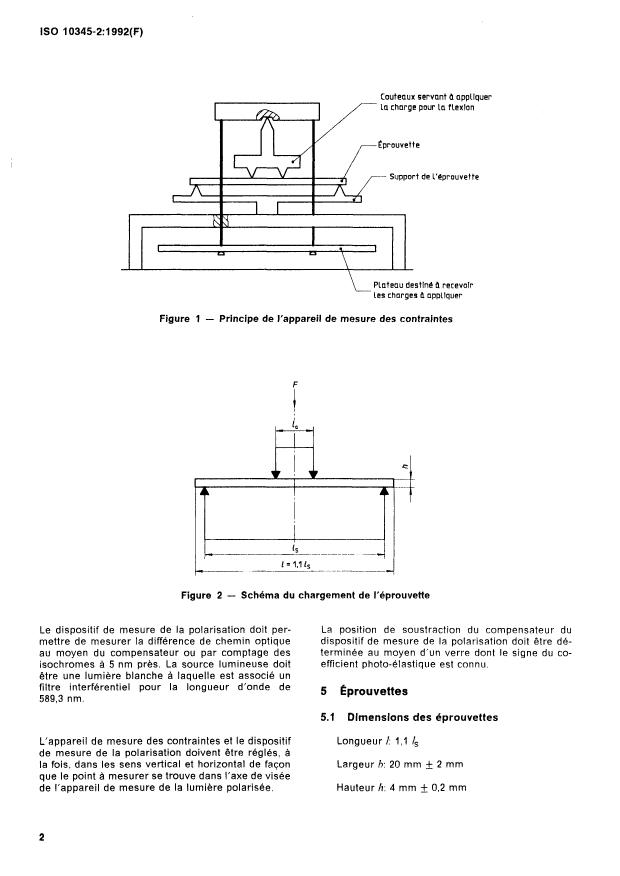
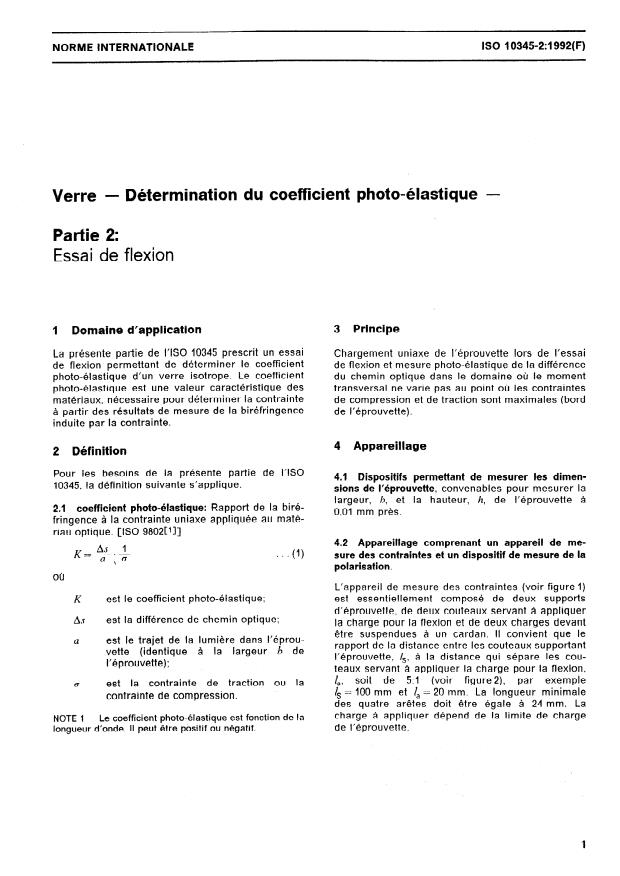
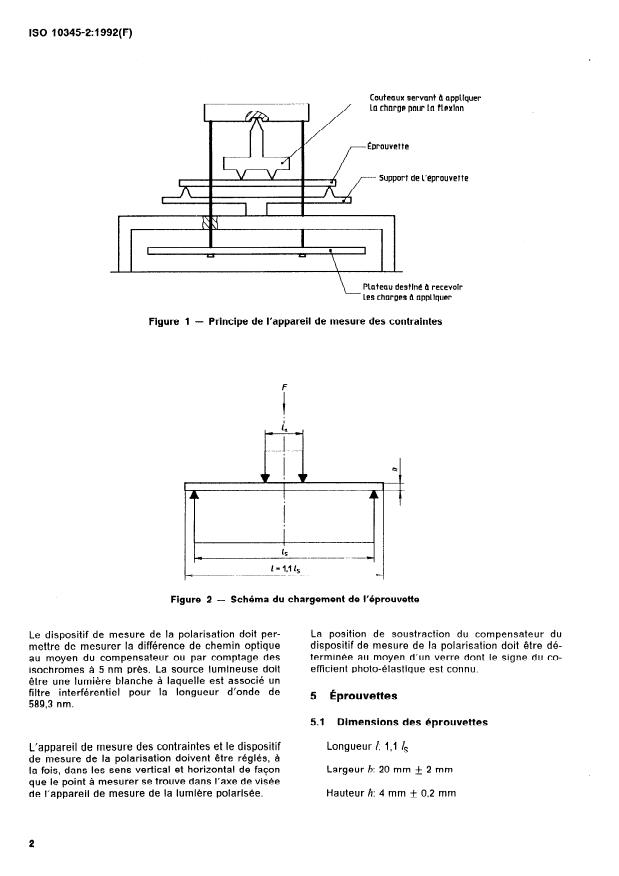
L’appareil de mesure des contraintes (voir figure 1)
K est le coefficient photo-élastique: est essentiellenient composé de deux supports
d’kprouvette, de deux couteaux servant a appliquer
As est la différence de chemin optique;
la charge pour la flexion et de deux charges devant
être suspendues à un cardan II convient que le
a est le trajet de la lumi&t-e dans l’éprou-
rapport de la distance entre les couteaux supportant
vette (identique à la largeur h de
I’éprouvette, I,, à la distance qui sépare les cou-
I ’ é p roil ve tt e) ;
teaux servant à appliquer la charge pour la flexion,
I., soit de 5 1 (voir figure2), par exemple
a est la contrainte de traction ou la
I, = 100 mm et Ia = 20 tnm La longueur minimale
contrainte de compression.
des quatre arêtes doit être égale à 24 mm. La
charge à appliquer dépend de la limite de charge
Le coefficient photo-élastique est fonction de la
NOTE 1
de I’éprouvette
longueur d’onde. II peut être positif ou négatif.
IS0 10345-2:1992(F)
Couteaux servant d aoollouer
.. .. . .
la la charge charge pour pour la la rlexlan rlexlan
Support Support de de L’eprouvette L’eprouvette
II II
Plateau destlne destlne h h recevoir recevoir
Plateau
les les charges charges h h nppllquer nppllquer
Figure Figure 1 1 - - Principe Principe de de l’appareil l’appareil de de mesure mesure des des contraintes contraintes
F
Figure 2 - Schema du chargement de I’éprouvette
Le dispositif de mesure de la polarisation doit per- La position de soustraction du compensateur du
mettre de mesurer la différence de chemin optique dispositif de mesure de la polarisation doit être dé-
au moyen du compensateur ou par comptage des terminée au moyen d’un verre dont le signe du co-
efficient photo-élastique est connu.
à 5 nm près. La source lumineuse doit
isochromes
être une lumière blanche à laquelle est associé un
filtre interférentiel pour la longueur d’onde de 5 ~~~~~~~tt~~
589,3 nm.
...
NORME
INTERNATIONALE 103452
Première édition
1992-05-O 1
- Détermination du coefficient
Verre
photo-élastique -
Partie 2:
Essai de flexion
Glass - Uetermination of stress-optical coefficient -
Part 2: Bending test
SS-
---.- .--
-. --
Numéro de référence
----
.- . __-.-._ - - .--._
ISO 10345-2: 1992(F)
ISO 103452:1992(F)
Avant-propos
L’ISO (Organisation internationale de normalisation) est une fédération
mondiale d’organismes nationaux de normalisation (comités membres
de I’ISO). L’élaboration des Normes internationales est en général
confiée aux comités techniques de I’ISO. Chaque comité membre inté-
ressé par une étude a le droit de faire partie du comité technique créé
à cet effet. Les organisations internationales, gouvernementales et non
gouvernementales, en liaison avec I’ISO participent également aux tra-
vaux. L’ISO collabore étroitement avec la Commission électrotechnique
internationale (CEI) en ce qui concerne la normalisation électrotech-
nique.
Les projets de Normes internationales adoptés par les comités techni-
ques sont soumis aux comités membres pour vote. Leur publication
comme Normes internationales requiert l’approbation de 75 % au moins
des comités membres votants.
La Norme internationale ISO 10345-2 a été élaborée par le comité tech-
nique ISO/TC 48, Verrerie de laboratoire et appareils connexes, sous-
comité SC 5, Qualité de la verrerie.
L’ISO 10345 comprend les parties suivantes, présentées sous le titre
général Verre - Détermination du coefficient photo-élastique:
-- Partie 1: Essai de traction
- Partie 2: Essai de flexion
L’annexe A de la présente partie de I’ISO 10345 est donnée uniquement
à titre d’information.
0 ISO 1992
Droits de reproduction réservés. Aucune partie de cette publication ne peut être repro-
duite ni utilisée sous quelque forme que ce soit et par aucun procédé, électronique ou
mécanique, y compris la photocopie et les microfilms, sans l’accord écrit de l’éditeur.
Organisation inter ,nationale de normalisation
Case Postale 56 l CH-1211 Genève 20 l Suisse
Imprimé en Suisse
ii
ISO 103452:1992(F)
NORME INTERNATIONALE
- Détermination du coefficient photo-élastique -
Verre
Partie 2:
Essai de flexion
3 Principe
1 Domaine d’application
Chargement uniaxe de l’éprouvette lors de l’essai
La présente partie de I’ISO 10345 prescrit un essai
de flexion et mesure photo-élastique de la différence
de flexion permettant de déterminer le coefficient
photo-élastique d’un verre isotrope. Le coefficient du chemin optique dans le domaine où le moment
photo-élastique est une valeur caractéristique des transversal ne varie pas au point où les contraintes
matériaux, nécessaire pour déterminer la contrainte de compression et de traction sont maximales (bord
à partir des résultats de mesure de la biréfringence de l’éprouvette).
induite par la contrainte.
4 Appareillage
2 Définition
Pour les besoins de la présente partie de I’ISO
4.1 Dispositifs permettant de mesurer les dimen-
10345, la définition suivante s’applique.
sions de l’éprouvette, convenables pour mesurer la
largeur, 13, et la hauteur, h, de l’éprouvette à
2.1 coefficient photo-élastique: Rapport de la biré-
0,Ol mm près.
fringence à la contrainte uniaxe appliquée au maté-
riau optique. [ISO 9802[11]
4.2 Appareillage comprenant un appareil de me-
K As 1
--.-
- . . .
sure des contraintes et un dispositif de mesure de la
(1)
n
Y
polarisation.
où
L’appareil de mesure des contraintes (voir figure 1)
K est le coefficient photo-élastique; est essentiellement composé de deux supports
d’éprouvette, de deux couteaux servant à appliquer
AT A est la différence de chemin optique;
la charge pour la flexion et de deux charges devant
être suspendues à un cardan. II convient que le
a est le trajet de la lumière dans I’éprou-
rapport de la distance entre les couteaux supportant
vette (identique à la largeur h de
l’éprouvette, /s, à la distance qui sépare les cou-
l’éprouvette);
teaux servant à appliquer la charge pour la flexion,
Z.‘., soit de 511 (voir figure 2), par exemple
est la contrainte de traction ou la
(I
I, = 100 mm et /a = 20 mm. La longueur minimale
contrainte de compression.
des quatre arêtes doit être égale à 24 mm. La
charge à appliquer dépend de la limite de charge
Le coefficient photo-élastique est fonction de la
NOTE 1
de l’éprouvette.
longueur d’onde. II peut être positif ou négatif.
ISO 103452:1992(F)
Couteaux servanthappllquer
la chargepourla tlexlon
Support de l’@prouvette
Plateau destIr@ h recevoir
Lescharges happllquer
- Principe de l’appareil de mesure des contraintes
Figure 1
Figure 2 - Schéma du chargement de l’éprouvette
La position de soustraction du compensateur du
Le dispositif de mesure de la polarisation doit per-
dispositif de mesure de la polarisation doit être dé-
mettre de mesurer la différence de chemin optique
terminée au moyen d’un verre dont le signe du co-
au moyen du compensateur ou par comptage des
efficient photo-élastique est connu.
isochromes à 5 nm près. La source lumineuse doit
être une lumière blanche à laquelle est associé un
filtre interférentiel pour la longueur d’onde de
5 Éprouvettes
589,3 nm.
5.1 Dimensions des éprouvettes
Longueur I: 1,l Iq
L’appareil de mesure
...