

ISO 10599-2:1997
(Main)Car radios — Coaxial aerial connectors — Part 2: Characteristic values, performance requirements and tests
General Information
- Abstract
- Status
- Published
- Publication Date
- 21-May-1997
- Technical Committee
- ISO/TC 22/SC 32 - Electrical and electronic components and general system aspects
- Drafting Committee
- ISO/TC 22/SC 32/WG 6 - On-board electrical connections
- Current Stage
- 9093 - International Standard confirmed
- Start Date
- 29-Jun-2026
- Completion Date
- 29-Aug-2026
Buy Documents
ISO 10599-2:1997 - Car radios — Coaxial aerial connectors — Part 2: Characteristic values, performance requirements and tests Released:5/22/1997
ISO 10599-2:1997 - Autoradios — Connecteurs coaxiaux d'antenne — Partie 2: Valeurs caractéristiques, performances et essais Released:5/22/1997
ISO 10599-2:1997 - Autoradios — Connecteurs coaxiaux d'antenne — Partie 2: Valeurs caractéristiques, performances et essais Released:5/22/1997
Overview
ISO 10599-2:1997 specifies the characteristic values, performance requirements and test methods for coaxial aerial (antenna) connectors used on car radios mounted in road vehicles. It is Part 2 of the ISO 10599 series and complements ISO 10599-1 (Dimensions) by defining environmental, mechanical and electrical performance criteria and the associated test procedures.
Key topics and technical requirements
- Test class: Connectors conform to test class 40/085/04 (meaning lowest operating temperature −40 °C, highest +85 °C, damp-heat duration 4 days) as referenced to IEC/ISO environmental test methods.
- Contact resistance: Maximum contact resistance limits are specified-centre contact and outer contact: 20 mΩ (milliohms).
- Mechanical forces and endurance:
- Requirements for engaging, separation and withdrawal forces are defined (minimum and maximum ranges are specified in the standard).
- Mechanical endurance test: specified number of mating/unmating cycles (example in the standard: 50 operations) with defined operation frequency and dwell times.
- Environmental tests: Includes cold, dry-heat and damp-heat steady-state tests (referencing IEC/ISO environmental testing standards and procedures).
- Soldering test: Soldering conditions are specified (reference to IEC 169-1), e.g., use of a size B soldering iron for the soldering test.
- Test equipment and gauges: Dedicated gauges for outer sleeve and centre sleeve and the set-up for measuring contact resistance are defined (figures and dimension tables referenced).
- Test plan: Independent test sequences (initial examination, environmental sequences, mechanical endurance, contact resistance verification) are specified; each sequence uses multiple plug/socket pairs and acceptance criteria.
Applications and who uses this standard
ISO 10599-2 is used by:
- Automotive OEMs and vehicle electronics engineers specifying antenna connector performance for car radios.
- Automotive radio and antenna manufacturers and suppliers to ensure interoperability and durability.
- Connector designers and test laboratories for developing, validating and certifying coaxial aerial connectors.
- Procurement and quality assurance teams enforcing compliance with vehicle electromagnetic and mechanical requirements.
Practical benefits include improved connector reliability under temperature and humidity extremes, repeatable electrical performance (low contact resistance), and compatibility across vehicle and radio manufacturers.
Related standards
- ISO 10599-1 - Coaxial aerial connector dimensions (Part 1)
- IEC 169-1:1987 - Radio-frequency connectors - general requirements and measuring methods
- ISO/IEC 68 series - Environmental testing methods
- ISO 2768-1 - General tolerances (linear/angular)
Keywords: car radio connector, coaxial aerial connector, antenna connector, contact resistance, mechanical endurance, environmental testing, ISO 10599-2.
Relations
- Consolidated By
ISO 4490:2001 - Metallic powders — Determination of flow time by means of a calibrated funnel (Hall flowmeter) - Effective Date
- 06-Jun-2022
Buy Documents
ISO 10599-2:1997 - Car radios — Coaxial aerial connectors — Part 2: Characteristic values, performance requirements and tests Released:5/22/1997
ISO 10599-2:1997 - Autoradios — Connecteurs coaxiaux d'antenne — Partie 2: Valeurs caractéristiques, performances et essais Released:5/22/1997
ISO 10599-2:1997 - Autoradios — Connecteurs coaxiaux d'antenne — Partie 2: Valeurs caractéristiques, performances et essais Released:5/22/1997
Get Certified
Connect with accredited certification bodies for this standard

TÜV Rheinland
TÜV Rheinland is a leading international provider of technical services.

TÜV SÜD
TÜV SÜD is a trusted partner of choice for safety, security and sustainability solutions.

DEKRA Certification Inc.
DEKRA US certification services.
Sponsored listings
Frequently Asked Questions
ISO 10599-2:1997 is a standard published by the International Organization for Standardization (ISO). Its full title is "Car radios — Coaxial aerial connectors — Part 2: Characteristic values, performance requirements and tests". This standard covers: Car radios — Coaxial aerial connectors — Part 2: Characteristic values, performance requirements and tests
Car radios — Coaxial aerial connectors — Part 2: Characteristic values, performance requirements and tests
ISO 10599-2:1997 is classified under the following ICS (International Classification for Standards) categories: 43.040.15 - Car informatics. On board computer systems. The ICS classification helps identify the subject area and facilitates finding related standards.
ISO 10599-2:1997 has the following relationships with other standards: It is inter standard links to ISO 4490:2001. Understanding these relationships helps ensure you are using the most current and applicable version of the standard.
ISO 10599-2:1997 is available in PDF format for immediate download after purchase. The document can be added to your cart and obtained through the secure checkout process. Digital delivery ensures instant access to the complete standard document.
Standards Content (Sample)
INTERNATIONAL IS0
10599-2
STANDARD
First edition
1997-06-01
Car radios - Coaxial aerial connectors -
Part 2:
Characteristic values, performance
requirements and tests
Autoradios - Connecteurs coaxiaux d’antenne -
Parfie 2: Valeurs caracthristiques, performances et essais
Reference number
IS0 10599-2: 1997(E)
IS0 10599-2: 1997(E)
Foreword
IS0 (the International Organization for Standardization) is a worldwide
federation of national standards bodies (IS0 member bodies). The work of
preparing International Standards is normally carried out through ISO
technical committees. Each member body interested in a subject for which
a technical committee has been established has the right to be represented
on that committee. International organizations, governmental and non-
governmental, in liaison with ISO, also take part in the work. IS0
collaborates closely with the International Electrotechnical Commission
(IEC) on all matters of electrotechnical standardization.
Draft International Standards adopted by the technical committees are
circulated to the member bodies for voting. Publication as an International
Standard requires approval by at least 75 % of the member bodies casting
a vote.
International Standard IS0 10599-2 was prepared by Technical Committee
ISO/TC 22, Road vehicles.
IS0 10599 consists of the following parts, under the general title Car
radios - Coaxial aerial connectors:
- Part 1: Dimensions
- Part 2: Characteristic values, performance requirements and test
Annex A of this part of IS0 10599 is for information only.
@ BSO 4997
All rights reserved. Unless otherwise specified, no part of this publication may be
reproduced or utilized in any form or by any means, electronic or mechanical9 including
photocopying and microfilm, without permission in writing from the publisher.
International Organization for Standardization
Case postale 56 l CH-1211 Geneve 20 l Switzerland
Internet: central @ iso.ch
x.400: c=ch; a=400net; p=iso; o=isocs; s=central
Printed in Switzerland
ii
INTERNATIONAL STANDARD @ IS0 IS0 10599-2: 1997(E)
Car radios
- Coaxial aerial connectors -
Part 2:
Characteristic values, performance requirements and tests
1 Scope
This part of IS0 10599 specifies characteristic values, performance requirements and test methods for coaxial
antenna connectors according to IS0 10599-I for car radios to be mounted in road vehicles.
2 Normative references
The following standards contain provisions which, through reference in this text, constitute provisions of this part of
IS0 10599. At the time of publication, the editions indicated were valid. All standards are subject to revision, and
parties to agreements based on this part of IS0 10599 are encouraged to investigate the possibility of applying the
most recent editions of the standards indicated below. Members of IEC and IS0 maintain registers of currently valid
International Standards.
Part I: Tolerances for linear and angular dimensions without individual
IS0 2768-l :I 989, Genera/ tolerances -
tolerance indications.
IS0 10599-I :I 992, Car radios - Coaxial antenna connectors - Part I: Dimensions.
I EC 169-l : 1987, Radio-frequency connectors - Par? I: General requirements and measuring methods.
3 Characteristic values
3.1 Test class
Coaxial aerial connectors according to IS0 10599-I shall be in conformance with the test class 40/085/04, as
specified in IEC 68-l :1988, annex A, and explicitly presented in table 1.
The first two digits of the test class indicate the lowest operating temperature, i.e. - 40 OC, according to IEC 68-2-I.
NOTE -
The following three digits indicate the highest environmental temperature, i.e. + 85 “C according to IEC 68-2-2, and the last digit
indicates the duration of test in days, i.e. 4 days, according to IEC 68-2-3.
0 IS0
IS0 10599-2:1997(E)
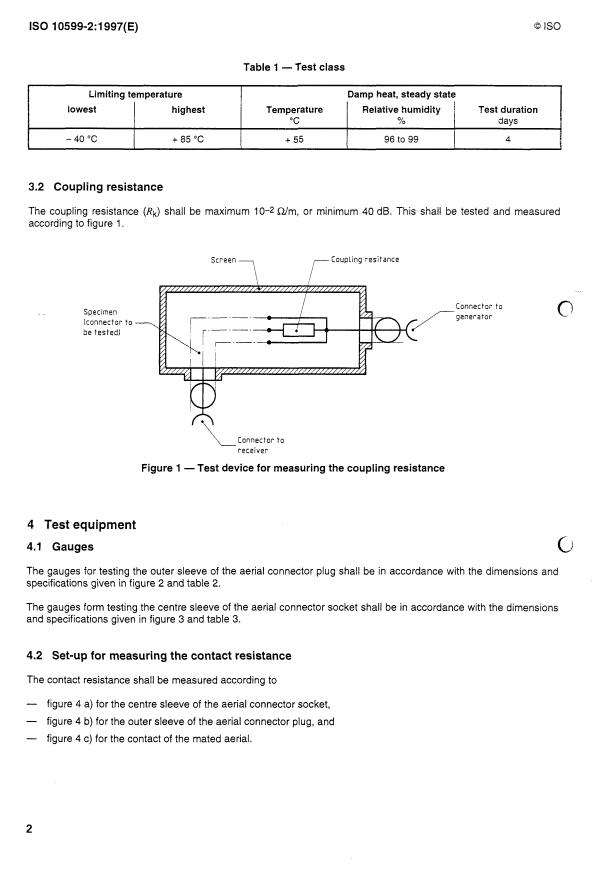
Table 1 - Test class
Limiting temperature Damp heat, steady state
lowest highest Temgeratu re Relative humidity 1 Test duration
"@ % days
- 40 "C + 85 "C 4.55 96 to 99 4
Coupling resitance
Connector to
Specimen
.- _. generator
(connector to
be tested)
receiver
Figure 1 -Test device for measuring the coupling resistance
4 Test equipment
4.1 Gauges
c;
The gauges for testing the outer sleeve of the aerial connector plug shall be in accordance with the dimensions and
specifications given in figure 2 and table 2.
The gauges form testing the centre sleeve of the aerial connector socket shall be in accordance with the dimensions
and specifications given in figure 3 and table 3.
4.2 Set-up for measuring the contact resistance
The contact resistance shall be measured according to
- figure 4 a) for the centre sleeve of the aerial connector socket,
- figure 4 b) for the outer sleeve of the aerial connector plug, a
...
NORME ISO
INTERNATIONALE 10599-2
Première édition
1997-06-01
Autoradios - Connecteurs coaxiaux
d’antenne -
Partie 2:
Valeurs caractéristiques, performances et
essais
Coaxial aerial connectors -
Car radios -
Par? 2: Characteristic values, performance requirements and tests
Numéro de référence
ISO 10599-2: 1997(F)
ISO 10599=2:1997(F)
Avant-propos
L’ISO (Organisation internationale de normalisation) est une fédération
mondiale d’organismes nationaux de normalisation (comités membres de
I’ISO). L’élaboration des Normes internationales est en général confiée aux
comités techniques de I’ISO. Chaque comité membre intéressé par une
étude a le droit de faire partie du comité technique créé a cet effet. Les
organisations internationales, gouvernementales et non gouvernementales,
en liaison avec I’ISO participent également aux travaux. L’ISO collabore
étroitement avec la Commission électrotechnique internationale (CEI) en
ce qui concerne la normalisation électrotechnique.
Les projets de Normes internationales adoptés par les comités techniques
sont soumis aux comités membres pour vote. Leur publication comme
Normes internationales requiert l’approbation de 75 % au moins des
comités membres votants.
La Norme internationale ISO 10599-2 a été élaborée par le comité
technique ISO/TC 22, Véhicules routiers.
L’ISO 10599 comprend les parties suivantes, présentées sous le titre
général Autoradios - Connecteurs coaxiaux d’antenne:
- Partie 1: Dimensions
- Partie 2: Valeurs caractéristiques, performances et essais
L’annexe A de la présente partie de I’ISO 10599 est donnée uniquement à
titre d’information.
0 ISO 1997
Droits de reproduction réservés. Sauf prescription différente, aucune partie de cette publi-
cation ne peut être reproduite ni utilisée sous quelque forme que ce soit et par aucun pro-
cédé, électronique ou mécanique, y compris la photocopie et les microfilms, sans l’accord
écrit de l’éditeur.
Organisation internationale de normalisation
Case postale 56 l CH-121 1 Genève 20 l Suisse
Internet central @ iso.ch
c=ch; a=40Onet; p=iso; o=isocs; s=central
x.400
Imprimé en Suisse
ii
NORME INTERNATIONALE @ ISO ISO 10599-2: 1997(F)
Autoradios - Connecteurs coaxiaux d’antenne -
Partie 2:
Valeurs caractéristiques, performances et essais
1 Domaine d’application
La présente partie de I’ISO 10599 prescrit les valeurs caractéristiques, les exigences de performance et les
méthodes d’essai des connecteurs coaxiaux d’antenne conformes à I’ISO 10599-1, pour les autoradios destinés à
être montés sur les véhicules routiers.
2 Références normatives
Les normes suivantes contiennent des dispositions qui, par suite de la référence qui en est faite, constituent des
dispositions valables pour la présente partie de I’ISO 10599. Au moment de la publication, les éditions indiquées
étaient en vigueur. Toute norme est sujette à révision et les parties prenantes des accords fondés sur la présente
partie de I’ISO 10599 sont invitées à rechercher la possibilité d’appliquer les éditions les plus récentes des normes
indiquées ci-après. Les membres de la CEI et de I’ISO possèdent le registre des Normes internationales en vigueur
à un moment donné.
- Partie 1: Tolérances pour dimensions linéaires et angulaires non
ISO 2768-l :1989, Tolérances générales
affectées de tolérances individuelles.
ISO 10599-I :1992, Autoradios - Raccords coaxiaux d’antenne - Partie 1: Dimensions.
CE I 169-l : 1987, Connecteurs pour fréquences radioélectriques - Première partie: Prescriptions générales et
méthodes de mesure.
3 Valeurs caractéristiques
3.1 Classe d’essai
Les connecteurs coaxiaux d’antenne conformes à I’ISO 10599-I doivent appartenir à la classe d’essai 40/085/04,
telle que prescrite dans la CEI 68-l :1988, annexe A, et explicitée dans le tableau 1.
NOTE - Les deux premiers chiffres de la classe d’essai indiquent la température minimale de service, soit - 40 OC,
conformément à la CEI 68-2-l. Les trois chiffres suivants indiquent la température ambiante la plus élevée, soit + 85 “C selon
la CEI 68-2-2, et le dernier chiffre indique la durée de l’essai en jours, soit 4 jours, conformément à la CEI 68-2-3.
0 os0
ISO 10599-2: 1997(F)
Tableau 1 - Classe d’essai
.
Température limite État permanent de chaleur humide
Température Humidité relative Durée de l’essai
inférieure supérieure
“C % jours
+ 85 “C + 55 96 à 99 4
- 40 “C
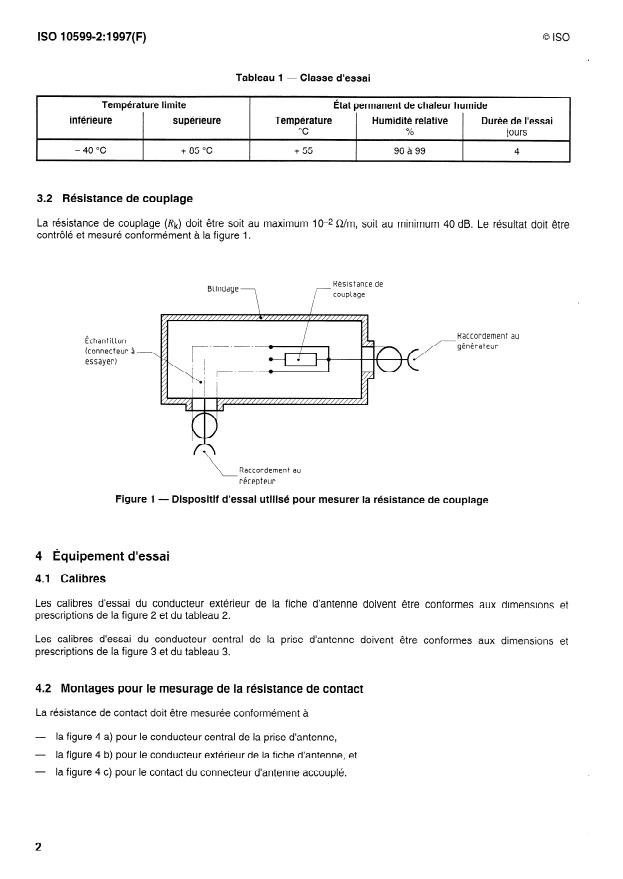
3.2 Résistance de couplage
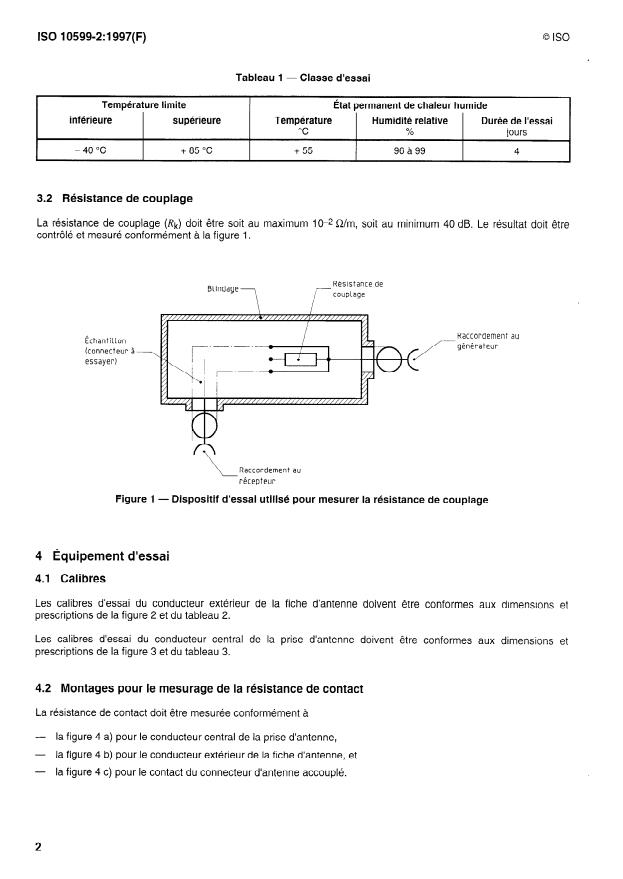
La résistance de couplage (&) doit être soit au maximum 10-2 Q/m, soit au minimum 40 dB. Le résultat doit être
contrôlé et mesuré conformément à la figure 1.
Résïstance de
Blindage
i-
couplage
l
Échantillon
konnecteurà-
essayer)
Raccordement au
récepteur
Dispositif d’essai utilisé pour mesurer la résistance de couplage
Figure 1 -
4 Équipement d’essai
4.1 Calibres
Les calibres d’essai du conducteur extérieur de la fiche d’antenne doivent être conformes aux dimensions et
prescriptions de la figure 2 et du tableau 2.
Les calibres d’essai du conducteur central de la prise d’antenne doivent être conformes aux dimensions et
prescriptions de la figure 3 et du tableau 3.
4.2 Montages pour le mesurage de la résistance de contact
La résistance de contact doit être mesurée conformément à
- la figure 4 a) pour le conducteur central de la prise d’antenne,
la figure 4 b) pour le conducteur extérieur de la fiche d’antenne, et
-
- la figure 4 c) pour le contact du connecteur d’antenne accouplé.
ISO 10599=2:1997(F)
Dimensions en millimètres
Valeurs de rugosité de surface en micromètres
Tolérance générale: ISO 2768-m
Ra 025
Ra 0,16/
I
\
--_--- ------~--
c
i
W,( \RO,Z ~
j_
Figure 2 - Calibres d’essai du conducteur extérieur de la fiche
Tableau 2 - Dimensions des calibres d’essai du conducteur extérieur de la fiche
Dimensions en millimètres
Matériau
Type du calibre Fonction du calibre
dl d2
Élargissement du conducteur
+ 0,Ol + 0,Ol
PI
Acier pour calibres, trempé
1096 o 10,1 0
extérieur de la fiche
Mesurage des forces
P2 ‘Oy - “0 01 Acier pour calibres, trempé
10-“ool
d’accouplement et de 9 >
désaccouplement
Mesurage de la résistance de
Cuprobéryllium, revêtu de rhodium
P3
999 - ; 01
contact 1
Dimensions en millimètres
Valeurs de rugosité de surface en micromètres
6 kO,l
Ra 025
Ra 0,16
l-l
\SR dl2
Figure 3 - Calibres d’essai du conducteur central de la prise
- Dimensions des calibres d’essai du conducteur central de la prise
Tableau 3
Dimensions en millimètres
Fonction du calibre d Matériau
Type du calibre 1
+ 0,Ol
Acier pour calibres, trempé
P4 Élargissement du conducteur central de la prise
294 0
Mesurage des forces d’accouplement et de
Acier pour calibres, trempé
P5
235 - “0 01
désaccouplement ,
Mesurage de la résistance de contact Cuprobéryllium, revêtu de rhodium
P6
235 - ; 01
ISO 10599=2:1997(F)
Dimension
...
NORME ISO
INTERNATIONALE 10599-2
Première édition
1997-06-01
Autoradios - Connecteurs coaxiaux
d’antenne -
Partie 2:
Valeurs caractéristiques, performances et
essais
Coaxial aerial connectors -
Car radios -
Par? 2: Characteristic values, performance requirements and tests
Numéro de référence
ISO 10599-2: 1997(F)
ISO 10599=2:1997(F)
Avant-propos
L’ISO (Organisation internationale de normalisation) est une fédération
mondiale d’organismes nationaux de normalisation (comités membres de
I’ISO). L’élaboration des Normes internationales est en général confiée aux
comités techniques de I’ISO. Chaque comité membre intéressé par une
étude a le droit de faire partie du comité technique créé a cet effet. Les
organisations internationales, gouvernementales et non gouvernementales,
en liaison avec I’ISO participent également aux travaux. L’ISO collabore
étroitement avec la Commission électrotechnique internationale (CEI) en
ce qui concerne la normalisation électrotechnique.
Les projets de Normes internationales adoptés par les comités techniques
sont soumis aux comités membres pour vote. Leur publication comme
Normes internationales requiert l’approbation de 75 % au moins des
comités membres votants.
La Norme internationale ISO 10599-2 a été élaborée par le comité
technique ISO/TC 22, Véhicules routiers.
L’ISO 10599 comprend les parties suivantes, présentées sous le titre
général Autoradios - Connecteurs coaxiaux d’antenne:
- Partie 1: Dimensions
- Partie 2: Valeurs caractéristiques, performances et essais
L’annexe A de la présente partie de I’ISO 10599 est donnée uniquement à
titre d’information.
0 ISO 1997
Droits de reproduction réservés. Sauf prescription différente, aucune partie de cette publi-
cation ne peut être reproduite ni utilisée sous quelque forme que ce soit et par aucun pro-
cédé, électronique ou mécanique, y compris la photocopie et les microfilms, sans l’accord
écrit de l’éditeur.
Organisation internationale de normalisation
Case postale 56 l CH-121 1 Genève 20 l Suisse
Internet central @ iso.ch
c=ch; a=40Onet; p=iso; o=isocs; s=central
x.400
Imprimé en Suisse
ii
NORME INTERNATIONALE @ ISO ISO 10599-2: 1997(F)
Autoradios - Connecteurs coaxiaux d’antenne -
Partie 2:
Valeurs caractéristiques, performances et essais
1 Domaine d’application
La présente partie de I’ISO 10599 prescrit les valeurs caractéristiques, les exigences de performance et les
méthodes d’essai des connecteurs coaxiaux d’antenne conformes à I’ISO 10599-1, pour les autoradios destinés à
être montés sur les véhicules routiers.
2 Références normatives
Les normes suivantes contiennent des dispositions qui, par suite de la référence qui en est faite, constituent des
dispositions valables pour la présente partie de I’ISO 10599. Au moment de la publication, les éditions indiquées
étaient en vigueur. Toute norme est sujette à révision et les parties prenantes des accords fondés sur la présente
partie de I’ISO 10599 sont invitées à rechercher la possibilité d’appliquer les éditions les plus récentes des normes
indiquées ci-après. Les membres de la CEI et de I’ISO possèdent le registre des Normes internationales en vigueur
à un moment donné.
- Partie 1: Tolérances pour dimensions linéaires et angulaires non
ISO 2768-l :1989, Tolérances générales
affectées de tolérances individuelles.
ISO 10599-I :1992, Autoradios - Raccords coaxiaux d’antenne - Partie 1: Dimensions.
CE I 169-l : 1987, Connecteurs pour fréquences radioélectriques - Première partie: Prescriptions générales et
méthodes de mesure.
3 Valeurs caractéristiques
3.1 Classe d’essai
Les connecteurs coaxiaux d’antenne conformes à I’ISO 10599-I doivent appartenir à la classe d’essai 40/085/04,
telle que prescrite dans la CEI 68-l :1988, annexe A, et explicitée dans le tableau 1.
NOTE - Les deux premiers chiffres de la classe d’essai indiquent la température minimale de service, soit - 40 OC,
conformément à la CEI 68-2-l. Les trois chiffres suivants indiquent la température ambiante la plus élevée, soit + 85 “C selon
la CEI 68-2-2, et le dernier chiffre indique la durée de l’essai en jours, soit 4 jours, conformément à la CEI 68-2-3.
0 os0
ISO 10599-2: 1997(F)
Tableau 1 - Classe d’essai
.
Température limite État permanent de chaleur humide
Température Humidité relative Durée de l’essai
inférieure supérieure
“C % jours
+ 85 “C + 55 96 à 99 4
- 40 “C
3.2 Résistance de couplage
La résistance de couplage (&) doit être soit au maximum 10-2 Q/m, soit au minimum 40 dB. Le résultat doit être
contrôlé et mesuré conformément à la figure 1.
Résïstance de
Blindage
i-
couplage
l
Échantillon
konnecteurà-
essayer)
Raccordement au
récepteur
Dispositif d’essai utilisé pour mesurer la résistance de couplage
Figure 1 -
4 Équipement d’essai
4.1 Calibres
Les calibres d’essai du conducteur extérieur de la fiche d’antenne doivent être conformes aux dimensions et
prescriptions de la figure 2 et du tableau 2.
Les calibres d’essai du conducteur central de la prise d’antenne doivent être conformes aux dimensions et
prescriptions de la figure 3 et du tableau 3.
4.2 Montages pour le mesurage de la résistance de contact
La résistance de contact doit être mesurée conformément à
- la figure 4 a) pour le conducteur central de la prise d’antenne,
la figure 4 b) pour le conducteur extérieur de la fiche d’antenne, et
-
- la figure 4 c) pour le contact du connecteur d’antenne accouplé.
ISO 10599=2:1997(F)
Dimensions en millimètres
Valeurs de rugosité de surface en micromètres
Tolérance générale: ISO 2768-m
Ra 025
Ra 0,16/
I
\
--_--- ------~--
c
i
W,( \RO,Z ~
j_
Figure 2 - Calibres d’essai du conducteur extérieur de la fiche
Tableau 2 - Dimensions des calibres d’essai du conducteur extérieur de la fiche
Dimensions en millimètres
Matériau
Type du calibre Fonction du calibre
dl d2
Élargissement du conducteur
+ 0,Ol + 0,Ol
PI
Acier pour calibres, trempé
1096 o 10,1 0
extérieur de la fiche
Mesurage des forces
P2 ‘Oy - “0 01 Acier pour calibres, trempé
10-“ool
d’accouplement et de 9 >
désaccouplement
Mesurage de la résistance de
Cuprobéryllium, revêtu de rhodium
P3
999 - ; 01
contact 1
Dimensions en millimètres
Valeurs de rugosité de surface en micromètres
6 kO,l
Ra 025
Ra 0,16
l-l
\SR dl2
Figure 3 - Calibres d’essai du conducteur central de la prise
- Dimensions des calibres d’essai du conducteur central de la prise
Tableau 3
Dimensions en millimètres
Fonction du calibre d Matériau
Type du calibre 1
+ 0,Ol
Acier pour calibres, trempé
P4 Élargissement du conducteur central de la prise
294 0
Mesurage des forces d’accouplement et de
Acier pour calibres, trempé
P5
235 - “0 01
désaccouplement ,
Mesurage de la résistance de contact Cuprobéryllium, revêtu de rhodium
P6
235 - ; 01
ISO 10599=2:1997(F)
Dimension
...