

ISO/IEC 19583-27:2025
(Main)Information technology — Concepts and usage of metadata — Part 27: Mapping between metamodel for computable data registration and bioinformatics analyses by high-throughput sequencing (HTS)
General Information
- Abstract
This document provides a mapping between the ISO/IEC 11179-34 metamodel for computable data registration and the IEEE 2791 standard for bioinformatics analyses generated by high-throughput sequencing (HTS), to facilitate the production of IEEE 2791 objects from instances of ISO/IEC 11179-34 metamodel and the registration of IEEE 2791 objects as computable data within an MDR conforming to ISO/IEC 11179-34. This document is applicable to those who are submitting data to organizations that require metadata submissions in IEEE 2791 compliant format, as well as those aiming to register IEEE 2791 objects into an MDR that conforms to ISO/IEC 11179-34.
- Status
- Published
- Publication Date
- 11-Dec-2025
- Technical Committee
- ISO/IEC JTC 1/SC 32 - Data management and interchange
- Drafting Committee
- ISO/IEC JTC 1/SC 32 - Data management and interchange
- Current Stage
- 6060 - International Standard published
- Start Date
- 12-Dec-2025
- Due Date
- 24-Oct-2026
- Completion Date
- 12-Dec-2025
Buy Documents


ISO/IEC 19583-27:2025 - Information technology — Concepts and usage of metadata — Part 27: Mapping between metamodel for computable data registration and bioinformatics analyses by high-throughput sequencing (HTS) Released:12. 12. 2025
Overview
ISO/IEC 19583-27:2025 defines a formal mapping between two metadata standards used in bioinformatics and metadata registries: the ISO/IEC 11179-34 metamodel for computable data registration and the IEEE 2791 JSON Schema for bioinformatics analyses generated by high‑throughput sequencing (HTS). The standard specifies bidirectional mapping mechanisms to (1) produce IEEE 2791 objects from instances of ISO/IEC 11179-34, and (2) register IEEE 2791 objects as computable data in a Metadata Registry (MDR) conforming to ISO/IEC 11179-34. It supports semantic interoperability, reproducibility, and consistent metadata exchange between research, clinical, and regulatory ecosystems.
Key topics and technical requirements
- Mapping mechanisms
- S2M (Schema to Metamodel): maps IEEE 2791 JSON Schema elements into ISO/IEC 11179-34 computable‑data metamodel objects (e.g., spec_version, provenance_domain, io_domain).
- M2S (Metamodel to Schema): maps ISO/IEC 11179-34 computable‑data entries into IEEE 2791 JSON Schema objects.
- Data transformation
- Defines transformation rules and types: one‑to‑one, one‑to‑many, many‑to‑one, many‑to‑many (some mappings require human review).
- Covers domain‑specific transformations (spec_version, provenance_domain.review, contributors, pipeline_steps, input/output subdomains, error_domain).
- MDR implementation and registration
- Requirements for recording Computable_Data, Supporting_Document, Input_Output_Data, and error metadata within an MDR.
- Validation and examples
- Includes mapping tables (e.g., Table 1) and informative Annexes A and B with examples of transforming between IEEE 2791 objects and ISO/IEC 11179-34 computable data.
- Normative references
- Relies on ISO/IEC 11179-3, ISO/IEC 11179-33, ISO/IEC 11179-34, and IEEE 2791-2020.
Practical applications and who should use it
- Data submitters who must provide HTS bioinformatics metadata in IEEE 2791 format to regulators, repositories, or partners.
- MDR administrators and data stewards implementing ISO/IEC 11179-34 to register computable data and enable downstream generation of IEEE 2791 objects.
- Bioinformatics platform developers and integrators building exporters/importers between JSON IEEE 2791 artifacts and metadata registries.
- Regulatory agencies, pharmaceutical companies, and research consortia seeking reproducible, machine‑readable HTS workflow metadata for review, audit, or data sharing.
- Software engineers and ETL specialists responsible for data transformation, validation, and mapping logic between standards.
Related standards
- ISO/IEC 11179‑3:2023 (MDR metamodel common facilities)
- ISO/IEC 11179‑33:2023 (Metamodel for data set registration)
- ISO/IEC 11179‑34:2024 (Metamodel for computable data registration)
- IEEE 2791‑2020 (Bioinformatics Analyses Generated by HTS; JSON Schema)
Keywords: ISO/IEC 19583-27:2025, metadata mapping, computable data registration, IEEE 2791, ISO/IEC 11179-34, MDR, HTS, bioinformatics, JSON Schema, data transformation, S2M mapping, M2S mapping.
Buy Documents
ISO/IEC 19583-27:2025 - Information technology — Concepts and usage of metadata — Part 27: Mapping between metamodel for computable data registration and bioinformatics analyses by high-throughput sequencing (HTS) Released:12. 12. 2025
Get Certified
Connect with accredited certification bodies for this standard

BSI Group
BSI (British Standards Institution) is the business standards company that helps organizations make excellence a habit.

NYCE
Mexican standards and certification body.
Sponsored listings
Frequently Asked Questions
ISO/IEC 19583-27:2025 is a standard published by the International Organization for Standardization (ISO). Its full title is "Information technology — Concepts and usage of metadata — Part 27: Mapping between metamodel for computable data registration and bioinformatics analyses by high-throughput sequencing (HTS)". This standard covers: This document provides a mapping between the ISO/IEC 11179-34 metamodel for computable data registration and the IEEE 2791 standard for bioinformatics analyses generated by high-throughput sequencing (HTS), to facilitate the production of IEEE 2791 objects from instances of ISO/IEC 11179-34 metamodel and the registration of IEEE 2791 objects as computable data within an MDR conforming to ISO/IEC 11179-34. This document is applicable to those who are submitting data to organizations that require metadata submissions in IEEE 2791 compliant format, as well as those aiming to register IEEE 2791 objects into an MDR that conforms to ISO/IEC 11179-34.
This document provides a mapping between the ISO/IEC 11179-34 metamodel for computable data registration and the IEEE 2791 standard for bioinformatics analyses generated by high-throughput sequencing (HTS), to facilitate the production of IEEE 2791 objects from instances of ISO/IEC 11179-34 metamodel and the registration of IEEE 2791 objects as computable data within an MDR conforming to ISO/IEC 11179-34. This document is applicable to those who are submitting data to organizations that require metadata submissions in IEEE 2791 compliant format, as well as those aiming to register IEEE 2791 objects into an MDR that conforms to ISO/IEC 11179-34.
ISO/IEC 19583-27:2025 is classified under the following ICS (International Classification for Standards) categories: 07.080 - Biology. Botany. Zoology; 35.240.70 - IT applications in science. The ICS classification helps identify the subject area and facilitates finding related standards.
ISO/IEC 19583-27:2025 is available in PDF format for immediate download after purchase. The document can be added to your cart and obtained through the secure checkout process. Digital delivery ensures instant access to the complete standard document.
Standards Content (Sample)
International
Standard
ISO/IEC 19583-27
First edition
Information technology — Concepts
2025-12
and usage of metadata —
Part 27:
Mapping between metamodel for
computable data registration and
bioinformatics analyses by high-
throughput sequencing (HTS)
Reference number
© ISO/IEC 2025
All rights reserved. Unless otherwise specified, or required in the context of its implementation, no part of this publication may
be reproduced or utilized otherwise in any form or by any means, electronic or mechanical, including photocopying, or posting on
the internet or an intranet, without prior written permission. Permission can be requested from either ISO at the address below
or ISO’s member body in the country of the requester.
ISO copyright office
CP 401 • Ch. de Blandonnet 8
CH-1214 Vernier, Geneva
Phone: +41 22 749 01 11
Email: copyright@iso.org
Website: www.iso.org
Published in Switzerland
© ISO/IEC 2025 – All rights reserved
ii
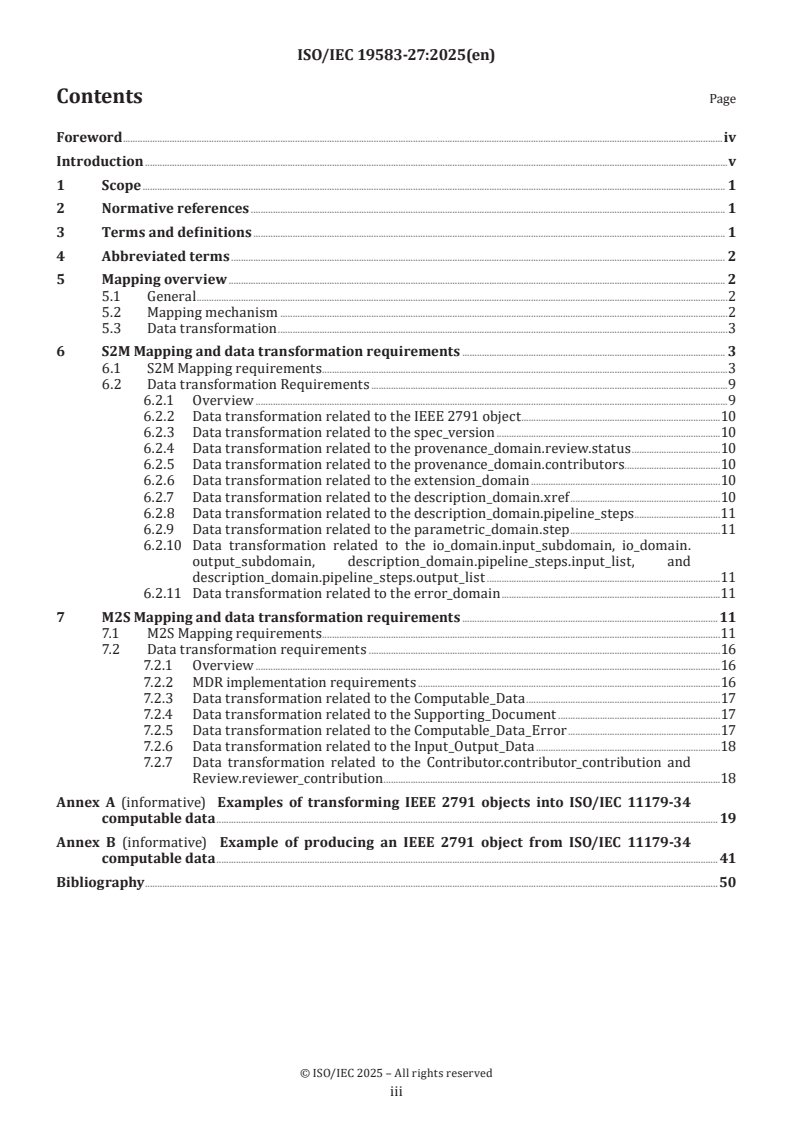
Contents Page
Foreword .iv
Introduction .v
1 Scope . 1
2 Normative references . 1
3 Terms and definitions . 1
4 Abbreviated terms . 2
5 Mapping overview . 2
5.1 General .2
5.2 Mapping mechanism .2
5.3 Data transformation .3
6 S2M Mapping and data transformation requirements . 3
6.1 S2M Mapping requirements .3
6.2 Data transformation Requirements .9
6.2.1 Overview .9
6.2.2 Data transformation related to the IEEE 2791 object .10
6.2.3 Data transformation related to the spec_version .10
6.2.4 Data transformation related to the provenance_domain.review.status .10
6.2.5 Data transformation related to the provenance_domain.contributors.10
6.2.6 Data transformation related to the extension_domain .10
6.2.7 Data transformation related to the description_domain.xref .10
6.2.8 Data transformation related to the description_domain.pipeline_steps .11
6.2.9 Data transformation related to the parametric_domain.step .11
6.2.10 Data transformation related to the io_domain.input_subdomain, io_domain.
output_subdomain, description_domain.pipeline_steps.input_list, and
description_domain.pipeline_steps.output_list .11
6.2.11 Data transformation related to the error_domain .11
7 M2S Mapping and data transformation requirements .11
7.1 M2S Mapping requirements.11
7.2 Data transformation requirements .16
7.2.1 Overview .16
7.2.2 MDR implementation requirements .16
7.2.3 Data transformation related to the Computable_Data .17
7.2.4 Data transformation related to the Supporting_Document .17
7.2.5 Data transformation related to the Computable_Data_Error .17
7.2.6 Data transformation related to the Input_Output_Data .18
7.2.7 Data transformation related to the Contributor.contributor_contribution and
Review.reviewer_contribution .18
Annex A (informative) Examples of transforming IEEE 2791 objects into ISO/IEC 11179-34
computable data . 19
Annex B (informative) Example of producing an IEEE 2791 object from ISO/IEC 11179-34
computable data . 41
Bibliography .50
© ISO/IEC 2025 – All rights reserved
iii
Foreword
ISO (the International Organization for Standardization) and IEC (the International Electrotechnical
Commission) form the specialized system for worldwide standardization. National bodies that are
members of ISO or IEC participate in the development of International Standards through technical
committees established by the respective organization to deal with particular fields of technical activity.
ISO and IEC technical committees collaborate in fields of mutual interest. Other international organizations,
governmental and non-governmental, in liaison with ISO and IEC, also take part in the work.
The procedures used to develop this document and those intended for its further maintenance are described
in the ISO/IEC Directives, Part 1. In particular, the different approval criteria needed for the different types
of document should be noted. This document was drafted in accordance with the editorial rules of the ISO/
IEC Directives, Part 2 (see www.iso.org/directives or www.iec.ch/members_experts/refdocs).
ISO and IEC draw attention to the possibility that the implementation of this document may involve the
use of (a) patent(s). ISO and IEC take no position concerning the evidence, validity or applicability of any
claimed patent rights in respect thereof. As of the date of publication of this document, ISO and IEC had not
received notice of (a) patent(s) which may be required to implement this document. However, implementers
are cautioned that this may not represent the latest information, which may be obtained from the patent
database available at www.iso.org/patents and https://patents.iec.ch. ISO and IEC shall not be held
responsible for identifying any or all such patent rights.
Any trade name used in this document is information given for the convenience of users and does not
constitute an endorsement.
For an explanation of the voluntary nature of standards, the meaning of ISO specific terms and expressions
related to conformity assessment, as well as information about ISO's adherence to the World Trade
Organization (WTO) principles in the Technical Barriers to Trade (TBT) see www.iso.org/iso/foreword.html.
In the IEC, see www.iec.ch/understanding-standards.
This document was prepared by Joint Technical Committee ISO/IEC JTC 1, Information technology,
Subcommittee SC 32, Data management and interchange.
A list of all parts in the ISO/IEC 19583 series can be found on the ISO and IEC websites.
Any feedback or questions on this document should be directed to the user’s national standards
body. A complete listing of these bodies can be found at www.iso.org/members.html and
www.iec.ch/national-committees.
© ISO/IEC 2025 – All rights reserved
iv
Introduction
ISO/IEC 11179-34 provides a specification of the extensions to the registry metamodel specified in
ISO/IEC 11179-3:2023 to enable the registration of metadata about computable data. Metadata about
computable data are like a manifest describing all details related to input files, output files, and the
pipeline used to process these files. The intent of ISO/IEC 11179-34 is to facilitate efficient communication
and interoperability among different platforms, industries, scientists, and regulators and to improve
reproducibility and replicability.
[1]
IEEE 2791-2020 aims to improve communication of bioinformatics protocols and data to facilitate
bioinformatics workflow related exchange and communication between regulatory agencies, pharmaceutical
companies, bioinformatics platform providers and researchers.
Both ISO/IEC 11179-34 and IEEE 2791 aim to ensure data reproducibility, which enhances confidence in the
decisions and conclusions drawn from such data. The consistency and quality of mapping between them will
ensure metadata for computable data to be accurately translated and applied across different systems and
applications.
© ISO/IEC 2025 – All rights reserved
v
International Standard ISO/IEC 19583-27:2025(en)
Information technology — Concepts and usage of metadata —
Part 27:
Mapping between metamodel for computable data
registration and bioinformatics analyses by high-throughput
sequencing (HTS)
1 Scope
This document provides a mapping between the ISO/IEC 11179-34 metamodel for computable data
registration and the IEEE 2791 standard for bioinformatics analyses generated by high-throughput
sequencing (HTS), to facilitate the production of IEEE 2791 objects from instances of ISO/IEC 11179-34
metamodel and the registration of IEEE 2791 objects as computable data within an MDR conforming to
ISO/IEC 11179-34.
This document is applicable to those who are submitting data to organizations that require metadata
submissions in IEEE 2791 compliant format, as well as those aiming to register IEEE 2791 objects into an
MDR that conforms to ISO/IEC 11179-34.
2 Normative references
The following documents are referred to in the text in such a way that some or all of their content constitutes
requirements of this document. For dated references, only the edition cited applies. For undated references,
the latest edition of the referenced document (including any amendments) applies.
ISO/IEC 11179-3:2023, Information technology — Metadata registries (MDR) — Part 3: Metamodel for registry
common facilities
ISO/IEC 11179-33:2023, Information technology — Metadata registries (MDR) — Part 33: Metamodel for data
set registration
ISO/IEC 11179-34:2024, Information technology — Metadata registries (MDR) — Part 34: Metamodel for
computable data registration
IEEE 2791-2020, Standard for Bioinformatics Analyses Generated by High-Throughput Sequencing (HTS) to
Facilitate Communication
3 Terms and definitions
For the purposes of this document, the terms and definitions given in ISO/IEC 11179-34 apply.
ISO and IEC maintain terminology databases for use in standardization at the following addresses:
— ISO Online browsing platform: available at https:// www .iso .org/ obp
— IEC Electropedia: available at https:// www .electropedia .org/
© ISO/IEC 2025 – All rights reserved
4 Abbreviated terms
JSON JavaScript Object Notation
MDR Metadata Registry
UML Unified Modeling Language
URI Uniform Resource Identifier
URL Uniform Resource Locator
5 Mapping overview
5.1 General
ISO/IEC 11179-34 provides a specification for an extension to a metadata registry (MDR), as specified in
ISO/IEC 11179-3, in which metadata that describe computable data can be registered. The specification in
ISO/IEC 11179-34, together with the relevant clauses of the specification in ISO/IEC 11179-3, provides the
ability to record metadata about computable data.
IEEE 2791 captures relevant information from a high-throughput sequencing workflow as an IEEE 2791 object
in order to enable a user to understand and interpret the workflow efficiently and with high confidence. IEEE
2791 is a standard that was initially created with a goal of improving efficiency in regulatory review. Pursuant
to this, workflow steps and prerequisites to execute workflow steps are recorded in detail in an IEEE 2791
object, information is recorded using key-value pairs in JSON, adhering to the IEEE 2791 JSON Schema.
NOTE 1 The IEEE 2791 schema is the formal definition of the IEEE 2791 specification against which instances of
IEEE 2791 specification can be validated.
NOTE 2 An IEEE 2791 object is an instance of the IEEE 2791 specification and is a text file written in JSON data
structure that consists of all domains required by the IEEE 2791 schema.
Although ISO/IEC 11179-34 and IEEE 2791 differ in their structure, style of representation, and intended
areas of application, they converge in their shared goals. ISO/IEC 11179-34 has been developed with the
consideration of being compatible with IEEE 2791, which provides a solid basis for semantic interoperability
and facilitates the mapping between these two standards.
5.2 Mapping mechanism
This document defines two mapping mechanisms:
— S2M Mapping (Schema to Metamodel Mapping): Mapping from the IEEE 2791 JSON Schema to the
ISO/IEC 11179-34 computable data registration metamodel;
— M2S Mapping (Metamodel to Schema Mapping): Mapping from the ISO/IEC 11179-34 computable data
registration metamodel to the IEEE 2791 JSON Schema.
Both mechanisms enable interoperability by allowing the transformation of metadata and data
representations between the two standards. The S2M Mapping enables the transformation of IEEE 2791
objects into computable data that can be registered in an MDR conforming to ISO/IEC 11179-34. Conversely,
the M2S Mapping facilitates the conversion of metadata items registered in an MDR that conforms to
ISO/IEC 11179-34 into IEEE 2791 objects. This bidirectional mapping ensures that metadata can be
accurately translated and utilized across different systems and applications using either standard, thereby
supporting efficient data exchange and consistency.
© ISO/IEC 2025 – All rights reserved
5.3 Data transformation
For the purpose of this document, data transformation refers to the process of converting and structuring
data from its original format into the target format that adheres to the corresponding IEEE 2791 JSON
Schema or ISO/IEC 11179-34 metamodel. This process utilizes either the S2M mapping mechanism or the
M2S mapping mechanism.
Considering the heterogeneity between the ISO/IEC 11179-34 metamodel and the IEEE 2791 JSON Schema,
not all mappings are one-to-one; they may also be zero-to-one, one-to-zero, one-to-many, many-to-one, or
many-to-many. While data transformation is straightforward for one-to-one and many-to-one mappings,
transformations related to other types of mappings require human involvement.
6 S2M Mapping and data transformation requirements
6.1 S2M Mapping requirements
The S2M Mapping is specified in Table 1.
In Table 1, for objects listed in column 2, IEEE 2791-2020 shall be used; for objects listed in column 3,
ISO/IEC 11179-3:2023, ISO/IEC 11179-33:2023 and ISO/IEC 11179-34:2024 shall be used.
Table 1 — S2M Mapping
IEEE 2791-2020 JSON Schema ISO/IEC 11179-34:2024
No. Note
object metamodel object
Scoped_Identifier.identifier (ISO/IEC
1 object_id
11179-3:2023, 7.3.2)
Supporting_Document (ISO/IEC
2 spec_version
11179-34:2024, 7.2.2.3)
Computable_Data.etag (ISO/IEC
3 etag
11179-34:2024, 7.2.2.1)
There is no single class or
attribute in ISO/IEC 11179-
34:2024 metamodel that
metamodel objects in rows from 5
4 provenance_domain covers the entire range of
to 30
the provenance_domain. It is
mapped to multiple classes
and attributes.
Designation.sign (ISO/IEC 11179-
5 provenance_domain.name
3:2023, 8.4.1)
Computable_Data.version (ISO/IEC
6 provenance_domain.version
11179-34:2024, 7.2.2.1)
Review (ISO/IEC 11179-34:2024,
7 provenance_domain.review
7.2.2.8)
Review.review_date (ISO/IEC 11179-
8 provenance_domain.review .date
34:2024, 7.2.2.8)
There is no single class or
attribute in ISO/IEC 11179-
34:2024 metamodel that
metamodel objects in rows from 10 covers the entire range of the
9 provenance_domain.review .reviewer
to 14 provenance_domain.review
.reviewer. It is mapped to
multiple attributes of one or
more classes.
provenance_domain.review .review- Review.reviewer_name (ISO/IEC
er.name 11179-34:2024, 7.2.2.8)
© ISO/IEC 2025 – All rights reserved
TTabablele 1 1 ((ccoonnttiinnueuedd))
IEEE 2791-2020 JSON Schema ISO/IEC 11179-34:2024
No. Note
object metamodel object
Table 2 presents the mapping
of values from the contribu-
tion property defined in IEEE
provenance_domain.review .review- Review.reviewer_contribution (ISO/
11 2791-2020 to the correspond-
er.contribution IEC 11179-34:2024, 7.2.2.8)
ing Contribution enumerated
class as specified in ISO/IEC
11179-34.
provenance_domain.review .review- Review.reviewer_affiliation (ISO/IEC
er.affiliation 11179-34:2024, 7.2.2.8)
provenance_domain.review .review- Review.reviewer_email (ISO/IEC
er.email 11179-34:2024, 7.2.2.8)
provenance_domain.review .review- Review.reviewer_orcid (ISO/IEC
er.orcid 11179-34:2024, 7.2.2.8)
provenance_domain.review .review- Review.reviewer_comment (ISO/IEC
er_comment 11179-34:2024, 7.2.2.8)
Table 3 presents the mapping
of values from the status
property defined in IEEE
Review.review_status (ISO/IEC
16 provenance_domain.review .status 2791 to the corresponding
11179-34:2024, 7.2.2.8)
Review_Status enumerated
class as specified in ISO/IEC
11179-34.
Computable_Data.derived_from
17 provenance_domain.derived_from
(ISO/IEC 11179-34:2024, 7.2.2.1)
Computable_Data.obsolete_after_
18 provenance_domain.obsolete_after datetime (ISO/IEC 11179-34:2024,
7.2.2.1)
Computable_Data.embargo_period
19 provenance_domain.embargo
(ISO/IEC 11179-34:2024, 7.2.2.1)
Computable_Data.embargo_period.
provenance_domain.embargo.start_
20 start_datetime (ISO/IEC 11179-
time
34:2024, 7.2.2.1)
Computable_Data.embargo_peri-
provenance_domain.embargo.end_
21 od. end_datetime (ISO/IEC 11179-
time
34:2024, 7.2.2.1)
Computable_Data.created_datetime
22 provenance_domain.created
(ISO/IEC 11179-34:2024, 7.2.2.1)
Computable_Data.modified_datetime
23 provenance_domain.modified
(ISO/IEC 11179-34:2024, 7.2.2.1)
Contributor (ISO/IEC 11179-34:2024,
7.2.2.5)
Individual_Contributor (ISO/IEC
24 provenance_domain.contributors
11179-34:2024, 7.2.2.6)
Organization_Contributor (ISO/IEC
11179-34:2024, 7.2.2.7)
provenance_domain.contributors. Designation.sign (ISO/IEC 11179-
contributor.name 3:2023, 8.4.1)
Individual_Contributor.contributor_
provenance_domain.contributors.
26 affiliation (ISO/IEC 11179-34:2024,
contributor.affiliation
7.2.2.6)
Individual_Contributor.contribu-
provenance_domain.contributors.
27 tor_email (ISO/IEC 11179-34:2024,
contributor.email
7.2.2.6)
© ISO/IEC 2025 – All rights reserved
TTabablele 1 1 ((ccoonnttiinnueuedd))
IEEE 2791-2020 JSON Schema ISO/IEC 11179-34:2024
No. Note
object metamodel object
Table 2 presents the mapping
of values from the contribu-
Individual_Contributor.contribu- tion property defined in IEEE
provenance_domain.contributors.
28 tor_contribution (ISO/IEC 11179- 2791-2020 to the correspond-
contributor.contribution
34:2024, 7.2.2.5) ing Contribution enumerated
class as specified in ISO/IEC
11179-34.
Individual_Contributor.contribu-
provenance_domain.contributors.
29 tor_orcid (ISO/IEC 11179-34:2024,
contributor.orcid
7.2.2.6)
Computable_Data.licence (ISO/IEC
30 provenance_domain.license
11179-34:2024, 7.2.2.1)
Computable_Data.usability (ISO/IEC
31 usability_domain
11179-34:2024, 7.2.2.1)
Supporting_Document (ISO/IEC
32 extension_domain
11179-34:2024, 7.2.2.3)
There is no single class or
attribute in ISO/IEC 11179-
34:2024 metamodel that
metamodel objects in rows from 34
33 description_domain covers the entire range of
to 64
the description_domain. It is
mapped to multiple classes
and attributes.
Designation.sign (ISO/IEC 11179-
34 description_domain.keywords
3:2023, 8.4.1)
Supporting_Document (ISO/IEC
35 description_domain.xref
11179-34:2024, 7.2.2.3)
Supporting_Document (ISO/IEC
36 description_domain.xref.namespace
11179-34:2024, 7.2.2.3)
Supporting_Document (ISO/IEC
37 description_domain.xref.name
11179-34:2024, 7.2.2.3)
Supporting_Document (ISO/IEC
38 description_domain.xref.ids
11179-34:2024, 7.2.2.3)
Supporting_Document (ISO/IEC
39 description_domain.xref.access_time
11179-34:2024, 7.2.2.3)
Computation_Execution_Environ-
40 description_domain.platform ment.platform (ISO/IEC 11179-
34:2024, 7.2.2.11)
Computation_Step (ISO/IEC 11179-
41 description_domain.pipeline_steps
34:2024, 7.2.2.9)
description_domain.pipeline_steps. Computation_Step.step_number
step_number (ISO/IEC 11179-34:2024, 7.2.2.9)
description_domain.pipeline_steps. Designation.sign (ISO/IEC 11179-
name 3:2023, 8.4.1)
description_domain.pipeline_steps. Computation_Step.purpose (ISO/IEC
description 11179-34:2024, 7.2.2.9)
description_domain.pipeline_steps. Computation_Step.version (ISO/IEC
version 11179-34:2024, 7.2.2.9)
description_domain.pipeline_steps. Computation_Step_Prerequisite
prerequisite (ISO/IEC 11179-34:2024, 7.2.2.16)
description_domain.pipeline_steps. Designation.sign (ISO/IEC 11179-
prerequisite.name 3:2023, 8.4.1)
© ISO/IEC 2025 – All rights reserved
TTabablele 1 1 ((ccoonnttiinnueuedd))
IEEE 2791-2020 JSON Schema ISO/IEC 11179-34:2024
No. Note
object metamodel object
There is no single class or
attribute in ISO/IEC 11179-
34:2024 metamodel that
description_domain.pipeline_steps. metamodel objects in rows from 49 covers the entire range of the
prerequisite.uri to 52 description_domain.pipeline_
steps.prerequisite.uri. It is
mapped to multiple attributes
of one or more classes.
Computation_Step_Prerequisite.
description_domain.pipeline_steps.
49 filename (ISO/IEC 11179-34:2024,
prerequisite.uri.filename
7.2.2.16)
description_domain.pipeline_steps. Computation_Step_Prerequisite.uri
prerequisite.uri.uri (ISO/IEC 11179-34:2024, 7.2.2.16)
Computation_Step_Prerequisite.
description_domain.pipeline_steps.
51 access_datetime (ISO/IEC 11179-
prerequisite.uri.access_time
34:2024, 7.2.2.16)
Computation_Step_Prerequisite.
description_domain.pipeline_steps.
52 sha1_checksum (ISO/IEC 11179-
prerequisite.uri.sha1_checksum
34:2024, 7.2.2.16)
description_domain.pipeline_steps. Input_Output_Data (ISO/IEC 11179-
input_list 34:2024, 7.2.2.10)
There is no single class or
attribute in ISO/IEC 11179-
34:2024 metamodel that
description_domain.pipeline_steps. metamodel objects in rows from 55 covers the entire range of the
input_list.uri to 58 description_domain.pipe-
line_steps.input_list.uri. It is
mapped to multiple attributes
of one or more classes.
description_domain.pipeline_steps. Designation.sign (ISO/IEC 11179-
input_list.uri.filename 3:2023, 8.4.1)
description_domain.pipeline_steps. Input_Output_Data.uri (ISO/IEC
input_list.uri.uri 11179-34:2024, 7.2.2.10)
description_domain.pipeline_steps. Input_Output_Data.access_datetime
input_list.uri.access_time (ISO/IEC 11179-34:2024, 7.2.2.10)
description_domain.pipeline_steps. Input_Output_Data.sha1_checksum
input_list.uri.sha1_checksum (ISO/IEC 11179-34:2024, 7.2.2.10)
description_domain.pipeline_steps. Input_Output_Data (ISO/IEC 11179-
output_list 34:2024, 7.2.2.10)
There is no single class or
attribute in ISO/IEC 11179-
34:2024 metamodel that
description_domain.pipeline_steps. metamodel objects in rows from 61 covers the entire range of the
output_list.uri to 64 description_domain.pipe-
line_steps.output_list.uri. It is
mapped to multiple attributes
of one or more classes.
description_domain.pipeline_steps. Designation.sign (ISO/IEC 11179-
output_list.uri.filename 3:2023, 8.4.1)
description_domain.pipeline_steps. Input_Output_Data.uri (ISO/IEC
output_list.uri.uri 11179-34:2024, 7.2.2.10)
description_domain.pipeline_steps. Input_Output_Data.access_datetime
output_list.uri.access_time (ISO/IEC 11179-34:2024, 7.2.2.10)
© ISO/IEC 2025 – All rights reserved
TTabablele 1 1 ((ccoonnttiinnueuedd))
IEEE 2791-2020 JSON Schema ISO/IEC 11179-34:2024
No. Note
object metamodel object
description_domain.pipeline_steps. Input_Output_Data.sha1_checksum
output_list.uri.sha1_checksum (ISO/IEC 11179-34:2024, 7.2.2.10)
Computation_Execution_Environ-
65 execution_domain ment (ISO/IEC 11179-34:2024,
7.2.2.11)
Execution_Script (ISO/IEC 11179-
66 execution_domain.script
34:2024, 7.2.2.12)
There is no single class or
attribute in ISO/IEC 11179-
34:2024 metamodel that
metamodel objects in rows from 68 covers the entire range of
67 execution_domain.script.uri
to 71 the execution_domain.script.
uri. It is mapped to multiple
attributes of one or more
classes.
execution_domain.script.uri.filename Execution_Script.filename (ISO/IEC
11179-34:2024, 7.2.2.12)
execution_domain.script.uri.uri Execution_Script.uri (ISO/IEC 11179-
34:2024, 7.2.2.12)
execution_domain.script.uri.access_ Execution_Script.access_datetime
time (ISO/IEC 11179-34:2024, 7.2.2.12)
execution_domain.script.uri.sha1_ Execution_Script.sha1_checksum
checksum (ISO/IEC 11179-34:2024, 7.2.2.12)
Computation_Execution_Environ-
72 execution_domain.script_driver men. script_driver (ISO/IEC 11179-
34:2024, 7.2.2.11)
execution_domain.software_prereq- Software_Prerequisite (ISO/IEC
uisites 11179-34:2024, 7.2.2.13)
execution_domain.software_prereq- Designation.sign (ISO/IEC 11179-
uisites.name 3:2023, 8.4.1)
execution_domain.software_prereq- Software_Prerequisite.version (ISO/
uisites.version IEC 11179-34:2024, 7.2.2.13)
There is no single class or
attribute in ISO/IEC 11179-
34:2024 metamodel that
execution_domain.software_prereq- metamodel objects in rows from 77 covers the entire range of
uisites.uri to 80 the execution_domain.soft-
ware_prerequisites.uri. It is
mapped to multiple attributes
of one or more classes.
execution_domain.software_prereq- Software_Prerequisite.filename
uisites.uri.filename (ISO/IEC 11179-34:2024, 7.2.2.13)
execution_domain.software_prereq- Software_Prerequisite.uri (ISO/IEC
uisites.uri.uri 11179-34:2024, 7.2.2.13)
execution_domain.software_prereq- Software_Prerequisite.access_date-
79 uisites.uri.access_time time (ISO/IEC 11179-34:2024,
7.2.2.13)
execution_domain.software_prereq- Software_Prerequisite.sha1_check-
80 uisites.uri.sha1_checksum sum (ISO/IEC 11179-34:2024,
7.2.2.13)
execution_domain.external_data_ External_Data_Endpoint (ISO/IEC
endpoints 11179-34:2024, 7.2.2.15)
© ISO/IEC 2025 – All rights reserved
TTabablele 1 1 ((ccoonnttiinnueuedd))
IEEE 2791-2020 JSON Schema ISO/IEC 11179-34:2024
No. Note
object metamodel object
execution_domain.external_data_ Designation.sign (ISO/IEC 11179-
endpoints.name 3:2023, 8.4.1)
execution_domain.external_data_ External_Data_Endpoint.url (ISO/IEC
endpoints.url 11179-34:2024, 7.2.2.15)
execution_domain.environment_var- Environment_Variable (ISO/IEC
iables 11179-34:2024, 7.2.2.14)
Computation_Step_Parameter (ISO/
85 parametric_domain
IEC 11179-34:2024, 7.2.2.17)
Computation_Step.step_number
86 parametric_domain.step
(ISO/IEC 11179-34:2024, 7.2.2.9)
parametric_domain.param Computation_Step_Parameter.
87 parameter (ISO/IEC 11179-34:2024,
7.2.2.17)
parametric_domain.value Computation_Step_Parameter.value
(ISO/IEC 11179-34:2024, 7.2.2.17)
Input_Output_Data (ISO/IEC 11179-
89 io_domain
34:2024, 7.2.2.10)
Input_Output_Data (ISO/IEC 11179-
90 io_domain.input_subdomain
34:2024, 7.2.2.10)
There is no single class or
attribute in ISO/IEC 11179-
34:2024 metamodel that
metamodel objects in rows from 92 covers the entire range of the
91 io_domain.input_subdomain.uri
to 95 io_domain.input_subdomain.
uri. It is mapped to multiple
attributes of one or more
classes.
io_domain.input_subdomain.uri. Designation.sign (ISO/IEC 11179-
filename 3:2023, 8.4.1)
Input_Output_Data.uri (ISO/IEC
93 io_domain.input_subdomain.uri.uri
11179-34:2024, 7.2.2.10)
io_domain.input_subdomain.uri. Input_Output_Data.access_datetime
access_time (ISO/IEC 11179-34:2024, 7.2.2.10)
io_domain.input_subdomain.uri. Input_Output_Data.sha1_checksum
sha1_checksum (ISO/IEC 11179-34:2024, 7.2.2.10)
Input_Output_Data (ISO/IEC 11179-
96 io_domain.output_subdomain
34:2024, 7.2.2.10)
io_domain.output_subdomain.medi- Data_Set_Distribution.media_type
atype (ISO/IEC 11179-33:2023, 7.2.2.5)
There is no single class or
attribute in ISO/IEC 11179-
34:2024 metamodel that
metamodel objects in rows from 99 covers the entire range of
98 io_domain.output_subdomain.uri
to 102 the io_domain.output_sub-
domain.uri. It is mapped to
multiple attributes of one or
more classes.
io_domain.output_subdomain.uri. Designation.sign (ISO/IEC 11179-
filename 3:2023, 8.4.1)
Input_Output_Data.uri (ISO/IEC
100 io_domain.output_subdomain.uri.uri
11179-34:2024, 7.2.2.10)
io_domain.output_subdomain.uri. Input_Output_Data.access_datetime
access_time (ISO/IEC 11179-34:2024, 7.2.2.10)
© ISO/IEC 2025 – All rights reserved
TTabablele 1 1 ((ccoonnttiinnueuedd))
IEEE 2791-2020 JSON Schema ISO/IEC 11179-34:2024
No. Note
object metamodel object
io_domain.output_subdomain.uri. Input_Output_Data.sha1_checksum
sha1_checksum (ISO/IEC 11179-34:2024, 7.2.2.10)
Computable_Data_Error (ISO/IEC
103 error_domain
11179-34:2024, 7.2.2.4)
Computable_Data_Error (ISO/IEC
104 error_domain.empirical_error
11179-34:2024, 7.2.2.4)
Computable_Data_Error (ISO/IEC
105 error_domain.algorithmic_error
11179-34:2024, 7.2.2.4)
Table 2 — contribution property mapping
Value in contribution property Value in Contribution enumerated class
“authoredBy” “authoredBy”
“contributedBy” “contributedBy”
“createdAt” “createdAt”
“createdBy” “createdBy”
“createdWith” “createdWith”
“curatedBy” “curatedBy”
“derivedFrom” “derivedFrom”
“importedBy” “importedBy”
“importedFrom” “importedFrom”
“providedBy” “providedBy”
“retrievedBy” “retrievedBy”
“retrievedFrom” “retrievedFrom”
“sourceAccessedBy” “sourceAccessedBy”
N/A “sourceAccessedAt”
Table 3 — status property mapping
Value in status property Value in Review_Status enumerated class
“proposed”
“unreviewed”
“scheduled”
“in-review” “in-review”
“approved” “approved”
“suspended” “suspended”
“rejected” “rejected”
6.2 Data transformation Requirements
6.2.1 Overview
Subclause 6.2 addresses the data transformation requirements for specific IEEE 2791-2020 JSON Schema
objects that necessitate human involvement.
Two examples illustrating the transformation from IEEE 2791 objects into computable data using the S2M
Mapping mechanism are provided in Annex A.
© ISO/IEC 2025 – All rights reserved
6.2.2 Data transformation related to the IEEE 2791 object
An IEEE 2791 object is a complete JSON file that contains all JSON data. Therefore, each IEEE 2791 object shall
be transformed into an instance of the Computable_Data class, along with several instances of associated
classes.
6.2.3 Data transformation related to the spec_version
The spec_version in the IEEE 2791-2020 JSON Schema is a string that describes the version of the IEEE 2791
specification used to define the JSON document, with its format being a URI. The value of spec_version shall
be transformed into an instance of the Supporting_Document class with the following attributes:
— document_role: indicates that the document is a schema document used to define the IEEE 2791 object;
— supporting_document_identifier: specifies the URI of the IEEE 2791 specification.
6.2.4 Data transformation related to the provenance_domain.review.status
The permissible value “unreviewed” for provenance_domain.review.status is mapped to two values in the
Contribution enumerated class: “proposed” and “scheduled”. Human judgment is required to determine
which value shall be selected.
6.2.5 Data transformation related to the provenance_domain.contributors
The provenance_domain.contributors shall be mapped to one of the three classes:
— For individual contributors, the instance of provenance_domain.contributors shall be transformed into
an instance of Individual_Contributor;
— For organization contributors, the instance of provenance_domain.contributors shall be transformed
into an instance of Organization_Contributor;
— For other types of contributors, the instance of provenance_domain.contributors shall be transformed
into an instance of Contributor.
6.2.6 Data transformation related to the extension_domain
The extension_domain in the IEEE 2791-2020 JSON Schema is an optional domain that contains user-
defined fields. It provides the JSON Schema for the extension, with its format being a URI. Each value of
the extension_domain shall be transformed into an instance of the Supporting_Document class with the
following attributes:
— document_role: indicates that the document is a schema document used to specify user-defined fields;
— supporting_document.identifier: specifies the URI of the extension schema.
6.2.7 Data transformation related to the description_domain.xref
The description_domain.xref in the IEEE 2791-2020 JSON Schema provides a list of database or ontology
IDs that are cross-referenced in the IEEE 2791 object. Each instance of description_domain.xref shall be
transformed into an instance of the Supporting_Document class with the following attributes:
— document_role: indicates that the document is an external reference used to provide a list of database or
ontology Ids that are cross-referenced;
— supporting_document.provider: specifies the namespace of the database or ontology represented by the
value of description_domain.xref.namespace;
— supporting_document.title: specifies the name of the database or ontology represented by the value of
description_domain.xref.name;
© ISO/IEC 2025 – All rights reserved
— supporting_document.identifier: specifies the reference identifier represented by the value of
description_domain.xref.ids;
— access_datetime: specifies the date and time the external reference was accessed, represented by the
value of description_domain.xref.access_time.
6.2.8 Data transformation related to the description_domain.pipeline_steps
Each instance of description_domain.pipeline_steps shall be transformed into one instance of the
Computation_Step class. Additionally, there is no IEEE 2791-2020 JSON Schema object that directly maps
to the Pipeline class. During data transformation, an instance of the Pipeline class shall be created and
associated with the instance of the Computable_Data class, as well as with all instances of the Computation_
Step class.
6.2.9 Data transformation related to the parametric_domain.step
The parametric_domain.step in the IEEE 2791-2020 JSON Schema refers to the specific step of the workflow
relevant to the parameters specified in parametric_domain.param and parametric_domain.value. The value
of parametric_domain.step shall be used to locate the instance of the Computation_Step class with which
the instance of the Computation_Step_Parameter class shall be associated.
6.2.10 Data transformation related to the io_domain.input_subdomain, io_domain.output_
subdomain, description_domain.pipeline_steps.input_list, and description_domain.pipeline_steps.
output_list
The io_domain.input_subdomain, io_domain.output_subdomain, description_domain.pipeline_steps.input_
list, and description_domain.pipeline_steps.output_list, are all mapped to the Input_Output_Data class.
During data transformation, the instances of io_domain.input_subdomain and io_domain.output_subdomain
shall be associated with the instance of the Computable_Data class, while the instances of description_
domain.pipeline_steps.input_list and description_domain.pipeline_steps.output_list shall be associated
with the corresponding instances of the Computation_Step class.
6.2.11 Data transformation related to the error_domain
The error_domain.empirical_error and error_domain.algorithmic_error are both mapped to the Computable_
Data_Error class. During data transformation:
— for an instance of error_domain.empirical_error, the value of Computable_Data_Error.type shall be
“empirical error”;
— for an instance of error_domain.algorithmic_error, the value of Computable_Data_Error.type shall be
“algorithmic error”.
7 M2S Mapping and data transformation requirements
7.1 M2S Mapping requirements
The M2S Mapping is specified in Table 4.
In Table 4, for objects listed in column 2, ISO/IEC 11179-3:2023 and ISO/IEC 11179-34:2024 shall be used; for
objects listed in column 3, IEEE 2791-2020 shall be used.
© ISO/IEC 2025 – All rights reserved
Table 4 — M2S Mapping
ISO/IEC 11179-34:2024
No. IEEE 2791-2020 JSON Schema object Note
metamodel object
There is no single object in the
IEEE 2791-2020 JSON Schema
Computable_Data (ISO/IEC 11179- JSON Schema objects in rows from 2 that covers the entire range of
34:2024, 7.2.2.1) to 14 the Computable_Data class. It
is mapped to multiple domains
and fields.
Scoped_Identifier.identifier (ISO/IEC
2 object_id
11179-3:2023, 7.3.2)
Designation.sign (ISO/IEC 11179- description_domain.keywords, prove-
3:2023, 8.4.1) nance_domain.name
4 Computable_Data.etag etag
5 Computable_Data.version provenance_domain.version
6 Computable_Data.derived_from provenance_domain.derived_from
7 Computable_Data.created_datetime provenance_domain.created
8 Computable_Data.modified_datetime provenance_domain.modified
Computable_Data.obsolete_after_date-
9 provenance_domain.obsolete_after
time
10 Computable_Data.embargo_period provenance_domain.embargo
Computable_Data.embargo_period. provenance_domain.embargo.start_
start_datetime time
Computable_Data.embargo_period. provenance_domain.embargo.end_
end_datetime time
13 Computable_Data.usability usability_domain
14 Computable_Data.licence provenance_domain.license
There is no object in the IEEE
2791-2020 JSON Schema that di-
Pipeline (ISO/IEC 11179-34:2024, rectly maps to the Pipeline class.
15 /
7.2.2.2) Its mapping is achieved through
the mapping of the associated
Computation_Step class.
Supporting_Document (ISO/IEC 11179- spec_version, extension_domain, and
34:2024, 7.2.2.3) description_domain.xref
Computable_Data_Error (ISO/IEC
17 error_domain
11179-34:2024, 7.2.2.4)
Contributor (ISO/IEC 11179-34:2024,
18 provenance_domain.contributors
7.2.2.5)
Table 5 presents the mapping
of values from the Contribution
provenance_domain.contributors. enumerated class as specified in
19 Contributor.contributor_contribution
contributor.contribution ISO/IEC 11179-34 to the corre-
sponding contribution property
defined in IEEE 2791.
Designation.sign (ISO/IEC 11179- provenance_domain.contributors.
3:2023, 8.4.1) contributor.name
Individual_Contributor (ISO/IEC
21 provenance_domain.contributors
11179-34:2024, 7.2.2.6)
Individual_Contributor.contributor_af- provenance_domain.contributors.
filiation contributor.affiliation
Individual_Contributor.contribu- provenance_domain.contributors.
tor_email contributor.email
© ISO/IEC 2025 – All rights reserved
TTabablele 4 4 ((ccoonnttiinnueuedd))
ISO/IEC 11179-34:2024
No. IEEE 2791-2020 JSON Schema object Note
metamodel object
Individual_Contributor.contribu- provenance_domain.contributors.
tor_orcid contributor.orcid
Organization_Contributor (ISO/IEC Not supported in the IEEE 2791-
25 /
11179-34:2024 7.2.2.7) 2020
Review (ISO/IEC 11179-34:2024,
26 provenance_domain.review
7.2.2.8)
27 Review.review_date provenance_domain.review .date
Table 6 presents the mapping of
values from the Review_Status
enumerated class as specified in
28 Review.review_status provenance_domain.review .status
ISO/IEC 11179-34 to the corre-
sponding status property defined
in IEEE 2791.
provenance_domain.review .reviewer.
29 Review.reviewer_name
name
Table 5 presents the mapping
of values from the Contribution
provenance_domain.review.reviewer. enumerated class as specified in
30 Review.reviewer_contribution
contribution ISO/IEC 11179-34 to the corre-
sponding contribution property
defined in IEEE 2791.
provenance_domain.review .reviewer.
31 Review.reviewer_affiliation
affiliation
provenance_domain.review .reviewer.
32 Review.reviewer_email
email
provenance_domain.review .reviewer.
33 Review.reviewer_orcid
orcid
provenance_domain.review .review-
34 Review.reviewer_comment
er_comment
Computation_Step (ISO/IEC 11179-
35 description_domain.pipeline_steps
34:2024, 7.2.2.9)
descrip
...