

ISO 21507:2010
(Main)Earth-moving machinery — Performance requirements for non-metallic fuel tanks
General Information
- Abstract
ISO 21507:2010 gives the performance requirements for non-metallic fuel tanks used by earth‑moving machinery as defined in ISO 6165.
- Status
- Published
- Publication Date
- 15-Sep-2010
- Technical Committee
- ISO/TC 127/SC 1 - Test methods relating to safety and machine performance
- Current Stage
- 9093 - International Standard confirmed
- Start Date
- 13-Nov-2021
- Completion Date
- 29-Aug-2026
Buy Documents

ISO 21507:2010 - Earth-moving machinery — Performance requirements for non-metallic fuel tanks Released:9/16/2010

ISO 21507:2010 - Engins de terrassement — Exigences de performance pour les réservoirs de carburant non métalliques Released:9/16/2010
Overview
ISO 21507:2010 specifies the performance requirements for non-metallic fuel tanks used in earth-moving machinery as defined by ISO 6165. This international standard ensures the safety, durability, and reliability of fuel tanks fabricated from non-metallic materials, which are increasingly utilized in heavy construction equipment. It covers important aspects such as mechanical strength, resistance to corrosion, protection from external impacts, and compatibility with operational environments.
The standard is crucial for manufacturers, safety inspectors, and operators of earth-moving machinery to ensure compliance with global safety regulations and enhance fuel system integrity under demanding conditions.
Key Topics
Scope & Definitions
Defines relevant terms including "non-metallic fuel tank," "driver's cab," and "flammable temperature zones" within earth-moving machines.Protection Requirements
Fuel tanks must be shielded from contact with obstacles by chassis structures or protective elements. Unshielded areas must pass rigorous impact testing. Piping and tubing connected to tanks require protective coverings or strategic positioning.Corrosion Resistance
Design and manufacturing must prevent internal and external corrosion, with possible additional protective coatings or reinforcements.Installation Guidelines
Tanks must be robustly secured and accommodate machine torsion, flexion, and vibrations while preventing fuel accumulation in low spots. Placement must avoid proximity to hot surfaces above 200°C unless protected.Location Restrictions
Tanks cannot form part of the operator’s cabin structure, and tank openings must be accessible outside the operator’s workspace keeping safety top priority.Performance Criteria
Design ensures that in case of leaks during refueling, fuel cannot contact ignition risk zones, thereby enhancing operational safety.Testing Protocols
Includes extensive tests such as:- Pressure and mechanical resistance at elevated temperatures.
- Overturn (rollover) simulations with leakage limits.
- Vacuum resistance if no pressure relief valve is present.
- Impact resistance tests on exposed tank segments.
- Fuel permeability assessments to prevent volatile emissions.
- Fire resistance as per ISO 3795 combustion speed limits or UNECE R 34 regulations.
- High temperature endurance testing simulating ambient conditions up to 95°C.
Marking Requirements
Tanks must be marked following ISO 11469 plastics identification guidelines for traceability and compliance.
Applications
ISO 21507:2010 is essential for:
Manufacturers of Earth-moving Machinery
Ensuring fuel tanks meet global performance and safety standards, which is key for international market acceptance.Equipment Safety Certification
Providing a benchmark for performance testing laboratories evaluating non-metallic fuel tanks under realistic operating conditions.Design and Engineering Teams
Guiding optimal material selection, structural design, and installation methods that mitigate risks associated with fuel storage in heavy machinery.Maintenance and Inspection Professionals
Establishing criteria for assessing tank integrity over service life, including corrosion resistance and mechanical durability under field conditions.Regulatory and Compliance Bodies
Supporting enforcement of fuel system safety, preventing fire hazards or environmental contamination during operation or accidents.
Related Standards
- ISO 6165 – Classification and terminology for earth-moving machinery, providing foundational definitions used in ISO 21507.
- ISO 3411 – Defines operator dimensions and workspace envelopes relevant for positioning fuel tanks away from operator zones.
- ISO 3795 – Specifies combustion characteristics testing of interior materials, adopted for assessing fire resistance of tank materials.
- ISO 11469 – Covers generic identification and marking of plastic products, applied for fuel tank labeling.
- UNECE R 34:2003 – United Nations regulation on fire prevention applicable to vehicle fuel systems, referenced for fire safety compliance.
Keywords: ISO 21507, earth-moving machinery, non-metallic fuel tanks, performance requirements, fuel tank testing, mechanical resistance, corrosion resistance, fuel permeability, fire safety, earthmoving equipment standards.
Relations
- Effective Date
- 09-Feb-2026
- Effective Date
- 09-Feb-2026
- Effective Date
- 09-Feb-2026
- Effective Date
- 09-Feb-2026
- Effective Date
- 09-Feb-2026
- Referred By
EN ISO 19296:2018 - Mining - Mobile machines working underground - Machine safety (ISO 19296:2018) - Effective Date
- 09-Feb-2026
- Effective Date
- 09-Feb-2026
- Effective Date
- 09-Feb-2026
- Revises
ISO 21507:2005 - Earth-moving machinery — Performance requirements for non-metallic fuel tanks - Effective Date
- 15-Apr-2008
Buy Documents
ISO 21507:2010 - Earth-moving machinery — Performance requirements for non-metallic fuel tanks Released:9/16/2010
ISO 21507:2010 - Engins de terrassement — Exigences de performance pour les réservoirs de carburant non métalliques Released:9/16/2010
Frequently Asked Questions
ISO 21507:2010 is a standard published by the International Organization for Standardization (ISO). Its full title is "Earth-moving machinery — Performance requirements for non-metallic fuel tanks". This standard covers: ISO 21507:2010 gives the performance requirements for non-metallic fuel tanks used by earth‑moving machinery as defined in ISO 6165.
ISO 21507:2010 gives the performance requirements for non-metallic fuel tanks used by earth‑moving machinery as defined in ISO 6165.
ISO 21507:2010 is classified under the following ICS (International Classification for Standards) categories: 53.100 - Earth-moving machinery. The ICS classification helps identify the subject area and facilitates finding related standards.
ISO 21507:2010 has the following relationships with other standards: It is inter standard links to EN 474-1:2022, EN 1459-1:2017+A1:2020, EN 1459-1:2025, EN 1459-2:2015+A1:2018, EN 1459-1:2017, EN ISO 19296:2018, CEN/TS 1459-8:2018, EN 1459-2:2015, ISO 21507:2005. Understanding these relationships helps ensure you are using the most current and applicable version of the standard.
ISO 21507:2010 is available in PDF format for immediate download after purchase. The document can be added to your cart and obtained through the secure checkout process. Digital delivery ensures instant access to the complete standard document.
Standards Content (Sample)
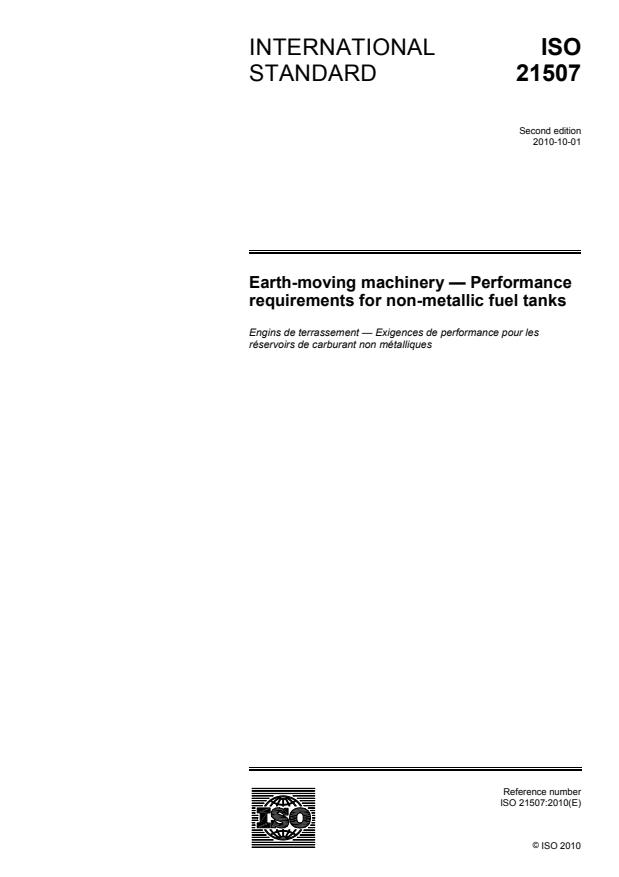
INTERNATIONAL ISO
STANDARD 21507
Second edition
2010-10-01
Earth-moving machinery — Performance
requirements for non-metallic fuel tanks
Engins de terrassement — Exigences de performance pour les
réservoirs de carburant non métalliques
Reference number
©
ISO 2010
PDF disclaimer
This PDF file may contain embedded typefaces. In accordance with Adobe's licensing policy, this file may be printed or viewed but
shall not be edited unless the typefaces which are embedded are licensed to and installed on the computer performing the editing. In
downloading this file, parties accept therein the responsibility of not infringing Adobe's licensing policy. The ISO Central Secretariat
accepts no liability in this area.
Adobe is a trademark of Adobe Systems Incorporated.
Details of the software products used to create this PDF file can be found in the General Info relative to the file; the PDF-creation
parameters were optimized for printing. Every care has been taken to ensure that the file is suitable for use by ISO member bodies. In
the unlikely event that a problem relating to it is found, please inform the Central Secretariat at the address given below.
© ISO 2010
All rights reserved. Unless otherwise specified, no part of this publication may be reproduced or utilized in any form or by any means,
electronic or mechanical, including photocopying and microfilm, without permission in writing from either ISO at the address below or
ISO's member body in the country of the requester.
ISO copyright office
Case postale 56 • CH-1211 Geneva 20
Tel. + 41 22 749 01 11
Fax + 41 22 749 09 47
E-mail copyright@iso.org
Web www.iso.org
Published in Switzerland
ii © ISO 2010 – All rights reserved
Foreword
ISO (the International Organization for Standardization) is a worldwide federation of national standards bodies
(ISO member bodies). The work of preparing International Standards is normally carried out through ISO
technical committees. Each member body interested in a subject for which a technical committee has been
established has the right to be represented on that committee. International organizations, governmental and
non-governmental, in liaison with ISO, also take part in the work. ISO collaborates closely with the
International Electrotechnical Commission (IEC) on all matters of electrotechnical standardization.
International Standards are drafted in accordance with the rules given in the ISO/IEC Directives, Part 2.
The main task of technical committees is to prepare International Standards. Draft International Standards
adopted by the technical committees are circulated to the member bodies for voting. Publication as an
International Standard requires approval by at least 75 % of the member bodies casting a vote.
Attention is drawn to the possibility that some of the elements of this document may be the subject of patent
rights. ISO shall not be held responsible for identifying any or all such patent rights.
ISO 21507 was prepared by Technical Committee ISO/TC 127, Earth-moving machinery, Subcommittee SC 1,
Test methods relating to safety and machine performance.
This second edition cancels and replaces the first edition (ISO 21507:2005), which has been technically
revised.
INTERNATIONAL STANDARD ISO 21507:2010(E)
Earth-moving machinery — Performance requirements for non-
metallic fuel tanks
1 Scope
This International Standard gives the performance requirements for non-metallic fuel tanks used by
earth-moving machinery as defined in ISO 6165.
2 Normative references
The following referenced documents are indispensable for the application of this document. For dated
references, only the edition cited applies. For undated references, the latest edition of the referenced
document (including any amendments) applies.
ISO 3411, Earth-moving machinery — Physical dimensions of operators and minimum operator space
envelope
ISO 3795, Road vehicles, and tractors and machinery for agriculture and forestry — Determination of burning
behaviour of interior materials
ISO 6165, Earth-moving machinery — Basic types — Identification and terms and definitions
ISO 11469, Plastics — Generic identification and marking of plastics products
UNECE R 34:2003, Uniform provisions concerning the approval of vehicles with regard to the prevention of
1)
fire risks, as amended
3 Terms and definitions
For the purposes of this document, the following terms and definitions apply.
3.1
non-metallic fuel tank
enclosed compartment on a machine made of a non-metallic material that holds fuel
3.2
operator station
space on the machine where the operator is stationed to control the machine functions
3.3
tank installation
system that includes the non-metallic tank, the filler cap and any pipes or tubes that are connected to the tank
1) United Nations Economic Commission for Europe regulation.
3.4
machine ignition temperature area
area on a machine where components have hot surfaces greater than 200 °C and could ignite materials or
fuel in direct contact or close proximity
EXAMPLE Engine exhaust manifold system.
4 Requirements
4.1 Protection
The tank shall be protected, by parts of the machine frame or the outer structure, from contact with obstacles
under or around the machine. Alternatively, any unprotected tank sections shall pass the impact testing
specified in 5.1.5.
Tubing or piping connected to the tank shall be protected by shielding such as braided or spiral sleeves,
specific guards, or guarding by location.
4.2 Corrosion resistance
The tank installation shall be designed, constructed and installed to resist any corrosion from both the internal
(within the fuel system) and external environment. Where necessary, protection (e.g. plating of metal parts)
should be provided.
4.3 Installation
The tank installation shall accommodate the twisting and bending movements and vibrations of the machine.
The connections of flexible pipes with rigid parts of the tank installation shall be so designed and constructed
as to maintain a sealed connection under these dynamic conditions.
The tank shall be securely fixed. The installation arrangement or construction shall ensure that any fuel
leaking from the tank, its filler hole or its connections shall not collect into pools without a passive means for
drainage.
If the tank will contain gasoline, the tank installation shall be designed and installed in the machine such that
any ignition hazard due to static electricity is avoided.
If the filler hole is located on the side of the machine, the filler cap shall not, when closed, project beyond the
external envelope of the machine.
The non-metallic fuel tank should be located on a machine so that it is neither in direct contact with, nor within
20 mm of, the surface of a machine ignition temperature area. If the tank is located within 20 mm of the
surface of a machine ignition temperature area, then some protection for the tank shall be provided.
Non-metallic tank material that has temperature resistance greater than the maximum surface temperatures of
the machine ignition temperature area sati
...
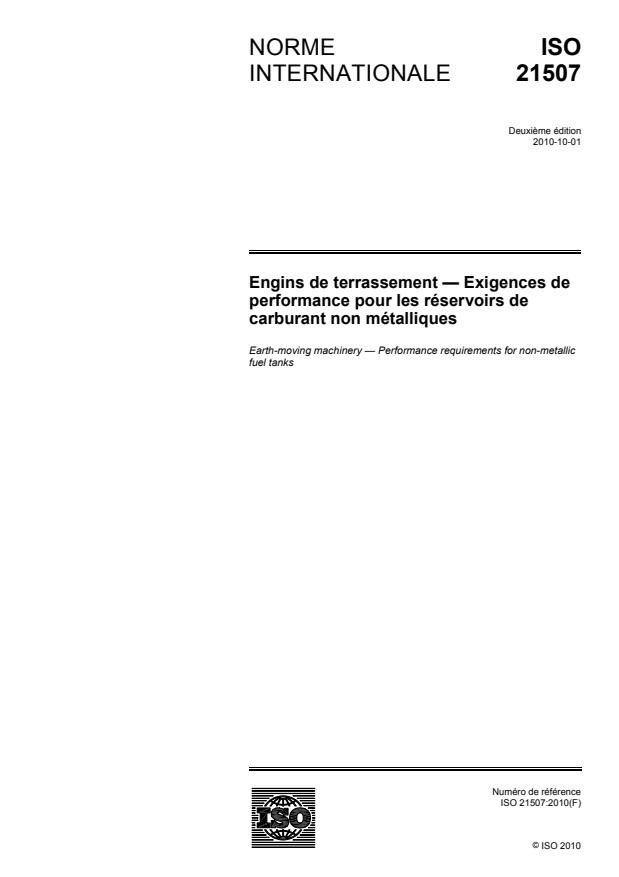
NORME ISO
INTERNATIONALE 21507
Deuxième édition
2010-10-01
Engins de terrassement — Exigences de
performance pour les réservoirs de
carburant non métalliques
Earth-moving machinery — Performance requirements for non-metallic
fuel tanks
Numéro de référence
©
ISO 2010
PDF – Exonération de responsabilité
Le présent fichier PDF peut contenir des polices de caractères intégrées. Conformément aux conditions de licence d'Adobe, ce fichier
peut être imprimé ou visualisé, mais ne doit pas être modifié à moins que l'ordinateur employé à cet effet ne bénéficie d'une licence
autorisant l'utilisation de ces polices et que celles-ci y soient installées. Lors du téléchargement de ce fichier, les parties concernées
acceptent de fait la responsabilité de ne pas enfreindre les conditions de licence d'Adobe. Le Secrétariat central de l'ISO décline toute
responsabilité en la matière.
Adobe est une marque déposée d'Adobe Systems Incorporated.
Les détails relatifs aux produits logiciels utilisés pour la création du présent fichier PDF sont disponibles dans la rubrique General Info
du fichier; les paramètres de création PDF ont été optimisés pour l'impression. Toutes les mesures ont été prises pour garantir
l'exploitation de ce fichier par les comités membres de l'ISO. Dans le cas peu probable où surviendrait un problème d'utilisation,
veuillez en informer le Secrétariat central à l'adresse donnée ci-dessous.
DOCUMENT PROTÉGÉ PAR COPYRIGHT
© ISO 2010
Droits de reproduction réservés. Sauf prescription différente, aucune partie de cette publication ne peut être reproduite ni utilisée sous
quelque forme que ce soit et par aucun procédé, électronique ou mécanique, y compris la photocopie et les microfilms, sans l'accord écrit
de l'ISO à l'adresse ci-après ou du comité membre de l'ISO dans le pays du demandeur.
ISO copyright office
Case postale 56 • CH-1211 Geneva 20
Tel. + 41 22 749 01 11
Fax + 41 22 749 09 47
E-mail copyright@iso.org
Web www.iso.org
Publié en Suisse
ii © ISO 2010 – Tous droits réservés
Avant-propos
L'ISO (Organisation internationale de normalisation) est une fédération mondiale d'organismes nationaux de
normalisation (comités membres de l'ISO). L'élaboration des Normes internationales est en général confiée
aux comités techniques de l'ISO. Chaque comité membre intéressé par une étude a le droit de faire partie du
comité technique créé à cet effet. Les organisations internationales, gouvernementales et non
gouvernementales, en liaison avec l'ISO participent également aux travaux. L'ISO collabore étroitement avec
la Commission électrotechnique internationale (CEI) en ce qui concerne la normalisation électrotechnique.
Les Normes internationales sont rédigées conformément aux règles données dans les Directives ISO/CEI,
Partie 2.
La tâche principale des comités techniques est d'élaborer les Normes internationales. Les projets de Normes
internationales adoptés par les comités techniques sont soumis aux comités membres pour vote. Leur
publication comme Normes internationales requiert l'approbation de 75 % au moins des comités membres
votants.
L'attention est appelée sur le fait que certains des éléments du présent document peuvent faire l'objet de
droits de propriété intellectuelle ou de droits analogues. L'ISO ne saurait être tenue pour responsable de ne
pas avoir identifié de tels droits de propriété et averti de leur existence.
L'ISO 21507 a été élaborée par le comité technique ISO/TC 127, Engins de terrassement, sous-comité SC 1,
Méthodes d'essai relatives aux performances et à la sécurité des engins.
Cette deuxième édition annule et remplace la première édition (ISO 21507:2005), qui a fait l'objet d'une
révision technique.
NORME INTERNATIONALE ISO 21507:2010(F)
Engins de terrassement — Exigences de performance pour les
réservoirs de carburant non métalliques
1 Domaine d'application
La présente Norme internationale donne les exigences de performance pour les réservoirs de carburant non
métalliques utilisés dans les engins de terrassement tels que définis dans l'ISO 6165.
2 Références normatives
Les documents de référence suivants sont indispensables pour l'application du présent document. Pour les
références datées, seule l'édition citée s'applique. Pour les références non datées, la dernière édition du
document de référence s'applique (y compris les éventuels amendements).
ISO 3411, Engins de terrassement — Dimensions des opérateurs et espace enveloppe minimal pour les
opérateurs
ISO 3795, Véhicules routiers et tracteurs et matériels agricoles et forestiers — Détermination des
caractéristiques de combustion des matériaux intérieurs
ISO 6165, Engins de terrassement — Principaux types — Identification et termes et définitions
ISO 11469, Plastiques — Identification générique et marquage des produits en matière plastique
UNECE R 34:2003, Prescriptions uniformes relatives à l'homologation des véhicules en ce qui concerne la
1)
prévention des risques d'incendie
3 Termes et définitions
Pour les besoins du présent document, les termes et définitions suivants s'appliquent.
3.1
réservoir de carburant non métallique
compartiment clos d'un engin fabriqué à partir d'un matériau non métallique et contenant du carburant
3.2
poste de conduite
espace sur l'engin où se trouve l'opérateur pour commander les fonctions de l'engin
3.3
réservoir complet
ensemble incluant le réservoir non métallique, le bouchon de remplissage et tout tuyau ou tubulure raccordé
au réservoir
1) Commission économique pour l'Europe des Nations unies.
3.4
zone de température d'inflammation de l'engin
zone d'un engin où certains éléments comportent des surfaces brûlantes supérieures à 200 °C susceptibles
d'enflammer des matériaux ou carburant se trouvant en contact direct ou à proximité immédiate
EXEMPLE Zone de la tubulure d'échappement du moteur.
4 Exigences
4.1 Protection
Le réservoir doit être protégé de tout contact avec des obstacles situés sous l'engin ou autour de celui-ci, par
des éléments du châssis ou de la structure externe de l'engin. Dans le cas contraire, les parties de réservoir
non protégées doivent satisfaire à l'essai de choc décrit en 5.1.5.
Les tuyaux ou les tubes reliés au réservoir doivent être protégés avec des écrans, tels que des manchons
tressés ou spiralés, des protecteurs spécifiques ou par leur positionnement.
4.2 Résistance à la corrosion
Le réservoir complet doit être conçu, fabriqué et installé de manière à résister à un environnement de
corrosion à la fois interne (dans le système de carburant) et externe. Lorsque cela est nécessaire, il convient
d'installer une protection (par exemple revêtement de plaques métalliques).
4.3 Installation
Le réservoir complet doit être installé de manière à s'adapter aux mouvements de torsion et de flexion ainsi
qu'aux vibrations de l'engin. Les raccordements entre tuyaux souples et parties rigides du réservoir complet
doivent être conçus et fabriqués de manière à maintenir un raccordement étanche dans ces conditions
dynamiques.
Le réservoir doit être fermement fixé. Il doit être installé ou conçu de sorte que, en cas de fuite du réservoir,
de l'orifice de remplissage ou des raccordements, le liquide ne stagne pas dans des creux dépourvus de
système de drainage passif.
Si le réservoir est destiné à contenir de l'essence, le réservoir complet doit être conçu et installé dans l'engin
de manière à éviter tout risque d'inflammation par électricité statique.
Si l'orifice de remplissage est situé sur une partie latérale de l'engin, le bouchon en position fermée ne doit
pas former saillie par rapport à l'enveloppe extérieure de l'engin.
Il convient que le réservoir de carburant non métallique soit situé de manière à n'être ni en contact direct ni à
moins de 20 mm de la surface d'une zone de température d'inflammation de l'engin. S'il se trouve à moins de
20 mm, une protection doit être prévue. Un matériau de réservoir non métallique dont la résistance à la
température est supérieure aux températures maximales de surface de la zone de température d'inflammation
de l'engin satisfait à cette exigence.
4.4 Restriction d'emplacement
Un réservoi
...