

ISO 8361-1:1991
(Main)Thermoplastics pipes and fittings — Water absorption — Part 1: General test method
General Information
- Abstract
The specified method describes the principle, the immersion fluids, the apparatus, the test pieces, the test procedure, the expression of results and the contents of the test report. Annex A is for information only.
- Status
- Published
- Publication Date
- 04-Sep-1991
- Current Stage
- 9093 - International Standard confirmed
- Start Date
- 05-Oct-2023
- Completion Date
- 29-Aug-2026
Buy Documents
ISO 8361-1:1991 - Thermoplastics pipes and fittings — Water absorption — Part 1: General test method Released:9/5/1991
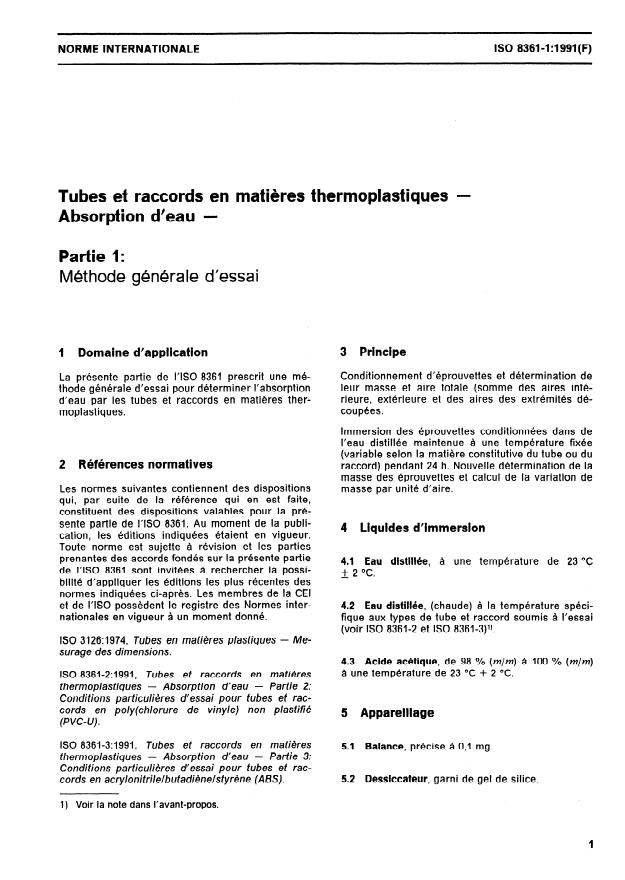
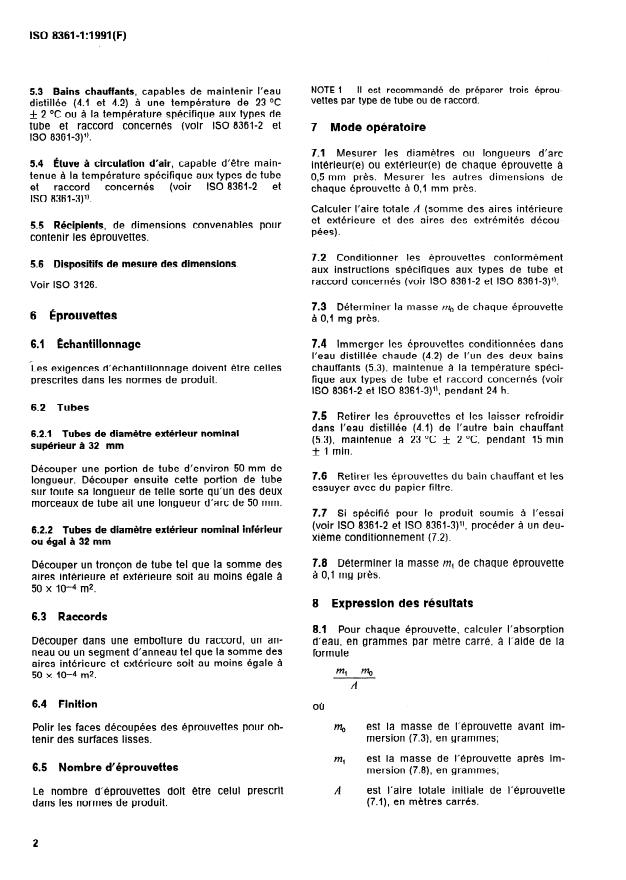
ISO 8361-1:1991 - Tubes et raccords en matieres thermoplastiques — Absorption d'eau — Partie 1: Méthode générale d'essai Released:9/5/1991
ISO 8361-1:1991 - Tubes et raccords en matieres thermoplastiques — Absorption d'eau — Partie 1: Méthode générale d'essai Released:9/5/1991
Overview
ISO 8361-1:1991 sets out a general test method for determining the water absorption of thermoplastics pipes and fittings. Published by the International Organization for Standardization (ISO), this standard provides systematic procedures for evaluating how much water is absorbed by these plastic products when exposed to immersion fluids under specified conditions. The document covers the principle of the test, the types of immersion fluids used, necessary apparatus, test piece preparation, test procedure, expression of results, and the required content for test reports. This general methodology is essential for quality control and product development in industries using thermoplastic piping systems.
Key Topics
- Scope and Purpose: Defines a standardized approach for assessing water absorption in thermoplastics pipes and fittings, ensuring consistency and reliability across laboratories and manufacturers.
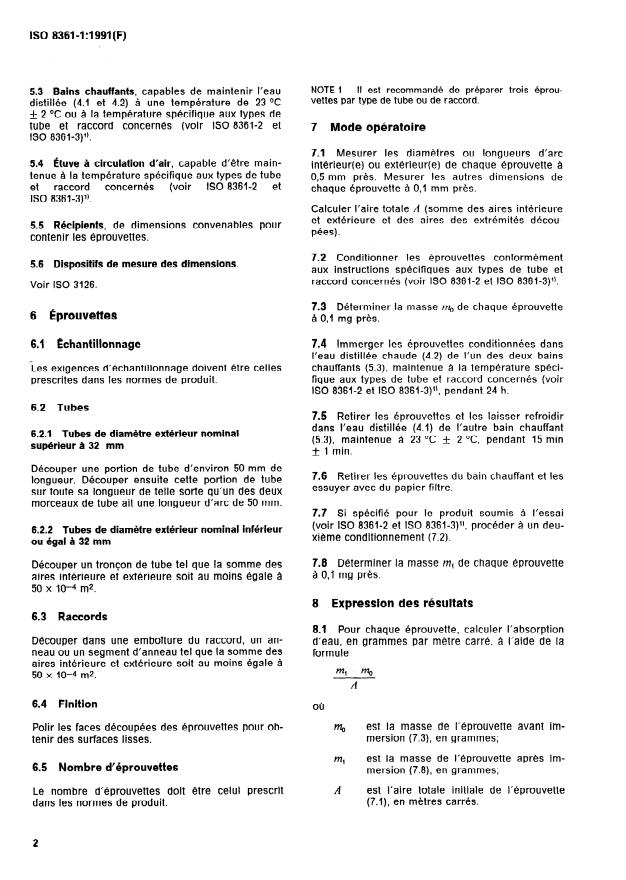
- Test Principle: Involves conditioning test pieces, immersing them in distilled water (or other specified fluids), determining their mass before and after immersion, and calculating the increase in mass per unit area.
- Immersion Fluids: Primarily distilled water at controlled temperatures, with references to alternative fluids according to specific material types or product requirements.
- Apparatus:
- High-precision balance (0.1 mg accuracy)
- Thermostatic baths for maintaining controlled immersion temperatures
- Desiccator with silica gel
- Forced-air oven (for some materials)
- Tools for precise dimension measurements (in accordance with ISO 3126)
- Test Samples: Selection and preparation guidelines for pipes (by diameter) and fittings, including detailed instructions to ensure test pieces are representative and reproducible in size and surface condition.
- Results and Reporting: Methods for calculating water absorption, as well as mandatory information for test reports to facilitate traceability and comparability.
Applications
The ISO 8361-1:1991 standard is practically applied in several fields related to plastics engineering and manufacturing:
- Quality Assurance and Compliance: Enables manufacturers of thermoplastics pipes and fittings to verify product consistency, durability, and compliance with industry requirements.
- Product Development and Material Selection: Assists engineers in comparing different thermoplastic compounds and additives based on their water absorption characteristics, which may affect mechanical properties and lifespan.
- End-Use Suitability: Helps end users and specifiers confirm the suitability of thermoplastics pipes and fittings for applications where exposure to moisture is a concern, such as potable water systems, drainage, or chemical processing environments.
- Third-Party Testing and Certification: Testing laboratories and certifying bodies use this standard as a benchmark for impartial evaluation of product performance.
Related Standards
Multiple related ISO standards complement ISO 8361-1:1991 to address specific materials and testing requirements:
- ISO 8361-2:1991 - Test conditions for unplasticized poly(vinyl chloride) (PVC-U) pipes and fittings.
- ISO 8361-3:1991 - Test conditions for acrylonitrile/butadiene/styrene (ABS) pipes and fittings.
- ISO 62:1980 - General methods for determination of water absorption in plastics.
- ISO 3126:1974 - Provides guidance for measurement of dimensions for plastics pipes.
By adhering to ISO 8361-1:1991 and its related documents, stakeholders ensure robust, reproducible testing and contribute to the global harmonization of quality standards in the plastics and piping industry.
Relations
- Effective Date
- 25-Aug-2026
- Effective Date
- 25-Aug-2026
- Effective Date
- 25-Aug-2026
- Effective Date
- 25-Aug-2026
- Effective Date
- 25-Aug-2026
Buy Documents
ISO 8361-1:1991 - Thermoplastics pipes and fittings — Water absorption — Part 1: General test method Released:9/5/1991
ISO 8361-1:1991 - Tubes et raccords en matieres thermoplastiques — Absorption d'eau — Partie 1: Méthode générale d'essai Released:9/5/1991
ISO 8361-1:1991 - Tubes et raccords en matieres thermoplastiques — Absorption d'eau — Partie 1: Méthode générale d'essai Released:9/5/1991
Get Certified
Connect with accredited certification bodies for this standard

Institut za varilstvo d.o.o. (Welding Institute)
Slovenia's leading welding institute since 1952. ISO 3834, EN 1090, pressure equipment certification, NDT personnel, welder qualification. Only IIW Au
Sponsored listings
Frequently Asked Questions
ISO 8361-1:1991 is a standard published by the International Organization for Standardization (ISO). Its full title is "Thermoplastics pipes and fittings — Water absorption — Part 1: General test method". This standard covers: The specified method describes the principle, the immersion fluids, the apparatus, the test pieces, the test procedure, the expression of results and the contents of the test report. Annex A is for information only.
The specified method describes the principle, the immersion fluids, the apparatus, the test pieces, the test procedure, the expression of results and the contents of the test report. Annex A is for information only.
ISO 8361-1:1991 is classified under the following ICS (International Classification for Standards) categories: 23.040.20 - Plastics pipes; 23.040.45 - Plastics fittings. The ICS classification helps identify the subject area and facilitates finding related standards.
ISO 8361-1:1991 has the following relationships with other standards: It is inter standard links to EN 1455-1:1999, EN 1566-1:2022, EN 1566-1:1998, EN 1565-1:1998, EN 1455-1:2022. Understanding these relationships helps ensure you are using the most current and applicable version of the standard.
ISO 8361-1:1991 is available in PDF format for immediate download after purchase. The document can be added to your cart and obtained through the secure checkout process. Digital delivery ensures instant access to the complete standard document.
Standards Content (Sample)
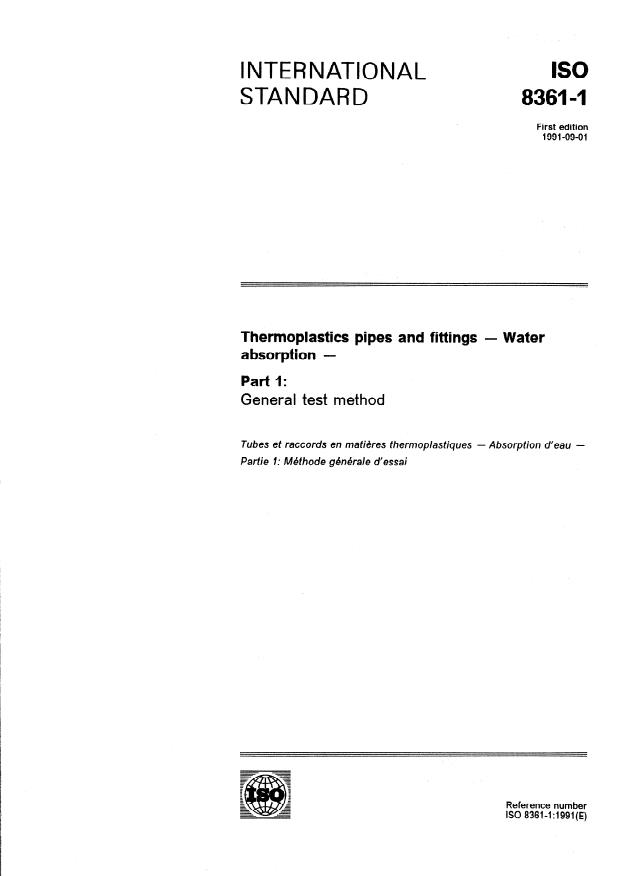
IS0
INTERNATIONAL
STANDARD 836111
First edition
1991-09-01
Thermoplastics pipes and fittings - Water
absorption -
Part 1:
General test method
Tubes et raccords en matikes thermoplastiques - Absorption d’eau -
Partie 1: MHhode g&&ale d’essai
Reference number
IS0 83614:1991(E)
IS0 83614:1991(E)
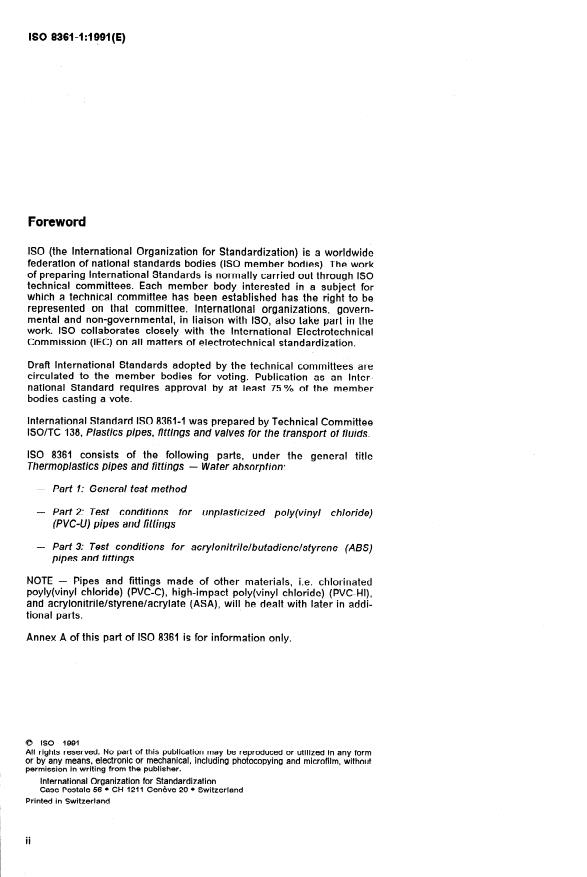
IS0 (the International Organization for Standardization) is a worldwide
federation of national standards bodies (IS0 member bodies). The work
of preparing International Standards is normally carried out through IS0
technical committees. Each member body interested in a subject for
which a technical committee has been established has the right to be
represented on that committee. International organizations, govern-
mental and non-governmental, in liaison with ISO, also take part in the
work. IS0 collaborates closely with the International Electrotechnical
Commission (IEC) on all matters of electrotechnical standardization.
Draft International Standards adopted by the technical committees are
circulated to the member bodies for voting. Publication as an lnter-
national Standard requires approval by at least 75 O/a of the member
bodies casting a vote.
International Standard IS0 8361-l was prepared by Technical Committee
ISO/TC 138, Plastics pipes, fittings and valves for the transport of #uids.
IS0 8361 consists of the following parts, under the general title
Thermoplastics pipes and fittings - Water absorption:
- Part 1: General test method
- Part 2: Test conditions for unplasticized poly(viny1 chloride)
(PVC-U) pipes and fittings
- Part 3: Test conditions for acrylonitrilelbutadiene/styrene (A BS)
pipes and fittings
NOTE - Pipes and fittings made of other materials, i.e. chlorinated
poyly(vinyl chloride) (PVC-C), high-impact poly(vinyl chloride) (PVC-HI),
and acrylonitrile/styrene/acrylate (ASA), will be dealt with later in addi-
tional parts.
Annex A of this part of IS0 8361 is for information only.
0 IS0 1991
All rights reserved. No part of this publication may be reproduced or utilized in any form
or by any means, electronic or mechanical, including photocopying and microfilm, without
permission in writing from the publisher.
International Organization for Standardization
l Cl-l-1211 Genkve 20 l Switzerland
Case Postale 56
Printed in Switzerland
IS0 83614:1991(E)
INTERNATIONAL STANDARD
- Water absorption -
Thermoplastics pipes and fittings
Part 1:
General test method
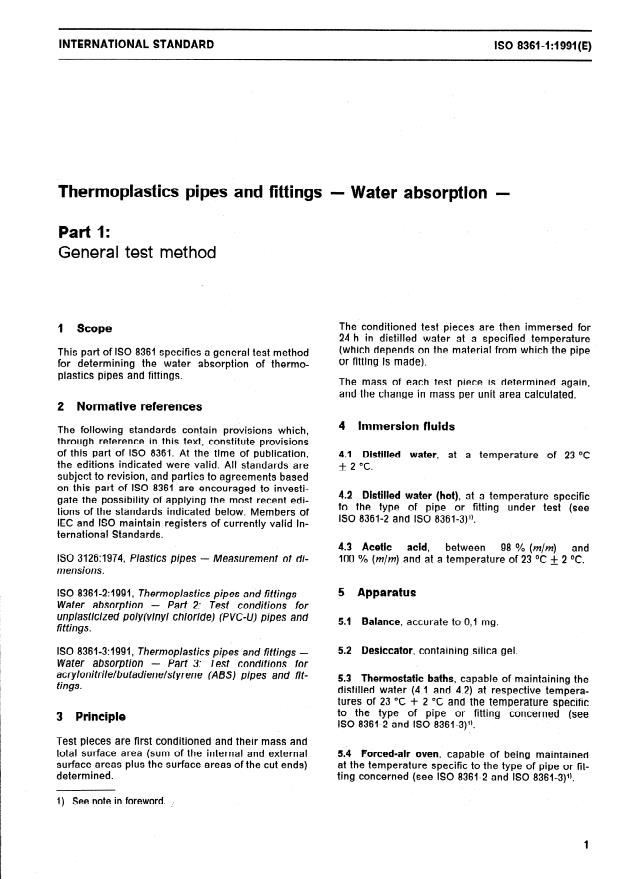
The conditioned test pieces are then immersed for
1 Scope
24 h in distilled water at a specified temperature
(which depends on the material from which the pipe
This part of IS0 8361 speciftes a general test method
or fitting is made).
for determining the water absorption of thermo-
plastics pipes and fittings.
The mass of each test piece is determined again,
and the change in mass per unit area calculated.
2 Normative references
4 Immersion fluids
The following standards contain provisions which,
through reference in this text, constitute provisions
of this part of IS0 8361. At the time of publication, 4.1 Distilled water, at a temperature of 23 OC
the ed’itions indicated were valid. All standards are + 2 OC.
-
subject to revision, and parties to agreements based
on this part of IS0 8361 are encouraged to investi-
4.2 Distilled water (hot), at a temperature specific
gate the possibility of applying the most recent edi-
to the type of pipe or fitting under test (see
tions of the standards indicated below. Members of
IS0 8361-2 and IS0 8361-3)‘).
IEC and IS0 maintain registers of currently valid In-
ternational Standards.
acid, between and
4.3 Acetic 98 % (m/m)
IS0 3126:1974, Plastics pipes - Measurement of di- 100 % (m/m) and at a temperature of 23 OC + 2 OC.
-
mensions.
5 Apparatus
IS0 8361-2:1991, Thermoplastics pipes and fittings -
Water absorption - Part 2: Test conditions for
unplasticized poly(vinyl chloride) (PVC-U) pipes and
5.1 Balance, accurate to 0,l mg.
fittings.
5.2 Desiccator, containing silica gel.
IS0 8361,3:1991, Thermoplastics pipes and fittings -
Water absorption - Part 3: Test conditions for
acrylonitrilelbutadiene/styrene (A BS) pipes and fit-
5.3 Thermostatic baths, capable of maintaining the
tings.
distilled water (4.1 and 4.2) at respective tempera-
tures of 23 OC + 2 OC and the temperature specific
to the type of pipe or fitting concerned (see
3 Principle
IS0 8361-2 and IS0 8361-3)‘).
Test pieces are first conditioned and their mass and
...
ISO
NORME
INTERNATIONALE
Première édition
1991-09-01
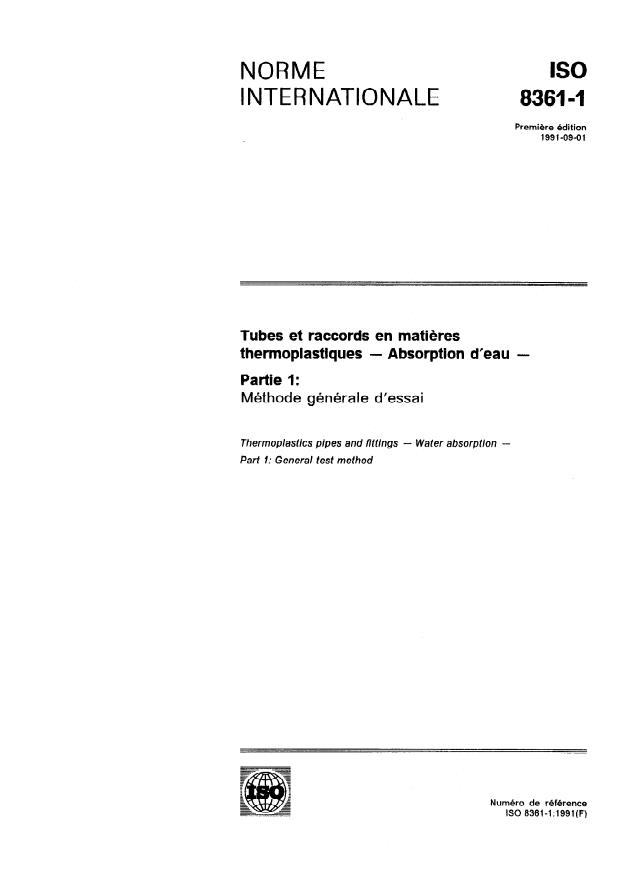
Tubes et raccords en matières
thermoplastiques - Absorption d’eau -
Partie 1:
Méthode générale d’essai
Thermoplastics pipes and fïttings - Water absorption -
Part 1: General test method
Numéro de reférence
ISO 83614:1991(F)
ISO 83614:1991(F)
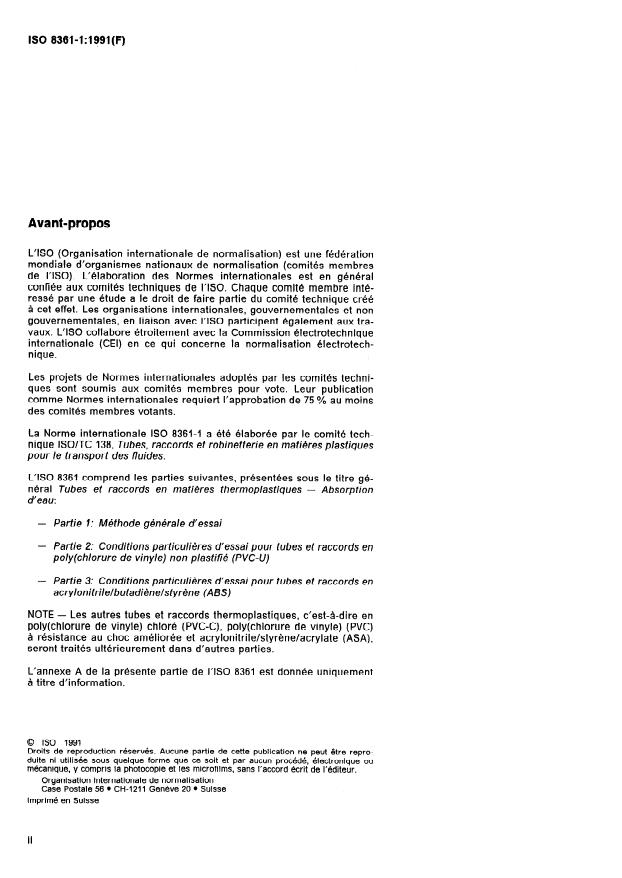
Avant-propos
L’ISO (Organisation internationale de normalisation) est une fédération
mondiale d’organismes nationaux de normalisation (comités membres
de I’ISO). L’elaboration des Normes internationales est en général
confiée aux comités techniques de I’ISO. Chaque comité membre inte-
ressé par une étude a le droit de faire partie du comite technique créé
à cet effet. Les organisations internationales, gouvernementales et non
gouvernementales, en liaison avec I’ISO participent également aux tra-
vaux. L’ISO collabore étroitement avec la Commission électrotechnique
internationale (CEI) en ce qui concerne la normalisation 4Iectrotech-
nique.
Les projets de Normes internationales adoptés par les comités techni-
ques sont soumis aux comités membres pour vote. Leur publication
comme Normes internationales requiert l’approbation de 75 */o au moins
des comités membres votants.
La Norme internationale ISO 8361-1 a été élaborée par le comité tech-
nique ISO/TC 138, Tubes, raccords et robinetterie en matiéres plastiques
pour le transport des f7uides.
L’ISO 8361 comprend les parties suivantes, présentées sous le titre gé-
néral Tubes et raccords en matières thermoplastiques - Absorption
d’eau:
- Partie 1: Méthode générale d’essai
- Partie 2: Conditions particulières d’essai pour tubes et raccords en
poly(chlorure de vinyle) non plastifié (PVC-U)
- Partie 3: Conditions particulières d’essai pour tubes et raccords en
acrylonifrilelbutadiènektyrène (ABS)
NOTE - Les autres tubes et raccords thermoplastiques, c’est-à-dire en
poly(chlorure de vinyle) chloré (PVC-C), poly(chlorure de vinyle) (PVC)
à résistance au choc améliorée et acrylonitrile/styrène/acrylate (ASA),
seront traités ultérieurement dans d’autres parties.
L’annexe A de la présente partie de I’ISO 8361 est donnée uniquement
à titre d’information.
0 ISO 1991
Droits de reproduction réservés. Aucune partie de cette publication ne peut être repro-
duite ni utilisée sous quelque forme que ce soit et par aucun procédé, électronique ou
mécanique, y compris la photocopie et les microfilms, sans l’accord écrit de l’éditeur.
Organisation Internationale de normalisation
Case Postale 56 l CH-1211 Genève 20 l Suisse
Imprimé en Suisse
ii
ISO 83614:1991(F)
NORME INTERNATIONALE
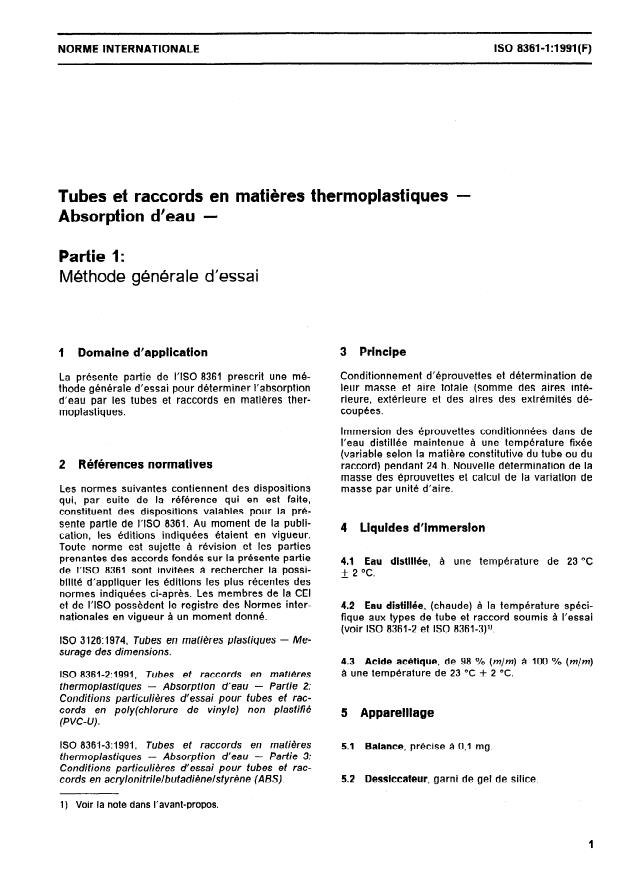
Tubes et raccords en matières thermoplastiques -
Absorption d’eau -
Partie 1:
Méthode généra le d’essa i
3 Principe
1 Domaine d’application
Conditionnement d’éprouvettes et détermination de
La présente partie de I’ISO 8361 prescrit une mé-
leur masse et aire totale (somme des aires inté-
thode générale d’essai pour déterminer l’absorption
rieure, extérieure et des aires des extrémités dé-
d’eau par les tubes et raccords en matières ther-
coupées.
moplastiques.
Immersion des éprouvettes conditionnées dans de
l’eau distilke maintenue fr une température fixée
(variable selon la matière constitutive du tube ou du
2 Références normatives
raccord) pendant 24 h. Nouvelle détermination de la
masse des éprouvettes et calcul de la variation de
Les normes suivantes contiennent des dispositions masse par unité d’aire.
qui, par suite de la référence qui en est faite,
constituent des dispositions valables pour la pré-
sente partie de I’ISO 8361. Au moment de la publi-
4 Liquides d’immersion
cation, les éditions indiquées etaient en vigueur.
Toute norme est sujette à révision et les parties
prenantes des accords fondés sur la présente partie
4.1 Eau dlstlllée, CI une température de 23 OC
de I’ISO 8361 sont invitées à rechercher la possi-
+ 2 OC.
-
bilité d’appliquer les éditions les plus récentes des
normes indiquées ci-après. Les membres de la CEI
et de I’ISO possèdent le registre des Normes inter-
4.2 Eau distillée, (chaude) à la température spéci-
nationales en vigueur à un moment donné. fique aux types de tube et raccord soumis à l’essai
(voir ISO 8361-2 et ISO 8361-3)‘).
ISO 3126:1974, Tubes en matiéres plastiques - Me-
surage des dimensions.
4.3 Acide acétique, de 98 % (m/m) à 100 % (m/m)
fr une température de 23 OC + 2 OC.
-
ISO 8361-2:1991, Tubes et raccords en matiéres
thermoplastiques - Absorption d’eau - Partie 2:
Conditions particulières d’essai pour tubes et rac-
cords en poly(chlorure de vinyle) non plastifié
5 Appareillage
(PVC-U).
ISO 8361-3:1991, Tubes et raccords en matières
5.1 Balance, précise à 0,l mg.
thermoplastiques - Absorption d’eau - Partie 3:
Conditions particulières d’essai pour tubes et rac-
5.2 Desslc
...
ISO
NORME
INTERNATIONALE
Première édition
1991-09-01
Tubes et raccords en matières
thermoplastiques - Absorption d’eau -
Partie 1:
Méthode générale d’essai
Thermoplastics pipes and fïttings - Water absorption -
Part 1: General test method
Numéro de reférence
ISO 83614:1991(F)
ISO 83614:1991(F)
Avant-propos
L’ISO (Organisation internationale de normalisation) est une fédération
mondiale d’organismes nationaux de normalisation (comités membres
de I’ISO). L’elaboration des Normes internationales est en général
confiée aux comités techniques de I’ISO. Chaque comité membre inte-
ressé par une étude a le droit de faire partie du comite technique créé
à cet effet. Les organisations internationales, gouvernementales et non
gouvernementales, en liaison avec I’ISO participent également aux tra-
vaux. L’ISO collabore étroitement avec la Commission électrotechnique
internationale (CEI) en ce qui concerne la normalisation 4Iectrotech-
nique.
Les projets de Normes internationales adoptés par les comités techni-
ques sont soumis aux comités membres pour vote. Leur publication
comme Normes internationales requiert l’approbation de 75 */o au moins
des comités membres votants.
La Norme internationale ISO 8361-1 a été élaborée par le comité tech-
nique ISO/TC 138, Tubes, raccords et robinetterie en matiéres plastiques
pour le transport des f7uides.
L’ISO 8361 comprend les parties suivantes, présentées sous le titre gé-
néral Tubes et raccords en matières thermoplastiques - Absorption
d’eau:
- Partie 1: Méthode générale d’essai
- Partie 2: Conditions particulières d’essai pour tubes et raccords en
poly(chlorure de vinyle) non plastifié (PVC-U)
- Partie 3: Conditions particulières d’essai pour tubes et raccords en
acrylonifrilelbutadiènektyrène (ABS)
NOTE - Les autres tubes et raccords thermoplastiques, c’est-à-dire en
poly(chlorure de vinyle) chloré (PVC-C), poly(chlorure de vinyle) (PVC)
à résistance au choc améliorée et acrylonitrile/styrène/acrylate (ASA),
seront traités ultérieurement dans d’autres parties.
L’annexe A de la présente partie de I’ISO 8361 est donnée uniquement
à titre d’information.
0 ISO 1991
Droits de reproduction réservés. Aucune partie de cette publication ne peut être repro-
duite ni utilisée sous quelque forme que ce soit et par aucun procédé, électronique ou
mécanique, y compris la photocopie et les microfilms, sans l’accord écrit de l’éditeur.
Organisation Internationale de normalisation
Case Postale 56 l CH-1211 Genève 20 l Suisse
Imprimé en Suisse
ii
ISO 83614:1991(F)
NORME INTERNATIONALE
Tubes et raccords en matières thermoplastiques -
Absorption d’eau -
Partie 1:
Méthode généra le d’essa i
3 Principe
1 Domaine d’application
Conditionnement d’éprouvettes et détermination de
La présente partie de I’ISO 8361 prescrit une mé-
leur masse et aire totale (somme des aires inté-
thode générale d’essai pour déterminer l’absorption
rieure, extérieure et des aires des extrémités dé-
d’eau par les tubes et raccords en matières ther-
coupées.
moplastiques.
Immersion des éprouvettes conditionnées dans de
l’eau distilke maintenue fr une température fixée
(variable selon la matière constitutive du tube ou du
2 Références normatives
raccord) pendant 24 h. Nouvelle détermination de la
masse des éprouvettes et calcul de la variation de
Les normes suivantes contiennent des dispositions masse par unité d’aire.
qui, par suite de la référence qui en est faite,
constituent des dispositions valables pour la pré-
sente partie de I’ISO 8361. Au moment de la publi-
4 Liquides d’immersion
cation, les éditions indiquées etaient en vigueur.
Toute norme est sujette à révision et les parties
prenantes des accords fondés sur la présente partie
4.1 Eau dlstlllée, CI une température de 23 OC
de I’ISO 8361 sont invitées à rechercher la possi-
+ 2 OC.
-
bilité d’appliquer les éditions les plus récentes des
normes indiquées ci-après. Les membres de la CEI
et de I’ISO possèdent le registre des Normes inter-
4.2 Eau distillée, (chaude) à la température spéci-
nationales en vigueur à un moment donné. fique aux types de tube et raccord soumis à l’essai
(voir ISO 8361-2 et ISO 8361-3)‘).
ISO 3126:1974, Tubes en matiéres plastiques - Me-
surage des dimensions.
4.3 Acide acétique, de 98 % (m/m) à 100 % (m/m)
fr une température de 23 OC + 2 OC.
-
ISO 8361-2:1991, Tubes et raccords en matiéres
thermoplastiques - Absorption d’eau - Partie 2:
Conditions particulières d’essai pour tubes et rac-
cords en poly(chlorure de vinyle) non plastifié
5 Appareillage
(PVC-U).
ISO 8361-3:1991, Tubes et raccords en matières
5.1 Balance, précise à 0,l mg.
thermoplastiques - Absorption d’eau - Partie 3:
Conditions particulières d’essai pour tubes et rac-
5.2 Desslc
...