

ISO/IEC 13714:1995
(Main)Information technology — Document processing and related communication — User interface to telephone-based services — Voice messaging applications
General Information
- Abstract
Will provide users of voice messaging systems with a consistent mode of interaction in a way that is independent of the underlying system implementations. The interface is based on a set of design guidelines defined in annex A. The interface supports the ability of all users described in the user-system model to access the features of voice messaging systems. In the call answering application, the interface allows callers to leave messages from all types of telephones. In the voice mail application, the interface allows subscribers to send and receive voice messages and to manage stored data.
- Status
- Published
- Publication Date
- 01-Feb-1995
- Technical Committee
- ISO/IEC JTC 1 - Information technology
- Drafting Committee
- ISO/IEC JTC 1 - Information technology
- Current Stage
- 9093 - International Standard confirmed
- Start Date
- 29-Jul-2008
- Completion Date
- 29-Aug-2026
Overview
ISO/IEC 13714:1995 - "Information technology - User interface to telephone-based services - Voice messaging applications" - defines a consistent, implementation‑independent user interface for voice messaging systems. Published in 1995, the standard targets DTMF (dual‑tone multi‑frequency) telephone interfaces and covers core applications such as call answering, voice mail, voice bulletin boards and voice message delivery. Its goal is predictable, learnable interaction that works for callers from all telephone types and for subscribers managing stored voice data.
Key topics and technical requirements
- DTMF-based interaction model: The standard is built around DTMF input (keys 0–9, * and #) and audio prompts; it recognizes the limitations of audio output and short‑term memory in telephone UIs.
- User/system model and menus: Defines menu structures (control menu, main/listen/send menus) and expected behaviors for common tasks like recording, playback and mailbox access.
- Mandatory interface elements: Two requirements apply across contexts - use of ## as an input delimiter and universal access to the control menu (invoked with *).
- Conformance classifications: Features are categorized as mandatory/reserved, optional/reserved, or optional/not reserved, clarifying required and optional behaviors for conforming systems.
- Dialog and timing guidelines: Includes guidance on time‑outs, system response times, and use of #/* keys (Annex A provides dialogue design guidelines).
- Reusability: Annex B summarizes features applicable beyond voice messaging to other interactive voice response (IVR) services.
Practical applications and users
ISO/IEC 13714 is valuable for:
- Telephony product managers and system architects designing voice mail and automated call‑answering systems.
- IVR/voice UX designers who need standardized dialog flows and key allocations for usability and accessibility.
- Telecom vendors and software developers implementing DTMF interfaces to ensure interoperability and predictable behavior.
- Service operators and integrators who deploy multi‑vendor environments and want consistent caller/subscriber experience.
Business benefits:
- Faster user learning and higher satisfaction
- Easier cross‑system use (users with mailboxes on multiple systems)
- Better interoperability and reduced support costs
Related standards
- CCITT Volume VI, Recommendation Q.23 (DTMF telephone features)
- ITU‑T Recommendation E.161 (arrangement of digits, letters and symbols on telephones)
- ISO/IEC JTC 1/SC 18 work on document processing and related communications
Keywords: ISO/IEC 13714:1995, voice messaging systems, DTMF interface, telephone-based services, voice mail, call answering, IVR user interface.
Relations
- Effective Date
- 25-Aug-2026
Get Certified
Connect with accredited certification bodies for this standard

BSI Group
BSI (British Standards Institution) is the business standards company that helps organizations make excellence a habit.

NYCE
Mexican standards and certification body.
Sponsored listings
Frequently Asked Questions
ISO/IEC 13714:1995 is a standard published by the International Organization for Standardization (ISO). Its full title is "Information technology — Document processing and related communication — User interface to telephone-based services — Voice messaging applications". This standard covers: Will provide users of voice messaging systems with a consistent mode of interaction in a way that is independent of the underlying system implementations. The interface is based on a set of design guidelines defined in annex A. The interface supports the ability of all users described in the user-system model to access the features of voice messaging systems. In the call answering application, the interface allows callers to leave messages from all types of telephones. In the voice mail application, the interface allows subscribers to send and receive voice messages and to manage stored data.
Will provide users of voice messaging systems with a consistent mode of interaction in a way that is independent of the underlying system implementations. The interface is based on a set of design guidelines defined in annex A. The interface supports the ability of all users described in the user-system model to access the features of voice messaging systems. In the call answering application, the interface allows callers to leave messages from all types of telephones. In the voice mail application, the interface allows subscribers to send and receive voice messages and to manage stored data.
ISO/IEC 13714:1995 is classified under the following ICS (International Classification for Standards) categories: 35.100.70 - Application layer. The ICS classification helps identify the subject area and facilitates finding related standards.
ISO/IEC 13714:1995 has the following relationships with other standards: It is inter standard links to EN ISO 9241-154:2013. Understanding these relationships helps ensure you are using the most current and applicable version of the standard.
ISO/IEC 13714:1995 is available in PDF format for immediate download after purchase. The document can be added to your cart and obtained through the secure checkout process. Digital delivery ensures instant access to the complete standard document.
Standards Content (Sample)
INTERNATIONAL
ISO/IEC
STANDARD
First edition
1995-02-01
Information technology - Document
processing and related communication -
User interface to telephone-based
Services - Voice messaging applications
Technologies de I ’information - Traitemen t de documen ts et
communica tion connexe - Interface de I ’utilisa teur et des Services a
base de tklkphone - Applications de messagerie vocale
Reference number
Page
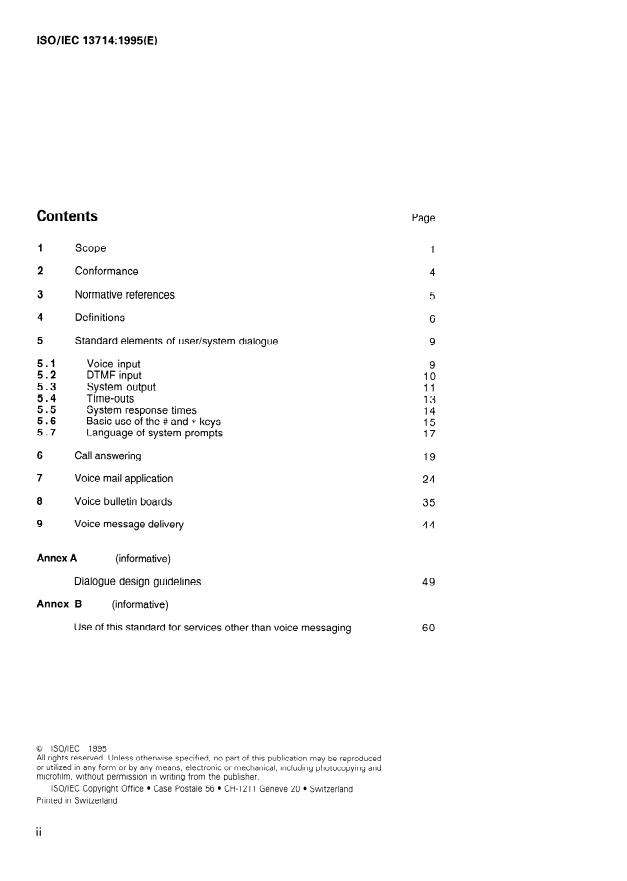
Contents
1 Scope
2 Conformance
3 Normative references
4 Definitions
Standard elements of user/system dialogue
5.1 Voice input
DTMF input
5.2
5.3 System output
5.4 Time-outs
5.5 System response times
5.6 Basic use of the # and * keys
5.7 Language of System prompts
Cal1 answering
Voice mail application
Voice bulletin boards
Voice message delivery
Annex A (informative)
Dialogue design guidelines
Annex 6 (informative)
Use of this Standard for Services other than voice messaging
0 ISO/IEC 1995
All rights reserved. Unless otherwise specified, no part of this publication may be reproduced
or utilized in any form or by any means, electronie or mechanical, rncluding photocopying and
microfilm, without Permission in writing from the publisher.
l Case Postale 56 l CH-l 211 Geneve 20 l Switzerland
I SO/I EC Copyright Office
Printed in Switzerland
ii
ISO/lEC 13714:1995(E)
o lSO/IEC
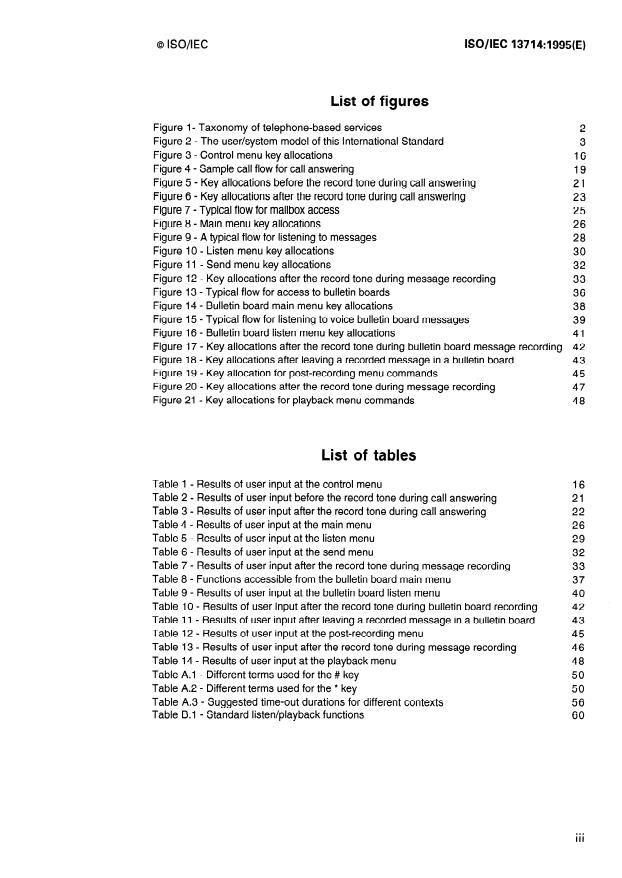
List of figures
Figure l- Taxonomy of telephone-based Services 2
Figure 2 - The user/system model of this International Standard 3
Figure 3 - Control menu key allocations
Figure 4 - Sample call flow for call answering
Figure 5 - Key allocations before the record tone during call answering
Figure 6 - Key allocations after the record tone during call answering
Figure 7 - Typical flow for mailbox access 25
Figure 8 - Main menu key allocations 26
Figure 9 - A typical flow for listening to messages
Figure 10 - Listen menu key allocations
Figure 11 - Send menu key allocations
Figure 12 - Key allocations after the record tone during message recording
Figure 13 - Typical flow for access to bulletin boards
Figure 14 - Bulletin board main menu key allocations
Figure 15 - Typical flow for listening to voice bulletin board messages
Figure 16 - Bulletin board listen menu key allocations
Figure 17 - Key allocations after the record tone during bulletin board message recording
Figure 18 - Key allocations after leaving a recorded message in a bulletin board
Figure 19 - Key allocation for post-recording menu commands
Figure 20 - Key allocations after the record tone during message recording
Figure 21 - Key allocations for playback menu commands
List of tables
Table 1 - Results of User input at the control menu
Table 2 - Results of user input before the record tone during call answering 21
Table 3 - Results of user input after the record tone during call answering 22
Table 4 - Results of User input at the main menu 26
Table 5 - Results of user input at the listen menu 29
Table 6 - Results of User input at the send menu
Table 7 - Results of user input after the record tone during message recording
Table 8 - Functions accessible from the bulletin board main menu
Table 9 - Results of User input at the bulletin board listen menu
Table 10 - Results of User input after the record tone during bulletin board recording
Table 11 - Results of User input after leaving a recorded message in a bulletin board
Table 12 - Results of user input at the post-recording menu
Table 13 - Results of User input after the record tone during message recording
Table 14 - Results of User input at the playback menu
Table A.l - Different terms used for the # key
Table A.2 - Different terms used for the * key
Table A.3 - Suggested time-out durations for different contexts
Table B.l - Standard listen/playback functions
Foreword
ISO (the International Organization for Standardization) and IEC (the Inter-
national Electrotechnical Commission) form the specialized System for
worldwide standardization. National bodies that are members of ISO or
IEC participate in the development of International Standards through
technical committees established by the respective organization to deal
with particular fields of technical activity. ISO and IEC technical com-
mittees collaborate in fields of mutual interest. Other international organ-
izations, governmental and non-governmental, in liaison with ISO and IEC,
also take part in the work.
In the field of information technology, ISO and IEC have established a joint
technical committee, lSO/IEC JTC 1. Draft International Standards adopted
by the joint technical committee are circulated to national bodies for vot-
ing. Publication as an International Standard requires approval by at least
75 % of the national bodies casting a vote.
International Standard lSO/IEC 13714 was prepared by Joint Technical
Committee lSO/IEC JTC 1, Information technology, Subcommittee SC 18,
Documen t processing and rela ted communica tion.
Annexes A and B of this International Standard are for information only.
o lSO/IEC ISO/IEC 13714:1995(E)
Introduction
Voice messaging Systems allow telephone users to leave recorded messages for People who
are unable to answer their telephone, either because they are absent or busy, or because
they are currently engaged on another telephone call. This is commonly referred to as cal1
answering. Voice messaging Systems tan also allow users to send voice messages directly,
without accessing call answering.
Voice messaging Systems are increasingly available and accessed from homes and offices, as
well as from public and mobile telephones. With callers leaving messages on many different
Systems and subscribers increasingly likely to have mailboxes on more than one System,
there is a need for users to have a common interface for the basic features of voice messaging
Systems.
Experience has shown that consistent and predictable human interfaces benefit users.
Benefits tan include faster learning, greater productivity, and greater satisfaction. Consistent
human interfaces tan also benefit an industry by promoting greater acceptance for products
and Services.
The DTMF intetface provides a highly restricted User interface, as there are only 12 different
keys available for input, and output is via an audio channel, whose Performance is constrained
by Speed and users’ limited short-term memory capabilities. For these reasons, users are
particularly likely to benefit from common User interface features both within and across
different voice messaging Systems they encounter, as they tan learn a common set of input
and output protocols, which will maximise the efficiency and usability of these interfaces.
This International Standard includes only some of the features in DTMF-controlled Systems
used for voice messaging (see clauses 5, 6, 7, 8, and 9, following) but, as described later in
this International Standard (see clause 1 and Figure 1) there exist large areas of commonality
with important functions in other telephone-based (i.e., interactive voice response) Systems
and Services. Many of the user interface features specified in this International Standard will
be usable for and implemented in other interactive voice response applications. Annex B of
this Standard summarises the subset of the telephone user interface features described in
the body of this Standard that are generally applicable in DTMF-controlled telephone-based
interfaces beyond voice messaging.
V
This page intentionally left blank
INTERNATIONAL STANDARD o lSO/IEC
Information technology - Document processing and
related communication - User interface to telephone-
- Voice messaging applications
based Services
1 Scope
This International Standard will provide users of voice messaging Systems with a consistent mode of
interaction in a way that is independent of the underlying System implernentations. The interface is
based on a set of design guidelines annexed to this International Standard.
The interface supports the ability of all users described in the user-system model (see Figure 2) to
access the features of voice messaging Systems. In a call answering application, the interface allows
callers to leave messages from all types of telephones. lt also allows callers to access additional
features through the use of DTMF devices. In the voice mail application, through the use of DTMF
devices, the interface allows subscribers to send and receive voice messages, and to manage stored
data, and allows non-subscribers to leave voice messages for subscribers.
This International Standard addresses the following six functional areas:
a caller leaving a voice message, when the call is answered by a voice messaging System call
answering facility;
l
a caller leaving a voice message, when a message is sent to a subscriber by a subscriber or non-
subscriber through direct messaging;
a subscriber listening to and processing voice messages received;
a subscriber creating and sending voice messages through the voice mail application;
the sending and receiving of messages via voice message delivery applications; and
the use of voice bulletin boards.
Within these functional areas, only certain features are defined in this International Standard.
However, standard-conforming Systems are not limited to these functions and features, and this
International Standard does not preclude alternative methods of invoking features specified in this
International Standard, providing that these alternatives do not conflict with the Standard interface
specified for other features covered in this International Standard.
In this International Standard, the direct messaging functional area is covered in the clause specifying
the call answering application.
In addition,, this International Standard specifies two requirements to be satisfied in all voice
messaging contexts, not just the application contexts specified earlier in this clause: the use of ## as a
delimiter (see 5.6.1), and the access to and presence of the control menu (see 56.2) and its
associated functionality.
This International Standard does not address the user/system interface for administrators, who have
responsibility for the management and maintenance of the voice messaging System.
This International Standard also does not address the proactive method, if any, employed by a voice
messaging System to notify a User that a voice mailbox contains a message. Notification is, at present,
typically achieved by a message waiting light, a distinctive dial-tone, or a pager device.
This International Standard does not specify a non-DTMF user interface for Integrated Services Digital
Network (ISDN) terminal access to voice messaging applications; however, if a user ’s ISDN terminal or
switching equipment has the capability for full Simulation of DTMF tones after call connection, the user
interface specified in this International Standard will operate a conforming voice messaging System.
Figure 1 Shows a taxonomy of telephone-based Services, with shaded boxes indicating the Services
within the scope of this International Standard:
Database
Access Messaging Transaction
I Info Retrieval I
I I
I I
Automatic altemate billing Bank by phone Account Status
System (AABS) Benefi ts Benefits
ti
Automated attendant Reservations Case Status
Connection sen/ices Service registrations Crossword puzzle
Custom cal1 setvices Stock trading clues
Transcription Services Financial
FW
Other
Custom local area Trouble reporting information
I Messaaina
signaling Services Health
(CLASS) Movie info
Facsimile
Directory assistance with Museum info
Paging
cal1 completion News
Text
Teleconference Person locator
Telephone
Sports
device for
Stock quotes
the deaf (TDD)
Train schedules
Weather
Notes:
The scope of this Standard is shown by the shaded areas.
Database Info Retrieval: Read-Only access to storetipresented information.
Transaction: Readkite access to a database or a Service.
Figure l- Taxonomy of telephone-based Services
o lSO/IEC
Figure 2 Shows a userkystem model of the scope of this International Standard:
Figure 2 - The userkystem model of this International Standard
o lSO/IEC
lSO/lEC 13714:1995(E)
2 Conformance
The user interface to a conforming voice messaging System shall conform to clause 5. Additionally,
the User interface to a conforming call answering application shall conform to clause 6; the User
interface to a conforming voice mail application shall conform to clause 7; the User interface to a
conforming voice bulletin board application shall conform to clause 8; and the user interface to a
conforming voice message delivery application shall conform to clause 9. The only requirement for
conformance with respect to callers using non-DTMF telephones is as specified in 6.1.
A conforming System may also provide one or more additional, alternative user interfaces which are
inconsistent with any or all of clauses 5, 7, 8, and 9, but only to logged-in subscribers who have
Chosen that alternative interface. The intetface specified in this International Standard shall be the
default configuration of the System when supplied.
A voice messaging System in which the call answering application conforms to clauses 5 & 6, but in
which the other voice messaging applications covered by the scope of this International Standard do
not conform may be described as having a conforming call answering application.
Throughout clauses 5, 6, 7, 8, and 9, the following conventions are used to indicate levels of
conformance required of compliant Systems:
Mandatory/reserved: Conforming Systems shall have this function/feature and the
function/feature shall be accessible in (at least) the way specified.
Optionakeserved: Conforming Systems may or may not have this function/feature. If the
function/feature is offered, it shall be accessible in (at least) the way
specified. 16 the function/feature is not offered the access mechanism
specified shall not be used to access any other function/feature.
OptionaVnot reserved: Conforming Systems may or may not have this function/feature. If the
function/feature is offered in the System state and menu level concerned, it
shall be accessible in (at least) the way specified at the menu concerned. If
the function/feature is not offered, the access mechanism may be used to
access another function/feature.
Note: In desct-ibing the effect of key-presses in a conforming interface, this International Standard uses a
simple declarative mode (e.g. “the play command Causes playback.” ). The normative content of the Standard
is carried by the specification of “mandatory/reserved ”, “optionaVreserved” and “optional/not reserved” in the
associated table. Where the effect of user input is not specified, a conforming System may assign any effect to
that user input, including an effect which is also available through a standard-specified means. For example, the
help function as specified in this document on the control menu could additionally be presented as an Option in
other menus within that application.
ISO/lEC 13714:1995(E)
o lSO/IEC
3 Normative references
The following Standards contain provisions which, through reference in this text, constitute provisions
of this International Standard. At the time of publication, the editions indicated were valid. All
Standards are subject to revision, and Parties to agreements based on this International Standard are
encouraged to investigate the possibility of applying the most recent editions of the Standards
indicated below. Members of IEC and ISO maintain registers of currently valid International Standards.
CCITT Volume VI: General recommendations on telephone switching and signaling,
ßecommendation Q.23: Technical features of push-button telephone sets (1988).
ITU-T: The telephone network and ISDN Operation, numbering, routing and mobile Service,
ßecommendation E. 16 1: Arrangement of digits, letters and symbols on telephones and other
devices that tan be used for gaining access to a telephone network (1993).
4 Definitions
For the purpose of this International Standard the following definitions apply:
4.1 administration: Voice messaging System functions concerned with the establishment and
management of voice mailboxes on a system-wide basis, the configuration of the System, and the
definition of system-wide and initial default individual Parameters.
4.2 administrator: A person charged with the Administration of a voice messaging System.
4.3 cail answering: That Segment of a voice messaging System concerned with accepting
incoming calls and allowing the callerto leave a message in a voice mailbox.
4.4 caller: A voice messaging System user who accesses the sysfem and is provided with a
capability to send, leave, or record voice messages. A caller need not be a subscriber. Callers may
enter the System either through the ca// answering facility or by direct connection to the voice mail
application.
4.5 cancel: Clear the current (i.e. not yet delimited ’) DTMFor voice input. Typically, the System will
indicate the cancellation and reprompt for continuing.
46 . control menu : A men of control functions accessible from any state in the System. This menu
is p lresented when the use r presses the * key in any context other than the control menu itself.
4.7 data entry: Numeric DTMF input that the System does not interpret as commands.
4.8 delimit: lndicate or Cause completion of an input.
4.9 dial-ahead: The ability to enter DTMF input before the System has requested it. lt is commonly
used for rapid entry of data or a series of menu choices. In dial-ahead, a user enters a key-press or
key-presses in advance of the associated prompt(s) and the output of these further prompt(s)
associated with the input key-press(es) is suppressed.
Note: this term may also be referred to as key-ahead, or type-ahead.
4.10 dial-through: The interruption of System output with D;TMF input acted on just as if it had
been entered at the end of System output.
Note: this term may also be referred to as key-through or tut-through.
4.11 direct messaging: The capability for a voice messaging System to allow a user (either
subscriber or non-subscriber) to leave a message for a subscriber without using the call-answering
facility or the send facility.
4.12 DTMF: Dual tone multi-frequency encoding sf key press input. The definition of the encoding
employed may be found in CCITT Volume VI, Q.23.
4.13 DTMF device: A device through which a user tan generate (or, in the case sf equipment
such as digital telephones, duplicate the effect of) the DTMFtones associated with the keys O-9, *
and #. This device is typically a DTMF-telephone but may also be a tone generator, a digital telephone
used to invoke DTMFsignals from a telephone switch, or a digital telephone.
4.14 feedback: Information supplied by the System to indicate that user actions have had their
intended effects, or have had unintended effects. Typically, feedback consists of a new prompt or
o ISO/IEC
message indicating that an action has had its intended effect, but feedback also includes error
indications and tones.
4.15 forced disconnect: A User request to a voice messaging System for the System to
disconnect from the call.
4.16 header: System supplied information associated with an individual message. This may include
date, time, Source and Status information such as urgency and privacy.
4.17 help: Information provided, either automatically or upon request, to inform users of their
available prompted and unprompted choices, and of their current place in the System.
4.18 inter-key time-out: The interval within which two DTMF Signals must be input to be
considered part of a Single string.
4.19 interactive voice response: A telephone-based System or Service where users enter
information and make rnenu selections using DTMF devices, and receive information via System
prompts.
4.20 interruptibility: Susceptibility of System output to dial-through.
4.21 key-press: The noun associated with the verb press.
4.22 mailbox access: A procedure required to gain access to the facilities of a voice messaging
System for subscribers. Mailbox access typically involves use of a security Code and of some form of
user identification, but either or both of these may be available to the voice messaging System
through other means than user input.
4.23 main menu: The menu typically presented after a subscriber has accessed a voice
messaging System .
4.24 mandatory [feature/function]: A feature/function required by this International Standard.
4.25 menu: The presentation to the user of a list of possible actions. A menu typically consists of a
set of prompts each describing an available function and the User action necessaty to invoke that
function.
4.26 message: Auditory data placed in a voice mailbox. Messages may be left by callers,
subscribers, Systems, or System administrators.
4.27 message originator: A voice messaging System User who sends messages. A message
originator need not be the speaker of the original voice data.
4.28 message recipient: A voice messaging System user who receives messages.
4.29 non-reserved [feature/function]: The key assigned to this Standard function in the given
state may be used for other function(s) if the Standard function is not provided at the given state.
4.30 non-subscriber: A user of a voice messaging System who is not acting as a subscriber.
4.31 not specified: Used in User action/effect tables to indicate that the effect of that action in the
associated context is not addressed by this International Standard.
8 ISO/IEC
4.32 optional [feature/function]: A conforming System is not required to have this
feature/function.
4.33 press: The verb used to describe the User action that generates DTMF tones.
4.34 prompt: Auditory System output providing instructions or guidance to the users. Prompts
consist of recorded or synthesised voice and/or tones.
4.35 record tone: A tone output by a voice messaging System when it expects a user to record
voice input. A record tone is a type of prompt.
4.36 reserved key: In the given context, available for use only for the purpose specified in this
International Standard.
4.37 security Code: Data that authorises access to a specific voice mailbox or user function. May
also be known as password, Passcode, personal identification number, etc.
4.38 subscriber: A voice messaging System user who usually has the capability to originate and
receive voice messages and to manage the stored voice data.
4.39 System: A voice messaging System. Note: In this International Standard, the word “ syst em”
alone refers to a voice messaging System.
4.40 time-out: (1) An interval of no user input that Causes the System to Change state. (2) The
state Change resulting from such an interval. For example, a time-out during numeric input may be
interpreted as end-of-string and Cause the System to Change from numeric input state to command
state or some appropriate action state.
4.41 user-configurable: Of an Option, able to be set by an individual User, or by an administrator
on his/her behalf.
4.42 User identification (User ID): Data that identify a subscriber to a voice messaging System.
4.43 voice input: Auditory input by a User.
4.44 voice mailbox: A descriptive term for those functions of a voice messaging System that
receive and store voice messages for a subscriber, or for the logical storage itself.
4.45 voice message: A message.
4.46 voice messaging System: An automated System for the recording, storage, and retrieva
of voice messages.
4.47 #: The DTMF key or button located at the Iower right-hand corner of the Standard 12.key pad
ic
on a DTMF telephone. Common names for this Symbol are listed in annex A.2.2. Acceptable graph
representations for this Symbol are shown in CCITT Recommendation E.161 (1993).
4.48 *: The DTMF key or button located at the lower left-hand corner of the Standard 12-key pad on
a DTMF telephone. Common names for this Symbol are listed in annex A.2.3. The acceptable graphic
representation for this Symbol is shown in CCITT Recommendation E.161 (1993).
o lSO/IEC ISO/IEC 13714:1995(E)
5 Standard elements of userkystem dialogue
Voice messaging functions are invoked and controlled by a dialogue, or series of exchanges,
between the System and a User. This International Standard addresses the following three general
states of a voice messaging System: voice input by the User, DTMF input by the User, and System
output. Depending upon the context, user input to the voice messaging System may be either voice
or DTMF tones. For the purposes of this International Standard, voice input generally refers to any
auditory input other than DTMF, and all DTMF input is assumed to result from a DTMF device.
The System portions of the dialogue contain voice or other auditory output. Other auditory output
controlled by the System, such as music-on-hold, is outside the scope of this International Standard.
Auditory feedback that accompanies DTMF input by the User is not considered to be part of the
user/system dialogue and is outside the scope of this International Standard. Voice input by the user
leaving messages is also outside the scope of this International Standard, except as specified in 5.1.
Some command/response sequences employ time-outs. The length and details of these time-outs
are specified in 5.4 and in the description of the affected sequences.
The tables in this and subsequent clauses show standard-conforming DTMF input for the functional
areas specified in clause 1. This International Standard does not preclude the use of alternative
methods of invoking the functions described, as Iong as the Standard methods are also available.
5.1 Voice input
5.1.1 This International Standard does not require voice input to be interpreted by the voice
messaging System. However, annex A provides some informative guidelines for using voice input to
control the System.
5.1.2 During all voice input states, DTMF input as specified in this clause shall delimit the recording
of ongoing voice input, with the indicated effects. During voice input the # key delimits the input
state. The * key interrupts the input state and takes the User to the control menu (see 5.6.2).
5.1.3 When a pause is used to delimit the voice input state, the length of the time-out for no action
(see 5.4.2.1) should be used as a guideline as to whether the pause should delimit or be ignored.
5.1.4 During all voice input states, the handling of Sound interpreted by the System as invalid DTMF
input is outside the scope of this International Standard.
lSO/lEC 13714:1995(E) o lSO/IEC
5.2 DTMF input
5.2.1 General
5.2.1.1 DTMF input shall be accepted at any time, except as specified in 5.3.2, 5.3.3.4, and 5.3.6.3.
Any key press will interrupt System output except as specified in 5.3.3.4 and 5.3.6.3. If the DTMF
input is valid in the current System state, the indicated action is taken. If the DTMF input is not valid in
the current System state, an appropriate error indication should be output to the User.
5.2.1.2 In data-entry contexts, a string of DTMF Signals that is valid input to the voice messaging
System in its current state, but that includes a signal-free period greater than that specified in 5.4.3.1,
shall result in an inter-key time-out and shall Cause output of an appropriate indication to the User.
5.2.1.3 If the System receives more key presses than it tan treat as valid input in a data entty state,
these should be considered as dial-ahead. Effects of DTMF input received during voice input states
are specified in 5.1.
5.2.1.4 The presence and nature of audible key-press feedback to users as they make DTMF input
is not considered to be patt of the user/system dialogue, and is outside the scope of this International
Standard.
5.2.2 Dial-through
5.2.2.1 Dial-through means the interruption of System output with DTMF input acted on just as if it
had been entered at the end of System output. Except as specified in 5.3.2 and 5.3.6.3 all System
output shall allow dial-through.
5.2.2.2 When dial-through is enabled, user DTMF input shall terminate the current System output as
specified in 5.5.1.
5.2.2.3 DTMF input that is invalid in a current System context and that Causes dial-through shall
result in the same error message as would apply if the System output had been completed Prior to the
input.
5.2.3 Dial-ahead
5.2.3.1 Dial-ahead is the entry of a sequence of key presses providing input to several successive
System states. Dial-ahead of valid commands shall be possible in all contexts. Intervening
interruptible prompts should be suppressed by dial-ahead.
5.2.3.2 If an invalid input is included in a dial-ahead buffer, all buffered key presses subsequent to
the one causing the error should be discarded (also see 5.3.6.3).
5.2.3.3 If a dial-ahead sequence includes user input which delimits recording, the System need
consider this delimiter as valid input.
o lSO/IEC ISO/IEC 13714:1995(E)
5.3 System output
5.3.1 General
System output in a voice messaging System consists of various forms of auditoty output provided by
the System to facilitate the dialogue. System output may include System prompts, menus, Status
indications, error indications, help, warnings, confirmations, and other feedback. The exact
specification of the content of System output is beyond the scope of this International Standard.
5.3.2 Interruptibility
5.3.2.1 System output may have an interruptible po rtion (during which dial-through is enabled)
and
a non-interruptible Portion (during which dial- through is disabled).
5.3.2.2 Non-interruptible System output should be as brief as practicable and should only be used
for information that the user would normally consider urgent or important.
5.3.3 Record tone
5.3.3.1 When a voice messaging System is ready to accept voice input in any of the call answering,
voice mail, voice message delivery, or voice bulletin board applications within the scope of this
International Standard, it shall Signal the user with a record tone.
5.3.3.2 This International Standard recommends use of the record tone specified in 5.3.3.3. lt is
clearly distinguishable from current record tones. Users, primarily callers, will learn that it indicates that
the System they are using provides Standard access to many features.
If a System uses a record tone different than that specified, it should be easily discriminable from the
specified tone.
5.3.3.3 The record tone is a sequence:
l a 150 ms, 500 Hz Sound
l a pause of 75 ms
l a 150 ms, 620 Hz Sound
The tones should be of a Single frequency (pure sine wave). Frequencies and durations of the
components of the sequence should be accurate to +/- 2 %. The total distortion power (harmonics
and noise) of the record-tone sequence should be at least 33 dB less than the tone power.
5.3.3.4 The system ’s record tone shall not be interruptible. User input occurring during the record
tone, whether voice or DTMF, need not be saved.
o lSO/IEC
lSO/IEC 13714:1995(E)
5.3.4 Other tones
A tone or tone sequence indicating one Status or function shofild be easily discriminable from tones
or tone sequences indicating different Status or functions. The necessary discrimination may be
achieved through differentiation in pitch or rhythmic Pattern, but should not depend on length alone.
5.3.5 Completeness of prompts
A menu prompt need not include all system-defined user actions available at that Point in the
user/system dialogue. However, if a menu prompt does not include information about all valid actions
available at that Point, such information should be available in or via the help message associated with
that menu, or in the control menu output (see 5.6.2.1).
5.3.6 Error indications
5.3.6.1 Voice messaging Systems shall provide tontext-sensitive error indications in response to
invalid user input, except during voice recording (see 5.1.4).
5.3.6.2 Error indications may include any sf the following:
l an error tone;
l a Statement of the nature of the error;
l a description of the current System Status;
l what to do, including repeating the original prompt;
l what to do, including more information or Options than in the original prompt.
If an error tone is included in the error indication, it shall be presented first.
5.3.6.3 Error indications, whether tone(s) or System auditory output, shall terminate dial-ahead
sequences. The error tone shall be non-interruptible. A Statement of the nature of the error may
include a non-interruptible Portion. Other portions of an error indication shall be interruptible.
After some system-determined number of consecutive errors or of total errors, including periods of no
input from the User, the System may take some special action (e.g., disconnecting or connecting to an
attendant), after informing the User that such action will occur.
At the conclusion of, or as patt of, the error indication, a prompt should be played that indicates the
Options available at the state that was reached when the error was encountered.
5.3.7 Output of messages
Message output tan consist of up to three Parts: a system-supplied header, the message as supplied
by the message originator, and a system-supplied end-of-message prompt.
5.3.7.1 A message header or end-of-message prompt is not required; however, if one is provided,
it shall be interruptible. A message header may include information about the type of message, the
date and time a message was delivered, and whatever is known about the message originator (e.g.,
name, telephone number, etc.). If automatic playback of headers is implemented, the choice
o lSO/IEC
between automatic playback and suppression of the message headers should be user configurable,
and the interface should provide a way to move directly from the header to the message content.
5.3.7.2 The message itself shall be interruptible.
5.3.8 System help
5.3.8.1 Help shall be available in all input contexts and interruptible output contexts, except as
specified in 5.3.8.3 and 5.3.8.7. Menu prompts and titles alone are not considered help.
5.3.8.2 Help shall consist of one or more of the following Parts:
* a Statement of the current activity;
* a repetition of the prompted choices;
l further descriptions of menu choices;
l descriptions of additional (originally unprompted) available Options.
5.3.8.3 The effect of a help request during the playing of a help message itself may be System and
context dependent.
5.3.8.4 All valid menu choices available in the System state from which pre-recorded help was
requested shall be operable during the entire help output, and key presses selecting such Options
shall immediately terminate the help output and effect the choice selected. This implies that only keys
which are not assigned in the state from which help was requested shall be available for other
functions which apply to help itself.
5.3.8.5 If a time-out for no action occurs after a pre-recorded help prompt, the System shall prompt
the User with appropriate choices (see 5.4.2).
5.3.8.6 The help message associated with a main menu shall describe access to the control menu.
5.3.8.7 When help is accessed via the control menu, the help message shall be appropriate to the
context from which the control menu was accessed, and may include help about the control menu
functions accessible from that context.
5.3.8.8 When a System returns from help to a data entry context or a voice input context, interrupted
user input may be retained or discarded. The user should be informed of this disposition.
5.4 Time-outs
5.4.1 General
A time-out is a voice messaging System state Change in response to a period in which no User input is
detected (see annex A.lO). Voice messaging Systems shall provide an inter-key time-out (5.4.3) and
a time-out for no action (5.4.2).
5.4.2 Time-out for no action
5.4.2.1 The time-out for no action is the time the System waits before continuing after a prompt
requiring User input, if no user input is received. In data entry states, voice input need not be
o lSO/IEC
ISO/lEC 13714:1995(E)
detected or considered. The range for the time-out for no action for functional areas within the scope
of this International Standard should be no shorter than 3 s and should be no greater than 30 s. See
annex A.10 for further guidance on use of time-outs in different contexts.
5.4.2.2 In DTMF data entry and voice input contexts, a time-out for no action should normally result
in the User being reprompted. After some system-determined number of consecutive time-outs, the
System may take some special action (e.g., disconnecting or connecting to an attendant), typically
after informing the User.
5.4.2.3 At a menu or prompt, the time-out for no action should lead to repetition of the original
menu or prompt, or to more detailed information.
5.4.3 Inter-key time-out
5.4.3.1 The inter-key time-out is the time allowed between key presses during multi-digit data entry
states. The range for the inter-key time-out shall be at minimum 3 s, and should be at maximum 8 s.
5.4.3.2 After an inter-key time-out occurs during a data entry state, the System may interpret the
time-out as a delimiter, or may prompt the User to explicitly delimit the data, or take other appropriate
action.
5.4.3.3 This International Standard does not specify the disposition of DTMF input occurring after
the inter-key time-out and before the time-out for no action. Such disposition may be both context-
dependent and system-dependent.
5.4.4 Behaviour after repeated time-outs
After some system-determined number of consecutive time-outs or of total time-outs, the System may
take some special action (e.g., disconnecting or connecting to an attendant), after informing the user
that such action is about to occur.
5.4.5 Time-outs during voice input
If a time-out for no action is detected during a voice input context after some voice input has been
received, it should be interpreted as a delimiter.
5.5 System response times
5.5.1 Response time on dial-through
In normal Operation, the time from receipt of DTMF causing dial-through to the cessation of ongoing
System output shall be less than 0,5 s on 95% of occasions, and should never exceed 1 s.
5.5.2 Feedback response time
In all situations where DTMF input is explicitly or implicitly delimited, either because it is of fixed length
or through the entry of an explicit delimiter, the time from System receipt of the last key press to the
beginning of the next System output (e.g. confirmation of entry, comfort message etc.) shall be less
than 3 s on 95% of occasions, in normal Operation.
o lSO/IEC
If the wait is likely to be longer than 6 s, the System should inform the user of such delays.
5.5.3 Minimum response time
The minimum delay from receipt of DTMF entry to the audible statt of the resulting System response
should be sufficient to accommodate the needs of users with DTMF keypads built into telephone
handsets and those with separate DTMF Senders.
5.6 Basic use of the # and * keys
to a small number
This subclause defines the key sequences corresponding of navigational and user
guidance functions that apply generally within the System.
The two keys corresponding to * and # on a DTMF telephone are used, alone or in conjunction with
other keys, to invoke basic navigational and User guidance from any Point in the user/system
dialogue, unless otherwise specified in individual clauses of this Standard.
5.6.1 Use of the # key
In general, the # key indicates that the User has completed the current activity or entry and instructs
the System to delimit this activity and move on to the next activity or state of the user/system dialogue.
When a delimiter is required for voice input or for various forms of numeric or data entry, #
5.6.1 .l
shall indicate the end of input and Cause the System to begin the next System output. A time-out may
also serve as a delimiter (see 5.4.3.2). A redundant # entered in a fixed-length data entty context (i.e.,
entered after the expected number of characters but within the inter-key time-out) shall be ignored.
5.6.1.2 If the User is listening to messages, pressing # shall delimit the current message, and result
in a skip to the next logical state.
5.6.1.3 In call answering, when a User is listening to a subscriber ’s greeting, pressing # shall end the
greeting and skip to the record tone or a prompt indicating other available Options, if there are any.
5.6.1.4 No delimiter should be required for a Single key menu selection.
5.6.2 Basic use of * to access the control menu
Whenever DTMF is enabled, except within the control menu itself, pressing * at any Point in the
System shall give the user access to the control menu except as detailed in 5.3.2, 5.3.3.4, and
5.3.6.3.
lt should be noted that there is a large installed base of terminals which use the * key to switch from
pulse to DTMF signaling on a per-cal1 basis. This may result in a System receiving a * when the User did
not intend to send one, or not receiving one when the user did intend to send one. System
designers should consider this carefully, especially when specifying the effect of the cancel/backup
function (i.e., a user enters * *) when no Prior DTMF input has been received from the caller.
ISO/lEC 13714:1995(E) o lSO/IEC
5.6.2.1 Control menu
Table 1 and Figure 3 list the functions accessible from the control menu:
Table 1 - Results of User input at the control menu
User action Effect Conformance level
Not specified
12,%43,6
c-
Go to top Ievel menu OptionaVreserved
,
8 Select language OptionaVreserved
Forced disconnect Mandatory/reserved
Disconnect Same as in context in which Mandatory/resetved
control menu was invoked
*
CanceVbackup
I
Figure 3 - Control menu key
allocations
Functions on the control menu are accessed directly from any System state other than the control
menu by pressing * and then the key-press specified in Table 1. This is an example of dial-ahead.
Alternatively, users tan access the control menu (unless already in the control menu ) by pressing *
and then listening to all or part of the menu prompt and then making the Single key-press selection
from Table 1.
o lSO/IEC
The conformance levels used in Table 1 and all other tables in which conformance levels appear are
explained in clause 2 (conformance).
Selecting go to top level menu positions the User at the highest level menu in the application and
presents the associated menu prompt. For example, within a stand-alone voice messaging
application, selecting go to top level menu moves the user to the main menu (see 7.5). If the voice
messaging application was itself selected from within another higher level application
...