


ISO/IEC 9075-4:1996
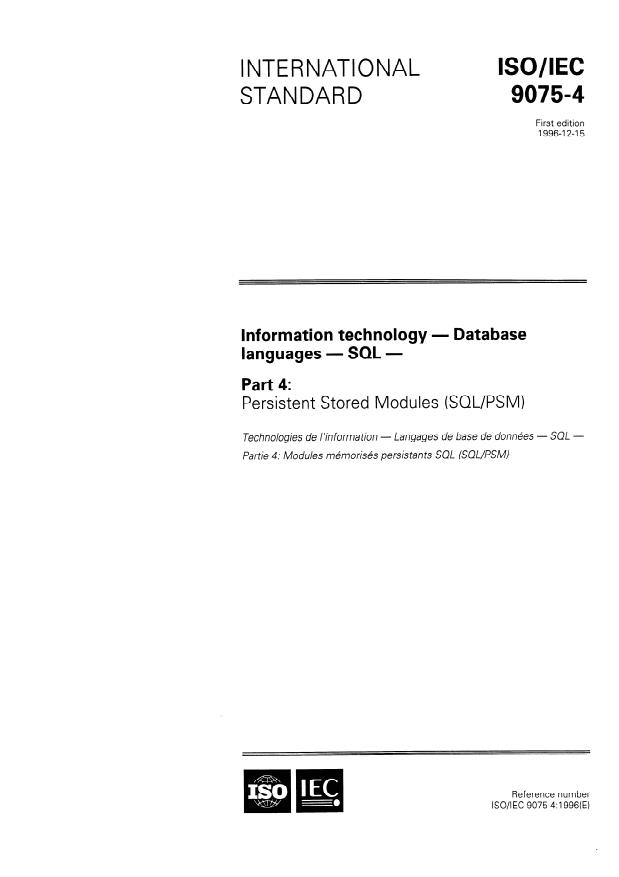
(Main)Information technology — Database languages — SQL — Part 4: Persistent Stored Modules (SQL/PSM)
Information technology — Database languages — SQL — Part 4: Persistent Stored Modules (SQL/PSM)
Technologies de l'information — Langages de base de données — SQL — Partie 4: Modules mémorisés persistants (SQL/PSM)
General Information
- Status
- Withdrawn
- Publication Date
- 25-Dec-1996
- Withdrawal Date
- 25-Dec-1996
- Technical Committee
- ISO/IEC JTC 1/SC 32 - Data management and interchange
- Drafting Committee
- ISO/IEC JTC 1/SC 32 - Data management and interchange
- Current Stage
- 9599 - Withdrawal of International Standard
- Start Date
- 16-Dec-1999
- Completion Date
- 14-Feb-2026
Relations
- Effective Date
- 15-Apr-2008
Get Certified
Connect with accredited certification bodies for this standard

BSI Group
BSI (British Standards Institution) is the business standards company that helps organizations make excellence a habit.

NYCE
Mexican standards and certification body.
Sponsored listings
Frequently Asked Questions
ISO/IEC 9075-4:1996 is a standard published by the International Organization for Standardization (ISO). Its full title is "Information technology — Database languages — SQL — Part 4: Persistent Stored Modules (SQL/PSM)". This standard covers: Information technology — Database languages — SQL — Part 4: Persistent Stored Modules (SQL/PSM)
Information technology — Database languages — SQL — Part 4: Persistent Stored Modules (SQL/PSM)
ISO/IEC 9075-4:1996 is classified under the following ICS (International Classification for Standards) categories: 35.060 - Languages used in information technology. The ICS classification helps identify the subject area and facilitates finding related standards.
ISO/IEC 9075-4:1996 has the following relationships with other standards: It is inter standard links to ISO/IEC 9075-4:1999. Understanding these relationships helps ensure you are using the most current and applicable version of the standard.
ISO/IEC 9075-4:1996 is available in PDF format for immediate download after purchase. The document can be added to your cart and obtained through the secure checkout process. Digital delivery ensures instant access to the complete standard document.
Standards Content (Sample)
ISO/IEC
INTERNATIONAL
9075-4
STANDARD
First edition
1996-l 2-l 5
Information technology - Database
languages - SQL -
Part 4:
Persistent Stored Modules (SQL/PSM)
- Langages de base de donnbes - SQL -
Technologies de I ‘information
Partie 4: Modules m6moris& persistan ts SQL (SQL/PSM)
Reference number
ISO/I EC 9075-4: 1996(E)
ISO/IEC 90754: 1996(E)
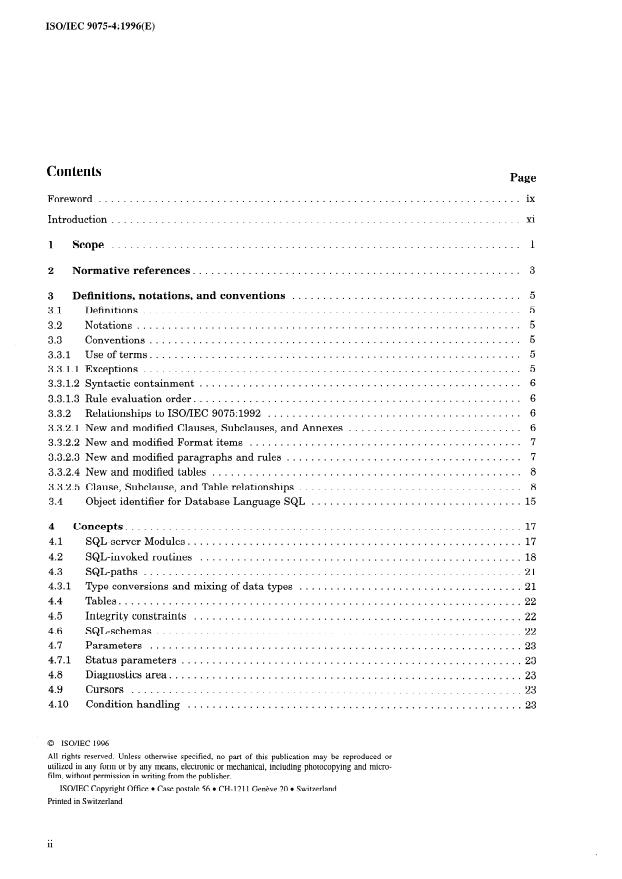
Contents
Page
Foreword . . . . . . . . . . . . . . . . . . . . . . . . . . . . . . . . . . . . . . . . . . . . . . . . . . . . . . . . . . . . . . . . . . . . ix
Introduction . . . . . . . . . . . . . . . . . . . . . . . . . . . . . . . . . . . . . . . . . . . . . . . . . . . . . . . . . . . . . . . . . . xi
Scope . . . . . . . . . . . . . . . . . . . . . . . . . . . . . . . . . . . . . . . . . . . . . . . . . . . . . . . . . . . . . . . . . .
2 Normativereferences. 3
.....................................
3 Definitions, notations, and conventions
31 . Definitions .
3.2 Notations .
33 Conventions. .
313.1 Useofterms .
3.3.1.1 Exceptions .
....................................................
3.3.1.2 Syntactic containment
.....................................................
3.3.1.3 Rule evaluation order
.........................................
3.3.2 Relationships to ISO/IEC 9075:1992
............................
3.3.2.1 New and modified Clauses, Subclauses, and Annexes
............................................
3.3.2.2 New and modified Format items
......................................
3.3.2.3 New and modified paragraphs and rules
..................................................
3.3.2.4 New and modified tables
....................................
3.3.2.5 Clause, Subclause, and Table relationships
..................................
3.4 Object identifier for Database Language SQL
4 Concepts.l 7
..................................................... 17
4.1 SQL-server Modules.
42 . SQL-invoked routines .
..2 1
4.3 SQL-paths .
4.3.1 Type conversions and mixing of data types .
4.4 Tables.2 2
4.5 Integrity constraints .
SQL-schemas .
4.6
Parameters .
4.7
4.7.1 Status parameters .
Diagnostics area.
4.8 .
...............................................................
4.9 Cursors
......................................................
4.10 Conditionhandling
0 ISO/IEC 1996
All rights reserved. Unless otherwise specified, no part of this publication may be reproduced or
utilized in any form or by any means, electronic or mechanical, including photocopying and micro-
film, without permission in writing from the publisher.
ISO/IEC Copyright Office l Case postale 56 l CH-1211 Geneve 20 l Switzerland
Printed in Switzerland
ii
ISO/IEC9075=4:1996(E)
WSOIIEC
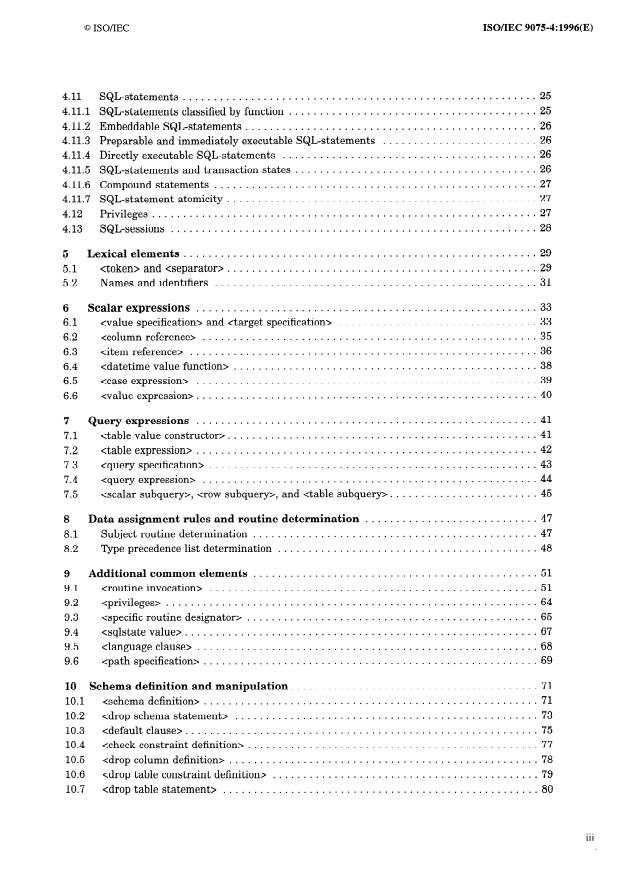
4.11 .
SQL-statements
........................................ 25
4.11.1
SQL-statements classified by function
...............................................
4.11.2 Embeddable SQL-statements
......................... 26
4.11.3 Preparable and immediately executable SQL-statements
......................................... 26
4.11.4 Directly executable SQL-statements
26 .
.......................................
SQL-statements and transaction states
4.11.5
....................................................
4.11.6 Compoundstatements
..................................................
4.11.7 SQL-statement atomicity
..2 7
4.12 Privileges. .
...........................................................
4.13 SQL-sessions
5 Lexicalelements. .
.................................................. 29
51 . and
....................................................
52 . Names and identifiers
6 Scalar expressions .O . . . . . . . . . . . . . . . . . . . . . . . . . . . . . . . . . . . . . . . . . . . . . . . . . . . 33
61 . and . . . . . . . . . . . . . . . . . . . . . . . . . . . . . . . . 33
......................................................
62 .
........................................................
63 .
.................................................
64 .
..3 9
65 . .
......................................................
.
66 .
..4 1
7 Query expressions .
.................................................
71 . .
72 .
.....................................................
73 .
......................................................
1.4
....................... 45
7.5 , , and
............................
8 Data assignment rules and routine determination
..............................................
81 . Subject routine determination
..........................................
82 . Type precedence list determination
..............................................
9 Additional common elements
.....................................................
91
9:2 .
...............................................
93 .
94 . .6 7
..6 8
.t .
......................................................
96 .
.......................................
10 Schema definition and manipulation.
......................................................
10.1
.................................................
10.2
.........................................................
10.3
...............................................
10.4
..................................................
10.5
...........................................
10.6
10.7 .
. . .
...................................................... ..8 1
$0.8
....................................................
10.9
.................................................
PO‘BO domain statement>
.............................................
10.11
................................................ $5
40*f2 .............................................. 86
IO.13 adrop tsansla~tiom statementw
.................................................... 87
10.1.4 ................................................ 88
PO.f5 ............................................. 89
PO.16 -43QL-sewer module definitionw
................................................. 92
10.17 rap module statement>
................................................... 93
10.18 ................................................. 102
IO.19
....................................................... 103
10.20
....................................................... 105
10.21
. . . . . . .O . . . . * . . . . . . . . . . . . . . . . . . . . . . . . . . . . . . . . . . . . . . . . . . . . . . . .A11
11.1 . . . . . . . . . . . . . . . . . .e . . . . . . . . . . . . . . . . . . . . . . . . . . . . . . . . . . . . . . . . .lll
..112
HI.2 .
....................................................
11.3 Calls ts a
...............................................
11.4
................................................
lB.5 -Data type correspondences.
..................................................... “129
I.2 uktticm
12.1 rsorw.12 9
..13 0
12.2 <~penstatementw .
.......................................................
12.3 .......................................................
12.4 ahse statementw
.............................................
12.5 .............................................
12.6 cdelete statement: positioned>
..............................................
12.7 .............................................
12.8 .............................................
.
12.9
.............................................. 138
P2.PO ....................................................... 141
13 ContPsl statemenf;s
........................................................ 141
13.1
...................................................... 142
13.2
................................................... 143
13.3 .................................................... 146
13.4 chandler declaratisnw
................................................... 149
93.5 ................................................ 150
13.6 L variable declaration>
‘151
.................................................
13.7 eassipment statement>
........................................................ 152
13.8
.......................................................... 154
13.9
....................................................... 156
13.10 cleave statement>
‘157
.......................................................
113.11
....................................................... 158
43.12
...................................................... 159
13.13
.........................................................
13.14
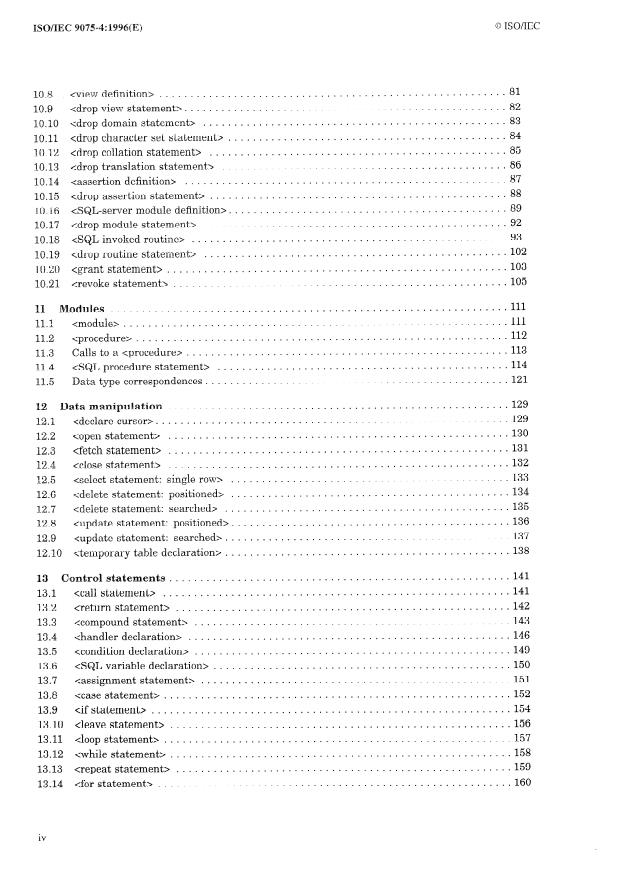
ISO/IEC 90754: 1996(E)
@ ISO/IEC
..16 3
14 Transactionmanagement .
..................................................... 163
14.1
..................................................... 164
14.2
..16 5
15 Sessionmanagement .
..................................................... 165
15.1
16 DynamicSQL.16 7
Description of SQL item descriptor areas. .
16.1
.
16.2
..17 0
. .
16.3
................................................. 175
17 Diagnostics management.
............................................... 175
17.1 .
...................................................... 178
17.2
..................................................... 179
17.3 cresignal statement>
..18 1
EmbeddedSQL .
............................................. 181
18.1
.................................
19 Information Schema and Definition Schema
19.1 Information Schema. . . . . . . . . . . . . . . . . . . . . . . . . . . . . . . . . . . . . . . . . . . . . . . . . . . . . . 183
19.1‘1 SCHEMATA view. . . . . . . . . . . . . . . . . . . . . . . . . . . . . . . . . . . . . . . . . . . . . . . . . . . . . . . . . 183
19.1‘2 DOMAINSview . . . . . . . . . . . . . . . . . . . . . . . . . . . . . . . . . . . . . . . . . . . . . . . . . . . . . . .184
19.1‘3 COLUMNSview . . . . . . . . . . . . . . . . . . . . . . . . . . . . . . . . . . . . . . . . . . . . . . . . . . . . . .185
19‘1.4 MODULESview.187
19.1.5 ROUTINESview . . . . . . . . . . . . . . . . . . . . . . . . . . . . . . . . . . . . . . . . . . . . . . . . . . . . . .188
19.1.6 PARAMETERSview . . . . . . . . . . . . . . . . . . . . . . . . . . . . . . . . . . . . . . . . . . . . . . . . . . .189
19.1‘7 MODULE TABLE USAGE view . . . . . . . . . . . . . . . . . . . . . . . . . . . . . . . . . . . . . . . . . . . . 190
- -
19.1.8 MODULE COLUMN USAGE view . . . . . . . . . . . . . . . . . . . . . . . . . . . . . . . . . . . . . . . . . . 191
- -
19.1‘9 MODULE PRIVILEGES view . . . . . . . . . . . . . . . . . . . . . . . . . . . . . . . . . . . . . . . . . . . . . . 192
-
19.1.10 ROUTINE PRIVILEGES view. . . . . . . . . . . . . . . . . . . . . . . . . . . . . . . . . . . . . . . . . . . . . . 193
-
19.1.11 ROUTINE TABLE USAGE view. . . . . . . . . . . . . . . . . . . . . . . . . . . . . . . . . . . . . . . . . . . . 194
- -
19.1.12 ROUTINE COLUMN USAGE view. . . . . . . . . . . . . . . . . . . . . . . . . . . . . . . . . . . . . . . . . . 195
- -
19.1.13 Definition of SQL built-in functions . . . . . . . . . . . . . . . . . . . . . . . . . . . . . . . . . . . . . . . . . . 196
19.2 DefinitionSchema ,.201
19.2‘1 SCHEMATA base table . . . . . . . . . . . . . . . . . . . . . . . . . . . . . . . . . . . . . . . . . . . . . . . . . . ,201
DATA TYPE DESCRIPTOR base table . . . . . . . . . . . . . . . . . . . . . . . . . . . . . . . . . . . . . . ,202
19.2‘2 -
-
19.2‘3 MODULES base table . . . . . . . . . . . . . . . . . . . . . . . . . . . . . . . . . . . . . . . . . . . . . . . . . . . ,206
19‘2.4 ROUTINES base table . . . . . . . . . . . . . . . . . . . . . . . . . . . . . . . . . . . . . . . . . . . . . . . . . . . ,208
19.2‘5 PARAMETERS base table . . . . . . . . . . . . . . . . . . . . . . . . . . . . . . . . . . . . . . . . . . . . . . . . .211
19.2.6 MODULE TABLE USAGE base table. . . . . . . . . . . . . . . . . . . . . . . . . . . . . . . . . . . . . . . ,213
- -
19.2‘7 MODULE COLUMN USAGE base table. . . . . . . . . . . . . . . . . . . . . . . . . . . . . . . . . . . . . ,214
- -
19.2.8 MODULE PRIVILEGES base table. . . . . . . . . . . . . . . . . . . . . . . . . . . . . . . . . . . . . . . . . ,215
-
19.2.9 ROUTINE PRIVILEGES base table . . . . . . . . . . . . . . . . . . . . . . . . . . . . . . . . . . . . . . . . ,217
-
19.2.10 ROUTINE TABLE USAGE base table . . . . . . . . . . . . . . . . . . . . . . . . . . . . . . . . . . . . . . ,219
- -
19.2.11 ROUTINE COLUMN USAGE base table . . . . . . . . . . . . . . . . . . . . . . . . . . . . . . . . . . . . ,220
- -
20 Statuscodes.221
20.1 SQLSTATE.221
@ ISOIIEC
ISO/IEC 90754:1996(E)
..22 3
21 Conformance.
........................................................
...................................................
,223
21.1 Claims of conformance
..22 3
21.2 Extensions andoptions
.................................................
..........................................
.223
21.2.1 Information Schema requirements
.........................................
.224
21.2.2 Schema manipulation requirements
...................................................
,224
Flagger requirements.
21.3
Implementation-defined elements . . . . . . . . . . . . . . . . . . . . . . . . . . . . . . . . . . .225
Annex A
Annex B Implementation-dependent elements . . . . . . . . . . . . . . . . . . . . . . . . . . . . . . . ,227
Annex C Deprecatedfeatures . . . . . . . . . . . . . . . . . . . . . . . . . . . . . . . . . . . . . . . . . . . .229
Annex D Incompatibilities with ISO/IEC 9075:1992 . . . . . . . . . . . . . . . . . . . . . . . . . . . ,231
Index . . . . . . . . . . . . . . . . . . . . . . . . . . . . . . . . . . . . . . . . . . . . . . . . . . . . . . . . . . . . . . . . . . . .233
Vi
ISOnEC 90754: 1996(E)
MSOIIEC
TABLES
Table
Page
Clause, Subclause, and Table relationships . 8
2 Standard programming languages . 68
3 Data type correspondences for Ada . 121
4 Data type correspondences for C . 122
5 Data type correspondences for COBOL . 123
6 Data type correspondences for Fortran . 124
7 Data type correspondences for MUMPS . 125
8 Data type correspondences for Pascal .
9 Data type correspondences for PL/I . 127 .
10 Data types of 11 Codes used for input/output SQL parameter modes in Dynamic SQL . 167
12 . 175
13 SQL-statement character codes for use in the diagnostics area . 176
14 SQLSTATE class and subclass values . ,221
vii
ISO/IEC 9075=4:1996(E) @ ISOIIEC
Foreword
IS0 (the International Organization for Standardization) and IEC (the International Electrotechnical
Commission) form the specialized system for worldwide standardization. National bodies that are
members of IS0 or IEC participate in the development of International Standards through technical
committees established by the respective organization to deal with particular fields of technical
activity. IS0 and IEC technical committees collaborate in fields of mutual interest. Other interna-
tional organizations, governmental and non-governmental, in liaison with IS0 and IEC, also take
part in the work.
In the field of information technology, IS0 and IEC have established a joint technical committee,
ISO/IEC JTC 1. Draft International Standards adopted by the joint technical committee are circu-
lated to national bodies for voting. Publication as an International Standard requires approval by
at least 75% of the national bodies casting a vote.
International Standard ISO/IEC 9075-4, was prepared by Joint Technical Committee ISO/IEC JTC
1, Information technology, Subcommittee SC21, Open systems interconnection, data management,
and open distributed processing.
ISO/IEC 9075 consists of the following parts, under the general title Information technology -
Database languages - SQL:
- Part 3: Call-Level Interface (SQUCLI)
- Part 4: Persistent Stored Modules (SQL/PSM)
Parts 1, 2, and 5 are currently published as ISO/IEC 9075:1992.
Part 3 is currently published as ISO/IEC 9075-3:1995.
Annexes A, B, C, and D of this part of ISO/IEC 9075 are for information only.
“‘
Vlll
ISO/IEC 9075-4: 1.996(E)
WSO/IEC
Introduction
The organization of this part of ISO/IEC 9075 is as follows:
1) Clause 1, “Scope”, specifies the scope of this part of ISO/IEC 9075.
identifies additional standards that, through reference in this
2) Clause 2, “Normative references”,
part of ISO/IEC 9075, constitute provisions of this part of ISO/IEC 9075.
defines the notations and conventions used
3) Clause 3, “Definitions, notations, and conventions”,
in this part of ISO/IEC 9075.
4) Clause 4, “Concepts”, presents concepts used in the definition of persistent stored modules.
of lexical elements used in the definition of
Clause 5, “Lexical elements”, defines a number
5)
persistent stored modules.
defines a number of scalar expressions used in the definition of
Clause 6, “Scalar expressions”,
6)
modules.
persistent stored
7) Clause 7, “Query expressions”, defines the elements of the language that produce rows and
tables of data as used in persistent stored modules.
defines the data assignment rules
8) Clause 8, “Data assignment rules and routine determination”,
used in the definition of persistent stored modules.
defines additional common elements used in the
9) Clause 9, “Additional common elements”,
definition of persistent stored modules.
defines the schema definition and manipula-
10) Clause 10, “Schema definition and manipulation”,
tion statements associated with the definition of persistent stored modules.
11) Clause 11, “Modules”, defines the facilities for using persistent stored modules.
12) Clause 12, “Data manipulation”, defines data manipulation operations associated with persistent
stored modules.
13) Clause 13, “Control statements”, defines the control statements used with persistent stored
modules.
statements
Clause 14, “Transaction management”, defines the SQL-transaction management
14)
associated with persistent stored modules.
Clause 15, “Session management”, defines the SQL-session management statements associated
15)
with persistent stored modules.
16) Clause 16, “Dynamic SQL”, defines the facilities for executing SQL-statements dynamically in
the context of persistent stored modules.
facilities used with persis-
Clause 17, “Diagnostics management”, defines enhancements to the
17)
tent stored modules.
ISO/IEC 9075-4: 1996(E) 0 ISO/IEC
Clause 18, “Embedded SQL”, defines host language embeddings related to persistent stored
18)
modules.
defines the Information and Definition
Clause 19, “Information Schema and Definition Schema”,
1%
Schema objects associated with persistent stored modules.
Clause 20, “Status codes”, defines SQLSTATE values related to persistent stored modules.
20)
Clause 21, “Conformance”, defines the criteria for conformance to this part of ISO/IEC 9075.
21)
is an informative Annex. It lists those features
Annex A, “Implementation-defined elements”,
2%
for which the body of this part of the standard states that the syntax or meaning or effect on
the database is partly or wholly implementation-defined, and describes the defining information
that an implementer shall provide in each case.
Annex B, “Implementation-dependent elements”, is an informative Annex. It lists those features
23)
for which the body of this part of the standard states that the syntax or meaning or effect on
the database is partly or wholly implementation-dependent.
\
Annex C, “Deprecated features”, is an informative Annex. It lists features that the responsible
24)
Technical Committee intends will not appear in a future revised version of ISO/IEC 9075.
Annex D, “Incompatibilities with ISO/IEC 9075:1992”, is an informative Annex. It lists the
25)
incompatibilities between this edition of ISO/IEC 9075 and ISO/IEC 9075:1992.
In the text of this part of ISO/IEC 9075, Clauses begin a new odd-numbered page, and in Clause 5,
“Lexical elements”, through Clause 21, “Conformance”, Subclauses begin a new page. Any resulting
blank space is not significant.
X
INTERNATIONAL STANDARD @ ISO/IEC
ISO/IEC 90754: 1996(E)
Information technology - Database languages - SQL -
Part 4:
Persistent Stored Modules (SQL/PSM)
1 Scope
This part of International Standard ISO/IEC 9075 specifies the syntax and semantics of a database
language for declaring and maintaining persistent database language routines either in SQL-server
modules or as standalone schema-level routines, and invoking them from programs written in a
standard programming language.
The database language for s and s includes:
- The specification of statements to direct the flow of control.
- The assignment of the result of expressions to variables and parameters.
- The specification of condition handlers that allow SQL-invoked routines to deal with various
conditions that arise during their execution.
- The specification of statements to signal and resignal conditions.
- The ability to set an SQL-path for controlling the determination of the subject routine to be
invoked.
- The declaration of local cursors.
- The declaration of local variables.
It also includes the definition of the Information Schema tables that contain schema information
pertaining to SQL-server modules and SQL-invoked routines.
NOTE 1 - The context for ISO/IEC 9075 is described by the Reference Model of Data Management (ISWIEC
10032: 1993).
Scope 1
OISOLCEC
2 Persistent Stored Modules (SQLLPSM)
OISO/IEC ISO/IEC 9075-4:1996 (E)
2 Normative references
The following standards contain provisions that, through reference in this text, constitute provisions
of this part of ISO/IEC 9075. At the time of publication, the editions indicated were valid. All
standards are subject to revision, and parties to agreements based on this part of ISO/IEC 9075
are encouraged to investigate the possibility of applying the most recent editions of the standards
indicated below. Members of IEC and IS0 maintain registers of currently valid International
Standards.
ISO/IEC 1539:1991, Information technology - Programming languages - FORTRAN.
IS0 1989:1985, Programming languages - COBOL.
IS0 6160:1979, Programming languages - PLI I.
IS0 \ IEC 7185:1990, Information technology - Programming languages - Pascal.
ISOIIEC 865211995, Information technology - Programming languages - Ada.
NOTE 2 - IS0 86521987 has been superseded by a new edition (ISO/IEC $6521995). However, when
this part of ISO/IEC 9075 was under development, the previous edition was valid and this part of
ISO/IEC 9075 is therefore based on that edition, which is listed below.
IS0 8652:1987, Programming languages - Ada.
ISO/IEC 90751992, Information technology - Database languages - SQL.
ISOAEC 9899:1990, Programming languages - C.
ISOIIEC 10206: 1991, Information technology - Programming languages - Extended Pascal.
ISOIIEC 11756:1992, Information technology - Programming languages - MUMPS.
Normative references
4 Persistent Stored Modules (SQL/PSM)
OISO/IEC ISO/IEC 9075-4:1996 (E)
3 Definitions, notations, and conventions
3.1 Definitions
[ Inset-t this paragraph 1 For the purposes of this part of ISO/IEC 9075, the definitions given in ISO/IEC
9075:1992 and the following definitions apply.
external routine: An SQL-invoked routine whose routine body is an external body reference
a>
that identifies a program written in a standard programming language other than SQL.
signature (of an SQL-invoked routine): The name of the SQL-invoked routine, the position
b)
and data types of each of its SQL parameters, and an indication of whether it is an SQL-invoked
function or an SQL-invoked procedure.
SQL routine: An SQL-invoked routine whose routine body is written in SQL.
d
SQL.
SQL-invoked routine: A routine that is allowed to be invoked only from within
d)
3.2 Notations
9075.
1 Insert this paragraph 1 All notations in ISO/IEC 9075:1992 apply to this part of ISO/IEC
.
1 1 r
1 Inset-t this paragraph 1 The syntax notation used in this part of ISO/IEC 9075 is an extenaea version or
BNF (“Backus Normal Form” or “Backus Naur Form”).
[ Insert this paragraph 1 This version of BNF is fully described in ISO/IEC 9075:1992.
3.3 Conventions
[ Insert this paragraph J Except as otherwise specified in this part of ISO/IEC 9075, the conventions used
in this part of ISO/IEC 9075 are identical to those described in part 1 of ISO/IEC 9075.
3.3.1 Use of terms
3.3.1.1 Exceptions
[ Modified paragraph ] The phrase “an exception condition is raised:“, followed by the name of a condi-
tion, is used in General Rules and elsewhere to indicate that:
The execution of a statement is unsuccessful.
- The application of General Rules, other than those of Subclause 12.3, ““, in ISO/IEC
9075:1992, Subclause 9.1, ““, Subclause 11.4, ““,
Subclause 20.1, ““, in ISO/IEC 9075:1992, Subclause 13.3, “ccompound
statement>“, and Subclause 13.4, “chandler declaration>“, may be terminated.
- Diagnostic information is to be made available.
Definitions, notations, and conventions 5
OISO/IEC
3.3 Conventions
- Execution of the statement is to have no effect on SQL-data or schemas.
areas of an
[ Insert this paragraph 1 The effect on &a rget specification>s and SQL descriptor
defined by this
SQL-statement that terminates with an exception condition, unless explicitly
International Standard, is implement ation-dependent.
[ Insert this paragraph 1 The phrase “C is re-raised by S” is used in General Rules and elsewhere to
indicate that C, a condition raised by an SQL-statement executed during exec ution of S, is ra .ised
again by S.
3.3.1.2 Syntactic containment
[ Insert this paragraph 1 If contains a
contains a RI, then is said to generally contain the s of all
s that are included in the set of subject routines of RI. If contains ,
then generally contains . If generally contains and generally contains CC>,
then eA> generally contains 4~
3.3.1.3 Rule evaluation order
[ Insert this paragraph I An invocation of an SQL-invoked function is inessential if the SQL-function
is deterministic and does not possibly modify SQL-data; otherwise, it is implementation-defined
whether or not it is inessential.
3.3.2 Relationships to ISO/IEC 90751992
This part of ISO/IEC 9075 depends on ISO/IEC 90753992 and its Technical Corrigenda. This
part of ISO/IEC 9075 is to be used as though it were merged with the text of ISO/‘IEC 9075:1992.
This Subclause describes the conventions used to specify the merger. The merger described also
accounts for the Technical Corrigenda that have been published to correct ISO/IEC 9075:1992. This
accommodation is typically indicated by the presence of a phrase like “in the Technical Corrigenda”
or “in the TC”.
3.3*2.1 New and modified Clauses, Subclauses, and Annexes
Clauses, Subclauses, and Annexes (other than Clause 1, ‘Scope” and Clause 2, “Normative refer-
ences”) in this part of ISO/IEC 9075 that have names identical to Clauses, Subclauses, or Annexes
in ISO/IEC 9075:1992 supplement the Clause, Subclause, or Annex, respectively, in ISO/IEC
9075:1992, typically by replacing paragraphs, Format items, or Rules or by providing new para-
graphs, Format items, or Rules. However, Clauses, Subclauses, and Annexes in this part of ISO/IEC
9075 that have names identical to Clauses, Subclauses, and Annexes in ISO/IEC 9075:1992 do not
necessarily have the same number or letter as the corresponding Clause, Subclause, or Annex in
ISO/IEC 9075:1992. Any differences in Clause or Subclause number or in Annex letter is not sig-
nificant. Table 1, “Clause, Subclause, and Table relationships”, identifies the relationships between
Clauses, Subclauses, and Annexes in this part of ISO/IEC 9075 and the corresponding Clauses,
Subclauses, and Annexes in ISO/IEC 90751992.
6 Persistent Stored Modules (SQL/PSM)
OISO/IEC ISO/IEC 90754:1996 (E)
3.3 Conventions
Clauses, Subclauses, and Annexes in this part of ISO/IEC 9075 that have names that are not
identical to Clauses, Subclauses, or Annexes in ISO/IEC 90751992 provide language specification
particular to this part of ISO/IEC 9075. Subclauses that are subsidiary to (“contained in”) Clauses
or Subclauses identified as new are inherently new and are not further identified.
The Clauses, Subclauses, and Annexes in this part of ISO/IEC 9075 appear in the order in which
they are intended to appear in the merged document. Absent other explicit instructions regarding
its placement, any new Clause, Subclause, or Annex is to be positioned as follows: Locate the
prior Clause, Subclause, or Annex in this part of ISO/IEC 9075 whose name is identical to the
name of a corresponding Clause, Subclause, or Annex that appears in ISO/IEC 90753992. The new
Clause, Subclause, or Annex shall immediately follow that Clause, Subclause, or Annex. If there are
multiple new Clauses, Subclauses, or Annexes with no intervening Clause, Subclause, or Annex that
modifies an existing Clause, Subclause, or Annex, then those new Clauses, Subclauses, or Annexes
appear in order, following the prior Clause, Subclause, or Annex whose name was matched.
3.3.2.2 New and modified Format items
In modified Subclauses, Format items that define a BNF nonterminal symbol (that is, the BNF
nonterminal symbol appears on the left-hand side of the : : = mark) sometimes modify a Format
item whose definition appears in ISO/IEC 90753992, sometimes replace a Format item whose
definition appears in ISO/IEC 9075:1992, and sometimes define a new Format item that does not
have a definition at all in ISO/IEC 90753992. Those Format items in this part of ISO/IEC 9075
that modify a Format item whose definition appears in ISO/IEC 90753992, are identified by the
existence of a “Format comment” such as:
::=
!! All alternatives from ISO/IECgO75:1992
I
By contrast, Format items that completely replace Format items in ISO/IEC 9075:1992 have BNF
nonterminal symbols identical to BNF nonterminal symbols of Format items in ISO/IEC 90753992,
but do not state that they include any alternatives from ISO/IEC 9075:1992.
New Format items that have no correspondence to any Format item in ISO/IEC 9075:1992 are not
specially identified in this part of ISO/IEC 9075.
In new Subclauses, all Format items are also new and require no specific marking.
3.3.2.3 New and modified paragraphs and rules
In modified Subclauses, each paragraph or Rule is marked to indicate whether it is a modification
of a paragraph or Rule in ISO/IEC 9075:1992, or is a new paragraph or Rule in this part of ISO/IEC
9075.
Modifications of paragraphs or Rules in ISO/IEC 9075:1992, are identified by the inclusion of an
indication such as [ Replace the 5th paragraph 1, meaning that the fifth paragraph of the corresponding
Subclause in ISO/IEC 9075:1992, is to be replaced by the paragraph to which the indication is
attached, or 1 Replace SR6)b)ii) 1 meaning that Syntax Rule 6)b)ii) of the corresponding Subclause in
ISO/IEC 9075:1992, is to be replaced by the rule to which the indication is attached. In some cases,
an indication such as 1 Augment SW) 1 is used. When this appears, it means that the referenced Rule
is extended or enhanced by the Rule to which the indication is attached. In most instances, the
augmentation is the addition of a new alternative meant to support new syntax.
Definitions, notations, and conventions 7
OISO/IEC
3.3 Conventions
New paragraphs or Rules in this part of ISOAEC 9075 are indicated by the inclusion of an indi-
1 Insert before 2nd paragraph 1, meaning that the paragraph to which the indication is
cation such as
attached is to be read as though it were inserted preceding the second paragraph of the correspond-
ing Subclause in ISO/IEC 9075:1992. I Insert before GR4) 1 should be interpreted to mean that the rule
to which the indication is attached is to be read as though it were inserted preceding General Rule
4) of the corresponding Subclause in ISO/IEC 9075:1992. When an indication does not indicate a
1 Insert this paragraph 1 or I Insert this GR , then it may be read as implic-
specific insertion point, such as
itly specifying that the new text is to be appended at the end of the appropriate section (the General
Rules, for example) of the corresponding Subclause in ISOLIEC 9075:1992.
“AR” is used to mean “Access Rule”, and
In such instructions, “SR” is used to mean “Syntax Rule”,
“Desc.” is used to mean “Description” and “Func.” is used to
“GR” is used to mean “General Rule”.
mean “Function”.
All paragraphs, Format items, and Rules in new Clauses or Subclauses are also new and therefore
do not require further identification.
3.3.2.4 New and modified tables
Similarly, tables in this part of ISO/IEC 9075 that have names that are identical to tables in
ISO/IEC 9075:1992 supplement the table in ISO/IEC 9075:1992, typically by adding or replacing one
or more table entries. Tables in this part of ISO/IEC 9075 that have names that are not identical
to the names of tables in ISO/IEC 9075:1992 are new tables specified by this part of ISO/IEC 9075.
identifies the relationships between tables in
Table 1, “Clause, Subclause, and Table relationships”,
this part of ISO/IEC 9075 and the corresponding tables in ISO/IEC 9075:1992.
The rows in modified tables are generally new rows to be effectively inserted into the corresponding
table in ISO/IEC 9075:1992, though in rare cases rows already in tables in ISO/IEC 9075:1992 are
effectively replaced by rows in the table in this part of ISO/IEC 9075. It is always obvious when
such an effective replacement is required, based on equality of values in the first column of the
table.
3.3.2.5 Clause, Subclause, and Table relationships
Table l-Clause, Subclause, and Table relationships
Clause, Subclause, or Table in this part of Corresponding Clause, Subclause, or Table
ISO/IEC 9075 from ISO/IEC 9075:1992
Clause 1, “Scope” Clause 1, “Scope”
Clause 2, “Normative references” Clause 2, “Normative references”
Clause 3, “Definitions, notations, and conven- Clause 3, “Definitions, notations, and conventions”
tions”
Subclause 3.1, “Definitions” Subclause 3.1, “Definitions”
Subclause 3.2, “Notations” Subclause 3.2, “Notation”
Subclause 3.3, “Conventions” Subclause 3.3, “Conventions”
Subclause 3.3.1, “Use of terms” Subclause 3.3.4, “Use of terms”
Subclause 3.3.1.1, “Exceptions”
Subclause 3.3.4.1, “Exceptions”
8 Persistent Stored Modules (SQWSM)
OISOAEC ISOKEC 9075-4r1996 (E)
3.3 Conventions
Table l-Clause, Subclause, and Table relationships (Cont.)
Clause, Subclause, or Table in this part of Corresponding Clause, Subclause, or Table
ISO/IEC 9075 from ISO/IEC 9075:1992
Subclause 3.3.1.2, “Syntactic containment” Subclause 3.3.4.2, “Syntactic containment”
Subclause 3.3.1.3, “Rule evaluation order” Subclause 3.3.4.4, “Rule evaluation order”
Subclause 3.3.2, “Relationships to ISO/IEC (none)
9075: 1992”
Subclause 3.3.2.1, “New and modified Clauses, (none)
Subclauses, and Annexes”
Subclause 3.3.2.2, “New and modified Format (none)
itemsn
(none)
Subclause 3.3.2.3, “New and modified paragraphs
and rules”
Subclause 3.3.2.4, “New and modified tables” (none)
Subclause 3.3.2.5, “Clause, Subclause, and Table (none)
relationships”
Subclause 3.4, “Object identifier for Database Subclause 3.4, “Object identifier for Database
Language SQL”
Language SQL”
Clause 4, “Concepts”
Clause 4, “Concepts”
(none)
Subclause 4.1, “SQL-server Modules”
(none)
Subclause 4.2, “SQL-invoked routines”
(none)
Subclause 4.3, “SQL-paths”
I’
Subclause 4.6, e conversions and mixing
Subclause 4.3.1, “Type conversions and mixing of
TYP
types”
data types”
Subclause 4.4, “Tables” Subclause 4.9, “Tables”
Subclause 4.5, “Integrity constraints” Subclause 4.10, “Integrity constraints”
Subclause 4.11, “SQL-schemas”
Subclause 4.6, “SQL-schemas”
Subclause 4.18, “Parameters”
Subclause 4.7, “Parameters”
Subclause 4.7.1, “Status parameters” Subclause 4.18.1, “Status parameters”
Subclause 4.8, “Diagnostics area” Subclause 4.19, “Diagnostics area”
Subclause 4.9, “Cursors” Subclause 4.2 1, “Cursors”
Subclause 4.10, “Condition handling” (none)
Subclause 4.11, ‘SQL-statements” Subclause 4.22, “SQL-statements”
Subclause 4.11.1, “SQL-statements classified by Subclause 4.22.2, “SQL-statements classified by
function” function”
Subclause 4.22.3, “Embeddable SQL-statements”
Subclause 4.11.2, “Embeddable SQL-statements”
Subclause 4.22.4, “Preparable and immediately
Subclause 4.11.3, “Preparable -and immediately
executable SQL-statements”
executable SQL-statements” ’
Subclause 4.225, “Directly executable SQL-
Subclause 4.11.4, “Directly executable SQL-
statements” statements”
Definitions, notations, and conventions 9
OISO/IEC
3.3 Conventions
Table I-Clause, Subclause, and Table relationships (Cont.)
Clause, Subclause, or Table in this part of Corresponding Clause, Subclause, or Table
ISOLIEC 9075 from ISO/IEC 90751992
Subclause 4.11.5, “SQL-statements and transac- Subclause 4.22.6, “SQL-statements and transaction
tion states” states”
Subclause 4.11.6, “Compound statements” (none)
Subclause 4.11.7, “SQL-statement atomicity” (none)
Subclause 4.12, “Privileges” Subclause 4.26, “Privileges”
Subclause 4.13, “SQL-sessions” Subclause 4.30, “SQL-sessions”
Clause 5, “Lexical elements” Clause 5, “Lexical elements”
Subclause 5.2, “ and ”
Subclause 5.1, “ and ”
Subclause 5.2, “Names and identifiers” Subclause 5.4, “Names and identifiers”
Clause 6, “Scalar expressions” Clause 6, “Scalar expressions”
Subclause 6.1, “ and and specification>” specification>”
Subclause 6.2, “” Subclause 6.4, “”
Subclause 6.3, ‘“” (none)
Subclause 6.4, “” Subclause 6.8, “cdatetime value function>”
Subclause 6.5, “” Subclause 6.9, “”
Subclause 6.69 “” Subclause 6.11, “”
8 Clause 7, “Query expressionsn Clause 7, “Query expressions”
Subclause 7.1, “
Subclause 7.2, “
Subclause 7.3, “” Subclause 7.9, “”
Subclause 7.4, “” Subclause 7.10, “”
Subclause 7.5, “, , ,
query>, and
Clause 8, “Data assignment rules and routine Clause 9, “Data assignment rules”
determination”
Subclause 8.1, “Subject routine determination” (none)
Subclause 8.2, “Type precedence list dete
...
Questions, Comments and Discussion
Ask us and Technical Secretary will try to provide an answer. You can facilitate discussion about the standard in here.
Loading comments...