


ISO 11290-2:2017/FDAmd 1
(Amendment)Microbiology of the food chain — Horizontal method for the detection and enumeration of Listeria monocytogenes and of Listeria spp. — Part 2: Enumeration method — Amendment 1: Inclusion of storage of the samples before analysis and changes in the control strain for performance testing of culture media and reagents
Microbiology of the food chain — Horizontal method for the detection and enumeration of Listeria monocytogenes and of Listeria spp. — Part 2: Enumeration method — Amendment 1: Inclusion of storage of the samples before analysis and changes in the control strain for performance testing of culture media and reagents
Microbiologie de la chaîne alimentaire — Méthode horizontale pour la recherche et le dénombrement de Listeria monocytogenes et de Listeria spp. — Partie 2: Méthode de dénombrement — Amendement 1: Inclusion du stockage des échantillons avant l'analyse et modifications dans la souche témoin pour les essais de performance des milieux de culture et des réactifs
General Information
- Status
- Not Published
- Technical Committee
- ISO/TC 34/SC 9 - Microbiology
- Drafting Committee
- ISO/TC 34/SC 9/WG 32 - Improvement of preenrichment step in ISO 11290-1
- Current Stage
- 5020 - FDIS ballot initiated: 2 months. Proof sent to secretariat
- Start Date
- 03-Apr-2026
- Completion Date
- 03-Apr-2026
Relations
- Effective Date
- 12-Feb-2026
- Effective Date
- 20-Jul-2024
- Effective Date
- 13-Jul-2024
Overview
ISO 11290-2:2017/FDAmd 1 is an amendment to the international standard outlining microbiological methods for detecting and enumerating Listeria monocytogenes and Listeria species in the food chain. This amendment introduces two key updates: the inclusion of sample storage guidelines before analysis and changes in control strains used for performance testing of culture media and reagents. Developed under ISO/TC 34/SC 9, this standard helps laboratories, food producers, and regulators ensure food safety through consistent, validated microbiological testing protocols.
Key Topics
- Sample Storage Prior to Analysis
- Defines best practices for storing perishable and non-perishable food samples before microbiological analysis.
- Clarifies acceptable storage temperatures and time frames to ensure sample integrity and reliable test results.
- Transportation and Handling
- Recommends referenced ISO standards for sampling techniques for different product categories such as ISO/TS 17728 (food and feed), ISO 707 (milk and milk products), and ISO 18593 (surface testing).
- Emphasizes the need to avoid damage or alteration of samples during transport and storage.
- Control Strain Update
- Replaces Listeria monocytogenes WDCM 00109 with WDCM 00231 for media and reagent performance testing, aligning with updated best practices in laboratory quality assurance.
- Performance Testing of Culture Media and Reagents
- Specifies validation requirements for productivity, specificity, and selectivity, referencing ISO 11133.
- Details required control strains and media characteristics for quality assurance in both enumeration and confirmation tests.
- Documentation and Traceability
- Highlights the importance of detailed reporting on storage conditions and analytical procedures, especially when deviations occur.
Applications
Implementing ISO 11290-2:2017/FDAmd 1 provides the following practical benefits across the food industry and analytical laboratories:
- Food Safety Management
- Ensures reliable detection and enumeration of Listeria spp., a critical step in risk assessment for ready-to-eat foods, dairy, meats, and other products susceptible to contamination.
- Regulatory Compliance
- Supports compliance with global food safety regulations and requirements set by authorities such as the FDA and EU regulators.
- Assists food businesses in meeting audit and certification standards, including those required by GFSI-recognized food safety schemes.
- Laboratory Quality Assurance
- Standardizes laboratory procedures, facilitating consistent, repeatable results for comparison and regulatory reporting.
- Improves confidence in the accuracy of culture media and reagent performance, reducing the risk of false negative/positive results.
- Research and Method Development
- Provides a validated reference for researchers developing or verifying new methods for Listeria detection in foods and food-processing environments.
Related Standards
To support comprehensive food safety and microbiological testing, organizations should consider related ISO standards, including:
- ISO 11290-1 - Detection method for Listeria monocytogenes and Listeria spp. in the food chain.
- ISO 11133 - Guidelines for preparation, production, storage, and performance testing of culture media.
- ISO/TS 17728 - Sampling techniques for food and animal feed.
- ISO 707 - Guidance on sampling for milk and milk products.
- ISO 18593 - Horizontal methods for surface sampling using contact plates and swabs.
- ISO 20976-1 - Requirements and guidelines for conducting challenge tests of food and feed products.
By incorporating ISO 11290-2:2017/FDAmd 1 and its related standards, organizations enhance their ability to manage Listeria risks, maintain product safety, and demonstrate robust food safety management practices.
Keywords: ISO 11290-2:2017/FDAmd 1, Listeria monocytogenes detection, food microbiology standards, sample storage, control strain, culture media performance testing, food safety compliance.
Buy Documents
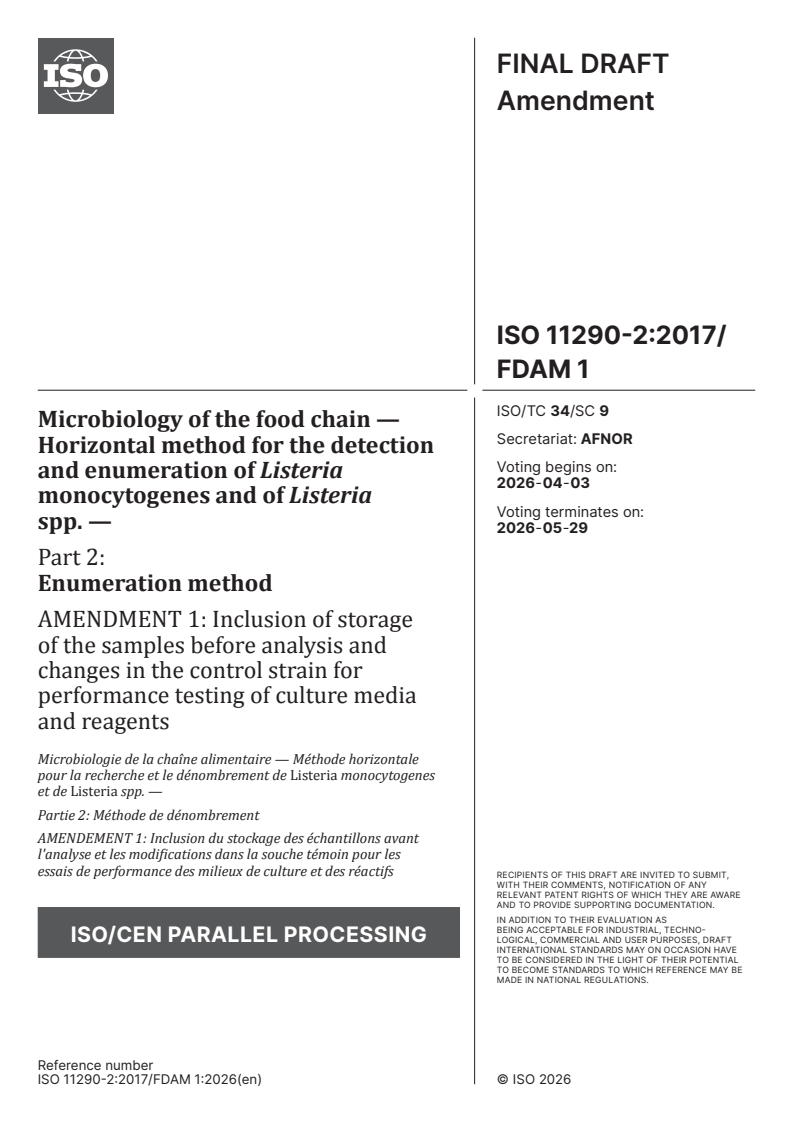
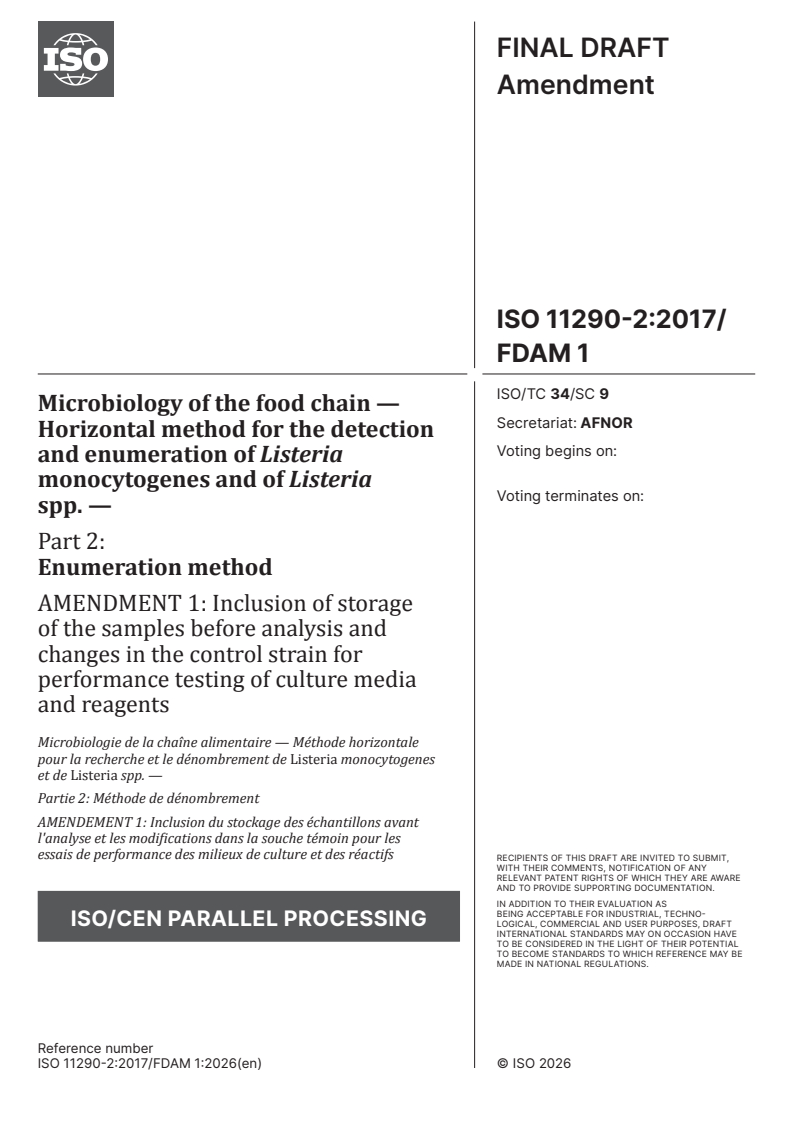

ISO 11290-2:2017/FDAmd 1 - Microbiology of the food chain — Horizontal method for the detection and enumeration of Listeria monocytogenes and of Listeria spp. — Part 2: Enumeration method — Amendment 1: Inclusion of storage of the samples before analysis and changes in the control strain for performance testing of culture media and reagents
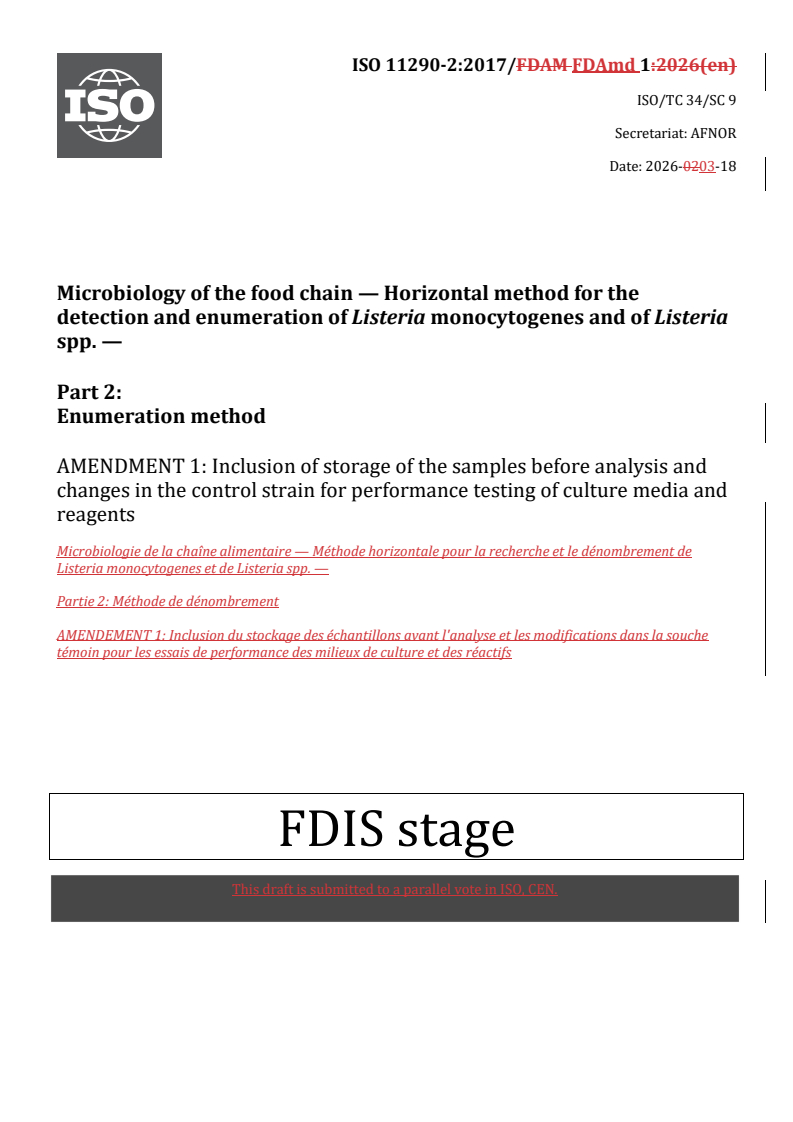

REDLINE ISO 11290-2:2017/FDAmd 1 - Microbiology of the food chain — Horizontal method for the detection and enumeration of Listeria monocytogenes and of Listeria spp. — Part 2: Enumeration method — Amendment 1: Inclusion of storage of the samples before analysis and changes in the control strain for performance testing of culture media and reagents

ISO 11290-2:2017/FDAmd 1 - Microbiologie de la chaîne alimentaire — Méthode horizontale pour la recherche et le dénombrement de Listeria monocytogenes et de Listeria spp. — Partie 2: Méthode de dénombrement — Amendement 1: Inclusion du stockage des échantillons avant l'analyse et modifications dans la souche témoin pour les essais de performance des milieux de culture et des réactifs
Frequently Asked Questions
ISO 11290-2:2017/FDAmd 1 is a draft published by the International Organization for Standardization (ISO). Its full title is "Microbiology of the food chain — Horizontal method for the detection and enumeration of Listeria monocytogenes and of Listeria spp. — Part 2: Enumeration method — Amendment 1: Inclusion of storage of the samples before analysis and changes in the control strain for performance testing of culture media and reagents". This standard covers: Microbiology of the food chain — Horizontal method for the detection and enumeration of Listeria monocytogenes and of Listeria spp. — Part 2: Enumeration method — Amendment 1: Inclusion of storage of the samples before analysis and changes in the control strain for performance testing of culture media and reagents
Microbiology of the food chain — Horizontal method for the detection and enumeration of Listeria monocytogenes and of Listeria spp. — Part 2: Enumeration method — Amendment 1: Inclusion of storage of the samples before analysis and changes in the control strain for performance testing of culture media and reagents
ISO 11290-2:2017/FDAmd 1 is classified under the following ICS (International Classification for Standards) categories: 07.100.30 - Food microbiology. The ICS classification helps identify the subject area and facilitates finding related standards.
ISO 11290-2:2017/FDAmd 1 has the following relationships with other standards: It is inter standard links to EN ISO 11290-2:2017/FprA1, ISO 2078:2022, ISO 11290-2:2017. Understanding these relationships helps ensure you are using the most current and applicable version of the standard.
ISO 11290-2:2017/FDAmd 1 is available in PDF format for immediate download after purchase. The document can be added to your cart and obtained through the secure checkout process. Digital delivery ensures instant access to the complete standard document.
Standards Content (Sample)
FINAL DRAFT
Amendment
ISO 11290-2:2017/
FDAM 1
ISO/TC 34/SC 9
Microbiology of the food chain —
Secretariat: AFNOR
Horizontal method for the detection
Voting begins on:
and enumeration of Listeria
2026-04-03
monocytogenes and of Listeria
Voting terminates on:
spp. —
2026-05-29
Part 2:
Enumeration method
AMENDMENT 1: Inclusion of storage
of the samples before analysis and
changes in the control strain for
performance testing of culture media
and reagents
Microbiologie de la chaîne alimentaire — Méthode horizontale
pour la recherche et le dénombrement de Listeria monocytogenes
et de Listeria spp. —
Partie 2: Méthode de dénombrement
AMENDEMENT 1: Inclusion du stockage des échantillons avant
l'analyse et les modifications dans la souche témoin pour les
essais de performance des milieux de culture et des réactifs
RECIPIENTS OF THIS DRAFT ARE INVITED TO SUBMIT,
WITH THEIR COMMENTS, NOTIFICATION OF ANY
RELEVANT PATENT RIGHTS OF WHICH THEY ARE AWARE
AND TO PROVIDE SUPPOR TING DOCUMENTATION.
IN ADDITION TO THEIR EVALUATION AS
BEING ACCEPTABLE FOR INDUSTRIAL, TECHNO-
ISO/CEN PARALLEL PROCESSING LOGICAL, COMMERCIAL AND USER PURPOSES, DRAFT
INTERNATIONAL STANDARDS MAY ON OCCASION HAVE
TO BE CONSIDERED IN THE LIGHT OF THEIR POTENTIAL
TO BECOME STAN DARDS TO WHICH REFERENCE MAY BE
MADE IN NATIONAL REGULATIONS.
Reference number
ISO 11290-2:2017/FDAM 1:2026(en) © ISO 2026
FINAL DRAFT
ISO 11290-2:2017/FDAM 1:2026(en)
Amendment
ISO 11290-2:2017/
FDAM 1
ISO/TC 34/SC 9
Microbiology of the food chain —
Secretariat: AFNOR
Horizontal method for the detection
Voting begins on:
and enumeration of Listeria
monocytogenes and of Listeria
Voting terminates on:
spp. —
Part 2:
Enumeration method
AMENDMENT 1: Inclusion of storage
of the samples before analysis and
changes in the control strain for
performance testing of culture media
and reagents
Microbiologie de la chaîne alimentaire — Méthode horizontale
pour la recherche et le dénombrement de Listeria monocytogenes
et de Listeria spp. —
Partie 2: Méthode de dénombrement
AMENDEMENT 1: Inclusion du stockage des échantillons avant
l'analyse et les modifications dans la souche témoin pour les
essais de performance des milieux de culture et des réactifs
RECIPIENTS OF THIS DRAFT ARE INVITED TO SUBMIT,
WITH THEIR COMMENTS, NOTIFICATION OF ANY
© ISO 2026
RELEVANT PATENT RIGHTS OF WHICH THEY ARE AWARE
AND TO PROVIDE SUPPOR TING DOCUMENTATION.
Al
...
ISO 11290-2:2017/FDAM FDAmd 1:2026(en)
ISO/TC 34/SC 9
Secretariat: AFNOR
Date: 2026-0203-18
Microbiology of the food chain — Horizontal method for the
detection and enumeration of Listeria monocytogenes and of Listeria
spp. —
Part 2:
Enumeration method
AMENDMENT 1: Inclusion of storage of the samples before analysis and
changes in the control strain for performance testing of culture media and
reagents
Microbiologie de la chaîne alimentaire — Méthode horizontale pour la recherche et le dénombrement de
Listeria monocytogenes et de Listeria spp. —
Partie 2: Méthode de dénombrement
AMENDEMENT 1: Inclusion du stockage des échantillons avant l'analyse et les modifications dans la souche
témoin pour les essais de performance des milieux de culture et des réactifs
FDIS stage
TTTTTTTTTTTTTTTThhhhhhhhhhhhhhhhiiiiiiiiiiiiiiiissssssssssssssss d d d d d d d d d d d d d d d drrrrrrrrrrrrrrrraftaftaftaftaftaftaftaftaftaftaftaftaftaftaftaft i i i i i i i i i i i i i i i issssssssssssssss s s s s s s s s s s s s s s s suuuuuuuuuuuuuuuubbbbbbbbbbbbbbbbmmmmmmmmmmmmmmmmiiiiiiiiiiiiiiiittttttttttttttttttttttttttttttttedededededededededededededededed t t t t t t t t t t t t t t t toooooooooooooooo a pa pa pa pa pa pa pa pa pa pa pa pa pa pa pa pararararararararararararararararallel vallel vallel vallel vallel vallel vallel vallel vallel vallel vallel vallel vallel vallel vallel vallel vooooooooooooooootttttttttttttttte e e e e e e e e e e e e e e e iiiiiiiiiiiiiiiinnnnnnnnnnnnnnnn I I I I I I I I I I I I I I I ISSSSSSSSSSSSSSSSOOOOOOOOOOOOOOOO,,,,,,,,,,,,,,,, C C C C C C C C C C C C C C C CEEEEEEEEEEEEEEEENNNNNNNNNNNNNNNN.
All rights reserved. Unless otherwise specified, or required in the context of its implementation, no part of this publication
may be reproduced or utilized otherwise in any form or by any means, electronic or mechanical, including photocopying,
or posting on the internet or an intranet, without prior written permission. Permission can be requested from either ISO
at the address below or ISO’s member body in the country of the requester.
ISO copyright office
CP 401 • Ch. de Blandonnet 8
CH-1214 Vernier, Geneva
Phone: + 41 22 749 01 11
E-mail: copyright@iso.org
Website: www.iso.org
Published in Switzerland
ii
Foreword
ISO (the International Organization for Standardization) is a worldwide federation of national standards
bodies (ISO member bodies). The work of preparing International Standards is normally carried out through
ISO technical committees. Each member body interested in a subject for which a technical committee has been
established has the right to be represented on that committee. International organizations, governmental and
non-governmental, in liaison with ISO, also take part in the work. ISO collaborates closely with the
International Electrotechnical Commission (IEC) on all matters of electrotechnical standardization.
The procedures used to develop this document and those intended for its further maintenance are described
in the ISO/IEC Directives, Part 1. In particular, the different approval criteria needed for the different types of
ISO document should be noted. This document was drafted in accordance with the editorial rules of the
ISO/IEC Directives, Part 2 (see www.iso.org/directives).
ISO draws attention to the possibility that the implementation of this document may involve the use of (a)
patent(s). ISO takes no position concerning the evidence, validity or applicability of any claimed patent rights
in respect thereof. As of the date of publication of this document, ISO had not received notice of (a) patent(s)
which may be required to implement this document. However, implementers are cautioned that this may not
represent the latest information, which may be obtained from the patent database available at
www.iso.org/patents. ISO shall not be held responsible for identifying any or all such patent rights.
Any trade name used in this document is information given for the convenience of users and does not
constitute an endorsement.
For an explanation of the voluntary nature of standards, the meaning of ISO specific terms and expressions
related to conformity assessment, as well as information about ISO’s adherence to the World Trade
Organization (WTO) principles in the Technical Barriers to Trade (TBT), see www.iso.org/iso/foreword.html.
This document was prepared by Technical Committee ISO/TC 34, Food products, Subcommittee SC 9,
Microbiology, in collaboration with the European Committee for Standardization (CEN) Technical Committee
CEN/TC 463, Microbiology of the food chain, in accordance with the Agreement on technical cooperation
between ISO and CEN (Vienna Agreement).
A list of all parts in the ISO 11290 series can be found on the ISO website.
Any feedback or questions on this document should be directed to the user’s national standards body. A
complete listing of these bodies can be found at www.iso.org/members.html.
iii
Microbiology of the food chain — Horizontal method for the detection
and enumeration of Listeria monocytogenes and of Listeria spp. —
Part 2:
Enumeration method
AMENDMENT 1: Inclusion of storage of the samples before analysis
and changes in the control strain for performance testing of culture
media and reagents
Clause 7
Replace the text with the following:
7. Sampling, transportation and storage of samples
Sampling is not part of the method specified in this document. Follow the specific International Standard
dealing with the product concerned. If there is no specific International Standard dealing with the sampling of
the product concerned, it is recommended that the parties concerned come to an agreement on this subject.
Recommended sampling techniques are given in the following documents:
[322]
— ISO/TS 17728 for food and animal feed;
[31]
— ISO 707 for milk and milk products;
[21]
— ISO 18593 for surfaces (see also see Reference [23]).
It is important that the laboratory receives a sample which is representative of the product under
consideration. The sample should not have been damaged or changed during transport or storage.
[2732]
NOTE 1 Shelf-life studies are not in the scope of this document but of ISO 20976-1 .
For storage conditions for stable samples (e.g nonperishable. non-perishable or low-moisture foods samples)
as well as frozen or deep-frozen products before analysis, see ISO 7218. For storage conditions for surface
[21]
samples, see ISO 7218 and ISO 18593 .
Before analysis, store perishable food samples refrigerated at 2 °C to 8 °C. Examine the samples immediately
upon receipt if possible, and if not possible, within a delay less than 8 h. In case of late arrival of samples in the
working day, samples may be stored overnight and should be analysed no later than 18 h after receipt. In this
case, the delay should be reported in the test report. However, if samples are stored between 1 °C and 5 °C,
the duration may be extended up to 24 h after receipt, without the necessity to include the delay in the test
report.
If these conditions cannot be applied, other storage conditions may be used provided it can be demonstrated
that the alternative conditions do not affect the contamination levels of Listeria spp./Listeria monocytogenes
or agreed between parties concerned. These conditions should be detailed and justified in the test report.
NOTE 2 Supporting data for storage of food samples before detection of Listeria monocytogenes or Listeria spp. are
available from: https://standards.iso.org/iso/11290/-2/ed-2/en/amd/1.
9.4.2.5.2 and 9.4.2.6
Replace all instances of Listeria monocytogenes WDCM 00109 with Listeria monocytogenes WDCM 00231.
Add the following note after the last paragraph:
NOTE Supporting data for the replacement of Listeria monocytogenes WDCM 00109 by Listeria monocytogenes
WDCM 00231 are available at: https://standards.iso.org/iso/11290/-2/ed-2/en/amd/1
B.2.8
Replace the text with the following:
B.2.8 Performance testing for the quality assurance of the culture media and reagents
The definition of productivity, specificity and selectivity are specified in ISO 11133. In general, follow the
procedures for performance testing described in ISO 11133. Table B.1 provides the performance testing for
the quality assurance of the culture medium for the enumeration. Table B.2 provides the performance testing
for the quality assurance of the culture media and reagents for the confirmation tests.
NOTE For productivity testing, in the case of enumeration of Listeria spp., it couldcan be informative to add another
control strain (from another Listeria species sensu stricto).
Table B.1— Performance testing for the quality assurance of the culture medium for the
enumeration
Medium Function Incubatio Control WDCM Referen Method Criteria and
a
n strains numbers ce of characteristic
a c
media control reactions
Listeria
b
monocytogenes 00021
PR ≥ 0,5,
serovar 4b
Productivit Quantitat blue green
f
TSA
y ive colonies with
Listeria
WDCM 023
Agar
opaque halo
monocytogenes
e
Listeria
serovars 1/2a, 3a
accordin
(48 ± 4) h/
g to 00012
d
(37 ± 1) °C Escherichia coli
Ottaviani or 00013
Qualitativ Total inhibition
Selectivity —
and
e (0)
Enterococcus 00009
Agosti
d
faecalis or 00087
Blue green
Qualitativ
b
Specificity Listeria innocua 00017 — colonies without
e
opaque halo
a Refer to the reference strain catalogue on http://www.wfcc.info for inform
...
PROJET FINAL
Amendement
ISO 11290-2:2017/
FDAM 1
ISO/TC 34/SC 9
Microbiologie de la chaîne
Secrétariat: AFNOR
alimentaire — Méthode
Début de vote:
horizontale pour la recherche
2026-04-03
et le dénombrement de Listeria
Vote clos le:
monocytogenes et de Listeria spp. —
2026-05-29
Partie 2:
Méthode de dénombrement
AMENDEMENT 1: Inclusion du
stockage des échantillons avant
l'analyse et modifications dans la
souche témoin pour les essais de
performance des milieux de culture et
des réactifs
Microbiology of the food chain — Horizontal method for the
detection and enumeration of Listeria monocytogenes and of
Listeria spp. —
LES DESTINATAIRES DU PRÉSENT PROJET SONT
Part 2: Enumeration method
INVITÉS À PRÉSENTER, AVEC LEURS OBSERVATIONS,
NOTIFICATION DES DROITS DE PROPRIÉTÉ DONT ILS
AMENDMENT 1: Inclusion of storage of the samples before AURAIENT ÉVENTUELLEMENT CONNAISSANCE ET À
FOURNIR UNE DOCUMENTATION EXPLICATIVE.
analysis and changes in the control strain for performance testing
OUTRE LE FAIT D’ÊTRE EXAMINÉS POUR
of culture media and reagents
ÉTABLIR S’ILS SONT ACCEPTABLES À DES FINS
INDUSTRIELLES, TECHNOLOGIQUES ET COM-MERCIALES,
AINSI QUE DU POINT DE VUE DES UTILISATEURS, LES
PROJETS DE NORMES
TRAITEMENT PARALLÈLE ISO/CEN
INTERNATIONALES DOIVENT PARFOIS ÊTRE CONSIDÉRÉS
DU POINT DE VUE DE LEUR POSSI BILITÉ DE DEVENIR DES
NORMES POUVANT
SERVIR DE RÉFÉRENCE DANS LA RÉGLEMENTATION
NATIONALE.
Numéro de référence
ISO 11290-2:2017/FDAM 1:2026(fr) © ISO 2026
PROJET FINAL
ISO 11290-2:2017/FDAM 1:2026(fr)
Amendement
ISO 11290-2:2017/
FDAM 1
ISO/TC 34/SC 9
Microbiologie de la chaîne
Secrétariat: AFNOR
alimentaire — Méthode
Début de vote:
horizontale pour la recherche
2026-04-03
et le dénombrement de Listeria
Vote clos le:
monocytogenes et de Listeria spp. —
2026-05-29
Partie 2:
Méthode de dénombrement
AMENDEMENT 1: Inclusion du
stockage des échantillons avant
l'analyse et modifications dans la
souche témoin pour les essais de
performance des milieux de culture et
des réactifs
Microbiology of the food chain — Horizontal method for the
detection and enumeration of Listeria monocytogenes and of
Listeria spp. —
LES DESTINATAIRES DU PRÉSENT PROJET SONT
Part 2: Enumeration method
INVITÉS À PRÉSENTER, AVEC LEURS OBSERVATIONS,
NOTIFICATION DES DROITS DE PROPRIÉTÉ DONT ILS
AURAIENT ÉVENTUELLEMENT CONNAISSANCE ET À
AMENDMENT 1: Inclusion of storage of the samples before
FOURNIR UNE DOCUMENTATION EXPLICATIVE.
analysis and changes in the control strain for performance testing
DOCUMENT PROTÉGÉ PAR COPYRIGHT
OUTRE LE FAIT D’ÊTRE EXAMINÉS POUR
of culture media and reagents
ÉTABLIR S’ILS SONT ACCEPTABLES À DES FINS
© ISO 2026 INDUSTRIELLES, TECHNOLOGIQUES ET COM-MERCIALES,
AINSI QUE DU POINT DE VUE DES UTILISATEURS, LES
Tous droits réservés. Sauf prescription différente ou nécessité dans le contexte de sa mise en œuvre, aucune partie de cette
PROJETS DE NORMES
TRAITEMENT PARALLÈLE ISO/CEN
INTERNATIONALES DOIVENT PARFOIS ÊTRE CONSIDÉRÉS
publication ne peut être reproduite ni utilisée sous quelque forme que ce soit et par aucun procédé, électronique ou mécanique,
DU POINT DE VUE DE LEUR POSSI BILITÉ DE DEVENIR DES
y compris la photocopie, ou la diffusion sur l’internet ou sur un intranet, sans autorisation écrite préalable. Une autorisation peut
NORMES POUVANT
être demandée à l’ISO à l’adresse ci-après ou au comité membre de l’ISO dans le pays du demandeur.
SERVIR DE RÉFÉRENCE DANS LA RÉGLEMENTATION
NATIONALE.
ISO copyright office
Case postale 401 • Ch. de Blandonnet 8
CH-1214 Vernier, Genève
Tél.: +41 22 749 01 11
E-mail: copyright@iso.org
Web: www.iso.org
Publié en Suisse Numéro de référence
ISO 11290-2:2017/FDAM 1:2026(fr) © ISO 2026
ii
ISO 11290-2:2017/FDAM 1:2026(fr)
Avant-propos
L’ISO (Organisation internationale de normalisation) est une fédération mondiale d’organismes nationaux
de normalisation (comités membres de l’ISO). L’élaboration des Normes internationales est en général
confiée aux comités techniques de l’ISO. Chaque comité membre intéressé par une étude a le droit de faire
partie du comité technique créé à cet effet. Les organisations internationales, gouvernementales et non
gouvernementales, en liaison avec l’ISO participent également aux travaux. L’ISO collabore étroitement avec
la Commission électrotechnique internationale (IEC) en ce qui concerne la normalisation électrotechnique.
Les procédures utilisées pour élaborer le présent document et celles destinées à sa mise à jour sont
décrites dans les Directives ISO/IEC, Partie 1. Il convient, en particulier, de prendre note des différents
critères d’approbation requis pour les différents types de documents ISO. Le présent document
a été rédigé conformément aux règles de rédaction données dans les Directives ISO/IEC, Partie 2
(voir www.iso.org/directives).
L’ISO attire l’attention sur le fait que la mise en application du présent document peut entraîner l’utilisation
d’un ou de plusieurs brevets. L’ISO ne prend pas position quant à la preuve, à la validité et à l’applicabilité
de tout droit de brevet revendiqué à cet égard. À la date de publication du présent document, l’ISO n’avait
pas reçu notification qu’un ou plusieurs brevets pouvaient être nécessaires à sa mise en application.
Toutefois, il y a lieu d’avertir les responsables de la mise en application du présent document que des
informations plus récentes sont susceptibles de figurer dans la base de données de brevets, disponible à
l’adresse www.iso.org/brevets. L’ISO ne saurait être tenue pour responsable de ne pas avoir identifié tout ou
partie de tels droits de brevet.
Les appellations commerciales éventuellement mentionnées dans le présent document sont données pour
information, par souci de commodité, à l’intention des utilisateurs et ne sauraient constituer un engagement.
Pour une explication de la nature volontaire des normes, la signification des termes et expressions
spécifiques de l’ISO liés à l’évaluation de la conformité, ou pour toute information au sujet de l’adhésion de
l’ISO aux principes de l’Organisation mondiale du commerce (OMC) concernant les obstacles techniques au
commerce (OTC), voir le lien suivant: www.iso.org/iso/fr/avant-propos.html.
Le présent document a été élaboré par le comité technique ISO/TC 34, Produits alimentaires, sous-comité SC 9,
Microbiologie, en collaboration avec le comité technique CEN/TC 463, Microbiologie de la chaîne alimentaire
du Comité européen de normalisation (CEN), conformément à l’Accord de coopération technique entre l’ISO
et le CEN (Accord de Vienne).
Une liste de toutes les parties de la série ISO 11290 peut être consultée sur le site de l’ISO.
Il convient que l’utilisateur adresse tout retour d’information ou toute question concernant le présent
document à l’organisme national de normalisation de son pays. Une liste exhaustive desdits organismes se
trouve à l’adresse www.iso.org/fr/members.html.
iii
ISO 11290-2:2017/FDAM 1:2026(fr)
Microbiologie de la chaîne alimentaire — Méthode
horizontale pour la recherche et le dénombrement de Listeria
monocytogenes et de Listeria spp. —
Partie 2:
Méthode de dénombrement
AMENDEMENT 1: Inclusion du stockage des échantillons avant
l'analyse et modifications dans la souche témoin pour les essais de
performance des milieux de culture et des réactifs
Article 7
Remplacer le texte par ce qui suit:
7. Échantillonnage, transport et stockage des échantillons
L’échantillonnage ne fait pas partie de la méthode indiquée dans le présent document. Suivre la Norme
internationale spécifique traitant du produit concerné. S’il n’existe aucune Norme internationale spécifique
pour l’échantillonnage du produit concerné, il convient que les parties concernées se mettent d’accord à ce
sujet. Les techniques d'échantillonnage recommandées sont données dans les documents suivants:
[22]
— ISO/TS 17728 pour les aliments et les aliments pour animaux;
[31]
— ISO 707 pour le lait et les produits laitiers;
[1]
— ISO 18593 pour les surfaces (voir également la Référence [23]).
Il est important que le laboratoire reçoive un échantillon représentatif du produit considéré. Il convient que
l'échantillon n'ait été ni endommagé, ni modifié au cours du transport ou du stockage.
NOTE 1 Les études sur la durée de conservation ne relèvent pas du domaine d'application du présent document
[32]
mais de l'ISO 20976-1 .
Pour les conditions de stockage des échantillons stables (par exemple, échantillons d’aliments non périssables
ou à faible teneur en eau) ainsi que des produits congelés ou surgelés avant analyse, voir l’ISO 7218. Pour les
[1]
conditions de stockage des prélèvements de surface, voir l’ISO 7218 et l’ISO 18593 .
Avant l’analyse, conserver les échantillons de produits alimentaires périssables réfrigérés à une température
comprise entre 2 °C et 8 °C. Examiner les échantillons immédiatement dès réception si possible et, dans
le cas contraire, dans un délai inférieur à 8 h. En cas d’arrivée tardive des échantillons le jour ouvrable,
les échantillons peuvent être stockés toute une nuit et il convient de les analyser au plus tard 18 h après
réception. Dans ce cas, il convient de signaler le retard dans le rapport d’essai. Toutefois, si les échantillons
sont stockés entre 1 °C et 5 °C, la durée peut être prolongée jusqu'à 24 h après la réception, sans qu'il soit
nécessaire d'inclure le retard dans le rapport d'essai.
Si ces conditions ne peuvent pas être appliquées, d’autres conditions de stockage peuvent être utilisées, à
condition qu’il puisse être démontré que les conditions alternatives n’ont pas d'incidence sur les niveaux
ISO 11290-2:2017/FDAM 1:2026(fr)
de contamination de Listeria spp./Listeria monocytogenes ou qu’elles aient fait l’objet d’un accord entre les
parties concernées. Il convient que ces conditions soient détaillées et justifiées dans le rapport d’essai.
NOTE 2 Les données justifiant le stockage des échantillons d’aliments avant la détection de Listeria monocytogenes
ou de Listeria spp. sont disponibles à l’adresse suivante: https:// standards .iso .org/ iso/ 11290/ -2/ ed -2/ en/ amd/ 1.
9.4.2.5.2 et 9.4.2.6
Remplacer toutes les occurrences de Listeria monocytogenes WDCM 00109 par Listeria monocytogenes
WDCM 00231.
Ajouter la note suivante après le dernier alinéa:
NOTE Les données justifiant le remplacement de Listeria monocytogenes WDCM 00109 par Listeria moncytogenes
WDCM 00231 sont disponibles à l'adresse suivante: https:// standards .iso .org/ iso/ 11290/ -2/ ed -2/ en/ amd/ 1
B.2.8
Remplacer le texte par ce qui suit:
B.2.8 Essais de performance relatifs à l'assurance qualité des milieux de culture et réactifs
Les définitions de la productivité, de la spécificité et de la sélectivité sont spécifiées dans l’ISO 11133. En règle
générale, suivre les modes opératoires des essais de performance décrits dans l’ISO 11133. Le Tableau B.1
fournit les essais de performance relatifs à l'assurance qualité des milieux de culture pour le dénombrement.
Le Tableau B.2 fournit les essais de performance relatifs à l'assurance qualité des milieux de culture et des
réactifs pour les essais de confirmation.
NOTE Pour l’essai de productivité, en cas de dénombrement de Listeria spp., il peut être utile d’ajouter une autre
souche témoin (d’une autre Listeria spp.).
ISO 11290-2:2017/FDAM 1:2026(fr)
Tableau B.1 — Essais de performance relatifs à l'assurance qualité des milieux de culture
pour le dénombrement
a
Milieu Fonction Incubation Souches témoins Numéros Milieux Méthode Critères et réac-
a
WDCM de réfé- de contrôle tions caractéristi-
c
rence ques
Listeria
b
monocytogenes 00021
P ≥ 0,5,
R
sérovar 4b
Producti- Quantita- Colonies
f
TSA
vité tive bleues-vertes avec
Listeria
e
halo opaque
monocytogenes WDCM 0231
Gélose
sérovars 1/2a, 3a
Listeria
(48 ± 4) h/
selon 00012
d
(37 ± 1) °C Escherichia coli
Ottaviani ou 00013
Inhibition totale
Sélectivité — Qualitative
et Agosti
(0)
Enterococcus fae- 00009
d
calis ou 00087
Colonies
b
Spécificité Listeria innocua 00017 — Qualitative bleues-vertes sans
halo opaque
a
Se reporter au catalogue des souches de référence disponible à l'adresse http:// www .wfcc .info pour obtenir des
informations sur les numéros des souches de la collection de culture et les coordonnées de contact. WDCM: World Data Centre for
Microorganisms.
b
Souches à utiliser au minimum.
c
P = rapport de productivité. La croissance est classée en 0: croissance nulle; 1: croissance faible (inhibition partielle); 2:
R
bonne croissance (voir l'ISO 11133).
...
Questions, Comments and Discussion
Ask us and Technical Secretary will try to provide an answer. You can facilitate discussion about the standard in here.
Loading comments...