

ISO 2382-19:1989
(Main)Information processing systems — Vocabulary — Part 19: Analog computing
General Information
- Abstract
Serves for the international communication in information processing. Provides selected English and French terms and their definition in the field of concepts relating to analog and hybrid arithmetic units, function generators, converters and modes of operation of such components.
- Status
- Published
- Publication Date
- 10-May-1989
- Technical Committee
- ISO/IEC JTC 1 - Information technology
- Drafting Committee
- ISO/IEC JTC 1 - Information technology
- Current Stage
- 9092 - International Standard to be revised
- Start Date
- 12-Dec-2025
- Completion Date
- 29-Aug-2026
Overview
ISO 2382-19:1989 - Information processing systems - Vocabulary - Part 19: Analog computing, is an international standard developed by ISO. This standard provides authoritative English and French terms, along with their definitions, relevant to analog and hybrid computing systems, particularly focusing on analog arithmetic units, function generators, converters, and operational modes. The primary goal is to foster clear, consistent international communication in information processing by standardizing terminology and ensuring precise definitions for commonly used concepts in analog computing.
Key Topics
ISO 2382-19:1989 covers an array of essential analog computing terminology, including:
- Analog Variables: Describes continuously variable signals representing mathematical or physical values.
- Arithmetic Units: Standardized terms for functional analog components such as operational amplifiers, summers, inverters, multipliers, dividers, and integrators.
- Function Generators: Definitions for devices that produce output as a function of one or more input analog variables, including both fixed and variable function generators.
- Converters: Terminology for analog-to-digital (ADC) and digital-to-analog (DAC) converters, facilitating understanding of data transformation between analog and digital signals.
- Modes of Operation: Standardized modes such as compute, hold, initial condition, and repetitive operation, which describe the functional states of analog and hybrid computing systems.
- Signal Processing Interfaces: Terms for devices like comparators, limiters, dead zone units, resolvers, and track and hold circuits used in analog computational workflows.
Applications
The vocabulary established in ISO 2382-19:1989 is vital across various sectors where analog computing and hybrid analog-digital systems are utilized. Key practical applications include:
- Analog and Hybrid Computer Design: Facilitates interdisciplinary collaboration by ensuring engineers and designers use consistent terminology regarding arithmetic units, converters, and operational modes.
- Technical Documentation and Training: Provides a dependable reference for educational materials, user manuals, and technical specifications, ensuring clarity and reducing ambiguities in international projects.
- Data Acquisition and Control Systems: Supports the specification and integration of ADCs, DACs, integrators, and limiters in industrial automation, signal processing, and instrumentation.
- System Standardization and Interoperability: Aids in aligning product documentation, software interfaces, and hardware components in multinational contexts by complying with recognized ISO terminology.
- Multilingual Communication: The bilingual (English-French) format ensures smooth translation and comprehension for international teams, reducing errors stemming from language barriers.
Related Standards
ISO 2382-19:1989 is part of the broader ISO 2382 family, which standardizes vocabulary in information processing. Related standards include:
- ISO 2382 (Other Parts): Covers vocabulary for additional fields within information processing, supporting unified terminology across digital, analog, and hybrid systems.
- ISO 639:1988: Code for the representation of names of languages, essential for standardized identification of language usage in terminology.
- ISO 1087: Terminology - Vocabulary, which provides guidelines for creating and arranging standardized entries.
- Other Sector Standards: Harmonizes with standards from the International Electrotechnical Commission (IEC) and national standards bodies, particularly for electrotechnical and computational terms.
- Application-Specific Standards: Complements requirements found in automation, measurement, and industrial control, ensuring terminological consistency across documentation and procurement.
By establishing standardized terminology for analog computing, ISO 2382-19:1989 enhances global collaboration, technical documentation quality, and the interoperability of systems across international projects. For professionals in engineering, information processing, and related industries, adherence to this standard is key for effective communication and integration in analog and hybrid computing environments.
Relations
- Effective Date
- 16-Feb-2013
- Effective Date
- 15-Apr-2008
Get Certified
Connect with accredited certification bodies for this standard

BSI Group
BSI (British Standards Institution) is the business standards company that helps organizations make excellence a habit.

NYCE
Mexican standards and certification body.
Sponsored listings
Frequently Asked Questions
ISO 2382-19:1989 is a standard published by the International Organization for Standardization (ISO). Its full title is "Information processing systems — Vocabulary — Part 19: Analog computing". This standard covers: Serves for the international communication in information processing. Provides selected English and French terms and their definition in the field of concepts relating to analog and hybrid arithmetic units, function generators, converters and modes of operation of such components.
Serves for the international communication in information processing. Provides selected English and French terms and their definition in the field of concepts relating to analog and hybrid arithmetic units, function generators, converters and modes of operation of such components.
ISO 2382-19:1989 is classified under the following ICS (International Classification for Standards) categories: 01.040.35 - Information technology (Vocabularies); 35.020 - Information technology (IT) in general. The ICS classification helps identify the subject area and facilitates finding related standards.
ISO 2382-19:1989 has the following relationships with other standards: It is inter standard links to ISO/IEC 2382:2015, ISO 2382-19:1980. Understanding these relationships helps ensure you are using the most current and applicable version of the standard.
ISO 2382-19:1989 is available in PDF format for immediate download after purchase. The document can be added to your cart and obtained through the secure checkout process. Digital delivery ensures instant access to the complete standard document.
Standards Content (Sample)
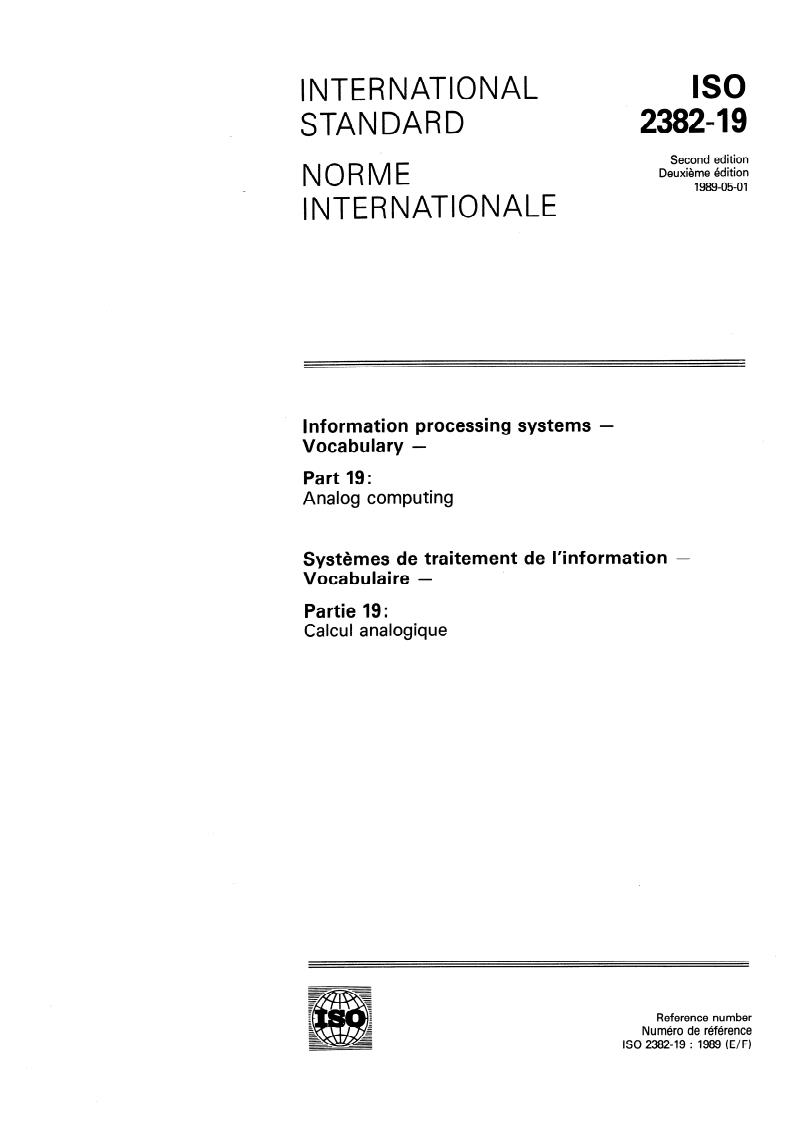
IS0
INTERNATIONAL
2382-19
STANDARD
Second edition
Deuxieme edition
NORME
1989-05-01
INTERNATIONALE
Information processing systems -
Vocabulary -
Part 19:
Analog computing
SystGmes de traitement de I’information -
Vocabulaire - 1
Partie 19:
Calcul analogique
Reference number
Numkro de reference
IS0 2382-19 : 1989 (E/F)
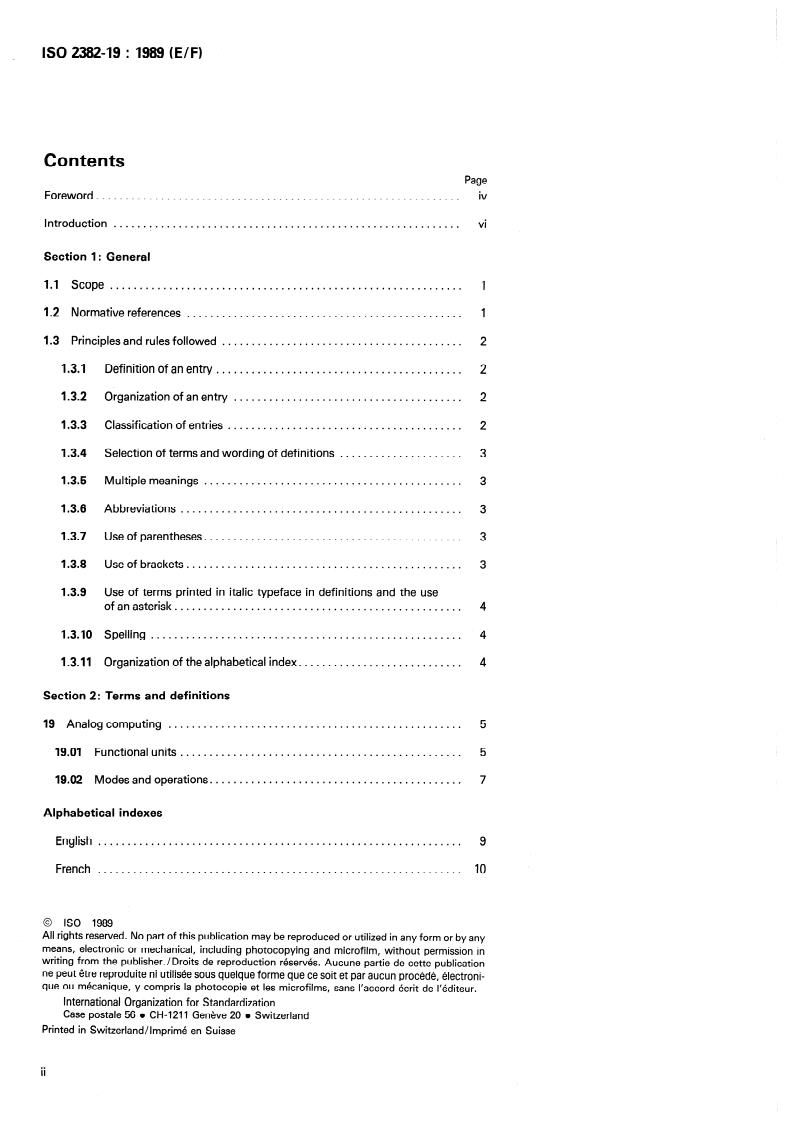
IS0 238249 : 1989 (E/F)
Contents
Page
Foreword. iv
Introduction . . . . . . . . . . . . . . . . . . . . . . . . . . . . . . . . . . . . . . . . . . . . . . . . . . . . . . . . . . . vi
Section 1: General
1.1 Scope . . . . . . . . . . . . . . . . . . . . . . . . . . . . . . . . . . . . . . . . . . . . . . . . . . . . . . . . . . . . 1
1.2 Normative references . . . . . . . . . . . . . . . . . . . . . . . . . . . . . . . . . . . . . . . . . . . . . . .
1.3 Principles and rules followed . . . . . . . . . . . . . . . . . . . . . . . . . . . . . . . . . . . . . . . . . 2
1.3.1 Definition of an entry . . . . . . . . . . . . . . . . . . . . . . . . . . . . . . . . . . . . . . . . . .
1.3.2 Organization of an entry . . . . . . . . . . . . . . . . . . . . . . . . . . . . . . . . . . . . . . . 2
1.3.3 Classification of entries . . . . . . . . . . . . . . . . . . . . . . . . . . . . . . . . . . . . . . . . 2
1.3.4 Selection of terms and wording of definitions . . . . . . . . . . . . . . . . . . . . . 3
1.3.5 Multiple meanings . . . . . . . . . . . . . . . . . . . . . . . . . . . . . . . . . . . . . . . . . . . . 3
1.3.6 Abbreviations . . . . . . . . . . . . . . . . . . . . . . . . . . . . . . . . . . . . . . . . . . . . . . . . 3
1.3.7 Use of parentheses. . . . . . . . . . . . . . . . . . . . . . . . . . . . . . . . . . . . . . . . . . .
1.3.8 Useof brackets. . . . . . . . . . . . . . . . . . . . . . . . . . . . . . . . . . . . . . . . . . . . . . 3
1.3.9 Use of terms printed in italic typeface in definitions and the use
ofanasterisk. 4
1.3.10 Spelling . . . . . . . . . . . . . . . . . . . . . . . . . . . . . . . . . . . . . . . . . . . . . . . . . . . . . 4
Organization of the alphabetical index. . . . . . . . . . . . . . . . . . . . . . . . . . . . 4
1.3.11
Section 2: Terms and definitions
19 Analog computing . . . . . . . . . . . . . . . . . . . . . . . . . . . . . . . . . . . . . . . . . . . . . . . . . .
19.01 Functional units . . . . . . . . . . . . . . . . . . . . . . . . . . . . . . . . . . . . . . . . . . . . . . . .
19.02 Modes and operations. . . . . . . . . . . . . . . . . . . . . . . . . . . . . . . . . . . . . . . . . . .
Alphabetical indexes
English . . . . . . . . . . . . . . . . . . . . . . . . . . . . . . . . . . . . . . . . . . . . . . . . . . . . . . . . . . . . . .
IO
French . . . . . . . . . . . . . . . . . . . . . . . . . . . . . . . . . . . . . . . . . . . . . . . . . . . . . . . . . . . . . .
0 IS0 1989
All rights reserved. No part of this publication may be reproduced or utilized in any form or by any
means, electronic or mechanical, including photocopying and microfilm, without permission in
writing from the publisher./Droits de reproduction reserves. Aucune partie de cette publication
ne peut etre reproduite ni utilisee sous quelque forme que ce soit et par aucun procede, electroni-
que ou mecanique, y compris la photocopie et les microfilms, sans I’accord ecrit de l’editeur.
International Organization for Standardization
Case postale 56 l CH-1211 Geneve 20 l Switzerland
Printed in Switzerland/lmprime en Suisse
ii
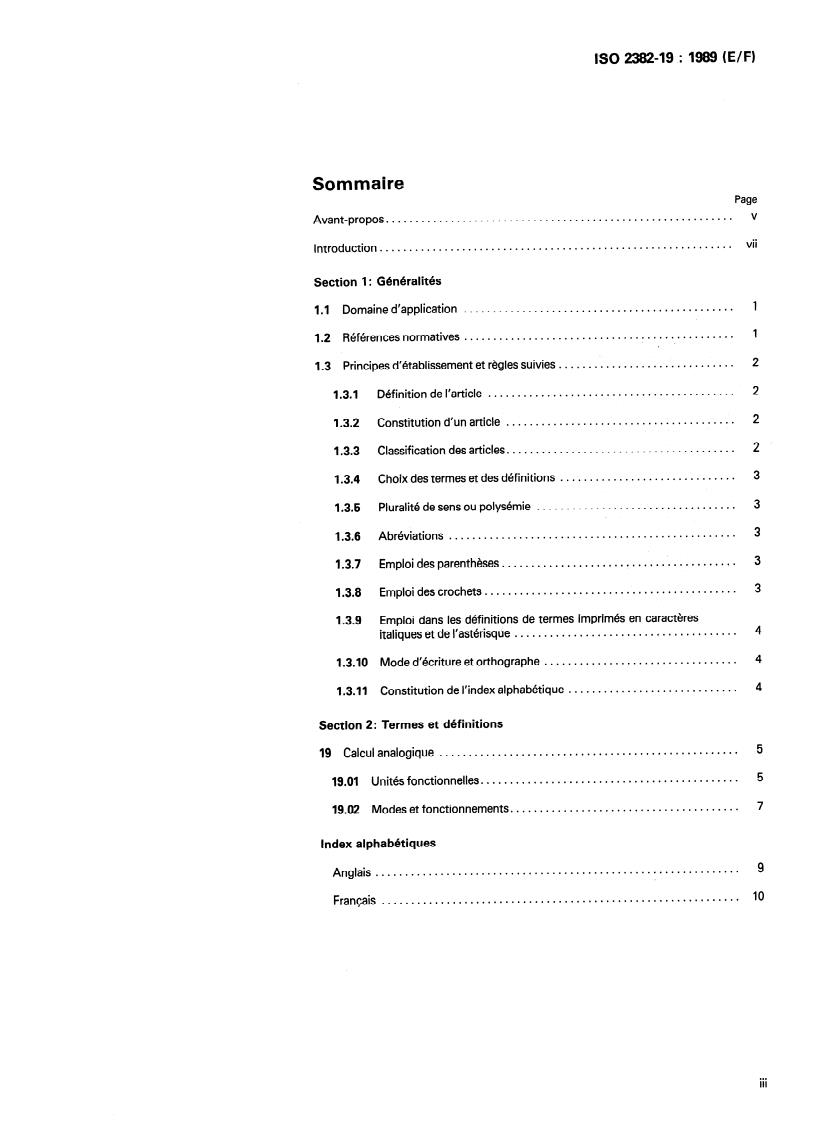
1~02382-19:1989 (E/F)
Sommaire
Page
V
Avant-propos . . . . . . . . . . . . a
vii
Introduction . . . . . . . . . . . . . .
Section 1: G&kralit~s
1.1 Domaine d’application
. . . . . . . . . . . . . . . . . . . . . . . . . . . . . . . . . . . . . .*. 1
1.2 References normatives
1.3 Principes d’etablissement et regles suivies . . . . . . . . . . . . . . . . . . . . . . . . . . . . . .
..........................................
1.3.1 Definition de I’article
.......................................
1.3.2 Constitution d’un article
......................................
1.3.3 Classification des articles.
..............................
1.3.4 Choix des termes et des definitions
..................................
1.3.5 Pluralite de sens ou polysemie
1.3.6 Abreviations .
.......................................
1.3.7 Emploi des parentheses.
..........................................
1.3.8 Emploi des crochets.
1.3.9 Emploi dans les definitions de termes imprimes en caracteres
...................................... 4
italiques et de I’asterisque
.................................
1.3.10 Mode d’ecriture et orthographe
............................. 4
1.3.11 Constitution de I’index alphabetique
Section 2: Termes et definitions
...................................................
19 Calcul analogique
...........................................
19.01 Unites fonctionnelles.
......................................
19.02 Modes et fonctionnements.
Index alphabetiques
Anglais.
Francais . . . . . . . . . . . . . . . . . . . . . . . . . . . . . . . . . . . . . . . . . . . . . . . . . . . . . . . . . . . . .
. . .
III
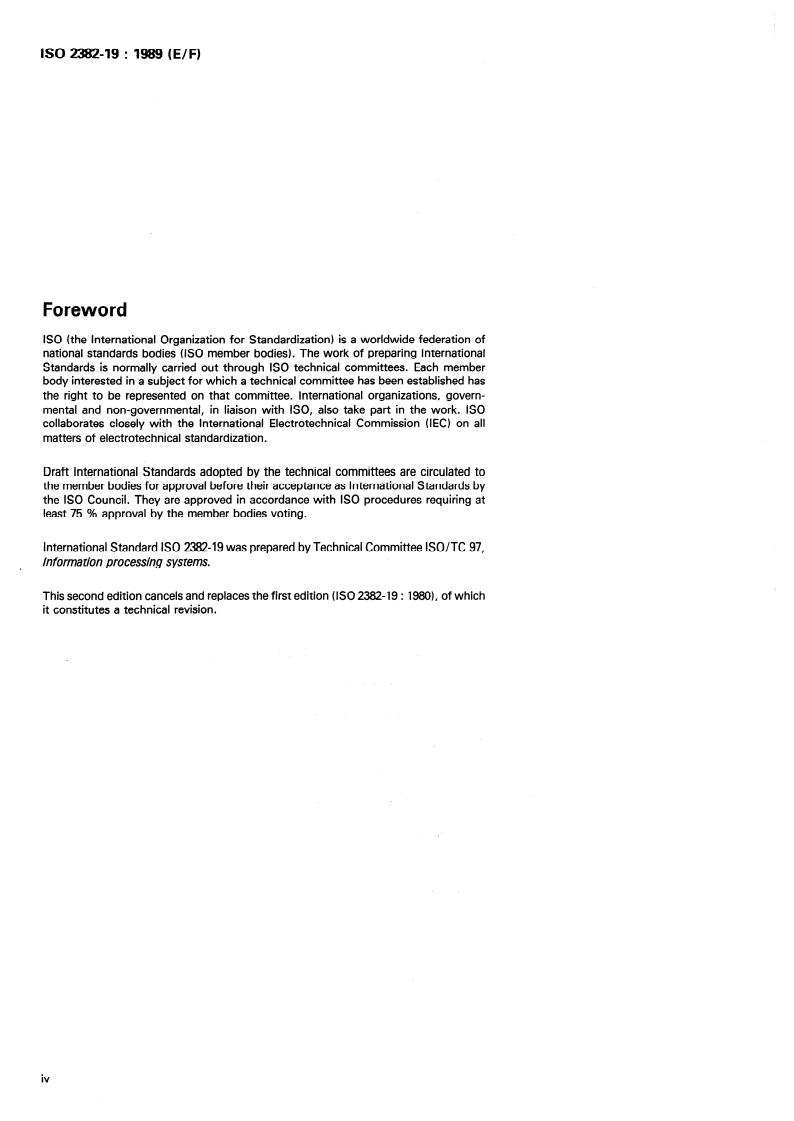
lSO’2382-19 : 1989 (E/F)
Foreword
IS0 (the International Organization for Standardization) is a worldwide federation of
national standards bodies (IS0 member bodies). The work of preparing International
Standards is normally carried out through IS0 technical committees. Each member
body interested in a subject for which a technical committee has been established has
the right to be represented on that committee. International organizations, govern-
mental and non-governmental, in liaison with ISO, also take part in the work. IS0
collaborates closely with the International Electrotechnical Commission (IEC) on all
matters of electrotechnical standardization.
Draft International Standards adopted by the technical committees are circulated to
the member bodies for approval before their acceptance as International Standards by
the IS0 Council. They are approved in accordance with IS0 procedures requiring at
least 75 % approval by the member bodies voting.
19 was prepared Technical Committee ISO/TC
International Standard IS0 2382- 97,
bY
lnforma tion processing s ys terns.
.
This second edition cancels and replaces the first edition (IS0 2382-19 : 19801, of which
it constitutes a technical revision.
:ISO 2382-w I 1989 (E/-F)
Avant-propos
L’ISO (Organisation internationale de normalisation) est une federation mondiale
d’organismes nationaux de normalisation (corn& membres de I’ISO). L’elaboration
des Normes internationales est en general confide aux comites techniques de I’ISO.
Chaque comite membre interesse par une etude a le droit de faire partie du comite
technique tree a cet effet. Les organisations internationales, gouvernementales et non
gouvernementales, en liaison avec I’ISO participent egalement aux travaux. L’ISO col-
labore etroitement avec la Commission electrotechnique internationale (CEI) en ce qui
concerne la normalisation electrotechnique.
Les projets de Normes internationales adopt& par les comites techniques sont soumis
aux comites membres pour approbation, avant leur acceptation comme Normes inter-
nationales par le Conseil de I’ISO. Les Normes internationales sont approuvees confor-
m6ment aux procedures de I’ISO qui requierent I’approbation de 75 % au moins des
comites membres votants.
La Norme internationale IS0 2382-19 a et6 elaboree par le comite technique
ISOITC 97, S ysthes de traitemen t de l’informa tion.
Cette deuxieme edition annule et remplace la premiere edition (IS0 2382-19 : 19801,
dont elle constitue une revision technique.
ISo2382-19:1989 (E/F)
Introduction
Information processing gives rise to numerous international exchanges of both an
intellectual and a material nature. These exchanges often become difficult, either
because of the great variety of terms used in various fields or languages to express the
same concept, or because of the absence or imprecision of the definitions of useful
concepts.
To avoid misunderstandings and to facilitate such exchanges it is essential to clarify the
concepts, to select terms to be used in various languages or in various countries to ex-
press the same concept, and to establish definitions providing satisfactory equivalents
for the various terms in different languages.
IS0 2382 was initially based mainly on the usage to be found in the Vocabulary of lnfor-
mation Processing which was established and published by the Inteinational Federa-
tion for Information Processing and the International Computation Centre, and in the
American National Dictionary for Information Processing systems and its earlier
editions published by the American National Standards Institute (formerly known as
the American Standards Association). Published and draft International Standards
relating to information processing of other international organizations (such as the
International Telecommunication Union and the International Electrotechnical Com-
mission) as well as published and draft national standards have also been considered.
The purpose of IS0 2382 is to provide definitions that are rigorous, uncomplicated and
which can be understood by all concerned. The scope of each concept defined has
been chosen to provide a definition that is suitable for general application. In those cir-
cumstances, where a restricted application is concerned, the definition may need to be
more specific.
However, while it is possible to maintain the self-consistency of individual parts, the
reader is warned that the dynamics of language and the problems associated with the
standardization and maintenance of vocabularies may introduce duplications and
inconsistencies between parts.
IS0 2382-19 : 1989 (E/F)
Introduction
Le traitement de I’information est a I’origine de multiples echanges intellectuels et
materiels sur le plan international. Ceux-ci souff rent souvent des difficult& provoquees
par la diversite des termes utilises pour exprimer la meme notion dans des langues ou
dans des domaines differents, ou encore de l’absence ou de I’imprecision des defini-
tions pour les notions les plus utiles.
Pour eviter des malentendus et faciliter de tels echanges, il paraR essentiel de preciser
les notions, de choisir les termes a employer dans les differentes langues et dans les
divers pays pour exprimer la meme notion, et d’etablir pour ces termes des definitions
equivalentes dans chaque langue.
L’ISO 2382 a et6 basee a I’origine principalement sur I’usage tel qu’il a et6 releve, d’une
part, dans le Vocabulary of Information Processing etabli et publie par I’lnternational
Federation for Information Processing et le Centre International de Calcul et, d’autre
part, dans I’American National Dictionary for Information Processing systems y com-
pris ses editions precedentes publiees par I’American National Standards Institute
(connu auparavant sous l’appellation d’American Standards Association). Les Normes
internationales publiees ou au stade de projets concernant le traitement de I’informa-
tion emanant d’autres organisations internationales (telles que I’Union internationale
des telecommunications et la Commission electrotechnique internationale) ainsi que
les normes nationales publiees ou au stade de projets, ont egalement et6 prises en
’ compte.
Le but de I’ISO 2382 est de procurer des definitions rigoureuses, simples et comprehen-
sibles pour tous les interesses. La pot-tee de chaque notion a et6 choisie de facon que
sa definition puisse avoir la valeur la plus generale. Cependant, il est parfois necessaire
de restreindre une notion a un domaine plus etroit et de lui donner alors une definition
plus specifique.
D’autre part, si l’on peut assurer la coherence interne de chaque partie prise individuel-
lement, la coherence des diverses parties entre elles est plus difficile a atteindre. Le lec-
teur ne doit pas s’en etonner : la dynamique des langues et les problemes de I’etablisse-
ment et de la revision des normes de vocabulaires peuvent etre 8 I’origine de quelques
repetitions ou contradictions entre des parties qui ne sont pas toutes preparees et
publiees simultanement.
vii
This page intentionally left blank
INTERNATIONAL STANDARD
IS0 2382-19 : 1989 (E/F)
NORME INTERNATIONALE
Information processing
SystGmes de traitement de
systems - Vocabulary -
I’infMmation -
Vocabulaire -
Part 19:
Analog computing Partie 19:
Calcul analogique
Section 1 I Gb6raIit6s
Section I: General
1.1 Scope 1 .l Domaine d’application
This part of IS0 2382 is intended to facilitate international com- La presente partie de I’ISO 2982 a pour objet de faciliter les
echanges internationaux dans le domaine des systemes de trai-
munication in information processing. It presents, in two
tement de I’information. A cet effet, elle presente un ensemble
languages, terms and definitions of selected concepts relevant
bilingue de termes et de definitions ayant trait a des notions
to the field of information processing and identifies relation-
ships between the entries. choisies dans ce domaine, et definit les relations pouvant exis-
ter entre les differentes notions.
In order to facilitate their translation into other languages, the
Les definitions ont et6 etablies de maniere a eviter les particula-
definitions are drafted so as to avoid, as far as possible, any
rismes propres a une langue donnee, en vue de faciliter leur
peculiarity attached to a language.
transposition dans les langues autres que celles ayant servi a la
redaction initiale.
IS0 2382 (which will comprise some twenty-eight parts)
defines concepts relating to analog and hybrid arithmetic units,
L’ISO 2982, qui en comprendra une trentaine, definit les
function generators, converters, and modes of operation of
such components. notions relatives aux unites arithmetiques analogiques et hybri-
des, aux generateurs de fonction, aux convertisseurs et aux
modes de fonctionnement de ces composants.
1.2 RGfbences normatives
1.2 Normative references
The following standards contain provisions which, through Les normes suivantes contiennent des dispositions qui, par
suite de la reference qui en est faite, constituent des disposi-
reference in this text, constitute provisions of this part of
tions valables pour la presente partie de I’ISO 2982. Au moment
IS0 2982. At the time of publication, the editions indicated
de la publication, les editions indiquees etaient en vigueur.
were valid. All standards are subject to revision, and parties to
Toute norme est sujette a revision et les parties prenantes des
agreements based on this part of IS0 2382 are encouraged to
investigate the possibility of applying the most recent editions accords fond& sur la presente partie de I’ISO 2382 sont invi-
tees a rechercher la possibilite d’appliquer les editions les plus
of the standards listed below. Members of IEC and IS0 main-
tain registers of currently valid International Standards. recentes des normes indiquees ci-apres. Les membres de la CEI
et de I’ISO possedent le registre des Normes internationales en
vigueur a un moment donne.
IS0 639 : 1988, Code for the representation of names of
languages.
IS0 639 : 1988, Code pour la reprkentation des noms de
langue.
IS0 1087 : - I), Terminology - Vocabulary.
IS0 1087 : - 1 )I Terminologie - Vocabulaire.
I) To be published. I) A publier.
IS0 238249 : 1989 (E/F)
1.3 Principes d’&ablissement et regles suivies
1.3 Principles and rules followed
1.3.1 Dhfinition de I’article
1.3.1 Definition of an entry
La section 2 est composee d’un certain nombre d’articles. Cha-
Section 2 comprises a number of entries. Each entry consists of a
que article est compose d’un ensemble d’elements essentiek
set of essential elements that includes an index number, one
comprenant le numero de reference, le terme ou plusieurs ter-
term or several synonymous terms, and a phrase defining one
mes synonymes et la definition d’une notion couverte par ces
concept. In addition, an entry may include examples, notes or il-
termes. Cet ensemble peut etre complete par des exemples,
lustrations to facilitate understanding of the concept.
des notes, des schemas ou des tableaux destines a faciliter la
comprehension de la notion.
Occasionally, the same term may be defined in different entries,
or two or more concepts may be covered by one entry, as
Parfois, le meme terme peut etre defini dans des articles diffe-
described in 1.3.5 and 1.3.8 respectively.
rents, ou bien deux notions ou davantage peuvent etre couver-
tes par un seul article : voir respectivement en 1.3.5 et 1.3.8.
Other terms such as vocabulary, concept, term and defini-
tion, are used in this part of IS0 2382 with the meaning defined
D’autres termes tels que vocabulaire, notion, terme, defini-
in IS0 1087.
tion sont employ& dans la presente partie de I’ISO 2382 avec le
sens qui leur est donne dans I’ISO 1087.
1.3.2 Constitution d’un article
1.3.2 Organization of an entry
Chaque article contient les elements essentiels definis en 1.3.1
Each entry contains the essential elements defined in 1.3.1 and, if
et, si necessaire, des elements supplementaires. L’article peut
necessary, additional elements. The entry may contain the
done comprendre dans I’ordre les elements suivants:
following elements in the following order:
a) un numero de reference (le meme, quelle que soit la lan-
a) an index number (common for all languages in which this
part of IS0 2382 is published); gue de publication de la presente partie de I’ISO 23821;
b) le terme, ou le terme prefer6 en general dans la langue.
b) the term or the generally preferred term in the language.
L’absence, dans une langue, de terme consacre ou a conseil-
The absence of a generally accepted term for the concept in
ler pour exprimer une notion est indiquee par un symbole
the language is indicated by a symbol consisting of five points
consistant en cinq points de suspension (. . . . .); les points de
(. . . . .I; a row of dots may be used to indicate, in a term, a
suspension peuvent etre employ& pour designer, dans un
word to be chosen in each particular case;
terme, un mot a choisir dans chaque cas particulier;
c) the preferred term in a particular country (identified
c) le terme prefer6 dans un certain pays (identifie selon les
according to the rules of IS0 639);
regles de I’ISO 639);
d) the abbreviation for the term;
d) I’abreviation pouvant etre employee a la place du terme;
e) permitted synonymous term(s);
le terme ou les termes admis comme synonymes;
e)
f) the text of the definition (see 1.3.4);
f) le texte de la definition (voir 1.3.4);
one or more examples with the heading “Example(s)“;
9)
un ou plusieurs exemples precedes du titre ((Exemplek)));
cl)
h) one or more notes specifying particular cases in the field
h) une ou plusieurs notes precisant le domaine d’application
of application of the concepts, with the heading “NOTE(S)“;
de la notion, precedees du titre ((NOTE(S)));
i) a picture, a diagram, or a table which could be common
i) une figure, un schema ou un tableau,
pouvant etre com-
to several entries.
muns a plusieu rs articles.
1.3.3 Classification des articles
1.3.3 Classification of entries
Chaque partie de la presente Norme internationale recoit un
A two-digit serial number is assigned to each part of this Inter-
numero d’ordre a deux chiffres, en commencant pas 01 ‘pour le
national Standard, beginning with 01 for “fundamental
chapitre (ttermes fondamentauxw
terms”.
Les articles sont repartis en groupes qui recoivent chacun un
The entries are classified in groups to each of which is assigned a
numero d’ordre a quatre chiffres, les deux premiers chiffres &ant
four-digit serial number; the first two digits being those of the
ceux du numero de pat-tie de la presente Norme internationale.
part of this International Standard.
ISO 2382-w : 1989 (E/F)
Each entry is assigned a six-digit index number; the first four Chaque article est rep&e par un numero de reference a six chif-
digits being those of the part of this International Standard and fres, les quatre premiers chiffres &ant ceux du numero de par-
the group. tie de la presente Norme internationale et de groupe.
In order that versions of this International Standard in various Les numeros des parties, des groupes et des articles sont les
memes pour toutes les langues, afin de mettre en evidence les
languages are related, the numbers assigned to parts, groups
correspondances des versions de la presente Norme interna-
and entries are the same for all languages.
tionale.
1.3.4 Selection of terms and wording of definitions 1.3.4 Choix des termes et des definitions
The selection of terms and the wording of definitions have, as Les choix qui ont et6 faits pour les termes et leurs definitions
sont, dans toute la mesure du possible, compatibles avec les
far as possible, followed established usage. When there were
usages etablis. Lorsque certains usages apparaissent contradic-
contradictions, solutions agreeable to the majority have been
toires, des solutions de compromis ont et6 retenues.
sought.
1.3.5 Pluralit de sens ou polysemie
1.3.5 Multiple meanings
Lorsque, dans I’une des langues de travail, un meme terme
When, in one of the working languages, a given term has
several meanings, each meaning is given a separate entry in peut prendre plusieurs sens, ces sens sont definis dans des arti-
cles differents, pour faciliter I’adaptation du vocabulaire dans
order to facilitate translation into other languages.
d’autres langues.
1.3.6 Abbreviations 1.3.6 Abreviations
Comme indique en 1.3.2, des abreviations litterales d’usage
As indicated in 1.3.2, abbreviations in current use are given for
courant, au moins en anglais, sont indiquees pour certains ter-
some terms. Such abbreviations are not used in the texts of the
mes. De telles abreviations ne sont pas employees dans le corps
definitions, examples or notes.
des definitions, exemples ou notes.
1.3.7 Emploi des parentheses
1.3.7 Use of parentheses
Dans certains termes, un ou plusieurs mots imprimes en carac-
In some terms, a word or words printed in bold typeface are
t&es gras sont places entre parentheses. Ces mots font partie
placed between parentheses. These words are part of the com-
integrante du terme complet, mais peuvent etre omis lorsque le
plete term, but they may be omitted when use of the abridged
terme ainsi abrege peut etre employ6 dans un contexte techni-
term in a technical context does not introduce ambiguity. In the
que determine sans que cette omission introduise d’ambiguite.
text of another definition, example, or note in this part of
Un tel terme n’est employ6 dans le texte d’une autre definition,
IS0 2332, such a term is used only in its complete form.
d’un exemple ou d’une note, dans la presente partie de
In some entries, the terms are followed by words in paren- I’ISO 2332, que sous sa forme complete.
theses in normal typeface. These words are not a part of the
Dans certains articles, les termes definis sont suivis par des
term but indicate directives for the use of the term, its particular
expressions imprimees en caracteres normaux et placees entre
field of application, or its grammatical form.
parentheses. Ces expressions ne font pas partie du terme mais
indiquent des prescriptions d’emploi, precisent un domaine
d’application particulier ou indiquent une forme grammaticale.
1.3.8 Use of brackets 1.3.8 Emploi des crochets
When several closely related terms can be defined by texts that Lorsque plusieurs termes etroitement apparent& peuvent etre
definis par des textes presque identiques, a quelques mots
differ only in a few words, the terms and their definitions are
grouped in a single entry. The words to be substituted in order pres, les termes et leurs definitions ont et6 group& en un seul
to obtain the different meanings are placed in brackets, i.e. article. Les mots a substituer a ceux qui les precedent pour
I, in the same order in the term and in the definition. In obtenir les differents sens sont places entre crochets (c’est-a-
[
order to avoid uncertainty regarding the words to be sub- dire [ I) dans le meme ordre dans le terme et dans la defi-
stituted, the last word that according to the above rule could be nition. En vue d’eviter toute incertitude
...