

ISO/IEC 2382-7:2000
(Main)Information technology — Vocabulary — Part 7: Computer programming
General Information
- Abstract
- Status
- Published
- Publication Date
- 05-Apr-2000
- Technical Committee
- ISO/IEC JTC 1 - Information technology
- Drafting Committee
- ISO/IEC JTC 1 - Information technology
- Current Stage
- 9092 - International Standard to be revised
- Start Date
- 12-Dec-2025
- Completion Date
- 29-Aug-2026
Overview
ISO/IEC 2382-7:2000 is an internationally recognized standard published by the International Organization for Standardization (ISO) and the International Electrotechnical Commission (IEC). Titled Information technology - Vocabulary - Part 7: Computer programming, this standard is a vital reference for anyone involved in computer programming or related information technology fields. Its main purpose is to facilitate international communication by providing consistent bilingual definitions (English and French) for terms and concepts in the area of computer programming. This ensures clarity and alignment across different languages, industries, and regions.
Key Topics
ISO/IEC 2382-7:2000 covers essential topics and terminology relevant to the practice of computer programming, such as:
- Kinds of Languages: Definitions for various programming language types used in software and application development.
- Methods and Techniques: Standardized terms describing programming methods, techniques, and program structure.
- Iteration and Recursion: Vocabulary for common programming constructs like loops and recursive procedures.
- Program Preparation: Terms related to creating, compiling, and assembling computer programs.
- Linking and Loading: Standard definitions for processes that connect and load program components for execution.
- Program Execution: Vocabulary around running software, including processes, tasks, and execution environments.
- Debugging and Checking: Terminology for activities ensuring program correctness, such as debugging and validation.
- Microprogramming: Definitions focusing on programming at the hardware or micro-level.
- Instructions and Addresses: Terms relating to instructions, memory addresses, and related programming aspects.
- Concurrent Processes: Vocabulary for parallel and concurrent execution in computer programs.
- Support Environments: Definitions for development environments and tools.
- Goals and Principles: Core programming principles and objectives.
The standard also provides guidance on the organization of entries, the use of abbreviations, parentheses, brackets, and offers examples, notes, and illustrations to clarify complex concepts.
Applications
The practical value of ISO/IEC 2382-7:2000 extends to several areas within information technology:
- Software Development: Provides a unified programming vocabulary for software engineers, system architects, and developers, promoting clear technical communication across international teams.
- Technical Documentation: Serves as a reference for technical writers and translators needing precise, standardized terms for programming documentation.
- Education and Training: Acts as authoritative material for educators and trainers in computer science, ensuring learners are familiar with internationally accepted terminology.
- Standards Compliance: Assists organizations in adhering to international IT standards, facilitating better collaboration and integration in global markets.
- Translation and Localization: Supports professionals translating programming documentation by offering bilingual, unambiguous definitions.
Related Standards
ISO/IEC 2382-7:2000 is part of the broader ISO/IEC 2382 series, a multi-part standard covering vocabulary for all facets of information technology. Relevant related standards include:
- ISO/IEC 2382-6: Information processing systems - Vocabulary - Part 6: Preparation and handling of data
- ISO/IEC 2382-10: Data processing - Vocabulary - Part 10: Operating techniques and facilities
- ISO/IEC 2382-20: Information technology - Vocabulary - Part 20: System development
- ISO/IEC 2382-23: Information technology - Vocabulary - Part 23: Text processing
Additional references supporting the definitions and structure within ISO/IEC 2382-7:2000 include ISO 1087 (Terminology - Vocabulary) and ISO 3166-1 (Codes for country names and subdivisions).
Utilizing ISO/IEC 2382-7:2000 ensures consistency, clarity, and interoperability in computer programming vocabulary across international projects and organizations. For any professional or organization involved in software development or information technology, this standard is an indispensable resource for best practices in programming terminology.
Relations
- Effective Date
- 16-Feb-2013
- Effective Date
- 15-Apr-2008
Get Certified
Connect with accredited certification bodies for this standard

BSI Group
BSI (British Standards Institution) is the business standards company that helps organizations make excellence a habit.

NYCE
Mexican standards and certification body.
Sponsored listings
Frequently Asked Questions
ISO/IEC 2382-7:2000 is a standard published by the International Organization for Standardization (ISO). Its full title is "Information technology — Vocabulary — Part 7: Computer programming". This standard covers: Information technology — Vocabulary — Part 7: Computer programming
Information technology — Vocabulary — Part 7: Computer programming
ISO/IEC 2382-7:2000 is classified under the following ICS (International Classification for Standards) categories: 01.040.35 - Information technology (Vocabularies); 35.020 - Information technology (IT) in general. The ICS classification helps identify the subject area and facilitates finding related standards.
ISO/IEC 2382-7:2000 has the following relationships with other standards: It is inter standard links to ISO/IEC 2382:2015, ISO/IEC 2382-7:1989. Understanding these relationships helps ensure you are using the most current and applicable version of the standard.
ISO/IEC 2382-7:2000 is available in PDF format for immediate download after purchase. The document can be added to your cart and obtained through the secure checkout process. Digital delivery ensures instant access to the complete standard document.
Standards Content (Sample)
INTERNATIONAL ISO/IEC
STANDARD 2382-7
NORME
Third edition
Troisième édition
INTERNATIONALE
2000-04-01
Information technology — Vocabulary —
Part 7:
Computer programming
Technologies de l’information —
Vocabulaire —
Partie 7:
Programmation des ordinateurs
Reference number
Numéro de référence
©
ISO/IEC 2000
PDF disclaimer
This PDF file may contain embedded typefaces. In accordance with Adobe's licensing policy, this file may be printed or viewed but shall not
be edited unless the typefaces which are embedded are licensed to and installed on the computer performing the editing. In downloading this
file, parties accept therein the responsibility of not infringing Adobe's licensing policy. The ISO Central Secretariat accepts no liability in this
area.
Adobe is a trademark of Adobe Systems Incorporated.
Details of the software products used to create this PDF file can be found in the General Info relative to the file; the PDF-creation parameters
were optimized for printing. Every care has been taken to ensure that the file is suitable for use by ISO member bodies. In the unlikely event
that a problem relating to it is found, please inform the Central Secretariat at the address given below.
PDF – Exonération de responsabilité
Le présent fichier PDF peut contenir des polices de caractères intégrées. Conformément aux conditions de licence d'Adobe, ce fichier peut
être imprimé ou visualisé, mais ne doit pas être modifié à moins que l'ordinateur employé à cet effet ne bénéficie d'une licence autorisant
l'utilisation de ces polices et que celles-ci y soient installées. Lors du téléchargement de ce fichier, les parties concernées acceptent de fait la
responsabilité de ne pas enfreindre les conditions de licence d'Adobe. Le Secrétariat central de l'ISO décline toute responsabilité en la
matière.
Adobe est une marque déposée d'Adobe Systems Incorporated.
Les détails relatifs aux produits logiciels utilisés pour la création du présent fichier PDF sont disponibles dans la rubrique General Info du
fichier; les paramètres de création PDF ont été optimisés pour l'impression. Toutes les mesures ont été prises pour garantir l'exploitation de
ce fichier par les comités membres de l'ISO. Dans le cas peu probable où surviendrait un problème d'utilisation, veuillez en informer le
Secrétariat central à l'adresse donnée ci-dessous.
© ISO/IEC 2000
All rights reserved. Unless otherwise specified, no part of this publication may be reproduced or utilized in any form or by any means, electronic
or mechanical, including photocopying and microfilm, without permission in writing from either ISO at the address below or ISO's member body
in the country of the requester. / Droits de reproduction réservés. Sauf prescription différente, aucune partie de cette publication ne peut être
reproduite ni utilisée sous quelque forme que ce soit et par aucun procédé, électronique ou mécanique, y compris la photocopie et les
microfilms, sans l'accord écrit de l’ISO à l’adresse ci-après ou du comité membre de l’ISO dans le pays du demandeur.
ISO copyright office
Case postale 56 � CH-1211 Geneva 20
Tel. + 41 22 749 01 11
Fax + 41 22 734 10 79
E-mail copyright@iso.ch
Web www.iso.ch
Printed in Switzerland/Imprimé en Suisse
ii © ISO/IEC 2000 – All rights reserved/Tous droits réservés
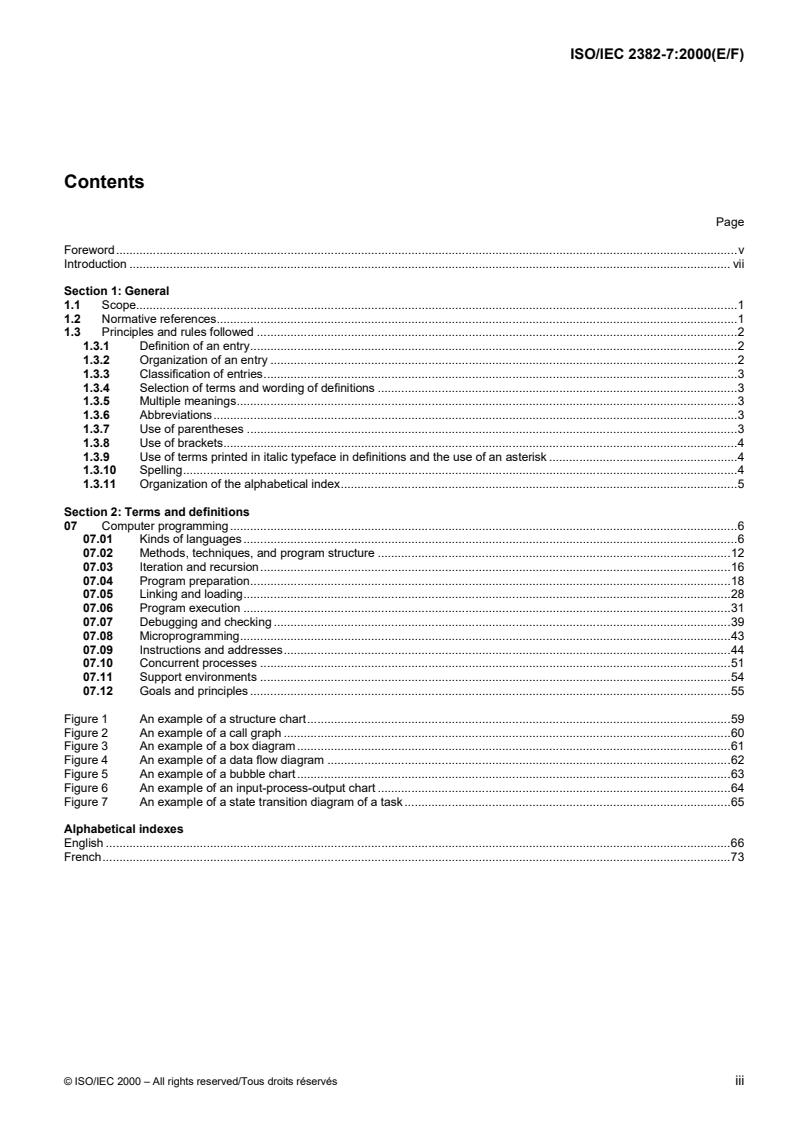
Contents
Page
Foreword.v
Introduction . vii
Section 1: General
1.1 Scope.1
1.2 Normative references.1
1.3 Principles and rules followed .2
1.3.1 Definition of an entry.2
1.3.2 Organization of an entry .2
1.3.3 Classification of entries.3
1.3.4 Selection of terms and wording of definitions .3
1.3.5 Multiple meanings.3
1.3.6 Abbreviations.3
1.3.7 Use of parentheses .3
1.3.8 Use of brackets.4
1.3.9 Use of terms printed in italic typeface in definitions and the use of an asterisk .4
1.3.10 Spelling.4
1.3.11 Organization of the alphabetical index.5
Section 2: Terms and definitions
07 Computer programming.6
07.01 Kinds of languages .6
07.02 Methods, techniques, and program structure .12
07.03 Iteration and recursion.16
07.04 Program preparation.18
07.05 Linking and loading.28
07.06 Program execution .31
07.07 Debugging and checking .39
07.08 Microprogramming.43
07.09 Instructions and addresses.44
07.10 Concurrent processes .51
07.11 Support environments .54
07.12 Goals and principles .55
Figure 1 An example of a structure chart.59
Figure 2 An example of a call graph .60
Figure 3 An example of a box diagram.61
Figure 4 An example of a data flow diagram .62
Figure 5 An example of a bubble chart.63
Figure 6 An example of an input-process-output chart .64
Figure 7 An example of a state transition diagram of a task.65
Alphabetical indexes
English .66
French.73
© ISO/IEC 2000 – All rights reserved/Tous droits réservés iii
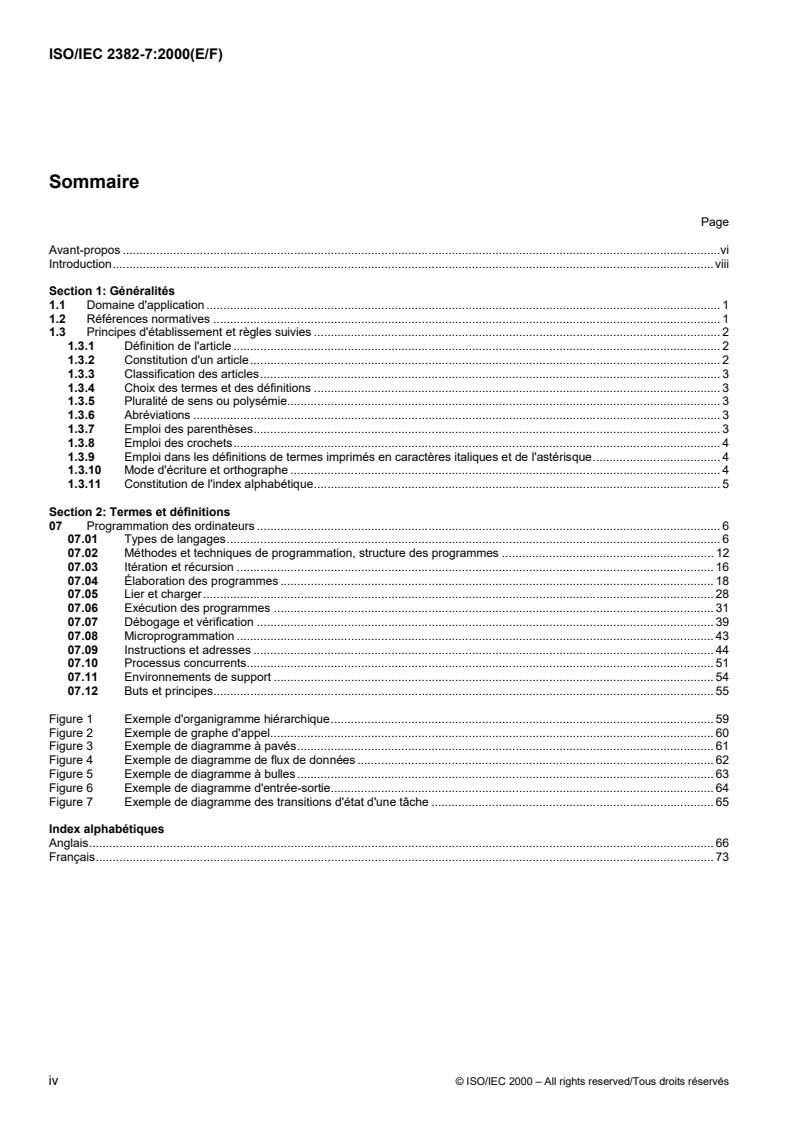
Sommaire
Page
Avant-propos .vi
Introduction.viii
Section 1: Généralités
1.1 Domaine d'application . 1
1.2 Références normatives . 1
1.3 Principes d'établissement et règles suivies . 2
1.3.1 Définition de l'article . 2
1.3.2 Constitution d'un article. 2
1.3.3 Classification des articles. 3
1.3.4 Choix des termes et des définitions . 3
1.3.5 Pluralité de sens ou polysémie. 3
1.3.6 Abréviations . 3
1.3.7 Emploi des parenthèses. 3
1.3.8 Emploi des crochets. 4
1.3.9 Emploi dans les définitions de termes imprimés en caractères italiques et de l'astérisque. 4
1.3.10 Mode d'écriture et orthographe . 4
1.3.11 Constitution de l'index alphabétique. 5
Section 2: Termes et définitions
07 Programmation des ordinateurs . 6
07.01 Types de langages. 6
07.02 Méthodes et techniques de programmation, structure des programmes . 12
07.03 Itération et récursion . 16
07.04 Élaboration des programmes . 18
07.05 Lier et charger. 28
07.06 Exécution des programmes . 31
07.07 Débogage et vérification . 39
07.08 Microprogrammation . 43
07.09 Instructions et adresses . 44
07.10 Processus concurrents. 51
07.11 Environnements de support . 54
07.12 Buts et principes. 55
Figure 1 Exemple d'organigramme hiérarchique. 59
Figure 2 Exemple de graphe d'appel. 60
Figure 3 Exemple de diagramme à pavés. 61
Figure 4 Exemple de diagramme de flux de données . 62
Figure 5 Exemple de diagramme à bulles. 63
Figure 6 Exemple de diagramme d'entrée-sortie. 64
Figure 7 Exemple de diagramme des transitions d'état d'une tâche . 65
Index alphabétiques
Anglais. 66
Français. 73
iv © ISO/IEC 2000 – All rights reserved/Tous droits réservés
Foreword
ISO (the International Organization for Standardization) and IEC (the International Electrotechnical Commission) form the
specialized system for worldwide standardization. National bodies that are members of ISO and IEC participate in the
development of International Standards through technical committees established by the respective organization to deal with
particular fields of technical activity. ISO and IEC technical committees collaborate in fields of mutual interest. Other
international organizations, governmental and non-governmental, in liaison with ISO and IEC, also take part in the work.
International Standards are drafted in accordance with the rules given in the ISO/IEC Directives, Part 3.
In the field of information technology, ISO and IEC have established a joint technical committee, ISO/IEC JTC 1. Draft
International Standards adopted by the joint technical committee are circulated to national bodies for voting. Publication as an
International Standard requires approval by at least 75 % of the national bodies casting a vote.
Attention is drawn to the possibility that some of the elements of this part of ISO/IEC 2382 may be the subject of patent rights.
ISO and IEC shall not be held responsible for identifying any or all such patent rights.
International Standard ISO/IEC 2382-7 was prepared by Joint Technical Committee ISO/IEC JTC 1, Information Technology,
Subcommittee SC 1, Vocabulary.
This third edition cancels and replaces the second edition (ISO/IEC 2382-7:1989), which has been technically revised.
ISO/IEC 2382 will consist of some 37 parts, under the general title Information technology – Vocabulary.
© ISO/IEC 2000 – All rights reserved/Tous droits réservés v
Avant-propos
L'ISO (Organisation internationale de normalisation) et la CEI (Commission électrotechnique internationale) forment le système
spécialisé de la normalisation mondiale. Les organismes nationaux membres de l'ISO ou de la CEI participent au
développement de Normes internationales par l'intermédiaire des comités techniques créés par l'organisation concernée afin de
s'occuper des domaines particuliers de l'activité technique. Les comités techniques de l'ISO et de la CEI collaborent dans des
domaines d'intérêt commun. D'autres organisations internationales, gouvernementales et non gouvernementales, en liaison
avec l'ISO et la CEI participent également aux travaux.
Les Normes internationales sont rédigées conformément aux règles données dans les Directives ISO/CEI, Partie 3.
Dans le domaine des technologies de l'information, l'ISO et la CEI ont créé un comité technique mixte, l'ISO/CEI JTC 1. Les
projets de Normes internationales adoptés par le comité technique mixte sont soumis aux organismes nationaux pour vote. Leur
publication comme Normes internationales requiert l'approbation de 75 % au moins des organismes nationaux votants.
L’attention est appelée sur le fait que certains des éléments de la présente partie de l’ISO/CEI 2382 peuvent faire l’objet de
droits de propriété intellectuelle ou de droits analogues. L’ISO et la CEI ne sauraient être tenues pour responsables de ne pas
avoir identifié de tels droits de propriété et averti de leur existence.
La Norme internationale ISO/CEI 2382-7 a été élaborée par le comité technique mixte ISO/CEI JTC 1, Technologies de
l'information, sous-comité SC 1, Vocabulaire.
Cette troisième édition annule et remplace la deuxième édition (ISO/CEI 2382-7:1989), dont elle constitue une révision
technique.
L'ISO/CEI 2382 comprendra environ 37 parties, présentées sous le titre général Technologies de l'information – Vocabulaire.
vi © ISO/IEC 2000 – All rights reserved/Tous droits réservés
Introduction
Information technology gives rise to numerous international exchanges of both an intellectual and a material nature. These
exchanges often become difficult, either because of the great variety of terms used in various fields or languages to express the
same concept, or because of the absence or imprecision of the definitions of useful concepts.
To avoid misunderstandings and to facilitate such exchanges it is essential to clarify the concepts, to select terms to be used in
various languages or in various countries to express the same concept, and to establish definitions providing satisfactory
equivalents for the various terms in different languages.
ISO 2382 was initially based mainly on the usage to be found in the Vocabulary of Information Processing which was
established and published by the International Federation for Information Processing and the International Computation Centre,
and in the American National Dictionary for Information Processing Systems and its earlier editions published by the American
National Standards Institute (formerly known as the American Standards Association). Published and Draft International
Standards relating to information technology of other international organizations (such as the International Telecommunication
Union and the International Electrotechnical Commission) as well as published and draft national standards have also been
considered.
The purpose of ISO/IEC 2382 is to provide definitions that are rigorous, uncomplicated and which can be understood by all
concerned. The scope of each concept defined has been chosen to provide a definition that is suitable for general application. In
those circumstances, where a restricted application is concerned, the definition may need to be more specific.
However, while it is possible to maintain the self-consistency of individual parts, the reader is warned that the dynamics of
language and the problems associated with the standardization and maintenance of vocabularies may introduce duplications
and inconsistencies among parts.
© ISO/IEC 2000 – All rights reserved/Tous droits réservés vii
Introduction
Les technologies de l'information sont à l'origine de multiples échanges intellectuels et matériels sur le plan international. Ceux-
ci souffrent souvent de difficultés provoquées par la diversité des termes utilisés pour exprimer la même notion dans des
langues ou des domaines différents, ou encore de l'absence ou de l'imprécision des définitions pour les notions les plus utiles.
Pour éviter des malentendus et faciliter de tels échanges, il paraît essentiel de préciser les notions, de choisir les termes à
employer dans les différentes langues et dans les divers pays pour exprimer la même notion, et d'établir pour ces termes des
définitions équivalentes dans chaque langue.
L'ISO 2382 a été basée à l'origine principalement sur l'usage tel qu'il a été relevé, d'une part, dans le Vocabulary of Information
Processing établi et publié par l'International Federation for Information Processing et le Centre international de calcul et, d'autre
part, dans l'American National Dictionary for Information Processing Systems y compris ses éditions précédentes publiées par
l'American National Standards Institute (connu auparavant sous l'appellation d'American Standards Association). Les Normes
internationales publiées ou au stade de projets concernant les technologies de l'information émanant d'autres organisations
internationales (telles que l'Union internationale des télécommunications et la Commission électrotechnique internationale),
ainsi que les normes nationales publiées ou au stade de projets, ont également été prises en compte.
Le but de l'ISO/CEI 2382 est de procurer des définitions rigoureuses, simples et compréhensibles pour tous les intéressés. La
portée de chaque notion a été choisie de façon que sa définition puisse avoir la valeur la plus générale. Cependant, il est
parfois nécessaire de restreindre une notion à un domaine plus étroit et de lui donner alors une définition plus spécifique.
D'autre part, si l'on peut assurer la cohérence interne de chaque partie prise individuellement, la cohérence des diverses parties
entre elles est plus difficile à atteindre. Le lecteur ne doit pas s'en étonner: la dynamique des langues et les problèmes de
l'établissement et de la révision des normes de vocabulaire peuvent être à l'origine de quelques répétitions ou contradictions
entre des parties qui ne sont pas toutes préparées et publiées simultanément.
viii © ISO/IEC 2000 – All rights reserved/Tous droits réservés
INTERNATIONAL STANDARD
NORME INTERNATIONALE
Information technology — Technologies de
Vocabulary — l'information — Vocabulaire —
Part 7: Partie 7:
Computer programming Programmation des ordinateurs
Section 1: General Section 1: Généralités
1.1 Scope 1.1 Domaine d'application
This part of ISO/IEC 2382 is intended to facilitate La présente partie de l'ISO/CEI 2382 a pour objet de faciliter
international communication in computer programming. It les échanges internationaux dans le domaine de la
presents, in two languages, terms and definitions of programmation des ordinateurs. À cet effet, elle présente un
selected concepts relevant to the field of information ensemble bilingue de termes et de définitions ayant trait à
technology and identifies relationships among the entries. des notions choisies dans ce domaine et définit les relations
pouvant exister entre les différentes notions.
In order to facilitate their translation into other languages, Les définitions ont été établies de manière à éviter les
the definitions are drafted so as to avoid, as far as possible, particularismes propres à une langue donnée, en vue de
any peculiarity attached to a language. faciliter leur transposition dans les langues autres que celles
ayant servi à la rédaction initiale.
This part of ISO/IEC 2382 contains general and selected La présente partie de l'ISO/CEI 2382 contient des termes
terms concerning computer programming, and specifically généraux et sélectionnés concernant la programmation des
preparation, execution, debugging, and verification of ordinateurs, et notamment la préparation, l'exécution, la
programs. ITU Recommendations have been taken into mise au point et la vérification des programmes. Les
account. Not included are proprietary terms and terms Recommandations de l'UIT ont été prises en compte. Ne
considered as too technical. sont pas inclus les termes spécifiques d'un constructeur et
les termes considérés comme trop techniques.
1.2 Normative references 1.2 Références normatives
The following normative documents contain provisions Les documents normatifs suivants contiennent des
which, through reference in this text, constitute provisions of dispositions qui, par suite de la référence qui y est faite,
this part of ISO/IEC 2382. For dated references, subsequent constituent des dispositions valables pour la présente partie
amendments to, or revisions of, any of these publications do de l'ISO/CEI 2382. Pour les références datées, les
not apply. However, parties to agreements based on this amendements ultérieurs ou les révisions de ces publications
part of ISO/IEC 2382 are encouraged to investigate the ne s'appliquent pas. Toutefois, les parties prenantes aux
possibility of applying the most recent editions of the accords fondés sur la présente partie de l'ISO/CEI 2382
normative documents indicated below. For undated sont invitées à rechercher la possibilité d'appliquer les
references, the latest edition of the normative document éditions les plus récentes des documents normatifs indiqués
referred to applies. Members of ISO and IEC maintain ci-après. Pour les références non datées, la dernière édition
registers of currently valid International Standards. du document normatif en référence s'applique. Les
membres de l'ISO et de la CEI possèdent le registre des
Normes internationales en vigueur.
1) 2)
ISO 1087:1990 , Terminology — Vocabulary. ISO 1087:1990 , Terminologie — Vocabulaire.
1)
Currently under revision.
2)
Actuellement en révision.
© ISO/IEC 2000 – All rights reserved/Tous droits réservés 1
ISO 3166-1:1997, Codes for the representation of names of ISO 3166-1:1997, Codes pour la représentation des noms
countries and their subdivisions — Part 1: Country codes. de pays et de leurs subdivisions — Partie 1: Codes pays.
ISO 2382-6:1987, Information processing systems — ISO 2382-6:1987, Systèmes de traitement de l'information —
Vocabulary — Part 6: Preparation and handling of data. Vocabulaire — Partie 6: Préparation et manipulation des
données.
ISO 2382-10:1979, Data processing — Vocabulary — ISO 2382-10:1979, Traitement de l'information —
Part 10: Operating techniques and facilities. Vocabulaire — Partie 10: Techniques et moyens
d'exploitation.
ISO/IEC 2382-20:1990, Information technology — ISO/CEI 2382-20:1990, Technologies de l'information —
Vocabulary — Part 20: System development. Vocabulaire — Partie 20: Développement de système.
ISO/IEC 2382-23:1994, Information technology — ISO/CEI 2382-23:1994, Technologies de l'information —
Vocabulary — Part 23: Text processing. Vocabulaire — Partie 23: Traitement de texte.
1.3 Principles and rules followed 1.3 Principes d'établissement et règles
suivies
1.3.1 Definition of an entry 1.3.1 Définition de l'article
Section 2 comprises a number of entries. Each entry La section 2 est composée d'un certain nombre d'articles.
consists of a set of essential elements that includes an Chaque article est composé d'un ensemble d'éléments
index number, one term or several synonymous terms, and essentiels comprenant le numéro de référence, le terme ou
a phrase defining one concept. In addition, an entry may plusieurs termes synonymes et la définition de la notion
include examples, notes or illustrations to facilitate couverte par ces termes. Cet ensemble peut être complété
understanding of the concept. par des exemples, des notes, des schémas ou des tableaux
destinés à faciliter la compréhension de la notion.
Occasionally, the same term may be defined in different Parfois, le même terme peut être défini dans des articles
entries, or two or more concepts may be covered by one différents, ou bien deux notions ou davantage peuvent être
entry, as described in 1.3.5 and 1.3.8 respectively. couvertes par un seul article: voir respectivement en 1.3.5 et
1.3.8.
Other terms such as vocabulary, concept, term,and D'autres termes tels que vocabulaire, notion, terme,
definition are used in this part of ISO/IEC 2382 with the définition, sont employés dans la présente partie de
meaning defined in ISO 1087. l'ISO/CEI 2382 avec le sens qui leur est donné dans l'ISO
1087.
1.3.2 Organization of an entry 1.3.2 Constitution d'un article
Each entry contains the essential elements defined in 1.3.1 Chaque article contient des éléments essentiels définis en
and, if necessary, additional elements. The entry may 1.3.1 et, si nécessaire, des éléments supplémentaires.
contain the following elements in the following order: L'article peut donc comprendre dans l'ordre les éléments
suivants:
a) an index number (common for all languages in which this a) un numéro de référence (le même, quelle que soit la
part of ISO/IEC 2382 is published); langue de publication de la présente partie de l'ISO/CEI
2382);
b) the term or the generally preferred term in the language. b) le terme, ou le terme préféré en général dans la langue.
The absence of a generally preferred term for the concept in L'absence, dans une langue, de terme consacré ou à
the language is indicated by a symbol consisting of five dots conseiller pour exprimer une notion est indiquée par un
(.); a row of dots may be used to indicate, in a term, a symbole consistant en cinq points de suspension (.); les
word to be chosen in each particular case; points de suspension peuvent être employés pour désigner,
dans un terme, un mot à choisir dans un cas particulier;
c) the preferred term in a particular country (identified c) le terme préféré dans un certain pays (identifié selon les
according to the rules of ISO 3166); règles de l'ISO 3166);
d) the abbreviation for the term; d) l'abréviation pouvant être employée à la place du terme;
e) permitted synonymous term(s); e) le terme ou les termes admis comme synonymes;
2 © ISO/IEC 2000 – All rights reserved/Tous droits réservés
f) the text of the definition (see 1.3.4); f) le texte de la définition (voir 1.3.4);
g) one or more examples with the heading "Example(s)"; g) un ou plusieurs exemples précédés du titre
«Exemple(s)»;
h) one or more notes specifying particular cases in the field h) une ou plusieurs notes précisant le domaine d'application
of application of the concepts with the heading "NOTE(S)"; de la notion, précédées du titre «NOTE(S)»;
i) a picture, a diagram, or a table which could be common to i) une figure, un schéma ou un tableau, pouvant être
several entries. communs à plusieurs articles.
1.3.3 Classification of entries 1.3.3 Classification des articles
A two-digit serial number is assigned to each part of Chaque partie de l'ISO/CEI 2382 reçoit un numéro d'ordre à
ISO/IEC 2382, beginning with 01 for "Fundamental terms". deux chiffres, en commençant par 01 pour la partie
«Termes fondamentaux».
The entries are classified in groups to each of which is Les articles sont répartis en groupes qui reçoivent chacun
assigned a four-digit serial number; the first two digits being un numéro d'ordre à quatre chiffres, les deux premiers
those of the part of ISO/IEC 2382. chiffres étant ceux du numéro de la partie de l'ISO/CEI
2382.
Each entry is assigned a six-digit index number; the first four Chaque article est repéré par un numéro de référence à six
digits being those of the part of ISO/IEC 2382 and the chiffres, les quatre premiers chiffres étant ceux du numéro
group. de partie de l'ISO/CEI 2382 et de groupe.
To show the relationship between versions of ISO/IEC 2382 Les numéros des parties, des groupes et des articles sont
in various languages, the numbers assigned to parts, les mêmes pour toutes les langues, afin de mettre en
groups, and entries are the same for all languages. évidence les correspondances des versions de l'ISO/CEI
2382.
1.3.4 Selection of terms and wording 1.3.4 Choix des termes et des définitions
of definitions
The selection of terms and the wording of definitions have, Les choix qui ont été faits pour les termes et leurs
as far as possible, followed established usage. Where there définitions sont, dans toute la mesure du possible,
were contradictions, solutions agreeable to the majority compatibles avec les usages établis. Lorsque certains
have been sought. usages apparaissent contradictoires, des solutions de
compromis ont été retenues.
1.3.5 Multiple meanings 1.3.5 Pluralité de sens ou polysémie
When, in one of the working languages, a given term has Lorsque, dans l'une des langues de travail, un même terme
several meanings, each meaning is given a separate entry peut prendre plusieurs sens, ces sens sont définis dans des
to facilitate translation into other languages. articles différents, pour faciliter l'adaptation du vocabulaire
dans d'autres langues.
1.3.6 Abbreviations 1.3.6 Abréviations
As indicated in 1.3.2, abbreviations in current use are given Comme indiqué en 1.3.2, des abréviations d'usage courant,
for some terms. Such abbreviations are not used in the texts au moins en anglais, sont indiquées pour certains termes.
of the definitions, examples or notes. De telles abréviations ne sont pas employées dans le corps
des définitions, exemples ou notes.
1.3.7 Use of parentheses 1.3.7 Emploi des parenthèses
In some terms, one or more words printed in bold typeface Dans certains termes, un ou plusieurs mots imprimés en
are placed between parentheses. These words are part of caractères gras sont placés entre parenthèses. Ces mots
the complete term, but they may be omitted when use of the font partie intégrante du terme complet, mais peuvent être
abridged term in a technical context does not introduce omis lorsque le terme ainsi abrégé peut être employé dans
ambiguity. In the text of another definition, example, or note un contexte technique déterminé sans que cette omission
of ISO/IEC 2382, such a term is used only in its complete ne crée d'ambiguïté. Un tel terme n'est employé dans le
form. texte d'une autre définition, d'un exemple ou d'une note de
l'ISO/CEI 2382, que sous sa forme complète.
© ISO/IEC 2000 – All rights reserved/Tous droits réservés 3
In some entries, the terms are followed by words in Dans certains articles, les termes définis sont suivis par des
parentheses in normal typeface. These words are not a part expressions imprimées en caractères normaux et placées
of the term but indicate directives for the use of the term, its entre parenthèses. Ces expressions ne font pas partie du
particular field of application, or its grammatical form. terme mais indiquent des prescriptions d'emploi, précisent
un domaine d'application particulier ou indiquent une forme
grammaticale.
1.3.8 Use of brackets 1.3.8 Emploi des crochets
When several closely related terms can be defined by texts Lorsque plusieurs termes étroitement apparentés peuvent
that differ only in a few words, the terms and their definitions être définis par des textes presque identiques, à quelques
are grouped in a single entry. The words to be substituted in mots près, les termes et leurs définitions ont été groupés en
order to obtain the different meanings are placed in un seul article. Les mots à substituer à ceux qui les
brackets, i.e. [ ], in the same order in the term and in the précèdent pour obtenir les différents sens sont placés entre
definition. To clearly identify the words to be substituted, the crochets, c'est-à-dire [ ], dans le même ordre dans le terme
last word that according to the above rule could be placed in et la définition. En vue d'éviter toute incertitude sur les mots
front of the opening bracket is, wherever possible, placed à remplacer, le dernier mot qui, suivant la règle ci-dessus,
inside the bracket and repeated for each alternative. pourrait être placé devant le crochet d'ouverture, est placé,
si possible, à l'intérieur des crochets et répété à chaque
occasion.
1.3.9 Use of terms printed in italic typeface 1.3.9 Emploi dans les définitions de termes
in definitions and the use of imprimés en caractères italiques et de
an asterisk l'astérisque
A term printed in italic typeface in a definition, an example, Dans le texte d'une définition, d'un exemple ou d'une note,
or a note is defined in another entry in this International tout terme imprimé en caractères italiques a le sens défini
Standard, which may be in another part. However, the term dans un autre article de la présente Norme internationale,
is printed in italic typeface only the first time it occurs in qui peut se trouver dans une autre partie. Cependant le
each entry. terme est imprimé en caractères italiques uniquement la
première fois qu'il apparaît dans chaque article.
Italic typeface is also used for other grammatical forms of a Les caractères italiques sont également utilisés pour les
term, for example, plurals of nouns and participles of verbs. autres formes grammaticales du terme, par exemple les
noms au pluriel et les verbes au participe.
The basic forms of all terms printed in italic typeface which La liste des formes de base des termes imprimés en
are defined in this part of ISO/IEC 2382 are listed in the caractères italiques qui sont définis dans la présente partie
index at the end of the part (see 1.3.11). de l'ISO/CEI 2382 est fournie dans l'index à la fin de la
partie (voir 1.3.11).
An asterisk is used to separate terms printed in italic L'astérisque sert à séparer les termes imprimés en
typeface when two such terms are referred to in separate caractères italiques quand deux termes se rapportent à des
entries and directly follow each other (or are separated only articles séparés et se suivent directement (ou bien sont
by a punctuation mark). séparés simplement par un signe de ponctuation).
Words or terms that are printed in normal typeface are to be Les mots ou termes imprimés en caractères normaux
understood as defined in current dictionaries or authoritative doivent être compris dans le sens qui leur est donné dans
technical vocabularies. les dictionnaires courants ou vocabulaires techniques
faisant autorité.
1.3.10 Spelling 1.3.10 Mode d'écriture et orthographe
In the English language version of this part of ISO/IEC 2382, Dans la version anglaise de la présente partie de l'ISO/CEI
terms, definitions, examples, and notes are given in the 2382, les termes, définitions, exemples et notes sont écrits
spelling preferred in the USA. Other correct spellings may suivant l'orthographe prévalant aux États-Unis. D'autres
be used without violating this part of ISO/IEC 2382. orthographes correctes peuvent être utilisées sans violer la
présente partie de l'ISO/CEI 2382.
4 © ISO/IEC 2000 – All rights reserved/Tous droits réservés
1.3.11 Organization of the alphabetical index 1.3.11 Constitution de l'index alphabétique
For each language used, an alphabetical index is provided Pour chaque langue de travail, un index alphabétique est
at the end of each part. The index includes all terms defined fourni à la fin de chaque partie. L'index comprend tous les
in the part. Multiple-word terms appear in alphabetical order termes définis dans la partie. Les termes composés de
under each of their key words. plusieurs mots sont répertoriés alphabétiquement suivant
chacun des mots clés.
© ISO/IEC 2000 – All rights reserved/Tous droits réservés 5
Section 2: Terms and definitions Section 2: Termes et définitions
07 Computer programming 07 Programmation des ordinateurs
07.01 Kinds of languages 07.01 Types de langages
07.01.01 07.01.01
metalanguage métalangage
A language used to specify some or all aspects of another Langage utilisé pour spécifier tout ou partie des
language and possibly itself. caractéristiques d'un autre langage, et éventuellement des
siennes.
Example: Backus-Naur form.
Exemple: Notation de Backus-Naur.
07.01.02 07.01.02
algorithmic language langage algorithmique
An artificial language for expressing algorithms. Langage artificiel permettant d'exprimer des algorithmes.
07.01.03 (01.05.10) 07.01.03 (01.05.10)
programming language langage de programmation
An artificial language for expressing programs. Langage artificiel permettant d'exprimer des programmes.
07.01.04 07.01.04
machine language langage machine
langage d’ordinateur
An artificial language composed only of the machine
instructions of a specific computer or class of computers. Langage artificiel qui contient uniquement des instructions
machine d'un ordinateur particulier ou d'une classe
d'ordinateurs.
07.01.05 07.01.05
machine-oriented language langage orienté machine
computer-oriented language Langage de programmation dont les instructions simples ont
A programming language,the simple statements of which une structure identique ou semblable à celle des
have the same or similar structure as the machine instructions machine d'un ordinateur particulier ou d'une
instructions of a specific computer or class of computers. classe d'ordinateurs.
07.01.06 07.01.06
assembly language langage d’assemblage
A machine-oriented language that provides symbolic Langage orienté machine qui utilise des noms symboliques
naming of operations and locations and other features such pour désigner les opérations et les emplacements, ainsi que
as macroinstructions. d'au
...