


ISO 2057:1981
(Main)Agricultural tractors — Remote control hydraulic cylinders for trailed implements
Agricultural tractors — Remote control hydraulic cylinders for trailed implements
This second edition cancels and replaces the first edition (1975). Gives the specifications and dimensions for the assembly and clearances common to hydraulically operated cylinders and to trailing-type farm implements. The specifications given permit: the interchangeability of hydraulic operation between tractors, and the transference of the hydraulic cylinder from one implement to another. It applies to three categories of tractors as follows: 1 (up to 35 kW), 2 (30 to 75 kW), 3 (over 70 kW).
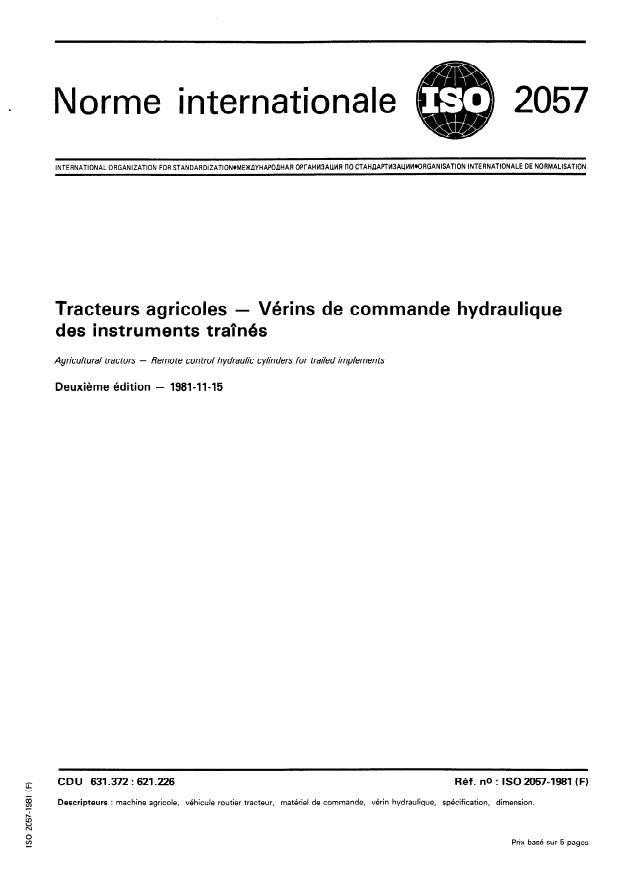
Tracteurs agricoles — Vérins de commande hydraulique des instruments traînés
General Information
- Status
- Published
- Publication Date
- 31-Oct-1981
- Technical Committee
- ISO/TC 23/SC 4 - Tractors
- Drafting Committee
- ISO/TC 23/SC 4 - Tractors
- Current Stage
- 9093 - International Standard confirmed
- Start Date
- 22-Jul-2024
- Completion Date
- 14-Feb-2026
Overview
ISO 2057:1981 is an international standard that specifies the dimensions and assembly requirements for remote control hydraulic cylinders used with agricultural tractors and trailed implements. This second edition, published in 1981, replaces the original 1975 version, streamlining specifications by removing inch-based measurements and refining editorial content. The standard enables hydraulic cylinder interchangeability between tractors and various implements, supporting operational flexibility and equipment compatibility across different tractor categories.
The standard applies to three categories of agricultural tractors based on power at the drawbar:
- Category 1: Up to 35 kW
- Category 2: Between 30 and 75 kW
- Category 3: Over 70 kW
This classification helps ensure the hydraulic cylinders match the power and operational needs of specific tractor classes, allowing for robust and efficient hydraulic control of attached implements.
Key Topics
- Hydraulic Cylinder Specifications: Defines critical dimensions, mounting clearances, and assembly features for hydraulic cylinders used with trailed agricultural implements.
- Interchangeability: Ensures hydraulic components can be transferred or replaced across implements and tractors within the specified power categories, promoting equipment modularity.
- Mounting Dimensions and Clearances: Provides detailed measurements, including length, width, heights, and spacing of key parts such as mobile ends, anchorage points, and clevis pins (clavettes).
- Hydraulic Hose Length and Routing: Specifies hose lengths to allow full movement of implements, including a 100 mm minimum backward movement for three-point hitches, and compliance with existing PTO and drawbar clearance zones (referencing ISO 500).
- Operational Requirements: Includes required actuator stroke times for each tractor category and push force minimums based on piston surface areas and pressure thresholds.
- Attachment Components: Defines design and operational expectations for clevis pins and clevis attachments, emphasizing ease of installation and removal.
- Compatibility with Other ISO Standards: Cross-references related ISO standards such as ISO 500 on PTO and drawbar specifications, ISO 730/1 for three-point hitch categories, and ISO 789/1 for power testing methods.
Applications
ISO 2057:1981 supports the agricultural machinery industry by providing uniform standards for hydraulic control cylinders on tractors and their attached implements. Applications include:
- Trailed Implements Compatibility: Ensures hydraulic cylinders on implements like plows, harrows, seeders, sprayers, and trailers fit tractors from various manufacturers without custom modifications.
- Equipment Interchange and Repair: Facilitates efficient equipment maintenance and replacement by standardizing hydraulic cylinder sizes and attachments, reducing downtime and costs.
- Tractor and Implement Design: Assists manufacturers in designing parts that comply with internationally recognized dimensions, improving global equipment compatibility and market reach.
- Hydraulic System Integration: Helps agricultural engineers and technicians integrate hydraulic control systems that meet performance and safety requirements for given tractor power classes.
- Safety and Reliability: Establishes clear specifications for safe operational clearances and pressure handling, reducing the risk of hydraulic failure or mechanical damage.
Related Standards
To ensure seamless integration and compliance, ISO 2057 references other important standards in the agricultural machinery domain:
- ISO 500: Agricultural tractors - Power take-off and drawbar - Specifications. Governs the safety zones around PTO shafts and drawbar mechanisms crucial for hydraulic hose routing.
- ISO 730/1: Agricultural tractors with wheels - Three-point hitch - Part 7: Categories 1, 2, and 3. Defines hitch geometry vital for determining the hydraulic cylinder mounting and hose lengths.
- ISO 789/1: Agricultural tractors - Test methods - Part 7: Power test. Includes guidelines on engine power testing necessary for classifying tractors under the categories used in ISO 2057.
By harmonizing with these standards, ISO 2057:1981 ensures hydraulic cylinder assemblies are compatible with tractor powertrain and hitching systems globally, promoting international trade and operational consistency.
Keywords: ISO 2057, hydraulic cylinders, agricultural tractors, trailed implements, remote control hydraulics, tractor categories, hydraulic cylinder dimensions, implement compatibility, tractor hitch standards, ISO 500, ISO 730, agricultural machinery standards.
Buy Documents
ISO 2057:1981 - Agricultural tractors -- Remote control hydraulic cylinders for trailed implements
ISO 2057:1981 - Tracteurs agricoles -- Vérins de commande hydraulique des instruments traînés
ISO 2057:1981 - Tracteurs agricoles -- Vérins de commande hydraulique des instruments traînés
Get Certified
Connect with accredited certification bodies for this standard

Control Union Certifications
Global certification for agriculture and sustainability.

ECOCERT
Organic and sustainability certification.

Rainforest Alliance Certification
Sustainable agriculture and forestry certification.
Sponsored listings
Frequently Asked Questions
ISO 2057:1981 is a standard published by the International Organization for Standardization (ISO). Its full title is "Agricultural tractors — Remote control hydraulic cylinders for trailed implements". This standard covers: This second edition cancels and replaces the first edition (1975). Gives the specifications and dimensions for the assembly and clearances common to hydraulically operated cylinders and to trailing-type farm implements. The specifications given permit: the interchangeability of hydraulic operation between tractors, and the transference of the hydraulic cylinder from one implement to another. It applies to three categories of tractors as follows: 1 (up to 35 kW), 2 (30 to 75 kW), 3 (over 70 kW).
This second edition cancels and replaces the first edition (1975). Gives the specifications and dimensions for the assembly and clearances common to hydraulically operated cylinders and to trailing-type farm implements. The specifications given permit: the interchangeability of hydraulic operation between tractors, and the transference of the hydraulic cylinder from one implement to another. It applies to three categories of tractors as follows: 1 (up to 35 kW), 2 (30 to 75 kW), 3 (over 70 kW).
ISO 2057:1981 is classified under the following ICS (International Classification for Standards) categories: 65.060.01 - Agricultural machines and equipment in general. The ICS classification helps identify the subject area and facilitates finding related standards.
ISO 2057:1981 is available in PDF format for immediate download after purchase. The document can be added to your cart and obtained through the secure checkout process. Digital delivery ensures instant access to the complete standard document.
Standards Content (Sample)
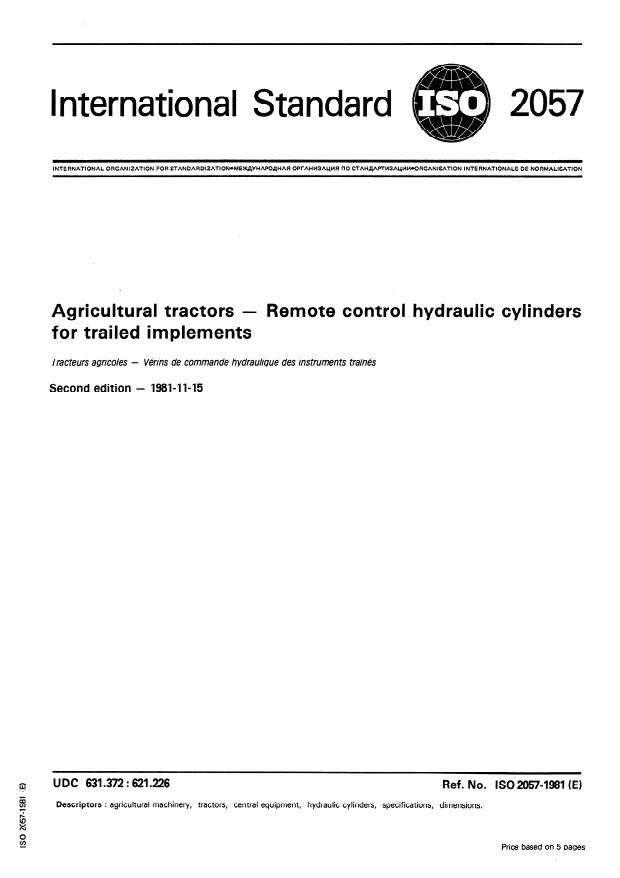
International Standard
INTERNATIONAL ORGANIZATION FOR STANDARDIZATIONWlE)I(L1YHAPO~HAR OPrAHM3AUMR IlO CTAH&WTM3A~MH@ORGANlSATlON INTERNATIONALE DE NORMALISATION
Remote control hydraulic cylinders
Agricultural tractors -
for trailed implements
Jracteurs agricoles - V&ins de commande hydraulique des instruments tra/^n&s
Second edition - 1981-11-15
UDC 631.372: 621.226
Ref. No. IS0 20574981 (E)
Descriptors : agricultural machinery, tractors, central equipment, hydraulic cylinders, specifications, dimensions.
Price based on 5 pages
Foreword
IS0 (the International Organization for Standardization) is a worldwide federation of
national standards institutes (IS0 member bodies). The work of developing Inter-
national Standards is carried out through IS0 technical committees. Every member
body interested in a subject for which a technical committee has been set up has the
right to be represented on that committee. International organizations, governmental
and non-governmental, in liaison with ISO, also take part in the work.
Draft International Standards adopted by the technical committees are circulated to
the member bodies for approval before their acceptance as International Standards by
the IS0 Council.
International Standard IS0 2057 was drawn up by Technical Committee ISO/TC 23,
and circulated to the member bodies in
Agricultural tractors and machinery,
September 1973.
It has been approved by the member bodies of the following countries :
Australia Germany, F.R. Portugal
Romania
Austria Hungary
Belgium India South Africa, Rep. of
Bulgaria Iran Spain
Ireland Sweden
Canada
Chile Italy Switzerland
Denmark Japan Thailand
Turkey
Egypt, Arab Rep. of Netherlands
Finland New Zealand United Kingdom
France Poland USA
No member body expressed disapproval of the document.
This second edition cancels and replaces the first edition (i.e. IS0 20574975). It differs
from the latter only by the deletion of the values in inches and some editorial changes.
@ International Organization for Standardization, 1981
Printed in Switzerland
IS0 2057-1981 (E)
INTERNATIONAL STANDARD
Agricultural tractors - Remote control hydraulic cylinders
for trailed implements
3 Definitions
1 Scope and field of application
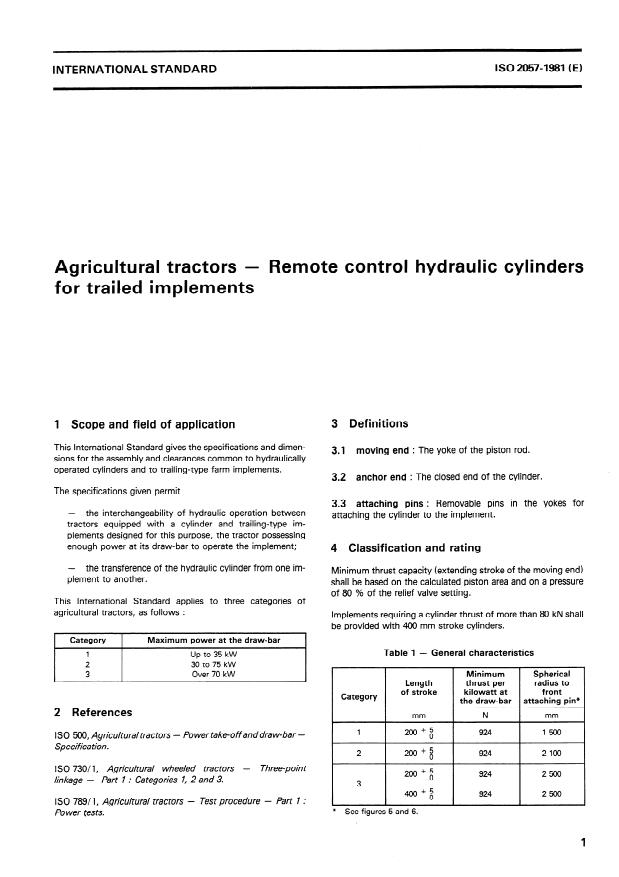
This International Standard gives the specifications and dimen-
: The yoke of the piston rod.
31 . moving end
sions for the assembly and clearances common to hydraulically
operated cylinders and to trailing-type farm implements.
3.2 anchor end : The closed end of the cylinder.
The specifications given permit
3.3 attaching pins : Removable pins in the yokes for
-
the interchangeability of hydraulic operation between
attaching the cylinder to the implement.
tractors equipped with a cylinder and trailing-type im-
plements designed for this purpose, the tractor possessing
enough power at its draw-bar to operate the implement;
4 Classification and rating
-
the transference of the hydraulic cylinder from one im-
Minimum thrust capacity (extending stroke of the moving end)
plement to another.
shall be based on the calculated piston area and on a pressure
of 80 % of the relief valve setting.
This International Standard applies to three categories of
agricultural tractors, as follows :
Implements requiring a cylinder thrust of more than 80 kN shall
be provided with 400 mm stroke cylinders.
Category Maximum power at the draw-bar
Table 1 - General characteristics
1 Up to 35 kW
2 30 to 75 kW
3 Over 70 kW
/ 0EE~e 1 tgizg;r 1 atfiE~in* /
Category
2 References
mm
mm N
I I I I
1 200 + 05 924 1500
I SO 500, Agricultural tractors - Power take-off and draw-bar -
~ I I- ~~~ I I
Specification.
2 200 + 05 924 2 loo
I I I I
IS0 730/l, Agricultural wheeled tractors - Three-point
200 + 5 924 2500
linkage - Part 7 : Categories 7, 2 and 3.
.
400+; 924 2500
IS0 78911, Agricultural tractors - Test procedure - Part 7 : .
* See figures 5 and 6.
Power tests.
IS0 20574981 (E)
5 Dimensional characteristics
5.1 Hydraulic cylinders
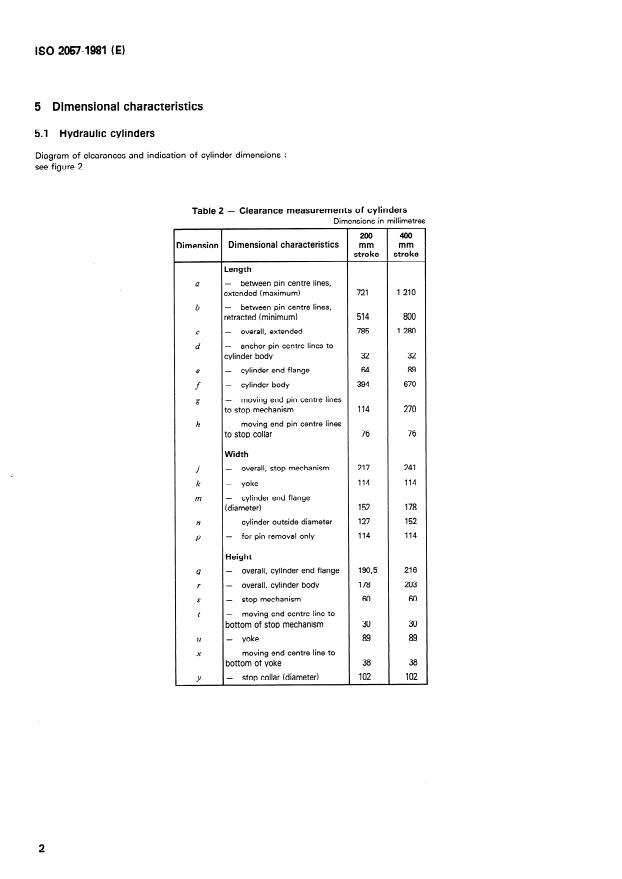
Diagram of clearances and indication of cylinder dimensions :
see figure 2.
Table 2 - Clearance measurements of cylinders
Dimensions in millimetres
Dimension Dimensional characteristics mm mm
stroke stroke
Length
- between pin centre lines,
a
extended (maximum) 721 1 210
- between pin centre lines,
b
retracted (minimum) 514 800
-
overall, extended 1 280
C 785
d - anchor pin centre
...
Norme internationale
INTERNATIONAL ORGANIZATION FOR STANDARDIZATION.ME)I(AYHAPOAHAR OPI-AHM3AlJMfl f-l0 CTAH~APTbl3AW’l@ORGANISATION INTERNATIONALE DE NORMALISATION
Tracteurs agricoles - Vérins de commande hydraulique
des instruments traînés
Agricultural tractors - Remo te con trol h ydraulic c ylinders for trailed implemen ts
Deuxième édition - 1981-11-W
. I
-;---- --- ~- ~~ ~~
Réf. no : ISO2057-1981 (F)
CDU 631.372 : 621.226
Descripteurs : machine agricole, véhicule routier tracteur, matériel de commande, vérin hydraulique, spécification, dimension.
Prix basé sur 5 pages
Avant-propos
L’ISO (Organisation internationale de normalisation) est une fédération mondiale
d’organismes nationaux de normalisation (comités membres de I’ISO). L’élaboration
des Normes internationales est confiée aux comités techniques de I’ISO. Chaque
comité membre intéressé par une étude a le droit de faire partie du comité technique
correspondant. Les organisations internationales, gouvernementales et non gouverne-
mentales, en liaison avec I’ISO, participent également aux travaux.
Les projets de Normes internationales adoptés par les comités techniques sont soumis
aux comités membres pour approbation, avant leur acceptation comme Normes inter-
nationales par le Conseil de I’ISO.
La Norme internationale ISO 2057 a été établie par le comité technique ISO/TC 23,
Tracteurs et matériels agricoles, et soumise aux comités membres en septembre 1973.
Elle a été approuvée par les comités membres des pays suivants :
Afrique du Sud, Rép. d’ Espagne Pays- Bas
Allemagne, R.F. Finlande Pologne
Australie France Portugal
Au triche Hongrie Roumanie
Belgique Inde Royaume-Uni
Bulgarie Iran Suède
Canada Irlande Suisse
Chili Thaïlande
Italie
Danemark Japon Turquie
Égypte, Rép. arabe d’ Nouvelle-Zélande USA
Aucun comité membre n’a désapprouvé le document
Cette deuxième édition annule et remplace la première édition (ISO 20574975). Elle
n’en diffère que par la suppression des valeurs en inches et par quelques modifications
d’ordre rédactionnel.
@ Organisation internationale de normalisation, 1981 0
Imprimé en Suisse
--
NORME INTERNATIONALE ISO 2057-1981 (F)
Vérins de commande hydraulique
Tracteurs agricoles A
des instruments traînés
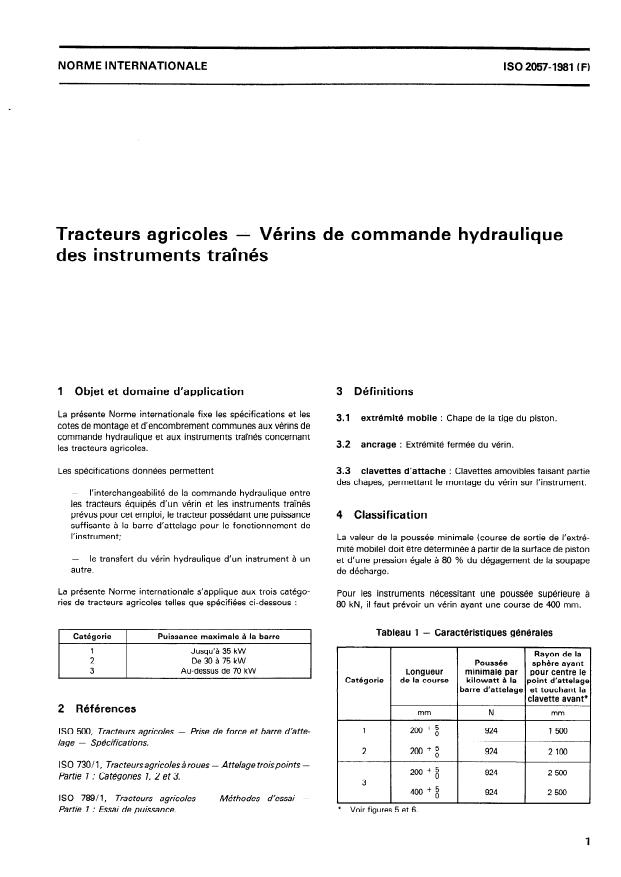
1 Objet et domaine d’application 3 Définitions
La présente Norme internationale fixe les spécifications et les
3.1 extrémité mobile : Chape de la tige du piston.
cotes de montage et d’encombrement communes aux vérins de
commande hydraulique et aux instruments traînés concernant
3.2 ancrage : Extrémité fermée du vérin.
les tracteurs agricoles.
Les spécifications données permettent 3.3 clavettes d’attache : Clavettes amovibles faisant partie
des chapes, permettant le montage du vérin sur l’instrument.
- I’interchangeabilité de la commande hydraulique entre
les tracteurs équipés d’un vérin et les instruments traînés
prévus pour cet emploi, le tracteur possédant une puissance
4 Classification
suffisante à la barre d’attelage pour le fonctionnement de
l’instrument;
La valeur de la poussée minimale (course de sortie de I’extré-
mité mobile) doit être déterminée à partir de la surface de piston
- le transfert du vérin hydraulique d’un instrument à un et d’une pression égale à 80 % du dégagement de la soupape
autre.
de décharge.
La présente Norme internationale s’applique aux trois catégo-
Pour les instruments nécessitant une poussée supérieure à
ries de tracteurs agricoles telles que spécifiées ci-dessous :
80 kN, il faut prévoir un vérin ayant une course de 400 mm.
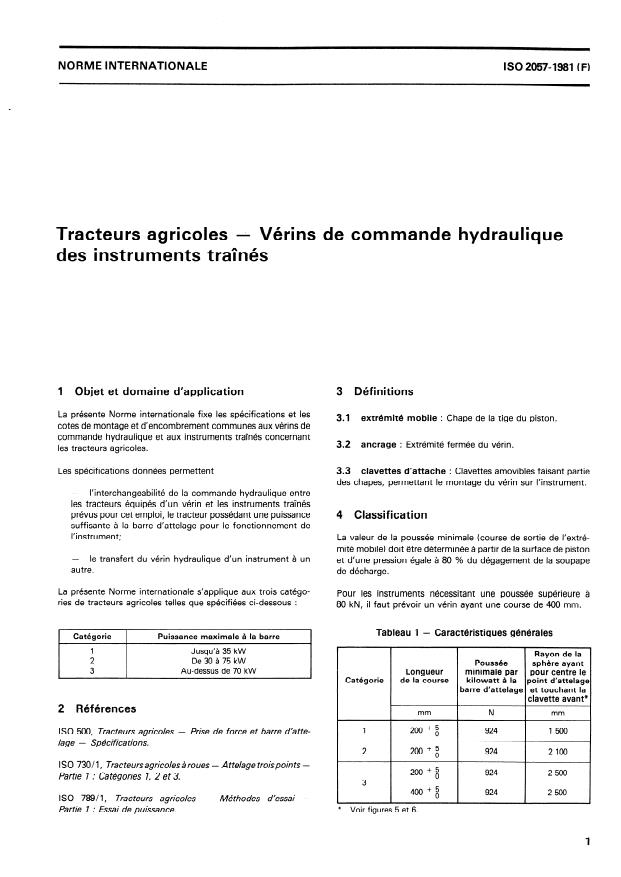
Tableau 1 - Caractéristiques générales
Catégorie Puissance maximale à la barre
1 Jusqu’à 35 kW
Rayon de la
2 De 30 à 75 kW
Pouss6e sphère ayant
3 Au-dessus de 70 kW Longueur minimale par pour centre le
de la course kilowatt à la
Catégorie point d’attelage
barre d’attelage et touchant la
clavette avant*
2 Références
mm
ISO 500, Tracteurs agricoles - Prise de force et barre d’atte-
lage - Spécifications.
2 200 + 924 2 100
ISO 73011, Tracteursagricolesàroues - Attelage troispoints -
200 + ; 924 2500
Partie 7 : Catégories 7, 2 et 3.
400 + z 924 2500
ISO 78911, Tracteurs agricoles - Méthodes d’essai -
Partie 7 : Essai de puissance. * Voir figures 5 et 6.
ISO 20574981 (FI
5 Caractéristiques dimensionnelles
5.1 Vérins hydrauliques
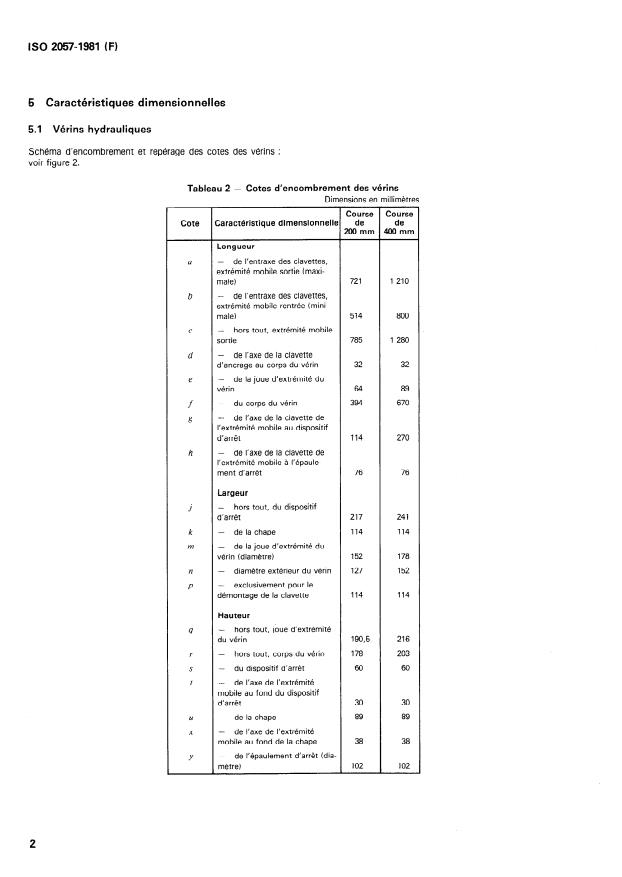
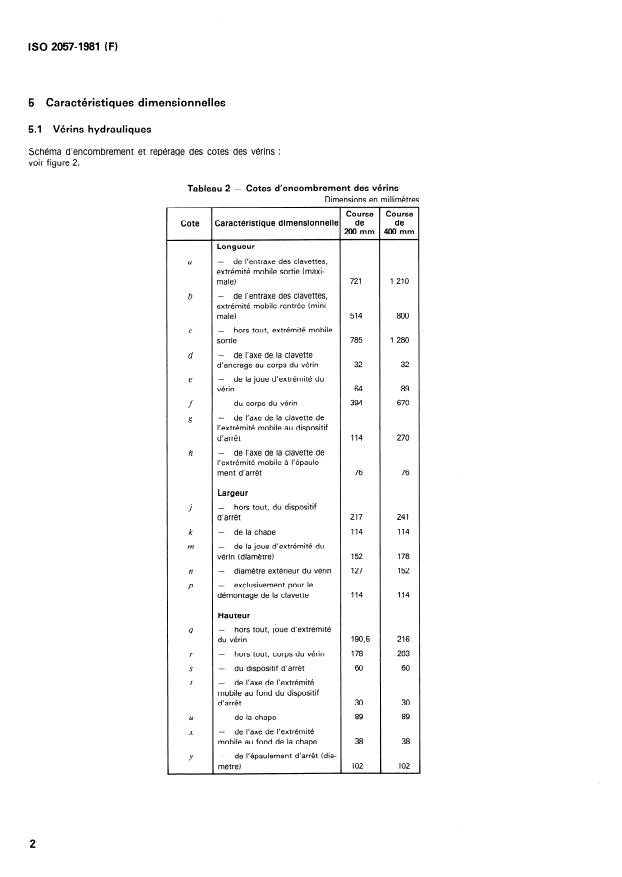
Schéma d’encombrement et repérage des cotes des vérins :
voir figure 2.
Tableau 2- Cotes d’encombrement des vérins
Dimensions en millimètres
Course
Course
Cote Caractéristique dimensionnelle de de
200mm 4OOmm
Longueur
-
a de I’entraxe des clavettes,
extrémité mobile sortie (maxi-
male) 721 1 210
- de I’entraxe des clavettes,
b
extrémité mobile rentrée (mini-
male) 514 800
-
hors tout, extrémité mobile
C
sortie 785 1 280
d - de l’axe de la clavette
d’ancrage au corps du vérin 32 32
e - de la joue d’extrémité du
vérin 64
- du corps du vérin 394 670
f
- de l’axe de la clavette de
g
l’extrémité mobile au dispositif
d’
...
Norme internationale
INTERNATIONAL ORGANIZATION FOR STANDARDIZATION.ME)I(AYHAPOAHAR OPI-AHM3AlJMfl f-l0 CTAH~APTbl3AW’l@ORGANISATION INTERNATIONALE DE NORMALISATION
Tracteurs agricoles - Vérins de commande hydraulique
des instruments traînés
Agricultural tractors - Remo te con trol h ydraulic c ylinders for trailed implemen ts
Deuxième édition - 1981-11-W
. I
-;---- --- ~- ~~ ~~
Réf. no : ISO2057-1981 (F)
CDU 631.372 : 621.226
Descripteurs : machine agricole, véhicule routier tracteur, matériel de commande, vérin hydraulique, spécification, dimension.
Prix basé sur 5 pages
Avant-propos
L’ISO (Organisation internationale de normalisation) est une fédération mondiale
d’organismes nationaux de normalisation (comités membres de I’ISO). L’élaboration
des Normes internationales est confiée aux comités techniques de I’ISO. Chaque
comité membre intéressé par une étude a le droit de faire partie du comité technique
correspondant. Les organisations internationales, gouvernementales et non gouverne-
mentales, en liaison avec I’ISO, participent également aux travaux.
Les projets de Normes internationales adoptés par les comités techniques sont soumis
aux comités membres pour approbation, avant leur acceptation comme Normes inter-
nationales par le Conseil de I’ISO.
La Norme internationale ISO 2057 a été établie par le comité technique ISO/TC 23,
Tracteurs et matériels agricoles, et soumise aux comités membres en septembre 1973.
Elle a été approuvée par les comités membres des pays suivants :
Afrique du Sud, Rép. d’ Espagne Pays- Bas
Allemagne, R.F. Finlande Pologne
Australie France Portugal
Au triche Hongrie Roumanie
Belgique Inde Royaume-Uni
Bulgarie Iran Suède
Canada Irlande Suisse
Chili Thaïlande
Italie
Danemark Japon Turquie
Égypte, Rép. arabe d’ Nouvelle-Zélande USA
Aucun comité membre n’a désapprouvé le document
Cette deuxième édition annule et remplace la première édition (ISO 20574975). Elle
n’en diffère que par la suppression des valeurs en inches et par quelques modifications
d’ordre rédactionnel.
@ Organisation internationale de normalisation, 1981 0
Imprimé en Suisse
--
NORME INTERNATIONALE ISO 2057-1981 (F)
Vérins de commande hydraulique
Tracteurs agricoles A
des instruments traînés
1 Objet et domaine d’application 3 Définitions
La présente Norme internationale fixe les spécifications et les
3.1 extrémité mobile : Chape de la tige du piston.
cotes de montage et d’encombrement communes aux vérins de
commande hydraulique et aux instruments traînés concernant
3.2 ancrage : Extrémité fermée du vérin.
les tracteurs agricoles.
Les spécifications données permettent 3.3 clavettes d’attache : Clavettes amovibles faisant partie
des chapes, permettant le montage du vérin sur l’instrument.
- I’interchangeabilité de la commande hydraulique entre
les tracteurs équipés d’un vérin et les instruments traînés
prévus pour cet emploi, le tracteur possédant une puissance
4 Classification
suffisante à la barre d’attelage pour le fonctionnement de
l’instrument;
La valeur de la poussée minimale (course de sortie de I’extré-
mité mobile) doit être déterminée à partir de la surface de piston
- le transfert du vérin hydraulique d’un instrument à un et d’une pression égale à 80 % du dégagement de la soupape
autre.
de décharge.
La présente Norme internationale s’applique aux trois catégo-
Pour les instruments nécessitant une poussée supérieure à
ries de tracteurs agricoles telles que spécifiées ci-dessous :
80 kN, il faut prévoir un vérin ayant une course de 400 mm.
Tableau 1 - Caractéristiques générales
Catégorie Puissance maximale à la barre
1 Jusqu’à 35 kW
Rayon de la
2 De 30 à 75 kW
Pouss6e sphère ayant
3 Au-dessus de 70 kW Longueur minimale par pour centre le
de la course kilowatt à la
Catégorie point d’attelage
barre d’attelage et touchant la
clavette avant*
2 Références
mm
ISO 500, Tracteurs agricoles - Prise de force et barre d’atte-
lage - Spécifications.
2 200 + 924 2 100
ISO 73011, Tracteursagricolesàroues - Attelage troispoints -
200 + ; 924 2500
Partie 7 : Catégories 7, 2 et 3.
400 + z 924 2500
ISO 78911, Tracteurs agricoles - Méthodes d’essai -
Partie 7 : Essai de puissance. * Voir figures 5 et 6.
ISO 20574981 (FI
5 Caractéristiques dimensionnelles
5.1 Vérins hydrauliques
Schéma d’encombrement et repérage des cotes des vérins :
voir figure 2.
Tableau 2- Cotes d’encombrement des vérins
Dimensions en millimètres
Course
Course
Cote Caractéristique dimensionnelle de de
200mm 4OOmm
Longueur
-
a de I’entraxe des clavettes,
extrémité mobile sortie (maxi-
male) 721 1 210
- de I’entraxe des clavettes,
b
extrémité mobile rentrée (mini-
male) 514 800
-
hors tout, extrémité mobile
C
sortie 785 1 280
d - de l’axe de la clavette
d’ancrage au corps du vérin 32 32
e - de la joue d’extrémité du
vérin 64
- du corps du vérin 394 670
f
- de l’axe de la clavette de
g
l’extrémité mobile au dispositif
d’
...
Questions, Comments and Discussion
Ask us and Technical Secretary will try to provide an answer. You can facilitate discussion about the standard in here.
Loading comments...