


ISO 17564:2008
(Main)Raw hydrogenated nitrile rubber (HNBR) - Determination of residual unsaturation by iodine value
Raw hydrogenated nitrile rubber (HNBR) - Determination of residual unsaturation by iodine value
ISO 17564:2008 specifies a method using Wijs' solution to determine the iodine value (i.e. the residual unsaturation) of raw hydrogenated nitrile rubber (HNBR).
Caoutchouc nitrile hydrogéné (HNBR) brut — Détermination de l'insaturation résiduelle par l'indice d'iode
General Information
Relations
Overview
ISO 17564:2008 is an international standard developed by the International Organization for Standardization (ISO) that specifies a reliable analytical method for determining the residual unsaturation in raw hydrogenated nitrile rubber (HNBR). This is achieved by measuring the iodine value, which quantifies the degree of unsaturation present in the rubber sample. The method utilizes Wijs' solution, a halogen reagent, to react with the double bonds in the polymer chain. Accurate measurement of residual unsaturation is critical for quality control and performance assessment of HNBR materials used in various industrial applications.
Key Topics
Scope of the Method
The standard defines a chemical titration procedure to determine the iodine value of raw HNBR, reflecting its residual unsaturation level.Principle of the Test
A known excess of Wijs' solution is added to a dissolved HNBR sample, allowing iodine to add across double bonds. Unreacted iodine is then quantified via titration with sodium thiosulfate, enabling the calculation of iodine value.Required Reagents and Apparatus
- Wijs' solution (prepared according to a specified procedure in Annex A)
- Chloroform solvent to dissolve HNBR
- Potassium iodide and starch solution for titration endpoint detection
- Standard volumetric sodium thiosulfate solution
- Laboratory equipment such as mechanical shaker, constant temperature bath, analytical balance, pipettes, and burette
Procedure Highlights
- Selection of test portion sizes based on expected iodine values
- Dissolution of sample in chloroform
- Controlled reaction with Wijs' solution at 25 ± 1°C for defined times
- Titration to quantify unreacted iodine
- Blank titration to ensure accuracy of results
Calculation
The iodine value is calculated using the volume difference between sample and blank titration, sample mass, sodium thiosulfate concentration, and iodine atomic mass factor.Precision Data
Annex B provides statistical precision information based on interlaboratory studies, defining repeatability and reproducibility parameters crucial for validating test results.Safety and Environmental Considerations
Due to hazardous chemicals involved (e.g., chloroform and iodine compounds), compliance with laboratory safety and environmental disposal protocols is emphasized.
Applications
Quality Control in Rubber Manufacturing
Determining residual unsaturation helps manufacturers monitor and control the hydrogenation process of nitrile rubber, ensuring product consistency and desired chemical properties.Material Characterization
The iodine value indicates the degree of hydrogenation, which directly affects the thermal stability, chemical resistance, and mechanical strength of HNBR products.Research and Development
Enables comparative studies of different HNBR grades and optimization of hydrogenation techniques in R&D environments.Compliance and Standardization
Adoption of ISO 17564:2008 facilitates consistent and internationally accepted testing methods for HNBR residual unsaturation, promoting harmonization across the rubber industry.
Related Standards
ISO 1795: Rubber, raw natural and raw synthetic - Sampling and further preparative procedures - referenced for sample collection and preparation.
ISO/TR 9272:2005: Rubber and rubber products - Determination of precision for test method standards - provides framework for assessing precision of this and related test methods.
ASTM D5902: Standard Test Method for Rubber - Determination of Residual Unsaturation in HNBR by Iodine Value - an alternative standard with similar methodology.
By following ISO 17564:2008, laboratories can accurately assess the residual unsaturation in raw hydrogenated nitrile rubber, ensuring materials meet stringent industrial specifications. The standard supports improved product performance and reliability through precise and reproducible iodine value determination.
Frequently Asked Questions
ISO 17564:2008 is a standard published by the International Organization for Standardization (ISO). Its full title is "Raw hydrogenated nitrile rubber (HNBR) - Determination of residual unsaturation by iodine value". This standard covers: ISO 17564:2008 specifies a method using Wijs' solution to determine the iodine value (i.e. the residual unsaturation) of raw hydrogenated nitrile rubber (HNBR).
ISO 17564:2008 specifies a method using Wijs' solution to determine the iodine value (i.e. the residual unsaturation) of raw hydrogenated nitrile rubber (HNBR).
ISO 17564:2008 is classified under the following ICS (International Classification for Standards) categories: 83.060 - Rubber. The ICS classification helps identify the subject area and facilitates finding related standards.
ISO 17564:2008 has the following relationships with other standards: It is inter standard links to ISO 17564:2001. Understanding these relationships helps ensure you are using the most current and applicable version of the standard.
You can purchase ISO 17564:2008 directly from iTeh Standards. The document is available in PDF format and is delivered instantly after payment. Add the standard to your cart and complete the secure checkout process. iTeh Standards is an authorized distributor of ISO standards.
Standards Content (Sample)
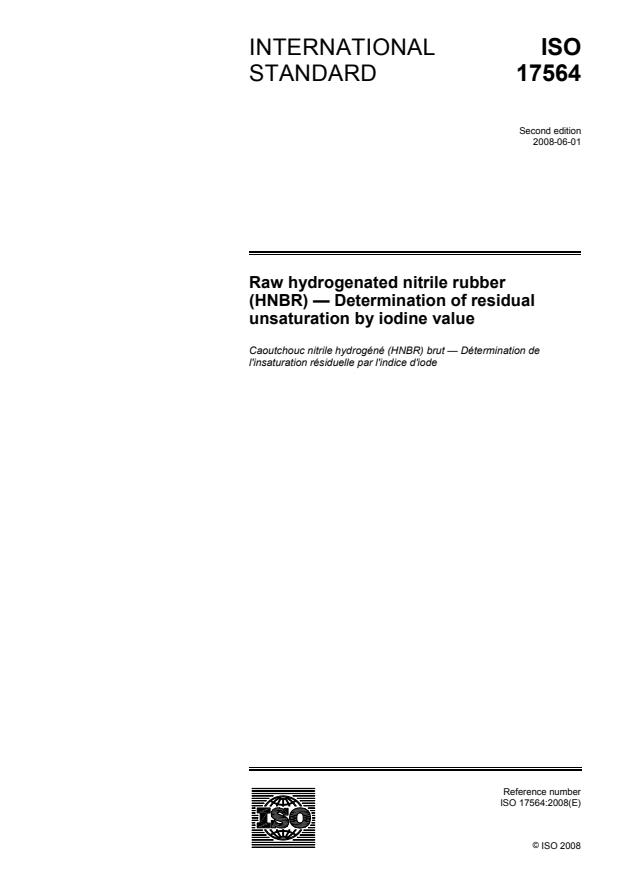
INTERNATIONAL ISO
STANDARD 17564
Second edition
2008-06-01
Raw hydrogenated nitrile rubber
(HNBR) — Determination of residual
unsaturation by iodine value
Caoutchouc nitrile hydrogéné (HNBR) brut — Détermination de
l'insaturation résiduelle par l'indice d'iode
Reference number
©
ISO 2008
PDF disclaimer
This PDF file may contain embedded typefaces. In accordance with Adobe's licensing policy, this file may be printed or viewed but
shall not be edited unless the typefaces which are embedded are licensed to and installed on the computer performing the editing. In
downloading this file, parties accept therein the responsibility of not infringing Adobe's licensing policy. The ISO Central Secretariat
accepts no liability in this area.
Adobe is a trademark of Adobe Systems Incorporated.
Details of the software products used to create this PDF file can be found in the General Info relative to the file; the PDF-creation
parameters were optimized for printing. Every care has been taken to ensure that the file is suitable for use by ISO member bodies. In
the unlikely event that a problem relating to it is found, please inform the Central Secretariat at the address given below.
© ISO 2008
All rights reserved. Unless otherwise specified, no part of this publication may be reproduced or utilized in any form or by any means,
electronic or mechanical, including photocopying and microfilm, without permission in writing from either ISO at the address below or
ISO's member body in the country of the requester.
ISO copyright office
Case postale 56 • CH-1211 Geneva 20
Tel. + 41 22 749 01 11
Fax + 41 22 749 09 47
E-mail copyright@iso.org
Web www.iso.org
Published in Switzerland
ii © ISO 2008 – All rights reserved
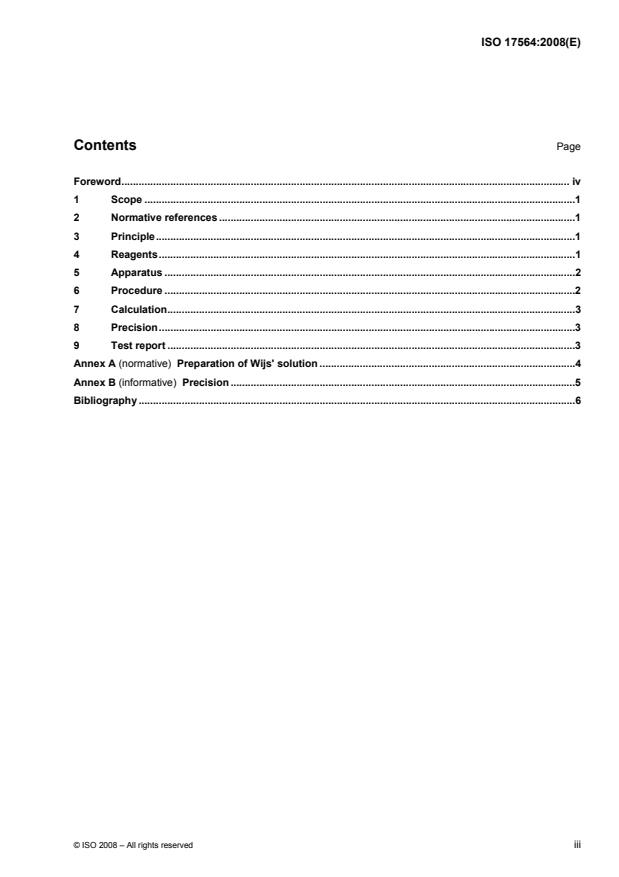
Contents Page
Foreword. iv
1 Scope.1
2 Normative references.1
3 Principle.1
4 Reagents.1
5 Apparatus.2
6 Procedure.2
7 Calculation.3
8 Precision.3
9 Test report.3
Annex A (normative) Preparation of Wijs' solution .4
Annex B (informative) Precision .5
Bibliography .6
Foreword
ISO (the International Organization for Standardization) is a worldwide federation of national standards bodies
(ISO member bodies). The work of preparing International Standards is normally carried out through ISO
technical committees. Each member body interested in a subject for which a technical committee has been
established has the right to be represented on that committee. International organizations, governmental and
non-governmental, in liaison with ISO, also take part in the work. ISO collaborates closely with the
International Electrotechnical Commission (IEC) on all matters of electrotechnical standardization.
International Standards are drafted in accordance with the rules given in the ISO/IEC Directives, Part 2.
The main task of technical committees is to prepare International Standards. Draft International Standards
adopted by the technical committees are circulated to the member bodies for voting. Publication as an
International Standard requires approval by at least 75 % of the member bodies casting a vote.
Attention is drawn to the possibility that some of the elements of this document may be the subject of patent
rights. ISO shall not be held responsible for identifying any or all such patent rights.
ISO 17564 was prepared by Technical Committee ISO/TC 45, Rubber and rubber products, Subcommittee
SC 2, Testing and analysis.
This second edition cancels and replaces the first edition (ISO 17564:2001), which has been revised primarily
to make the ranges of test portion sizes in Table 1 clearer, to correct the equation in Clause 7 and to include
new precision data (now in Annex B).
iv © ISO 2008 – All rights reserved
INTERNATIONAL STANDARD ISO 17564:2008(E)
Raw hydrogenated nitrile rubber (HNBR) — Determination of
residual unsaturation by iodine value
WARNING — Persons using this International Standard should be familiar with normal laboratory
practice. This standard does not purport to address all of the safety problems, if any, associated with
its use. It is the responsibility of the user to establish appropriate safety and health practices and to
ensure compliance with any national regulatory conditions.
CAUTION — Certain procedures specified in this International Standard may involve the use or
generation of substances, or the generation of waste, that could constitute a local environmental
hazard. Reference should be made to appropriate documentation on safe handling and disposal after
use.
1 Scope
This International Standard specifies a method using Wijs' solution to determine the iodine value (i.e. the
residual unsaturation) of raw hydrogenated nitrile rubber (HNBR).
2 Normative references
The following referenced documents are indispensable for the application of this document. For dated
references, only the edition cited applies. For undated references, the latest edition of the referenced
document (including any amendments) applies.
ISO 1795, Rubber, raw natural and raw synthetic — Sampling and further preparative procedures
3 Principle
A sample of HNBR is dissolved in chloroform. A known excess of Wijs’ solution is added to the solution and a
fixed time is allowed for addition of iodine to the residual unsaturation in the HNBR. Unreacted Wijs’ solution is
then neutralized with potassium iodide solution, the iodine thus liberated titrated with standard sodium
thiosulfate and the iodine value (residual unsaturation) calculated.
4 Reagents
During the analysis, unless otherwise stated, use only reagents of recognized analytical grade.
4.1 Water: During the analysis, use only distilled or demineralized water or water of equivalent purity.
4.2 Chloroform.
WARNING — Chloroform is a harmful solvent if swallowed or inhaled and irritating to skin. Special
safety precautions should therefore be taken, including the use of a fume hood.
4.3 Wijs' solution (see Annex A).
4.4 100 g/l aqueous potassium iodide solution.
...
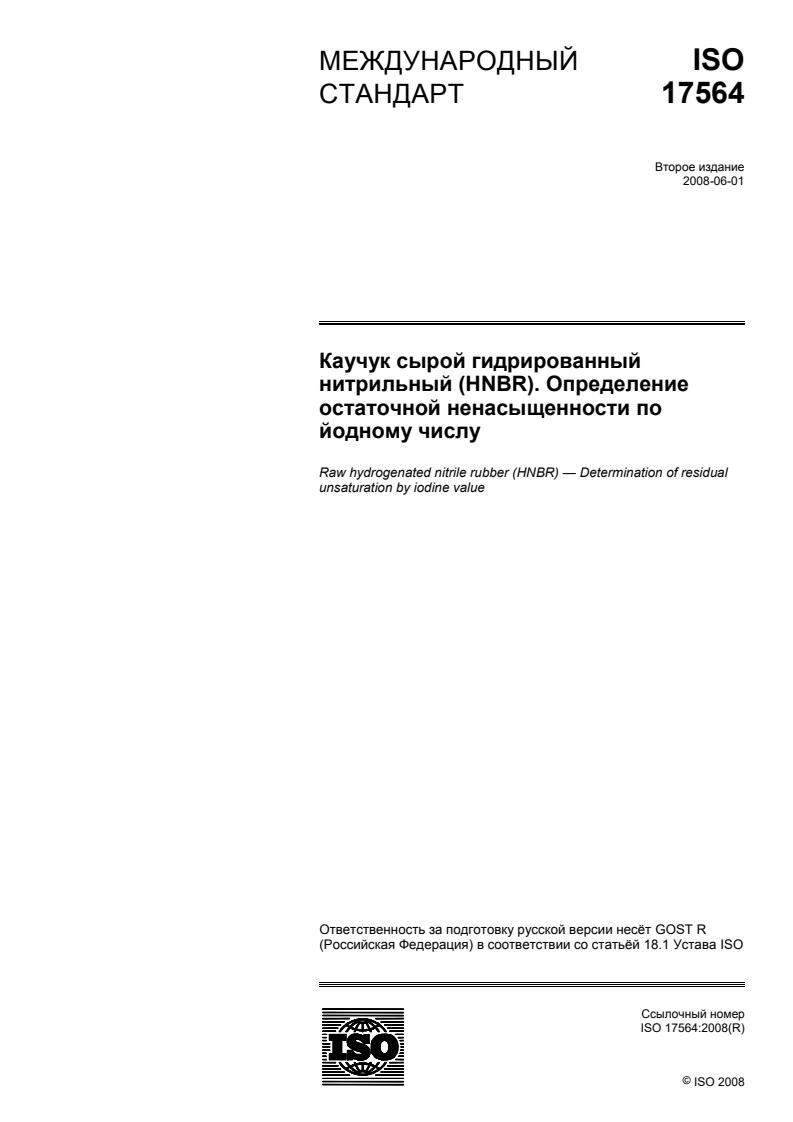
МЕЖДУНАРОДНЫЙ ISO
СТАНДАРТ 17564
Второе издание
2008-06-01
Каучук сырой гидрированный
нитрильный (HNBR). Определение
остаточной ненасыщенности по
йодному числу
Raw hydrogenated nitrile rubber (HNBR) — Determination of residual
unsaturation by iodine value
Ответственность за подготовку русской версии несѐт GOST R
(Российская Федерация) в соответствии со статьѐй 18.1 Устава ISO
Ссылочный номер
©
ISO 2008
Отказ от ответственности при работе в PDF
Настоящий файл PDF может содержать интегрированные шрифты. В соответствии с условиями лицензирования, принятыми
фирмой Adobe, этот файл можно распечатать или смотреть на экране, но его нельзя изменить, пока не будет получена
лицензия на установку интегрированных шрифтов в компьютере, на котором ведется редактирование. В случае загрузки
настоящего файла заинтересованные стороны принимают на себя ответственность за соблюдение лицензионных условий
фирмы Adobe. Центральный секретариат ISO не несет никакой ответственности в этом отношении.
Adobe — торговый знак Adobe Systems Incorporated.
Подробности, относящиеся к программным продуктам, использованным для создания настоящего файла PDF, можно найти в
рубрике General Info файла; параметры создания PDF оптимизированы для печати. Были приняты во внимание все меры
предосторожности с тем, чтобы обеспечить пригодность настоящего файла для использования комитетами – членами ISO. В
редких случаях возникновения проблемы, связанной со сказанным выше, просим информировать Центральный секретариат
по адресу, приведенному ниже.
ДОКУМЕНТ ЗАЩИЩЕН АВТОРСКИМ ПРАВОМ
© ISO 2008
Все права сохраняются. Если не указано иное, никакую часть настоящей публикации нельзя копировать или использовать в
какой-либо форме или каким-либо электронным или механическим способом, включая фотокопии и микрофильмы, без
предварительного письменного согласия ISO по адресу ниже или членов ISO в стране регистрации пребывания.
ISO copyright office
Case postale 56 CH-1211 Geneva 20
Tel. + 41 22 749 01 11
Fax + 41 22 749 09 47
E-mail copyright@iso.org
Web www.iso.org
Опубликовано в Швейцарии
ii © ISO 2008 – Все права сохраняются
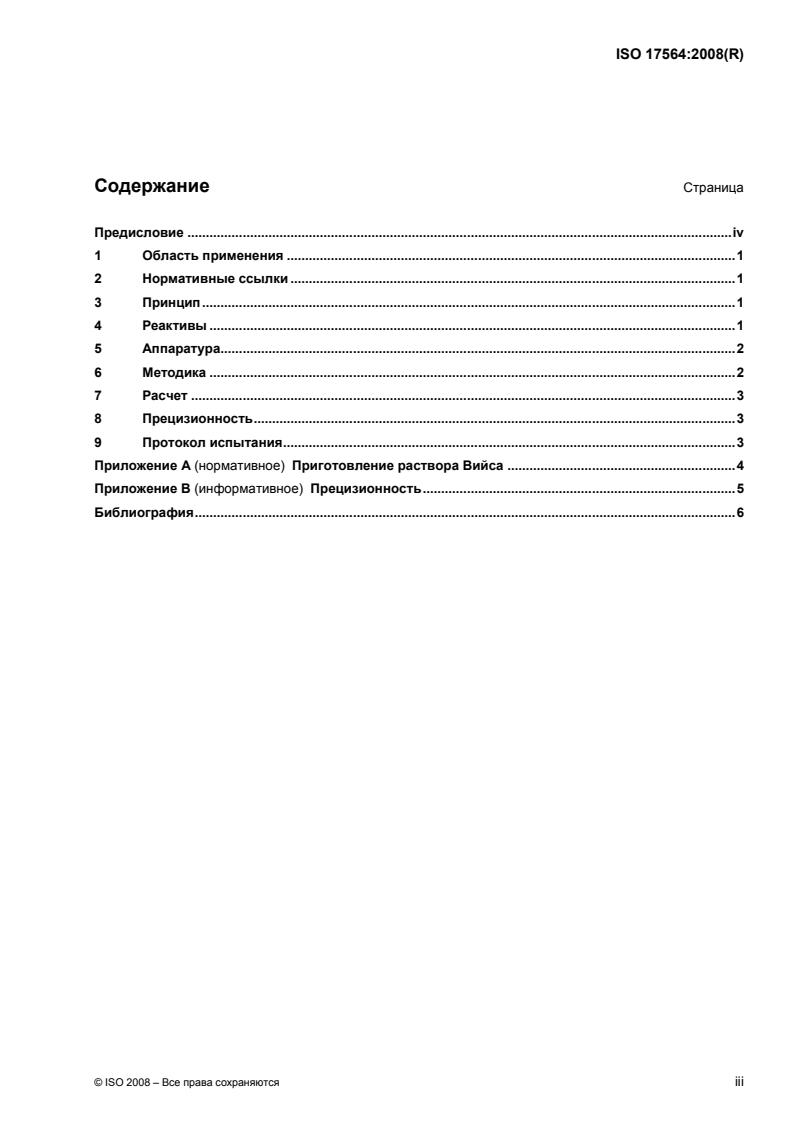
Содержание Страница
Предисловие . iv
1 Область применения . 1
2 Нормативные ссылки . 1
3 Принцип . 1
4 Реактивы . 1
5 Аппаратура. 2
6 Методика . 2
7 Расчет . 3
8 Прецизионность . 3
9 Протокол испытания . 3
Приложение A (нормативное) Приготовление раствора Вийса . 4
Приложение B (информативное) Прецизионность . 5
Библиография . 6
Предисловие
Международная организация по стандартизации (ISO) является всемирной федерацией национальных
организаций по стандартизации (комитетов-членов ISO). Разработка международных стандартов
обычно осуществляется техническими комитетами ISO. Каждый комитет-член ISO, заинтересованный
в деятельности, для которой был создан технический комитет, имеет право быть представленным в
этом комитете. Международные организации, правительственные и неправительственные, имеющие
связи с ISO, также принимают участие в работах. ISO непосредственно сотрудничает с
Международной электротехнической комиссией (IEC) по всем вопросам электротехнической
стандартизации.
Международные стандарты разрабатываются в соответствии с правилами, приведенными в
Директивах ISO/IEC, Часть 2.
Основная задача технических комитетов состоит в подготовке международных стандартов. Проекты
международных стандартов, одобренные техническими комитетами, рассылаются комитетам-членам
на голосование. Их опубликование в качестве международных стандартов требует одобрения, по
меньшей мере, 75 % комитетов-членов, принимающих участие в голосовании.
Следует иметь в виду, что некоторые элементы настоящего документа могут быть объектом патентных
прав. ISO не должен нести ответственность за идентификацию какого-либо одного или всех патентных
прав.
ISO 17564 разработан Техническим комитетом ISO/TC 45, Резина и резиновые изделия, Подкомитетом
SC 2, Испытания и анализ.
Настоящее второе издание отменяет и заменяет первое издание (ISO 17564:2001), которое было
пересмотрено, главным образом, для того, чтобы более четко установить диапазоны размеров проб
для анализа в Таблице 1, внести поправки в формулу Раздела 7 и включить новые показатели
прецизионности (в Приложении B).
iv © ISO 2008 – Все права сохраняются
МЕЖДУНАРОДНЫЙ СТАНДАРТ ISO 17564:2008(R)
Каучук сырой гидрированный нитрильный (HNBR).
Определение остаточной ненасыщенности по йодному
числу
ПРЕДУПРЕЖДЕНИЕ — Пользователи настоящего международного стандарта должны хорошо
знать обычную лабораторную практику. Целью данного международного стандарта не является
рассмотрение всех проблем безопасности, связанных с его применением. Пользователи этого
международного стандарта несут ответственность за установление соответствующих правил
техники безопасности и охраны здоровья и гарантируют соответствие любым национальным
регулирующим положениям.
ПРЕДОСТЕРЕЖЕНИЕ — Некоторые методики, установленные в настоящем международном
стандарте, могут включать использование или образование веществ либо образование
отходов, которые могут оказывать вредное местное воздействие на окружающую среду.
Необходимо делать ссылку на соответствующую документацию по безопасному обращению и
удалению их после использования.
1 Область применения
Настоящий международный стандарт устанавливает метод определения йодного числа (т.е.
остаточной ненасыщенности) с помощью раствора Вийса в сыром гидрированном нитрильном каучуке
(HNBR).
2 Нормативные ссылки
Следующие ссылочные нормативные документы являются обязательными при применении данного
документа. Для жестких ссылок применяется только цитированное издание документа. Для плавающих
ссылок необходимо использовать самое последнее издание нормативного ссылочного документа
(включая любые изменения).
ISO 1795, Каучук сырой натуральный и синтетический. Отбор образцов и процедуры их
приготовления
3 Принцип
Растворяют образец HNBR в хлороформе. Добавляют известный избыток раствора Вийса к
полученному раствору и оставляют его на заданное время для завершения реакции присоединения
йода, чтобы определить остаточную ненасыщенность каучука HNBR. Затем нейтрализуют
непрореагировавший раствор Вийса раствором йодида калия, титруют выделенный таким образом йод
стандартным раствором тиосульфата натрия и рассчитывают йодное число (остаточную
ненасыщенность).
4 Реактивы
При анализе используют только реактивы признанного аналитического качества, если не оговорено особо.
4.1 Вода: При анализе используют только дистиллированную или деминерализованную воду или
воду эквивалентной чистоты.
4.2 Хлороформ.
ПРЕДОСТЕРЕЖЕНИЕ — Хлороформ опасен п
...
Questions, Comments and Discussion
Ask us and Technical Secretary will try to provide an answer. You can facilitate discussion about the standard in here.
Loading comments...