


ISO/IEC 9075:1992
(Main)Information technology — Database languages — SQL
Information technology — Database languages — SQL
Technologies de l'information — Langages de base de données — SQL
General Information
- Status
- Withdrawn
- Publication Date
- 18-Nov-1992
- Withdrawal Date
- 18-Nov-1992
- Technical Committee
- ISO/IEC JTC 1/SC 32 - Data management and interchange
- Drafting Committee
- ISO/IEC JTC 1/SC 32 - Data management and interchange
- Current Stage
- 9599 - Withdrawal of International Standard
- Start Date
- 16-Dec-1999
- Completion Date
- 14-Feb-2026
Relations
- Corrected By
ISO/IEC 9075:1992/Cor 3:1999 - Information technology — Database languages — SQL — Technical Corrigendum 3 - Effective Date
- 06-Jun-2022
- Corrected By
ISO/IEC 9075:1992/Cor 1:1996 - Information technology — Database languages — SQL — Technical Corrigendum 1 - Effective Date
- 06-Jun-2022
- Effective Date
- 15-Apr-2008
- Effective Date
- 15-Apr-2008
- Effective Date
- 15-Apr-2008
- Effective Date
- 15-Apr-2008
- Effective Date
- 15-Apr-2008
- Effective Date
- 15-Apr-2008
- Effective Date
- 15-Apr-2008
- Effective Date
- 15-Apr-2008
Get Certified
Connect with accredited certification bodies for this standard

BSI Group
BSI (British Standards Institution) is the business standards company that helps organizations make excellence a habit.

NYCE
Mexican standards and certification body.
Sponsored listings
Frequently Asked Questions
ISO/IEC 9075:1992 is a standard published by the International Organization for Standardization (ISO). Its full title is "Information technology — Database languages — SQL". This standard covers: Information technology — Database languages — SQL
Information technology — Database languages — SQL
ISO/IEC 9075:1992 is classified under the following ICS (International Classification for Standards) categories: 35.060 - Languages used in information technology. The ICS classification helps identify the subject area and facilitates finding related standards.
ISO/IEC 9075:1992 has the following relationships with other standards: It is inter standard links to ISO/IEC 9075:1992/Cor 3:1999, ISO/IEC 9075:1992/Cor 1:1996, ISO/IEC 9075-4:1999, ISO/IEC 9075-1:1999, ISO/IEC 9075-2:1999, ISO/IEC 9075:1989, ISO/IEC 9075-3:1999, ISO/IEC 9075-5:1999; is excused to ISO/IEC 9075:1992/Cor 3:1999, ISO/IEC 9075:1992/Cor 1:1996. Understanding these relationships helps ensure you are using the most current and applicable version of the standard.
ISO/IEC 9075:1992 is available in PDF format for immediate download after purchase. The document can be added to your cart and obtained through the secure checkout process. Digital delivery ensures instant access to the complete standard document.
Standards Content (Sample)
INTERNATIONAL
lSO/IEC
STANDARD 9075
Third edition
1992-11-01
Information technology - Database
languages - SQL
Technologies de I ‘information - Langages de base de donnkes - SQL
Reference number
1somc 9075:1992 (E)
Page
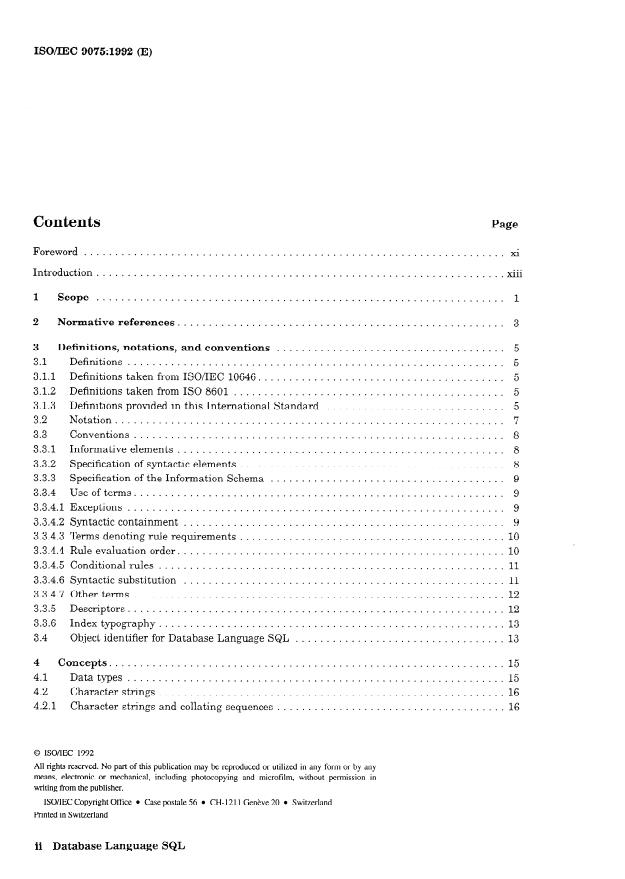
Contents
Foreword . . . . . . . . . . . . . . . . . . . . . . . . . . . . . . . . . . . . . . . . . . . . . . . . . . . . . . . . . . . . . . . . . . . . xi
Introduction.xlii
Scope . . . . . . . . . . . . . . . . . . . . . . . . . . . . . . . . . . . . . . . . . . . . . . . . . . . . . . . . . . . . . . . . . .
No~ativereferences. 3
.....................................
3 Defhitions, notations, and conventions
.............................................................
31 . Definitions
Definitions taken from ISO/IEC 10646. .
3.1.1
Definitions taken from ISO 8601 .
3.1.2
.............................
Definitions provided in this International Standard
3.1.3
. Notation .
. Conventions .
3.3.1 Informative elements .
3.32 Specification of syntactic elements .
3.3.3 Specification of the Information Schema .
3.3.4 Useofterms .
3.3.4.1 Exceptions . 9
3.3.4.2 Syntactic containment .
...........................................
3.3.4.3 Terms denoting rule requirements
3.3.4.4 Rufe evaluation Order. .
3.3.4.5 Conditional rules .
....................................................
3.3.4.6 Syntactic Substitution
............................................................
3.3.4.7 Otherterms
3.3.5 Descriptors.l 2
Index ty-pography .
3.3.6
..................................
. Object identifier for Database Language SQL
4 Concepts.l 5
4.1 Datatypes .
4.2 Character strings .
.....................................
4.2.1 Character strings and collating sequences
0 1s0/1Fc 1992
All rights reserved. No part of this publication may be reproduced or utilized in any form or by any
means, electronie or mechanical, including photocopying and microfilm, without permission in
writing from the publisher.
ISO/IEC Copyright Office l Case postale 56 l CH-121 1 Geneve 20 l Switzerland
Printed in Switzerland
ii Database Language SQL
ISOKEC 9075:1992 (E)
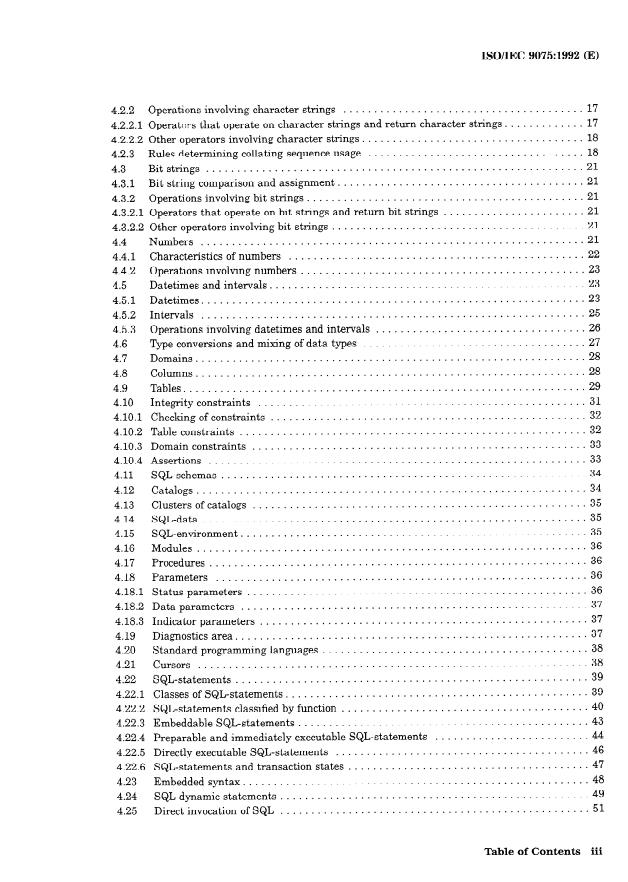
....................................... 17
4.2.2 Operations involving Character strings
............. 17
4.2.2.1 Operatcns that operate on Character strings and return Character strings
.................................... 18
4.2.2.2 Other Operators involving Character strings
................................... 18
Rules determining collating sequence usage
4.2.3
..2 1
Bitstrings
4.3 .
........................................
4.3.1 Bit string comparison and assignment
............................................. 21
4.3.2 Operations involving bit strings
....................... 21
4.3.2.1 Operators that operate on bit strings and retum bit strings
......................................... 21
4.3.2.2 Other Operators involving bit strings
..2 1
4.4 Numbers
............................................................
................................................ 22
4.4.1 Characteristics of numbers
.............................................. 23
4.4.2 Operations involving numbers
................................................... 23
4.5 Datetimes and intervals
4.5.1 Datetimes.Z 3
4.5.2 Intervals .
.................................. 26
4.5.3 Operations involving datetimes and intervals
.................................... 27
4.6 Type conversions and mixing of data types
4.7 Domains.2 8
4.8 Columns.2 8
4.9 Tables.2 9
..................................................... 31
4.10 Integrity constraints
................................................... 32
4.10.1 Checking of constraints
........................................................ 32
4.10.2 Table constraints
...................................................... 33
4.10.3
Domain constraints
4.10.4 .
Assertions
4.11 SQL-Schemas. .
4.12 Catalogs .
...................................................... 35
4.13 Clusters of catalogs
4.14 SQL-data .
4.15 SQL-environment .
4.16 Modules .
4.17 Procedures .
............................................................
4.18 Parameters
....................................................... 36
4.18.1 Status Parameters
........................................................ 37
4.18.2 Data Parameters
..................................................... 37
4.18.3 Indicator Parameters
......................................................... 37
4.19
Diagnostics area
........................................... 38
4.20
Standard programming languages
4.21 Cursors .
......................................................... 39
4.22 SQL-Statements
................................................ 39
4.22.1 Classes of SQL-Statements.
........................................ 40
4.22.2 SQL-Statements classified by fwnction
...............................................
4.22.3 Embeddable SQL-Statements
......................... 44
4.22.4 Preparable and immediately executable SQL-Statements
......................................... 46
4.22.5 Directly executable SQL-Statements
....................................... 47
4.22.6 SQL-Statements and transaction states
4.23 Embedded Syntax .
.................................................. 49
4.24 SQL dynamic Statements
.................................................. 51
4.25 Direct invocation of SQL
Table of Contents iii
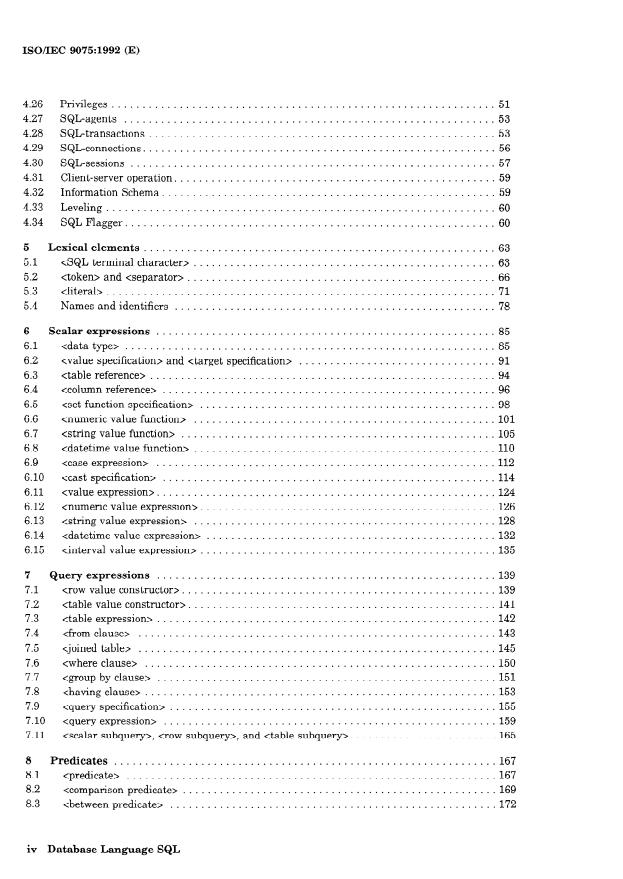
ISOIIEC 9075:1992 (E)
4.26 Pnvileges.5 1
4.27 SQL-agents .
4.28 SQL-transactions .
4.29 SQL-connections.5 6
4.30 SQL-Sessions .
4.31 Client-server Operation. .
4.32 Information Schema. .
4.33 Leveling .
4.34 SQLFlagger.6 0
5 Lexicalelements . . . . . . . . . . . . . . . . . . . . . . . . . . . . . . . . . . . . . . . . . . . . . . . . . . . . . . . . . 63
51 . . . . . . . . . . . . . . . . . . . . . . . . . . . . . . . . . . . . . . . . . . . . . . . . . . 63
52 . and . . . . . . . . . . . . . . . . . . . . . . . . . . . . . . . . . . . . . . . . . . . . . . . . . . 66
53 . . 71
54 . Names and identifiers . . . . . . . . . . . . . . . . . . . . . . . . . . . . . . . . . . . . . . . . . . . . . . . . . . . . 78
6 Scalarexpressions . . . . . . . . . . . . . . . . . . . . . . . . . . . . . . . . . . . . . . . . . . . . . . . . . . . . . . . 85
61 . cdatatype> .
................................
62 . and
........................................................
63 . ctable reference>
.
64 .
................................................
65 .
66 . cnumeric value function> .
6.7 ostring value function> .
. .
68 cdatetime value function>
69 ccase expression> .
6’10 . .
6.11 .
................................................
6.12
.................................................
6.13 ostring value expression>
...............................................
6.14 cdatetime value expression>
................................................
6.15 cinterval value expression>
..13 9
.....................................................
7 Queryexpressions
7.1 crow value constructor> .
72 . .
73 . ctable expression> .
..14 3
74 . cfrom clause> .
75 . .
..15 0
76 . .
..15 1
7.7 .
..15 3
78 . chavingclause>. .
.....................................................
79 cquery specification>
7.10 . .
........................ 165
7.11
cscalar subquery>, , and
Predicates . . . . . . . . . . . . . . . . . . . . . . . . . . . . . . . . . . . . . . . . . . . . . . . . . . . . . . . . . . . .167
81 .
. . . . . . . . . . . . . . . . . . . . . . . . . . . . . . . . . . . . . . . . . . . . . . . . . . . . . . . . . .167
82 . . . . . . . . . . . . . . . . . . . . . . . . . . . . . . . . . . . . . . . . . . . . . . . . . . . . 169
83 . cbetween predicate> . . . . . . . . . . . . . . . . . . . . . . . . . . . . . . . . . . . . . . . . . . . . . . . . . . . . . 172
iv Database Language SQL
cinpredicate> .17 3
84 . .
.17 5
85 . .
86 . .
........................................... 180
87 . cquantified comparison predicate>
88 . cexists predicate> .
.
89 .
cmatch predicate>
8.10 .
8.11 .
8.12 csearch condition> .
9 Data assignment rules .
. Retrieval assignment . 191
92 . Store assignment . 193
93 . Set Operation result data types .
10 Additional common elements .
10.1 Cinterval qualifier> .
..20 1
10.2 .
..20 3
10.3 cprivileges> .
.205
10.4 .
.207
10.5 .
......................... 208
10.6 cconstraint name definition> and cconstraint attributes>
Schema defknition and manipulation . .211
.2ll
11.1 .
.214
11.2 .
11.3 .21 6
..218
11.4 .
11.5 .22 1
.224
11.6 ctable constraint definition> .
.226
11.7 .
.228
11.8 creferential constraint definition> .
11.9 .233
.
11.10 . .235
11.11 .23 6
11.12 .237
.
11.13 . .238
.239
11.14 .
.240
11.15 .
.242
11.16 .
.243
11.17 .
.244
11.18 .
.245
11.19 .
,249
11.20 . .
11.21 .25 0
.252
11.22 .
.253
11.23 . .
............................................. .254
11.24
11.25 . .255
11.26 . .256
Table of Contents v
. . . . . 257
11.27 . . . .
-259
11.28
................................................
.261
11.29
............................................
.262
11.30
....................................................
.265
11.31 .
.267
11.32 ctranslation definition>
..................................................
.269
11.33 .
..27 0
11.34
..................................................
.272
11.35
...............................................
.273
11.36 qrant Statement>
......................................................
.276
11.37
.....................................................
12 Module.28 1
12.1 .28 1
.284
12.2 .
..28 5
.
12.3
.........................................................
.290
Calls to a
12.4 .
12.5 .
.307
Data manipulation
13 .
13.1 .
..310
13.2
.....................................................
13.3 .
.315
13.4
......................................................
13.5 .
13.6 cdelete Statement: positioned> .
13.7 .
13.8 .
......................................................
13.9 Cupdate Statement: positioned> .
.328
Cupdate Statement: searched>
13.10 .
13.11 .
.333
14 Transaction management .
.
14.1 .
14.2 .
.337
14.3 .
14.4
.....................................................
15 Connectionmanagement.34 1
15.1 .
15.2 .
15.3 cdisconnect Statement> .
..34 9
16 Sessionmanagement .
16.1 cset catalog Statement> .
..................................................
16.2 .
16.3 .
16.4 .
16.5 .
.
vi Database Language SQL
ISODEC 9075:1992 (E)
17 DynamicSQL.35 5
17.1 Description of SQL item descriptor areas
...................................... 355
17.2
.............................................
17.3 cdeallocate descriptor Statement>
........................................... 362
17.4
................................................ 363
17.5 cset descriptor Statement>.
................................................ 366
17.6 369
.....................................................
17.7 cdeallocate prepared Statement> 375
............................................
17.8 cdescribe Statement> 376
.....................................................
17.9 . . .37 7
17.10 cexecute Statement> 383
.....................................................
17.11 . 385
............................................
17.12
.387
................................................
17.13 callocate cursor Statement>
................................................
17.14
................................................ 390
17.15
................................................ 392
17.16 cdynamic close Statement>
................................................
17.17 cdynamic delete Statement: positioned> 395
......................................
17.18
..................................... 396
17.19 cpreparable dynamic delete Statement: positioned>
............................. 398
17.20 cpreparable dynamic update Statement: positioned> 399
.............................
18 Diagnosticsmanagement.40 1
18.1 . .401
..............................................
19 EmbeddedSQL
........................................................ ..411
19.1
............................................ .411
19.2
.......................................... .418
19.3
............................................ .421
19.4
.............................................. .424
19.5
......................................... .428
19.6
......................................... .431
19.7 .434
........................................
19.8
.......................................... .436
19.9 . .439
...........................................
20 Direct invocation of SQL
.443
.................................................
20.1 cdirect SQL Statement>. .443
.................................................
20.2 cdirect select Statement: multiple rows>
......................................
21 Information Schema and Definition Schema . . . . . . . . . . . . . . . . . . . . . . . . . . . . . . . . .449
21.1 Introduction.449
21.2 Information Schema. . . . . . . . . . . . . . . . . . . . . . . . . . . . . . . . . . . . . . . . . . . . . . . . . . . . . .450
21.2.1 INFORMATION SCHEMA Schema. . . . . . . . . . . . . . . . . . . . . . . . . . . . . . . . . . . . . . . . . .450
-
21.2.2 INFORMATIONJXHEMA CATALOG NAME base table. . . . . . . . . . . . . . . . . . . . . . . . .451
- -
21.2.3 INFORNATION-SCHEMA-CATALOG NAME-CARDINALITY assertion . . . . . . . . . . . .452
-
21.2.4 SCHEMAII’Aview.453
DOMAINSview . . . . . . . . . . . . . . . . . . . . . . . . . . . . . . . . . . . . . . . . . . . . . . . . . . . . . . .454
21.2.5
21.2.6
DOMAIN-CONSTRAINTS view . . . . . . . . . . . . . . . . . . . . . . . . . . . . . . . . . . . . . . . . . . . . .455
21.2.7 TABLESview.,.456
Table of Contents vii
21.2.8 VIEWSview.45 7
..45 8
21.2.9 COLUMNSview .
.460
21.2.10 TABLE-PRIVILEGES view .
,461
21.2.11 COLUMN_PRIVILEGES view .
.462
21.2.12 USAGE-PRIVILEGES view .
21.2.13 TABLE-CONSTRAINTS view . .463
.464
21.2.14 REFERENTIAL CONSTR&NTS view .
-
21.2.15 CHECK-CONSTRAINTS view . .465
............................................. .466
21.2.16 KEY-COLUh!INJJSAGE view
..................................................... .467
21.2.17 ASSER.TIONS view
.468
21.2.18 CHARACTER-SETS view .
..................................................... .469
21.2.19 COLLATIONS view
................................................... .470
21.2.20 TRANSLATIONS view
.............................................. .471
21.2.21 VIEW-TABLEJJSAGE view
212.22 VIEW-COLUMNJJSAGE view . .472
.473
21.2.23 CONSTRAINT TABLE USAGE view .
- -
.474
21.2.24 CONSTRJJINT-COLUMNJJSAGE view .
.475
21.225 COLUMN-DOMAINJSAGE view .
21.2.26 SQL LANGUAGES view . .476
-
.477
21.2.27 SQLJDENTIFIER domain .
.477
21.2.28 CHARACTER-DATA domain .
............................................ .478
21.2.29 CARDINAL NUMBER domain
-
..47 9
21.3 DefinitionSchema .
........................................................... .479
21.3.1 Introduction
.......................................... .480
21.3.2 DEFINITION-SCHEMA Schema.
...................................................... ,481
21.3.3 USERS base table
.................................................. .482
21.3.4 SCHEMATA base table
...................................... .483
21.3.5 DATA-TYPE-DESCRIPTOR base table
.................................................... .485
21.3.6 DOMAINS base table
....................................... .486
21.3.7 DOMAIN-CONSTRAINTS base table
..................................................... .488
21.3.8 TABLES base table
...................................................... .489
21.3.9 VIEWS base table
................................................... ,491
21.3.10 COLUMNS base table
.493
21.3.11 VIEW-TABLEJJSAGE base table .
.494
21.3.12 VIEW-COLUMN USAGE base table .
-
......................................... .495
21.3.13 TABLE-CONSTRAINTS base table
......................................... .497
21.3.14 KEY COLUMNJJSAGE base table
-
.................................. .499
21.3.15 REFERENTLAL-CONSTRAINTS base table
......................................... 501
21.3.16 CHECK CONSTRAINTS base table
-
........................................
21.3.17 CHECK TABLE USAGE base table .502
- -
21.3.18 CHECK COLUMN USAGE base table . 503
- -
..................................................
21.3.19 ASSERTIONS base table 504
21.320 TABLE PRIVILEGES base table . 505
-
21,321 COLUMN-PRMLEGES base table. . .5O7
21.322 USAGE PRIVILEGES base table . 509
-
.............................................
21.3.23 CHARACTER SETS base table 511
-
21.3.24COLLATIONSbasetable. . -513
..............................................
21.3.25 TRANSLATIONS base table .515
.............................................
21.3.26 SQL LANGUAGES base table. 517
-
viii Database Language SQL
ISOLIEC 9075:1992 (E)
21.4 Assertions on the base tables
............................................... 520
21.4.1 UNIQUE-CONSTRAINT-NAME assertion
................................... .520
21.4.2 EQUALJXEY-DEGREES assertion
......................................... .521
21.4.3 KEY~DEGREE~GREATER~THAN~OR~EQUAL~TO~l assertion.
................... 522
22 Statuscodes.52 3
22.1 SQLSTATE.52 3
22.2 SQLCODE
........................................................... ..52 7
23 Conformance
......................................................... ...52 9
23.1 , Introduction.
..52 9
........................................................
23.2 Claims of conformance
................................................... .529
23.3 Extensions and Options
................................................... 530
23.4 Flagger requirements
.................................................... .530
23.5 Processing methods
..................................................... .530
Annex A Leveling the SQL Language
....................................... .533
AS Intermediate SQL Specifications
........................................... .533
A.2 Entry SQL Specifications
..................................................
Annex B Implementation-defined elements . . . . . . . . . . . . . . . . . . . . . . . . . . . . . . . . . . .553
Annex C Implementation-dependent elements . . . . . . . . . . . . . . . . . . . . . . . . . . . . . . . .565
Annex D Deprecatedfeatures . . . . . . . . . . . . . . . . . . . . . . . . . . . . . . . . . . . . . . . . . . . .571
Annex E Incompatibilities with ISO/IEC 9075:1989 . . . . . . . . . . . . . . . . . . . . . . . . . . . .573
Annex F Maintenance and interpretation of SQL. . . . . . . . . . . . . . . . . . . . . . . . . . . . . .579
Index.581
Table of Contents ix
ISOAEC 9075:1992 (E)
TABLES
Table Page
1 Collating coercibility rules for monadic Operators 19
...............................
2 Collating coercibility rules for dyadic Operators 19
.................................
3 Collating sequence usage for comparisons 20
.....................................
4 Fields in datetime items 24
..................................................
5 Fields in year-month INTERVAL items 25
.......................................
6 Fields in day-time INTERVAL items 25
.........................................
7 Valid values for fields in INTERVAL items 26
....................................
8 Valid Operators involving datetimes and intervals . 26
9 SQL-transaction isola tion levels and the three phenomena . 55
10 Valid values for fields in datetime items
......................................
11 Valid values for fields in INTERVAL items . 90
12 semantics .
13 ‘Ruth table for the AND boolean . 189
14 Truth table for the OR boolean .
15 Truth table for the IS boolean .
16 Standard programming languages .201
..........................................
17 Data types of ckey wordx used in SQL item descriptor areas .
Codes used for SQL data types in Dynamit SQL .358
18 .
Codes associated with datetime data tvpes in Dynamit SQL . 358
20 Codes used for cinterval qualifierx in Dynamit SQL . 359
21 cidentifierx for use with . .403
22 SQL-Statement Character Codes for use in the diagnostics area . 404
23 SQLSTATE class and subclass values . .523
24 SQLCODE values. . .527
x Database Language SQL
ISO/lEC 9075:1992 (E)
Foreword
ISO (the International Organization for Standardization) and IEC (the
International Electrotechnical Commission) ferm the specialized System for
worldwide standardization. National bodies that are members of ISO or IEC
participate in the development of International Standards through technical
committees established by the respective organization to deal with particular
fields of technical activity. ISO and IEC technical committees collaborate in
fields of mutual interest. Other international organizations, governmental and
non-governmental, in liaison with ISO and IEC, also take part in the work.
In the field of information technology, ISO and IEC have established a joint
technical committee, ISOLIEC JTC 1. Draft International Standards adopted by
the joint technical committee are circulated to national bodies for voting.
Publication as an International Standard requires approval by at least 75 o/ of
the national bodies casting a vote.
International Standard ISOLIEC 9075 was prepared by Joint Technical
Committee ISO/IEC JTC 1, Information technology.
This third edition cancels and replaces the second edition (ISO 9075: 1989),
which has been technically revised.
Annexes A, B, C, D, E and F of this International Standard are for information
only.
Foreword xi
This page intentionally left blank
ISO/lEC 9075:1992 (E)
Introduction
This International Standard was approved in 1992.
This International Standard was developed from ISO/IEC 9075: 1989, Information Systems,
Database Language SQL with Integrity Enhancements, and replaces that International Standard.
It adds significant new features and capabilities to the specifications. It is generally compatible
with ISO/IEC 90751989, in the sense that, with very few exceptions, SQL language that con-
forms to ISO/IEC 90751989 also conforms to this International Standard, and will be treated
in the same way by an implementation of this International Standard as it would by an imple-
mentation of ISO/IEC 90751989. The known incompatibilities between ISO/IEC 90753989 and
this International Standard are stated in informative Annex E, “Incompatibilities with ISO/IEC
9075: 1989”.
Technical changes between ISO/IEC 9075:1989 and this International Standard include both im-
provements or enhancements to existing features and the definition of new features. Significant
improvements in existing features include:
- A better definition of direct invocation of SQL language;
- Improved diagnostic capabilities, especially a new Status Parameter (SQLSTATE), a diagnostics
area, and supporting Statements.
Significant new features are:
Support for additional data types (DATE, TIME, TIMESTAMP, INTERVAL, BIT string, variable-
1)
length Character and bit strings, and NATIONAL CHARACTER strings),
Support for Character sets beyond that required to express SQL language itself and support for
additional collations,
Support for additional scalar operations, such as string operations for concatenate and sub-
3)
string, date and time operations, and a ferm for conditional expressions,
Increased generality and orthogonality in the use of scalar-valued and table-valued quer-y
4)
expressions,
Additional set Operators (for example, union join, natura1 join, set differente, and set intersec-
5)
tion),
Capability for domain definitions in the Schema,
6)
Support for Schema Manipulation capabilities (especially DROP and ALTER Statements),
7)
Support for bindings (modules and embedded Syntax) in the Ada, C, and MUMPS languages,
8)
Additional privilege capabili ties,
9)
Introduction xiii
ISO/lEC 9075:1992 (E)
10) Additional referential integrity facilities, including referential actions, subqueries in CHECK
constraints, separate assertions, and user-controlled deferral of constraints,
11) Definition of an Information Schema,
12) Support for dynamic execution of SQL language,
Access (especially connection man-
Support for certain facilities required for Remote Database
13)
agement Statements and qualified Schema names),
14) Support for temporar-y tables,
15) Support for transaction consistency levels,
16) Support for data type conversions (CAST expressions among data types),
17) Support for scrolled cursors, and
18) A requirement for a flagging capability to aid in portability of application programs.
The organization of this International Standard is as follows:
1) Clause 1, “Scope”, specifies the scope of this International Standard.
2) Clause 2, “Normative references”, identifies additional Standards that, through reference in this
International Standard, constitute provisions of this International Standard.
defines the notations and conventions used
3) Clause 3, “Definitions, notations, and conventions”,
in this International Standard.
4) Clause 4, “Concepts”, presents concepts used in the definition of SQL.
5) Clause 5, “Lexical elements”, defines the lexical elements of the language.
defines the elements of the language that produce scalar values.
6) Clause 6, “Scalar expressions”,
7) Clause 7, “Quer-y expressions”, defines the elements of the language that produce rows and
tables of data.
8) Clause 8, “Predicates”, defines the predicates of the language.
specifies the rules for assignments that retrieve data from or
9) Clause 9, “Data assignment rules”,
skore data into the database, and formation rules for set operations.
defines additional language elements that are used
10) Clause 10, “Additional common elements”,
in various Parts of the language.
defines facilities for creating and managing a
11) Clause 11, “Schema definition and manipulation”,
Schema.
12) Clause 12, “Module”, defines modules and procedures.
13) Clause 13, “Data manipulation”, defines the data manipulation Statements.
defines the SQL-transaction management Statements.
14) Clause 14, “Transaction management”,
15) Clause 15, “Connection management” defines the SQL-connection management Statements.
defines the SQL-Session management Statements.
16) Clause 16, “Session management”,
17) Clause 17, “Dynamit SQL”, defines the facilities for executing SQL-Statements dynamically
defines the diagnostics management facilities.
18) Clause 18, “Diagnostics management”,
xiv Database Language SQL
ISO/lEC 9075:1992 (E)
19) Clause 19, “Embedded SQL”, defines Syntax for embedding SQL in certain Standard program-
ming languages.
20) Clause 20, “Direct invocation of SQL”, defines the direct invocation of SQL language.
21) Clause 21, “Information Schema and Definition Schema”, dennes viewed tables that contain
Schema information.
22) Clause 22, “Status Codes”, defines values that identify the Status of the execution of SQL-
Statements and the mechanisms by which those values are returned.
23) Clause 23, “Conformance”, defines the criteria for conformance to this International Standard.
24) Annex A, “Leveling the SQL Language”, is an informative Annex. It lists the leveling rules
defining the Entry SQL and Intermediate SQL subset levels of the SQL language.
is an informative Annex. It lists those features
25) Annex B, “Implementation-defined elements”,
for which the body of the International Standard states that the Syntax or meaning or effect on
the database is partly or wholly implementation-defined, and describes the defining information
that an implernentor shall provide in each case.
is an informative Annex. It lists those features
26) Annex C, “Implementation-dependent elements”,
for which the body of the International Standard states explicitly that the meaning or effect on
the database is implementation-dependent.
is an informative Annex. It lists features that the responsible
27) Annex D, “Deprecated features”,
Technical Committee intends will not appear in a future revised Version of this International
Standard.
28) Annex E, “Incompatibilities with ISO/IEC 9075:1989”, is an informative Annex. It lists the
incompatibilities between this Version of this International Standard and ISO/IEC 9075:1989.
29) Annex F, “Maintenance and interpretation of SQL”, is an informative Annex. It identifies SQL
interpretations and corrections that have been processed by ISO/IEC JTCUSC21 since adoption
of ISO/IEC 9075:1989.
In the text of this International Standard, Clauses begin a new odd-numbered Page, and in
Clause 5, “Lexical elements”, through Clause 22, “Status Codes”, Subclauses begin a new Page.
Any resulting blank space is not significant.
Introduction
This page intentionally left blank
INTERNATIONAL STANDARD
Information technology - Database languages - SQL
1 Scope
This International Standard defines the data structures and basic operations on SQ.L-data. It
provides functional capabilities for creating, accessing, maintaining, controlling, and protecting
SQL-data.
Not;e: The fiamework for this International Standard is described by the Reference Model of Data
Management (ISWIEC DIS 10032:1991).
This International Standard specifies the Syntax and semantics of a database language
- for specifying and modifying the structure and the integrity constraints of SQL-data,
- for declaring and invoking operations on SQL-data and cursors, and
- for declaring database language procedures and embedding them into a Standard programming
language.
It also specifies an Information Schema that describes the structure and the integrity constraints of
SQL-data.
This International Standard
provides a vehicle for portability of data definitions and compilation units between SQL-
implernentations,
provides a vehicle for interconnection of SQL-implernentations,
specifies Syntax for embedding SQL-Statements in a compilation unit that otherwise conforms to
the Standard for a particular programming language. It defines how an equivalent compilation
unit may be derived that conforms to the particular programming language Standard. In that
equivalent compilation unit, each embedded SQL-Statement has been replaced by Statements
that invoke a database language procedure that contains the SQL-Statement, and
specifies Syntax for direct invocation of SQL-Statements.
This International Standard does not define the method or time of binding between any of
- databäae management System components,
- SQL data def!inition declarations,
- SQL procedures, or
- compilation units, including those containing embedded SQL.
Scope 1
ISOLIEC 9075:1992 (E)
Implernentations of this International Standard may exist in environments that also support
application programming languages, end-user query languages, report generator Systems, data
dictionary Systems, program library Systems, and distributed communication Systems, as well as
various tools for database design, data administration, and Performance optimization.
2 Database Language SQL
ISO/lEC 9075:1992 (E)
2 Normative references
The following Standards contain provisions that, through reference in this text, constitute pro-
visions of this International Standard. At the time of publication, the editions indicated were
valid. All Standards are subject to revision, and Parties to agreements based on this International
Standard are encouraged to investigate the possibility of applying the most recent editions of the
Standards listed below. Members of
...
Questions, Comments and Discussion
Ask us and Technical Secretary will try to provide an answer. You can facilitate discussion about the standard in here.
Loading comments...