

SIST ISO 7905-2:2022
(Main)Plain bearings - Bearing fatigue - Part 2: Test with a cylindrical specimen of a metallic bearing material
General Information
- Abstract
This document specifies а method for the determination of the endurance limit in fatigue of bearing materials alone (not attached to steel backing).
- Status
- Published
- Publication Date
- 10-Feb-2022
- Technical Committee
- ISEL - Mechanical elements
- Current Stage
- 6060 - National Implementation/Publication (Adopted Project)
- Start Date
- 10-Feb-2022
- Due Date
- 17-Apr-2022
- Completion Date
- 11-Feb-2022
Buy Documents


ISO 7905-2:2021 - Plain bearings -- Bearing fatigue
ISO 7905-2:2021 - Plain bearings — Bearing fatigue — Part 2: Test with a cylindrical specimen of a metallic bearing material/17/2021
Overview
ISO 7905-2:2021 specifies a laboratory method to determine the endurance limit in fatigue of metallic plain bearing materials tested as standalone specimens (i.e., not bonded to steel backing). The method uses a polished, cylindrical specimen and an axial oscillating load to reproduce the cyclic stresses that cause bearing fatigue. Results are presented as stress–number (S–N or Wöhler) curves and evaluated statistically to define endurance limits under controlled test conditions.
Key topics and requirements
- Specimen geometry and surface finish: Cylindrical specimens manufactured in accordance with the standard’s figure and polished to be representative of production bearing surfaces. Surface roughness is specified as R < 6 µm (per ISO 4287).
- Test rig and loading: Specimens are axially clamped and subjected to an oscillating compressive/tensile load. The rig must record load and displacement; an example configuration is provided in the standard.
- Test parameters: The standard defines the test cycle range, test frequency range (document specifies 50–80 Hz) and the approach for finite-life and endurance (infinite-life) determination.
- Data presentation and evaluation:
- S–N (Wöhler) curves at a specified temperature (±2 °C).
- Statistical evaluation is recommended because of fatigue scatter.
- Alternative representations such as Gerber or Goodman–Haigh diagrams may be used to show stress amplitude vs mean stress.
- Metallographic examination of failed specimens to identify damage mechanisms, corrosion or thermal diffusion effects.
- Limitations noted: Results apply to bulk material specimens; they do not capture residual stresses or metallurgical conditions that may exist in thin bearing layers bonded to backing materials.
Applications and users
ISO 7905-2 is practical for:
- Bearing manufacturers validating material fatigue endurance of plain bearing alloys
- Materials and tribology engineers conducting R&D on bearing materials
- Independent test laboratories performing fatigue characterization or quality assurance
- Design engineers needing S–N data to inform bearing life predictions and safety factors
Use cases include material selection, comparative fatigue performance testing, and supporting specifications for plain bearings where the bearing material behaviour (not the bonded assembly) must be quantified.
Related standards
- ISO 4287 - Surface texture: profile method (referenced for roughness)
- Other parts of the ISO 7905 series (plain bearing test methods)
- ISO 3548-1 and ISO 4378-1 (related bearing design, materials and terminology)
Keywords: ISO 7905-2, plain bearings, bearing fatigue testing, endurance limit, cylindrical specimen, S–N curve, Wöhler curve, metallic bearing material.
Relations
- Effective Date
- 23-Apr-2020
Buy Documents
ISO 7905-2:2021 - Plain bearings -- Bearing fatigue
ISO 7905-2:2021 - Plain bearings — Bearing fatigue — Part 2: Test with a cylindrical specimen of a metallic bearing material/17/2021
Frequently Asked Questions
SIST ISO 7905-2:2022 is a standard published by the Slovenian Institute for Standardization (SIST). Its full title is "Plain bearings - Bearing fatigue - Part 2: Test with a cylindrical specimen of a metallic bearing material". This standard covers: This document specifies а method for the determination of the endurance limit in fatigue of bearing materials alone (not attached to steel backing).
This document specifies а method for the determination of the endurance limit in fatigue of bearing materials alone (not attached to steel backing).
SIST ISO 7905-2:2022 is classified under the following ICS (International Classification for Standards) categories: 21.100.10 - Plain bearings. The ICS classification helps identify the subject area and facilitates finding related standards.
SIST ISO 7905-2:2022 has the following relationships with other standards: It is inter standard links to SIST ISO 7905-2:2002. Understanding these relationships helps ensure you are using the most current and applicable version of the standard.
SIST ISO 7905-2:2022 is available in PDF format for immediate download after purchase. The document can be added to your cart and obtained through the secure checkout process. Digital delivery ensures instant access to the complete standard document.
Standards Content (Sample)
SLOVENSKI STANDARD
01-april-2022
Drsni ležaji - Utrujanje ležaja - 2. del: Preskušanje kovinskega drsnega materiala z
vzorčnim valjem
Plain bearings - Bearing fatigue - Part 2: Test with a cylindrical specimen of a metallic
bearing material
Paliers lisses - Fatigue des paliers - Partie 2: Essai d'éprouvettes cylindriques en
matériau antifriction métallique
Ta slovenski standard je istoveten z: ISO 7905-2:2021
ICS:
21.100.10 Drsni ležaji Plain bearings
2003-01.Slovenski inštitut za standardizacijo. Razmnoževanje celote ali delov tega standarda ni dovoljeno.
INTERNATIONAL ISO
STANDARD 7905-2
Second edition
2021-12
Plain bearings — Bearing fatigue —
Part 2:
Test with a cylindrical specimen of a
metallic bearing material
Paliers lisses — Fatigue des paliers —
Partie 2: Essai d'éprouvettes cylindriques en matériau antifriction
métallique
Reference number
© ISO 2021
All rights reserved. Unless otherwise specified, or required in the context of its implementation, no part of this publication may
be reproduced or utilized otherwise in any form or by any means, electronic or mechanical, including photocopying, or posting on
the internet or an intranet, without prior written permission. Permission can be requested from either ISO at the address below
or ISO’s member body in the country of the requester.
ISO copyright office
CP 401 • Ch. de Blandonnet 8
CH-1214 Vernier, Geneva
Phone: +41 22 749 01 11
Email: copyright@iso.org
Website: www.iso.org
Published in Switzerland
ii
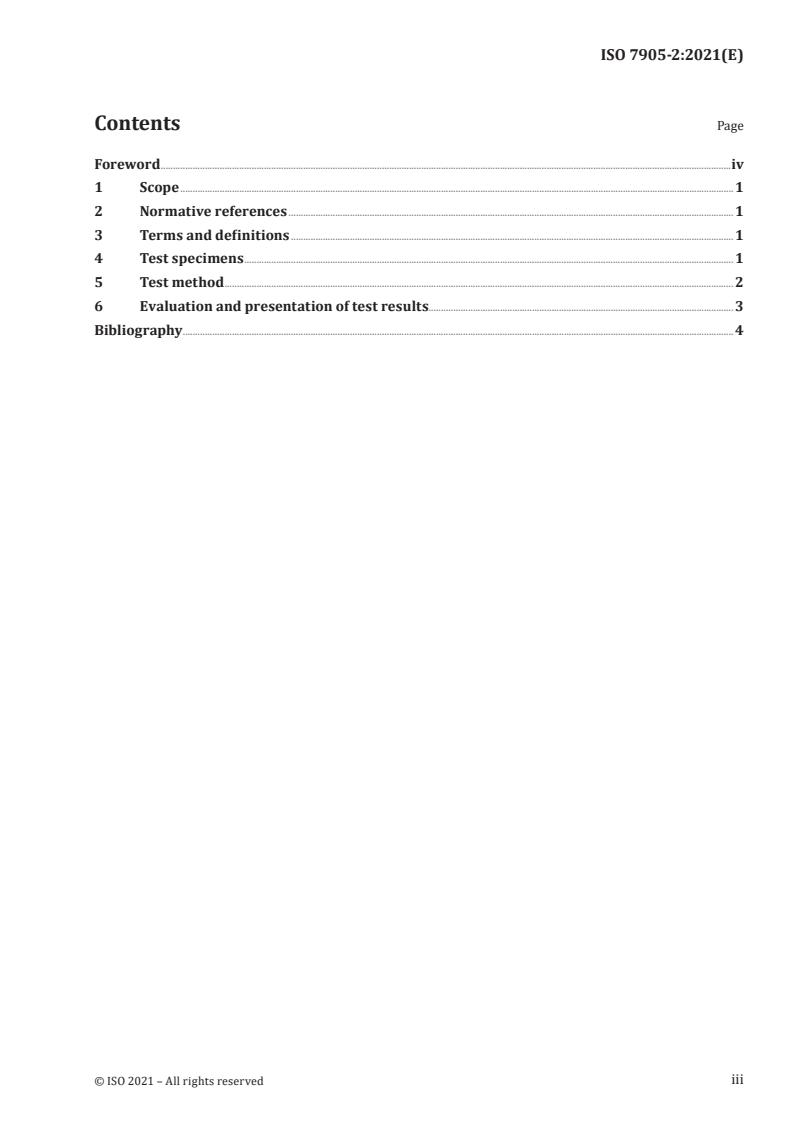
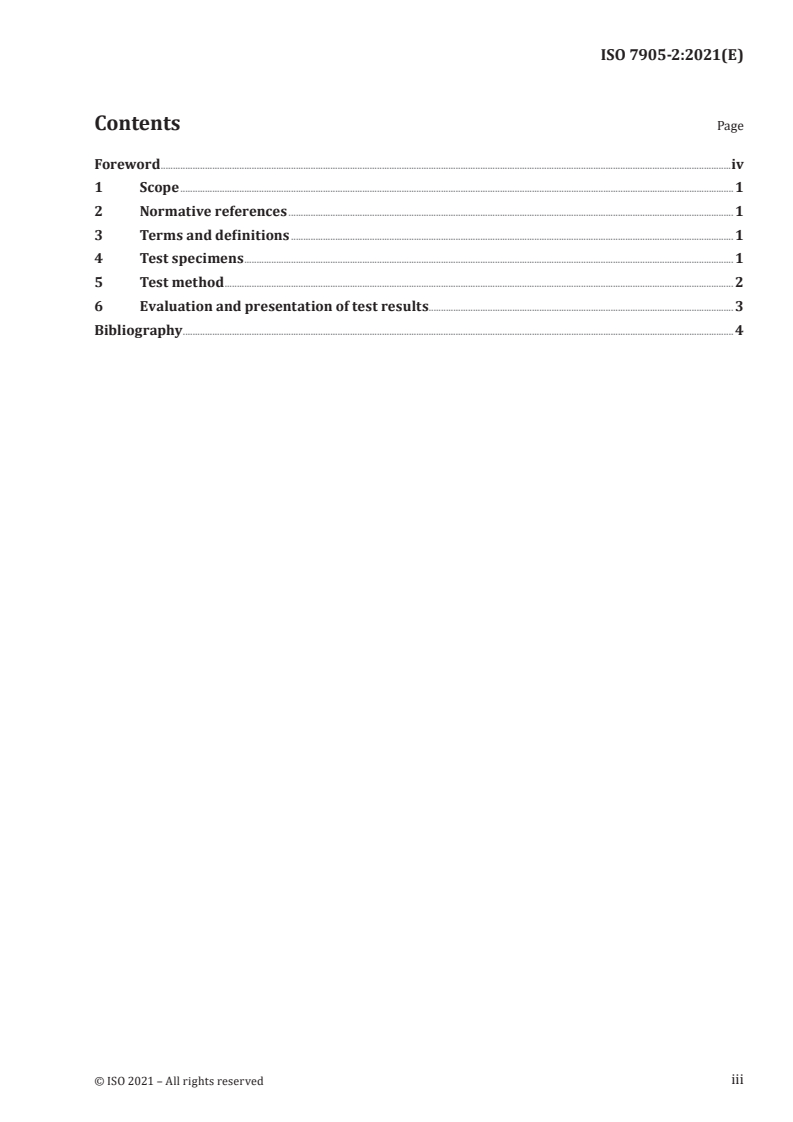
Contents Page
Foreword .iv
1 Scope . 1
2 Normative references . 1
3 Terms and definitions . 1
4 Test specimens . 1
5 Test method . 2
6 E valuation and presentation of test results . 3
Bibliography . 4
iii
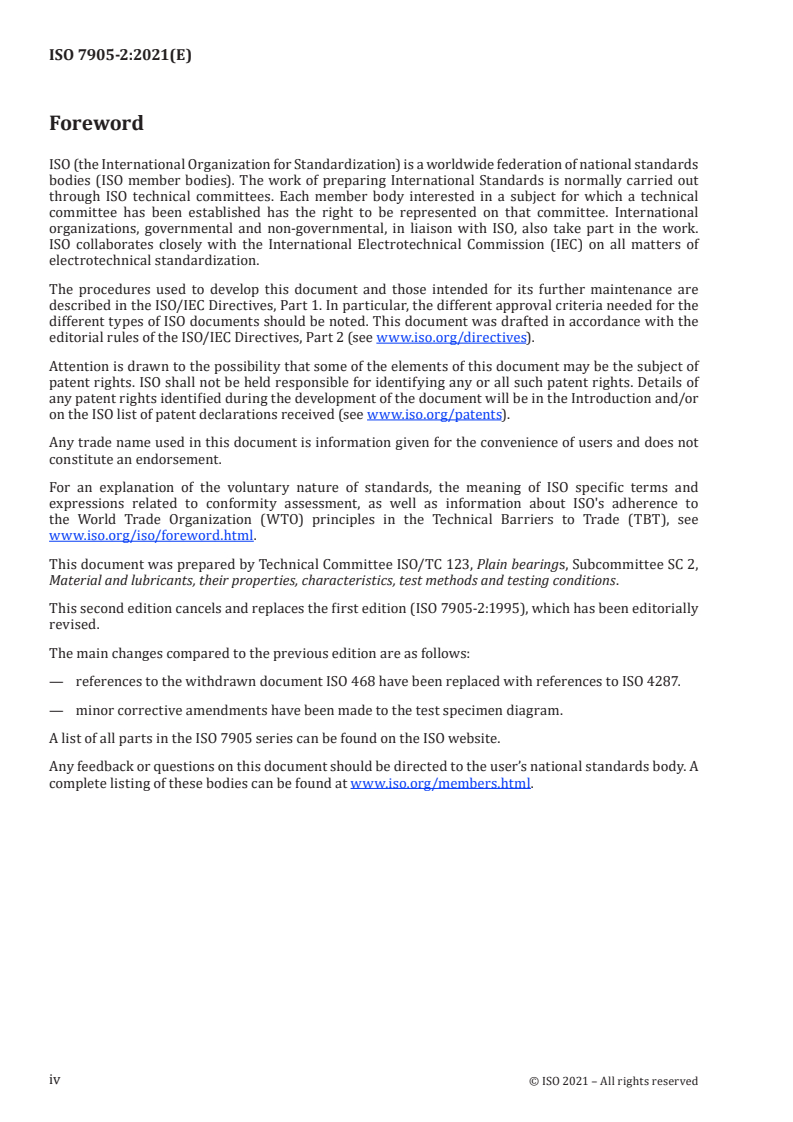
Foreword
ISO (the International Organization for Standardization) is a worldwide federation of national standards
bodies (ISO member bodies). The work of preparing International Standards is normally carried out
through ISO technical committees. Each member body interested in a subject for which a technical
committee has been established has the right to be represented on that committee. International
organizations, governmental and non-governmental, in liaison with ISO, also take part in the work.
ISO collaborates closely with the International Electrotechnical Commission (IEC) on all matters of
electrotechnical standardization.
The procedures used to develop this document and those intended for its further maintenance are
described in the ISO/IEC Directives, Part 1. In particular, the different approval criteria needed for the
different types of ISO documents should be noted. This document was drafted in accordance with the
editorial rules of the ISO/IEC Directives, Part 2 (see www.iso.org/directives).
Attention is drawn to the possibility that some of the elements of this document may be the subject of
patent rights. ISO shall not be held responsible for identifying any or all such patent rights. Details of
any patent rights identified during the development of the document will be in the Introduction and/or
on the ISO list of patent declarations received (see www.iso.org/patents).
Any trade name used in this document is information given for the convenience of users and does not
constitute an endorsement.
For an explanation of the voluntary nature of standards, the meaning of ISO specific terms and
expressions related to conformity assessment, as well as information about ISO's adherence to
the World Trade Organization (WTO) principles
...
INTERNATIONAL ISO
STANDARD 7905-2
Second edition
2021-12
Plain bearings — Bearing fatigue —
Part 2:
Test with a cylindrical specimen of a
metallic bearing material
Paliers lisses — Fatigue des paliers —
Partie 2: Essai d'éprouvettes cylindriques en matériau antifriction
métallique
Reference number
© ISO 2021
All rights reserved. Unless otherwise specified, or required in the context of its implementation, no part of this publication may
be reproduced or utilized otherwise in any form or by any means, electronic or mechanical, including photocopying, or posting on
the internet or an intranet, without prior written permission. Permission can be requested from either ISO at the address below
or ISO’s member body in the country of the requester.
ISO copyright office
CP 401 • Ch. de Blandonnet 8
CH-1214 Vernier, Geneva
Phone: +41 22 749 01 11
Email: copyright@iso.org
Website: www.iso.org
Published in Switzerland
ii
Contents Page
Foreword .iv
1 Scope . 1
2 Normative references . 1
3 Terms and definitions . 1
4 Test specimens . 1
5 Test method . 2
6 E valuation and presentation of test results . 3
Bibliography . 4
iii
Foreword
ISO (the International Organization for Standardization) is a worldwide federation of national standards
bodies (ISO member bodies). The work of preparing International Standards is normally carried out
through ISO technical committees. Each member body interested in a subject for which a technical
committee has been established has the right to be represented on that committee. International
organizations, governmental and non-governmental, in liaison with ISO, also take part in the work.
ISO collaborates closely with the International Electrotechnical Commission (IEC) on all matters of
electrotechnical standardization.
The procedures used to develop this document and those intended for its further maintenance are
described in the ISO/IEC Directives, Part 1. In particular, the different approval criteria needed for the
different types of ISO documents should be noted. This document was drafted in accordance with the
editorial rules of the ISO/IEC Directives, Part 2 (see www.iso.org/directives).
Attention is drawn to the possibility that some of the elements of this document may be the subject of
patent rights. ISO shall not be held responsible for identifying any or all such patent rights. Details of
any patent rights identified during the development of the document will be in the Introduction and/or
on the ISO list of patent declarations received (see www.iso.org/patents).
Any trade name used in this document is information given for the convenience of users and does not
constitute an endorsement.
For an explanation of the voluntary nature of standards, the meaning of ISO specific terms and
expressions related to conformity assessment, as well as information about ISO's adherence to
the World Trade Organization (WTO) principles in the Technical Barriers to Trade (TBT), see
www.iso.org/iso/foreword.html.
This document was prepared by Technical Committee ISO/TC 123, Plain bearings, Subcommittee SC 2,
Material and lubricants, their properties, characteristics, test methods and testing conditions.
This second edition cancels and replaces the first edition (ISO 7905-2:1995), which has been editorially
revised.
The main changes compared to the previous edition are as follo
...
INTERNATIONAL ISO
STANDARD 7905-2
Second edition
2021-12
Plain bearings — Bearing fatigue —
Part 2:
Test with a cylindrical specimen of a
metallic bearing material
Paliers lisses — Fatigue des paliers —
Partie 2: Essai d'éprouvettes cylindriques en matériau antifriction
métallique
Reference number
© ISO 2021
All rights reserved. Unless otherwise specified, or required in the context of its implementation, no part of this publication may
be reproduced or utilized otherwise in any form or by any means, electronic or mechanical, including photocopying, or posting on
the internet or an intranet, without prior written permission. Permission can be requested from either ISO at the address below
or ISO’s member body in the country of the requester.
ISO copyright office
CP 401 • Ch. de Blandonnet 8
CH-1214 Vernier, Geneva
Phone: +41 22 749 01 11
Email: copyright@iso.org
Website: www.iso.org
Published in Switzerland
ii
Contents Page
Foreword .iv
1 Scope . 1
2 Normative references . 1
3 Terms and definitions . 1
4 Test specimens . 1
5 Test method . 2
6 E valuation and presentation of test results . 3
Bibliography . 4
iii
Foreword
ISO (the International Organization for Standardization) is a worldwide federation of national standards
bodies (ISO member bodies). The work of preparing International Standards is normally carried out
through ISO technical committees. Each member body interested in a subject for which a technical
committee has been established has the right to be represented on that committee. International
organizations, governmental and non-governmental, in liaison with ISO, also take part in the work.
ISO collaborates closely with the International Electrotechnical Commission (IEC) on all matters of
electrotechnical standardization.
The procedures used to develop this document and those intended for its further maintenance are
described in the ISO/IEC Directives, Part 1. In particular, the different approval criteria needed for the
different types of ISO documents should be noted. This document was drafted in accordance with the
editorial rules of the ISO/IEC Directives, Part 2 (see www.iso.org/directives).
Attention is drawn to the possibility that some of the elements of this document may be the subject of
patent rights. ISO shall not be held responsible for identifying any or all such patent rights. Details of
any patent rights identified during the development of the document will be in the Introduction and/or
on the ISO list of patent declarations received (see www.iso.org/patents).
Any trade name used in this document is information given for the convenience of users and does not
constitute an endorsement.
For an explanation of the voluntary nature of standards, the meaning of ISO specific terms and
expressions related to conformity assessment, as well as information about ISO's adherence to
the World Trade Organization (WTO) principles in the Technical Barriers to Trade (TBT), see
www.iso.org/iso/foreword.html.
This document was prepared by Technical Committee ISO/TC 123, Plain bearings, Subcommittee SC 2,
Material and lubricants, their properties, characteristics, test methods and testing conditions.
This second edition cancels and replaces the first edition (ISO 7905-2:1995), which has been editorially
revised.
The main changes compared to the previous edition are as follo
...