

SIST EN 1393:1997
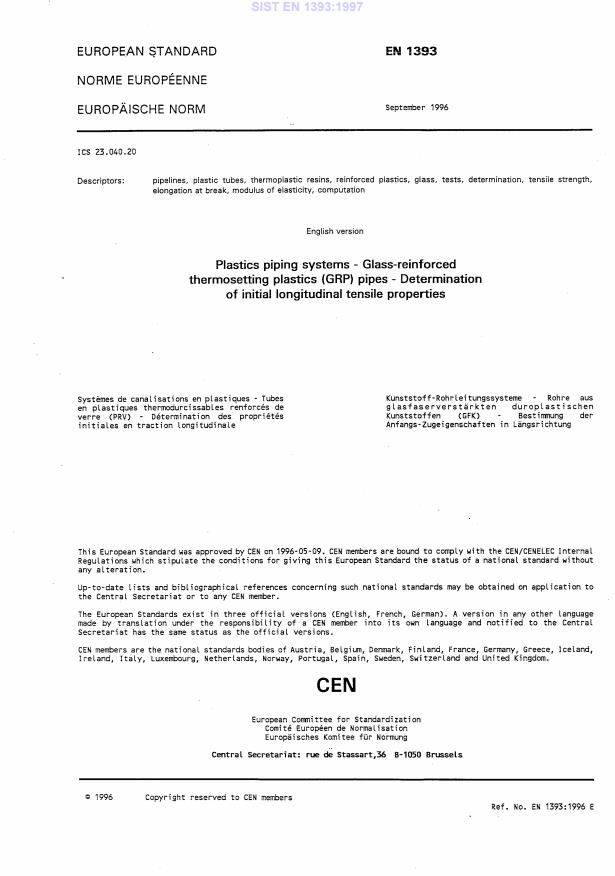
(Main)Plastics piping systems - Glass-reinforced thermosetting plastics (GRP) pipes - Determination of initial longitudinal tensile properties
General Information
- Abstract
This standard specifies three test methods for determining the longitudinal tensile properties of pipes of glass-reinforced thermosetting plastics (GRP). The properties which can be determined are: - the longitudinal tensile strength; - the percentage ultimate elongation; - the longitudinal modulus of elasticity. Method A uses for the test piece(s) a longitudinal strip cut from a pipe. Method B uses a specified length of the full cross section of the pipe. Method C uses a notched plate cut from a pipe wall section.
- Status
- Published
- Publication Date
- 31-Jan-1997
- Technical Committee
- PCV - Plastic pipes, fittings and valves
- Current Stage
- 6060 - National Implementation/Publication (Adopted Project)
- Start Date
- 01-Feb-1997
- Due Date
- 01-Feb-1997
- Completion Date
- 01-Feb-1997


Overview
EN 1393:1996 is a CEN standard for plastics piping systems made from glass‑reinforced thermosetting plastics (GRP). It specifies three standardized test methods for the determination of the initial longitudinal tensile properties of GRP pipes. The standard defines how to measure the longitudinal tensile strength, percentage ultimate elongation, and longitudinal modulus of elasticity for pipe specimens.
Key Topics
- Scope
- Applies to GRP (glass‑reinforced thermosetting plastics) pipes and sets out procedures to determine initial tensile behaviour in the pipe’s longitudinal direction.
- Measured properties
- Longitudinal tensile strength
- Percentage ultimate elongation
- Longitudinal modulus of elasticity
- Test methods
- Method A: Test pieces are longitudinal strips cut from the pipe wall.
- Method B: Uses a specified length of the pipe’s full cross section as the test specimen.
- Method C: Uses a notched plate cut from a pipe wall section to assess tensile response.
- Standardization context
- Published by the European Committee for Standardization (CEN) as EN 1393:1996; intended for consistent, comparable test results across laboratories and manufacturers.
Applications
EN 1393:1996 is practical for:
- Manufacturers of GRP pipes for product development, production control and batch verification.
- Testing laboratories performing mechanical characterization and certification testing.
- Design engineers assessing material behaviour for structural or pressure-bearing applications.
- Quality assurance and compliance teams ensuring products meet specifications and regulatory requirements.
- Procurement and specification writers creating tender documents or technical specifications that require standardized tensile data.
Typical uses include material selection, comparative performance evaluation of GRP pipe constructions, validation of production processes, and R&D into laminate configurations and resin/fibre combinations.
Related standards
- EN 1393:1996 should be used alongside other CEN plastics piping system standards and GRP product standards that cover dimensional, structural and pressure testing. Consult current CEN listings for the latest related standards and any superseding revisions.
Keywords: EN 1393:1996, GRP pipes, glass‑reinforced thermosetting plastics, longitudinal tensile properties, tensile strength, elongation, modulus of elasticity, test methods.
Relations
- Effective Date
- 28-Jan-2026
- Effective Date
- 28-Jan-2026
- Effective Date
- 22-Dec-2008
Get Certified
Connect with accredited certification bodies for this standard

DIN CERTCO
DIN Group product certification.
Institut za varilstvo d.o.o. (Welding Institute)
Slovenia's leading welding institute since 1952. ISO 3834, EN 1090, pressure equipment certification, NDT personnel, welder qualification. Only IIW Au

Smithers Quality Assessments
US management systems and product certification.
Sponsored listings
Frequently Asked Questions
SIST EN 1393:1997 is a standard published by the Slovenian Institute for Standardization (SIST). Its full title is "Plastics piping systems - Glass-reinforced thermosetting plastics (GRP) pipes - Determination of initial longitudinal tensile properties". This standard covers: This standard specifies three test methods for determining the longitudinal tensile properties of pipes of glass-reinforced thermosetting plastics (GRP). The properties which can be determined are: - the longitudinal tensile strength; - the percentage ultimate elongation; - the longitudinal modulus of elasticity. Method A uses for the test piece(s) a longitudinal strip cut from a pipe. Method B uses a specified length of the full cross section of the pipe. Method C uses a notched plate cut from a pipe wall section.
This standard specifies three test methods for determining the longitudinal tensile properties of pipes of glass-reinforced thermosetting plastics (GRP). The properties which can be determined are: - the longitudinal tensile strength; - the percentage ultimate elongation; - the longitudinal modulus of elasticity. Method A uses for the test piece(s) a longitudinal strip cut from a pipe. Method B uses a specified length of the full cross section of the pipe. Method C uses a notched plate cut from a pipe wall section.
SIST EN 1393:1997 is classified under the following ICS (International Classification for Standards) categories: 23.040.20 - Plastics pipes; 83.120 - Reinforced plastics. The ICS classification helps identify the subject area and facilitates finding related standards.
SIST EN 1393:1997 has the following relationships with other standards: It is inter standard links to SIST EN 14364:2006+A1:2009, SIST EN 1796:2006+A1:2009, SIST EN 1393:1997/AC:1999. Understanding these relationships helps ensure you are using the most current and applicable version of the standard.
SIST EN 1393:1997 is associated with the following European legislation: EU Directives/Regulations: 93/38/EEC; Standardization Mandates: M/BC/CEN/88/15. When a standard is cited in the Official Journal of the European Union, products manufactured in conformity with it benefit from a presumption of conformity with the essential requirements of the corresponding EU directive or regulation.
SIST EN 1393:1997 is available in PDF format for immediate download after purchase. The document can be added to your cart and obtained through the secure checkout process. Digital delivery ensures instant access to the complete standard document.
Standards Content (Sample)
2003-01.Slovenski inštitut za standardizacijo. Razmnoževanje celote ali delov tega standarda ni dovoljeno.Kunststoff-Rohrleitungssysteme - Rohre aus glasfaserverstärkten duroplastischen Kunststoffen (GFK) - Bestimmung der Anfangs-Zugeigenschaften in LängsrichtungSystemes de canalisations en plastiques - Tubes en plastiques thermodurcissables renforcés de verre (PRV) - Détermination des propriétés initiales en traction longitudinalePlastics piping systems - Glass-reinforced thermosetting plastics (GRP) pipes - Determination of initial longitudinal tensile properties83
...