SIST EN 15287-2:2023
(Main)Chimneys - Design, installation and commissioning - Part 2: Chimneys and connecting flue pipes for room sealed combustion appliances
Chimneys - Design, installation and commissioning - Part 2: Chimneys and connecting flue pipes for room sealed combustion appliances
This document describes the method of specifying the design, installation and labelling criteria for chimney systems, construction of custom-built chimneys, the relining or converting of existing chimneys, connecting flue pipes and air supply pipes for room sealed combustion appliances as well as the use of chimney products. It also gives information on commissioning of an installed chimney.
This document applies to chimneys which are subject to the following limiting conditions:
- the distance between the supports not to exceed 4 m;
- the distance above the last structural attachment not to exceed 3 m;
- the free-standing height above the uppermost structural support attachment for chimneys with rectangular cross section is not more than five times the smallest external dimension.
This document does not cover:
- chimneys which serve a mixture of fan assisted or forced draught burners or natural draught appliances,
- installations having a configuration of the type C2.
NOTE Room sealed gas appliances are classified as type C according to EN 1749.
The methods in this part of this document are applicable to chimneys and connecting flue pipes for room sealed combustion appliances. The methods in Part 1 of this document are applicable to chimneys and connecting flue pipes for non-room sealed combustion appliances.
Abgasanlagen - Planung, Montage und Abnahme - Teil 2: Senkrechte Teile von Abgasanlagen und Verbindungsstücke für raumluftunabhängige Verbrennungseinrichtungen
Dieses Dokument beschreibt das Verfahren zur Festlegung der Planungs-, Montage- und Kennzeichnungskriterien für Abgasanlagensysteme, Montage-Abgasanlagen, die Sanierung oder Umrüstung bestehender senkrechter Teile von Abgasanlagen, Verbindungsstücke und Luftschächte für raumluftunabhängige Verbrennungseinrichtungen sowie die Verwendung von Produkten für Abgasanlagen. Es enthält auch Angaben zur Endkontrolle einer eingebauten Abgasanlage.
Dieses Dokument ist anwendbar für senkrechte Teile von Abgasanlagen, die folgenden Randbedingungen genügen:
— der Abstand zwischen den Abstützungen überschreitet 4 m nicht;
— der Abstand zur letzten Abstützung überschreitet 3 m nicht;
— die freistehende Höhe über der obersten Abstützung beträgt bei Abgasanlagen mit rechteckigem Querschnitt höchstens das Fünffache der kleinsten Außenabmessung.
Dieses Dokument ist nicht anwendbar für:
— Abgasanlagen, die mit einer Kombination von Gebläse unterstützten Brennern oder Gebläsebrennern oder Verbrennungseinrichtungen mit natürlichem Zug belegt sind;
— Anlagen der Geräteart C2.
ANMERKUNG Raumluftunabhängige Gasfeuerstätten werden dem Typ C nach EN 1749 zugeordnet.
Die Verfahren in diesem Teil dieses Dokuments sind anwendbar für senkrechte Teile von Abgasanlagen und Verbindungsstücke für raumluftunabhängige Verbrennungseinrichtungen. Die Verfahren in Teil 1 dieses Dokuments sind anwendbar für senkrechte Teile von Abgasanlagen und Verbindungsstücke für raumluftabhängige Verbrennungseinrichtungen.
Conduits de fumée - Conception et mise en œuvre - Partie 2 : Conduits de fumée et conduits de raccordement pour appareils à combustion a qui ne dépendent pas de l’air dans la pièce
Le présent document décrit la méthode permettant de spécifier les critères de conception, d’installation et d’étiquetage relatifs aux systèmes de conduits, aux conduits de fumée construits sur site, au tubage ou à la conversion de conduits de fumée existants, aux conduits de raccordement et aux conduits d’alimentation en air pour les appareils de combustion à circuit étanche, ainsi que pour l’utilisation de composants de conduits de fumée. Il fournit également des informations pour la mise en service d’un conduit de fumée venant d’être installé.
Le présent document s’applique aux conduits de fumée soumis aux conditions contraignantes suivantes :
- la distance entre supports ne doit pas dépasser 4 m ;
- la distance au-dessus de la dernière fixation à la structure ne doit pas dépasser 3 m ;
- la hauteur libre au-dessus de la fixation la plus haute des supports à la structure pour les conduits de fumée avec section rectangulaire n’est pas supérieure à cinq fois la plus petite dimension extérieure.
Le présent document ne couvre pas :
- les conduits de fumée desservant un mélange de brûleurs ventilés, de brûleurs à air soufflé ou d’appareils à tirage naturel ;
- les installations dont la configuration est de type C2.
NOTE Les appareils à gaz étanches sont classés comme étant de type C selon l’EN 1749.
Les méthodes mentionnées dans cette partie du présent document sont applicables aux conduits de fumée et conduits de raccordement pour appareils de combustion à circuit étanche. Les méthodes mentionnées dans la partie 1 du présent document sont applicables aux conduits de fumée et conduits de raccordement pour appareils de combustion qui prélèvent l’air comburant dans la pièce.
Dimniki - Projektiranje, vgradnja in pregled - 2. del: Dimniki in povezovalni dimovodi za ogrevalne naprave neodvisne od zraka v prostoru
Ta evropski standard opisuje metodo določanja meril za projektiranje, vgradnjo in označevanje dimovodnih sistemov, konstrukcijo obrtniško izdelanih dimnikov, obnovo ali predelavo obstoječih dimnikov, povezovalnih dimovodov in cevi za dovod zraka za kurilne naprave, neodvisne od zraka v prostoru. Dokument vsebuje tudi informacije o zagonu vgrajenega dimnika.
Ta evropski standard se uporablja za dimnike, za katere veljajo naslednji omejitveni pogoji (določeni v standardu EN 13084-1):
– vodoravna razdalja med stavbo in zunanjo steno dimovodnega sistema ne sme presegati 1 m;
– razdalja med oporami ne sme presegati 4 m;
– razdalja nad zadnjo konstrukcijsko pritrditvijo ne sme presegati 3 m;
Ta standard ne zajema:
– dimnikov za gorilnike, ki uporabljajo ventilator, ali gorilnike na prisilni oziroma naravni vlek;
– vgradenj s konfiguracijo tipa C2.
OPOMBA: V skladu s standardom EN 1749 so plinske naprave, neodvisne od zraka v prostoru, razvrščene kot tip C.
Metode v tem delu tega evropskega standarda se uporabljajo za dimnike in povezovalne dimovode za ogrevalne naprave, neodvisne od zraka v prostoru. Metode v 1. delu tega evropskega standarda se uporabljajo za dimnike in povezovalne dimovode za ogrevalne naprave, odvisne od zraka v prostoru.
Za namene tega evropskega standarda izraz »vgradnja« vključuje konstrukcijo.
General Information
Relations
Overview
EN 15287-2:2023 - "Chimneys - Design, installation and commissioning - Part 2" is the CEN standard that specifies how to design, install, label and commission chimneys and connecting flue pipes for room-sealed (type C) combustion appliances. It covers custom-built chimneys, relining or conversion of existing chimneys, air supply pipes, the use of chimney products and the handover/commissioning process for installed chimneys. The standard also sets limiting conditions for support spacing and free‑standing heights.
Key topics and technical requirements
- Scope & limits: applies to room-sealed combustion appliances; excludes mixed configurations of fan-assisted/forced-draught or natural-draught appliances and installations of configuration type C2. Specific physical limits include:
- maximum distance between supports: 4 m
- maximum distance above the last structural attachment: 3 m
- for rectangular free‑standing chimneys, height ≤ 5 × smallest external dimension
- Chimney designation and classes: temperature, pressure, condensate resistance, corrosion resistance and sootfire resistance classes for correct specification and product selection.
- Design information requirements: required data from appliances, building structure and site conditions to ensure safe sizing, routing and material selection.
- Materials and construction: guidance for custom-built chimneys, relining, materials selection and use of chimney products and accessories.
- Installation and accessories: routing of connecting flue pipes and air supply pipes, minimum distances to combustible materials, support and attachment rules, and accessory specifications.
- Labelling & chimney plate: required marking information for installed systems to support maintenance and inspections.
- Commissioning and handover: checks, documentation and commissioning procedures to validate performance and safety.
- Informative annexes: terminology, appliance data lists, commissioning guidance (Annex N), inspection/cleaning/maintenance recommendations (Annex O) and examples for designation determination.
Practical applications
EN 15287-2:2023 is used to:
- Design safe and compliant chimney systems for room-sealed gas appliances
- Specify relining or conversion works for existing chimneys
- Select appropriate chimney products and accessories based on temperature, pressure and corrosion classes
- Guide installers through correct installation, labelling and commissioning steps
- Provide documentation (chimney plate) for future inspection and maintenance
Who should use this standard
- Chimney and HVAC designers and engineers
- Installation contractors and site supervisors
- Manufacturers of chimney systems, liners and flue components
- Building inspectors, commissioning agents and maintenance teams
- Specifiers and consultants preparing compliance documentation
Related standards
- EN 15287-1 (chimneys for non-room sealed appliances)
- EN 1443:2019 (general chimney requirements)
- Product and test standards cited in EN 15287-2 (EN 1856, EN 13063 series, EN 13384, etc.)
Keywords: EN 15287-2:2023, chimneys, room sealed combustion appliances, connecting flue pipes, chimney design, chimney installation, chimney commissioning, relining, chimney standards.
Standards Content (Sample)
SLOVENSKI STANDARD
01-november-2023
Nadomešča:
SIST EN 15287-2:2008
Dimniki - Projektiranje, vgradnja in pregled - 2. del: Dimniki in povezovalni
dimovodi za ogrevalne naprave neodvisne od zraka v prostoru
Chimneys - Design, installation and commissioning - Part 2: Chimneys and connecting
flue pipes for room sealed combustion appliances
Abgasanlagen - Planung, Montage und Abnahme - Teil 2: Senkrechte Teile von
Abgasanlagen und Verbindungsstücke für raumluftunabhängige
Verbrennungseinrichtungen
Conduits de fumée - Conception et mise en œuvre - Partie 2 : Conduits de fumée et
conduits de raccordement pour appareils à combustion a qui ne dépendent pas de l’air
dans la pièce
Ta slovenski standard je istoveten z: EN 15287-2:2023
ICS:
91.060.40 Dimniki, jaški, kanali Chimneys, shafts, ducts
2003-01.Slovenski inštitut za standardizacijo. Razmnoževanje celote ali delov tega standarda ni dovoljeno.
EN 15287-2
EUROPEAN STANDARD
NORME EUROPÉENNE
July 2023
EUROPÄISCHE NORM
ICS 91.060.40 Supersedes EN 15287-2:2008
English Version
Chimneys - Design, installation and commissioning - Part
2: Chimneys and connecting flue pipes for room sealed
combustion appliances
Conduits de fumée - Conception, installation et mise en Abgasanlagen - Planung, Montage und Abnahme - Teil
service - Partie 2 : Conduits de fumée et conduits de 2: Senkrechte Teile von Abgasanlagen und
raccordement pour appareils de combustion à circuit Verbindungsstücke für raumluftunabhängige
étanche Verbrennungseinrichtungen
This European Standard was approved by CEN on 5 June 2023.
CEN members are bound to comply with the CEN/CENELEC Internal Regulations which stipulate the conditions for giving this
European Standard the status of a national standard without any alteration. Up-to-date lists and bibliographical references
concerning such national standards may be obtained on application to the CEN-CENELEC Management Centre or to any CEN
member.
This European Standard exists in three official versions (English, French, German). A version in any other language made by
translation under the responsibility of a CEN member into its own language and notified to the CEN-CENELEC Management
Centre has the same status as the official versions.
CEN members are the national standards bodies of Austria, Belgium, Bulgaria, Croatia, Cyprus, Czech Republic, Denmark, Estonia,
Finland, France, Germany, Greece, Hungary, Iceland, Ireland, Italy, Latvia, Lithuania, Luxembourg, Malta, Netherlands, Norway,
Poland, Portugal, Republic of North Macedonia, Romania, Serbia, Slovakia, Slovenia, Spain, Sweden, Switzerland, Türkiye and
United Kingdom.
EUROPEAN COMMITTEE FOR STANDARDIZATION
COMITÉ EUROPÉEN DE NORMALISATION
EUROPÄISCHES KOMITEE FÜR NORMUNG
CEN-CENELEC Management Centre: Rue de la Science 23, B-1040 Brussels
© 2023 CEN All rights of exploitation in any form and by any means reserved Ref. No. EN 15287-2:2023 E
worldwide for CEN national Members.
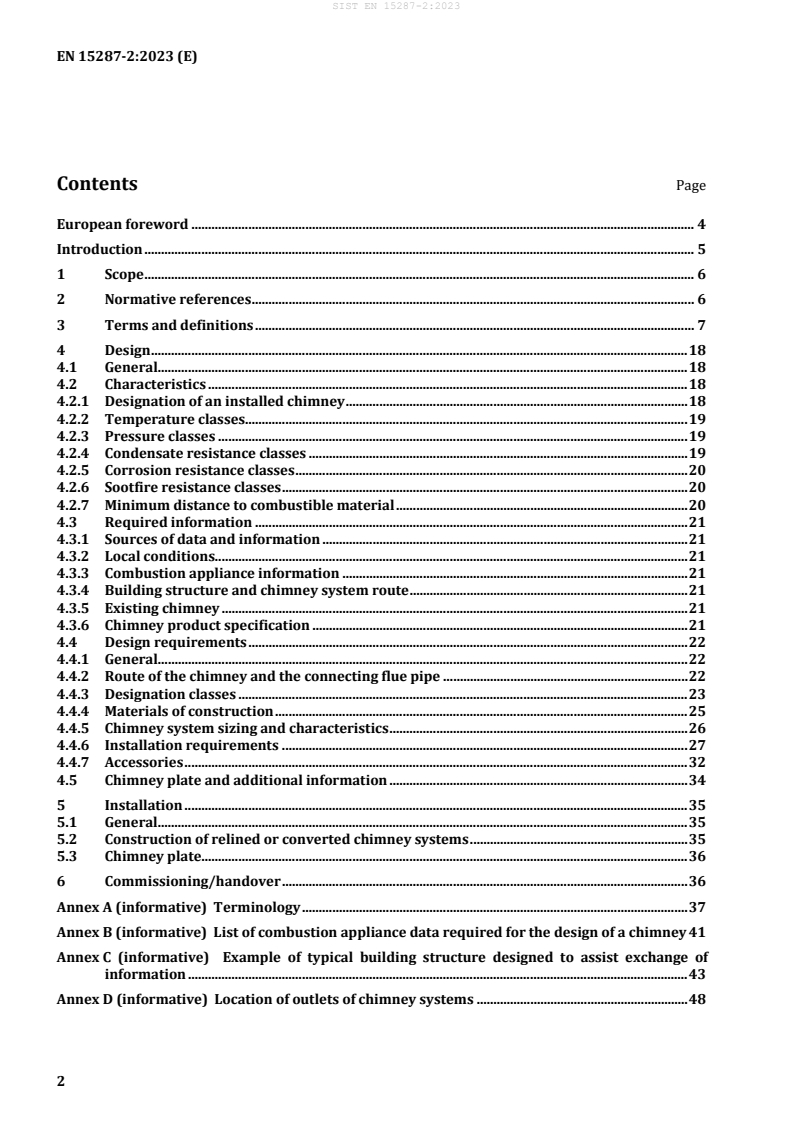
Contents Page
European foreword . 4
Introduction . 5
1 Scope . 6
2 Normative references . 6
3 Terms and definitions . 7
4 Design . 18
4.1 General. 18
4.2 Characteristics . 18
4.2.1 Designation of an installed chimney . 18
4.2.2 Temperature classes. 19
4.2.3 Pressure classes . 19
4.2.4 Condensate resistance classes . 19
4.2.5 Corrosion resistance classes . 20
4.2.6 Sootfire resistance classes . 20
4.2.7 Minimum distance to combustible material . 20
4.3 Required information . 21
4.3.1 Sources of data and information . 21
4.3.2 Local conditions. 21
4.3.3 Combustion appliance information . 21
4.3.4 Building structure and chimney system route . 21
4.3.5 Existing chimney . 21
4.3.6 Chimney product specification . 21
4.4 Design requirements . 22
4.4.1 General. 22
4.4.2 Route of the chimney and the connecting flue pipe . 22
4.4.3 Designation classes . 23
4.4.4 Materials of construction . 25
4.4.5 Chimney system sizing and characteristics . 26
4.4.6 Installation requirements . 27
4.4.7 Accessories . 32
4.5 Chimney plate and additional information . 34
5 Installation . 35
5.1 General. 35
5.2 Construction of relined or converted chimney systems . 35
5.3 Chimney plate. 36
6 Commissioning/handover . 36
Annex A (informative) Terminology . 37
Annex B (informative) List of combustion appliance data required for the design of a chimney 41
Annex C (informative) Example of typical building structure designed to assist exchange of
information . 43
Annex D (informative) Location of outlets of chimney systems . 48
Annex E (informative) Correlation between the product designation of metal system chimneys,
liners and connecting flue pipes and the corrosion loads in Member States (MS) . 53
Annex F (informative) Correlation between type of flue liner according to the designation of
parameters for clay/ceramic flue liners, clay/ceramic flue blocks and concrete flue blocks
and the designation according to EN 1443 . 60
Annex G (informative) Example for chimney system plate . 62
Annex H (informative) Determination of the chimney system designation for custom-built,
relined and converted chimney systems with concentric air/flue configuration . 64
Annex I (informative) Example for the determination of the designation of a converted or relined
chimney system . 76
Annex J (informative) Example for the determination of the designation of a custom-built chimney
system . 81
Annex K (informative) Minimum distances to combustible material . 86
Annex L (informative) Calculating the temperature of adjacent material . 89
Annex M (informative) Useful hints for handling of materials and components on site . 93
Annex N (informative) Chimney system commissioning . 95
Annex O (informative) Recommendations for inspection, cleaning and maintenance. 100
Annex P (informative) Flue damper . 101
Annex Q (informative) Terminals . 106
Bibliography . 108
European foreword
This document (EN 15287-2:2023) has been prepared by Technical Committee CEN/TC 166 “Chimneys”,
the secretariat of which is held by ASI.
This European Standard shall be given the status of a national standard, either by publication of an
identical text or by endorsement, at the latest by January 2024 and conflicting national standards shall
be withdrawn at the latest by January 2024.
Attention is drawn to the possibility that some of the elements of this document may be the subject of
patent rights. CEN shall not be held responsible for identifying any or all such patent rights.
This document will supersede EN 15287-2:2008.
This European Standard is part of the series Chimneys — Design, installation and commissioning:
— Part 1: Chimneys and connecting flue pipes for non-room sealed combustion appliances;
— Part 2: Chimneys and connecting flue pipes for room sealed combustion appliances.
In comparison with the previous edition, the following technical modifications have been made:
a) restructuring of the chapters and annexes;
b) harmonization of the text with part 1;
c) updating the content according to EN 1443:2019;
d) adoption of all relevant terms from EN 1443:2019 and EN 15287-1;
e) adoption of all relevant chapters and annexes from EN 15287-1;
f) description of the designation and classes of a chimney according to EN 1443:2019;
g) expanding the specifications for accessories;
h) recommendations for some minimum distances from combustible material;
i) scope now also covers chimneys for medium and high positive pressure.
Any feedback and questions on this document should be directed to the users’ national standards body.
A complete listing of these bodies can be found on the CEN website.
According to the CEN-CENELEC Internal Regulations, the national standards organizations of the
following countries are bound to implement this European Standard: Austria, Belgium, Bulgaria, Croatia,
Cyprus, Czech Republic, Denmark, Estonia, Finland, France, Germany, Greece, Hungary, Iceland, Ireland,
Italy, Latvia, Lithuania, Luxembourg, Malta, Netherlands, Norway, Poland, Portugal, Republic of North
Macedonia, Romania, Serbia, Slovakia, Slovenia, Spain, Sweden, Switzerland, Türkiye and the United
Kingdom.
Introduction
CEN/TC 166 started with its programme on standardization of chimneys approximately 30 years ago,
with standards for interfaces, for products, for tests and last but not least for design, installation,
construction and commissioning matters.
In the last years, first priority in the work program was given to product and test standards.
In the meantime, most of the product and test standards were published or are nearly ready for
publication. In order to introduce the products in a simple way on the markets of the different Member
States, some common rules for design, installation, and commissioning especially with reference to the
designation of a chimney were considered helpful.
Initially, CEN/TC 166/SC 2 started the work on execution standards for metal chimneys, the first
standard being EN 12391-1 in 2003.
In order not to repeat this work in all material orientated WGs and SCs, CEN/TC 166 decided in 2002 to
give the task to WG 1 to develop a material independent design, installation and commissioning standard.
CEN/TC 166/WG 1 started the work in 2003 and decided first to draft two documents, one for chimneys
connected to non-room sealed combustion appliances and one for chimneys connected to room sealed
combustion appliances.
Application of this document presupposes awareness of applicable legal requirements in the different
CEN Member States and its affiliates. In CEN Member States and its affiliates where no applicable legal
requirements exist, this document provides guidance for the design, installation and commissioning of
chimneys.
NOTE Where “Member States” is mentioned in this document this also includes affiliates.
1 Scope
This document describes the method of specifying the design, installation and labelling criteria for
chimney systems, construction of custom-built chimneys, the relining or converting of existing chimneys,
connecting flue pipes and air supply pipes for room sealed combustion appliances as well as the use of
chimney products. It also gives information on commissioning of an installed chimney.
This document applies to chimneys which are subject to the following limiting conditions:
— the distance between the supports not to exceed 4 m;
— the distance above the last structural attachment not to exceed 3 m;
— the free-standing height above the uppermost structural support attachment for chimneys with
rectangular cross section is not more than five times the smallest external dimension.
This document does not cover:
— chimneys which serve a mixture of fan assisted or forced draught burners or natural draught
appliances;
— installations having a configuration of the type C .
NOTE Room sealed gas appliances are classified as type C according to EN 1749.
The methods in this part of this document are applicable to chimneys and connecting flue pipes for room
sealed combustion appliances. The methods in Part 1 of this document are applicable to chimneys and
connecting flue pipes for non-room sealed combustion appliances.
2 Normative references
The following documents are referred to in the text in such a way that some or all of their content
constitutes requirements of this document. For dated references, only the edition cited applies. For
undated references, the latest edition of the referenced document (including any amendments) applies.
EN 1443:2019, Chimneys - General requirements
EN 1457-1, Chimneys - Clay/ceramic flue liners - Part 1: Flue liners operating under dry conditions -
Requirements and test methods
EN 1457-2, Chimneys - Clay/ceramic flue liners - Part 2: Flue liners operating under wet conditions -
Requirements and test methods
EN 1806, Chimneys - Clay/ceramic flue blocks for single wall chimneys - Requirements and test methods
EN 1856-1, Chimneys - Requirements for metal chimneys - Part 1: System chimney products
EN 1856-2, Chimneys - Requirements for metal chimneys - Part 2: Metal flue liners and connecting flue pipes
EN 1857, Chimneys - Components - Concrete flue liners
EN 1858, Chimneys - Components - Concrete flue blocks
EN 12446, Chimneys - Components - Concrete outer wall elements
EN 13063-1, Chimneys - System chimneys with clay/ceramic flue liners - Part 1: Requirements and test
methods for sootfire resistance
EN 13063-2, Chimneys - System chimneys with clay/ceramic flue liners - Part 2: Requirements and test
methods under wet conditions
EN 13063-3, Chimneys - System chimneys with clay/ceramic flue liners - Part 3: Requirements and test
methods for air flue system chimneys
EN 13069, Chimneys - Clay/ceramic outer walls for system chimneys - Requirements and test methods
EN 13084-1, Free-standing chimneys - Part 1: General requirements
EN 13216-1, Chimneys - Test methods for system chimneys - Part 1: General test methods
EN 13384-1, Chimneys - Thermal and fluid dynamic calculation methods - Part 1: Chimneys serving one
combustion appliance
EN 13384-2, Chimneys - Thermal and fluid dynamic calculation methods - Part 2: Chimneys serving more
than one combustion appliance
EN 13502, Chimneys - Requirements and test methods for clay/ceramic flue terminals
EN 14297, Chimneys - Freeze-thaw resistance test method for chimney products
EN 14471, Chimneys - System chimneys with plastic flue liners - Requirements and test methods
EN 14989-1, Chimneys - Requirements and test methods for metal chimneys and material independent air
supply ducts for roomsealed heating applications - Part 1: Vertical air/flue terminals for C6-type appliances
EN 14989-2, Chimneys - Requirements and test methods for metal chimneys and material independent air
supply ducts for roomsealed heating applications - Part 2: Flue and air supply ducts for room sealed
appliances
EN 16497-1, Chimneys - Concrete System Chimneys - Part 1: Non-balanced flue applications
EN 16497-2, Chimneys - Concrete System Chimneys - Part 2: Balanced flue applications
EN 15287-1:2023, Chimneys - Design, installation and commissioning of chimneys - Part 1: Chimneys for
non-roomsealed combustion appliances
3 Terms and definitions
For the purposes of this document, the terms and definitions given in EN 1443:2019 and the following
apply.
ISO and IEC maintain terminology databases for use in standardization at the following addresses:
— IEC Electropedia: available at https://www.electropedia.org/
— ISO Online browsing platform: available at https://www.iso.org/obp/
NOTE 1 Examples of chimney construction identifying individual component terminology and definitions are
given in Figures A.1, A.2 and A.3 in Annex A. Examples of balanced air/flue configurations for room sealed
applications are given in Figures A.4 and A.5. The configurations of Figure A.4 and Figure A.5 can be created from
converting or relining an existing chimney.
NOTE 2 The European scheme for the classification of gas appliances is given in EN 1749.
3.1
fire compartment
part of the building comprising one or more rooms, spaces or storeys constructed to prevent the spread
of fire
[SOURCE: EN 15287-1:2023, 3.1]
3.2
combustion appliance
unit generating products of combustion which need to be conveyed to the outside atmosphere
Note 1 to entry: E.g. heating appliances, cooking appliances, motors, CHPs (en: combined heat power).
[SOURCE: EN 1443:2019, 3.1]
3.3
room sealed appliance
appliance in which the combustion circuit (air supply, combustion chamber, heat exchanger and
evacuation of the products of combustion) is sealed with respect to the room in which the appliance is
installed
3.4
flue
passage for conveying the products of combustion to the outside atmosphere
[SOURCE: EN 1443:2019, 3.2]
3.5
flue gas
gaseous portion of the products of combustion conveyed in a flue
[SOURCE: EN 1443:2019, 3.3]
3.6
products of combustion
products resulting from the combustion of fuel (gaseous, liquid and solid constituents)
[SOURCE: EN 1443:2019, 3.4]
3.7
chimney
structure consisting of a wall or walls enclosing a flue or flues conveying the products of combustion into
the outside atmosphere
Note 1 to entry: The generic word “chimney”, when used in this document, refers to chimneys used to convey the
products of combustion from any combustion appliance to the outside atmosphere, and thus includes all other
terms of common use, such as: vents, flues, shafts, exhaust systems, flue ducts, etc.
[SOURCE: EN 1443:2019, 3.5]
3.8
chimney system
combination of both a flue duct and an air supply duct for room sealed applications
3.9
balanced flue chimney configuration
configuration where the air entry to the combustion air supply duct is adjacent to the discharge of
combustion products from the flue, the inlet and outlet being so positioned that wind effects are
substantially balanced
3.10
concentric air/flue configuration
configuration in which the flue duct is fully surrounded by the air supply duct
Note 1 to entry: This includes chimney configurations where the flue duct and air supply duct do not share a
common axis.
3.11
separate air/flue configuration
configuration in which the air supply duct and the flue duct are separate
3.12
chimney stack
chimney enclosing more than one flue
[SOURCE: EN 15287-1:2023, 3.7]
3.13
single-wall chimney
chimney with only one wall
[SOURCE: EN 1443:2019, 3.17]
3.14
multi-wall chimney
chimney consisting of a flue liner and at least one additional wall
[SOURCE: EN 1443:2019, 3.18]
3.15
system chimney
chimney that is installed using a combination of compatible chimney components, obtained or specified
as a kit from one manufacturing source with product responsibility for the whole chimney
[SOURCE: EN 1443:2019, 3.19]
3.16
system chimney for room sealed applications
chimney configuration that is installed using a combination of compatible components, obtained or
specified from one manufacturing source with product responsibility for the whole chimney system
Note 1 to entry This product is understood to constitute a kit under the Mandate M/105.
3.17
custom-built chimney
chimney that is installed or built on-site using a combination of compatible components that may be from
one or different sources
[SOURCE: EN 1443:2019, 3.20]
3.18
custom-built chimney for room sealed applications
chimney configuration that is installed or built on-site using a combination of compatible components
that may be from one or different sources
3.19
converted chimney
existing chimney for non-room sealed applications changed to a chimney system
3.20
relining
process of renovating or replacing the flue liner of a chimney
[SOURCE: EN 1443:2019, 3.21]
3.21
relined chimney
existing chimney where a liner is restored or replaced
Note 1 to entry: The process of inserting a new liner into an existing chimney without a change of the air/flue
configuration is also regarded as relining the chimney
3.22
flue duct
duct containing the flue of the chimney system
3.23
air supply duct
duct in a chimney system only for conveying combustion air to a room-sealed appliance
3.24
flue liner
rigid or flexible inner wall of a chimney consisting of components the inner surface of which is in contact
with products of combustion
[SOURCE: EN 1443:2019, 3.6, modified — Replaced “surface” with “inner surface”.]
3.25
flue liner kit
flue liner that is installed using a combination of compatible flue liner components, obtained or specified
as a kit from one manufacturing source with product responsibility for the whole flue liner including all
its components
Note 1 to entry: A flue liner kit is not considered a system chimney.
[SOURCE: EN 1443:2019, 3.7]
3.26
rigid flue liner
flue liner that cannot bend without permanent deformation
[SOURCE: EN 15287-1:2023, 3.15]
3.27
flexible flue liner
tube having a single or multi-skin construction that is able to bend in any direction without permanent
deformation
[SOURCE: FprEN 15287-1:2023, 3.16]
3.28
outer wall
external wall of a chimney system, on the outer surface of which the minimum distance to combustible
material is referred
[SOURCE: EN 1443:2019, 3.22, modified — Added “system” and replaced “from the surface of which the
distance to combustible is measured” with “, on the outer surface of which the minimum distance to
combustible is referred”.]
3.29
enclosure
additional structure, combustible or non-combustible, built around a chimney
Note 1 to entry: An enclosure which is specified as a part of the chimney is considered an “outer wall” of the
chimney.
Note 2 to entry: Enclosures can for example give additional safety in case of fire, provide additional heat transfer
resistance, prevent accidental human contact, prevent impact damage and can be used for decorative purposes.
[SOURCE: EN 1443:2019, 3.23]
3.30
mid feather wall
dividing wall separating multiple flues within a chimney stack
[SOURCE: EN 15287-1:2023, 3.19]
3.31
flue block
factory-made single- or multi-wall chimney component with one or more flues
[SOURCE: EN 1443:2019, 3.24]
3.32
connecting air supply pipe
component or components connecting the combustion appliance air supply to the air supply duct of the
chimney system
3.33
connecting flue pipe
component or components connecting the combustion appliance outlet and the flue duct of the chimney
system
[SOURCE: EN 1443:2019, 3.8, modified — Replaced “chimney” with “flue duct of the chimney system”.]
3.34
component
any part of a chimney, of a flue liner or of a connecting flue pipe
[SOURCE: EN 1443:2019, 3.9]
3.35
section
straight chimney component of a flue liner or of a connecting flue pipe, conveying products of combustion
[SOURCE: EN 1443:2019, 3.10]
3.36
joint
connection between two components
[SOURCE: EN 1443:2019, 3.15]
3.37
seal
prefabricated element that joins two components in such a way as to fulfil leakage requirements
[SOURCE: EN 14241-1:2013, 3.7, modified — Replaced "prevent leakage" by "fulfil leakage
requirements".]
3.38
sealant
material which, applied in an unformed state to a joint, seals it by adhering to appropriate surfaces within
the joint in such a way as to fulfil leakage requirements
[SOURCE: EN 15287-1:2023, 3.26]
3.39
fitting
component of a chimney, of a flue liner or of a connecting flue pipe conveying products of combustion
except a section
[SOURCE: EN 1443:2019, 3.11]
3.40
elbow/bend
chimney fitting which provides a change of direction of the flue
[SOURCE: EN 15287-1:2023, 3.28]
3.41
T-piece
chimney fitting which allows a combustion appliance, connecting flue pipe or accessory to be connected
to the chimney flue at an angle
[SOURCE: EN 15287-1:2023, 3.29]
3.42
access component
component installed in the chimney or in the connecting flue pipe to provide access to the flue for the
purpose of inspection or cleaning
Note 1 to entry: An access component can be a part of a system chimney, flue liner or connecting flue pipe or can
be an accessory.
[SOURCE: EN 15287-1:2023, 3.30]
3.43
back ventilation
ventilation of the space between two walls of the chimney or the chimney and an enclosure
[SOURCE: EN 15287-1:2023, 3.31]
3.44
centralising spacer
component to centralize the flue liner
[SOURCE: EN 15287-1:2023, 3.32]
3.45
support
component of a chimney, a flue liner or a connecting flue pipe used to fix, or transfer the load of
components to structural elements
Note 1 to entry: Structural elements can be a building, a mast, etc.
[SOURCE: EN 1443:2019, 3.13]
3.46
sleeve
component which provides an aperture through a wall, floor or roof through which a chimney or a
connecting flue pipe pass
[SOURCE: EN 15287-1:2023, 3.34]
3.47
flashing
prefabricated component or site fabricated materials used for weatherproofing the penetration of the
roof by the chimney
[SOURCE: EN 15287-1:2023, 3.35]
3.48
fire stop
component intended to provide fire resistance to fire spread between rooms or compartments
[SOURCE: EN 15287-1:2023, 3.36]
3.49
chimney adapter
component which connects the chimney to the connecting flue pipe or a combustion appliance
[SOURCE: EN 15287-1:2023, 3.37]
3.50
combustion appliance adapter
component which connects the connecting flue pipe or the chimney to a combustion appliance
[SOURCE: EN 15287-1:2023, 3.38]
3.51
test point
component that provides access for flue gas sampling and measurement
[SOURCE: EN 15287-1:2023, 3.39]
3.52
accessory
additional flue gas carrying component added to a chimney or a connecting flue pipe to perform a
particular function
[SOURCE: EN 1443:2019, 3.12]
3.53
draught regulator
device with a flap in a flue opening to allow entry of secondary air into the flue to regulate the draught
Note 1 to entry: A draught regulator can be a part of a chimney, flue liner or connecting flue pipe or can be an
accessory.
[SOURCE: EN 15287-1:2023, 3.41]
3.54
standstill opening devices
device which is opened by a motor to allow air to enter the flue during the standstill period of the
combustion appliance
Note 1 to entry: A stand still opening device can be a part of a chimney, flue liner or connecting flue pipe or can be
an accessory.
[SOURCE: EN 15287-1:2023, 3.42]
3.55
combined secondary air device
combination of a draught regulator and standstill opening device
Note 1 to entry: A combined secondary air device can be a part of a chimney, flue liner or connecting flue pipe or
can be an accessory.
[SOURCE: EN 15287-1:2023, 3.43]
3.56
explosion relief
device that protects the chimney against overpressure arising from deflagration or explosion in the flue
[SOURCE: EN 15287-1:2023, 3.44]
3.57
silencer
product used in connecting flue pipes or on top of chimney for reducing noise emission caused by
combustion appliances including emergency generators or fans
Note 1 to entry: A silencer can be a part of a chimney, flue liner or connecting flue pipe or can be an accessory.
[SOURCE: EN 15287-1:2023, 3.45]
3.58
condensate drain
component to facilitate the disposal of condensate
[SOURCE: EN 15287-1:2023, 3.46]
3.59
flue damper
device used to close or partially close the flue
Note 1 to entry: A flue damper can be a part of a chimney, flue liner or connecting flue pipe or can be an accessory.
[SOURCE: EN 15287-1:2023, 3.47]
3.60
terminal
component installed at the outlet of a chimney or a flue liner
Note 1 to entry: There are terminals only for decorative purposes or terminals intended for specified
performances.
[SOURCE: EN 1443:2019, 3.14]
3.61
rain cap
part of the chimney that protects against the entry of rain
Note 1 to entry: A rain cap can be a part of a system chimney, flue liner or terminal or can be an accessory
[SOURCE: EN 15287-1:2023, 3.49]
3.62
chimney fan
fan positioned on the outlet of the chimney (exhaust fan) or fan positioned in the connecting flue pipe
(inline fan)
[SOURCE: EN 15287-1:2023, 3.50]
3.63
nominal working temperature
flue gas temperature under normal operating conditions of the combustion appliance at maximum heat
input as specified in the appliance product standards
[SOURCE: EN 1443:2019, 3.25]
3.64
negative pressure chimney
chimney designed to operate with the pressure inside the flue equal or less than the pressure outside the
flue
Note 1 to entry: The class for negative pressure is "N".
[SOURCE: EN 1443:2019, 3.26]
3.65
positive pressure chimney
chimney designed to operate with the pressure inside the flue greater than the pressure outside the flue
Note 1 to entry: Classes for positive pressure are e.g. "P", "M", "H"
[SOURCE: EN 1443:2019, 3.27]
3.66
condensate
liquid products formed when the flue gas is below the water dew point
[SOURCE: EN 1443:2019, 3.28]
3.67
dry operating condition
condition when the chimney is designed to operate normally with the temperature of the inner surface
of the flue liner at or above the water dew point
Note 1 to entry: Dry operating condition is designated "D".
[SOURCE: EN 1443:2019, 3.29]
3.68
wet operating condition
condition when the chimney is designed to operate normally with the temperature of the inner surface
of the flue liner below the water dew point
Note 1 to entry: Wet operating condition is designated "W".
Note 2 to entry: The characteristic "W" is not related to rainwater ingress.
[SOURCE: EN 1443:2019, 3.30]
3.69
sootfire
combustion of the flammable residue deposited on the flue liner or connecting flue pipe
[SOURCE: EN 1443:2019, 3.31]
3.70
sootfire resistant chimney
chimney that is resistant to sootfire and is reusable after
Note 1 to entry: Sootfire resistant chimneys are designated "G".
[SOURCE: EN 1443:2019, 3.32]
3.71
sootfire safe accessory
accessory that may not perform its intended function during and after a sootfire but does not prevent the
safe operation or change the designation “G” of the chimney or connecting flue pipe
Note 1 to entry: Sootfire safe accessories are designated "As".
Note 2 to entry: “As” is used only for accessories and not for chimneys, flue liners and connecting flue pipes.
Note 3 to entry: Sootfire safe accessories are considered as replaceable without dismantling the chimney.
Note 4 to entry: Measures to be taken after the event of a sootfire are to be found in the relevant product standard.
[SOURCE: EN 1443:2019, 3.33]
3.72
minimum distance to combustible material
minimum distance of the outer wall of the chimney to combustible material
Note 1 to entry: The minimum distance to combustible is designated with "xx".
[SOURCE: EN 1443:2019, 3.34, modified — Replaced “distance” with “minimum distance”.]
3.73
fire resistance external to external
ability of the chimney to prevent the spread of fire from one compartment to another
[SOURCE: EN 1443:2019, 3.35, modified — Deleted the Note to entry.]
3.74
thermal resistance of a chimney
resistance to heat transfer through the wall or walls of the chimney
Note 1 to entry: The thermal resistance of a chimney is given as "(1/Λ)".
[SOURCE: EN 1443:2019, 3.36]
3.75
flow resistance
pressure loss in a flue or in a combustion air supply duct opposed to the flow of the flue gas or combustion
air in motion at a given temperature and velocity
[SOURCE: EN 1443:2019, 3.37]
3.76
coefficient of flow resistance
ratio between the flow resistance of a fitting and the dynamic pressure of the medium due to a directional
and/or cross-sectional change in the fitting
[SOURCE: EN 1443:2019, 3.38]
3.77
freeze-thaw resistant chimney
chimney that is capable of withstanding freeze-thaw exposure
[SOURCE: EN 1443:2019, 3.39]
4 Design
4.1 General
In order to design a chimney, the following steps should be followed to achieve a safe chimney.
Specify whether the chimney design is for a single combustion appliance or multiple combustion
appliance application. Specify the type of multiple combustion appliance configuration, i.e. whether
cascade or multiple inlet.
The design shall specify whether the chimney configuration to be installed shall comprise two concentric
or separate ducts.
NOTE Where a chimney is approved together with the combustion appliance, the information for flue sizing or
the designation parameters not associated with the installation aspects are not necessary as the combination of
combustion appliance and chimney has been certificated together.
4.2 Characteristics
4.2.1 Designation of an installed chimney
In order to identify the characteristics of the chimney the installed chimney shall be designated.
The designation shall include information on the temperature class, the pressure class, the condensate
resistance class, the corrosion resistance class and the sootfire resistance class and where appropriate
the minimum distance to combustible material.
The meaning of the listed characteristics corresponds to the product characteristics of system chimneys
and components for chimneys such as flue liners, connecting flue pipes and accessories.
EXAMPLE For a designation of an installed chimney:
EN 15287–2 T 200 P1 W 2 O 20
Number of the corresponding
standard
Temperature class (see
4.2.2)
Pressure class (see 4.2.3)
Condensate resistance class (see
4.2.4)
Corrosion resistance class (see
4.2.5)
Sootfire resistance class (see
4.2.6)
Minimum distance to combustible material (see
4.2.7)
4.2.2 Temperature classes
Temperature classes under normal operating conditions are given in Table 1.
Table 1 — Temperature classes
Temperature class Nominal working temperature
°C
T 080 ≤ 80
T 100 ≤ 100
T 120 ≤ 120
T 140 ≤ 140
T 160 ≤ 160
T 200 ≤ 200
T 250 ≤ 250
T 300 ≤ 300
T 400 ≤ 400
T 450 ≤ 450
T 600 ≤ 600
4.2.3 Pressure classes
Pressure classes are given in Table 2 (value for a gas tightness determined by a threshold leakage rate
appropriate to the pressure class).
Table 2 — Pressure classes
a
Pressure class Type of use Leakage rate
Pressure
−1 −2
Pa l ⋅ s ⋅ m
N 1 ≤ 0 for negative pressure chimneys ≤ 2,0
N 2 ≤ 0 for negative pressure chimneys ≤ 3,0
P 1 ≤ 200 for low positive pressure chimneys ≤ 0,006
P 2 ≤ 200 for low positive pressure chimneys ≤ 0,120
M 1 ≤ 1 500 for medium positive pressure chimneys ≤ 0,006
M 2 ≤ 1 500 for medium positive pressure chimneys ≤ 0,120
H 1 ≤ 5 000 for high positive pressure chimneys ≤ 0,006
H 2 ≤ 5 000 for high positive pressure chimneys ≤ 0,120
a
Pressure at steady-state condition under normal operating conditions.
4.2.4 Condensate resistance classes
Condensate resistance classes are:
— D for chimneys, flue liners, connecting flue pipes, components and accessories operating under dry
conditions;
— W for chimneys, flue liners, connecting flue pipes, components and accessories operating under wet
conditions.
4.2.5 Corrosion resistance classes
Corrosion resistance classes are given in Table 3.
Table 3 — Corrosion resistance classes
Corrosion
Gaseous fuels Liquid fuels Solid fuels
resistance
class
1 — gas: – –
sulfur-
content ≤ 50 mg/m
— LNG
— LPG
2 — gas: — oil: — chemically
sulfur- sulfur- untreated wood
content ≤ 2 000 mg/kg and
content ≤ 2 000 mg/m
chemically
— kerosene
— LNG
untreated woody
— LPG
a
biomass
3 — gas — oil — wood
— LNG — kerosene — coal
— LPG — peat
NOTE Table 3 does not categorize process gases or liquids.
a
Natural wood and biomass from natural wood are considered as chemically untreated.
4.2.6 Sootfire resistance classes
Sootfire resistance classes are:
— O for chimneys, flue liners, connecting flue pipes, components and accessories without sootfire
resistance;
— G for chimneys, flue liners, connecting flue pipes, components and accessories with sootfire
resistance;
— As for accessories that are sootfire safe.
NOTE 1 Chimneys, flue liners, connecting flue pipes, components and accessories designated "O" can only be
used for combustion appliances for liquid and gaseous fuels.
NOTE 2 Chimneys, flue liners, connecting flue pipes, components and accessories designated "G" can be used for
all types of fuels.
NOTE 3 Accessories designated "As" can be used for all types of fuels.
4.2.7 Minimum distance to combustible material
The minimum allowed distance of the outer surface of the chimney to walls, floors and roofs comprising
combustible material is expressed as “xx”, where “xx” is the value in whole millimetres.
4.3 Required information
4.3.1 Sources of data and information
The data and information specified in 4.3.2 to 4.3.6 shall be obtained and documented as appropriate.
NOTE The sources can be:
— local building rules;
— architect’s drawings, plans or site surveys;
— combustion appliance manufacturer‘s literature:
— chimney manufacturer‘s literature including installation instructions;
— Annexes of this document (e.g. material characteristics).
4.3.2 Local conditions
Building rules, environmental and topographical particulars of the site shall be obtained.
4.3.3 Combustion appliance information
The information for the intended combustion appliance(s) (see Annex B for an example) shall be obtained
from the documentation for the combustion appliance or if not available, default values can be used (see
EN 13384-1:2015+A1:2019, Annex B), but the source of the data shall be documented in the design (see
4.3.1).
4.3.4 Building structure and chimney system route
In ord
...
SLOVENSKI STANDARD
01-november-2023
Nadomešča:
SIST EN 15287-2:2008
Dimniki - Projektiranje, vgradnja in pregled - 2. del: Dimniki in povezovalni
dimovodi za ogrevalne naprave v zatesnjenih prostorih
Chimneys - Design, installation and commissioning - Part 2: Chimneys and connecting
flue pipes for room sealed combustion appliances
Abgasanlagen - Planung, Montage und Abnahme - Teil 2: Senkrechte Teile von
Abgasanlagen und Verbindungsstücke für raumluftunabhängige
Verbrennungseinrichtungen
Conduits de fumée - Conception et mise en œuvre - Partie 2 : Conduits de fumée et
conduits de raccordement pour appareils à combustion a qui ne dépendent pas de l’air
dans la pièce
Ta slovenski standard je istoveten z: EN 15287-2:2023
ICS:
91.060.40 Dimniki, jaški, kanali Chimneys, shafts, ducts
2003-01.Slovenski inštitut za standardizacijo. Razmnoževanje celote ali delov tega standarda ni dovoljeno.
EN 15287-2
EUROPEAN STANDARD
NORME EUROPÉENNE
July 2023
EUROPÄISCHE NORM
ICS 91.060.40 Supersedes EN 15287-2:2008
English Version
Chimneys - Design, installation and commissioning - Part
2: Chimneys and connecting flue pipes for room sealed
combustion appliances
Conduits de fumée - Conception, installation et mise en Abgasanlagen - Planung, Montage und Abnahme - Teil
service - Partie 2 : Conduits de fumée et conduits de 2: Senkrechte Teile von Abgasanlagen und
raccordement pour appareils de combustion à circuit Verbindungsstücke für raumluftunabhängige
étanche Verbrennungseinrichtungen
This European Standard was approved by CEN on 5 June 2023.
CEN members are bound to comply with the CEN/CENELEC Internal Regulations which stipulate the conditions for giving this
European Standard the status of a national standard without any alteration. Up-to-date lists and bibliographical references
concerning such national standards may be obtained on application to the CEN-CENELEC Management Centre or to any CEN
member.
This European Standard exists in three official versions (English, French, German). A version in any other language made by
translation under the responsibility of a CEN member into its own language and notified to the CEN-CENELEC Management
Centre has the same status as the official versions.
CEN members are the national standards bodies of Austria, Belgium, Bulgaria, Croatia, Cyprus, Czech Republic, Denmark, Estonia,
Finland, France, Germany, Greece, Hungary, Iceland, Ireland, Italy, Latvia, Lithuania, Luxembourg, Malta, Netherlands, Norway,
Poland, Portugal, Republic of North Macedonia, Romania, Serbia, Slovakia, Slovenia, Spain, Sweden, Switzerland, Türkiye and
United Kingdom.
EUROPEAN COMMITTEE FOR STANDARDIZATION
COMITÉ EUROPÉEN DE NORMALISATION
EUROPÄISCHES KOMITEE FÜR NORMUNG
CEN-CENELEC Management Centre: Rue de la Science 23, B-1040 Brussels
© 2023 CEN All rights of exploitation in any form and by any means reserved Ref. No. EN 15287-2:2023 E
worldwide for CEN national Members.
Contents Page
European foreword . 4
Introduction . 5
1 Scope . 6
2 Normative references . 6
3 Terms and definitions . 7
4 Design . 18
4.1 General. 18
4.2 Characteristics . 18
4.2.1 Designation of an installed chimney . 18
4.2.2 Temperature classes. 19
4.2.3 Pressure classes . 19
4.2.4 Condensate resistance classes . 19
4.2.5 Corrosion resistance classes . 20
4.2.6 Sootfire resistance classes . 20
4.2.7 Minimum distance to combustible material . 20
4.3 Required information . 21
4.3.1 Sources of data and information . 21
4.3.2 Local conditions. 21
4.3.3 Combustion appliance information . 21
4.3.4 Building structure and chimney system route . 21
4.3.5 Existing chimney . 21
4.3.6 Chimney product specification . 21
4.4 Design requirements . 22
4.4.1 General. 22
4.4.2 Route of the chimney and the connecting flue pipe . 22
4.4.3 Designation classes . 23
4.4.4 Materials of construction . 25
4.4.5 Chimney system sizing and characteristics . 26
4.4.6 Installation requirements . 27
4.4.7 Accessories . 32
4.5 Chimney plate and additional information . 34
5 Installation . 35
5.1 General. 35
5.2 Construction of relined or converted chimney systems . 35
5.3 Chimney plate. 36
6 Commissioning/handover . 36
Annex A (informative) Terminology . 37
Annex B (informative) List of combustion appliance data required for the design of a chimney 41
Annex C (informative) Example of typical building structure designed to assist exchange of
information . 43
Annex D (informative) Location of outlets of chimney systems . 48
Annex E (informative) Correlation between the product designation of metal system chimneys,
liners and connecting flue pipes and the corrosion loads in Member States (MS) . 53
Annex F (informative) Correlation between type of flue liner according to the designation of
parameters for clay/ceramic flue liners, clay/ceramic flue blocks and concrete flue blocks
and the designation according to EN 1443 . 60
Annex G (informative) Example for chimney system plate . 62
Annex H (informative) Determination of the chimney system designation for custom-built,
relined and converted chimney systems with concentric air/flue configuration . 64
Annex I (informative) Example for the determination of the designation of a converted or relined
chimney system . 76
Annex J (informative) Example for the determination of the designation of a custom-built chimney
system . 81
Annex K (informative) Minimum distances to combustible material . 86
Annex L (informative) Calculating the temperature of adjacent material . 89
Annex M (informative) Useful hints for handling of materials and components on site . 93
Annex N (informative) Chimney system commissioning . 95
Annex O (informative) Recommendations for inspection, cleaning and maintenance. 100
Annex P (informative) Flue damper . 101
Annex Q (informative) Terminals . 106
Bibliography . 108
European foreword
This document (EN 15287-2:2023) has been prepared by Technical Committee CEN/TC 166 “Chimneys”,
the secretariat of which is held by ASI.
This European Standard shall be given the status of a national standard, either by publication of an
identical text or by endorsement, at the latest by January 2024 and conflicting national standards shall
be withdrawn at the latest by January 2024.
Attention is drawn to the possibility that some of the elements of this document may be the subject of
patent rights. CEN shall not be held responsible for identifying any or all such patent rights.
This document will supersede EN 15287-2:2008.
This European Standard is part of the series Chimneys — Design, installation and commissioning:
— Part 1: Chimneys and connecting flue pipes for non-room sealed combustion appliances;
— Part 2: Chimneys and connecting flue pipes for room sealed combustion appliances.
In comparison with the previous edition, the following technical modifications have been made:
a) restructuring of the chapters and annexes;
b) harmonization of the text with part 1;
c) updating the content according to EN 1443:2019;
d) adoption of all relevant terms from EN 1443:2019 and EN 15287-1;
e) adoption of all relevant chapters and annexes from EN 15287-1;
f) description of the designation and classes of a chimney according to EN 1443:2019;
g) expanding the specifications for accessories;
h) recommendations for some minimum distances from combustible material;
i) scope now also covers chimneys for medium and high positive pressure.
Any feedback and questions on this document should be directed to the users’ national standards body.
A complete listing of these bodies can be found on the CEN website.
According to the CEN-CENELEC Internal Regulations, the national standards organizations of the
following countries are bound to implement this European Standard: Austria, Belgium, Bulgaria, Croatia,
Cyprus, Czech Republic, Denmark, Estonia, Finland, France, Germany, Greece, Hungary, Iceland, Ireland,
Italy, Latvia, Lithuania, Luxembourg, Malta, Netherlands, Norway, Poland, Portugal, Republic of North
Macedonia, Romania, Serbia, Slovakia, Slovenia, Spain, Sweden, Switzerland, Türkiye and the United
Kingdom.
Introduction
CEN/TC 166 started with its programme on standardization of chimneys approximately 30 years ago,
with standards for interfaces, for products, for tests and last but not least for design, installation,
construction and commissioning matters.
In the last years, first priority in the work program was given to product and test standards.
In the meantime, most of the product and test standards were published or are nearly ready for
publication. In order to introduce the products in a simple way on the markets of the different Member
States, some common rules for design, installation, and commissioning especially with reference to the
designation of a chimney were considered helpful.
Initially, CEN/TC 166/SC 2 started the work on execution standards for metal chimneys, the first
standard being EN 12391-1 in 2003.
In order not to repeat this work in all material orientated WGs and SCs, CEN/TC 166 decided in 2002 to
give the task to WG 1 to develop a material independent design, installation and commissioning standard.
CEN/TC 166/WG 1 started the work in 2003 and decided first to draft two documents, one for chimneys
connected to non-room sealed combustion appliances and one for chimneys connected to room sealed
combustion appliances.
Application of this document presupposes awareness of applicable legal requirements in the different
CEN Member States and its affiliates. In CEN Member States and its affiliates where no applicable legal
requirements exist, this document provides guidance for the design, installation and commissioning of
chimneys.
NOTE Where “Member States” is mentioned in this document this also includes affiliates.
1 Scope
This document describes the method of specifying the design, installation and labelling criteria for
chimney systems, construction of custom-built chimneys, the relining or converting of existing chimneys,
connecting flue pipes and air supply pipes for room sealed combustion appliances as well as the use of
chimney products. It also gives information on commissioning of an installed chimney.
This document applies to chimneys which are subject to the following limiting conditions:
— the distance between the supports not to exceed 4 m;
— the distance above the last structural attachment not to exceed 3 m;
— the free-standing height above the uppermost structural support attachment for chimneys with
rectangular cross section is not more than five times the smallest external dimension.
This document does not cover:
— chimneys which serve a mixture of fan assisted or forced draught burners or natural draught
appliances;
— installations having a configuration of the type C .
NOTE Room sealed gas appliances are classified as type C according to EN 1749.
The methods in this part of this document are applicable to chimneys and connecting flue pipes for room
sealed combustion appliances. The methods in Part 1 of this document are applicable to chimneys and
connecting flue pipes for non-room sealed combustion appliances.
2 Normative references
The following documents are referred to in the text in such a way that some or all of their content
constitutes requirements of this document. For dated references, only the edition cited applies. For
undated references, the latest edition of the referenced document (including any amendments) applies.
EN 1443:2019, Chimneys - General requirements
EN 1457-1, Chimneys - Clay/ceramic flue liners - Part 1: Flue liners operating under dry conditions -
Requirements and test methods
EN 1457-2, Chimneys - Clay/ceramic flue liners - Part 2: Flue liners operating under wet conditions -
Requirements and test methods
EN 1806, Chimneys - Clay/ceramic flue blocks for single wall chimneys - Requirements and test methods
EN 1856-1, Chimneys - Requirements for metal chimneys - Part 1: System chimney products
EN 1856-2, Chimneys - Requirements for metal chimneys - Part 2: Metal flue liners and connecting flue pipes
EN 1857, Chimneys - Components - Concrete flue liners
EN 1858, Chimneys - Components - Concrete flue blocks
EN 12446, Chimneys - Components - Concrete outer wall elements
EN 13063-1, Chimneys - System chimneys with clay/ceramic flue liners - Part 1: Requirements and test
methods for sootfire resistance
EN 13063-2, Chimneys - System chimneys with clay/ceramic flue liners - Part 2: Requirements and test
methods under wet conditions
EN 13063-3, Chimneys - System chimneys with clay/ceramic flue liners - Part 3: Requirements and test
methods for air flue system chimneys
EN 13069, Chimneys - Clay/ceramic outer walls for system chimneys - Requirements and test methods
EN 13084-1, Free-standing chimneys - Part 1: General requirements
EN 13216-1, Chimneys - Test methods for system chimneys - Part 1: General test methods
EN 13384-1, Chimneys - Thermal and fluid dynamic calculation methods - Part 1: Chimneys serving one
combustion appliance
EN 13384-2, Chimneys - Thermal and fluid dynamic calculation methods - Part 2: Chimneys serving more
than one combustion appliance
EN 13502, Chimneys - Requirements and test methods for clay/ceramic flue terminals
EN 14297, Chimneys - Freeze-thaw resistance test method for chimney products
EN 14471, Chimneys - System chimneys with plastic flue liners - Requirements and test methods
EN 14989-1, Chimneys - Requirements and test methods for metal chimneys and material independent air
supply ducts for roomsealed heating applications - Part 1: Vertical air/flue terminals for C6-type appliances
EN 14989-2, Chimneys - Requirements and test methods for metal chimneys and material independent air
supply ducts for roomsealed heating applications - Part 2: Flue and air supply ducts for room sealed
appliances
EN 16497-1, Chimneys - Concrete System Chimneys - Part 1: Non-balanced flue applications
EN 16497-2, Chimneys - Concrete System Chimneys - Part 2: Balanced flue applications
EN 15287-1:2023, Chimneys - Design, installation and commissioning of chimneys - Part 1: Chimneys for
non-roomsealed combustion appliances
3 Terms and definitions
For the purposes of this document, the terms and definitions given in EN 1443:2019 and the following
apply.
ISO and IEC maintain terminology databases for use in standardization at the following addresses:
— IEC Electropedia: available at https://www.electropedia.org/
— ISO Online browsing platform: available at https://www.iso.org/obp/
NOTE 1 Examples of chimney construction identifying individual component terminology and definitions are
given in Figures A.1, A.2 and A.3 in Annex A. Examples of balanced air/flue configurations for room sealed
applications are given in Figures A.4 and A.5. The configurations of Figure A.4 and Figure A.5 can be created from
converting or relining an existing chimney.
NOTE 2 The European scheme for the classification of gas appliances is given in EN 1749.
3.1
fire compartment
part of the building comprising one or more rooms, spaces or storeys constructed to prevent the spread
of fire
[SOURCE: EN 15287-1:2023, 3.1]
3.2
combustion appliance
unit generating products of combustion which need to be conveyed to the outside atmosphere
Note 1 to entry: E.g. heating appliances, cooking appliances, motors, CHPs (en: combined heat power).
[SOURCE: EN 1443:2019, 3.1]
3.3
room sealed appliance
appliance in which the combustion circuit (air supply, combustion chamber, heat exchanger and
evacuation of the products of combustion) is sealed with respect to the room in which the appliance is
installed
3.4
flue
passage for conveying the products of combustion to the outside atmosphere
[SOURCE: EN 1443:2019, 3.2]
3.5
flue gas
gaseous portion of the products of combustion conveyed in a flue
[SOURCE: EN 1443:2019, 3.3]
3.6
products of combustion
products resulting from the combustion of fuel (gaseous, liquid and solid constituents)
[SOURCE: EN 1443:2019, 3.4]
3.7
chimney
structure consisting of a wall or walls enclosing a flue or flues conveying the products of combustion into
the outside atmosphere
Note 1 to entry: The generic word “chimney”, when used in this document, refers to chimneys used to convey the
products of combustion from any combustion appliance to the outside atmosphere, and thus includes all other
terms of common use, such as: vents, flues, shafts, exhaust systems, flue ducts, etc.
[SOURCE: EN 1443:2019, 3.5]
3.8
chimney system
combination of both a flue duct and an air supply duct for room sealed applications
3.9
balanced flue chimney configuration
configuration where the air entry to the combustion air supply duct is adjacent to the discharge of
combustion products from the flue, the inlet and outlet being so positioned that wind effects are
substantially balanced
3.10
concentric air/flue configuration
configuration in which the flue duct is fully surrounded by the air supply duct
Note 1 to entry: This includes chimney configurations where the flue duct and air supply duct do not share a
common axis.
3.11
separate air/flue configuration
configuration in which the air supply duct and the flue duct are separate
3.12
chimney stack
chimney enclosing more than one flue
[SOURCE: EN 15287-1:2023, 3.7]
3.13
single-wall chimney
chimney with only one wall
[SOURCE: EN 1443:2019, 3.17]
3.14
multi-wall chimney
chimney consisting of a flue liner and at least one additional wall
[SOURCE: EN 1443:2019, 3.18]
3.15
system chimney
chimney that is installed using a combination of compatible chimney components, obtained or specified
as a kit from one manufacturing source with product responsibility for the whole chimney
[SOURCE: EN 1443:2019, 3.19]
3.16
system chimney for room sealed applications
chimney configuration that is installed using a combination of compatible components, obtained or
specified from one manufacturing source with product responsibility for the whole chimney system
Note 1 to entry This product is understood to constitute a kit under the Mandate M/105.
3.17
custom-built chimney
chimney that is installed or built on-site using a combination of compatible components that may be from
one or different sources
[SOURCE: EN 1443:2019, 3.20]
3.18
custom-built chimney for room sealed applications
chimney configuration that is installed or built on-site using a combination of compatible components
that may be from one or different sources
3.19
converted chimney
existing chimney for non-room sealed applications changed to a chimney system
3.20
relining
process of renovating or replacing the flue liner of a chimney
[SOURCE: EN 1443:2019, 3.21]
3.21
relined chimney
existing chimney where a liner is restored or replaced
Note 1 to entry: The process of inserting a new liner into an existing chimney without a change of the air/flue
configuration is also regarded as relining the chimney
3.22
flue duct
duct containing the flue of the chimney system
3.23
air supply duct
duct in a chimney system only for conveying combustion air to a room-sealed appliance
3.24
flue liner
rigid or flexible inner wall of a chimney consisting of components the inner surface of which is in contact
with products of combustion
[SOURCE: EN 1443:2019, 3.6, modified — Replaced “surface” with “inner surface”.]
3.25
flue liner kit
flue liner that is installed using a combination of compatible flue liner components, obtained or specified
as a kit from one manufacturing source with product responsibility for the whole flue liner including all
its components
Note 1 to entry: A flue liner kit is not considered a system chimney.
[SOURCE: EN 1443:2019, 3.7]
3.26
rigid flue liner
flue liner that cannot bend without permanent deformation
[SOURCE: EN 15287-1:2023, 3.15]
3.27
flexible flue liner
tube having a single or multi-skin construction that is able to bend in any direction without permanent
deformation
[SOURCE: FprEN 15287-1:2023, 3.16]
3.28
outer wall
external wall of a chimney system, on the outer surface of which the minimum distance to combustible
material is referred
[SOURCE: EN 1443:2019, 3.22, modified — Added “system” and replaced “from the surface of which the
distance to combustible is measured” with “, on the outer surface of which the minimum distance to
combustible is referred”.]
3.29
enclosure
additional structure, combustible or non-combustible, built around a chimney
Note 1 to entry: An enclosure which is specified as a part of the chimney is considered an “outer wall” of the
chimney.
Note 2 to entry: Enclosures can for example give additional safety in case of fire, provide additional heat transfer
resistance, prevent accidental human contact, prevent impact damage and can be used for decorative purposes.
[SOURCE: EN 1443:2019, 3.23]
3.30
mid feather wall
dividing wall separating multiple flues within a chimney stack
[SOURCE: EN 15287-1:2023, 3.19]
3.31
flue block
factory-made single- or multi-wall chimney component with one or more flues
[SOURCE: EN 1443:2019, 3.24]
3.32
connecting air supply pipe
component or components connecting the combustion appliance air supply to the air supply duct of the
chimney system
3.33
connecting flue pipe
component or components connecting the combustion appliance outlet and the flue duct of the chimney
system
[SOURCE: EN 1443:2019, 3.8, modified — Replaced “chimney” with “flue duct of the chimney system”.]
3.34
component
any part of a chimney, of a flue liner or of a connecting flue pipe
[SOURCE: EN 1443:2019, 3.9]
3.35
section
straight chimney component of a flue liner or of a connecting flue pipe, conveying products of combustion
[SOURCE: EN 1443:2019, 3.10]
3.36
joint
connection between two components
[SOURCE: EN 1443:2019, 3.15]
3.37
seal
prefabricated element that joins two components in such a way as to fulfil leakage requirements
[SOURCE: EN 14241-1:2013, 3.7, modified — Replaced "prevent leakage" by "fulfil leakage
requirements".]
3.38
sealant
material which, applied in an unformed state to a joint, seals it by adhering to appropriate surfaces within
the joint in such a way as to fulfil leakage requirements
[SOURCE: EN 15287-1:2023, 3.26]
3.39
fitting
component of a chimney, of a flue liner or of a connecting flue pipe conveying products of combustion
except a section
[SOURCE: EN 1443:2019, 3.11]
3.40
elbow/bend
chimney fitting which provides a change of direction of the flue
[SOURCE: EN 15287-1:2023, 3.28]
3.41
T-piece
chimney fitting which allows a combustion appliance, connecting flue pipe or accessory to be connected
to the chimney flue at an angle
[SOURCE: EN 15287-1:2023, 3.29]
3.42
access component
component installed in the chimney or in the connecting flue pipe to provide access to the flue for the
purpose of inspection or cleaning
Note 1 to entry: An access component can be a part of a system chimney, flue liner or connecting flue pipe or can
be an accessory.
[SOURCE: EN 15287-1:2023, 3.30]
3.43
back ventilation
ventilation of the space between two walls of the chimney or the chimney and an enclosure
[SOURCE: EN 15287-1:2023, 3.31]
3.44
centralising spacer
component to centralize the flue liner
[SOURCE: EN 15287-1:2023, 3.32]
3.45
support
component of a chimney, a flue liner or a connecting flue pipe used to fix, or transfer the load of
components to structural elements
Note 1 to entry: Structural elements can be a building, a mast, etc.
[SOURCE: EN 1443:2019, 3.13]
3.46
sleeve
component which provides an aperture through a wall, floor or roof through which a chimney or a
connecting flue pipe pass
[SOURCE: EN 15287-1:2023, 3.34]
3.47
flashing
prefabricated component or site fabricated materials used for weatherproofing the penetration of the
roof by the chimney
[SOURCE: EN 15287-1:2023, 3.35]
3.48
fire stop
component intended to provide fire resistance to fire spread between rooms or compartments
[SOURCE: EN 15287-1:2023, 3.36]
3.49
chimney adapter
component which connects the chimney to the connecting flue pipe or a combustion appliance
[SOURCE: EN 15287-1:2023, 3.37]
3.50
combustion appliance adapter
component which connects the connecting flue pipe or the chimney to a combustion appliance
[SOURCE: EN 15287-1:2023, 3.38]
3.51
test point
component that provides access for flue gas sampling and measurement
[SOURCE: EN 15287-1:2023, 3.39]
3.52
accessory
additional flue gas carrying component added to a chimney or a connecting flue pipe to perform a
particular function
[SOURCE: EN 1443:2019, 3.12]
3.53
draught regulator
device with a flap in a flue opening to allow entry of secondary air into the flue to regulate the draught
Note 1 to entry: A draught regulator can be a part of a chimney, flue liner or connecting flue pipe or can be an
accessory.
[SOURCE: EN 15287-1:2023, 3.41]
3.54
standstill opening devices
device which is opened by a motor to allow air to enter the flue during the standstill period of the
combustion appliance
Note 1 to entry: A stand still opening device can be a part of a chimney, flue liner or connecting flue pipe or can be
an accessory.
[SOURCE: EN 15287-1:2023, 3.42]
3.55
combined secondary air device
combination of a draught regulator and standstill opening device
Note 1 to entry: A combined secondary air device can be a part of a chimney, flue liner or connecting flue pipe or
can be an accessory.
[SOURCE: EN 15287-1:2023, 3.43]
3.56
explosion relief
device that protects the chimney against overpressure arising from deflagration or explosion in the flue
[SOURCE: EN 15287-1:2023, 3.44]
3.57
silencer
product used in connecting flue pipes or on top of chimney for reducing noise emission caused by
combustion appliances including emergency generators or fans
Note 1 to entry: A silencer can be a part of a chimney, flue liner or connecting flue pipe or can be an accessory.
[SOURCE: EN 15287-1:2023, 3.45]
3.58
condensate drain
component to facilitate the disposal of condensate
[SOURCE: EN 15287-1:2023, 3.46]
3.59
flue damper
device used to close or partially close the flue
Note 1 to entry: A flue damper can be a part of a chimney, flue liner or connecting flue pipe or can be an accessory.
[SOURCE: EN 15287-1:2023, 3.47]
3.60
terminal
component installed at the outlet of a chimney or a flue liner
Note 1 to entry: There are terminals only for decorative purposes or terminals intended for specified
performances.
[SOURCE: EN 1443:2019, 3.14]
3.61
rain cap
part of the chimney that protects against the entry of rain
Note 1 to entry: A rain cap can be a part of a system chimney, flue liner or terminal or can be an accessory
[SOURCE: EN 15287-1:2023, 3.49]
3.62
chimney fan
fan positioned on the outlet of the chimney (exhaust fan) or fan positioned in the connecting flue pipe
(inline fan)
[SOURCE: EN 15287-1:2023, 3.50]
3.63
nominal working temperature
flue gas temperature under normal operating conditions of the combustion appliance at maximum heat
input as specified in the appliance product standards
[SOURCE: EN 1443:2019, 3.25]
3.64
negative pressure chimney
chimney designed to operate with the pressure inside the flue equal or less than the pressure outside the
flue
Note 1 to entry: The class for negative pressure is "N".
[SOURCE: EN 1443:2019, 3.26]
3.65
positive pressure chimney
chimney designed to operate with the pressure inside the flue greater than the pressure outside the flue
Note 1 to entry: Classes for positive pressure are e.g. "P", "M", "H"
[SOURCE: EN 1443:2019, 3.27]
3.66
condensate
liquid products formed when the flue gas is below the water dew point
[SOURCE: EN 1443:2019, 3.28]
3.67
dry operating condition
condition when the chimney is designed to operate normally with the temperature of the inner surface
of the flue liner at or above the water dew point
Note 1 to entry: Dry operating condition is designated "D".
[SOURCE: EN 1443:2019, 3.29]
3.68
wet operating condition
condition when the chimney is designed to operate normally with the temperature of the inner surface
of the flue liner below the water dew point
Note 1 to entry: Wet operating condition is designated "W".
Note 2 to entry: The characteristic "W" is not related to rainwater ingress.
[SOURCE: EN 1443:2019, 3.30]
3.69
sootfire
combustion of the flammable residue deposited on the flue liner or connecting flue pipe
[SOURCE: EN 1443:2019, 3.31]
3.70
sootfire resistant chimney
chimney that is resistant to sootfire and is reusable after
Note 1 to entry: Sootfire resistant chimneys are designated "G".
[SOURCE: EN 1443:2019, 3.32]
3.71
sootfire safe accessory
accessory that may not perform its intended function during and after a sootfire but does not prevent the
safe operation or change the designation “G” of the chimney or connecting flue pipe
Note 1 to entry: Sootfire safe accessories are designated "As".
Note 2 to entry: “As” is used only for accessories and not for chimneys, flue liners and connecting flue pipes.
Note 3 to entry: Sootfire safe accessories are considered as replaceable without dismantling the chimney.
Note 4 to entry: Measures to be taken after the event of a sootfire are to be found in the relevant product standard.
[SOURCE: EN 1443:2019, 3.33]
3.72
minimum distance to combustible material
minimum distance of the outer wall of the chimney to combustible material
Note 1 to entry: The minimum distance to combustible is designated with "xx".
[SOURCE: EN 1443:2019, 3.34, modified — Replaced “distance” with “minimum distance”.]
3.73
fire resistance external to external
ability of the chimney to prevent the spread of fire from one compartment to another
[SOURCE: EN 1443:2019, 3.35, modified — Deleted the Note to entry.]
3.74
thermal resistance of a chimney
resistance to heat transfer through the wall or walls of the chimney
Note 1 to entry: The thermal resistance of a chimney is given as "(1/Λ)".
[SOURCE: EN 1443:2019, 3.36]
3.75
flow resistance
pressure loss in a flue or in a combustion air supply duct opposed to the flow of the flue gas or combustion
air in motion at a given temperature and velocity
[SOURCE: EN 1443:2019, 3.37]
3.76
coefficient of flow resistance
ratio between the flow resistance of a fitting and the dynamic pressure of the medium due to a directional
and/or cross-sectional change in the fitting
[SOURCE: EN 1443:2019, 3.38]
3.77
freeze-thaw resistant chimney
chimney that is capable of withstanding freeze-thaw exposure
[SOURCE: EN 1443:2019, 3.39]
4 Design
4.1 General
In order to design a chimney, the following steps should be followed to achieve a safe chimney.
Specify whether the chimney design is for a single combustion appliance or multiple combustion
appliance application. Specify the type of multiple combustion appliance configuration, i.e. whether
cascade or multiple inlet.
The design shall specify whether the chimney configuration to be installed shall comprise two concentric
or separate ducts.
NOTE Where a chimney is approved together with the combustion appliance, the information for flue sizing or
the designation parameters not associated with the installation aspects are not necessary as the combination of
combustion appliance and chimney has been certificated together.
4.2 Characteristics
4.2.1 Designation of an installed chimney
In order to identify the characteristics of the chimney the installed chimney shall be designated.
The designation shall include information on the temperature class, the pressure class, the condensate
resistance class, the corrosion resistance class and the sootfire resistance class and where appropriate
the minimum distance to combustible material.
The meaning of the listed characteristics corresponds to the product characteristics of system chimneys
and components for chimneys such as flue liners, connecting flue pipes and accessories.
EXAMPLE For a designation of an installed chimney:
EN 15287–2 T 200 P1 W 2 O 20
Number of the corresponding
standard
Temperature class (see
4.2.2)
Pressure class (see 4.2.3)
Condensate resistance class (see
4.2.4)
Corrosion resistance class (see
4.2.5)
Sootfire resistance class (see
4.2.6)
Minimum distance to combustible material (see
4.2.7)
4.2.2 Temperature classes
Temperature classes under normal operating conditions are given in Table 1.
Table 1 — Temperature classes
Temperature class Nominal working temperature
°C
T 080 ≤ 80
T 100 ≤ 100
T 120 ≤ 120
T 140 ≤ 140
T 160 ≤ 160
T 200 ≤ 200
T 250 ≤ 250
T 300 ≤ 300
T 400 ≤ 400
T 450 ≤ 450
T 600 ≤ 600
4.2.3 Pressure classes
Pressure classes are given in Table 2 (value for a gas tightness determined by a threshold leakage rate
appropriate to the pressure class).
Table 2 — Pressure classes
a
Pressure class Type of use Leakage rate
Pressure
−1 −2
Pa l ⋅ s ⋅ m
N 1 ≤ 0 for negative pressure chimneys ≤ 2,0
N 2 ≤ 0 for negative pressure chimneys ≤ 3,0
P 1 ≤ 200 for low positive pressure chimneys ≤ 0,006
P 2 ≤ 200 for low positive pressure chimneys ≤ 0,120
M 1 ≤ 1 500 for medium positive pressure chimneys ≤ 0,006
M 2 ≤ 1 500 for medium positive pressure chimneys ≤ 0,120
H 1 ≤ 5 000 for high positive pressure chimneys ≤ 0,006
H 2 ≤ 5 000 for high positive pressure chimneys ≤ 0,120
a
Pressure at steady-state condition under normal operating conditions.
4.2.4 Condensate resistance classes
Condensate resistance classes are:
— D for chimneys, flue liners, connecting flue pipes, components and accessories operating under dry
conditions;
— W for chimneys, flue liners, connecting flue pipes, components and accessories operating under wet
conditions.
4.2.5 Corrosion resistance classes
Corrosion resistance classes are given in Table 3.
Table 3 — Corrosion resistance classes
Corrosion
Gaseous fuels Liquid fuels Solid fuels
resistance
class
1 — gas: – –
sulfur-
content ≤ 50 mg/m
— LNG
— LPG
2 — gas: — oil: — chemically
sulfur- sulfur- untreated wood
content ≤ 2 000 mg/kg and
content ≤ 2 000 mg/m
chemically
— kerosene
— LNG
untreated woody
— LPG
a
biomass
3 — gas — oil — wood
— LNG — kerosene — coal
— LPG — peat
NOTE Table 3 does not categorize process gases or liquids.
a
Natural wood and biomass from natural wood are considered as chemically untreated.
4.2.6 Sootfire resistance classes
Sootfire resistance classes are:
— O for chimneys, flue liners, connecting flue pipes, components and accessories without sootfire
resistance;
— G for chimneys, flue liners, connecting flue pipes, components and accessories with sootfire
resistance;
— As for accessories that are sootfire safe.
NOTE 1 Chimneys, flue liners, connecting flue pipes, components and accessories designated "O" can only be
used for combustion appliances for liquid and gaseous fuels.
NOTE 2 Chimneys, flue liners, connecting flue pipes, components and accessories designated "G" can be used for
all types of fuels.
NOTE 3 Accessories designated "As" can be used for all types of fuels.
4.2.7 Minimum distance to combustible material
The minimum allowed distance of the outer surface of the chimney to walls, floors and roofs comprising
combustible material is expressed as “xx”, where “xx” is the value in whole millimetres.
4.3 Required information
4.3.1 Sources of data and information
The data and information specified in 4.3.2 to 4.3.6 shall be obtained and documented as appropriate.
NOTE The sources can be:
— local building rules;
— architect’s drawings, plans or site surveys;
— combustion appliance manufacturer‘s literature:
— chimney manufacturer‘s literature including installation instructions;
— Annexes of this document (e.g. material characteristics).
4.3.2 Local conditions
Building rules, environmental and topographical particulars of the site shall be obtained.
4.3.3 Combustion appliance information
The information for the intended combustion appliance(s) (see Annex B for an example) shall be obtained
from the documentation for the combustion appliance or if not available, default values can be used (see
EN 13384-1:2015+A1:2019, Annex B), but the source of the data shall be documented in the design (see
4.3.1).
4.3.4 Building structure and chimney system route
In order to
...
Frequently Asked Questions
SIST EN 15287-2:2023 is a standard published by the Slovenian Institute for Standardization (SIST). Its full title is "Chimneys - Design, installation and commissioning - Part 2: Chimneys and connecting flue pipes for room sealed combustion appliances". This standard covers: This document describes the method of specifying the design, installation and labelling criteria for chimney systems, construction of custom-built chimneys, the relining or converting of existing chimneys, connecting flue pipes and air supply pipes for room sealed combustion appliances as well as the use of chimney products. It also gives information on commissioning of an installed chimney. This document applies to chimneys which are subject to the following limiting conditions: - the distance between the supports not to exceed 4 m; - the distance above the last structural attachment not to exceed 3 m; - the free-standing height above the uppermost structural support attachment for chimneys with rectangular cross section is not more than five times the smallest external dimension. This document does not cover: - chimneys which serve a mixture of fan assisted or forced draught burners or natural draught appliances, - installations having a configuration of the type C2. NOTE Room sealed gas appliances are classified as type C according to EN 1749. The methods in this part of this document are applicable to chimneys and connecting flue pipes for room sealed combustion appliances. The methods in Part 1 of this document are applicable to chimneys and connecting flue pipes for non-room sealed combustion appliances.
This document describes the method of specifying the design, installation and labelling criteria for chimney systems, construction of custom-built chimneys, the relining or converting of existing chimneys, connecting flue pipes and air supply pipes for room sealed combustion appliances as well as the use of chimney products. It also gives information on commissioning of an installed chimney. This document applies to chimneys which are subject to the following limiting conditions: - the distance between the supports not to exceed 4 m; - the distance above the last structural attachment not to exceed 3 m; - the free-standing height above the uppermost structural support attachment for chimneys with rectangular cross section is not more than five times the smallest external dimension. This document does not cover: - chimneys which serve a mixture of fan assisted or forced draught burners or natural draught appliances, - installations having a configuration of the type C2. NOTE Room sealed gas appliances are classified as type C according to EN 1749. The methods in this part of this document are applicable to chimneys and connecting flue pipes for room sealed combustion appliances. The methods in Part 1 of this document are applicable to chimneys and connecting flue pipes for non-room sealed combustion appliances.
SIST EN 15287-2:2023 is classified under the following ICS (International Classification for Standards) categories: 91.060.40 - Chimneys, shafts, ducts. The ICS classification helps identify the subject area and facilitates finding related standards.
SIST EN 15287-2:2023 has the following relationships with other standards: It is inter standard links to SIST EN 15287-2:2008. Understanding these relationships helps ensure you are using the most current and applicable version of the standard.
SIST EN 15287-2:2023 is associated with the following European legislation: EU Directives/Regulations: 2017-01-3733. When a standard is cited in the Official Journal of the European Union, products manufactured in conformity with it benefit from a presumption of conformity with the essential requirements of the corresponding EU directive or regulation.
You can purchase SIST EN 15287-2:2023 directly from iTeh Standards. The document is available in PDF format and is delivered instantly after payment. Add the standard to your cart and complete the secure checkout process. iTeh Standards is an authorized distributor of SIST standards.
The SIST EN 15287-2:2023 standard provides a comprehensive framework for the design, installation, and commissioning of chimney systems specifically tailored for room sealed combustion appliances. This document is pivotal in standardizing the practices surrounding chimneys and connecting flue pipes, ensuring safety, efficiency, and reliability in installations. One of the significant strengths of this standard lies in its well-defined scope. It delineates specific criteria for the construction of custom-built chimneys, the relining or conversion of existing chimneys, and the integration of connecting flue pipes and air supply pipes. The inclusion of labeling criteria aids in the clear identification and compliance of chimney systems, which enhances safety and effectiveness in their use. This emphasis on detailed specifications ensures that practitioners in the field can adhere to uniform standards, thereby reducing the risk of installation errors and enhancing the overall quality of chimney systems. Furthermore, the document outlines critical limiting conditions that must be adhered to during the installation of chimneys. For instance, the limitations on the distance between supports and the height specifications provide clear parameters to ensure structural integrity and operational efficiency of chimney systems. These specifications are essential in preventing potential hazards associated with chimney installations, such as inadequate support or potential for system failure. Another noteworthy aspect is the document's distinction between different types of combustion appliances. By specifically addressing the requirements for room sealed combustion appliances and clearly stating the exclusions for mixed configurations or natural draught appliances, the standard caters to the unique needs of various appliance types. This targeted approach ensures that practitioners are equipped with the necessary guidance to implement the most suitable chimney solutions based on the appliance in use. Moreover, the emphasis on commissioning procedures underscores the standard’s relevance in ensuring that installed chimney systems perform optimally. Proper commissioning allows for the verification of installation compliance and operational efficiency, making it an essential part of the chimney installation process. In summary, SIST EN 15287-2:2023 serves as an essential standard for ensuring the safe and effective design and installation of chimneys for room sealed combustion appliances. Its well-defined scope, clear specifications, and operational guidelines significantly contribute to enhancing safety and reliability in the field. The standard not only facilitates compliance within the industry but also promotes best practices and improved performance of chimney systems.
SIST EN 15287-2:2023は、室内密閉燃焼機器向けの煙突および接続フル管に関する設計、設置、試運転の基準を定義した重要な標準文書です。この標準は、煙突システムの設計、施工、およびラベリング基準を明確に示し、カスタム煙突の構築や既存の煙突の再ライニングや改修、室内密閉燃焼機器用の接続フル管及び空気供給管の利用に関する情報を提供します。特に煙突製品の使用方法に関する具体的な指針が記載されているため、業界内での適切な運用が期待できます。 この標準の強みは、適用範囲が明確に示されており、煙突と接続フル管が満たすべき条件が詳細に設定されている点です。支持間の距離が4メートルを超えないことや、最後の構造的取り付け点から3メートルを超えることがない高架部分の上限設定など、具体的な制限条件が挙げられています。これにより、実際の施工時における安全性と効率性を確保できます。 加えて、このドキュメントは、室内密閉燃焼機器の特定型式に対する適用性に関しても言及しており、C型のガス設備に関する基準がEN 1749に基づいて定義されています。標準は、煙突や接続フル管が裏付けられた方法論に基づいて設計されているため、業界の専門家にとって非常に価値のある資料となっています。 さらに、既存煙突の改修や、新たに煙突システムを設計する際の指針が整備されているため、施工業者や設計者は適正な基準に従って作業できる利点があります。 SIST EN 15287-2:2023は、どのような施設であっても、室内密閉燃焼機器を扱う際に遵守すべき不可欠な規範を提供します。革新的な設計基準と共に実用的なガイドラインが盛り込まれた本書は、業界の信頼性向上に貢献する重要な役割を果たすことでしょう。
SIST EN 15287-2:2023は、密閉型燃焼機器用の煙突および接続気筒についての設計、設置、試運転の基準を明確に定義した重要な標準文書です。この標準の範囲は、煙突システムの設計基準や設置基準、ラベリング基準を規定しており、カスタム煙突の構築、既存煙突の再ライニングまたは改造、接続気筒と空気供給管の使用に関する指針を提供しています。また、設置された煙突の試運転に関する情報も含まれています。 この文書は、支持間の距離が4メートルを超えないこと、最後の構造的取り付け部上の距離が3メートルを超えないこと、長方形の断面を持つ煙突の自由立ち高さが最も小さい外径の5倍を超えないことなどの制限条件に適用されます。これにより、使用される煙突システムの保証と安全性が高められます。 この標準の強みは、密閉型燃焼機器に特化した指針を提供することであり、特にCタイプのガス機器に関して信頼性の高い設計基準を確立しています。非密閉型燃焼機器に対しては、別のパートが用意されており、用途に応じて適切なガイドラインが設けられています。これにより、さまざまな設置環境に応じた柔軟な対応が可能となり、業界全体の安全基準を向上させることが期待できます。 総じて、SIST EN 15287-2:2023は、密閉型燃焼機器に関連する煙突と接続気筒に関する設計と実施の標準化を図るための必須の文書であり、信頼性と安全性を確保するための基盤となっています。
The SIST EN 15287-2:2023 standard presents a comprehensive framework for the design, installation, and commissioning of chimney systems specifically for room sealed combustion appliances. This document is critical for professionals in the field, providing a clear methodology for specifying design parameters and installation protocols. One of the significant strengths of this standard is its detailed guidelines concerning the construction and labelling of chimney systems. By covering aspects such as the relining or conversion of existing chimneys and the installation of connecting flue pipes and air supply pipes, it ensures that practitioners can manage both new and existing combustion appliance installations effectively. The standard's scope includes practical limits that enhance the safety and reliability of chimney installations, such as specifying maximum distances between supports and the maximum free-standing height for chimneys with rectangular cross-sections. These limitations are essential for maintaining structural integrity and preventing hazards associated with inadequate support or excessive height. Moreover, the inclusion of commissioning processes underscores the importance of proper system verification after installation, ensuring that chimneys function effectively within the specified parameters. This focus on thorough commissioning processes contributes to the overall safety and efficiency of combustion appliances. However, it is important to note the standard's explicit exclusions, such as the inapplicability to chimneys servicing mixed types of burners or specific configurations like type C2. This clarification helps users of the standard understand its boundaries, thereby reducing the risk of misuse or misapplication in contexts where this standard does not apply. In conclusion, the SIST EN 15287-2:2023 standard is highly relevant for professionals involved with room sealed combustion appliances. Its strengths lie in its detailed guidance on chimney design and installation, as well as its reinforcement of safety measures through limiting conditions and commissioning processes. This makes it an indispensable resource for ensuring effective and compliant chimney systems.
SIST EN 15287-2:2023 표준 문서는 실내 밀폐 연소기기를 위한 굴뚝 및 연결 플루 파이프의 설계, 설치 및 커미셔닝 방법을 명확하게 규정하고 있습니다. 이 문서의 주요 범위는 맞춤형 굴뚝의 건설, 기존 굴뚝의 내부 재구성 또는 변환, 연결 플루 파이프 및 공기 공급 파이프의 사용을 포함하여 굴뚝 시스템의 설계 및 라벨링 기준을 설명하는 것입니다. 이러한 요소들은 안전성과 효율성을 고려하여 실내 밀폐형 연소기기가 원활하게 작동할 수 있도록 도와줍니다. 이 표준의 강점은 구체적이고 실용적인 지침을 제공함으로써, 굴뚝 시스템 설치 시 발생할 수 있는 여러 위험 요소를 최소화하는 데 중점을 두고 있다는 것입니다. 또한, 굴뚝의 설치 후 커미셔닝에 대한 정보를 제공하여 설치 된 시스템이 최적의 성능을 발휘할 수 있도록 하는 데 기여합니다. 이를 통해 최종 사용자는 연료 소모를 줄이고 환경 보호 기여는 물론, 더 나은 에너지 효율성을 경험할 수 있습니다. SIST EN 15287-2:2023은 또한 굴뚝 설치에 대한 특정 제한 조건을 명시하고 있으며(예: 지지대 사이의 최대 거리 4m, 구조적 부착 위의 최대 거리 3m 등), 이러한 기준은 굴뚝이 설계 요구 사항을 충족할 수 있도록 보장합니다. 그러나 이 문서는 팬 보조 또는 강제 배기 버너와 자연 배기 기기를 위한 굴뚝에는 적용되지 않으며, 이는 특정한 설치 요구 사항을 가진 사용자에게 참고가 될 수 있습니다. 이 표준은 특히 실내 밀폐형 가스 기기를 위한 중요한 가이드라인으로, EN 1749에 따라 타입 C로 분류된 연소 기기의 안전성과 성능을 보장하기 위한 기반을 제공하고 있습니다. 따라서 이러한 표준의 준수는 연소 기기 설치 및 운용 시 필수적인 요소로 작용할 것입니다.
SIST EN 15287-2:2023 문서는 방화 및 채널 시스템 설계, 설치 및 커미셔닝에 관련된 기준을 체계적으로 제시합니다. 주요 내용은 방화 제품, 맞춤형 방화 설계, 기존 방화의 리라이닝 또는 변환, 연결 플루 및 공기 공급 파이프에 대한 사항을 포함하고 있습니다. 이 문서는 연소 장치에 대해 밀폐된 공간에서 사용되는 연소 기구를 위해 설계된 방화 및 연결 플루 시스템의 명세 방법을 자세히 설명합니다. 이 표준의 강점 중 하나는 특정 거리 및 구조적 제약 조건을 명확히 규정하여 안전성을 확보하는 데 기여한다는 점입니다. 지원 간 거리는 4m를 초과할 수 없으며, 마지막 구조적 부착물 위의 거리는 3m를 초과하지 않아야 합니다. 특히, 직사각형 단면을 가진 방화의 경우 상단 지원 부착물 이상으로 자립 높이는 가장 작은 외부 치수의 다섯 배를 초과할 수 없도록 규정되어 있습니다. 이러한 명확한 제정은 설계 및 설치 시 준수해야 할 안전 기준을 제공합니다. 또한, 문서는 방화 제품의 사용에 대한 정보를 포함하고 있어 설치 이후의 커미셔닝 절차까지도 안내합니다. 이는 설치된 방화의 성능을 보장하는 데 필수적이며, 연소가 이루어지는 방안에 특별히 초점을 맞추고 있습니다. SIST EN 15287-2:2023 표준은 방화 시스템이 특정한 조건을 충족하는 경우에만 적용된다는 점을 분명히 하고 있으며, 특히 C2 유형의 구성이 아닌 플루 시스템에 적용된다는 것을 명시합니다. 이러한 사항들은 사용자와 설치업체 모두가 따라야 할 명확하고 일관된 지침을 제공하므로, 표준의 적용 가능성을 높입니다. 총체적으로 SIST EN 15287-2:2023 표준은 방화 설계 및 설치에서의 안전성과 효과적인 통합을 위한 필수적인 문서로, 연소 응용 제품 사용 시에 더욱 중요성이 부각됩니다.


Questions, Comments and Discussion
Ask us and Technical Secretary will try to provide an answer. You can facilitate discussion about the standard in here.
Loading comments...