


kSIST FprEN 3475-811:2026
(Main)Aerospace series - Cables, electrical, aircraft use - Test methods - Part 811: Unbalance attenuation
General Information
- Abstract
This document specifies test methods for measuring the attenuation of converted differential-mode signals into common-mode signals, and vice versa, due to unbalance characteristics of cables used in analogue and digital communication systems. The unbalance attenuation is measured in, respectively converted to, standard operational conditions. If not otherwise specified, e.g. by product specifications, the standard operational conditions are a differential-mode which is matched with its nominal characteristic impedance (e.g. 100 Ω) and a common-mode which is loaded with 50 Ω.
- Status
- Not Published
- Public Enquiry End Date
- 25-Jul-2023
- Technical Committee
- I13 - Imaginarni 13
- Current Stage
- 5020 - Formal vote (FV) (Adopted Project)
- Start Date
- 20-Aug-2026
- Due Date
- 08-Oct-2026
- Completion Date
- 20-Aug-2026

Overview
kSIST FprEN 3475-811:2026 is a draft European standard developed by SIST for the aerospace sector. It specifies test methods for measuring unbalance attenuation in electrical cables designed for aircraft. The standard focuses on how differential-mode signals convert into common-mode signals (and vice versa) due to cable unbalance, affecting both analogue and digital aviation communication systems. Accurate measurement of unbalance attenuation is crucial for ensuring cable performance in high-reliability aerospace environments where electromagnetic interference and signal integrity are critical.
Key Topics
- Unbalance Attenuation: The core focus is on evaluating how well an aerospace cable resists the conversion of signals between differential and common modes, which is vital for maintaining signal integrity in complex aircraft systems.
- Measurement Methods: The document describes comprehensive procedures including preparation of specimens, necessary apparatus, calibration, and detailed steps for performing LCL (longitudinal conversion loss) and LCTL (longitudinal conversion transfer loss) tests.
- Operational Conditions: All testing is conducted under standard operational conditions, typically with a differential-mode impedance matched to the nominal value (e.g., 100 Ω) and a common-mode loaded with 50 Ω.
- Instrument Requirements: The standard outlines the precise equipment and setup specifications, including the use of high-frequency network analyzers and impedance transformers (baluns) with exact performance standards.
- Result Evaluation: LCL and LCTL results must meet the limits specified in the relevant product standards to ensure compliance and quality assurance for aerospace cable applications.
Applications
- Aircraft Electrical Systems: These test methods help manufacturers and maintainers verify the electrical performance of cables used in avionic systems, communication lines, and in-flight entertainment networks.
- Signal Integrity Assessment: By measuring unbalance attenuation, organizations can predict and mitigate electromagnetic interference (EMI), crosstalk, and transmission errors, which are common concerns in aircraft and spacecraft environments.
- Quality Assurance and Compliance: Adoption of this standard ensures that aerospace electrical cables meet stringent requirements, supporting safety, airworthiness, and interoperability across international aviation markets.
- Design and Development: Cable designers can use these standardized test methods during development and validation, ensuring new products are robust against mode conversion losses and compatible with existing aircraft systems.
- Maintenance and Inspection: MRO (Maintenance, Repair, and Overhaul) teams use these procedures to test cable installations, diagnose faults, and certify repairs or replacements according to international best practices.
Related Standards
EN 3475-100 – Aerospace series - Cables, electrical, aircraft use - Test methods - Part 100: General
This foundational document provides general test methods for electrical cables in aerospace, supporting the specific methodologies in Part 811.EN 50289-1-9 – Communication cables - Specifications for test methods - Part 1-9: Electrical test methods - Unbalance attenuation (transverse conversion loss TCL, transverse conversion transfer loss TCTL)
Referenced for additional technical details and alignment of test terminology and methods.ISO/IEC Guides and Databases – For complete and up-to-date terminology and testing references, organizations are encouraged to use the ISO Online Browsing Platform and IEC Electropedia.
By adhering to kSIST FprEN 3475-811:2026, organizations in the aerospace sector can consistently meet performance, safety, and regulatory requirements for aircraft electrical cabling, ensuring reliable operation in demanding in-flight environments.
Relations
- Effective Date
- 28-Jan-2023
Get Certified
Connect with accredited certification bodies for this standard

DEKRA North America
DEKRA certification services in North America.

Eagle Registrations Inc.
American certification body for aerospace and defense.

Element Materials Technology
Materials testing and product certification.
Sponsored listings
Frequently Asked Questions
kSIST FprEN 3475-811:2026 is a draft published by the Slovenian Institute for Standardization (SIST). Its full title is "Aerospace series - Cables, electrical, aircraft use - Test methods - Part 811: Unbalance attenuation". This standard covers: This document specifies test methods for measuring the attenuation of converted differential-mode signals into common-mode signals, and vice versa, due to unbalance characteristics of cables used in analogue and digital communication systems. The unbalance attenuation is measured in, respectively converted to, standard operational conditions. If not otherwise specified, e.g. by product specifications, the standard operational conditions are a differential-mode which is matched with its nominal characteristic impedance (e.g. 100 Ω) and a common-mode which is loaded with 50 Ω.
This document specifies test methods for measuring the attenuation of converted differential-mode signals into common-mode signals, and vice versa, due to unbalance characteristics of cables used in analogue and digital communication systems. The unbalance attenuation is measured in, respectively converted to, standard operational conditions. If not otherwise specified, e.g. by product specifications, the standard operational conditions are a differential-mode which is matched with its nominal characteristic impedance (e.g. 100 Ω) and a common-mode which is loaded with 50 Ω.
kSIST FprEN 3475-811:2026 is classified under the following ICS (International Classification for Standards) categories: 29.060.20 - Cables; 49.060 - Aerospace electric equipment and systems. The ICS classification helps identify the subject area and facilitates finding related standards.
kSIST FprEN 3475-811:2026 has the following relationships with other standards: It is inter standard links to SIST EN 3475-811:2009. Understanding these relationships helps ensure you are using the most current and applicable version of the standard.
kSIST FprEN 3475-811:2026 is available in PDF format for immediate download after purchase. The document can be added to your cart and obtained through the secure checkout process. Digital delivery ensures instant access to the complete standard document.
Standards Content (Sample)
SLOVENSKI STANDARD
oSIST prEN 3475-811:2023
01-julij-2023
Aeronavtika - Električni kabli za uporabo v zračnih plovilih - Preskusne metode -
811. del: Neenakomerno slabljenje
Aerospace series - Cables, electrical, aircraft use - Test methods - Part 811: Unbalance
attenuation
Luft- und Raumfahrt - Elektrische Leitungen für Luftfahrtverwendung - Prüfverfahren -
Teil 811: Unsymmetriedämpfung
Série aérospatiale - Câbles électriques à usage aéronautique - Méthode d'essai - Partie
811: Affaiblissement de dissymétrie
Ta slovenski standard je istoveten z: prEN 3475-811
ICS:
29.060.20 Kabli Cables
49.060 Letalska in vesoljska Aerospace electric
električna oprema in sistemi equipment and systems
oSIST prEN 3475-811:2023 en,fr,de
2003-01.Slovenski inštitut za standardizacijo. Razmnoževanje celote ali delov tega standarda ni dovoljeno.
oSIST prEN 3475-811:2023
oSIST prEN 3475-811:2023
DRAFT
EUROPEAN STANDARD
prEN 3475-811
NORME EUROPÉENNE
EUROPÄISCHE NORM
May 2023
ICS 49.060 Will supersede EN 3475-811:2009
English Version
Aerospace series - Cables, electrical, aircraft use - Test
methods - Part 811: Unbalance attenuation
Série aérospatiale - Câbles électriques à usage Luft- und Raumfahrt - Elektrische Leitungen für
aéronautique - Méthode d'essai - Partie 811: Luftfahrtverwendung - Prüfverfahren - Teil 811:
Affaiblissement de dissymétrie Unsymmetriedämpfung
This draft European Standard is submitted to CEN members for enquiry. It has been drawn up by the Technical Committee ASD-
STAN.
If this draft becomes a European Standard, CEN members are bound to comply with the CEN/CENELEC Internal Regulations
which stipulate the conditions for giving this European Standard the status of a national standard without any alteration.
This draft European Standard was established by CEN in three official versions (English, French, German). A version in any other
language made by translation under the responsibility of a CEN member into its own language and notified to the CEN-CENELEC
Management Centre has the same status as the official versions.
CEN members are the national standards bodies of Austria, Belgium, Bulgaria, Croatia, Cyprus, Czech Republic, Denmark, Estonia,
Finland, France, Germany, Greece, Hungary, Iceland, Ireland, Italy, Latvia, Lithuania, Luxembourg, Malta, Netherlands, Norway,
Poland, Portugal, Republic of North Macedonia, Romania, Serbia, Slovakia, Slovenia, Spain, Sweden, Switzerland, Türkiye and
United Kingdom.
Recipients of this draft are invited to submit, with their comments, notification of any relevant patent rights of which they are
aware and to provide supporting documentation.
Warning : This document is not a European Standard. It is distributed for review and comments. It is subject to change without
notice and shall not be referred to as a European Standard.
EUROPEAN COMMITTEE FOR STANDARDIZATION
COMITÉ EUROPÉEN DE NORMALISATION
EUROPÄISCHES KOMITEE FÜR NORMUNG
CEN-CENELEC Management Centre: Rue de la Science 23, B-1040 Brussels
© 2023 CEN All rights of exploitation in any form and by any means reserved Ref. No. prEN 3475-811:2023 E
worldwide for CEN national Members.
oSIST prEN 3475-811:2023
prEN 3475-811:2023 (E)
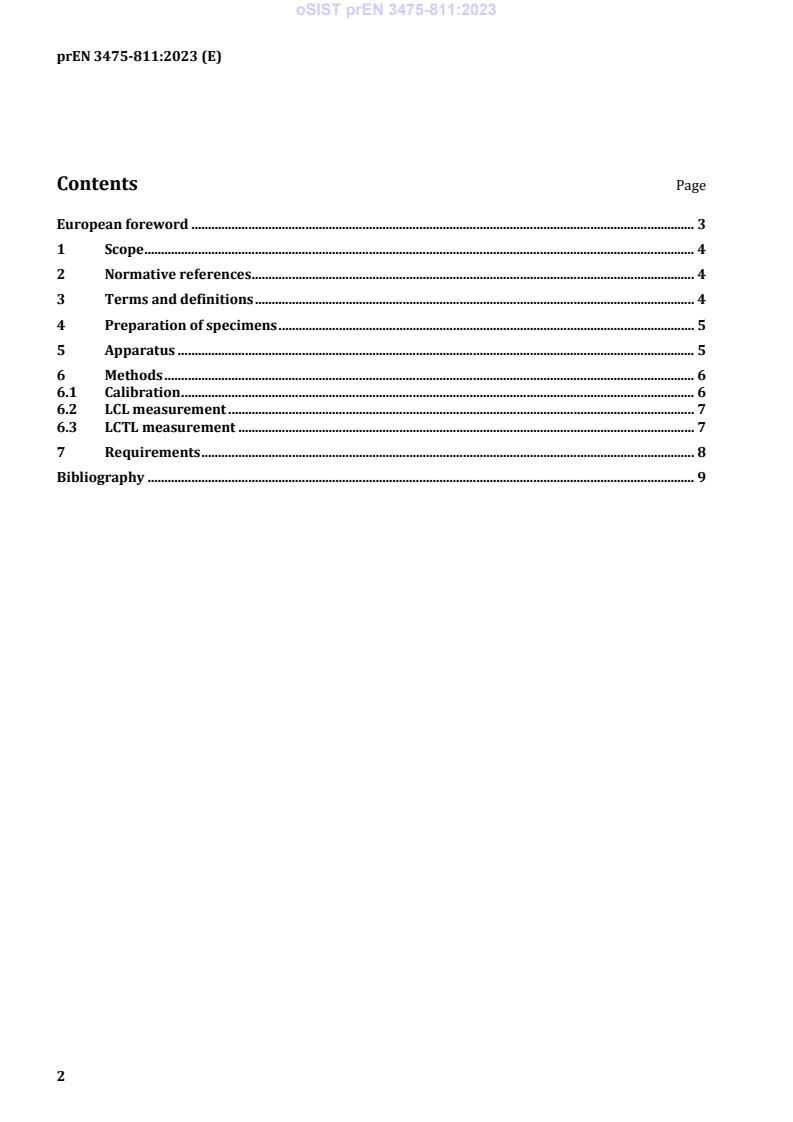
Contents Page
European foreword . 3
1 Scope . 4
2 Normative references . 4
3 Terms and definitions . 4
4 Preparation of specimens . 5
5 Apparatus . 5
6 Methods . 6
6.1 Calibration . 6
6.2 LCL measurement . 7
6.3 LCTL measurement . 7
7 Requirements . 8
Bibliography . 9
oSIST prEN 3475-811:2023
prEN 3475-811:2023 (E)
European foreword
This document (prEN 3475-811:2023) has been prepared by the Aerospace and Defence Industries
Association of Europe — Standardization (ASD-STAN).
After enquiries and votes carried out in accordance with the rules of this Association, this document has
received the approval of the National Associations and the Official Services of the member countries of
ASD-STAN, prior to its presentation to CEN.
This document is currently submitted to the CEN Enquiry.
This document will supersede EN 3475-811:2009.
The main changes compared to the previous edition are as follows:
— addition of reference to EN 50289-1-9 to the scope;
— editorial revision of the document.
Any feedback and questions on this document should be directed to the users’ national s
...