

SIST EN 2889:2009
(Main)Aerospace series - Metric bolts, normal hexagon head, coarse tolerance normal shank, short thread, in alloy steel, cadmium plated - Classification: 900 MPa (at ambient temperature)/235 °C
- Abstract
This standard specifies the characteristics of bolts, normal hexagonal head, coarse tolerance normal shank, short thread, in alloy steel, cadmium plated.
Classification: 900 MPa ) / 235 °C ) .
- Status
- Published
- Publication Date
- 26-Jan-2009
- Technical Committee
- I13 - Imaginarni 13
- Current Stage
- 6060 - National Implementation/Publication (Adopted Project)
- Start Date
- 19-Jan-2009
- Due Date
- 26-Mar-2009
- Completion Date
- 27-Jan-2009



SIST EN 2889:2009 is the Slovenian adoption of EN 2889:2006 for aerospace metric bolts with a normal hexagon head, coarse tolerance normal shank, short thread, in alloy steel, cadmium plated. It specifies the bolt characteristics, how the bolts are identified and marked, and the technical basis for making and inspecting them. The standard is for aerospace design, procurement, manufacturing and quality teams that need a defined fastener type with a stated 900 MPa / 235 °C classification.
What does SIST EN 2889:2009 specify?
SIST EN 2889:2009 specifies the characteristics of these bolts and organizes them as a product standard rather than a general fastener handbook. In practice, that means a buyer or engineer can use one document to define the bolt family, the permitted options, and the related marking and quality rules.
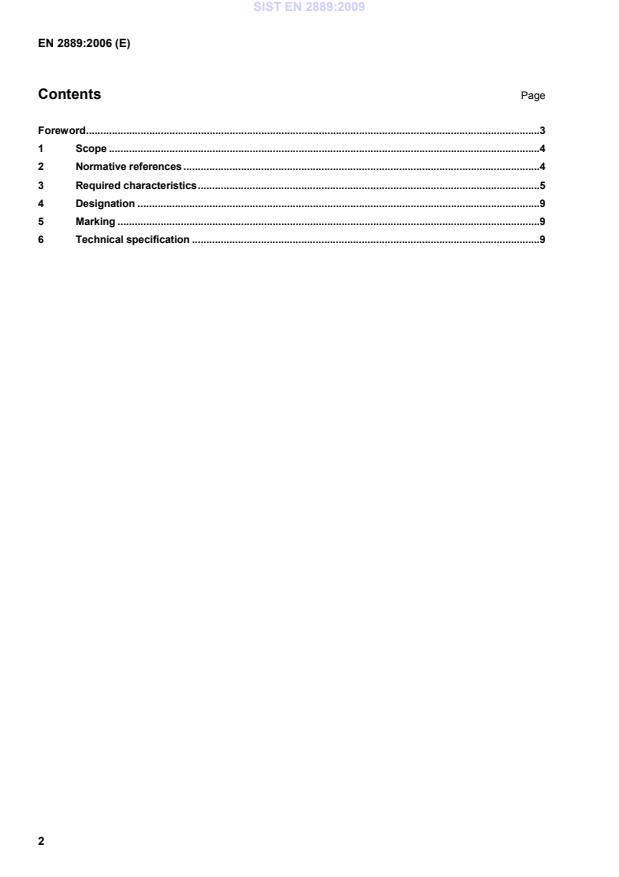
The document is arranged in six clauses: Scope, Normative references, Required characteristics, Designation, Marking, and Technical specification. Figure 1 and Tables 1 to 3 carry the product-specific details that support ordering, checking and identification.
What are the key requirements of SIST EN 2889:2009?
SIST EN 2889:2009 ties the bolt definition to geometry, material, coating, designation and acceptance-related rules. The most important points are the ones that affect interchangeability, corrosion protection, and how the bolt is ordered and inspected.
Geometry and dimensions
Clause 3 says the configuration, dimensions and masses are given in Figure 1 and Table 1. Dimensions and tolerances follow ISO 3193 and apply after surface treatment, while form and position tolerances follow ISO 7913.
In practice, this means the finished, coated part is the reference for dimensional control. Manufacturers cannot rely only on pre-coating size; the final bolt has to fit the aerospace interface after plating.
Material and classification
Clause 3.3 assigns the material basis through TR 3775 as alloy steel in strength class 900 MPa. The title and scope also classify the bolt for 900 MPa at ambient temperature and 235 °C.
In practice, this tells the user the expected strength class and the temperature-related limit linked to the surface condition. It is the starting point for design selection and procurement matching.
Surface treatment
Clause 3.4 requires cadmium plating to EN 2133. The plating is defined for all surfaces that can be contacted by a 20 mm diameter ball, and the rest of the surface must also have continuous cadmium coverage.
In practice, this matters for corrosion protection and for checking whether the coating reaches all accessible areas. The clause also allows a black colour option identified by code B.
Designation
Clause 4 gives the designation structure using a description block and an identity block. The example shows how the standard number, hole code, diameter code, length code and colour code are combined.
In practice, this is what purchasers and planners use on drawings, purchase orders and stock records. If needed, code I9005 is inserted between the blocks.
Marking
Clause 5 requires marking according to EN 2424 and Figure 1, with the style linked to Table 3. The diameter code determines the marking style.
In practice, this helps trace the bolt after supply and during incoming inspection. It links the physical marking to the ordered size.
Technical specification
Clause 6 bases the technical specification on ISO 7689 and then modifies it. It adds manufacturer approval through EN 9100, changes the hardness requirement at the thread end, replaces the defect classification limit, and deletes several requirements including qualification of bolts, cold rolling, tension fatigue strength, tensile strength and head-to-shank fillet work effect.
In practice, this clause is the quality-control core of the standard. It tells manufacturers what approval system to work under and what technical checks the bolt has to satisfy.
What terms does SIST EN 2889:2009 define?
- Description block - The first part of the designation that names the product and the standard.
- Identity block - The code part that carries the hole, diameter, length and colour information.
- Hole code - The code that shows whether the bolt has no hole, a lockwire hole, a split pin hole, or both.
- Diameter code - The size code used in the designation and in the marking rules.
- Black colour code B - The option used when the black finish variant is required.
- MJ threads - The aerospace metric thread form used for the bolts.
- Lockwire - A securing option identified by the hole code.
- Split pin - Another securing option identified by the hole code.
Who uses SIST EN 2889:2009?
SIST EN 2889:2009 is used by aerospace designers, fastener manufacturers, plating suppliers, procurement teams and inspection staff. Designers use it to specify the right bolt form, buyers use it to order the correct coded product, and quality teams use it to verify material, coating, marking and technical compliance.
What changed in SIST EN 2889:2009 from the previous edition?
SIST EN 2889:2009 supersedes EN 2889:1995. The foreword states that the newer European Standard replaces the earlier edition.
Which standards are used with SIST EN 2889:2009?
| Reference | What it contributes |
|---|---|
| ISO 3193 | Dimensions for normal hexagonal head bolts with normal shank and short or medium length MJ threads |
| ISO 3353-1 | Lead and runout threads for rolled external threads |
| ISO 5855-2 | Limit dimensions for MJ threads on bolts and nuts |
| ISO 7689 | Base procurement specification, modified by clause 6 |
| ISO 7913 | Tolerances of form and position |
| EN 2133 | Cadmium plating requirement |
| EN 2424 | Marking of aerospace products |
| EN 9100 | Manufacturer approval through the aerospace quality management system |
| TR 3775 | National materials basis for the alloy steel |
What does the SIST EN 2889:2009 document contain?
SIST EN 2889:2009 contains one product configuration figure, three tables and six clauses. Figure 1 shows the bolt shape, optional holes and marking position. Table 1 gives the dimensional system, length coding and approximate masses, Table 2 gives the hole codes, and Table 3 links diameter code to marking style. Clause 6 is especially useful for manufacturing and inspection because it states the modified technical specification that sits behind acceptance and supply.
Relations
- Effective Date
- 01-Mar-2009
- Effective Date
- 28-Jan-2026
- Effective Date
- 28-Jan-2026
- Effective Date
- 28-Jan-2026
- Effective Date
- 28-Jan-2026
- Effective Date
- 28-Jan-2026
- Effective Date
- 28-Jan-2026
Get Certified
Connect with accredited certification bodies for this standard

BUREAU VERITAS Certification Germany
Bureau Veritas certification in Germany.

Element Materials Technology
Materials testing and product certification.

AQMS Ltd.
AQMS provides ISO certification to SMEs across the UK.
Sponsored listings
Frequently Asked Questions
SIST EN 2889:2009 is a standard published by the Slovenian Institute for Standardization (SIST). Its full title is "Aerospace series - Metric bolts, normal hexagon head, coarse tolerance normal shank, short thread, in alloy steel, cadmium plated - Classification: 900 MPa (at ambient temperature)/235 °C". This standard covers: This standard specifies the characteristics of bolts, normal hexagonal head, coarse tolerance normal shank, short thread, in alloy steel, cadmium plated. Classification: 900 MPa ) / 235 °C ) .
This standard specifies the characteristics of bolts, normal hexagonal head, coarse tolerance normal shank, short thread, in alloy steel, cadmium plated. Classification: 900 MPa ) / 235 °C ) .
SIST EN 2889:2009 is classified under the following ICS (International Classification for Standards) categories: 49.030.20 - Bolts, screws, studs. The ICS classification helps identify the subject area and facilitates finding related standards.
SIST EN 2889:2009 has the following relationships with other standards: It is inter standard links to SIST EN 2889:2001, SIST EN 9100:2018, SIST EN ISO 14585:2002, SIST EN 2424:2008, SIST EN 2133:2021, SIST EN 14460:2006, SIST EN 840-6:2004+A1:2008. Understanding these relationships helps ensure you are using the most current and applicable version of the standard.
SIST EN 2889:2009 is available in PDF format for immediate download after purchase. The document can be added to your cart and obtained through the secure checkout process. Digital delivery ensures instant access to the complete standard document.
Standards Content (Sample)
2003-01.Slovenski inštitut za standardizacijo. Razmnoževanje celote ali delov tega standarda ni dovoljeno.Luft- und Raumfahrt - Metrische Sechskantschrauben, kurzes Gewinde, aus legiertem Stahl, verkadmet - Klasse: 900 MPa (bei Raumtemperatur)/235 °CSérie aérospatiale - Vis métrique à tête hexagonale normale, fût normal à tolérance large, filetage court, en acier allié, cadmiées - Classification: 900 MPa (à température ambiante)/235 °CAerospace series - Metric bolts, normal hexagon head, coarse tolerance normal shank, short thread, in alloy steel, cadmium plated - Classification: 900 MPa (at ambient temperature)/235 °C49.030.20Sorniki, vijaki, stebelni vijakiBolts, screws, studsICS:Ta slovenski standard je istoveten z:EN 2889:2006SIST EN 2889:2009en,de01-marec-2009SIST EN 2889:2009SLOVENSKI
STANDARDSIST EN 2889:20011DGRPHãþD
EUROPEAN STANDARD NORME EUROPÉENNE EUROPÄISCHE NORM
EN 2889
July 2006 ICS 49.030.20 Supersedes EN 2889:1995 English Version
Aerospace series - Metric bolts, normal hexagon head, coarse tolerance normal shank, short thread, in alloy steel, cadmium plated - Classification: 900 MPa (at ambient temperature)/235 °C
Série aérospatiale - Vis à tête hexagonale normale, fût normal à tolérance large, filetage court, en acier allié, cadmiées - Classification: 900 MPa (à température ambiante)/235 °C
Luft- und Raumfahrt - Sechskantschrauben, kurzes Gewinde, aus legiertem Stahl, verkadmet - Klasse: 900 MPa (bei Raumtemperatur)/235 °C This European Standard was approved by CEN on 13 January 2006.
CEN members are bound to comply with the CEN/CENELEC Internal Regulations which stipulate the conditions for giving this European Standard the status of a national standard without any alteration. Up-to-date lists and bibliographical references concerning such national standards may be obtained on application to the Central Secretariat or to any CEN member.
This European Standard exists in three official versions (English, French, German). A version in any other language made by translation under the responsibility of a CEN member into its own language and notified to the Central Secretariat has the same status as the official versions.
CEN members are the national standards bodies of Austria, Belgium, Cyprus, Czech Republic, Denmark, Estonia, Finland, France, Germany, Greece, Hungary, Iceland, Ireland, Italy, Latvia, Lithuania, Luxembourg, Malta, Netherlands, Norway, Poland, Portugal, Romania, Slovakia, Slovenia, Spain, Sweden, Switzerland and United Kingdom.
EUROPEAN COMMITTEE FOR STANDARDIZATION
COMITÉ EUROPÉEN DE NORMALISATION EUROPÄISCHES KOMITEE FÜR NORMUNG
Management Centre: rue de Stassart, 36
B-1050 Brussels © 2006 CEN All rights of exploitation in any form and by any means reserved worldwide for CEN national Members. Ref. No. EN 2889:2006: ESIST EN 2889:2009
2 Normative references The following referenced documents are indispensable for the application of this document. For date
...