


SIST EN ISO 18497-3:2024
(Main)Agricultural machinery and tractors - Safety of partially automated, semi-autonomous and autonomous machinery - Part 3: Autonomous operating zones (ISO 18497-3:2024)
Agricultural machinery and tractors - Safety of partially automated, semi-autonomous and autonomous machinery - Part 3: Autonomous operating zones (ISO 18497-3:2024)
This document specifies principles for the design of agricultural machinery and tractors utilizing systems (perception, supervisory or other) to prevent unintended excursions beyond the boundary of the autonomous operating zone which are used in agricultural applications and that have partially automated, semi-autonomous and autonomous functions. Additionally, it provides guidance on the type of information to be provided by the manufacturer on safe working practices (including information about residual risks).
The autonomous operating zone itself is not within the scope of this document. The autonomous operating zone can include, for example, considerations for the autonomous operating zone location, physical or virtual boundaries, physical boundary types (natural or man-made) and the associated risks with the systems (perception, supervisory or other) to prevent unintended excursions beyond the boundary of the autonomous operating zone design.
The purpose of this document is to assist in the provision of more specific safety requirements, means of verification and information for use to ensure an appropriate level of safety for agricultural machinery and tractors with partially automated, semi-autonomous and autonomous functions used in a specified way.
This document deals with the significant hazards relevant to agricultural machinery and tractors with partially automated, semi-autonomous and autonomous functions when used as intended and under the conditions of misuse reasonably foreseeable by the manufacturer during normal operation and service.
Applicability of the design principles and any additional detailed requirements for design, verification, validation or information for use are outside the scope of this document. When risk assessment concludes that hazards are not significant hazards, the principles of this document do not apply.
NOTE Safety requirements for specific non-automated functions of agricultural machinery and tractors can be available in machine-specific type-C standards.
This document is not applicable to:
— forestry applications;
— operations on public roads including relevant requirements for braking and steering systems.
This document is not applicable to agricultural machinery and tractors which are manufactured before the date of its publication, or to systems applied to agricultural machinery and tractors put into use before the date of its publication.
Landmaschinen und Traktoren - Sicherheit von teilautomatisierten, halbautonomen und autonomen Maschinen - Teil 3: Gestaltungsleitsätze für autonome Betriebsbereiche (ISO 18497-3:2024)
Dieses Dokument legt Gestaltungsgrundlagen für Landmaschinen und Traktoren, die autonome Systeme (Erkennungs-, Überwachungs- und andere Systeme) zur Vermeidung der unbeabsichtigten Bewegung über die Grenze des autonomen Betriebsbereichs hinaus zu landwirtschaftlichen Zwecken nutzen, und die über teilweise automatisierte, halbautonome und autonome Funktionen verfügen, fest. Zudem liefert es einen Leitfaden zu der Art von Informationen, die der Hersteller zu sicheren Arbeitspraktiken (einschließlich Informationen zu Restrisiken) angeben muss.
Der autonome Betriebsbereich selbst liegt außerhalb des Anwendungsbereichs dieses Dokuments. Der autonome Betriebsbereich kann beispielsweise Erwägungen für den Standort des autonomen Betriebsbereichs, physische oder virtuelle Grenzen, Arten von physischen Grenzen (natürlich oder künstlich) und die damit verbundenen Risiken mit den Systemen (Erkennungs-, Überwachungs- oder andere Systeme) beinhalten, um unbeabsichtigte Bewegungen über die Grenze der Gestaltung des autonomen Betriebsbereichs hinaus zu verhindern.
Zweck dieses Dokuments ist es, bei der Bereitstellung spezifischerer Sicherheitsanforderungen, Mitteln zur Verifizierung und Benutzerinformationen zu helfen, um ein angemessenes Sicherheitsniveau für Landmaschinen und Traktoren mit auf bestimmte Weise verwendeten teilweise automatisierten, halbautonomen und autonomen Funktionen zu liefern.
Dieses Dokument behandelt für Landmaschinen und Traktoren mit teilweise automatisierten, halbautonomen und autonomen Funktionen, wenn diese wie vernünftigerweise vorgesehen und unter den im Normalbetrieb und der Wartung vom Hersteller vorhersehbaren Missbrauchsbedingungen verwendet werden, relevanten signifikanten Gefährdungen.
Die Anwendbarkeit der Gestaltungsgrundsätze sowie jegliche zusätzlichen detaillierten Anforderungen an Gestaltung, Verifizierung, Validierung oder Benutzerinformationen liegen außerhalb des Anwendungsbereichs dieses Dokuments. Wenn eine Risikobeurteilung feststellt, dass Gefährdungen keine signifikanten Gefährdungen sind, sind die Grundsätze dieses Dokuments nicht anwendbar.
ANMERKUNG Sicherheitsanforderungen an spezifische nicht automatisierte Funktionen von Landmaschinen und Traktoren können in maschinenspezifischen Typ C Normen verfügbar sein.
Dieses Dokument ist nicht anwendbar auf:
forstwirtschaftliche Anwendungen;
Tätigkeiten auf öffentlichen Straßen einschließlich geltender Anforderungen an Brems- und Lenkeinrichtungen.
Dieses Dokument gilt nicht für Landmaschinen und Traktoren, die vor dem Veröffentlichungsdatum hergestellt wurden oder für Systeme, die vor dem Veröffentlichungsdatum an Landmaschinen und Traktoren in Betrieb genommen wurden.
Tracteurs et matériels agricoles - Sécurité des machines partiellement automatisées, semi-autonomes et autonomes - Partie 3: Zones de fonctionnement autonome (ISO 18497-3:2024)
Le présent document spécifie les principes de conception des tracteurs et matériels agricoles utilisant des systèmes (de détection, de surveillance ou autres) pour empêcher les excursions accidentelles au-delà de la limite de la zone de fonctionnement autonome, qui sont utilisés dans les applications agricoles et qui possèdent des fonctions partiellement automatisées, semi-autonomes et autonomes. En outre, il fournit des recommandations sur le type d'informations relatives aux pratiques d'utilisation sûres (y compris les informations relatives aux risques résiduels) que le fabricant est tenu de fournir.
La zone de fonctionnement autonome elle-même ne relève pas du domaine d'application du présent document. La zone de fonctionnement autonome peut inclure, par exemple, des considérations sur l'emplacement de la zone de fonctionnement autonome, les limites physiques ou virtuelles, les types de limites physiques (naturelles ou artificielles) et les risques associés aux systèmes (de détection, de surveillance ou autres) visant à empêcher les excursions accidentelles au-delà de la limite de la conception de la zone de fonctionnement autonome.
L'objectif du présent document est d'aider à fournir des exigences de sécurité plus spécifiques, des moyens de vérification et des informations pour l'utilisation afin d'assurer un niveau de sécurité approprié pour les tracteurs et matériels agricoles équipés de fonctions partiellement automatisées, semi-autonomes et autonomes utilisées de façon spécifiée.
Le présent document traite des phénomènes dangereux significatifs applicables aux tracteurs et matériels agricoles équipés de fonctions partiellement automatisées, semi-autonomes et autonomes, lorsqu'ils sont utilisés tel que prévu et dans les conditions de mauvais usage raisonnablement prévisibles par le fabricant pendant des conditions normales d'utilisation et d'entretien.
L'applicabilité des principes de conception et toute exigence détaillée supplémentaire pour la conception, la vérification, la validation ou les informations pour l'utilisation ne relèvent pas du domaine d'application du présent document. Lorsque l'appréciation du risque conclut que les phénomènes dangereux ne sont pas significatifs, les principes du présent document ne s'appliquent pas.
NOTE Les exigences de sécurité pour les fonctions non automatisées spécifiques des tracteurs et matériels agricoles peuvent être disponibles dans des normes de type C spécifiques aux machines.
Le présent document ne s'applique pas aux:
— applications de sylviculture;
— opérations sur voies publiques, y compris les exigences pour le freinage et la direction.
Le présent document ne s'applique pas aux tracteurs et matériels agricoles fabriqués avant la date de sa publication ni aux systèmes appliqués aux tracteurs et matériels agricoles mis en service avant la date de sa publication.
Kmetijski stroji in traktorji - Varnost delno avtomatiziranih, polavtonomnih in avtonomnih strojev - 3. del: Avtonomna delovna območja (ISO 18497-3:2024)
Ta dokument določa načela za načrtovanje avtonomnih delovnih območij za delno avtomatizirane, polavtonomne in avtonomne kmetijske stroje in traktorje, ki se uporabljajo v kmetijstvu. Podaja tudi smernice glede vrste informacij, ki jih mora predložiti proizvajalec v zvezi z varnimi delovnimi postopki (vključno z informacijami o ostalih tveganjih).
Dokument je namenjen kot pomoč pri zagotavljanju natančnejših varnostnih zahtev, načinov preverjanja in informacij za uporabo, s čimer se zagotovi ustrezna stopnja varnosti delno avtomatiziranih, polavtonomnih in avtonomnih kmetijskih strojev in traktorjev, ki se uporabljajo na določen način.
Ta dokument obravnava vsa večja tveganja, nevarne situacije in nevarne dogodke v zvezi z delno avtomatiziranimi, polavtonomnimi in avtonomnimi kmetijskimi stroji in traktorji, kadar se med normalnim delovanjem in vzdrževanjem uporabljajo v skladu s predvidenim namenom in pod pogoji pričakovane nepravilne uporabe, ki jih določa proizvajalec.
OPOMBA 1: Čeprav ta skupina dokumentov podaja načela za načrtovanje, preverjanje, validacijo in zagotavljanje informacij za uporabo, so podrobne zahteve odvisne od posameznega primera uporabe. Zato je treba načela načrtovanja, podana v tem dokumentu, razširiti in pojasniti z uporabo ustreznih posebnih standardov (tip C), če so na voljo, oziroma mora to storiti proizvajalec stroja na podlagi ocene tveganja. Uporabnost načel načrtovanja in morebitne dodatne zahteve za načrtovanje, preverjanje, validacijo ali informacije za uporabo ne spadajo na področje uporabe tega dokumenta.
OPOMBA 2: Varnostne zahteve za posebne neavtomatizirane funkcije kmetijskih strojev in traktorjev so lahko na voljo v standardih tipa C za posamezne stroje.
Ta dokument se ne uporablja za:
– gozdarstvo;
– dejavnosti na javnih cestah, vključno z ustreznimi zahtevami za zavorne in krmilne sisteme.
Ta dokument se ne uporablja za kmetijske stroje in traktorje, ki so bili izdelani pred datumom njegove objave.
General Information
- Status
- Published
- Publication Date
- 04-Sep-2024
- Technical Committee
- IMKG - Machinery for agriculture and forestry
- Current Stage
- 6060 - National Implementation/Publication (Adopted Project)
- Start Date
- 04-Sep-2024
- Due Date
- 09-Nov-2024
- Completion Date
- 05-Sep-2024
Relations
- Effective Date
- 01-Oct-2024
Overview - EN ISO 18497-3:2024 (Autonomous operating zones)
EN ISO 18497-3:2024, published by CEN/ISO, provides design principles and manufacturer guidance for agricultural machinery and tractors with partially automated, semi‑autonomous or fully autonomous functions that operate within an autonomous operating zone. The document focuses on systems (for example, perception and supervisory systems) intended to prevent unintended excursions beyond the autonomous operating zone boundary, and on the information manufacturers must supply about safe working practices and residual risks. The autonomous operating zone itself (its siting or definition) is not prescriptively defined by this part, but the standard addresses related considerations and associated risks.
Key topics and technical focus
- Principles for preventing boundary excursions: guidance for perception, supervisory and related systems used to keep machinery within defined autonomous operating zones.
- Manufacturer information: recommended content for user instructions, safe working practices and disclosure of residual risks.
- Hazard scope: addresses significant hazards that are reasonably foreseeable during intended use and foreseeable misuse; if hazards are judged non‑significant by risk assessment, the principles do not apply.
- Scope limitations: not applicable to forestry, public‑road operations (including braking/steering requirements), or machines manufactured/placed in service before publication.
- Relationship to verification & design details: this part provides high‑level principles; detailed design, verification, validation or prescriptive technical requirements are outside its scope (see related parts for those topics).
- Regulatory alignment: includes an informative Annex ZA linking the standard to Directive 2006/42/EC (machinery directive) for EU conformity considerations.
Practical applications - who uses this standard
- Manufacturers and system integrators designing perception, supervisory and control solutions to prevent zone breaches.
- Safety engineers and risk assessors evaluating hazards and defining necessary information for safe operation.
- Product certification bodies and regulators assessing conformity with machinery safety requirements.
- Farm operators and fleet managers seeking manufacturer guidance on safe working practices for autonomous deployments.
- Standards developers and researchers aligning machine safety strategies with industry best practice.
Related standards
- EN ISO 18497‑1:2024 (Machine design principles & vocabulary)
- EN ISO 18497‑2:2024 (Design principles for obstacle protective systems)
- EN ISO 18497‑4:2024 (Verification methods & validation principles)
- ISO 12100, ISO 13849, ISO 25119 (safety of machinery and safety‑related control system standards)
EN ISO 18497-3:2024 is essential reading when developing safe autonomous operating zones for agricultural machinery - helping teams combine perception and supervision design with clear manufacturer instructions to reduce boundary‑related risks.

Frequently Asked Questions
SIST EN ISO 18497-3:2024 is a standard published by the Slovenian Institute for Standardization (SIST). Its full title is "Agricultural machinery and tractors - Safety of partially automated, semi-autonomous and autonomous machinery - Part 3: Autonomous operating zones (ISO 18497-3:2024)". This standard covers: This document specifies principles for the design of agricultural machinery and tractors utilizing systems (perception, supervisory or other) to prevent unintended excursions beyond the boundary of the autonomous operating zone which are used in agricultural applications and that have partially automated, semi-autonomous and autonomous functions. Additionally, it provides guidance on the type of information to be provided by the manufacturer on safe working practices (including information about residual risks). The autonomous operating zone itself is not within the scope of this document. The autonomous operating zone can include, for example, considerations for the autonomous operating zone location, physical or virtual boundaries, physical boundary types (natural or man-made) and the associated risks with the systems (perception, supervisory or other) to prevent unintended excursions beyond the boundary of the autonomous operating zone design. The purpose of this document is to assist in the provision of more specific safety requirements, means of verification and information for use to ensure an appropriate level of safety for agricultural machinery and tractors with partially automated, semi-autonomous and autonomous functions used in a specified way. This document deals with the significant hazards relevant to agricultural machinery and tractors with partially automated, semi-autonomous and autonomous functions when used as intended and under the conditions of misuse reasonably foreseeable by the manufacturer during normal operation and service. Applicability of the design principles and any additional detailed requirements for design, verification, validation or information for use are outside the scope of this document. When risk assessment concludes that hazards are not significant hazards, the principles of this document do not apply. NOTE Safety requirements for specific non-automated functions of agricultural machinery and tractors can be available in machine-specific type-C standards. This document is not applicable to: — forestry applications; — operations on public roads including relevant requirements for braking and steering systems. This document is not applicable to agricultural machinery and tractors which are manufactured before the date of its publication, or to systems applied to agricultural machinery and tractors put into use before the date of its publication.
This document specifies principles for the design of agricultural machinery and tractors utilizing systems (perception, supervisory or other) to prevent unintended excursions beyond the boundary of the autonomous operating zone which are used in agricultural applications and that have partially automated, semi-autonomous and autonomous functions. Additionally, it provides guidance on the type of information to be provided by the manufacturer on safe working practices (including information about residual risks). The autonomous operating zone itself is not within the scope of this document. The autonomous operating zone can include, for example, considerations for the autonomous operating zone location, physical or virtual boundaries, physical boundary types (natural or man-made) and the associated risks with the systems (perception, supervisory or other) to prevent unintended excursions beyond the boundary of the autonomous operating zone design. The purpose of this document is to assist in the provision of more specific safety requirements, means of verification and information for use to ensure an appropriate level of safety for agricultural machinery and tractors with partially automated, semi-autonomous and autonomous functions used in a specified way. This document deals with the significant hazards relevant to agricultural machinery and tractors with partially automated, semi-autonomous and autonomous functions when used as intended and under the conditions of misuse reasonably foreseeable by the manufacturer during normal operation and service. Applicability of the design principles and any additional detailed requirements for design, verification, validation or information for use are outside the scope of this document. When risk assessment concludes that hazards are not significant hazards, the principles of this document do not apply. NOTE Safety requirements for specific non-automated functions of agricultural machinery and tractors can be available in machine-specific type-C standards. This document is not applicable to: — forestry applications; — operations on public roads including relevant requirements for braking and steering systems. This document is not applicable to agricultural machinery and tractors which are manufactured before the date of its publication, or to systems applied to agricultural machinery and tractors put into use before the date of its publication.
SIST EN ISO 18497-3:2024 is classified under the following ICS (International Classification for Standards) categories: 65.060.01 - Agricultural machines and equipment in general. The ICS classification helps identify the subject area and facilitates finding related standards.
SIST EN ISO 18497-3:2024 has the following relationships with other standards: It is inter standard links to SIST EN ISO 18497:2019. Understanding these relationships helps ensure you are using the most current and applicable version of the standard.
SIST EN ISO 18497-3:2024 is associated with the following European legislation: EU Directives/Regulations: 2006/42/EC; Standardization Mandates: M/396. When a standard is cited in the Official Journal of the European Union, products manufactured in conformity with it benefit from a presumption of conformity with the essential requirements of the corresponding EU directive or regulation.
SIST EN ISO 18497-3:2024 is available in PDF format for immediate download after purchase. The document can be added to your cart and obtained through the secure checkout process. Digital delivery ensures instant access to the complete standard document.
Standards Content (Sample)
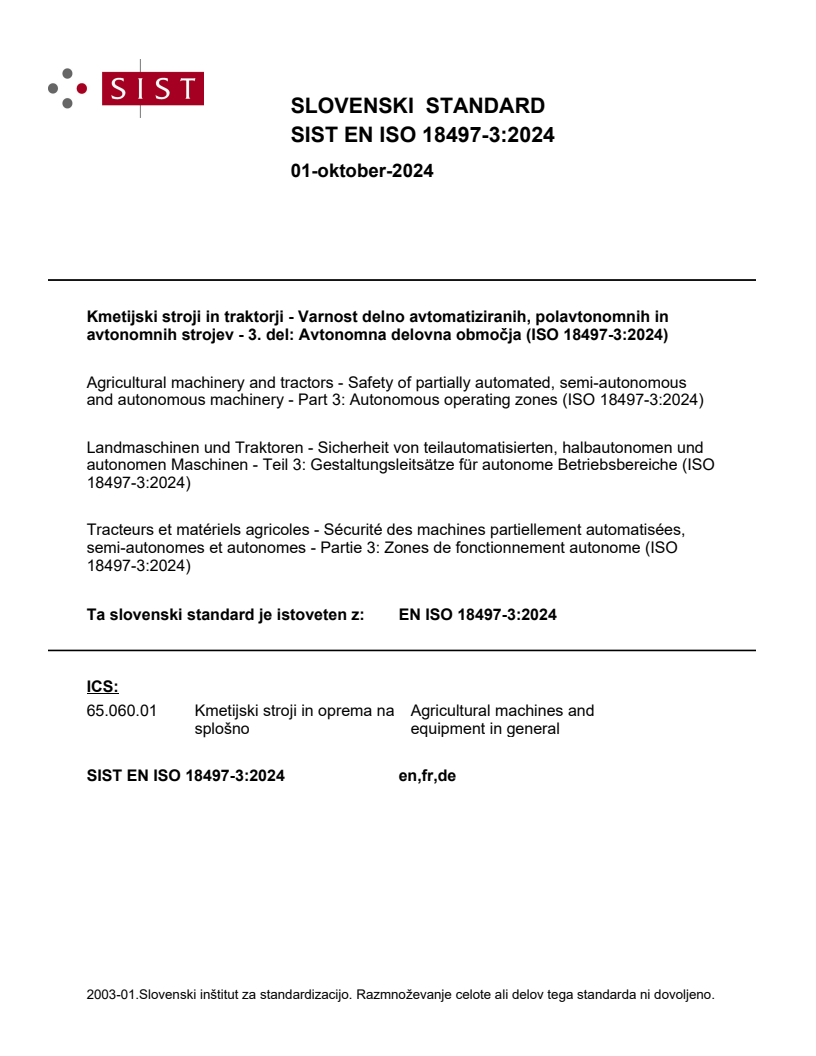
SLOVENSKI STANDARD
01-oktober-2024
Kmetijski stroji in traktorji - Varnost delno avtomatiziranih, polavtonomnih in
avtonomnih strojev - 3. del: Avtonomna delovna območja (ISO 18497-3:2024)
Agricultural machinery and tractors - Safety of partially automated, semi-autonomous
and autonomous machinery - Part 3: Autonomous operating zones (ISO 18497-3:2024)
Landmaschinen und Traktoren - Sicherheit von teilautomatisierten, halbautonomen und
autonomen Maschinen - Teil 3: Gestaltungsleitsätze für autonome Betriebsbereiche (ISO
18497-3:2024)
Tracteurs et matériels agricoles - Sécurité des machines partiellement automatisées,
semi-autonomes et autonomes - Partie 3: Zones de fonctionnement autonome (ISO
18497-3:2024)
Ta slovenski standard je istoveten z: EN ISO 18497-3:2024
ICS:
65.060.01 Kmetijski stroji in oprema na Agricultural machines and
splošno equipment in general
2003-01.Slovenski inštitut za standardizacijo. Razmnoževanje celote ali delov tega standarda ni dovoljeno.
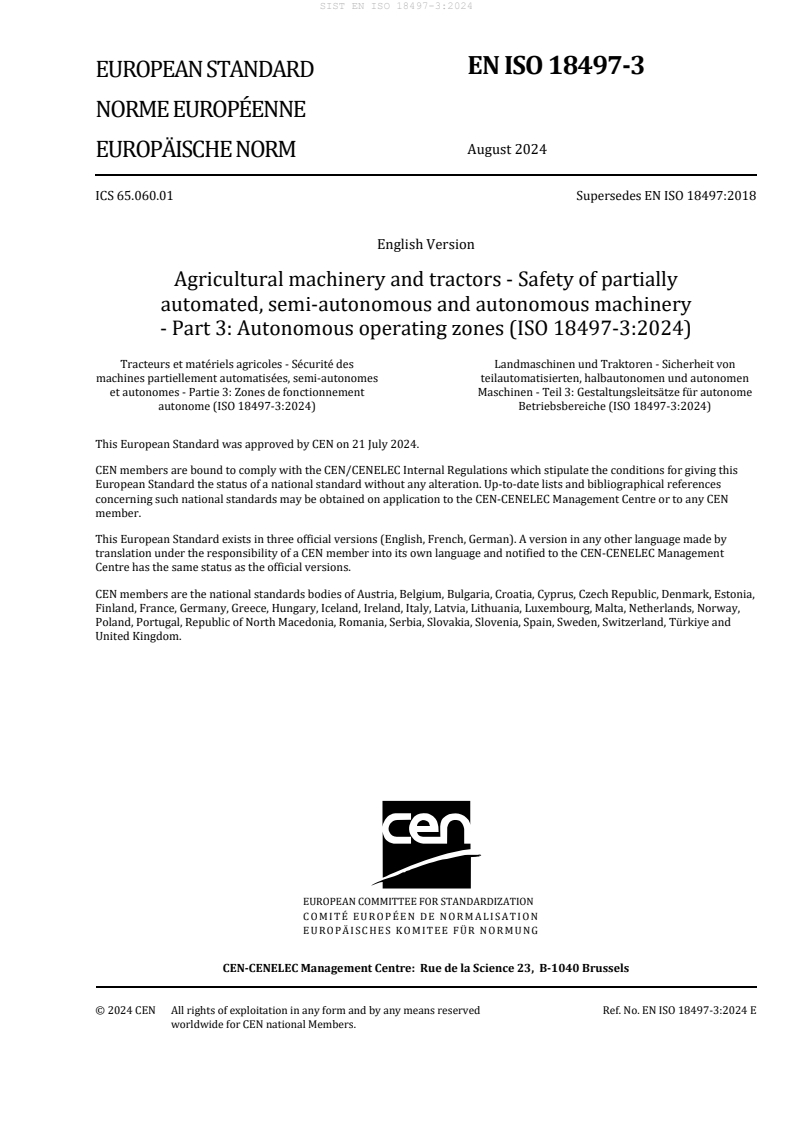
EN ISO 18497-3
EUROPEAN STANDARD
NORME EUROPÉENNE
August 2024
EUROPÄISCHE NORM
ICS 65.060.01 Supersedes EN ISO 18497:2018
English Version
Agricultural machinery and tractors - Safety of partially
automated, semi-autonomous and autonomous machinery
- Part 3: Autonomous operating zones (ISO 18497-3:2024)
Tracteurs et matériels agricoles - Sécurité des Landmaschinen und Traktoren - Sicherheit von
machines partiellement automatisées, semi-autonomes teilautomatisierten, halbautonomen und autonomen
et autonomes - Partie 3: Zones de fonctionnement Maschinen - Teil 3: Gestaltungsleitsätze für autonome
autonome (ISO 18497-3:2024) Betriebsbereiche (ISO 18497-3:2024)
This European Standard was approved by CEN on 21 July 2024.
CEN members are bound to comply with the CEN/CENELEC Internal Regulations which stipulate the conditions for giving this
European Standard the status of a national standard without any alteration. Up-to-date lists and bibliographical references
concerning such national standards may be obtained on application to the CEN-CENELEC Management Centre or to any CEN
member.
This European Standard exists in three official versions (English, French, German). A version in any other language made by
translation under the responsibility of a CEN member into its own language and notified to the CEN-CENELEC Management
Centre has the same status as the official versions.
CEN members are the national standards bodies of Austria, Belgium, Bulgaria, Croatia, Cyprus, Czech Republic, Denmark, Estonia,
Finland, France, Germany, Greece, Hungary, Iceland, Ireland, Italy, Latvia, Lithuania, Luxembourg, Malta, Netherlands, Norway,
Poland, Portugal, Republic of North Macedonia, Romania, Serbia, Slovakia, Slovenia, Spain, Sweden, Switzerland, Türkiye and
United Kingdom.
EUROPEAN COMMITTEE FOR STANDARDIZATION
COMITÉ EUROPÉEN DE NORMALISATION
EUROPÄISCHES KOMITEE FÜR NORMUNG
CEN-CENELEC Management Centre: Rue de la Science 23, B-1040 Brussels
© 2024 CEN All rights of exploitation in any form and by any means reserved Ref. No. EN ISO 18497-3:2024 E
worldwide for CEN national Members.
Contents Page
European foreword . 3
Annex ZA (informative) Relationship between this European Standard and the essential
requirements of Directive 2006/42/EC aimed to be covered . 4
European foreword
This document (EN ISO 18497-3:2024) has been prepared by Technical Committee ISO/TC 23 "Tractors
and machinery for agriculture and forestry" in collaboration with Technical Committee CEN/TC 144
“Tractors and machinery for agriculture and forestry” the secretariat of which is held by AFNOR.
This European Standard shall be given the status of a national standard, either by publication of an
identical text or by endorsement, at the latest by February 2025, and conflicting national standards
shall be withdrawn at the latest by February 2025.
Attention is drawn to the possibility that some of the elements of this document may be the subject of
patent rights. CEN shall not be held responsible for identifying any or all such patent rights.
This document supersedes EN ISO 18497:2018.
This document has been prepared under a standardization request addressed to CEN by the European
Commission. The Standing Committee of the EFTA States subsequently approves these requests for its
Member States.
For the relationship with EU Legislation, see informative Annex ZA, which is an integral part of this
document.
Any feedback and questions on this document should be directed to the users’ national standards
body/national committee. A complete listing of these bodies can be found on the CEN website.
According to the CEN-CENELEC Internal Regulations, the national standards organizations of the
following countries are bound to implement this European Standard: Austria, Belgium, Bulgaria,
Croatia, Cyprus, Czech Republic, Denmark, Estonia, Finland, France, Germany, Greece, Hungary, Iceland,
Ireland, Italy, Latvia, Lithuania, Luxembourg, Malta, Netherlands, Norway, Poland, Portugal, Republic of
North Macedonia, Romania, Serbia, Slovakia, Slovenia, Spain, Sweden, Switzerland, Türkiye and the
United Kingdom.
Endorsement notice
The text of ISO 18497-3:2024 has been approved by CEN as EN ISO 18497-3:2024 without any
modification.
Annex ZA
(informative)
Relationship between this European Standard and the essential
requirements of Directive 2006/42/EC aimed to be covered
This European Standard has been prepared under a Commission’s standardization request “M/396
Mandate to CEN and CENELEC for Standardisation in the field of machinery" to provide one voluntary
means of conforming to essential requirements of Directive 2006/42/EC of the European Parliament
and of the Council of 17 May 2006 on machinery, and amending Directive 95/16/EC (recast).
Once this standard is cited in the Official Journal of the European Union under that Directive,
compliance with the normative clauses of this standard given in Table ZA.1 confers, within the limits of
the scope of this standard, a presumption of conformity with the corresponding essential requirements
of that Directive, and associated EFTA regulations.
Table ZA.1 — Correspondence between this European Standard and Annex I of Directive
2006/42/EC
The relevant Essential Clause(s)/sub-clause(s) of this Remarks/Notes
Requirements of Directive EN
2006/42/EC
1.1.2. Principles of safety -----
integration
1.1.2(a) 4
1.1.2(c) 4
1.1.2(d) NOT COVERED
1.1.2(e) NOT COVERED
1.1.3. Materials and products NOT COVERED
1.1.4. Lighting NOT COVERED
1.1.5. Design of machinery to
NOT COVERED
facilitate its handling
1.1.6. Ergonomics 4.2.4
1.1.7. Operating positions NOT COVERED
1.1.8. Seating NOT COVERED
1.2. CONTROL SYSTEMS -----
1.2.1. Safety and reliability of 4.2.2, 4.2.3, 4.2.5
control systems
1.2.2. Control devices NOT COVERED
1.2.3. Starting NOT COVERED
1.2.4. Stopping NOT COVERED
1.2.5. Selection of control or NOT COVERED
The relevant Essential Clause(s)/sub-clause(s) of this Remarks/Notes
Requirements of Directive EN
2006/42/EC
operating modes
1.2.6. Failure of the power 4.2.5
supply
1.3. PROTECTION AGAINST ----
MECHANICAL HAZARDS
1.3.1. Risk of loss of stability NOT COVERED
1.3.2. Risk of break-up during
NOT COVERED
operation
1.3.3. Risks due to falling or
NOT COVERED
ejected objects
1.3.4. Risks due to surfaces,
NOT COVERED
edges or angles
1.3.5. Risks related to combined
NOT COVERED
machinery
1.3.6. Risks related to variations
NOT COVERED
in operating conditions
1.3.7. Risks related to moving
NOT COVERED
parts
1.3.8. Choice of protection
against risks arising from NOT COVERED
moving parts
1.3.9. Risks of uncontrolled
NOT COVERED
movements
1.4. REQUIRED ----
CHARACTERISTICS OF GUARDS
AND PROTECTIVE DEVICES
1.4.1. General requirements NOT COVERED
1.4.2. Special requirements for
NOT COVERED
guards
1.4.3. Special requirements for
NOT COVERED
protective devices
1.5. RISKS DUE TO OTHER ----
HAZARDS
1.5.1. Electricity supply NOT COVERED
1.5.2. Static electricity NOT COVERED
1.5.3. Energy supply other than
NOT COVERED
electricity
1.5.4. Errors of fitting NOT COVERED
The relevant Essential Clause(s)/sub-clause(s) of this Remarks/Notes
Requirements of Directive EN
2006/42/EC
1.5.5. Extreme temperatures NOT COVERED
1.5.6. Fire NOT COVERED
1.5.7. Explosion NOT COVERED
1.5.8. Noise NOT COVERED
1.5.9. Vibrations NOT COVERED
1.5.10. Radiation NOT COVERED
1.5.11. External radiation NOT COVERED
1.5.12. Laser radiation NOT COVERED
1.5.13. Emissions of hazardous
NOT COVERED
materials and substances
1.5.14. Risk of being trapped in a
NOT COVERED
machine
1.5.15. Risk of slipping, tripping
NOT COVERED
or falling
1.5.16. Lightning NOT COVERED
1.6. MAINTENANCE -----
1.6.1. Machinery maintenance NOT COVERED
1.6.2. Access to operating
NOT COVERED
positions and servicing points
1.6.3. Isolation of energy sources NOT COVERED
1.6.4. Operator intervention NOT COVERED
1.6.5. Cleaning of internal parts NOT COVERED
1.7. INFORMATION ----
1.7.1. Information and warnings 4.3
on the machinery
1.7.1.1. Information and 4.2.4, 4.3, 4.4
information devices
1.7.1.2. Warning devices NOT COVERED
1.7.2. Warning of residual risks 4.2.4
1.7.3. Marking of machinery NOT COVERED
1.7.4. Instructions 4.4
2.4. MACHINERY FOR ----
PESTICIDE APPLICATION
2.4.2. General NOT COVERED
The relevant Essential Clause(s)/sub-clause(s) of this Remarks/Notes
Requirements of Directive EN
2006/42/EC
2.4.3. Controls and monitoring NOT COVERED
2.4.4. Filling and emptying NOT COVERED
2.4.5. Application of pesticides ----
2.4.5.1. Application rate NOT COVERED
2.4.5.2. Distribution, deposition
NOT COVERED
and drift of pesticide
2.4.5.3. Tests NOT COVERED
2.4.5.4. Losses during stoppage NOT COVERED
2.4.6. Maintenance ----
2.4.6.1. Cleaning NOT COVERED
2.4.6.2. Servicing NOT COVERED
2.4.7. Inspections NOT COVERED
2.4.8. Marking of nozzles,
NOT COVERED
strainers and filters
2.4.9. Indication of pesticide in
NOT COVERED
use
2.4.10. Instructions NOT COVERED
3.2 WORK POSITIONS ---
3.2.1. Driving position NOT COVERED
3.2.2. Seating NOT COVERED
3.2.3. Positions for other persons NOT COVERED
3.3 CONTROL SYSTEMS ---
3.3.1. Control devices NOT COVERED
3.3.2. Starting/moving NOT COVERED
3.3.3. Travelling function NOT COVERED
3.3.4. Movement of pedestrian-
NOT COVERED
controlled machinery
3.3.5. Control circuit failure NOT COVERED
3.4 PROTECTION AGAINST ---
MECHANICAL HAZARDS
3.4.1. Uncontrolled movements NOT COVERED
3.4.2. Moving transmission parts NOT COVERED
3.4.3. Roll-over and tip-over NOT COVERED
3.4.4. Falling objects NOT COVERED
The relevant Essential Clause(s)/sub-clause(s) of this Remarks/Notes
Requirements of Directive EN
2006/42/EC
3.4.5. Means of access NOT COVERED
3.4.6. Towing devices NOT COVERED
3.4.7. Transmission of power
between self-propelled
NOT COVERED
machinery (or tractor) and
recipient machinery
3.5 PROTECTION AGAINST ----
OTHER HAZARDS
3.5.1. Batteries NOT COVERED
3.5.2. Fire NOT COVERED
3.5.3. Emissions of hazardous
NOT COVERED
substances
3.6 INFORMATION AND ----
INDICATIONS
3.6.1. Signs, signals and
NOT COVERED
warnings
3.6.2. Marking NOT COVERED
3.6.3. Instructions ----
3.6.3.1. Vibrations NOT COVERED
3.6.3.2. Multiple uses NOT COVERED
Table ZA.2 — Applicable Standards to confer presumption of conformity as described in this
Annex ZA
Column 1 Column 2 International Column 3 Column 4
Reference in Standard Edition
Title Corresponding
Clause 2
European Standard
Edition
ISO 3767-1:2016 ISO 3767-1:2016 Tractors, machinery for None
agriculture and forestry,
ISO 3767-
powered lawn and garden
1:2016/A1:2020
For applicable
equipment — Symbols for
standard edition see
operator controls and
Column 2
other displays — Part 1:
Common symbols
ISO 3767-2:2016 ISO 3767-2:2016 Tractors, machinery for None
agriculture and forestry,
ISO 3767-
powered lawn and garden
2:2016/A1:2020
For applicable
equipment — Symbols for
standard edition see
operator controls and
Column 2
other displays — Part 2:
Symbols for agricultural
Column 1 Column 2 International Column 3 Column 4
Reference in Standard Edition
Title Corresponding
Clause 2
European Standard
Edition
tractors and machinery
ISO 12100:2010 ISO 12100:2010 Safety of machinery — EN ISO 12100:2010
General principles for
design — Risk assessment
and risk reduction
ISO 13849-1:2023 ISO 13849-1:2023 Safety of machinery — EN ISO 13849-1:2023
Safety-related parts of
control systems — Part 1:
General principles for
design
ISO 13849-2:2012 ISO 13849-2:2012 Safety of machinery — EN ISO 13849-2:2012
Safety-related parts of
control systems — Part 2:
Validation
ISO 18497-1:2024 ISO 18497-1:2024 Agricultural machinery EN ISO 18497-1:2024
and tractors — Safety of
partially automated, semi-
autonomous and
autonomous machinery —
Part 1: Machine design
principles and vocabulary
ISO 18497-2:2024 ISO 18497-2:2024 Agricultural machinery EN ISO 18497-2:2024
and tractors — Safety of
partially automated, semi-
autonomous and
autonomous machinery —
Part 2: Design principles
for obstacle protective
systems
ISO 18497-4:2024 ISO 18497-4:2024 Agricultural machinery EN ISO 18497-4:2024
and tractors — Safety of
partially automated, semi-
autonomous and
autonomous machinery —
Part 4: Verification
methods and validation
principles
ISO 25119-1:2018 ISO 25119-1:2018 Tractors and machinery EN ISO 25119-1:2023
for agriculture and
ISO 25119- EN ISO 25119- 1:2023/
forestry — Safety-related
1:2018/A1:2020 A1:2023
parts of control systems
— Part 1: General
principles for design and
development
Column 1 Column 2 International Column 3 Column 4
Reference in Standard Edition
Title Corresponding
Clause 2
European Standard
Edition
ISO 25119-2:2019 ISO 25119-2:2019 Tractors and machinery EN ISO 25119-2:2023
for agriculture and
forestry — Safety-related
parts of control systems
— Part 2: Concept phase
ISO 25119-3:2018 ISO 25119-3:2018 Tractors and machinery EN ISO 25119-3:2023
for agriculture and
ISO 25119- EN ISO 25119-3:2023/
forestry — Safety-related
3:2018/A1:2020 A1:2023
parts of control systems
— Part 3: Series
development, hardware
and software
ISO 25119-4:2018 ISO 25119-4:2018 Tractors and machinery EN ISO 25119-4:2023
for agriculture and
ISO 25119- EN ISO 25119- 4:2023/
forestry — Safety-related
4:2018/A1:2020 A1:2023
parts of control systems
— Part 4: Production,
operation, modification
and supporting processes
The documents listed in the Column 1 of Table ZA.2, in whole or in part, are normatively referenced in
this document, i.e. are indispensable for its application. The achievement of the presumption of
conformity is subject to the application of the edition of Standards as listed in Column 4 or, if no
European Standard Edition exists, the International Standard Edition given in Column 2 of Table ZA.2.
WARNING 1 Presumption of conformity stays valid only as long as a reference to this European
Standard is maintained in the list published in the Official Journal of the European Union. Users of this
standard should consult frequently the latest list published in the Official Journal of the European
Union.
WARNING 2 Other Union legislation may be applicable to the product(s) falling within the scope of this
standard.
International
Standard
ISO 18497-3
First edition
Agricultural machinery and
2024-07
tractors — Safety of partially
automated, semi-autonomous and
autonomous machinery —
Part 3:
Autonomous operating zones
Tracteurs et matériels agricoles — Sécurité des machines
partiellement automatisées, semi-autonomes et autonomes —
Partie 3: Zones de fonctionnement autonome
Reference number
ISO 18497-3:2024(en) © ISO 2024
ISO 18497-3:2024(en)
© ISO 2024
All rights reserved. Unless otherwise specified, or required in the context of its implementation, no part of this publication may
be reproduced or utilized otherwise in any form or by any means, electronic or mechanical, including photocopying, or posting on
the internet or an intranet, without prior written permission. Permission can be requested from either ISO at the address below
or ISO’s member body in the country of the requester.
ISO copyright office
CP 401 • Ch. de Blandonnet 8
CH-1214 Vernier, Geneva
Phone: +41 22 749 01 11
Email: copyright@iso.org
Website: www.iso.org
Published in Switzerland
ii
ISO 18497-3:2024(en)
Contents Page
Foreword .iv
Introduction .v
1 Scope . 1
2 Normative references . 1
3 Terms and definitions . 2
4 Safety requirements and protective or risk reduction measures . 3
4.1 General .3
4.2 Design principles .3
4.2.1 General .3
4.2.2 Boundary detection .4
4.2.3 Operational limits .6
4.2.4 Monitoring .6
4.2.5 Faults and failures .6
4.3 Labelling and identification .7
4.4 Information for use .7
Bibliography . 9
iii
ISO 18497-3:2024(en)
Foreword
ISO (the International Organization for Standardization) is a worldwide federation of national standards
bodies (ISO member bodies). The work of preparing International Standards is normally carried out through
ISO technical committees. Each member body interested in a subject for which a technical committee
has been established has the right to be represented on that committee. International organizations,
governmental and non-governmental, in liaison with ISO, also take part in the work. ISO collaborates closely
with the International Electrotechnical Commission (IEC) on all matters of electrotechnical standardization.
The procedures used to develop this document and those intended for its further maintenance are described
in the ISO/IEC Directives, Part 1. In particular, the different approval criteria needed for the different types
of ISO document should be noted. This document was drafted in accordance with the editorial rules of the
ISO/IEC Directives, Part 2 (see www.iso.org/directives).
ISO draws attention to the possibility that the implementation of this document may involve the use of (a)
patent(s). ISO takes no position concerning the evidence, validity or applicability of any claimed patent
rights in respect thereof. As of the date of publication of this document, ISO had not received notice of (a)
patent(s) which may be required to implement this document. However, implementers are cautioned that
this may not represent the latest information, which may be obtained from the patent database available at
www.iso.org/patents. ISO shall not be held responsible for identifying any or all such patent rights.
Any trade name used in this document is information given for the convenience of users and does not
constitute an endorsement.
For an explanation of the voluntary nature of standards, the meaning of ISO specific terms and expressions
related to conformity assessment, as well as information about ISO's adherence to the World Trade
Organization (WTO) principles in the Technical Barriers to Trade (TBT), see www.iso.org/iso/foreword.html.
This document was prepared by Technical Committee ISO/TC 23, Tractors and machinery for agriculture and
forestry, Subcommittee SC 19, Agricultural electronics, in collaboration with the European Committee for
Standardization (CEN) Technical Committee CEN/TC 144, Tractors and machinery for agriculture and forestry,
in accordance with the Agreement on technical cooperation between ISO and CEN (Vienna Agreement).
This first edition of ISO 18497-3, together with ISO 18497-1, ISO 18497-2 and ISO 18497-4, cancels and
replaces ISO 18497:2018, which has been technically revised.
The main changes are as follows:
— autonomous operating zones were defined and were made its own part (i.e. ISO 18497-3), accounting for
the wide range of functionality and use cases within agricultural machines and tractors.
A list of all parts in the ISO 18497 series can be found on the ISO website.
Any feedback or questions on this document should be directed to the user’s national standards body. A
complete listing of these bodies can be found at www.iso.org/members.html.
iv
ISO 18497-3:2024(en)
Introduction
This document is a type-B1 standard as stated in ISO 12100:2010.
This document is of relevance, in particular, for the following stakeholder groups representing the market
players with regard to machinery safety:
— machine manufacturers (small, medium and large enterprises);
— health and safety bodies (regulators, accident prevention organisations, market surveillance, etc.).
Others can be affected by the level of machinery safety achieved with the means of the document by the
above-mentioned stakeholder groups:
— machine users/employers (small, medium and large enterprises);
— machine users/employees (e.g. trade unions, organizations for people with special needs);
— service providers, e.g. for maintenance (small, medium and large enterprises);
— consumers (in case of machinery intended for use by consumers).
The above-mentioned stakeholder groups have been given the possibility to participate at the drafting
process of this document.
In addition, this document is intended for standa
...
Questions, Comments and Discussion
Ask us and Technical Secretary will try to provide an answer. You can facilitate discussion about the standard in here.
Loading comments...