

SIST EN 15466-2:2024
(Main)Primers for cold and hot applied joint sealants - Part 2: Determination of resistance against alkali
General Information
- Abstract
This document describes a method for determining the resistance against alkali of primers for cold and hot applied joint sealants.
- Status
- Published
- Public Enquiry End Date
- 07-Sep-2023
- Publication Date
- 08-May-2024
- Technical Committee
- CES - Roads
- Current Stage
- 6060 - National Implementation/Publication (Adopted Project)
- Start Date
- 10-Apr-2024
- Due Date
- 15-Jun-2024
- Completion Date
- 09-May-2024

Overview
SIST EN 15466-2:2024 is a European standard developed by CEN that specifies a standardized method for determining the alkali resistance of primers used with cold and hot applied joint sealants. This measurement is critical to ensure the durability and performance of primers when exposed to alkaline environments, such as those encountered in road construction and other civil engineering applications.
The standard replaces the previous 2010 version and clarifies testing procedures to avoid misinterpretations. It forms part of a series addressing key properties of primers for joint sealants, ensuring harmonized quality and reliable field performance.
Key Topics
- Scope: Defines the method to assess alkali resistance of primers applied on glass plates and immersed in alkali solutions.
- Test Principle: Two glass plates, coated uniformly with primer, are immersed separately in distilled water and a 0.5% potassium hydroxide solution, then conditioned at a standard atmosphere for 24 hours.
- Evaluation Criteria:
- Visual changes in the alkali and water solutions (color, turbidity, sediment)
- Physical inspection of primer coatings for cloudiness, bubbles, peeling, and hardness differences under wet and dry conditions
- Test Equipment: Includes glass beakers, glass plates, potassium hydroxide solution, preparation needles, brushes, and standard conditioning atmospheres.
- Procedure Outline:
- Primer homogenization and conditioning
- Glass plate preparation and primer application based on solids content
- Specimen immersion and conditioning in alkali and water solutions
- Post-immersion inspection including scratch testing for coating integrity and hardness
- Result Interpretation: Primers passing all criteria without significant changes or damage are classified as resistant to alkali.
- Reporting Requirements: Detailed test reports capturing sample specifics, test conditions, analyst details, and results summary.
Applications
SIST EN 15466-2:2024 is essential for manufacturers, quality control laboratories, and specifiers who require reliable testing and certification of primers used in:
- Joint Sealants for Road Construction: Ensuring primers withstand aggressive alkaline environments in pavement joints.
- Building Expansion Joints: Assessing primer durability where alkali exposure may affect joint longevity.
- Civil Engineering Projects: Verifying materials used in structures exposed to alkali from concrete or other sources.
- Product Development: Supporting formulation improvements and quality assurance for primers designed for cold and hot application.
This standard helps stakeholders ensure that primers maintain adhesion, mechanical properties, and chemical stability, which are critical to the long-term performance of joint sealing systems.
Related Standards
- EN 15466-1:2024 – Primers for cold and hot applied joint sealants - Determination of homogeneity
- EN 15466-3:2024 – Primers for cold and hot applied joint sealants - Determination of solids content and evaporation behavior of volatiles
- EN 14188-4:2009 – Specifications for primers used with joint sealants
- EN ISO 291 – Standard atmospheres for conditioning and testing plastics, applicable for standard atmosphere conditions in primer testing
By adhering to SIST EN 15466-2:2024 in conjunction with these related standards, industry professionals can comprehensively evaluate primer products and ensure compliance with European harmonized quality and safety requirements.
Keywords: SIST EN 15466-2:2024, alkali resistance, primer testing, joint sealants, cold and hot applied primers, road construction materials, curing primers, potassium hydroxide test, CEN standards, sealing materials, primer durability, standards for primers
Relations
- Effective Date
- 01-Jun-2024
- Effective Date
- 28-Jan-2026
Get Certified
Connect with accredited certification bodies for this standard

DIBt (Deutsches Institut für Bautechnik)
German Institute for Building Technology.
DIN CERTCO
DIN Group product certification.
Zavod za gradbeništvo Slovenije (ZAG) - Inšpekcija
ZAG inspection body for construction products, structures, and materials.
Sponsored listings
Frequently Asked Questions
SIST EN 15466-2:2024 is a standard published by the Slovenian Institute for Standardization (SIST). Its full title is "Primers for cold and hot applied joint sealants - Part 2: Determination of resistance against alkali". This standard covers: This document describes a method for determining the resistance against alkali of primers for cold and hot applied joint sealants.
This document describes a method for determining the resistance against alkali of primers for cold and hot applied joint sealants.
SIST EN 15466-2:2024 is classified under the following ICS (International Classification for Standards) categories: 91.100.50 - Binders. Sealing materials; 93.080.20 - Road construction materials. The ICS classification helps identify the subject area and facilitates finding related standards.
SIST EN 15466-2:2024 has the following relationships with other standards: It is inter standard links to SIST EN 15466-2:2010, SIST EN 14188-4:2010. Understanding these relationships helps ensure you are using the most current and applicable version of the standard.
SIST EN 15466-2:2024 is available in PDF format for immediate download after purchase. The document can be added to your cart and obtained through the secure checkout process. Digital delivery ensures instant access to the complete standard document.
Standards Content (Sample)
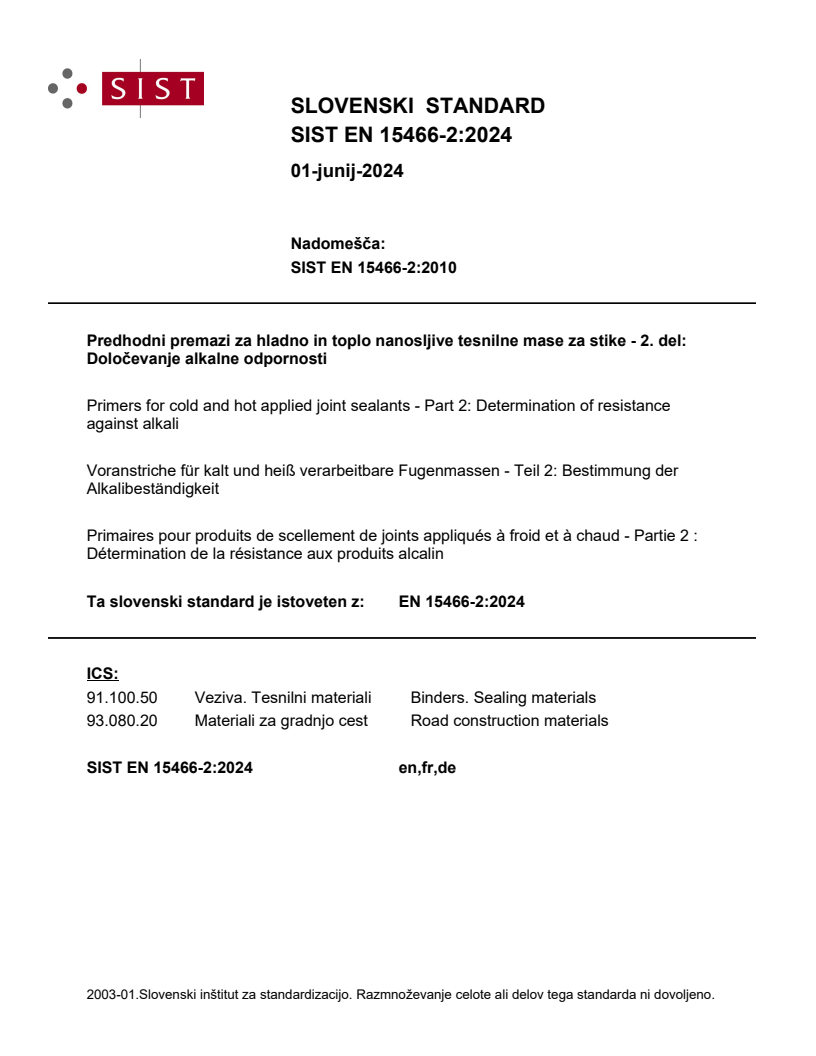
SLOVENSKI STANDARD
01-junij-2024
Nadomešča:
SIST EN 15466-2:2010
Predhodni premazi za hladno in toplo nanosljive tesnilne mase za stike - 2. del:
Določevanje alkalne odpornosti
Primers for cold and hot applied joint sealants - Part 2: Determination of resistance
against alkali
Voranstriche für kalt und heiß verarbeitbare Fugenmassen - Teil 2: Bestimmung der
Alkalibeständigkeit
Primaires pour produits de scellement de joints appliqués à froid et à chaud - Partie 2 :
Détermination de la résistance aux produits alcalin
Ta slovenski standard je istoveten z: EN 15466-2:2024
ICS:
91.100.50 Veziva. Tesnilni materiali Binders. Sealing materials
93.080.20 Materiali za gradnjo cest Road construction materials
2003-01.Slovenski inštitut za standardizacijo. Razmnoževanje celote ali delov tega standarda ni dovoljeno.
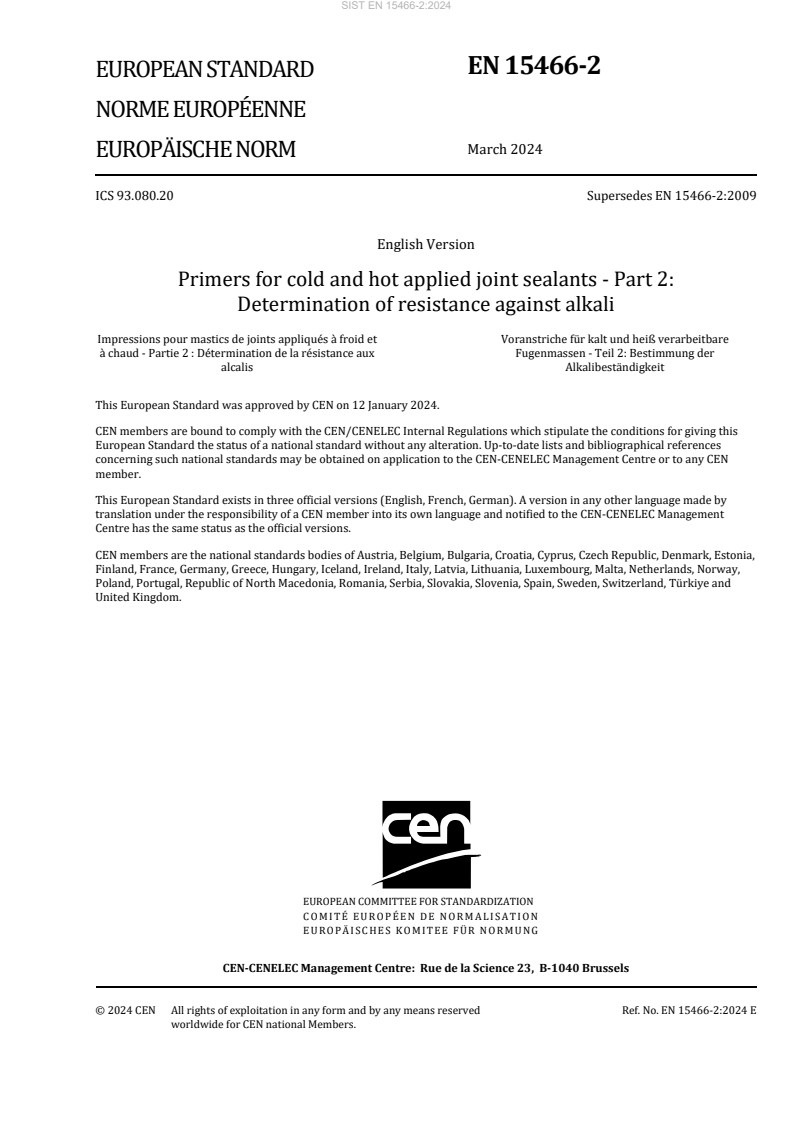
EN 15466-2
EUROPEAN STANDARD
NORME EUROPÉENNE
March 2024
EUROPÄISCHE NORM
ICS 93.080.20 Supersedes EN 15466-2:2009
English Version
Primers for cold and hot applied joint sealants - Part 2:
Determination of resistance against alkali
Impressions pour mastics de joints appliqués à froid et Voranstriche für kalt und heiß verarbeitbare
à chaud - Partie 2 : Détermination de la résistance aux Fugenmassen - Teil 2: Bestimmung der
alcalis Alkalibeständigkeit
This European Standard was approved by CEN on 12 January 2024.
CEN members are bound to comply with the CEN/CENELEC Internal Regulations which stipulate the conditions for giving this
European Standard the status of a national standard without any alteration. Up-to-date lists and bibliographical references
concerning such national standards may be obtained on application to the CEN-CENELEC Management Centre or to any CEN
member.
This European Standard exists in three official versions (English, French, German). A version in any other language made by
translation under the responsibility of a CEN member into its own language and notified to the CEN-CENELEC Management
Centre has the same status as the official versions.
CEN members are the national standards bodies of Austria, Belgium, Bulgaria, Croatia, Cyprus, Czech Republic, Denmark, Estonia,
Finland, France, Germany, Greece, Hungary, Iceland, Ireland, Italy, Latvia, Lithuania, Luxembourg, Malta, Netherlands, Norway,
Poland, Portugal, Republic of North Macedonia, Romania, Serbia, Slovakia, Slovenia, Spain, Sweden, Switzerland, Türkiye and
United Kingdom.
EUROPEAN COMMITTEE FOR STANDARDIZATION
COMITÉ EUROPÉEN DE NORMALISATION
EUROPÄISCHES KOMITEE FÜR NORMUNG
CEN-CENELEC Management Centre: Rue de la Science 23, B-1040 Brussels
© 2024 CEN All rights of exploitation in any form and by any means reserved Ref. No. EN 15466-2:2024 E
worldwide for CEN national Members.
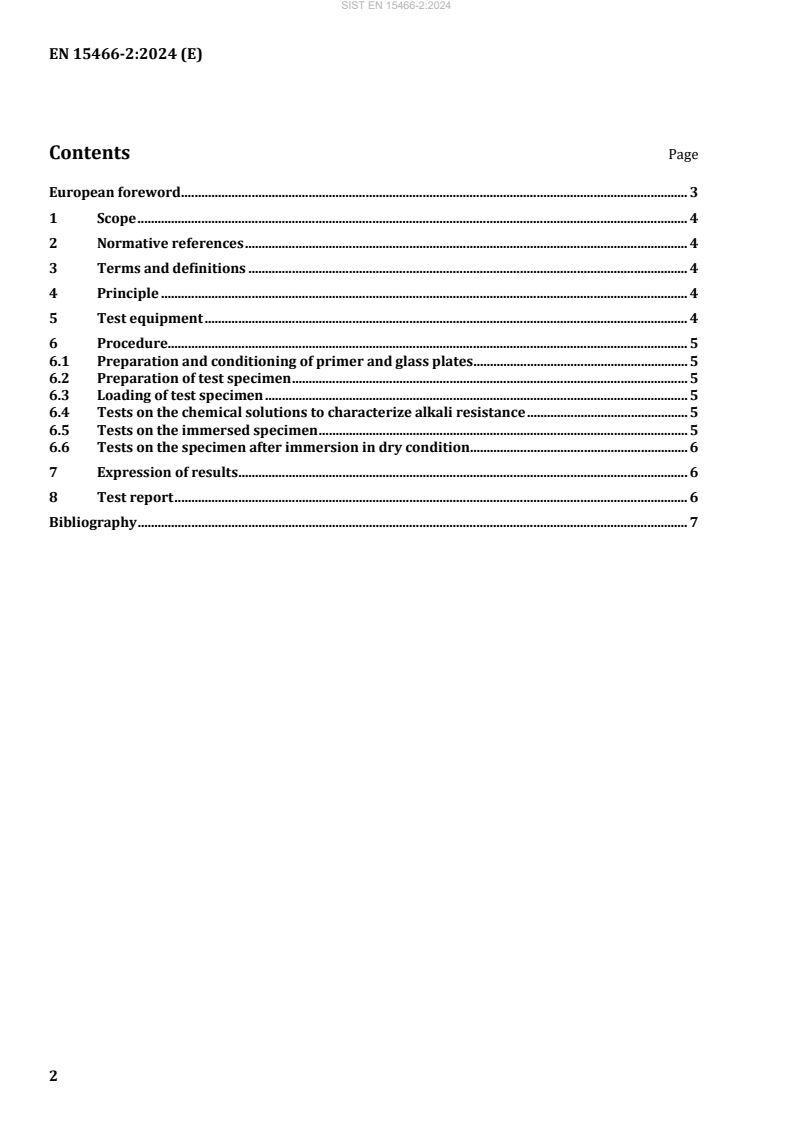
Contents Page
European foreword . 3
1 Scope . 4
2 Normative references . 4
3 Terms and definitions . 4
4 Principle . 4
5 Test equipment . 4
6 Procedure. 5
6.1 Preparation and conditioning of primer and glass plates. 5
6.2 Preparation of test specimen . 5
6.3 Loading of test specimen . 5
6.4 Tests on the chemical solutions to characterize alkali resistance . 5
6.5 Tests on the immersed specimen . 5
6.6 Tests on the specimen after immersion in dry condition. 6
7 Expression of results . 6
8 Test report . 6
Bibliography . 7
European foreword
This document (EN 15466-2:2024) has been prepared by Technical Committee CEN/TC 227 “Road
materials”, the secretariat of which is held by BSI.
This European Standard shall be given the status of a national standard, either by publication of an
identical text or by endorsement, at the latest by September 2024, and conflicting national standards shall
be withdrawn at the latest by September 2024.
Attention is drawn to the possibility that some of the elements of this document may be the subject of
patent rights. CEN shall not be held responsible for identifying any or all such patent rights.
This document supersedes EN 15466-2:2009.
The main changes compared to the previous edition are listed below:
— Clause 6 and Clause 4 have been redrafted to clarify the former description of the test, that did lead
to erroneous interpretation, although technically no changes have been included;
— information to be included in the test report has been updated;
— additionally, some headings have been renamed.
This document is one of a series of standards as listed below:
— EN 15466-1, Primers for cold and hot applied joint sealants — Part 1: Determination of homogeneity;
— EN 15466-2, Primers for cold and hot applied joint sealants — Part 2: Determination of resistance
against alkali;
— EN 15466-3, Primers for cold and hot applied joint sealants — Part 3: Determination of solids content
and evaporation behaviour of volatiles.
Any feedback and questions on this document should be directed to the users’ national standards body.
A complete listing of these bodies can be found on the CEN website.
According to the CEN-CENELEC Internal Regulations, the national standards organisations of the
following countries are bound to implement this European Standard: Austria, Belgium, Bulgaria, Croatia,
Cyprus, Czech Republic, Denmark, Estonia, Finland, France, Germany, Greece, Hungary, Iceland, Ireland,
Italy, Latvia, Lithuania, Luxembourg, Malta, Netherlands, Norway, Poland, Portugal, Republic of North
Macedonia, Romania, Serbia, Slovakia, Slovenia, Spain, Sweden, Switzerland, Türkiye and the United
Kingdom.
...