

SIST EN 300 728 V8.0.1:2003
(Main)Digital cellular telecommunications system (Phase 2+) (GSM); Comfort noise aspects for Enhanced Full Rate (EFR) speech traffic channels (GSM 06.62 version 8.0.1 Release 1999)
- Abstract
Updated to version 8.0.0 CRs from SMG#31
- Status
- Published
- Publication Date
- 30-Nov-2003
- Current Stage
- 6060 - National Implementation/Publication (Adopted Project)
- Start Date
- 01-Dec-2003
- Due Date
- 01-Dec-2003
- Completion Date
- 01-Dec-2003
- Mandate
- T-172



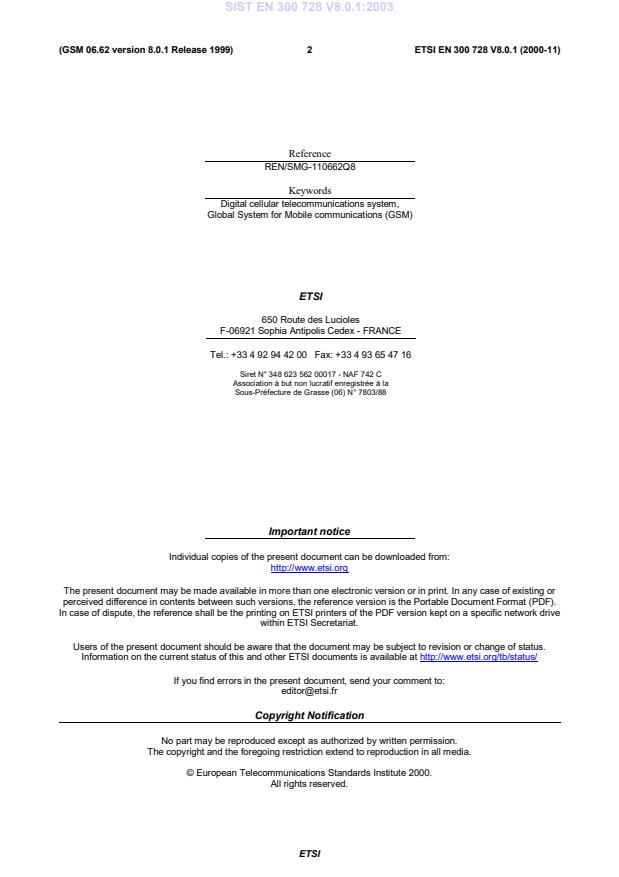
SIST EN 300 728 V8.0.1:2003 is the Slovenian adoption of ETSI EN 300 728 Version 8.0.1. It specifies comfort noise aspects for Enhanced Full Rate (EFR) speech traffic channels in the Digital Cellular Telecommunications System (Phase 2+) (GSM), for engineers and test teams working on GSM speech processing.
What does SIST EN 300 728 V8.0.1:2003 specify?
SIST EN 300 728 V8.0.1:2003 specifies the GSM comfort-noise aspects for EFR speech traffic channels and identifies itself with GSM 06.62 version 8.0.1 Release 1999. In practice, it is the reference for how this GSM speech mode handles comfort noise behavior during speech pauses.
The scope statement says this version is updated to version 8.0.0 CRs from SMG#31. That matters because implementers and reviewers can treat it as a maintenance release with those change requests incorporated.
The document is organized as a technical ETSI standard with front matter and a formula-based technical body. The visible text shows the standard reference, keywords, publication data, and then the technical content that follows the GSM comfort-noise specification.
What are the key requirements of SIST EN 300 728 V8.0.1:2003?
SIST EN 300 728 V8.0.1:2003 sets out the technical description for comfort noise on EFR speech traffic channels. For implementers, the main practical point is that the behavior is specified for a defined GSM speech mode, so equipment should follow the same model when generating or handling comfort noise.
Main technical points
The standard is tied to EFR speech traffic channels.
In practice, this tells codec and terminal designers which speech path the specification applies to.The standard belongs to GSM Phase 2+.
That helps network and terminal teams match the document to the correct GSM generation and feature set.The technical body uses mathematical expressions and variable relationships.
In practice, this means the comfort-noise behavior is defined analytically, so implementation should follow the equations rather than a rough approximation.The document is identified as GSM 06.62 version 8.0.1 Release 1999.
In practice, that version label is important for interoperability checks, legacy equipment support, and document traceability.The scope statement says the version includes CRs from SMG#31.
In practice, this signals that the text reflects agreed corrections and should be used as the updated reference point.The front matter gives the ETSI reference, keywords, and status information.
In practice, these details help teams confirm they are using the correct edition and standard family.
What terms does SIST EN 300 728 V8.0.1:2003 define?
Digital cellular telecommunications system (Phase 2+) (GSM) - The GSM system named in the title; the standard applies within this cellular speech environment.
Global System for Mobile Communication (GSM) - The full name used for the mobile communication system covered by the standard.
Enhanced Full Rate (EFR) - The speech mode addressed by the standard; it is the specific speech traffic channel type for which comfort noise aspects are specified.
Comfort noise - The background-noise behavior used on speech channels during silent periods, so the channel does not sound abruptly empty.
Release 1999 - The ETSI release label attached to this version of GSM 06.62, which helps identify the exact technical baseline.
SMG#31 - The standards meeting named in the scope note as the source of the incorporated CRs.
Who uses SIST EN 300 728 V8.0.1:2003?
SIST EN 300 728 V8.0.1:2003 is used by GSM equipment designers, speech codec engineers, and interoperability test teams working on EFR speech traffic channels. It is also relevant to quality managers and buyers who need to check whether a GSM product or subsystem is aligned with the specified comfort-noise behavior. Network and terminal suppliers use it when verifying consistent speech-quality behavior across implementations.
What changed in SIST EN 300 728 V8.0.1:2003 from the previous edition?
SIST EN 300 728 V8.0.1:2003 is updated to version 8.0.0 CRs from SMG#31. That is the change stated in the scope note and is the main revision cue in this edition.
What does the SIST EN 300 728 V8.0.1:2003 document contain?
SIST EN 300 728 V8.0.1:2003 contains front matter with the standard identification, keywords, publication data, and copyright notice, followed by a technical body. The visible technical text is dominated by mathematical notation and equations for the comfort-noise model. That makes the document useful for implementation work, conformance checking, and detailed technical verification of GSM EFR speech behavior.
Get Certified
Connect with accredited certification bodies for this standard

ANCE
Mexican certification and testing association.

Intertek Slovenia
Intertek testing, inspection, and certification services in Slovenia.

LNE (Laboratoire National de Métrologie et d'Essais)
French national laboratory for metrology and testing.
Sponsored listings
Frequently Asked Questions
SIST EN 300 728 V8.0.1:2003 is a standard published by the Slovenian Institute for Standardization (SIST). Its full title is "Digital cellular telecommunications system (Phase 2+) (GSM); Comfort noise aspects for Enhanced Full Rate (EFR) speech traffic channels (GSM 06.62 version 8.0.1 Release 1999)". This standard covers: Updated to version 8.0.0 CRs from SMG#31
Updated to version 8.0.0 CRs from SMG#31
SIST EN 300 728 V8.0.1:2003 is classified under the following ICS (International Classification for Standards) categories: 33.070.50 - Global System for Mobile Communication (GSM). The ICS classification helps identify the subject area and facilitates finding related standards.
SIST EN 300 728 V8.0.1:2003 is associated with the following European legislation: Standardization Mandates: T-172. When a standard is cited in the Official Journal of the European Union, products manufactured in conformity with it benefit from a presumption of conformity with the essential requirements of the corresponding EU directive or regulation.
SIST EN 300 728 V8.0.1:2003 is available in PDF format for immediate download after purchase. The document can be added to your cart and obtained through the secure checkout process. Digital delivery ensures instant access to the complete standard document.
Standards Content (Sample)
2003-01.Slovenski inštitut za standardizacijo. Razmnoževanje celote ali delov tega standarda ni dovoljeno.Digital cellular telecommunications system (Phase 2+) (GSM); Comfort noise aspects for Enhanced Full Rate (EFR) speech traffic channels (GSM 06.62 version 8.0.1 Release 1999)33.070.50Globalni sistem za mobilno telekomunikacijo (GSM)Global System for Mobile Communication (GSM)ICS:Ta slovenski standard je istoveten z:EN 300 728 Version 8.0.1SIST EN 300 728 V8.0.1:2003en01-december-2003SIST EN 300 728 V8.0.1:2003SLOVENSKI
STANDARD
5SIST EN 300 728 V8.0.1:2003
ETSIETSIEN300728V8.0.1(2000-11)2(GSM06.62version8.0.1Release1999)ReferenceREN/SMG-110662Q8KeywordsDigitalcellulartelecommunicationssystem,GlobalSystemforMobilecommunications(GSM)ETSI650RoutedesLuciolesF-06921SophiaAntipolisCedex-FRANCETel.:+33492944200Fax:+33493654716SiretN°34862356200017-NAF742CAssociationàbutnonlucratifenregistréeàlaSous-PréfecturedeGrasse(06)N°7803/88ImportantnoticeIndividualcopiesofthepresentdocumentcanbedownloadedfrom:http://www.etsi.orgThepresentdocumentmaybemadeavailableinmorethanoneelectronicversionorinprint.Inanycaseofexistingorperceiveddifferenceincontentsbetweensuchversions,thereferenceversionisthePortableDocumentFormat(PDF).Incaseofdispute,thereferenceshallbetheprintingonETSIprintersofthePDFversionkeptonaspecificnetworkdrivewithinETSISecretariat.Usersofthepresentdocumentshouldbeawarethatthedocumentmaybesubjecttorevisionorchangeofstatus.InformationonthecurrentstatusofthisandotherETSIdocumentsisavailableathttp://www.etsi.org/tb/status/Ifyoufinderrorsinthepresentdocument,sendyourcommentto:editor@etsi.frCopyrightNotificationNopartmaybereproducedexceptasauthorizedbywrittenpermission.Thecopyrightandtheforegoingrestrictionextendtoreproductioninallmedia.©EuropeanTelecommunicationsStandardsInstitute2000.Allrightsreserved.SIST EN 300 728 V8.0.1:2003
) *+,""-&.&$"$'"""/'',2"$$%"#%'''/%%%' !"#$%$&''''''''''''''''''''''''''''''''''''''''''''''''''''''''''''
...