


SIST EN 17020-2:2023
(Main)Extended application of test results on durability of self-closing for fire resistance and/or smoke control doorsets and openable windows - Part 2: Durability of self-closing of steel rolling shutters
Extended application of test results on durability of self-closing for fire resistance and/or smoke control doorsets and openable windows - Part 2: Durability of self-closing of steel rolling shutters
This document covers steel rolling shutters as covered by EN 15269 10 or EN 15269 20.
This document prescribes the methodology for extending the application of test results obtained from durability self-closing test(s) conducted in accordance with EN 16034.
Subject to the completion of the appropriate self-closing test or tests, the extended application could cover all or some of the following non-exhaustive list:
— shutter curtain;
— wall/ceiling fixed elements (frame/suspension system);
— decorative finishes;
— intumescent, smoke, draught or acoustic seals;
— alternative supporting construction(s).
Erweiterter Anwendungsbereich von Prüfergebnissen zur Dauerhaftigkeit der Selbstschließung für Feuerschutz- und/oder Rauchschutztüren und zu öffnende Fenster - Teil 2: Dauerhaftigkeit der Selbstschließung von Rolltoren aus Stahl
Dieses Dokument behandelt Rolltore aus Metall (z. B. Stahl, Edelstahl, Aluminium) wie auch in EN 15269 10 und EN 15269 20 beschrieben.
Dieses Dokument schreibt die Methodik zur Erweiterung der Anwendung von Prüfergebnissen zur Dauerhaftigkeit der Selbstschließung vor, siehe EN 12605:2000.
In Abhängigkeit von der Durchführung der entsprechenden Prüfung oder Prüfungen zur Dauerhaftigkeit der Selbstschließung könnte die erweiterte Anwendung die nachfolgende nicht-abschließende Auflistung ganz oder auch nur teilweise abdecken:
— Rollpanzer;
— an der Wand oder Decke befestigte Elemente (Rahmen- oder Aufhängungssysteme);
— Baubeschläge;
— dekorative Oberflächenbeschichtungen;
— dämmschichtbildende Dichtungen oder nicht-dämmschichtbildende Dichtungen (z. B. Rauchschutzdichtungen, Schallschutzdichtungen);
— alternative Tragkonstruktion(en).
Application étendue des résultats d’essais de durabilité de la fermeture automatique des blocs-portes et fenêtres ouvrantes résistants au feu et/ou étanches à la fumée - Partie 2 : Durabilité de la fermeture automatique des rideaux à enroulement en acier
Le présent document couvre les rideaux à enroulement en acier visés par l’EN 15269 10 ou l’EN 15269 20.
Le présent document établit la méthodologie d’extension de l’application des résultats d’essai obtenus suite aux essais de durabilité de la fermeture automatique réalisés conformément à l’EN 16034.
Sous réserve de la réalisation de l’essai ou des essais appropriés de fermeture automatique, l’application étendue pourrait couvrir tout ou partie des éléments de la liste non exhaustive suivante :
— tablier de rideau ;
— éléments fixes muraux/de plafond (structure/système de suspension) ;
— finitions décoratives ;
— joints intumescents, joints d’étanchéité aux fumées, joints d’étanchéité à l’air ou joints acoustiques ;
— autres supports.
Razširjena uporaba rezultatov preskusov trajnosti samozapiranja za požarno odporna in/ali dimotesna vrata in okna, ki se odpirajo - 2. del: Trajnost samozapiranja jeklenih valjanih zapiral
Ta dokument zajema jeklena roloja, kot jih zajemata standarda EN 15269 10 ali EN 15269 20.
Ta dokument predpisuje metodologijo za razširitev uporabe rezultatov, pridobljenih iz preskusov trajnosti samozapiranja, izvedenih v skladu s standardom EN 16034.
Razširjena uporaba lahko (glede na opravljene ustrezne preskuse samozapiranja) zajema vse ali nekatere primere iz naslednjega neizčrpnega seznama:
– polkna;
– stensko/stropno okovje (okvir/sistem vzmetenja);
– okrasne zaključke;
– intumescentna, dimna, akustična tesnila in tesnila za preprečevanje prepiha;
– alternativne podporne konstrukcije.
General Information
- Status
- Published
- Public Enquiry End Date
- 24-May-2021
- Publication Date
- 08-Mar-2023
- Technical Committee
- POZ - Požarna varnost
- Current Stage
- 6060 - National Implementation/Publication (Adopted Project)
- Start Date
- 17-Feb-2023
- Due Date
- 24-Apr-2023
- Completion Date
- 09-Mar-2023
Overview
SIST EN 17020-2:2023 (aligned with EN 17020-2:2022) defines a standardized methodology for the extended application of durability test results for the self-closing function of steel rolling shutters used for fire resistance and/or smoke control. The document applies to metal rolling shutter assemblies (e.g., steel, stainless steel, aluminium) covered by EN 15269‑10 and EN 15269‑20 and prescribes how results from durability self‑closing tests (EN 12605) may be extrapolated to other product variants.
Key topics and technical requirements
- Scope and purpose
- Extends test results for durability of self‑closing to cover components such as shutter curtain, frame/suspension systems, decorative finishes, seals (intumescent, smoke, draught, acoustic) and alternative supporting constructions.
- Test basis
- Extension is based on one or more positive durability-of-self‑closing tests conducted in accordance with EN 12605:2000 and producing a classification per EN 13501‑2.
- Procedure for extended application
- Identify variations from the tested specimen.
- Locate variations in the Construction Parameter Variations table (Table A.1).
- Use column (3) to determine if extension is possible without further testing.
- Where required, follow column (4) to select additional weakest‑specimen tests or alternative test parameters.
- Record conclusions, restrictions and rules in an extended application report (per EN 15269‑1).
- Interpretation rules
- Conservatively base the extended field on the lowest performance from the test series unless failure is attributable to a specific parameter (that parameter is then omitted).
- Reporting and classification
- Produce an extended application report and subsequent classification report in accordance with EN 15269‑1 and EN 13501‑2.
- Annexes
- Annex A (normative): construction parameter variations (Table A.1).
- Annex B (normative): stress calculation methods for metal rolling shutter assemblies.
- Annex C (informative): figures supporting A and B.
Practical applications
- Manufacturers: extend a single durability self‑closing test result across a product range to reduce repeat testing while demonstrating retained durability performance.
- Test laboratories and certification bodies: apply the standardized procedure and Table A.1 to assess which product variations require further testing.
- Specifiers, fire engineers and installers: verify that self‑closing durability classifications for steel rolling shutters apply to specific configurations and supporting constructions.
- Procurement and compliance teams: use extended application and classification reports to support regulatory compliance, CE marking and fire/smoke performance claims.
Related standards (normative references)
- EN 12605, EN 1363‑1, EN 1363‑2, EN 1634‑1, EN 1634‑3, EN 13501‑2, EN 15269‑1, EN 15269‑10, EN 15269‑20, EN 16034, EN ISO 13943.
Keywords: SIST EN 17020‑2, EN 17020‑2, durability of self‑closing, steel rolling shutters, extended application, self‑closing test, EN 12605, fire resistance, smoke control, extended application report.



Frequently Asked Questions
SIST EN 17020-2:2023 is a standard published by the Slovenian Institute for Standardization (SIST). Its full title is "Extended application of test results on durability of self-closing for fire resistance and/or smoke control doorsets and openable windows - Part 2: Durability of self-closing of steel rolling shutters". This standard covers: This document covers steel rolling shutters as covered by EN 15269 10 or EN 15269 20. This document prescribes the methodology for extending the application of test results obtained from durability self-closing test(s) conducted in accordance with EN 16034. Subject to the completion of the appropriate self-closing test or tests, the extended application could cover all or some of the following non-exhaustive list: — shutter curtain; — wall/ceiling fixed elements (frame/suspension system); — decorative finishes; — intumescent, smoke, draught or acoustic seals; — alternative supporting construction(s).
This document covers steel rolling shutters as covered by EN 15269 10 or EN 15269 20. This document prescribes the methodology for extending the application of test results obtained from durability self-closing test(s) conducted in accordance with EN 16034. Subject to the completion of the appropriate self-closing test or tests, the extended application could cover all or some of the following non-exhaustive list: — shutter curtain; — wall/ceiling fixed elements (frame/suspension system); — decorative finishes; — intumescent, smoke, draught or acoustic seals; — alternative supporting construction(s).
SIST EN 17020-2:2023 is classified under the following ICS (International Classification for Standards) categories: 13.220.50 - Fire-resistance of building materials and elements; 91.060.50 - Doors and windows. The ICS classification helps identify the subject area and facilitates finding related standards.
SIST EN 17020-2:2023 is associated with the following European legislation: EU Directives/Regulations: 305/2011; Standardization Mandates: M/117. When a standard is cited in the Official Journal of the European Union, products manufactured in conformity with it benefit from a presumption of conformity with the essential requirements of the corresponding EU directive or regulation.
SIST EN 17020-2:2023 is available in PDF format for immediate download after purchase. The document can be added to your cart and obtained through the secure checkout process. Digital delivery ensures instant access to the complete standard document.
Standards Content (Sample)
SLOVENSKI STANDARD
01-april-2023
Razširjena uporaba rezultatov preskusov trajnosti samozapiranja za požarno
odporna in/ali dimotesna vrata in okna, ki se odpirajo - 2. del: Trajnost
samozapiranja jeklenih valjanih zapiral
Extended application of test results on durability of self-closing for fire resistance and/or
smoke control doorsets and openable windows - Part 2: Durability of self-closing of steel
rolling shutters
Erweiterter Anwendungsbereich von Prüfergebnissen zur Dauerhaftigkeit der
Selbstschließung für Feuerschutz- und/oder Rauchschutztüren und zu öffnende Fenster
- Teil 2: Dauerhaftigkeit der Selbstschließung von Rolltoren aus Stahl
Application étendue des résultats d’essais de durabilité de la fermeture automatique des
blocs-portes et fenêtres ouvrantes résistants au feu et/ou étanches à la fumée - Partie 2
: Durabilité de la fermeture automatique des rideaux à enroulement en acier
Ta slovenski standard je istoveten z: EN 17020-2:2022
ICS:
13.220.50 Požarna odpornost Fire-resistance of building
gradbenih materialov in materials and elements
elementov
91.060.50 Vrata in okna Doors and windows
2003-01.Slovenski inštitut za standardizacijo. Razmnoževanje celote ali delov tega standarda ni dovoljeno.
EN 17020-2
EUROPEAN STANDARD
NORME EUROPÉENNE
December 2022
EUROPÄISCHE NORM
ICS 13.220.50; 91.060.50
English Version
Extended application of test results on durability of self-
closing for fire resistance and/or smoke control doorsets
and openable windows - Part 2: Durability of self-closing
of steel rolling shutters
Application étendue des résultats d'essais de durabilité Erweiterter Anwendungsbereich von Prüfergebnissen
de la fermeture automatique des blocs-portes et zur Dauerhaftigkeit der Selbstschließung für
fenêtres ouvrantes résistants au feu et/ou étanches à la Feuerschutz- und/oder Rauchschutztüren und zu
fumée - Partie 2 : Durabilité de la fermeture öffnende Fenster - Teil 2: Dauerhaftigkeit der
automatique des rideaux à enroulement en acier Selbstschließung von Rolltoren aus Stahl
This European Standard was approved by CEN on 26 September 2022.
CEN members are bound to comply with the CEN/CENELEC Internal Regulations which stipulate the conditions for giving this
European Standard the status of a national standard without any alteration. Up-to-date lists and bibliographical references
concerning such national standards may be obtained on application to the CEN-CENELEC Management Centre or to any CEN
member.
This European Standard exists in three official versions (English, French, German). A version in any other language made by
translation under the responsibility of a CEN member into its own language and notified to the CEN-CENELEC Management
Centre has the same status as the official versions.
CEN members are the national standards bodies of Austria, Belgium, Bulgaria, Croatia, Cyprus, Czech Republic, Denmark, Estonia,
Finland, France, Germany, Greece, Hungary, Iceland, Ireland, Italy, Latvia, Lithuania, Luxembourg, Malta, Netherlands, Norway,
Poland, Portugal, Republic of North Macedonia, Romania, Serbia, Slovakia, Slovenia, Spain, Sweden, Switzerland, Türkiye and
United Kingdom.
EUROPEAN COMMITTEE FOR STANDARDIZATION
COMITÉ EUROPÉEN DE NORMALISATION
EUROPÄISCHES KOMITEE FÜR NORMUNG
CEN-CENELEC Management Centre: Rue de la Science 23, B-1040 Brussels
© 2022 CEN All rights of exploitation in any form and by any means reserved Ref. No. EN 17020-2:2022 E
worldwide for CEN national Members.
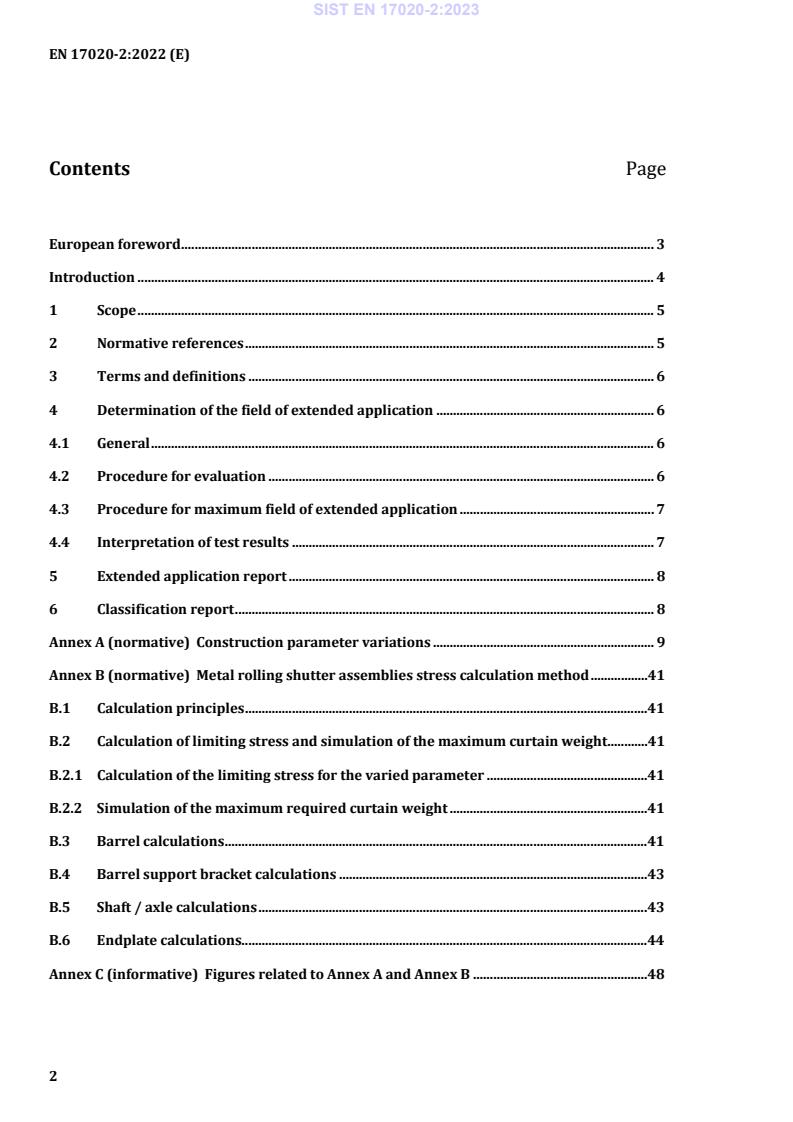
Contents Page
European foreword . 3
Introduction . 4
1 Scope . 5
2 Normative references . 5
3 Terms and definitions . 6
4 Determination of the field of extended application . 6
4.1 General . 6
4.2 Procedure for evaluation . 6
4.3 Procedure for maximum field of extended application . 7
4.4 Interpretation of test results . 7
5 Extended application report . 8
6 Classification report . 8
Annex A (normative) Construction parameter variations . 9
Annex B (normative) Metal rolling shutter assemblies stress calculation method .41
B.1 Calculation principles .41
B.2 Calculation of limiting stress and simulation of the maximum curtain weight .41
B.2.1 Calculation of the limiting stress for the varied parameter .41
B.2.2 Simulation of the maximum required curtain weight .41
B.3 Barrel calculations .41
B.4 Barrel support bracket calculations .43
B.5 Shaft / axle calculations .43
B.6 Endplate calculations.44
Annex C (informative) Figures related to Annex A and Annex B .48
European foreword
This document (EN 17020-2:2022) has been prepared by Technical Committee CEN/TC 127 “Fire safety
in buildings”, the secretariat of which is held by BSI.
This European Standard shall be given the status of a national standard, either by publication of an
identical text or by endorsement, at the latest by June 2023, and conflicting national standards shall be
withdrawn at the latest by June 2023.
Attention is drawn to the possibility that some of the elements of this document may be the subject of
patent rights. CEN shall not be held responsible for identifying any or all such patent rights.
This document has been prepared under a mandate given to CEN by the European Commission and the
European Free Trade Association.
A list of all parts in the EN 17020 series can be found on the CEN website.
Any feedback and questions on this document should be directed to the users’ national standards body.
A complete listing of these bodies can be found on the CEN website.
According to the CEN-CENELEC Internal Regulations, the national standards organisations of the
following countries are bound to implement this European Standard: Austria, Belgium, Bulgaria, Croatia,
Cyprus, Czech Republic, Denmark, Estonia, Finland, France, Germany, Greece, Hungary, Iceland, Ireland,
Italy, Latvia, Lithuania, Luxembourg, Malta, Netherlands, Norway, Poland, Portugal, Republic of North
Macedonia, Romania, Serbia, Slovakia, Slovenia, Spain, Sweden, Switzerland, Türkiye and the United
Kingdom.
Introduction
The EN 15269 series of standards covering extended application of test results for fire resistance and/or
smoke control for doorsets, rolling shutter assemblies and openable windows, including their items of
building hardware, does not yet include their durability of self-closing following an extended application
process. This document is one of the EN 17020 series of standards intended to be used for the purpose
of producing an extended application report based on the evaluation of one or more durability self-
closing tests. These European Standards may also be used to identify the best selection of test specimens
required to cover a wide range of product variations.
1 Scope
This document covers metal (e.g. steel, stainless steel, aluminium) rolling shutter assemblies also covered
by EN 15269-10 and EN 15269-20.
This document prescribes the methodology for extending the application of test results obtained from
durability of self-closing test(s), see EN 12605:2000.
Subject to the completion of the appropriate durability of self-closing test or tests, the extended
application could cover all or some of the following non-exhaustive list:
— shutter curtain;
— wall or ceiling fixed elements (frame or suspension system);
— items of building hardware;
— decorative finishes;
— intumescent or non-intumescent (e.g. smoke, draught) seals;
— alternative supporting construction(s).
2 Normative references
The following documents are referred to in the text in such a way that some or all of their content
constitutes requirements of this document. For dated references, only the edition cited applies. For
undated references, the latest edition of the referenced document (including any amendments) applies.
EN 1363-1, Fire resistance tests - Part 1: General requirements
EN 1363-2, Fire resistance tests - Part 2: Alternative and additional procedures
EN 1634-1, Fire resistance and smoke control tests for door and shutter assemblies, openable windows and
elements of building hardware - Part 1: Fire resistance test for door and shutter assemblies and openable
windows
EN 1634-3, Fire resistance and smoke control tests for door and shutter assemblies, openable windows and
elements of building hardware - Part 3: Smoke control test for door and shutter assemblies
EN 12433-1, Industrial, commercial and garage doors and gates - Terminology - Part 1: Types of doors
EN 12433-2, Industrial, commercial and garage doors and gates - Terminology - Part 2: Parts of doors
EN 12605:2000, Industrial, commercial and garage doors and gates - Mechanical aspects - Test methods
EN 13501-2, Fire classification of construction products and building elements - Part 2: Classification using
data from fire resistance tests, excluding ventilation services
EN 15269-1, Extended application of test results for fire resistance and/or smoke control for door, shutter
and openable window assemblies, including their elements of building hardware - Part 1: General
requirements
EN 15269-10, Extended application of test results for fire resistance and/or smoke control for door,
shutter and openable window assemblies including their elements of building hardware - Part 10: Fire
resistance of steel rolling shutter assemblies
EN 15269-20, Extended application of test results for fire resistance and/or smoke control for door,
shutter and openable window assemblies, including their elements of building hardware - Part 20: Smoke
control for doors, shutters, operable fabric curtains and openable windows
EN 16034, Pedestrian doorsets, industrial, commercial, garage doors and openable windows - Product
standard, performance characteristics - Fire resisting and/or smoke control characteristics
EN ISO 13943, Fire safety - Vocabulary (ISO 13943:2017)
3 Terms and definitions
For the purposes of this document, the terms and definitions given in EN 1363-1, EN 1363-2, EN 1634-1,
EN 1634-3, EN 15269-1, EN 15269-10, EN 15269-20, EN 12433-1, EN 12433-2 and EN ISO 13943 and
the following apply.
ISO and IEC maintain terminological databases for use in standardization at the following addresses:
— ISO Online browsing platform: available at https://www.iso.org/obp/ui
— IEC Electropedia: available at https://www.electropedia.org/
3.1
full scale test
test of a full size rolling shutter assembly
Note 1 to entry: This test is in accordance with EN 12605:2000.
4 Determination of the field of extended application
4.1 General
4.1.1 Before there can be any consideration for extended application, the metal rolling shutter
assembly shall have been tested in accordance with EN 12605:2000 to achieve a test result which could
generate a classification for the durability of self-closing in accordance with EN 13501-2 for the required
number of test cycles.
4.1.2 A review of the construction parameters can indicate that one or more characteristics may be
improved by a particular parameter variation. All evaluations shall be made on the basis of retaining the
classifications for the durability of self-closing obtainable from testing to EN 12605:2000, including those
with a lower number of opening and closing cycles. However, this shall never lead to an increased
classification for any specific parameter beyond that achieved during any one test unless specifically
identified in the relevant Construction Parameter Variation tables.
4.1.3 If, when following the extended application procedure, any part of the classified product cannot
be achieved by extended application rules, that part shall be omitted from the subsequent extended
application report and classification report.
4.2 Procedure for evaluation
4.2.1 Identify the variations from the original test specimen(s) which are required to be covered by an
extended application report. Ensure that the variation(s) do(es) not prevent the rolling shutter from self-
closing.
4.2.2 Locate the variations in the appropriate parameter variation by reference to columns (1) and (2)
of Table A.1.
4.2.3 Establish from the contents of column (3) of Table A.1 whether any extended application is
available without the need for further testing.
4.2.4 Where this is deemed to be possible this can be recorded in the extended application report
together with any appropriate restrictions and the stated rules from column (3) in Table A.1.
4.2.5 Where the variations required can only be achieved from additional testing according to
column (4) of Table A.1, the additional test can be made on a similar test specimen type to the original
test against which the extended application is sought. Alternatively, column (4) identifies an option for
alternative testing and relevant test parameters.
4.3 Procedure for maximum field of extended application
4.3.1 It is possible to provide a limited field of extended application from the results of a single test.
However, where a manufacturer intends to produce a range of rolling shutter assemblies incorporating
manual and power operated drives, insulated and uninsulated version, with alternative elements of
construction etc. it is recommended that careful consideration is given to the complete range of designs
and options in order to minimize the testing required before testing commences.
4.3.2 Establish all the parameter variations which are required to be part of the product range.
4.3.3 Determine which are the most important specification requirements and incorporate as many as
possible into the test specimen(s) for the first tests in the series.
4.3.4 Conduct the first durability of self-closing test or a series of tests and then establish which of the
original desired parameter variations have not been covered by this test(s).
4.3.5 Identify these parameter variations in Table A.1 and establish if any extended application is
possible without further testing.
4.3.6 Record this for the extended application report together with any restrictions and rules given in
column (3) in Table A.1.
4.3.7 Evaluate which, if any, of the desired parameter variations have not been covered by the initial
field of extended application derived from 4.3.6 above.
4.3.8 Select the required outstanding parameter variations from column (1) and column (2) of
Table A.1 and observe from column (4) of Table A.1 which are the most appropriate weakest test
specimen options for further testing.
4.3.9 If the complete selection of required parameter variations has not been covered by the tests
completed in accordance with 4.3.8 above, then an appropriate test or tests may be repeated with the
additional product variations incorporated.
4.4 Interpretation of test results
4.4.1 In order to maximize the field of extended application, it is important that the test reports shall
record details of any failures which occurred throughout the test duration.
4.4.2 Where a series of tests have been conducted, the field of extended application shall be based on
the lowest performance achieved from the complete series of tests unless premature failure has been
attributed to one or more specific construction parameter variation(s).
4.4.3 Where it has been possible to identify specific parameter failures, the extended application for all
other construction parameter variations can be based on the performance achieved after isolating the
premature failure(s). The failed parameter has to be omitted from the extended application report and
the subsequent classification report.
5 Extended application report
Prepare an extended application report in accordance with the requirements of EN 15269-1, based on
the results of evaluations in accordance with the above.
6 Classification report
The classification report shall be determined from the results of the extended application report and shall
be presented in accordance with EN 13501-2.
Annex A
(normative)
Construction parameter variations
Table A.1 below is designed to be used by experts competent in the field of durability of self-closing
testing of metal rolling shutter assemblies.
The table shall only be used to assess a field of extended application when at least one positive durability
of self-closing test to EN 12605 has generated a classification according to EN 13501-2 for the required
number of test cycles.
The first two columns identify possible variations to the construction details of the specimen tested. It is
presupposed that the variations do not restrain the rolling shutter assembly from closing.
Column (3) leads to the judgement of the possibility of extending the field of application.
Where additional tests are deemed to be necessary, the type of test specimen approved for incorporation
of the changed parameter is defined in column (4). Where it is possible to use information from tests
performed on one configuration for evidence on a different configuration, this allowance has been made
in order to reduce the overall number of tests required for extended application evaluation.
Where an additional test is required in column (4), the test is a full scale test unless otherwise specified.
In order to maximize the possible field of application from a minimum number of tests, the parameter
changes have been spread over a series of test specimens. Where more than a single parameter variation
is required, the influence on other variations shall also be taken into account.
All parameter variations in Table A.1 presuppose that the total weight of the curtain does not exceed the
maximum weight having been tested. If the durability of self-closing test is carried out with a test
specimen that has a lower curtain weight than the maximum weight required by the manufacturer (e.g.
due to size reasons), then the higher curtain weight shall be simulated in order to achieve the same
mechanical load in all load-bearing components that would result with the required maximum curtain
weight. For simulation of a higher weight of the varied curtain the test specimen for durability of self-
closing test can be loaded with additional weight(s) attached to the curtain according to the rules in
Annex B.
For standard parts (e.g. screws) or parts made exclusively of steel (e.g. barrel, support brackets) the
manufacturer may be changed as long as all characteristics of the part (e.g. material, geometry, welding
technique) remain the same and unless otherwise stated in Table A.1.
For figures relating to Table A.1 see Annex C.
FprEN 17020-2: 2022 (E)
Table A.1 — Construction parameter variation rules
Additional evidence
Construction parameter Variation Possibility of extension
required
(1) (2) (3) (4)
A General (See Figure C.1 for an example of a general arrangement of a rolling shutter assembly and Figures C.69 und C.70 for terms and
components used in a rolling shutter assembly)
A.1 Size variations / construction
Possible providing tightness and clearances are not changed.
A.1.1 Width between vertical guides
Decrease Full scale test
(See Figure C.2)
Otherwise not possible without an additional test.
Possible up to 30 % providing the static requirements to
fixings, barrel and load-bearing constructions are fulfilled
A.1.2 Width between vertical guides
Increase Full scale test
and the requirements of Annex B are satisfied.
(See Figure C.2)
Otherwise not possible without an additional test.
A.1.3 Height from floor level to centre
Decrease Possible -
line of barrel (See Figure C.3)
Possible up to the maximum tested curtain weight providing
the static requirements to fixings, barrel and load-bearing
A.1.4 Height from floor level to centre
constructions are fulfilled and the requirements of Annex B
Increase Full scale test
line of barrel (See Figure C.3)
are satisfied.
Otherwise not possible without an additional test.
Possible providing a minimum gap of 10 mm will remain
A.1.5 Expansion allowances between
during the opening/closing process
Decrease Full scale test
the end of the lath and guide
Otherwise not possible without an additional test
A.1.6 Expansion allowances between
Increase Possible -
the end of the lath and guide
Face fixed to within
A.1.7 Mounting Possible -
opening
FprEN 17020-2:2022 (E)
Additional evidence
Construction parameter Variation Possibility of extension
required
(1) (2) (3) (4)
Within opening to
A.1.8 Mounting Possible -
face fixed
A.2 Materials and constructions
Possible providing no moving part touches the insulation
material during the opening/closing process so that no
A.2.1 Insulation material whether
Alternative Full scale test
abrasion will occur.
intumescent or not
Otherwise not possible without an additional test.
Possible providing no moving part touches the insulation
material during the opening/closing process).
A.2.2 Density of insulation material Increase Full scale test
Otherwise not possible without an additional test.
Possible providing no moving part touches the insulation
material during the opening/closing process).
A.2.3 Density of insulation material Decrease Full scale test
Otherwise not possible without an additional test.
Possible but only for an identical composition or if no moving
Alternative
part touches the insulation material during the
A.2.4 Intumescent material supplier and/or Full scale test
opening/closing process).
manufacturer
Otherwise not possible without an additional test.
Possible providing no moving part touches the insulation
Alternative
material during the opening/closing process).
A.2.5 Intumescent material Full scale test
material
Otherwise not possible without an additional test.
Possible providing no moving part touches the insulation
A.2.6 Thickness of insulation material
material during the opening/closing process).
Increase Full scale test
except curtain’s material(s)
Otherwise not possible without an additional test.
A.2.7 Thickness of insulation material
Decrease Possible -
except curtain’s material
FprEN 17020-2: 2022 (E)
Additional evidence
Construction parameter Variation Possibility of extension
required
(1) (2) (3) (4)
B Curtain
B.1 Laths
Possible providing the interlock remains the same and the
interaction with parts touching the curtain (e.g. press rollers)
remains the same or a test has been passed successfully (with
B.1.1 Height (See Figure C.4) Decrease Full scale test
a similar type of rolling shutter assembly) with this
decreased size of laths.
Otherwise not possible without an additional test.
Possible providing a test has been passed successfully (with
a similar type of rolling shutter assembly) with this increased
B.1.2 Height (See Figure C.5) Increase Full scale test
size of laths with the same or lower barrel diameter.
Otherwise not possible without an additional test.
Possible providing a test has been passed successfully (with
another type of rolling shutter assembly) with this decreased
sheet thickness of the laths with the same or lower barrel
B.1.3 Thickness of metal sheet Decrease Full scale test
diameter.
Otherwise not possible without an additional test.
Possible providing a test has been passed successfully (with
another type of rolling shutter assembly) with this increased
sheet thickness of the laths with the same or smaller barrel
B.1.4 Thickness of metal sheet Increase Full scale test
diameter.
Otherwise not possible without an additional test.
FprEN 17020-2:2022 (E)
Additional evidence
Construction parameter Variation Possibility of extension
required
(1) (2) (3) (4)
B.1.5 Thickness of insulation material
Possible providing a test has been passed successfully (with
(See Figure C.6)
another type of rolling shutter assembly) with this decreased
NOTE: it is assumed that
thickness of insulation material in the laths with the same or
Decrease Full scale test
decreased insulation material
smaller barrel diameter.
thickness leads to decreased
Otherwise not possible without an additional test.
overall lath thickness.
Possible providing a test has been passed successfully (with
another type of rolling shutter assembly) with this increased
B.1.6 Thickness of insulation material
thickness of insulation material in the laths with the same or
(See Figure C.7)
smaller barrel diameter and assuming that the gap between
NOTE: it is assumed that
Increase Full scale test
the skins is full of insulating material and that the thickness
increased insulation material
of lath creates a corresponding increase in the width of the
thickness leads to increased
guides.
overall lath thickness.
Otherwise not possible without an additional test.
Possible providing the material is not loaded mechanically
(e.g. pulled or bended) or a test has been passed successfully
(with another type of rolling shutter assembly) with this
B.1.7 Density of insulation material Increase Full scale test
density of insulation material with the same or smaller barrel
diameter and the requirements of Annex B are satisfied.
Otherwise not possible without an additional test.
Possible providing the material is not loaded mechanically
(e.g. pulled or bended) or a test has been passed successfully
(with another type of rolling shutter assembly) with this
B.1.8 Density of insulation material Decrease Full scale test
density of insulation material with the same or smaller barrel
diameter.
Otherwise not possible without an additional test.
Mild steel to
B.1.9 Material Possible -
stainless steel
FprEN 17020-2: 2022 (E)
Additional evidence
Construction parameter Variation Possibility of extension
required
(1) (2) (3) (4)
Stainless steel to
B.1.10.1 Material Possible -
mild steel
B.1.10.2 Material Steel to aluminium Not possible without an additional test. Full scale test
B.1.10.3 Material Aluminium to steel Not possible without an additional test. Full scale test
Possible providing half the circumference of the barrel is
covered or a test has been passed successfully (with another
B.1.11 Number of laths on the barrel
type of rolling shutter assembly) with this number of laths on
when the curtain is in its closed Decrease Full scale test
the barrel with the same or smaller barrel diameter.
position
Otherwise not possible without an additional test.
B.1.12 Number of laths on the barrel
when the curtain is in its closed Increase Possible -
position
Possible providing interlock remains the same and the
interaction with parts touching the curtain (e.g. press rollers)
remains the same or a test has been passed successfully (with
B.1.13 Shape (for single skin only) (See
Alternative Full scale test
a similar type and weight of rolling shutter assembly) with
Figure C.8)
this shape of laths.
Otherwise not possible without an additional test.
Possible providing a test has been passed successfully (with
a similar type and weight of rolling shutter assembly) with
B.1.14 Number of skins Single skin to
this type of double skin laths with the same or smaller barrel
Full scale test
(See Figure C.9) double skin
diameter and the requirements of Annex B are satisfied.
Otherwise not possible without an additional test.
FprEN 17020-2:2022 (E)
Additional evidence
Construction parameter Variation Possibility of extension
required
(1) (2) (3) (4)
Possible providing a test has been passed successfully (with
a similar type and weight of rolling shutter assembly) with
B.1.15 Number of skins Double skin to
this type of single skin laths with the same or smaller barrel
Full scale test
(See Figure C.9) single skin
diameter and the requirements of Annex B are satisfied.
Otherwise not possible without an additional test.
B.2 Endlocks (see Figure C.10 for an example of an endlock)
Possible providing the endlocks do not touch the ground of
the side guides during the opening/closing process.
B.2.1 Size Decrease Full scale test
Otherwise not possible without an additional test.
Possible providing clearances in the side guides and interlock
remain unchanged.
B.2.2 Size Increase Full scale test
Otherwise not possible without an additional test.
Possible providing the endlocks do not touch the ground of
the side guides during the opening/closing process.
B.2.3 Thickness Decrease Full scale test
Otherwise not possible without an additional test.
Possible providing clearances in the side guides and interlock
remain unchanged.
B.2.4 Thickness Increase Full scale test
Otherwise not possible without an additional test.
Steel to malleable
B.2.5 Material Possible -
iron
Malleable iron to
B.2.6 Material Possible -
steel
Possible providing the endlocks do not touch the ground of
the side guides during the opening/closing process.
B.2.7 Material Steel to plastic Full scale test
Otherwise not possible without an additional test.
FprEN 17020-2: 2022 (E)
Additional evidence
Construction parameter Variation Possibility of extension
required
(1) (2) (3) (4)
Possible providing the endlocks do not touch the ground of
the side guides during the opening/closing process.
B.2.8 Material Plastic to steel Full scale test
Otherwise not possible without an additional test.
Possible providing the endlocks do not touch the ground of
the side guides during the opening/closing process.
B.2.9 Material Steel to aluminium Full scale test
Otherwise not possible without an additional test.
Possible providing the endlocks do not touch the ground of
the side guides during the opening/closing process.
B.2.10 Material Aluminium to steel Full scale test
Otherwise not possible without an additional test.
B.3 Endlock fixings
Possible providing a test has been passed successfully (with
a similar type of rolling shutter assembly) with this diameter
B.3.1 Diameter Decrease Full scale test
of endlock fixings with the same or smaller barrel diameter.
Otherwise not possible without an additional test.
B.3.2 Diameter Increase Possible
Possible providing a test has been passed successfully (with
a similar type of rolling shutter assembly) with this type of
B.3.3 Type Alternative Full scale test
endlock fixings with the same or smaller barrel diameter.
Otherwise not possible without an additional test.
Possible providing a test has been passed successfully (with
a similar type of rolling shutter assembly) with this type of
B.3.4 Material Alternative Full scale test
endlock fixings with the same or smaller barrel diameter.
Otherwise not possible without an additional test.
FprEN 17020-2:2022 (E)
Additional evidence
Construction parameter Variation Possibility of extension
required
(1) (2) (3) (4)
Possible providing a test has been passed successfully (with
a similar type of rolling shutter assembly) with the required
(or a lower) number of endlock fixings with the same or
B.3.5 Number Decrease Full scale test
smaller barrel diameter.
Otherwise not possible without an additional test.
B.3.6 Number Increase Possible -
B.4 Bottom rail
Possible providing a test has been passed successfully (with Full scale test
a similar type of rolling shutter assembly) with this size of
B.4.1 Size (See Figure C.11) Decrease
bottom rail with the same or smaller barrel diameter.
Otherwise not possible without an additional test
Possible if requirements of Annex B are satisfied. Full scale test
B.4.2 Size (See Figure C.12) Increase
Otherwise not possible without an additional test.
Possible providing a test has been passed successfully (with Full scale test
a similar type of rolling shutter assembly) with this bottom
rail metal/metal sheet thickness with the same or smaller
B.4.3 Thickness of metal Decrease
barrel diameter.
Otherwise not possible without an additional test
Possible if requirements of Annex B are satisfied. Full scale test
B.4.4 Thickness of metal Increase
Otherwise not possible without an additional test.
Stainless steel to -
B.4.5 Material Possible
mild steel
Mild steel to -
B.4.6 Material Possible
stainless steel
FprEN 17020-2: 2022 (E)
Additional evidence
Construction parameter Variation Possibility of extension
required
(1) (2) (3) (4)
Possible providing a test has been passed successfully (with Full scale test
a similar type of rolling shutter assembly) with this safety
B.4.7 Material of safety edge Alternative
edge material with the same or smaller barrel diameter.
Otherwise not possible without an additional test.
Possible providing a test has been passed successfully (with Full scale test
a similar type of rolling shutter assembly) with this flat type
B.4.8 Construction
T-section to flat
of bottom rail with the same or smaller barrel diameter.
(See Figure C.13)
Otherwise not possible without an additional test.
Possible. If the weight of the T-section bottom bar is higher
B.4.9 Construction
the requirements of Annex B shall be satisfied.
Flat to T-section Full scale test
(See Figure C.14)
Otherwise not possible without an additional test.
Possible providing a minimum gap of 10 mm will remain
B.4.10 Expansion allowances between
during opening/closing.
the end of the bottom rail and Decrease Full scale test
side guide
Otherwise not possible without an additional test.
B.4.11 Expansion allowances between
the end of the bottom rail and Increase Possible -
side guide
Possible providing the bending stiffness and weight will be
the same or higher. In case of a higher weight the
B.4.12 Construction T-section to double
Full scale test
requirements of Annex B shall be satisfied.
(See Figure C.15) angles
Otherwise not possible without an additional test.
Possible providing the bending stiffness and weight will be
the same or higher. In case of a higher weight the
B.4.13 Construction Double angles to T-
Full scale test
requirements of Annex B shall be satisfied.
(See Figure C.16) section
Otherwise not possible without an additional test.
FprEN 17020-2:2022 (E)
Additional evidence
Construction parameter Variation Possibility of extension
required
(1) (2) (3) (4)
Possible providing the bending stiffness and weight will be
the same or higher. In case of a higher weight the
B.4.14 Construction Insulated to T-
Full scale test
requirements of Annex B shall be satisfied.
(See Figure C.17) section
Otherwise not possible without an additional test.
Possible providing the bending stiffness and weight will be
the same or higher. In case of a higher weight the
B.4.15 Construction T-section to
Full scale test
requirements of Annex B shall be satisfied.
(See Figure C.18) insulated
Otherwise not possible without an additional test.
B.5 Bottom rail fixings
Possible providing the total cross-section of fixings not being
reduced.
B.5.1 Size Decrease Full scale test
Otherwise not possible without an additional test.
B.5.2 Size Increase Possible Full scale test
Possible providing the total cross-section of fixings not being
reduced.
B.5.3 Type Alternative Full scale test
Otherwise not possible without an additional test.
Possible providing the material has equal or better
mechanical properties (yield stress, Young’s modulus and
B.5.4 Material Alternative Full scale test
creep behaviour).
Otherwise not possible without an additional test.
B.5.5 Number Decrease Not possible without an additional test. Full scale test
B.5.6 Number Increase Possible -
C. Side guides (vertical guides)
C.1 Section
FprEN 17020-2: 2022 (E)
Additional evidence
Construction parameter Variation Possibility of extension
required
(1) (2) (3) (4)
C.1.1 Shape from channel to wind-
Alternative Possible -
lock type (See Figure C.19)
Possible providing no wind-end-locks are used.
C.1.2 Shape from wind-lock type to
Alternative Full scale test
channel (See Figure C.20)
Otherwise not possible without an additional test.
C.1.3 Depth (See Figure C.21) Decrease Not possible without an additional test. Full scale test
Possible providing tightness and clearances are not reduced.
C.1.4 Depth (See Figure C.22) Increase Full scale test
Otherwise not possible without an additional test.
Possible providing tightness and clearances are not reduced.
C.1.5 Width (See Figure C.23) Decrease Full scale test
Otherwise not possible without an additional test.
C.1.6 Width (See Figure C.24) Increase Possible -
C.1.7 Material thickness Decrease Not possible without an additional test. Full scale test
C.1.8 Material thickness Increase Possible -
Stainless steel to
C.1.9 Material Possible -
mild steel
Mild steel to
C.1.10 Material Possible -
stainless steel
Possible providing a minimum gap of 10 mm will remain
during the opening/closing process.
C.1.11 Expansion allowances Decrease Full scale test
Otherwise not possible without an additional test.
C.1.12 Expansion allowances Increase Possible -
C.2 Guide fixing section
C.2.1 Size (See Figure C.25) Decrease Not possible without an additional test. Full scale test
FprEN 17020-2:2022 (E)
Additional evidence
Construction parameter Variation Possibility of extension
required
(1) (2) (3) (4)
C.2.2 Size (See Figure C.26) Increase Possible -
C.2.3 Thickness Decrease Not possible without an additional test. Full scale test
C.2.4 Thickness Increase Possible -
Stainless steel to
C.2.5 Material Possible -
mild steel
Mild steel to
C.2.6 Material Possible -
stainless steel
C.2.7 Expansion allowances Decrease Possible -
C.2.8 Expansion allowances Increase Possible -
Possible providing material thickness and section modulus
are equal or greater.
C.2.9 Shape (See Figure C.27) Alternative Full scale test
Otherwise not possible without an additional test.
Continuous section
C.2.10 Length of section(s) Possible -
to short sections
Short sections to
C.2.11 Length of section(s) continuous Possible -
sections
Possible providing clearances (between curtain and guides)
Flag type including
C.2.12 Type of section
are not reduced.
endplate to Full scale test
(See Figure C.28)
separate
Otherwise not possible without an additional test.
Possible providing clearances (between curtain and guides)
Separate to flag
C.2.13 Type of section
are not reduced.
type including Full scale test
(See Figure C.29)
endplate
Otherwise not possible without an additional test.
FprEN 17020-2: 2022 (E)
Additional evidence
Construction parameter Variation Possibility of extension
required
(1) (2) (3) (4)
C.3 Fixings to supporting construction
Possible providing more fixings being used so that the total
cross-section of the fixings is not decreased.
C.3.1 Size Decrease Full scale test
Otherwise not possible without an additional test.
C.3.2 Size Increase Possible -
C.3.3 Spacing Decrease Possible -
Possible by up to 10 % and providing that the position
uppermost fixing (of each side) is not lowered.
C.3.4 Spacing Increase Full scale test
Otherwise not possible without an additional test.
C.3.5 Number Decrease Not possible without an additional test. Full scale test
C.3.6 Number Increase Possible -
Possible providing the fixings have been shown by test to
C.3.7 Type
have an equal or better pull-out strength (at ambient
Alternative Full scale test
NOTE: alternative type covers
temperature); see Annex B.
alternative material
Otherwise not possible without an additional test.
D Barrel
D.1 Tube
Possible providing a test has been passed successfully (with
a similar type of rolling shutter assembly) with equal or
D.1.1 Outside diameter
smaller tube diameter and the requirements in Annex B are
Decrease Full scale test
(See Figure C.30)
satisfied.
Otherwise not possible without an additional test.
FprEN 17020-2:2022 (E)
Additional evidence
Construction parameter Variation Possibility of extension
required
(1) (2) (3) (4)
Possible providing requirements in Annex B are satisfied.
D.1.2 Outside diameter
Increase Full scale test
(See Figure C.31)
Otherwise not possible without an additional test.
Possible providing requirements in Annex B are satisfied.
D.1.3 Wall thickness
Decrease Full scale test
(See Figure C.32)
Otherwise not possible without an additional test.
Possible providing requirements in Annex B are satisfied.
D.1.4 Wall thickness
Increase Full scale test
(See Figure C.33)
Otherwise not possible without an additional test.
Possible requirements in Annex B are satisfied or a test has
been passed successfully (with a similar type of rolling
D.1.5 Material Alternative Full scale test
shutter assembly) with the same
...
Questions, Comments and Discussion
Ask us and Technical Secretary will try to provide an answer. You can facilitate discussion about the standard in here.
Loading comments...