

kSIST FprES 204 135 V1.1.0:2026
(Main)Environmental Engineering (EE) - Guidelines for Assessing the Environmental Impact of Artificial Intelligence systems
General Information
- Abstract
DES/EE-EEPS77
- Status
- Not Published
- Technical Committee
- SPN - Services and Protocols for Networks
- Current Stage
- 5020 - Formal vote (FV) (Adopted Project)
- Start Date
- 13-Apr-2026
- Due Date
- 01-Jun-2026
- Completion Date
- 21-Apr-2026

Overview
kSIST FprES 204 135 V1.1.0:2026, developed by SIST in alignment with ETSI and ITU-T, sets forth comprehensive guidelines for assessing the environmental impact of Artificial Intelligence (AI) systems. This standard responds to the growing need to measure and manage the environmental footprint of AI, which is increasingly present in numerous sectors and applications. By employing a robust Life Cycle Assessment (LCA) methodology, the standard offers a systematic, objective, and transparent approach to evaluating both the direct and indirect impacts of AI solutions. It also enables practitioners to compare different AI systems for their environmental implications, supporting organizations in their pursuit of sustainable digital transformation.
Key Topics
- Life Cycle Assessment (LCA): The standard is grounded in the LCA methodology, following best practices from ITU-T L.1410 and ETSI ES 203 199, ensuring the full life cycle of AI systems is considered – from design and development to deployment, use, and end-of-life.
- Environmental Impact Assessment: Focus on both direct (e.g., data center energy use, resource consumption during model training) and indirect impacts (such as second- and higher-order effects arising from the use of AI systems in other sectors).
- Scope and Boundaries: The guidelines detail how to set clear system boundaries and define functional units, essential for comparability and reproducibility of assessments.
- Comparative Analysis: Methodology to compare environmental impacts between different AI systems or between AI and non-AI approaches.
- Greenhouse Gas Emission Reporting: Provides a structured framework for quantifying greenhouse gas (GHG) emissions and other relevant indicators throughout the AI system life cycle.
- Transparency and Documentation: Clear requirements for data collection, calculation, reporting, and critical review, supporting consistent interpretation and decision-making.
Applications
Implementing kSIST FprES 204 135 equips organizations with practical tools to:
- Evaluate AI Projects: Measure and minimize the environmental impact when developing or deploying AI systems, ensuring alignment with sustainability goals.
- Support Green Procurement: Enable informed decisions for procurement of AI solutions by comparing their environmental influence.
- Regulatory Compliance: Meet emerging regulatory and policy requirements, such as those in the EU Artificial Intelligence Act and related environmental directives.
- Corporate Sustainability Reporting: Enhance non-financial reporting, taking into account the GHG emissions and resource use linked to AI.
- Industry Benchmarking: Compare environmental performance of AI systems and applications, supporting industry-wide improvements and best-practice sharing.
- Innovation and R&D: Guide researchers and product developers in designing, validating, and refining eco-efficient AI systems.
Related Standards
The guidelines reference and interoperate with several key international standards, ensuring harmonization and global compatibility:
- ITU-T L.1410 / ETSI ES 203 199: Methodology for environmental life cycle assessments of ICT goods, networks, and services.
- ITU-T L.1480: Enabling the Net Zero transition by assessing how ICT solutions impact GHG emissions in other sectors.
- ISO 14040: Environmental management - Life cycle assessment - Principles and framework.
- ISO/IEC 22989: Information technology - Artificial intelligence - Concepts and terminology.
- ISO/IEC 5338: AI system life cycle processes.
- GHG Protocol: Corporate standard for GHG emissions accounting.
Adopted together, these standards create a robust framework for environmentally responsible development and deployment of AI systems, supporting organizations and regulators in the digital age.
Keywords: artificial intelligence, environmental impact assessment, AI systems, greenhouse gas emissions, life cycle assessment, sustainability, ICT, GHG reporting, comparative analysis, ETSI, SIST, eco-efficient AI
Get Certified
Connect with accredited certification bodies for this standard

BSI Group
BSI (British Standards Institution) is the business standards company that helps organizations make excellence a habit.

NYCE
Mexican standards and certification body.
Sponsored listings
Frequently Asked Questions
kSIST FprES 204 135 V1.1.0:2026 is a standard published by the Slovenian Institute for Standardization (SIST). Its full title is "Environmental Engineering (EE) - Guidelines for Assessing the Environmental Impact of Artificial Intelligence systems". This standard covers: DES/EE-EEPS77
DES/EE-EEPS77
kSIST FprES 204 135 V1.1.0:2026 is classified under the following ICS (International Classification for Standards) categories: 35.020 - Information technology (IT) in general. The ICS classification helps identify the subject area and facilitates finding related standards.
kSIST FprES 204 135 V1.1.0:2026 is available in PDF format for immediate download after purchase. The document can be added to your cart and obtained through the secure checkout process. Digital delivery ensures instant access to the complete standard document.
Standards Content (Sample)
Final draft ETSI ES 204 135 V1.1.0 (2026-04)
ETSI STANDARD
Environmental Engineering (EE);
Guidelines for Assessing the Environmental Impact of
Artificial Intelligence systems
2 Final draft ETSI ES 204 135 V1.1.0 (2026-04)
Reference
DES/EE-EEPS77
Keywords
artificial intelligence, green-house gas emission,
LCA
ETSI
650 Route des Lucioles
F-06921 Sophia Antipolis Cedex - FRANCE
Tel.: +33 4 92 94 42 00 Fax: +33 4 93 65 47 16
Siret N° 348 623 562 00017 - APE 7112B
Association à but non lucratif enregistrée à la
Sous-Préfecture de Grasse (06) N° w061004871
Important notice
The present document can be downloaded from the
ETSI Search & Browse Standards application.
The present document may be made available in electronic versions and/or in print. The content of any electronic and/or
print versions of the present document shall not be modified without the prior written authorization of ETSI. In case of any
existing or perceived difference in contents between such versions and/or in print, the prevailing version of an ETSI
deliverable is the one made publicly available in PDF format on ETSI deliver repository.
Users should be aware that the present document may be revised or have its status changed,
this information is available in the Milestones listing.
If you find errors in the present document, please send your comments to
the relevant service listed under Committee Support Staff.
If you find a security vulnerability in the present document, please report it through our
Coordinated Vulnerability Disclosure (CVD) program.
Notice of disclaimer & limitation of liability
The information provided in the present deliverable is directed solely to professionals who have the appropriate degree of
experience to understand and interpret its content in accordance with generally accepted engineering or
other professional standard and applicable regulations.
No recommendation as to products and services or vendors is made or should be implied.
No representation or warranty is made that this deliverable is technically accurate or sufficient or conforms to any law
and/or governmental rule and/or regulation and further, no representation or warranty is made of merchantability or fitness
for any particular purpose or against infringement of intellectual property rights.
In no event shall ETSI be held liable for loss of profits or any other incidental or consequential damages.
Any software contained in this deliverable is provided "AS IS" with no warranties, express or implied, including but not
limited to, the warranties of merchantability, fitness for a particular purpose and non-infringement of intellectual property
rights and ETSI shall not be held liable in any event for any damages whatsoever (including, without limitation, damages
for loss of profits, business interruption, loss of information, or any other pecuniary loss) arising out of or related to the use
of or inability to use the software.
Copyright Notification
No part may be reproduced or utilized in any form or by any means, electronic or mechanical, including photocopying and
microfilm except as authorized by written permission of ETSI.
The content of the PDF version shall not be modified without the written authorization of ETSI.
The copyright and the foregoing restriction extend to reproduction in all media.
© ETSI 2026.
All rights reserved.
ETSI
3 Final draft ETSI ES 204 135 V1.1.0 (2026-04)
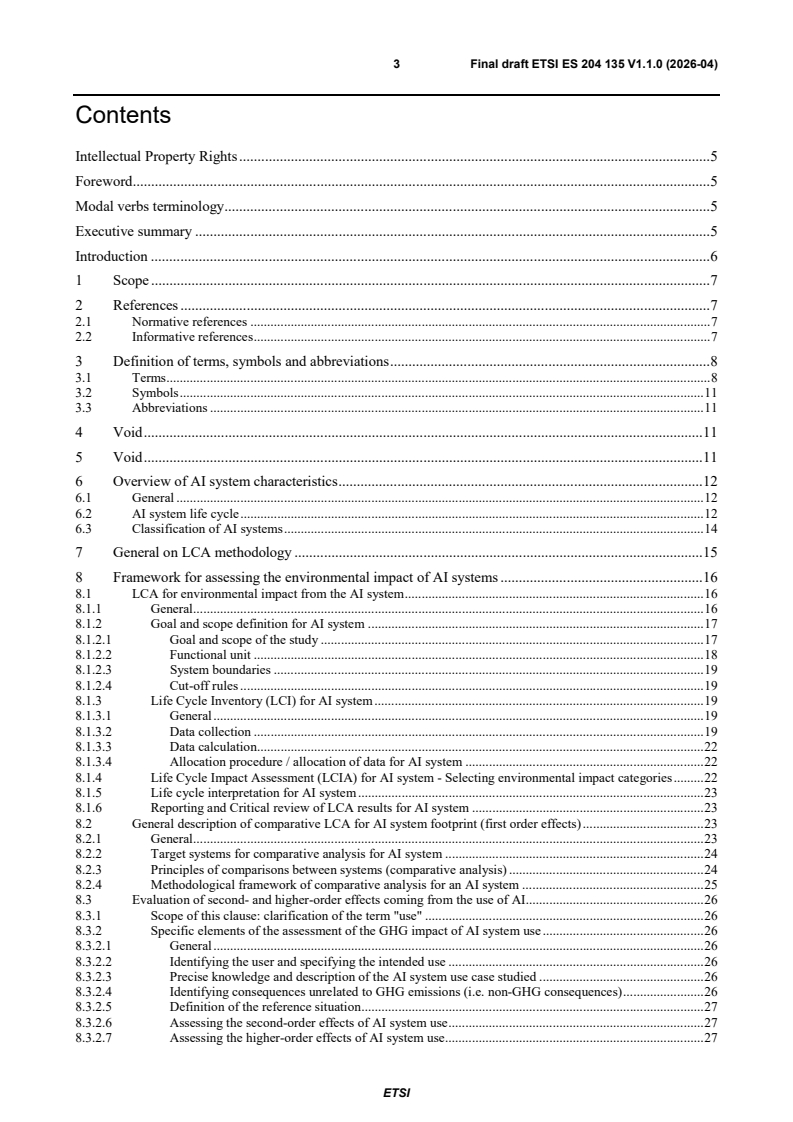
Contents
Intellectual Property Rights . 5
Foreword . 5
Modal verbs terminology . 5
Executive summary . 5
Introduction . 6
1 Scope . 7
2 References . 7
2.1 Normative references . 7
2.2 Informative references . 7
3 Definition of terms, symbols and abbreviations . 8
3.1 Terms . 8
3.2 Symbols . 11
3.3 Abbreviations . 11
4 Void . 11
5 Void . 11
6 Overview of AI system characteristics . 12
6.1 General . 12
6.2 AI system life cycle . 12
6.3 Classification of AI systems . 14
7 General on LCA methodology . 15
8 Framework for assessing the environmental impact of AI systems . 16
8.1 LCA for environmental impact from the AI system . 16
8.1.1 General . 16
8.1.2 Goal and scope definition for AI system . 17
8.1.2.1 Goal and scope of the study . 17
8.1.2.2 Functional unit . 18
8.1.2.3 System boundaries . 19
8.1.2.4 Cut-off rules . 19
8.1.3 Life Cycle Inventory (LCI) for AI system . 19
8.1.3.1 General . 19
8.1.3.2 Data collection . 19
8.1.3.3 Data calculatio n . 22
8.1.3.4 Allocation procedure / allocation of data for AI system . 22
8.1.4 Life Cycle Impact Assessment (LCIA) for AI system - Selecting environmental impact categories . 22
8.1.5 Life cycle interpretation for AI system . 23
8.1.6 Reporting and Critical review of LCA results for AI system . 23
8.2 General description of comparative LCA for AI system footprint (first order effects) . 23
8.2.1 General . 23
8.2.2 Target systems for comparative analysis for AI system . 24
8.2.3 Principles of comparisons between systems (comparative analysis) . 24
8.2.4 Methodological framework of comparative analysis for an AI system . 25
8.3 Evaluation of second- and higher-order effects coming from the use of AI. 26
8.3.1 Scope of this clause: clarification of the term "use" . 26
8.3.2 Specific elements of the assessment of the GHG impact of AI system use . 26
8.3.2.1 General . 26
8.3.2.2 Identifying the user and specifying the intended use . 26
8.3.2.3 Precise knowledge and description of the AI system use case studied . 26
8.3.2.4 Identifying consequences unrelated to GHG emissions (i.e. non-GHG consequences) . 26
8.3.2.5 Definition of the reference situation . 27
8.3.2.6 Assessing the second-order effects of AI system use . 27
8.3.2.7 Assessing the higher-order effects of AI system use . 27
ETSI
4 Final draft ETSI ES 204 135 V1.1.0 (2026-04)
Annex A (informative): Other initiatives on environmental impact of AI . 28
Annex B (informative): Examples of impacts from Open-source development of AI systems . 29
Annex C (informative): Example of LCI data for an AI system . 30
Annex D (informative): Analysis of the functional unit examples against the set criteria . 31
Annex E (informative): Example of a consequence tree for a specific use of an AI system . 32
History . 36
ETSI
5 Final draft ETSI ES 204 135 V1.1.0 (2026-04)
Intellectual Property Rights
Essential patents
IPRs essential or potentially essential to normative deliverables may have been declared to ETSI. The declarations
pertaining to these essential IPRs, if any, are publicly available for ETSI members and non-members, and can be
found in ETSI SR 000 314: "Intellectual Property Rights (IPRs); Essential, or potentially Essential, IPRs notified to
ETSI in respect of ETSI standards", which is available from the ETSI Secretariat. Latest updates are available on the
ETSI IPR online database.
Pursuant to the ETSI Directives including the ETSI IPR Policy, no investigation regarding the essentiality of IPRs,
including IPR searches, has been carried out by ETSI. No guarantee can be given as to the existence of other IPRs not
referenced in ETSI SR 000 314 (or the updates on the ETSI Web server) which are, or may be, or may become,
essential to the present document.
Trademarks
The present document may include trademarks and/or tradenames which are asserted and/or registered by their owners.
ETSI claims no ownership of these except for any which are indicated as being the property of ETSI, and conveys no
right to use or reproduce any trademark and/or tradename. Mention of those trademarks in the present document does
not constitute an endorsement by ETSI of products, services or organizations associated with those trademarks.
DECT™, PLUGTESTS™, UMTS™ and the ETSI logo are trademarks of ETSI registered for the benefit of its
Members. 3GPP™, LTE™ and 5G™ logo are trademarks of ETSI registered for the benefit of its Members and of the
3GPP Organizational Partners. oneM2M™ logo is a trademark of ETSI registered for the benefit of its Members and of ®
the oneM2M Partners. GSM and the GSM logo are trademarks registered and owned by the GSM Association.
Foreword
This final draft ETSI Standard (ES) has been produced by ETSI Technical Committee Environmental Engineering (EE),
and is now submitted for the ETSI Vote phase of the ETSI Membership Approval Procedure (MAP).
Modal verbs terminology
In the present document "shall", "shall not", "should", "should not", "may", "need not", "will", "will not", "can" and
"cannot" are to be interpreted as described in clause 3.2 of the ETSI Drafting Rules (Verbal forms for the expression of
provisions).
"must" and "must not" are NOT allowed in ETSI deliverables except when used in direct citation.
Executive summary
The present document provides methodology for assessing environmental impact of AI systems. The methodology is
based on Life Cycle Assessment (LCA) methodology standardized in Recommendation ITU-T L.1410 / ETSI
ES 203 199 [1] and method for enabling effects for other sectors standardized in Recommendation ITU-T L.1480 [2].
The guidance in the present document focuses on AI system specific aspects which need to be taken into account in the
assessment. Aggregation of AI impact on international, national or regional level is not part of the present document.
ETSI
6 Final draft ETSI ES 204 135 V1.1.0 (2026-04)
Introduction
The present document was developed jointly by ETSI TC EE and ITU-T Study Group 5. It was published respectively
by ITU as Recommendation ITU-T L.1801 [i.14] and ETSI as ETSI ES 204 135 (the present document), which are
equivalent in technical content.
As the demand for Artificial Intelligence (AI) technology increases, so does the environmental pressure it imposes. The
environmental impact associated with AI, driven by significant energy costs, has become a critical issue that needs to be
addressed for the future development of AI.
The present document provides a holistic framework for evaluating the environmental impact of AI systems, covering
direct and indirect impacts, assessment, and mitigation strategies. The methods in Recommendation ITU-T L.1410 /
ETSI ES 203 199 [1] and Recommendation ITU-T L.1480 [2] provide the baseline for this framework. This standard is
built on those methods and provides additional guidance to the practitioner on how to apply the methods for AI systems.
For minimizing and mitigating the environmental impact of AI systems, it is important to take a life cycle approach
understanding the whole life cycle of AI systems. For this, Life Cycle Assessment (LCA) is the most widely used and
best available methodology for assessing the environmental impact, including GHG emissions. Therefore,
Recommendation ITU-T L.1410 / ETSI ES 203 199 [1] has been taken as the baseline for this framework.
The present document can further help relevant parties ensure that current actions are effective in addressing the
evolving climate change over the long term. The present document provides a focused framework for evaluating
whether it is environmentally beneficial, from an environmental impact perspective, to use AI technology compared to
not using AI or comparing the environmental impact of two AI systems. This assessment takes into account the full life
cycle of AI systems, including the use of the AI system. It can help AI users choose a system or solution that will have
less impact on the environment. The methodology followed in the present document does not presume a result of the
assessment of the use of AI, which may either contribute to or undermine global sustainability.
AI and the Environment report from ITU [i.12] describes the earlier work in this area and contains references to ITU
documentation and the outcome from FG AI4EE group. This report also includes possible mitigation actions for
reducing the environmental impact of AI.
Annex A of the present document describes other initiatives on this topic.
ETSI
7 Final draft ETSI ES 204 135 V1.1.0 (2026-04)
1 Scope
The present document provides guidelines for assessing the environmental impact of Artificial Intelligence (AI) systems
objectively and transparently. The scope includes:
• Overview of the impacts of AI systems on the environment.
• Framework for evaluating the environmental impact of AI.
The guidelines in the present document are based on the Life Cycle Assessment (LCA) methodology standardized in
Recommendation ITU-T L.1410 / ETSI ES 203 199 [1] and method for enabling effects for other sectors standardized
in Recommendation ITU-T L.1480 [2].
The present document does not cover the assessment of the environmental impact of AI systems aggregated at
worldwide or national level, which may be covered in the future in another standard.
2 References
2.1 Normative references
References are either specific (identified by date of publication and/or edition number or version number) or
non-specific. For specific references, only the cited version applies. For non-specific references, the latest version of the
referenced document (including any amendments) applies.
Referenced documents which are not found to be publicly available in the expected location might be found in the
ETSI docbox.
NOTE: While any hyperlinks included in this clause were valid at the time of publication, ETSI cannot guarantee
their long-term validity.
The following referenced documents are necessary for the application of the present document.
[1] Recommendation ITU-T L.1410 (2024) / ETSI ES 203 199: "Methodology for environmental life
cycle assessments of information and communication technology goods, networks and services".
[2] Recommendation ITU-T L.1480: "Enabling the Net Zero transition - Assessing how the use of
information and communication technology solutions impacts greenhouse gas emissions of other
sectors".
NOTE: At the time of drafting the present document, the equivalent ETSI ES 204 087 is under development and
is expected to be submitted for Member Vote shortly.
2.2 Informative references
References are either specific (identified by date of publication and/or edition number or version number) or
non-specific. For specific references, only the cited version applies. For non-specific references, the latest version of the
referenced document (including any amendments) applies.
NOTE: While any hyperlinks included in this clause were valid at the time of publication, ETSI cannot guarantee
their long-term validity.
The following referenced documents may be useful in implementing an ETSI deliverable or add to the reader's
understanding, but are not required for conformance to the present document.
[i.1] Regulation (EU) 2024/1689 of the European Parliament and of the Council of 13 June 2024 laying
down harmonised rules on artificial intelligence and amending Regulations (EC) No 300/2008,
(EU) No 167/2013, (EU) No 168/2013, (EU) 2018/858, (EU) 2018/1139 and (EU) 2019/2144 and
Directives 2014/90/EU, (EU) 2016/797 and (EU) 2020/1828 (Artificial Intelligence Act).
ETSI
8 Final draft ETSI ES 204 135 V1.1.0 (2026-04)
[i.2] ISO 14040:2006: "Environmental management — Life cycle assessment — Principles and
framework".
[i.3] ISO/IEC 22989:2022: "Information technology — Artificial intelligence — Artificial intelligence
concepts and terminology".
[i.4] ISO/IEC 5338: 2023: "Information technology — Artificial intelligence — AI system life cycle
processes".
[i.5] ETSI EN 303 800-2 / Recommendation ITU-T L.1025: "Environmental Engineering (EE);
Assessment of material efficiency of ICT network infrastructure goods (circular economy); Part 2:
Server and data storage product secure data deletion functionality".
[i.6] Farzan, M.; Kallio, S.: "A transparent and standards-based way to assess the environmental impact
of AI systems", 2024.
[i.7] Recommendation ITU-T L.1420 (2012): "Methodology for energy consumption and greenhouse
gas emissions impact assessment of information and communication technologies in
organizations".
[i.8] GHG Protocol: "A Corporate Accounting and Reporting Standard".
[i.9] ILCD Handbook: "General guide for Life Cycle Assessment - Detailed guidance", 2010.
[i.10] ISO/IEC 22989:2022/DAmd 1: "Information technology — Artificial intelligence — Artificial
intelligence concepts and terminology", draft Amendment 1.
[i.11] ISO/IEC 5230:2020: "Information technology — OpenChain Specification".
[i.12] ITU: "AI and the Environment - 2024 Report".
[i.13] IEA: "Energy and AI", April 2025.
[i.14] Recommendation ITU-T L.1801 (2026): "Guidelines for assessing the environmental impact of
artificial intelligence systems".
3 Definition of terms, symbols and abbreviations
3.1 Terms
For the purposes of the present document, the following terms apply:
Artificial Intelligence (AI): research and development of mechanisms and applications of AI systems
NOTE 1: Research and development can take place across any number of fields such as computer science, data
science, humanities, mathematics and natural sciences.
NOTE 2: Source: ISO/IEC 22989:2022 [i.3].
AI agent: automated entity that senses and responds to its environment and takes actions to achieve its goals
NOTE: Source: ISO/IEC 22989:2022 [i.3].
AI system: engineered system that generates outputs such as content, forecasts, recommendations or decisions for a
given set of human-defined objectives
NOTE 1: The engineered system can use various techniques and approaches related to artificial intelligence to
develop a model to represent data, knowledge, processes, etc. which can be used to conduct tasks.
NOTE 2: AI systems are designed to operate with varying levels of automation.
NOTE 3: Source: ISO/IEC 22989:2022 [i.3].
ETSI
9 Final draft ETSI ES 204 135 V1.1.0 (2026-04)
automation: process or system that, under specified conditions, functions without human intervention
NOTE: Modified from Source: ISO/IEC 22989:2022 [i.3].
continual learning: incremental training of an AI system that takes place on an ongoing basis during the operation
phase of the AI system life cycle
NOTE: Source: ISO/IEC 22989:2022 [i.3].
data sanitization: process of deliberately and irreversibly deleting or destroying any data stored in memory on a device
to render it unrecoverable
NOTE: Source: ETSI EN 303 800-2 [i.5].
deep learning, deep neural network learning: approach to creating rich hierarchical
representations through the training of neural networks with many hidden layers
NOTE 1: Deep learning is a subset of ML.
NOTE 2: Source: ISO/IEC 22989:2022 [i.3].
embodied emissions: lifecycle(s) Greenhouse Gas (GHG) emissions from the following life cycle stages: raw material
acquisition, production and end-of-life treatment
NOTE 1: Each life cycle includes transportation as generic process.
NOTE 2 The Greenhouse Gas (GHG) emissions include all life cycle stages other than the use stage.
NOTE 3: Source: ETSI ES 203 199 [1].
environmental impact: impact including positive and negative aspects on the environment
NOTE: Source: ETSI ES 203 199 [1].
expert system: AI system that accumulates, combines and encapsulates knowledge provided by a human expert or
experts in a specific domain to infer solutions to problems
NOTE: Source: ISO/IEC 22989:2022 [i.3].
foundation model: AI model that can be used for or readily adapted to a wide range of tasks in one or more domains
NOTE 1: A typical way to build a foundation model is to apply supervised machine learning or self- supervised
machine learning on a large amount of data.
NOTE 2: A foundation model can be used as part of various applications, tasks and use cases, which do not
necessarily involve generative AI.
NOTE 3: Source: ISO/IEC 22989:2022/DAmd 1 [i.10].
functional unit: quantified performance of a product system for use as a reference unit
NOTE: Source: ISO 14040:2006 [i.2].
general AI, AGI, artificial general intelligence: type of AI system that addresses a broad range of tasks with a
satisfactory level of performance
NOTE 1: Compared to narrow AI.
NOTE 2: AGI is often used in a stronger sense, meaning systems that not only can perform a wide variety of tasks,
but all tasks that a human can perform.
NOTE 3: Source: ISO/IEC 22989:2022 [i.3].
generative artificial intelligence system, generative AI system, GenAI system: AI system based on techniques and
models that aim to generate new content
NOTE 1: Examples of generated content can include text, audio, code, video and image.
ETSI
10 Final draft ETSI ES 204 135 V1.1.0 (2026-04)
NOTE 2: Generated content encompasses new information or new ways to express preexisting information. That
preexisting information can be drawn from the input, a dataset involved in building the model or an
external repository.
NOTE 3: Source: ISO/IEC 22989:2022/DAmd 1 [i.10].
inference: reasoning by which conclusions are derived from known premises
NOTE 1: In AI, a premise is either a fact, a rule, a model, a feature or raw data.
NOTE 2: The term "inference" refers both to the process and its result.
NOTE 3: Source: ISO/IEC 22989:2022 [i.3].
Machine Learning (ML): process of optimizing model parameters through computational techniques, such that the
model's behaviour reflects the data or experience
NOTE: Source: ISO/IEC 22989:2022 [i.3].
machine learning algorithm: algorithm to determine parameters of a machine learning model from data according to
given criteria
EXAMPLE: Consider solving a univariate linear function y = θ + θ x where y is an output or result, x is an
0 1
θ is an intercept (the value of y where x=0) and θ is a weight. In machine learning, the
input, 0 1
process of determining the intercept and weights for a linear function is known as linear
regression.
NOTE: Source: ISO/IEC 22989:2022 [i.3].
model: physical, mathematical or otherwise logical representation of a system, entity, phenomenon, process or data
NOTE: Source: ISO/IEC 22989:2022 [i.3].
narrow AI: type of AI system that is focused on defined tasks to address a specific problem
NOTE 1: Compared to general AI.
NOTE 2: Source: ISO/IEC 22989:2022 [i.3].
Neural Network (NN): network of one or more layers of neurons connected by weighted links
with adjustable weights, which takes input data and produces an output
NOTE 1: Neural networks are a prominent example of the connectionist approach.
NOTE 2: Although the design of neural networks was initially inspired by the functioning of biological neurons,
most works on neural networks do not follow that inspiration anymore.
NOTE 3: Source: ISO/IEC 22989:2022 [i.3].
open-source: software subject to one or more licenses that meet the Open Source Definition published by the Open
Source Initiative (see opensource.org/osd) or the Free Software Definition published by the Free Software Foundation
(see gnu.org/philosophy/free-sw.html) or similar license
NOTE: Source: ISO/IEC 5230:2020 [i.11].
parameters, model parameter: internal variable of a model that affects how it computes its outputs
NOTE 1: Examples of parameters include the weights in a neural network and the transition probabilities in a
Markov model.
NOTE 2: Source: ISO/IEC 22989:2022 [i.3].
token: unit of content that an AI model treats as semantically meaningful
NOTE: Source: ISO/IEC 22989:2022/DAmd 1 [i.10].
ETSI
11 Final draft ETSI ES 204 135 V1.1.0 (2026-04)
training model, training: process to determine or to improve the parameters of a machine learning model, based on a
machine learning algorithm, by using training data
NOTE: Source: ISO/IEC 22989:2022 [i.3].
3.2 Symbols
Void.
3.3 Abbreviations
For the purposes of the present document, the following abbreviations apply:
AGI Artificial General Intelligence
AI Artificial Intelligence
API Application Programming Interface
CF Carbon Footprint
CI/CD Continuous Integration / Continuous Delivery
CPU Central Processing Unit
EoLT End of Life Treatment
EPD Environmental Product Declaration
FG Focus Group
FLOP Floating Point Operations Per second
GenAI Generative AI
GHG Greenhouse Gas
GPU Graphics Processing Unit
ICT Information and Communication Technology
LCA Life Cycle Assessment
LCI Life Cycle Inventory
LCIA Life Cycle Impact Assessment
LLM Large Language Model
ML Machine Learning
NN Neural Network
PoC Proof-of-Concept
PUE Power Usage Effectiveness
RFC Request for Comments
SVM Support Vector Machine
TPU Tensor Processing Unit
WUE Water Usage Effectiveness
4 Void
5 Void
ETSI
12 Final draft ETSI ES 204 135 V1.1.0 (2026-04)
6 Overview of AI system characteristics
6.1 General
AI is a rapidly advancing field with the potential to enhance economic, environmental and social benefits significantly
across various sectors. There are two perspectives associated with AI: AI for Sustainability and Sustainability of AI. AI
for Sustainability is about the use of AI systems to enable sustainability goals and the environmentally sustainable
development of different areas and industries, whereas Sustainability of AI is about considering the impact of AI itself,
where the entire lifecycle of AI system should be analysed starting from design, production of hardware, training,
tuning and re-tuning, deployment, use and end of life of the AI system. The main focus of the present document is on
the latter, to provide a methodology for assessing the environmental impact of AI systems. However, the present
document also includes a methodology to compare different AI systems and to start to assess the benefits/impact AI
brings to sustainability and other sectors.
On one hand, designing, deploying, training and using the AI system has its own environmental impact, therefore
assessing and minimizing the environmental impact of AI systems is important. On the other hand, AI can be used for
the benefit of the ecosystem by protection and improvement of the quality of the environment, biodiversity, improving
circularity, climate change mitigation and adaptation [i.1].
A general overview of AI systems and their applications have been developed by the IEA and is available in the report
on Energy and AI [i.13]. Some AI infrastructure and types of applications are provided in Figure 1.
Figure 1: Select AI Infrastructure and types of applications [i.13]
6.2 AI system life cycle
Some aspects of the life cycle stages of an AI system are unique compared to a non-AI product or traditional software.
Figure 2 illustrates the AI life cycle stages and major processes of an AI system based on ISO/IEC 5338 [i.4].
Depending on the intended purpose of the AI system, there might be some variation to this. However, the life cycle
description should include all stages from inception to retirement or a subset of these stages in a limited focus.
ETSI
13 Final draft ETSI ES 204 135 V1.1.0 (2026-04)
Figure 2: Life cycle stages of an AI system
A life cycle of an AI system consists of inception, design and development, verification and validation, deployment,
operation and monitoring, continuous validation, re-evaluation and, finally, retirement as shown in Figure 2. Training
and inference are not separate AI life cycle stages according to ISO/IEC 5338 [i.4] but they are central processes in
AI systems and therefore indicated in Figure 2, aligned with the AI life cycle stages according to the detailed
description given in ISO/IEC 5338 [i.4]. The design and development stage can include several processes like acquiring
training data, data preparation, algorithm selection, and model training. Likewise, the deployment can be separated into
metrics evaluation, reviews and operationalization.
AI system life cycle stages according to ISO/IEC 22989 [i.3]:
• Inception: Turn an idea into a tangible system by defining a set of requirements for the AI system to be
developed.
• Design and development: Creating an AI system that fulfils the original requirements.
• Verification and validation: Checking that the AI system from the design and development stage works
according to the requirements set at the inception stage.
• Deployment: Installing, releasing and configuring the AI system in a target environment.
• Operation and monitoring: The AI system is running and available for use. The AI system is monitored for
normal operation and possible incidents.
• Continuous validation: If the AI system uses continuous learning, incremental training takes place
continuously while the system is running in production. The operation of the AI system is continually checked
for correct operation using test data.
• Re-evaluation: Reassessment of whether the AI system still fulfils objectives and requirements, based on the
results of the work of the AI system.
• Retirement: The AI system can become obsolete when repairs and updates are not sufficient to meet new
requirements, in which case it may be decommissioned and discarded or replaced.
AI systems can also be developed in the open-source community. Some notes from that perspective for the different
AI system life cycle stages are described in Annex B.
AI systems can undergo several updates, bug fixes, adaptation to new data sets and improvements including the
continuous learning, validation and verification process as part of the same life cycle, as long as these activities do not
change the original set of requirements defined for the AI system during the Inception. However, at any point, if the
requirements defined during the Inception of the AI system are modified, such fundamental changes or significant
alterations to the AI system requirements or functionality qualify as a new AI system, different from the original
system. This would result in a different function of the AI system and a separate functional unit might be required
considering the new AI system requirements or the function of the AI system to assess the environmental impact.
ETSI
14 Final draft ETSI ES 204 135 V1.1.0 (2026-04)
The main processes are from their environmental impact perspective:
• Training: Training can be expanded over several AI system life cycle stages as shown in Figure 2. Training is
not a continuous activity but can be separated into initial training and re-training or continuous learning. Initial
training happens in the design and development stage to train the model to be relevant for the intended
purpose. Re-training happens during the continuous validation stage while the AI system is in use. Training
involves different data sets such as training data, validation data, test data, and data for continuous learning
(taken from the production data processed by the AI system in the operation phase). Training data is the input
from which the machine learning algorithm extracts its model to address the given task. Validation data is used
to validate some algorithmic choices. Test data is used to evaluate that the performance of the AI system fulfils
the needs and requirements before its deployment. Data for continuous learning is used during AI system
operation to re-train/update the trained model for continued performance to fulfil the intended purpose.
• Inference: During the use of the AI system, inference is the process of running live data through the trained
AI model and the generated result, e.g. prediction or conclusions.
Moreover, data handling is closely linked with the AI system. Below are some data related actions which do not
necessarily follow a specific sequence, ISO/IEC 5338 [i.4]:
• Acquire or select data: Collecting, recording or purchasing needed data.
• Verification and validation: Checking that data fulfils the needs and quality criteria (including fairness and
privacy aspects). Validation of the data source.
• Preparation: Processing of data, e.g. data cleaning or merging, change of format, labelling, metadata
preparation, preparing training and validation data, etc.
• Storage: Keeping data on a storage resource.
• Protection: Protecting sensitive data and securing data against malicious actors.
• Transfer/transmission: Moving data from one place to another or from one network to another over a
transmission network.
• Update: Acquiring new data.
• Archiving: Intermediate, easily accessible archiving or long-term, permanent archiving (data logging).
• Retirement: At the end of use, data is deleted or archived in a timely manner.
6.3 Classification of AI systems
While all AI systems share the same life cycle, their effects on resources can vary significantly.
AI can be categorized into different types of technology. Figure 3 illustrates some main AI technology types.
ETSI
15 Final draft ETSI ES 204 135 V1.1.0 (2026-04)
Figure 3: Some main AI technology types
Table 1 proposes a classification of AI technologies into four distinct categories, each reflecting its first order impact on
needed resources.
Table 1: Classification of AI systems by AI technology
AI technology Technologies examples Use case Hardware Data Energy
types examples resources resources resources
Expert systems Linear regression, logistic Text classification CPU Comparatively Comparatively
(subset of AI) regression, SVM, Naive Energy low low
based, Decision trees, optimization
Random Forest
Machine Statistical algorithms E-mail filtering, CPU + GPU Comparatively Comparatively
Learning product medium medium
(subset of AI) recommendations
Deep Learning Convolutional Neural Image recognition CPU + GPU Comparatively Comparatively
(subset of Network, Recurrent medium medium
Machine Neural Network, Long
Learning) short-term memory, etc.
Generative AI Small Language Models, Generation of A significant Comparatively Comparatively
(subset of Deep Large Language Models, summaries, videos number of medium to high high depending
Learning) Specialized models, or images GPU and/or depending on on the use
Multi-modal models TPU the use cases cases
It is important to allocate the environmental impact according to the full life cycle of the AI system, whether for general
or narrow AIs.
In the case of general AI, allocating the environmental impact associated with the used foundation model may be a
complex task because the foundation model may be used to create multiple derived models.
7 General on LCA methodology
LCA methodology is described in Recommendation ITU-T L.1410 (2024) / ETSI ES 203 199 [1]. The present
document refers to [1] for further details and requirements. However, in some cases simplified LCA standard can
potentially be considered instead, as applicable.
ETSI
16 Final draft ETSI ES 204 135 V1.1.0 (2026-04)
LCA is applicable for AI product systems, but as such it is not applicable for organizations' environmental impact
assessment. Other standards should be used for the organization's environmental impact, e.g. Recommendation
ITU-T L.1420 [i.7] or [i.8].
8 Framework for assessing the environmental impact
of AI systems
8.1 LCA for environmental impact from the AI system
8.1.1 General
Applying LCA methodology to an AI system needs careful consideration as the AI system life cycle stages do not
directly align with the four LCA stages in [1]: Raw Material Acquisition, Production, Use and End of Life Treatment
(EoLT).
Figure 4 depicts how the AI system life cycle stages and main processes can be mapped to LCA life cycle stages.
Figure 4: Mapping LCA life cycle stages with AI system life cycle stages [i.6]
The LCA Raw material acquisition stage shall contain the impact from materials for the hardware needed for the
AI system.
The Production stage of LCA shall include the impact from hardware production as well as the impact from inception,
design and development, and verification and validation stages of the AI system as shown in Figure 4. From the main
AI system processes, initial training shall be calculated as part of the LCA Production stage.
LCA Use stage shall include the impact from deployment, operation and monitoring, re-evaluation, and continuous
validation stages of the AI system. From the main AI system processes, inference and continuous learning (as part of
re-training) shall be calculated as part of the LCA Use stage.
NOTE 1: In some publications, deployment is mapped to belong to the Production stage. Mapping deployment in
the Use stage in the present document follows the principles in Recommendation ITU-T L.1410 (2024) /
ETSI ES 203 199 [1]. For this reason, it is recommended to mention in the reporting how deployment is
mapped in the life cycle stages.
In order not to have any ambiguity in reporting embodied emissions, the LCA practitioner should determine which part
of the training impact falls under the Production or Use stage of LCA using the above guidance. It is required that the
training impact is also reported separately for full transparency. Since initial training can be measured and an accurate
figure provided but continuous learning will be based on estimated figures (using assumptions), these shall be reported
separately.
Finally, the End of life treatment stage of LCA shall contain the impact from hardware end of life treatment as well as
the impact of the retirement stage of the AI system.
Physical transportation of materials and hardware shall be calculated in each LCA stage as defined in [1].
ETSI
17 Final draft ETSI ES 204 135 V1.1.0 (2026-04)
Data transmission and data storage impact shall be calculated in that LCA stage where the corresponding activity takes
place.
AI system installation and maintenance as well as site specific support activities (e.g. cooling systems, lighting, etc.)
during use shall be calculated for the LCA Use stage.
In shared infrastructure use, full life cycle impact of the infrastructure shall be allocated to the users according to their
usage.
Practitioner shall clearly indicate if multiple AI systems are included in the assessment, when these AI systems together
provide the intended functionality.
NOTE 2: Multiple AI systems in the assessment may become very complex with Agentic AI, especially if
multiple agents are involved.
8.1.2 Goal and scope definition for AI syst
...