

oSIST prEN 17821:2026
(Main)Building valves - Frost resistant taps for outdoor use (FRT) - General technical specification
- Abstract
This document specifies application, general construction, performance and material requirements for frost resistant taps for outdoor use (FRT), PN 10.
This document is applicable to potable water installations with a static pressure of maximum 1,0 MPa (10 bar) and a distribution temperature of maximum 25 °C (PWC).
NOTE See Annex A for a general overview of this document’s organization and test sequence.
- Status
- Not Published
- Public Enquiry End Date
- 24-Nov-2026
- Technical Committee
- IOVO - Water supply and waste water engineering
- Current Stage
- 4020 - Public enquire (PE) (Adopted Project)
- Start Date
- 02-Oct-2026
- Due Date
- 19-Feb-2027
- Completion Date
- 26-Nov-2026

prEN 17821:2026 is a draft European Standard from CEN for frost resistant taps for outdoor use (FRT). It specifies application, general construction, performance and material requirements for PN 10 taps used in potable water installations. The document is aimed at manufacturers, test laboratories, specifiers, buyers and installers who need one technical basis for product design, testing and description.
What does prEN 17821:2026 specify?
prEN 17821:2026 specifies the scope of use, the main construction features, the required performance and the material rules for frost resistant taps for outdoor use (FRT). It applies to potable water installations and is organized into clauses for scope, references, terms, materials, characteristics, test methods, marking and product information.
The document separates the product into indoor, wall and outdoor areas, and its requirements follow that layout. Annex A gives an informative overview of the test sequence and sampling.
| Annex | What it covers |
|---|---|
| Annex A | Tests and sampling, including the type-test sequence |
What are the key requirements of prEN 17821:2026?
prEN 17821:2026 requires the tap to be suitable for outdoor frost exposure, safe for potable water use, and verifiable by a defined set of mechanical, hydraulic, corrosion and acoustic tests. In practice, this means the manufacturer has to control the design, the materials, the connection type and the test evidence that supports the product claim.
Use conditions and construction
Clause 5.1 limits the intended service conditions and divides the tap into indoor, wall and outdoor areas. The inlet and outlet threads have to match recognized pipe-thread systems, and the outlet geometry has minimum wall-clearance requirements. For the reader, this means the tap must physically fit the installation location and the connection method must match the pipework used on site.
Backflow protection and frost protection
Clause 5.2 requires an integrated protection against backflow unit. If the outlet can accept a connected fitting or pipe, the backflow protection has to follow the relevant anti-pollution device standard referenced through EN 1717. Clause 5.3 allows two frost-protection concepts - automatic drainage or controlled expansion - and each one has its own test route in Clause 6. This matters because the chosen frost concept changes the validation method and the installation expectations.
Materials and corrosion resistance
Clause 4 requires metallic materials for the indoor-area end connection and for the body section in front of the wall. All water-contact materials have to be suitable for potable water and must not affect health, appearance, smell or taste. The document also covers dezincification-resistant copper alloy and general corrosion resistance, including a salt-spray test for the external part of the complete assembled tap. In practice, this is the section that protects product durability and water quality.
Mechanical, hydraulic and freeze tests
Clause 6 sets the verification tests. These include automatic drainage, resistance to damage by frost through controlled expansion, leak tightness upstream and downstream of the obturator, bending resistance, torsional strength of control elements, mechanical endurance of the operating mechanism, resistance under internal pressure, flow rate and acoustic behavior. For a buyer or test lab, this is the core of the standard: it defines how the product is challenged before it can be described as conforming.
Endurance and tightness expectations
Clause 6.6 requires repeated opening and closing operations under water and pressure conditions, and the valve has to remain functional after the cycle test. Clauses 6.3 and 6.7 require no leakage, seepage or permanent deformation in the specified checks. In practice, these clauses show whether the tap can survive repeated use, pressure loading and freezing-related stress without losing tightness.
Marking and product information
Clause 7 requires permanent and visible marking on the tap or a fixed identification plate. The marking includes the manufacturer identification, nominal size and safety equipment. Technical product information has to accompany each package, batch or catalogue and cover designation, installation instructions, maintenance, spare parts if any, material information, maximum operating temperature, acoustic group if applicable and nominal pressure. This helps installers select, fit and maintain the right product and helps buyers compare products on the same basis.
What terms does prEN 17821:2026 define?
prEN 17821:2026 uses a short set of product and installation terms that are important for interpreting the requirements.
- FRT - frost resistant tap for outdoor use; the document treats FRTs as products that may use drainage, controlled expansion, pre-assembled or on-site assembly, fixed or adjustable length, and one or two outlets.
- PWC - cold potable water; the standard uses this term for potable water below the temperature limit used in the document.
- Indoor area - the area inside the walls of a building, where the air temperature is expected to remain above freezing.
- Wall area - the interior area of the building wall, which can locally be colder than the indoor air.
- Outdoor area - the area outside the walls of a building, where frost exposure is a main design concern.
Who uses prEN 17821:2026?
prEN 17821:2026 is used by manufacturers of building valves, especially products sold as frost resistant taps for outdoor use. Test laboratories and certification bodies use it to run type tests for drainage, frost resistance, leak tightness, mechanical strength, endurance, flow rate, corrosion and acoustics.
Specifiers, designers, installers and buyers use it to choose compatible tap types, connection ends and product information for potable water installations. It is also relevant to quality managers who need a clear checklist for product release and technical file control.
What changed in prEN 17821:2026 from the previous edition?
prEN 17821:2026 will supersede EN 17821:2023.
Which standards are used with prEN 17821:2026?
| Standard | What it contributes |
|---|---|
| EN 1717 | Backflow protection context and related terminology for potable water installations |
| EN 248:2002 | Requirement basis for the corrosion appearance and coating-related assessment |
| EN 1254-2, EN 1254-3, EN 1254-4, EN 1254-6, EN 1254-7, EN 1254-8 | Connection compatibility for different copper-alloy and plastic/multilayer pipe fittings |
| EN 1213 | Alternative connection compliance route for other connection types |
| EN ISO 3822-1 | Acoustic measurement method |
| EN ISO 3822-3 | Mounting and operating conditions for acoustic testing |
| EN ISO 6509-1 | Dezincification resistance test method for copper alloys |
| EN ISO 9227 | Neutral salt-spray corrosion test |
| ISO 228-1 | Pipe threads where pressure-tight joints are not made on the threads |
| ISO 7-1 | Pipe threads where pressure-tight joints are made on the threads |
What does the prEN 17821:2026 document contain?
prEN 17821:2026 contains tables, figures, procedures and formulas that support design and type testing. It includes a figure showing the indoor, wall and outdoor areas of the tap, figures for outlet geometry, a freezer-test layout, and bending-test setups. It also includes formulas for calculating the remaining water after drainage testing.
The document gives detailed test procedures for drainage, frost resistance, leak tightness, bending, torsion, endurance, internal pressure, flow rate and acoustic classification. It also provides tables for use conditions, dimensions, endurance conditions, leak-tightness requirements, flow-rate requirements and acoustic groups.
Annex A is informative and sets out the test and sampling sequence for type testing. In practice, that annex helps laboratories plan the order of tests and understand which specimens are used for each check.
Relations
- Effective Date
- 30-Sep-2026
- Effective Date
- 18-Jun-2025
Get Certified
Connect with accredited certification bodies for this standard

DIBt (Deutsches Institut für Bautechnik)
German Institute for Building Technology.

DIN CERTCO
DIN Group product certification.

Aboma Certification B.V.
Specialized in construction, metal, and transport sectors.
Sponsored listings
Frequently Asked Questions
oSIST prEN 17821:2026 is a draft published by the Slovenian Institute for Standardization (SIST). Its full title is "Building valves - Frost resistant taps for outdoor use (FRT) - General technical specification". This standard covers: This document specifies application, general construction, performance and material requirements for frost resistant taps for outdoor use (FRT), PN 10. This document is applicable to potable water installations with a static pressure of maximum 1,0 MPa (10 bar) and a distribution temperature of maximum 25 °C (PWC). NOTE See Annex A for a general overview of this document’s organization and test sequence.
This document specifies application, general construction, performance and material requirements for frost resistant taps for outdoor use (FRT), PN 10. This document is applicable to potable water installations with a static pressure of maximum 1,0 MPa (10 bar) and a distribution temperature of maximum 25 °C (PWC). NOTE See Annex A for a general overview of this document’s organization and test sequence.
oSIST prEN 17821:2026 is classified under the following ICS (International Classification for Standards) categories: 23.060.01 - Valves in general; 91.140.60 - Water supply systems. The ICS classification helps identify the subject area and facilitates finding related standards.
oSIST prEN 17821:2026 has the following relationships with other standards: It is inter standard links to SIST EN 17821:2023/AC:2024, SIST EN 17821:2023. Understanding these relationships helps ensure you are using the most current and applicable version of the standard.
oSIST prEN 17821:2026 is available in PDF format for immediate download after purchase. The document can be added to your cart and obtained through the secure checkout process. Digital delivery ensures instant access to the complete standard document.
Standards Content (Sample)
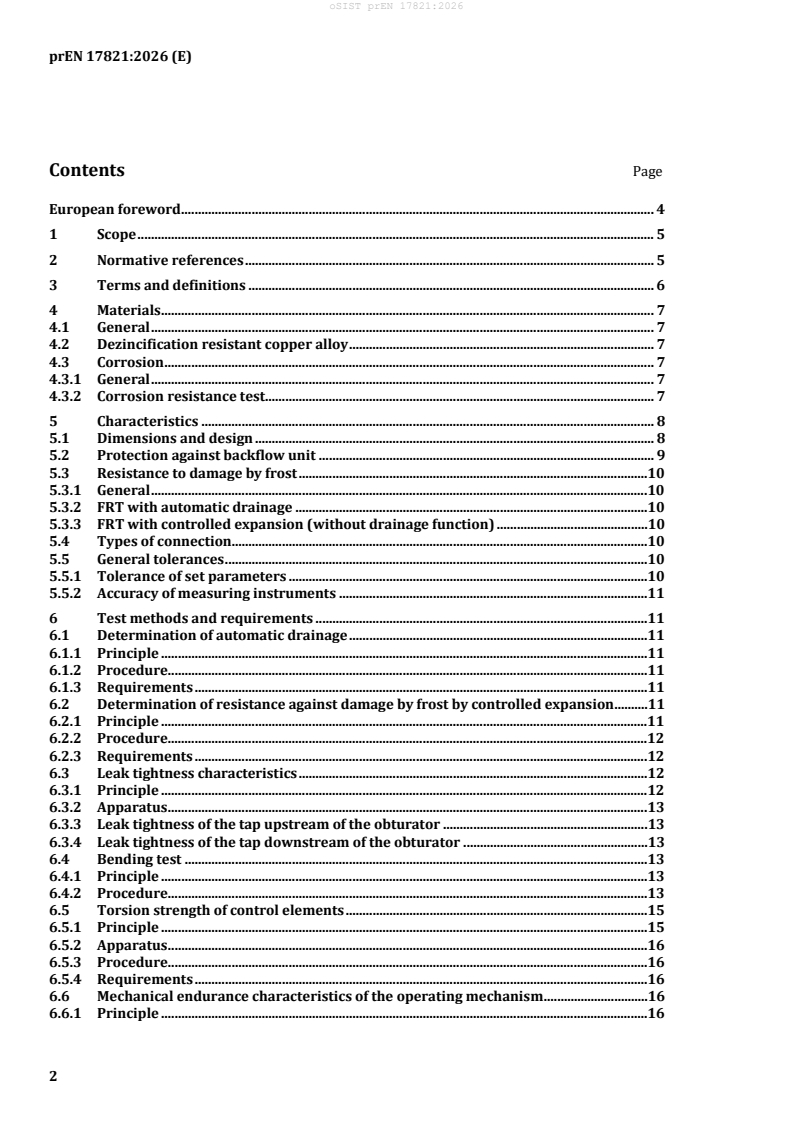
Contents
- 1 Scope
- 2 Normative references
- 3 Terms and definitions
- 3.1 FRT
- 3.2 PWC
- 3.3 indoor area
- 3.4 wall area
- 3.5 outdoor area
- 4 Materials
- 4.1 General
- 4.2 Dezincification resistant copper alloy
- 4.3 Corrosion
- 5 Characteristics
- 5.1 Dimensions and design
- 5.2 Protection against backflow unit
- 5.3 Resistance to damage by frost
- 5.4 Types of connection
- 5.5 General tolerances
- 6 Test methods and requirements
- 6.1 Determination of automatic drainage
- 6.2 Determination of resistance against damage by frost by controlled expansion
- 6.3 Leak tightness characteristics
- 6.4 Bending test
- 6.5 Torsion strength of control elements
- 6.6 Mechanical endurance characteristics of the operating mechanism
- 6.7 Resistance under internal pressure
- 1 Obturator Closed Open
- 2 Open Closed (60 + 5/0) s
- 6.8 Flow rate
- 6.9 Acoustic behaviour
- 7 Marking and technical product information
- 7.1 General
- 7.2 Marking
- 7.3 Technical product information
- Annex A
- Bibliography
1 Scope
This document specifies application, general construction, performance and material requirements for frost resistant taps for outdoor use (FRT), PN 10.
This document is applicable to potable water installations with a static pressure of maximum 1,0 MPa (10 bar) and a distribution temperature of maximum 25 °C (PWC). NOTE See Annex A for a general overview of this document’s organization and test sequence.
2 Normative references
The following documents are referred to in the text in such a way that some or all of their content constitutes requirements of this document. For dated references, only the edition cited applies. For undated references, the latest edition of the referenced document (including any amendments) applies. EN 248:2002, Sanitary tapware — General specification for electrodeposited coatings of Ni-Cr EN 1254-2, Copper and copper alloys — Plumbing fittings — Part 2: Compression fittings for use with copper tubes EN 1254-3, Copper and copper alloys — Plumbing fittings — Part 3: Compression fittings for use with plastics and multilayer pipes EN 1254-4, Copper and copper alloys — Plumbing fittings — Part 4: Threaded fittings EN 1254-6, Copper and copper alloys — Plumbing fittings — Part 6: Push-fit fittings for use with metallic tubes, plastics and multilayer pipes EN 1254-7, Copper and copper alloys — Plumbing fittings — Part 7: Press fittings for use with metallic tubes EN 1254-8, Copper and copper alloys — Plumbing fittings — Part 8: Press fittings for use with plastics and multilayer pipes EN 1717, Protection against pollution of water intended for human consumption in potable water installations and general requirements for devices to prevent pollution by backflow EN ISO 3822-1, Acoustics — Laboratory tests on noise emission from appliances and equipment used in water supply installations — Part 1: Method of measurement (ISO 3822-1) EN ISO 3822-3, Acoustics — Laboratory tests on noise emission from appliances and equipment used in water supply installations — Part 3: Mounting and operating conditions for in-line valves and appliances (ISO 3822-3) EN ISO 6509-1, Corrosion of metals and alloys — Determination of dezincification resistance of copper alloys with zinc — Part 1: Test method (ISO 6509-1) EN ISO 9227, Corrosion tests in artificial atmospheres — Salt spray tests (ISO 9227) ISO 228-1, Pipe threads where pressure-tight joints are not made on the threads — Part 1: Dimensions, tolerances and designation ISO 7-1, Pipe threads where pressure-tight joints are made on the threads — Part 1: Dimensions, tolerances and designation
oSIST prEN 17821:2026 prEN 17821:2026 (E)
3 Terms and definitions
For the purposes of this document, the terms and definitions given in EN 1717 and the following apply. ISO and IEC maintain terminology databases for use in standardization at the following addresses:
- ISO Online browsing platform: available at https://www.iso.org/obp
- IEC Electropedia: available at https://www.electropedia.org/
3.1 FRT
frost resistant tap for outdoor use Note 1 to entry: FRTs can be categorized in the following ways:
- method of achieving frost resistance (for example by drainage or by controlled expansion);
- pre-assembled or assembled on-site;
- fixed and adjustable length;
- one or two outlets (if FRTs use multiple outlets, the FRT shall be safe for every outlet used).
3.2 PWC
cold potable water Note 1 to entry: The temperature of cold potable water shall be less than 25 °C. This definition is in line with the European Drinking Water Directive, Directive (EU) 2020/2184.
3.3 indoor area
area inside the walls of a building Note 1 to entry: The air temperature of the indoor area shall be higher than 0 °C.
3.4 wall area
interior area of the walls of a building Note 1 to entry: Locally, the temperature of the wall area can be lower than 0 °C.
3.5 outdoor area
area outside the walls of a building 3.6 M
weight of a completely empty tap 3.7 M 1A weight of a tap including water between closing-part and the backflow part
oSIST prEN 17821:2026 prEN 17821:2026 (E) 3.8 M
weight of a tap filled with water 3.9 M
weight of an empty tap
4 Materials
4.1 General
The end connection in the indoor area (1) and the body in front of the wall (3), as indicated in Figure 1, shall be made of metallic materials.
All materials which come into contact with water intended for human consumption shall present no health risk nor cause any change to the water in terms of quality, appearance, smell or taste. NOTE It is noted that while awaiting the adoption of verifiable European criteria for testing materials in contact with water intended for human consumption, existing national regulations concerning the use and/or the characteristics of these products remain in force.
4.2 Dezincification resistant copper alloy
Copper-zinc alloys containing more than 15 % zinc are subject to dezincification when submitted to water capable of dezincification. When the use of products made of dezincification resistant materials is required, the materials used shall guarantee a dezincification depth less than 200 µm in any direction. For this purpose, materials shall be tested in accordance with EN ISO 6509-1 and the product shall be marked in accordance with Clause 7.
4.3 Corrosion
4.3.1 General
The applied materials shall be corrosion resistant or protected against corrosion. The materials used shall not have an adverse effect on other materials being used.
4.3.2 Corrosion resistance test
4.3.2.1 Principle
The corrosion resistance test tests the materials used in the external part of the FRT (Figure 1, area 3), especially when the intended use is in a humid atmosphere where condensation can occur. The FRT under test shall be fully assembled, and not only include the parts intended to be in contact with potable water, e.g. springs, spring caps.
4.3.2.2 Procedure
The test shall be conducted in accordance with the neutral saline-spray test of EN ISO 9227. Conduct the test in accordance with the following:
a) Subject the device to spraying for at least 100 h.
b) Halt the spraying treatment for (48 ± 1) h while maintaining the heat in the tank. c) Resume the spraying treatment for another (100 ± 1) h.
oSIST prEN 17821:2026 prEN 17821:2026 (E) For the duration of the test, the tank should only be opened to check and maintain the conditions, rest periods from spraying should be no longer than 30 minutes per day, heating should not be interrupted, and samples under test should not be handled, washed or checked. After treatment and before visual examination, rinse the test samples with water to remove any salt residue.
4.3.2.3 Requirements
The FRT shall comply with the requirements given in EN 248:2002, 5.1.
5 Characteristics
5.1 Dimensions and design
FRT valves consist of the 3 areas shown in Figure 1.
Key 1 indoor area 2 wall area 3 outdoor area Figure 1 — The different areas of FRT The conditions of use shall be in accordance with Table 1.
Table 1 — Conditions of use Supply Dimension Operating range Pressure recommended limits DN 15 Pressure static — max. ≤ 1,0 MPa (10,0 bar) to Pressure dynamic 0,1 to 0,5 MPa (1 to 5 bar) ≥ 0,05 MPa (0,5 bar) DN 20 Temperature cold — PWC ≤ 25 °C
Internal or external threads at the inlet and outlet of the FRT shall comply with ISO 228-1 or ISO 7-1. The minimum required distances to the wall shall be in accordance with Table 2. Figure 2 and Figure 3 are for exemplary or illustrative purposes only.
oSIST prEN 17821:2026 prEN 17821:2026 (E)
Key D distance from wall to outlet NOTE For the “front operated” FRT, other designs and/or angles for the outlet are possible. Figure 2 — Outlet dimensions for FRT (“front operated”)
Key A distance from wall to handle D distance from wall to outlet NOTE For the “above operated” FRT, other designs are possible. The distance D is between the wall and the cross point of middle line and thread end.
Figure 3 — Outlet dimensions for FRT (“above operated”) Table 2 — Outlet dimensions D (in mm) min. 30 A (in mm) min. 30
5.2 Protection against backflow unit
A protection against backflow unit shall be integrated in the complete product.
oSIST prEN 17821:2026 prEN 17821:2026 (E) If the tap has the possibility to connect fitting/pipe to the outlet, the backflow prevention shall comply with the relevant product standard for anti-pollution device referenced in EN 1717.
5.3 Resistance to damage by frost
5.3.1 General
Valves with a drainage function are used to prevent damage by frost. Two types of valves are possible for this purpose:
- automatic drainage;
- controlled expansion (without drainage function).
5.3.2 FRT with automatic drainage
The test procedure for FRT with automatic drainage shall be in accordance with 6.1.
5.3.3 FRT with controlled expansion (without drainage function)
The test procedure for FRT with controlled expansion (without drainage function) shall be in accordance with 6.2.
5.4 Types of connection
Inlet connections shall comply with EN 1254-2, EN 1254-3, EN 1254-4, EN 1254-6, EN 1254-7, and EN 1254-8, as applicable.
Valves with threaded connection ends shall have flats on the body which, when used for fitting, shall accommodate commercially available tools.
The connection ends as applied shall be suitable (and approved as such) for the nominal pressure of the valve.
Other types of connection may be used when the connections are in accordance with EN 1213.
5.5 General tolerances
5.5.1 Tolerance of set parameters
In the absence of any particular specifications, tolerances shall be in accordance with the following:
- Flow rate and pressure
- ± 2 % of the value specified;
- Temperature
- cold water: ± 5 °C of the value specified;
- other values: ± 2 °C of the value specified;
- Time +10
- ( ) % of the value specified.
oSIST prEN 17821:2026 prEN 17821:2026 (E)
...