

oSIST prEN 3682-002:2026
(Main)Aerospace series - Connectors, plug and receptacle, electrical, rectangular, interchangeable insert type, rack to panel, operating temperature 150 °C continuous - Part 002: Specification of performance and contact arrangements
- Abstract
This document specifies the common conditions for plug and receptacle, rack to panel with interchangeable insulators and continuous temperature rating 150 °C.
- Status
- Not Published
- Public Enquiry End Date
- 14-Dec-2026
- Technical Committee
- I13 - Imaginarni 13
- Current Stage
- 4020 - Public enquire (PE) (Adopted Project)
- Start Date
- 26-Oct-2026
- Due Date
- 15-Mar-2027

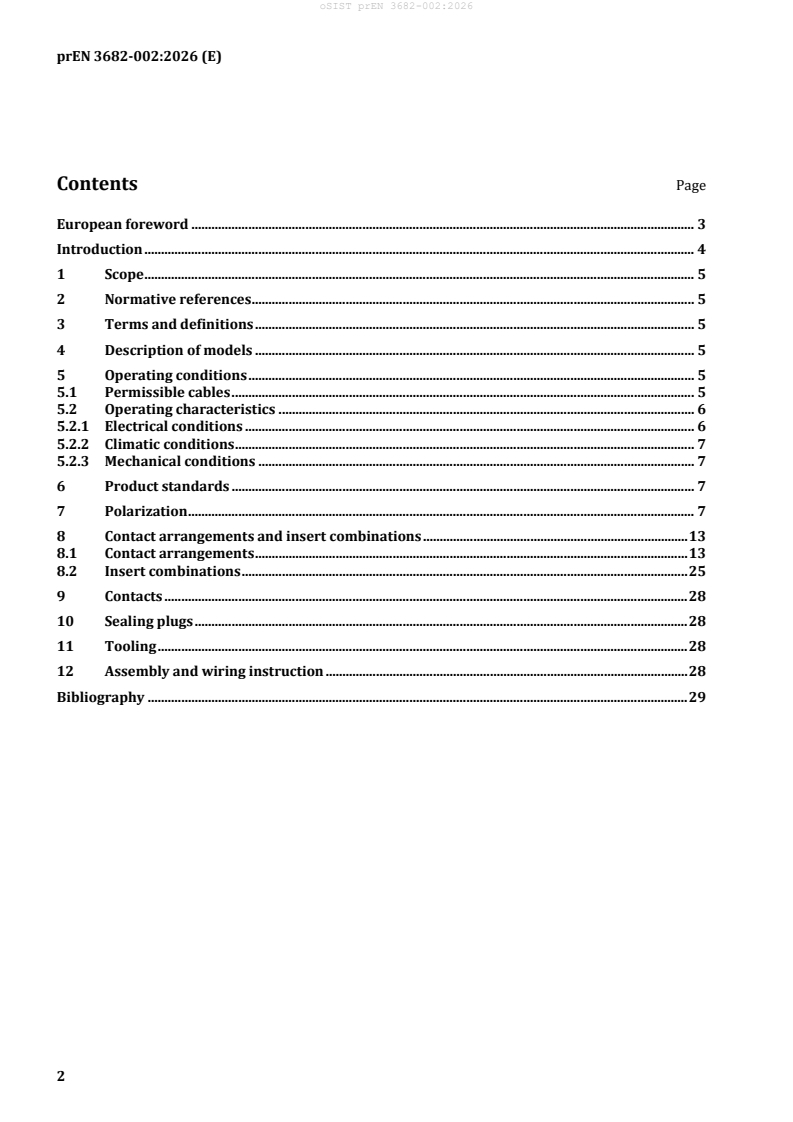
oSIST prEN 3682-002:2026 is the SIST publication of the draft European Standard prEN 3682-002, prepared by ASD-STAN for CEN. It covers aerospace rectangular plug and receptacle connectors with interchangeable inserts for rack-to-panel use at a continuous operating temperature of 150 °C. The document specifies the common conditions, performance levels, and contact arrangements for this connector family, which is derived from MIL-DTL-83527 and is intermateable with it.
What does oSIST prEN 3682-002:2026 specify?
oSIST prEN 3682-002:2026 specifies the common conditions for plug and receptacle connectors with interchangeable insulators and a continuous temperature rating of 150 °C. In practice, it tells you what connector models are covered, what operating conditions they must meet, and how the contact layouts and insert combinations are defined.
The document is organized into 12 clauses:
- Clause 1 - Scope
- Clause 2 - Normative references
- Clause 3 - Terms and definitions
- Clause 4 - Description of models
- Clause 5 - Operating conditions
- Clause 6 - Product standards
- Clause 7 - Polarization
- Clause 8 - Contact arrangements and insert combinations
- Clause 9 - Contacts
- Clause 10 - Sealing plugs
- Clause 11 - Tooling
- Clause 12 - Assembly and wiring instruction
That structure matters because the standard is not just a dimensional catalog. It combines environmental performance, mechanical endurance, connector coding, and the component standards needed to build a complete rack-to-panel connection system.
What are the key requirements of oSIST prEN 3682-002:2026?
Connector family, sizes, and intended configuration
oSIST prEN 3682-002:2026 covers environmental-resisting rectangular rack panel connectors with shell sizes 2, 3, and 4 and crimp contact class R. Clause 4 identifies the family, so a reader can quickly tell whether a proposed connector falls within the standard.
Clause 6 links the connector parts to the associated product standards for inserts and for receptacle and plug sizes. In practice, this is the part you use to select the matching component standards for a complete connector build.
Electrical, climatic, and mechanical performance
Clause 5 sets the operating conditions. It gives the cable dimensions that can be used, the electrical withstand levels, the temperature range from -65 °C to 150 °C, and a mechanical endurance of 500 mating and unmating operations.
The electrical conditions include insulation resistance at ambient temperature and withstand voltage values at sea level and at 33 000 m. For an engineer or buyer, this means the connector must be selected and qualified for the intended voltage environment, altitude, and insulation performance, not just for physical fit.
The climatic conditions also point back to EN 3682-001 for corrosion resistance and fluid resistance. That matters in aircraft and other aerospace installations where exposure to fluids and corrosive environments has to be part of the qualification plan.
Cable compatibility and wiring basis
Clause 5.1 lists the permissible cables by conductor size and outer diameter, and it says performance is achieved with those cable dimensions using the specified accessories and wiring tools. This is important in harness design because the connector performance depends on the cable build, not only on the connector shell.
Polarization and prevention of mismatch
Clause 7 defines polarization through coding key positions and states that the standard provides 99 different locating codes. The figures and tables show how the male and female keys are arranged.
In practical use, this lets designers and assemblers prevent incorrect mating between connectors that look similar but should not be interchangeable. It is a key part of system safety and of managing multiple connector positions in the same equipment.
Contact arrangements and insert combinations
Clause 8 is the main technical core of the document. Clause 8.1 ties each insulator type to defined contact arrangements and contact sizes, including power and signal layouts as well as coaxial, triaxial, and quadrax options.
Clause 8.2 assigns insert combination codes to shell sizes and cavity populations. For procurement, integration, and documentation, this code system is how the exact connector population is specified on drawings and parts lists.
The table updates in the foreword are especially relevant: the revised edition adds insert combination codes 288 to 292 and updates code 263, and it also updates the contact arrangements. That means users should check old part definitions against the new tables before reusing legacy configurations.
Contacts, sealing plugs, tooling, and assembly
Clause 9 identifies the contact standards that may be used in these connectors, including crimp and solder versions for male and female contacts. Clause 10 requires sealing plugs from EN 4529-002 in grommet cavities corresponding to unwired contacts.
Clause 11 points to the EN 3155 series for crimping, installing, and extracting removable contacts, and Clause 12 requires assembly and wiring instruction to follow EN 3197. In practice, these clauses tell a manufacturer or maintenance team what hardware and tooling must be used to assemble the connector correctly and keep unused cavities sealed.
What terms does oSIST prEN 3682-002:2026 define?
- LRU - line replaceable unit; a system unit intended to be removed and replaced at line maintenance level.
- Polarization - the keying arrangement that sets the locating code and controls how connectors mate.
- Insert combination - the coded arrangement of contacts or cavities within each shell size and cavity position.
- Triaxial - a contact arrangement using triaxial contacts for screened signal paths.
- Quadrax - a contact arrangement using quadrax contacts, used where that contact geometry is required.
- Sealing plugs - plugs used to close grommet cavities that correspond to unwired contacts.
- Crimp contact class R - the crimp contact class used for the connector family described in Clause 4.
Who uses oSIST prEN 3682-002:2026?
oSIST prEN 3682-002:2026 is used by aerospace design engineers, connector suppliers, wiring-harness manufacturers, integration teams, test laboratories, quality managers, and procurement staff. It is relevant wherever rack-to-panel electrical interconnection systems need a defined connector family with compatible inserts, contacts, and coding.
It also matters for maintenance organizations working with LRUs, because the polarization, contact arrangement, and tooling rules affect replacement, repair, and reinstallation. For buyers and verifiers, the standard helps identify the exact connector family and associated parts needed for a compliant build.
What changed in oSIST prEN 3682-002:2026 from the previous edition?
oSIST prEN 3682-002:2026 supersedes EN 3682-002:2013. The foreword states two significant technical changes:
- Table 6 insert combinations now introduces codes 288 to 292 and updates code 263.
- The contact arrangements have been updated.
Which standards are used with oSIST prEN 3682-002:2026?
| Standard | What it contributes |
|---|---|
| EN 2591-100 | General test methods for elements of electrical and optical connection. |
| EN 3197 | Assembly and wiring instruction for aircraft electrical and optical interconnection systems. |
| EN 3682-001 | Performance-related corrosion resistance and fluid resistance requirements for this connector family. |
| EN 4529-002 | Sealing plugs for unwired grommet cavities. |
| EN 3682-003 to EN 3682-009 | Companion product standards for inserts, receptacles, and plugs in sizes 2, 3, and 4. |
What does the oSIST prEN 3682-002:2026 document contain?
The document contains operating-condition tables, product-standard mappings, polarization figures, contact-arrangement tables, and insert-combination tables. It also includes a list of permitted contacts and references for sealing plugs, tooling, and assembly instructions.
Figures 1 and 2 show the coding-key positions used for polarization. Tables 1, 3, 4, 5, and 6 define cable compatibility, locating codes, contact arrangements, and insert combinations, while Table 7 lists the contact types that may be used. This makes the document useful for design definition, parts selection, harness building, and connector verification without having to interpret the family from drawings alone.
Relations
- Effective Date
- 28-Jan-2026
- Effective Date
- 28-Jan-2026
- Effective Date
- 03-May-2023
Get Certified
Connect with accredited certification bodies for this standard

BUREAU VERITAS Certification Germany
Bureau Veritas certification in Germany.

Element Materials Technology
Materials testing and product certification.

AQMS Ltd.
AQMS provides ISO certification to SMEs across the UK.
Sponsored listings
Frequently Asked Questions
oSIST prEN 3682-002:2026 is a draft published by the Slovenian Institute for Standardization (SIST). Its full title is "Aerospace series - Connectors, plug and receptacle, electrical, rectangular, interchangeable insert type, rack to panel, operating temperature 150 °C continuous - Part 002: Specification of performance and contact arrangements". This standard covers: This document specifies the common conditions for plug and receptacle, rack to panel with interchangeable insulators and continuous temperature rating 150 °C.
This document specifies the common conditions for plug and receptacle, rack to panel with interchangeable insulators and continuous temperature rating 150 °C.
oSIST prEN 3682-002:2026 is classified under the following ICS (International Classification for Standards) categories: 49.060 - Aerospace electric equipment and systems. The ICS classification helps identify the subject area and facilitates finding related standards.
oSIST prEN 3682-002:2026 has the following relationships with other standards: It is inter standard links to SIST EN 17462:2021, SIST EN ISO 734:2023, SIST EN 3682-002:2014. Understanding these relationships helps ensure you are using the most current and applicable version of the standard.
oSIST prEN 3682-002:2026 is available in PDF format for immediate download after purchase. The document can be added to your cart and obtained through the secure checkout process. Digital delivery ensures instant access to the complete standard document.
Standards Content (Sample)
SLOVENSKI STANDARD
01-december-2026
Aeronavtika - Konektorji, vtič in vtičnica, električni, pravokotni, zamenljivi tip, s
stojalom in ploščo, s stalno delovno temperaturo do 150 °C - 002. del:
Specifikacija lastnosti in razporeditev kontaktov
Aerospace series - Connectors, plug and receptacle, electrical, rectangular,
interchangeable insert type, rack to panel, operating temperature 150 °C continuous -
Part 002: Specification of performance and contact arrangements
Luft- und Raumfahrt - Elektrischer Rechtecksteckverbinder, freie und feste Bauform,
auswechselbare Isolierkörper, Gestell-Einschubsteckverbinder, Betriebstemperatur 150
°C konstant - Teil 002: Leistungsdaten und Kontaktanordnungen
Série aérospatiale - Connecteurs électriques rectangulaires rackables, fiches et
embases, à inserts interchangeables, temperature d’utilisation 150 °C continu - Partie
002 : Spécification de performances et arrangements de contacts
Ta slovenski standard je istoveten z: prEN 3682-002
ICS:
49.060 Letalska in vesoljska Aerospace electric
električna oprema in sistemi equipment and systems
2003-01.Slovenski inštitut za standardizacijo. Razmnoževanje celote ali delov tega standarda ni dovoljeno.
DRAFT
EUROPEAN STANDARD
NORME EUROPÉENNE
EUROPÄISCHE NORM
September 2026
ICS Will supersede EN 3682-002:2013
English Version
Aerospace series - Connectors, plug and receptacle,
electrical, rectangular, interchangeable insert type, rack to
panel, operating temperature 150 °C continuous - Part
002: Specification of performance and contact
arrangements
Série aérospatiale - Connecteurs électriques Luft- und Raumfahrt - Elektrischer
rectangulaires rackables, fiches et embases, à inserts Rechtecksteckverbinder, freie und feste Bauform,
interchangeables, temperature d'utilisation 150 °C auswechselbare Isolierkörper, Gestell-
continu - Partie 002 : Spécification de performances et Einschubsteckverbinder, Betriebstemperatur 150 °C
arrangements de contacts konstant - Teil 002: Leistungsdaten und
Kontaktanordnungen
This draft European Standard is submitted to CEN members for enquiry. It has been drawn up by the Technical Committee ASD-
STAN.
If this draft becomes a European Standard, CEN members are bound to comply with the CEN/CENELEC Internal Regulations
which stipulate the conditions for giving this European Standard the status of a national standard without any alteration.
This draft European Standard was established by CEN in three official versions (English, French, German). A version in any other
language made by translation under the responsibility of a CEN member into its own language and notified to the CEN-CENELEC
Management Centre has the same status as the official versions.
CEN members are the national standards bodies of Austria, Belgium, Bulgaria, Croatia, Cyprus, Czech Republic, Denmark, Estonia,
Finland, France, Germany, Greece, Hungary, Iceland, Ireland, Italy, Latvia, Lithuania, Luxembourg, Malta, Netherlands, Norway,
Poland, Portugal, Republic of North Macedonia, Romania, Serbia, Slovakia, Slovenia, Spain, Sweden, Switzerland, Türkiye and
United Kingdom.
Recipients of this draft are invited to submit, with their comments, notification of any relevant patent rights of which they are
aware and to provide supporting documentation.
Warning : This document is not a European Standard. It is distributed for review and comments. It is subject to change without
notice and shall not be referred to as a European Standard.
EUROPEAN COMMITTEE FOR STANDARDIZATION
COMITÉ EUROPÉEN DE NORMALISATION
EUROPÄISCHES KOMITEE FÜR NORMUNG
CEN-CENELEC Management Centre: Rue de la Science 23, B-1040 Brussels
© 2026 CEN All rights of exploitation in any form and by any means reserved Ref. No. prEN 3682-002:2026 E
worldwide for CEN national Members.
Contents Page
European foreword . 3
Introduction . 4
1 Scope . 5
2 Normative references . 5
3 Terms and definitions . 5
4 Description of models . 5
5 Operating conditions . 5
5.1 Permissible cables . 5
5.2 Operating characteristics . 6
5.2.1 Electrical conditions . 6
5.2.2 Climatic conditions . 7
5.2.3 Mechanical conditions . 7
6 Product standards . 7
7 Polarization . 7
8 Contact arrangements and insert combinations . 13
8.1 Contact arrangements . 13
8.2 Insert combinations . 25
9 Contacts . 28
10 Sealing plugs . 28
11 Tooling . 28
12 Assembly and wiring instruction . 28
Bibliography . 29
European foreword
This document (prEN 3682-002:2026) has been prepared by ASD-STAN.
After enquiries and votes carried out in accordance with the rules of this Association, this document has
received the approval of the National Associations and the Official Services of the member countries of
ASD-STAN, prior to its presentation to CEN.
This document is currently submitted to the CEN Enquiry.
This document will supersede EN 3682-002:2013.
EN 3682-002:2013:
— Table 6 insert combinations: introduction of codes 288 to 292 and update of code 263;
— update of contact arrangements.
Introduction
This family of connectors is derived from MIL-DTL-83527 with which it is intermateable.
1 Scope
This document specifies the common conditions for plug and receptacle, rack to panel with
interchangeable insulators and continuous temperature rating 150 °C.
2 Normative references
The following documents are referred to in the text in such a way that some or all of their content
constitutes requirements of this document. For dated references, only the edition cited applies. For
undated references, the latest edition of the referenced document (including any amendments) applies.
EN 2591-100, Aerospace series — Elements of electrical and optical connection — Test methods —
Part 100: General
EN 3197, Aerospace series — Design and installation of aircraft electrical and optical interconnection
systems
EN 3682-001, Aerospace series — Connectors, plug and receptacle, electrical, rectangular, interchangeable
insert type, rack to panel, operating temperature 150 °C continuous — Part 001: Technical specification
EN 4529-002, Aerospace series — Elements of electrical and optical connection — Sealing plugs —
Part 002: Index of product standards
3 Terms and definitions
For the purposes of this document, the terms and definitions given in EN 2591-100 and the following
apply.
ISO and IEC maintain terminology databases for use in standardization at the following addresses:
— ISO Online browsing platform: available at https://www.iso.org/obp/
— IEC Electropedia: available at https://www.electropedia.org/
3.1
LRU
line replaceable unit
4 Description of models
Electrical rectangular rack panel connectors, environmental resisting with 3 shell sizes 2, 3 and 4, crimp
contact class R.
5 Operating conditions
5.1 Permissible cables
The performance of these connectors is achieved with the cables of the dimensions in accordance with
Table 1 and using the accessories and wiring tools specified.
Table 1
Size Size of conductors Outer diameter of cables
Standard cables
mm
a
Contact Barrel AWG min. max.
22 22 24 0,76 1,32
20 20 22 0,89 1,52
16 16 18 1,21 2,03
12 12 2,31 2,90
Cavity #8 — 3,69 6,86
Cavity #5 — 4,85 5,49
Cavity #1 — 10,62 10,97
a
AWG: Closest American Wire Gauge.
5.2 Operating characteristics
5.2.1 Electrical conditions
The electrical conditions shall be the following:
— rated current: according to standards for contacts;
— insulation resistance at ambient temperature: 5 000 MΩ;
— withstand voltage at sea level:
— 22 AWG contacts: 1 300 V r.m.s;
— thicker gauge contacts: 1 500 V r.m.s;
— triaxial contacts: 500 V r.m.s;
— coaxial contacts: 500 V r.m.s;
— quadrax contacts : 500 V r.m.s;
— withstand voltage at 33 000 m:
— connectors mated together: 750 V r.m.s;
— connectors unmated: 200 V r.m.s.
5.2.2 Climatic conditions
The climatic conditions shall be the following:
— operating temperatures:
— minimum temperature: −65 °C;
— maximum temperature: 150 °C;
— corrosion resistance and fluid resistance shall be in accordance with EN 3682-001.
5.2.3 Mechanical conditions
Mechanical endurance shall be: 500 mating and unmating operations.
6 Product standards
Associated product standards are given in Table 2.
Table 2 — Components and associated product standards
Component Part of the EN 3682 series
Inserts EN 3682-003
Receptacle size 2 EN 3682-004
Plug size 2 EN 3682-005
Receptacle size 3 EN 3682-006
Plug size 3 EN 3682-007
Receptacle size 4 EN 3682-008
Plug size 4 EN 3682-009
7 Polarization
Figure 1 and Figure 2 and Table 3 and Table 4 show the various positions of the coding keys, which
provide 99 standard different locating codes.
The shaded area indicates the male key and the lighted area corresponds to the female key. Keys are
viewed from the front of the connector, and the top of the connector is facing upwards.
Figure 1
Table 3 — Polarization
Position left centre right
00 Keys not assembled
01 1 1 1
02 2 1 1
03 3 1 1
04 4 1 1
05 5 1 1
06 6 1 1
07 1 1 6
08 2 1 6
09 3 1 6
10 4 1 6
11 5 1 6
12 6 1 6
13 1 1 5
14 2 1 5
15 3 1 5
16 4 1 5
17 5 1 5
18 6 1 5
19 1 1 4
20 2 1 4
21 3 1 4
22 4 1 4
23 5 1 4
24 6 1 4
25 1 1 3
26 2 1 3
27 3 1 3
28 4 1 3
29 5 1 3
30 6 1 3
31 1 1 2
32 2 1 2
33 3 1 2
34 4 1 2
35 5 1 2
36 6 1 2
Position left centre right
37 1 1 1
38 2 2 1
39 3 2 1
40 4 2 1
41 5 2 1
42 6 2 1
43 1 2 6
44 2 2 6
45 3 2 6
46 4 2 6
47 5 2 6
48 6 2 6
49 1 2 5
50 2 2 5
51 3 2 5
52 4 2 5
53 5 2 5
54 6 2 5
55 1 2 4
56 2 2 4
57 3 2 4
58 4 2 4
59 5 2 4
60 6 2 4
61 1 2 3
62 2 2 3
63 3 2 3
64 4 2 3
65 5 2 3
66 6 2 3
67 1 2 2
68 2 2 2
69 3 2 2
70 4 2 2
71 5 2 2
72 6 2 2
73 1 3 1
74 2 3 1
Position left centre right
75 3 3 1
76 4 3 1
77 5 3 1
78 6 3 1
79 1 3 6
80 2 3 6
81 3 3 6
82 4 3 6
83 5 3 6
84 6 3 6
85 1 3 5
86 2 3 5
87 3 3 5
88 4 3 5
89 5 3 5
90 6 3 5
91 1 3 4
92 2 3 4
93 3 3 4
94 4 3 4
95 5 3 4
96 6 3 4
97 1 3 3
98 2 3 3
99 3 3 3
Figure 2
Table 4 — Polarization
Position left centre right
00 Keys not assembled
01 4 4 4
02 4 4 3
03 4 4 2
04 4 4 1
05 4 4 6
06 4 4 5
07 5 4 4
08 5 4 3
09 5 4 2
10 5 4 1
11 5 4 6
12 5 4 5
13 6 4 4
14 6 4 3
15 6 4 2
16 6 4 1
17 6 4 6
18 6 4 5
19 1 4 4
20 1 4 3
21 1 4 2
22 1 4 1
23 1 4 6
24 1 4 5
25 2 4 4
26 2 4 3
27 2 4 2
28 2 4 1
29 2 4 6
30 2 4 5
31 3 4 4
32 3 4 3
33 3 4 2
34 3 4 1
35 3 4 6
36 3 4 5
Position left centre right
37 4 3 4
38 4 3 3
39 4 3 2
40 4 3 1
41 4 3 6
42 4 3 5
43 5 3 4
44 5 3 3
45 5 3 2
46 5 3 1
47 5 3 6
48 5 3 5
49 6 3 4
50 6 3 3
51 6 3 2
52 6 3 1
53 6 3 6
54 6 3 5
55 1 3 4
56 1 3 3
57 1 3 2
58 1 3 1
59 1 3 6
60 1 3 5
61 2 3 4
62 2 3 3
63 2 3 2
64 2 3 1
65 2 3 6
66 2 3 5
67 3 3 4
68 3 3 3
69 3 3 2
70 3 3 1
71 3 3 6
72 3 3 5
73 4 2 4
74 4 2 3
Positi
...