

SIST EN IEC 62868-2-2:2022/A1:2025
(Amendment)Organic light emitting diode (OLED) light sources for general lighting - Safety - Part 2-2: Particular requirements - Integrated OLED modules (IEC 62868-2-2:2020/AMD1:2025)
General Information
- Abstract
- Status
- Published
- Public Enquiry End Date
- 31-Dec-2023
- Publication Date
- 17-Jul-2025
- Technical Committee
- IESV - Lamps and related equipment
- Current Stage
- 6060 - National Implementation/Publication (Adopted Project)
- Start Date
- 01-Jul-2025
- Due Date
- 05-Sep-2025
- Completion Date
- 18-Jul-2025

Overview
SIST EN IEC 62868-2-2:2022/A1:2025 specifies the safety requirements for integrated Organic Light Emitting Diode (OLED) modules used in general lighting applications. Issued by CENELEC (CLC), this European amendment aligns with the international standard to address technological advancements and evolving safety considerations for integrated OLED modules. The standard provides guidance on the classification, marking, construction, testing, and installation of integrated OLED light sources to ensure their safe use in a wide variety of lighting designs.
This amendment (A1:2025) updates key definitions, normative references, and compliance requirements, reinforcing its relevance for manufacturers, designers, and users of integrated OLED modules in lighting systems.
Key Topics
- Classification of OLED Modules: Differentiates between power supply types (tiles, panels, semi-integrated, and integrated modules) and installation methods (integral, built-in, and independent OLED modules).
- Definitions and Scope: Clarifies terminology, including the new definitions for independent, integral, and built-in OLED modules, supporting standardized industry communication.
- Safety Requirements: Outlines updated provisions for general safety, thermal resistance, photobiological safety, and electrical protection-ensuring user and system safety.
- Testing and Performance: Specifies general and specific test methods for OLED modules, including thermal stress, resistance to heat and fire, and durability of markings.
- Marking and Information: Sets requirements for consistent, durable, and legible product markings that contribute to safety and traceability.
- Installation and Construction: Details the construction and installation requirements for integrated OLED modules within luminaires and other lighting fixtures.
Applications
The SIST EN IEC 62868-2-2:2022/A1:2025 standard is crucial for the following applications within the lighting industry:
- General Lighting Fixtures: Provides the foundational safety requirements for integrated OLED modules in residential, commercial, and public lighting solutions.
- Architectural and Decorative Lighting: Supports the integration of flexible and customizable OLED light sources into innovative lighting designs while maintaining safety standards.
- OEM Module Development: Assists original equipment manufacturers in developing new OLED modules that comply with the latest European safety regulations.
- Product Certification and Compliance: Serves as a reference for conformity assessment and certification, ensuring products meet current safety benchmarks for the European market.
- Maintenance and Retrofitting: Guides professionals in safely upgrading or replacing integrated OLED modules in existing lighting systems.
Related Standards
To ensure full compliance and up-to-date practices, users should consider related standards, referenced and harmonized with SIST EN IEC 62868-2-2:2022/A1:2025:
- IEC 62868-1: Organic light emitting diode (OLED) light sources for general lighting - Safety - Part 1: General requirements and tests
- IEC 62868-2-3: Particular requirements for flexible OLED tiles and panels
- IEC 62868-2-4: Particular requirements for rigid OLED tiles and panels
- IEC 61347-1: General and safety requirements for control gear for lamps
Practical Value
Implementing SIST EN IEC 62868-2-2:2022/A1:2025 ensures that integrated OLED lighting modules used in general lighting are safe, reliable, and compliant with the latest European standards. This standard helps safeguard users and electrical systems, promotes technological innovation within safe boundaries, and supports market access across the EU and international markets. By adhering to these requirements, manufacturers and lighting designers strengthen their product quality, safety profile, and regulatory compliance in modern OLED lighting applications.
Relations
- Effective Date
- 03-Feb-2026
- Effective Date
- 03-Feb-2026
- Effective Date
- 01-Sep-2025
Get Certified
Connect with accredited certification bodies for this standard

IMQ S.p.A. (Certification)
Italian electrical product certification.

SLG Prüf- und Zertifizierungs GmbH
German testing and certification body.

UL Solutions
Global safety science company with testing, inspection and certification.
Sponsored listings
Frequently Asked Questions
SIST EN IEC 62868-2-2:2022/A1:2025 is a amendment published by the Slovenian Institute for Standardization (SIST). Its full title is "Organic light emitting diode (OLED) light sources for general lighting - Safety - Part 2-2: Particular requirements - Integrated OLED modules (IEC 62868-2-2:2020/AMD1:2025)". This standard covers: Organic light emitting diode (OLED) light sources for general lighting - Safety - Part 2-2: Particular requirements - Integrated OLED modules (IEC 62868-2-2:2020/AMD1:2025)
Organic light emitting diode (OLED) light sources for general lighting - Safety - Part 2-2: Particular requirements - Integrated OLED modules (IEC 62868-2-2:2020/AMD1:2025)
SIST EN IEC 62868-2-2:2022/A1:2025 is classified under the following ICS (International Classification for Standards) categories: 29.140.99 - Other standards related to lamps. The ICS classification helps identify the subject area and facilitates finding related standards.
SIST EN IEC 62868-2-2:2022/A1:2025 has the following relationships with other standards: It is inter standard links to SIST EN IEC 62868-1:2022, SIST EN IEC 62868-1:2022/A1:2025, SIST EN IEC 62868-2-2:2022. Understanding these relationships helps ensure you are using the most current and applicable version of the standard.
SIST EN IEC 62868-2-2:2022/A1:2025 is associated with the following European legislation: EU Directives/Regulations: 2014/35/EU; Standardization Mandates: M/511. When a standard is cited in the Official Journal of the European Union, products manufactured in conformity with it benefit from a presumption of conformity with the essential requirements of the corresponding EU directive or regulation.
SIST EN IEC 62868-2-2:2022/A1:2025 is available in PDF format for immediate download after purchase. The document can be added to your cart and obtained through the secure checkout process. Digital delivery ensures instant access to the complete standard document.
Standards Content (Sample)
SLOVENSKI STANDARD
01-september-2025
Organska svetleča dioda (OLED), svetlobni viri za splošno razsvetljavo - Varnost -
2-2. del: Posebne zahteve - Integrirani moduli OLED - Dopolnilo A1 (IEC 62868-2-
2:2020/AMD1:2025)
Organic light emitting diode (OLED) light sources for general lighting - Safety - Part 2-2:
Particular requirements - Integrated OLED modules (IEC 62868-2-2:2020/AMD1:2025)
Organische Licht emittierende Dioden (OLED) Lichtquellen für die Allgemeinbeleuchtung
- Sicherheit - Teil 2-2: Besondere Anforderungen - Integrierte OLED-Module (IEC 62868-
2-2:2020/AMD1:2025)
Sources lumineuses à diodes électroluminescentes organiques (OLED) destinées à
l’éclairage général - Sécurité - Partie 2-2: Exigences particulières - Modules OLED
intégrés (IEC 62868-2-2:2020/AMD1:2025)
Ta slovenski standard je istoveten z: EN IEC 62868-2-2:2021/A1:2025
ICS:
29.140.99 Drugi standardi v zvezi z Other standards related to
žarnicami lamps
2003-01.Slovenski inštitut za standardizacijo. Razmnoževanje celote ali delov tega standarda ni dovoljeno.
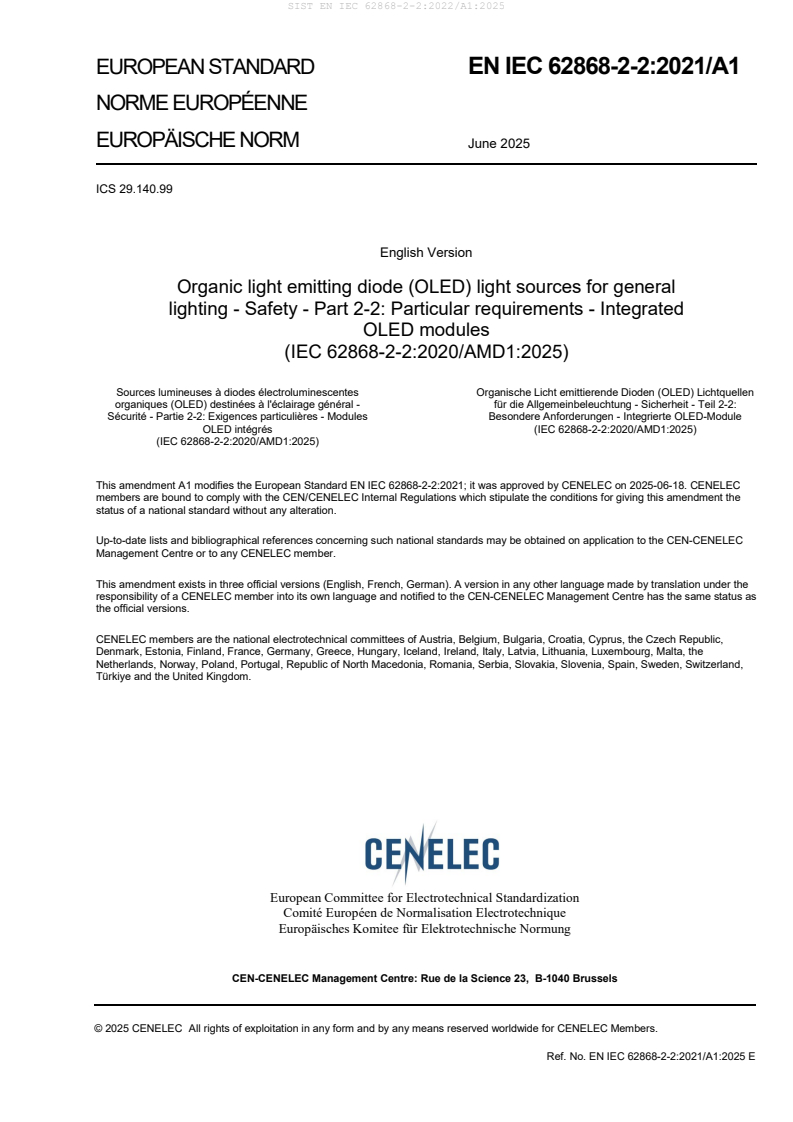
EUROPEAN STANDARD EN IEC 62868-2-2:2021/A1
NORME EUROPÉENNE
EUROPÄISCHE NORM June 2025
ICS 29.140.99
English Version
Organic light emitting diode (OLED) light sources for general
lighting - Safety - Part 2-2: Particular requirements - Integrated
OLED modules
(IEC 62868-2-2:2020/AMD1:2025)
Sources lumineuses à diodes électroluminescentes Organische Licht emittierende Dioden (OLED) Lichtquellen
organiques (OLED) destinées à l'éclairage général - für die Allgemeinbeleuchtung - Sicherheit - Teil 2-2:
Sécurité - Partie 2-2: Exigences particulières - Modules Besondere Anforderungen - Integrierte OLED-Module
OLED intégrés (IEC 62868-2-2:2020/AMD1:2025)
(IEC 62868-2-2:2020/AMD1:2025)
This amendment A1 modifies the European Standard EN IEC 62868-2-2:2021; it was approved by CENELEC on 2025-06-18. CENELEC
members are bound to comply with the CEN/CENELEC Internal Regulations which stipulate the conditions for giving this amendment the
status of a national standard without any alteration.
Up-to-date lists and bibliographical references concerning such national standards may be obtained on application to the CEN-CENELEC
Management Centre or to any CENELEC member.
This amendment exists in three official versions (English, French, German). A version in any other language made by translation under the
responsibility of a CENELEC member into its own language and notified to the CEN-CENELEC Management Centre has the same status as
the official versions.
CENELEC members are the national electrotechnical committees of Austria, Belgium, Bulgaria, Croatia, Cyprus, the Czech Republic,
Denmark, Estonia, Finland, France, Germany, Greece, Hungary, Iceland, Ireland, Italy, Latvia, Lithuania, Luxembourg, Malta, the
Netherlands, Norway, Poland, Portugal, Republic of North Macedonia, Romania, Serbia, Slovakia, Slovenia, Spain, Sweden, Switzerland,
Türkiye and the United Kingdom.
European Committee for Electrotechnical Standardization
Comité Européen de Normalisation Electrotechnique
Europäisches Komitee für Elektrotechnische Normung
CEN-CENELEC Management Centre: Rue de la Science 23, B-1040 Brussels
© 2025 CENELEC All rights of exploitation in any form and by any means reserved worldwide for CENELEC Members.
Ref. No. EN IEC 62868-2-2:2021/A1:2025 E
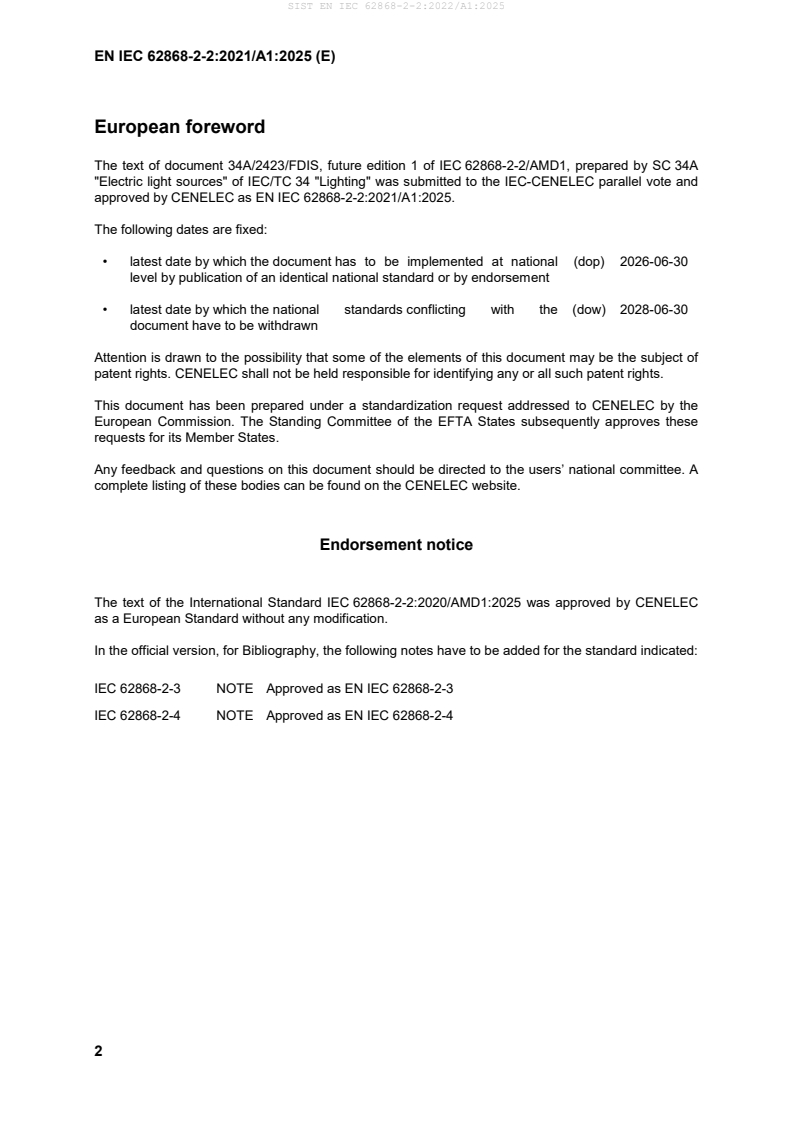
European foreword
The text of document 34A/2423/FDIS, future edition 1 of IEC 62868-2-2/AMD1, prepared by SC 34A
"Electric light sources" of IEC/TC 34 "Lighting" was submitted to the IEC-CENELEC parallel vote and
approved by CENELEC as EN IEC 62868-2-2:2021/A1:2025.
The following dates are fixed:
• latest date by which the document has to be implemented at national (dop) 2026-06-30
level by publication of an identical national standard or by endorsement
• latest date by which the national standards conflicting with the (dow) 2028-06-30
document have to be withdrawn
Attention is drawn to the possibility that some of the elements of this document may be the subject of
patent rights. CENELEC shall not be held responsible for identifying any or all such patent rights.
This document has been prepared under a standardization request addressed to CENELEC by the
European Commission. The Standing Committee of the EFTA States subsequently approves these
requests for its Member States.
Any feedback and questions on this document should be directed to the users’ national committee. A
complete listing of these bodies can be found on the CENELEC website.
Endorsement notice
The text of the International Standard IEC 62868-2-2:2020/AMD1:2025 was approved by CENELEC
as a European Standard without any modification.
In the official version, for Bibliography, the following notes have to be added for the standard indicated:
IEC 62868-2-3 NOTE Approved as EN IEC 62868-2-3
IEC 62868-2-4 NOTE Approved as EN IEC 62868-2-4
Annex ZA
(normative)
Normative references to international publications
with their corresponding European publications
The following documents are referred to in the text in such a way that some or all of their content
constitutes requirements of this document. For dated references, only the edition cited applies. For
undated references, the latest edition of the referenced document (including any amendments)
applies.
NOTE 1 Where an International Publication has been modified by common modifications, indicated by (mod),
the relevant EN/HD applies.
NOTE 2 Up-to-date information on the latest versions of the European Standards listed in this annex is available
here: www.cencenelec.eu.
Delete the following references:
Publication Year Title EN/HD Year
IEC 60598-1 2014 Luminaires - Part 1: General requirements EN IEC 60598-1 2021
and tests
+ AMD1 2017 + A1 2021
IEC 60838-2-2 Miscellaneous lampholders - Part 2-2: EN 60838-2-2
Particular requirements - Connectors for
LED-modules
Add the following reference:
Publication Year Title EN/HD Year
IEC 62868-1 2020 Organic light emitting diode (OLED) Light EN IEC 62868-1 2021
sources for general lighting - Safety - Part
1: General requirements and tests
+ AMD1 2025 + A1 2025
IEC 62868-2-2 ®
Edition 1.0 2025-05
INTERNATIONAL
STANDARD
NORME
INTERNATIONALE
AMENDMENT 1
AMENDEMENT 1
Organic light emitting diode (OLED) light sources for general lighting – Safety –
Part 2-2: Particular requirements – Integrated OLED modules
Sources lumineuses à diodes électroluminescentes organiques (OLED)
destinées à l’éclairage général – Sécurité –
Partie 2-2: Exigences particulières – Modules OLED intégrés
ICS 29.140.99 ISBN 978-2-8327-0409-7
IEC 62868-2-2:2020-08/AMD1:2025-05(en-fr)
– 2 – IEC 62868-2-2:2020/AMD1:2025
© IEC 2025
INTERNATIONAL ELECTROTECHNICAL COMMISSION
____________
ORGANIC LIGHT EMITTING DIODE (OLED) LIGHT
SOURCES FOR GENERAL LIGHTING – SAFETY –
Part 2-2: Particular requirements – Integrated OLED modules
AMENDMENT 1
FOREWORD
1) The International Electrotechnical Commission (IEC) is a worldwide organization for standardization comprising
all national electrotechnical committees (IEC National Committees). The object of IEC is to promote international
co-operation on all questions concerning standardization in the electrical and electronic fields. To this end and
in addition to other activities, IEC publishes International Standards, Technical Specifications, Technical Reports,
Publicly Available Specifications (PAS) and Guides (hereafter referred to as "IEC Publication(s)"). Their
preparation is entrusted to technical committees; any IEC National Committee interested in the subject dealt with
may participate in this preparatory work. International, governmental and non-governmental organizations liaising
with the IEC also participate in this preparation. IEC collaborates closely with the International Organization for
Standardization (ISO) in accordance with conditions determined by agreement between the two organizations.
2) The formal decisions or agreements of IEC on technical matters express, as nearly as possible, an international
consensus of opinion on the relevant subjects since each technical committee has representation from all
interested IEC National Committees.
3) IEC Publications have the form of recommendations for international use and are accepted by IEC National
Committees in that sense. While all reasonable efforts are made to ensure that the technical content of IEC
Publications is accurate, IEC cannot be held responsible for the way in which they are used or for any
misinterpretation by any end user.
4) In order to promote international uniformity, IEC National Committees undertake to
...