

oSIST prEN ISO 787-18:2026
(Main)General methods of test for pigments and extenders - Part 18: Determination of residue on sieve - Mechanical flushing procedure (ISO/DIS 787-18:2026)
General Information
- Abstract
The method specified can also be applied to the examination of other powders or granules which are insoluble in water. It is neither applicable to hydrophobic nor pelletized materials. In the test apparatus the material under test, dispersed in water, is brought into centrifugal motion by a system of rotating jets of water. he water flushes the fine particles through the sieve, the coarse particles being retained on the sieve. The residue on the sieve is dried and weighed. - Cancels and replaces ISO 787/18-1973 and constitutes its technical revision.
- Status
- Not Published
- Public Enquiry End Date
- 01-Jun-2026
- Technical Committee
- PIP - Pigments and extenders
- Current Stage
- 4020 - Public enquire (PE) (Adopted Project)
- Start Date
- 08-Apr-2026
- Due Date
- 26-Aug-2026
- Completion Date
- 06-Aug-2026

Overview
oSIST prEN ISO 787-18:2026:2026 sets out a standardized method for the determination of residue on a sieve from samples of pigments and extenders, using a mechanical flushing procedure. Developed by the European Committee for Standardization (CEN) in parallel with ISO, this draft standard revises and replaces ISO 787/18-1973, providing updated procedures that enhance consistency, reliability, and reproducibility for assessing the particle size distribution and purity of pigments, extenders, and other water-insoluble powders or granules. The method employs centrifugal motion and flushing with water jets to separate fine and coarse particles, allowing the coarse residue to be collected, dried, and weighed for quantitative analysis.
Key Topics
- Scope: Applies to pigments, extenders, and other water-insoluble powders or granules. The method is not applicable to hydrophobic or pelletized materials.
- Principle: The sample is dispersed in water and subjected to centrifugal action by rotating water jets. Fine particles pass through the sieve, while coarse residue is retained. After flushing, the residue is dried and weighed.
- Test Apparatus:
- Mechanical flushing device with rotating jets
- Sieve of specified mesh (e.g., 45 µm), conforming to ISO 565
- Oven (105 ± 2 °C), analytical balance, and desiccator
- Sampling and Preparation:
- Representative sampling as per ISO 15528
- Preparation of aqueous dispersions, with wetting agents as needed for difficult-to-wet materials
- Procedure:
- Duplicate determinations are required
- Clearly defined time and method for flushing and drying
- Expression of Results: Residue reported in parts per million (ppm) based on the mass of the sample tested
- Reporting Requirements: Documentation includes product identification, testing variables, deviations, and results according to the method
Applications
The mechanical flushing procedure described in oSIST prEN ISO 787-18:2026 is extensively used in the paints, coatings, plastics, inks, and construction industries. Its key applications include:
- Quality Control: Ensures pigments and extenders meet specified fineness, purity, and performance characteristics
- Compliance Assessment: Provides data for meeting product specifications and regulatory requirements
- Research and Development: Assists in the comparison of different pigment batches and evaluation of process changes
- Inspection of Raw Materials: Detects contamination or oversized particles in powders, enhancing product consistency
- Supplier Qualification: Supports supplier evaluation through standardized residue analysis
By providing a harmonized testing approach, this standard helps manufacturers and laboratories achieve comparable results, streamline material validation, and meet international quality requirements.
Related Standards
A number of related standards support and complement oSIST prEN ISO 787-18:2026:
- ISO 565: Test sieves - Nominal sizes of openings, crucial for specifying the correct sieve mesh
- ISO 787-7: Manual determination of residue on sieve, offering an alternative method for comparison
- ISO 15528: Sampling of paints, varnishes, and raw materials, ensuring representativeness of test samples
- ISO 18451-1: Terminology for pigments, dyestuffs, and extenders, ensuring consistent use of terms in testing and reporting
Organizations implementing oSIST prEN ISO 787-18:2026 benefit from a robust quality management system, improved product performance verification, and smoother global trade due to compliance with widely recognized standards for pigment and extender testing. By using this mechanical flushing procedure, laboratories can produce reliable, reproducible particle size distribution data essential for modern pigment and powder technologies.
Relations
- Effective Date
- 01-May-2026
Frequently Asked Questions
oSIST prEN ISO 787-18:2026 is a draft published by the Slovenian Institute for Standardization (SIST). Its full title is "General methods of test for pigments and extenders - Part 18: Determination of residue on sieve - Mechanical flushing procedure (ISO/DIS 787-18:2026)". This standard covers: The method specified can also be applied to the examination of other powders or granules which are insoluble in water. It is neither applicable to hydrophobic nor pelletized materials. In the test apparatus the material under test, dispersed in water, is brought into centrifugal motion by a system of rotating jets of water. he water flushes the fine particles through the sieve, the coarse particles being retained on the sieve. The residue on the sieve is dried and weighed. - Cancels and replaces ISO 787/18-1973 and constitutes its technical revision.
The method specified can also be applied to the examination of other powders or granules which are insoluble in water. It is neither applicable to hydrophobic nor pelletized materials. In the test apparatus the material under test, dispersed in water, is brought into centrifugal motion by a system of rotating jets of water. he water flushes the fine particles through the sieve, the coarse particles being retained on the sieve. The residue on the sieve is dried and weighed. - Cancels and replaces ISO 787/18-1973 and constitutes its technical revision.
oSIST prEN ISO 787-18:2026 is classified under the following ICS (International Classification for Standards) categories: 87.060.10 - Pigments and extenders. The ICS classification helps identify the subject area and facilitates finding related standards.
oSIST prEN ISO 787-18:2026 has the following relationships with other standards: It is inter standard links to SIST EN ISO 787-18:1997. Understanding these relationships helps ensure you are using the most current and applicable version of the standard.
oSIST prEN ISO 787-18:2026 is available in PDF format for immediate download after purchase. The document can be added to your cart and obtained through the secure checkout process. Digital delivery ensures instant access to the complete standard document.
Standards Content (Sample)
SLOVENSKI STANDARD
01-maj-2026
Splošne preskusne metode za pigmente in polnila - 18. del: Določanje ostanka na
situ - Mehanski postopek izpiranja (ISO/DIS 787-18:2026)
General methods of test for pigments and extenders - Part 18: Determination of residue
on sieve - Mechanical flushing procedure (ISO/DIS 787-18:2026)
Allgemeine Prüfverfahren für Pigmente und Füllstoffe - Teil18: Bestimmung des
Siebrückstandes - Mechanisches Spülverfahren (ISO/DIS 787-18:2026)
Méthodes générales d'essai des pigments et matières de charge - Partie 18:
Détermination du refus sur tamis - Méthode mécanique avec liquide d'entraînement
(ISO/DIS 787-18:2026)
Ta slovenski standard je istoveten z: prEN ISO 787-18
ICS:
87.060.10 Pigmenti in polnila Pigments and extenders
2003-01.Slovenski inštitut za standardizacijo. Razmnoževanje celote ali delov tega standarda ni dovoljeno.
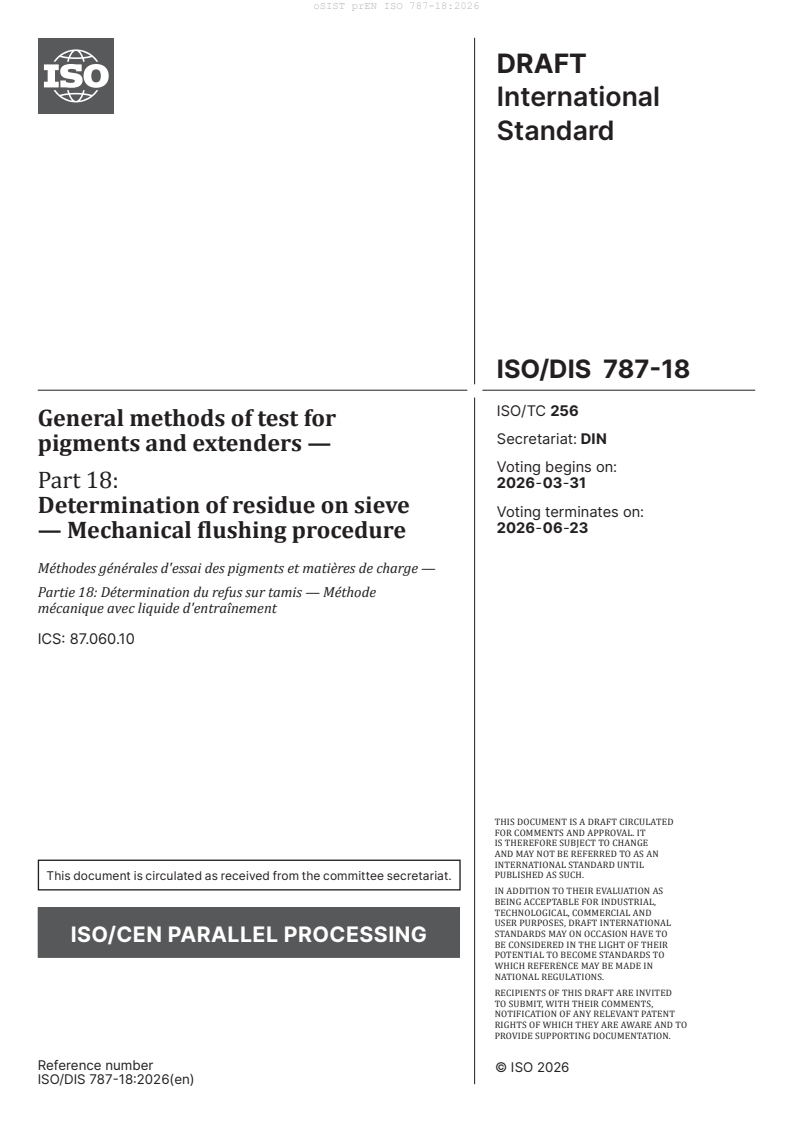
DRAFT
International
Standard
ISO/DIS 787-18
ISO/TC 256
General methods of test for
Secretariat: DIN
pigments and extenders —
Voting begins on:
Part 18: 2026-03-31
Determination of residue on sieve
Voting terminates on:
2026-06-23
— Mechanical flushing procedure
Méthodes générales d'essai des pigments et matières de charge —
Partie 18: Détermination du refus sur tamis — Méthode
mécanique avec liquide d'entraînement
ICS: 87.060.10
THIS DOCUMENT IS A DRAFT CIRCULATED
FOR COMMENTS AND APPROVAL. IT
IS THEREFORE SUBJECT TO CHANGE
AND MAY NOT BE REFERRED TO AS AN
INTERNATIONAL STANDARD UNTIL
PUBLISHED AS SUCH.
This document is circulated as received from the committee secretariat.
IN ADDITION TO THEIR EVALUATION AS
BEING ACCEPTABLE FOR INDUSTRIAL,
TECHNOLOGICAL, COMMERCIAL AND
USER PURPOSES, DRAFT INTERNATIONAL
STANDARDS MAY ON OCCASION HAVE TO
ISO/CEN PARALLEL PROCESSING
BE CONSIDERED IN THE LIGHT OF THEIR
POTENTIAL TO BECOME STANDARDS TO
WHICH REFERENCE MAY BE MADE IN
NATIONAL REGULATIONS.
RECIPIENTS OF THIS DRAFT ARE INVITED
TO SUBMIT, WITH THEIR COMMENTS,
NOTIFICATION OF ANY RELEVANT PATENT
RIGHTS OF WHICH THEY ARE AWARE AND TO
PROVIDE SUPPORTING DOCUMENTATION.
Reference number
ISO/DIS 787-18:2026(en)
DRAFT
ISO/DIS 787-18:2026(en)
International
Standard
ISO/DIS 787-18
ISO/TC 256
General methods of test for
Secretariat: DIN
pigments and extenders —
Voting begins on:
Part 18:
Determination of residue on sieve
Voting terminates on:
— Mechanical flushing procedure
Méthodes générales d'essai des pigments et matières de charge —
Partie 18: Détermination du refus sur tamis — Méthode
mécanique avec liquide d'entraînement
ICS: 87.060.10
THIS DOCUMENT IS A DRAFT CIRCULATED
FOR COMMENTS AND APPROVAL. IT
IS THEREFORE SUBJECT TO CHANGE
AND MAY NOT BE REFERRED TO AS AN
INTERNATIONAL STANDARD UNTIL
PUBLISHED AS SUCH.
This document is circulated as received from the committee secretariat.
IN ADDITION TO THEIR EVALUATION AS
BEING ACCEPTABLE FOR INDUSTRIAL,
© ISO 2026
TECHNOLOGICAL, COMMERCIAL AND
USER PURPOSES, DRAFT INTERNATIONAL
All rights reserved. Unless otherwise specified, or required in the context of its implementation, no part of this publication may
STANDARDS MAY ON OCCASION HAVE TO
ISO/CEN PARALLEL PROCESSING
be reproduced or utilized otherwise in any form or by any means, electronic or mechanical, including photocopying, or posting on
BE CONSIDERED IN THE LIGHT OF THEIR
the internet or an intranet, without prior written permission. Permission can be requested from either ISO at the address below
POTENTIAL TO BECOME STANDARDS TO
WHICH REFERENCE MAY BE MADE IN
or ISO’s member body in the country of the requester.
NATIONAL REGULATIONS.
ISO copyright office
RECIPIENTS OF THIS DRAFT ARE INVITED
CP 401 • Ch. de Blandonnet 8
TO SUBMIT, WITH THEIR COMMENTS,
CH-1214 Vernier, Geneva
NOTIFICATION OF ANY RELEVANT PATENT
Phone: +41 22 749 01 11
RIGHTS OF WHICH THEY ARE AWARE AND TO
PROVIDE SUPPORTING DOCUMENTATION.
Email: copyright@iso.org
Website: www.iso.org
Published in Switzerland Reference number
ISO/DIS 787-18:2026(en)
ii
ISO/DIS 787-18:2026(en)
Contents Page
Foreword .iv
Introduction .v
1 Scope . 1
2 Normative references . 1
3 Terms and definitions . 1
4 Principle . 1
5 Materials . 2
6 Apparatus . 2
7 Sampling . 4
8 Procedure . 4
8.1 Number of determinations .4
8.2 Test portion .4
8.3 Preparation of the dispersion .4
8.4 Determination .4
8.5 Examination of the residue .5
9 Expression of results . 5
10 Test report . 5
iii
ISO/DIS 787-18:2026(en)
Foreword
ISO (the International Organization for Standardization) is a worldwide federation of national standards
bodies (ISO member bodies). The work of preparing International Standards is normally carried out through
ISO technical committees. Each member body interested in a subject for which a technical committee
has been established has the right to be represented on that committee. International organizations,
governmental and non-governmental, in liaison with ISO, also take part in the work. ISO collaborates closely
with the International Electrotechnical Commission (IEC) on all matters of electrotechnical standardization.
The procedures used to develop this document and those intended for its further maintenance are described
in the ISO/IEC Directives, Part 1. In particular, the different approval criteria needed for the different types
of ISO documents should be noted. This document was drafted in accordance with the editorial rules of the
ISO/IEC Directives, Part 2 (see www.iso.org/directives).
ISO draws attention to the possibility that the implementation of this document may involve the use of (a)
patent(s). ISO takes no position concerning the evidence, validity or applicability of any claimed patent
rights in respect thereof. As of the date of publication of this document, ISO had not received notice of (a)
patent(s) which may be required to implement this document. However, implementers are cautioned that
this may not represent the latest information, which may be obtained from the patent database available at
www.iso.org/patents. ISO shall not be held responsible for identifying any or all such patent rights.
Any trade name used in this document is information given for the convenience of users and does not
constitute an endorsement.
For an explanation of the voluntary nature of standards, the meaning of ISO specific terms and expressions
related to conformity assessment, as well as information about ISO's adherence to the World Trade
Organization (WTO) principles in the Technical Barriers to Trade (TBT), see www.iso.org/iso/foreword.html.
This document was prepared by Technical Committee ISO/TC 256, Pigments, dyestuffs and extenders.
This third edition cancels and replaces the second edition (ISO 787-18:1983), which has been technically
revised.
The main changes are as follows:
— beaded pigments can also be tested for sieve residue in this way;
— deagglomeration of sieve residues can be completed by rubbing them on the sieve;
— the result is given in parts per million (ppm) instead of percentage %;
— information on how to state the result less than 0,001 % has been deleted;
— the normative references have been updated.
A list of all parts in the ISO 787 series can be found on the ISO website.
Any feedback or questions on this document should be directed to the user’s national standards body. A
complete listing of these bodies can be found at www.iso.org/members.html.
iv
ISO/DIS 787-18:2026(en)
Introduction
This document specifies a general method for determining the residue on a sieve from a sample of pigment
or extender dispersed in water, using a mechanical flushing proc
...