


SIST EN 12312-5:2021
(Main)Aircraft ground support equipment - Specific requirements - Part 5: Aircraft fuelling equipment
Aircraft ground support equipment - Specific requirements - Part 5: Aircraft fuelling equipment
This document specifies the technical requirements to minimize the hazards listed in Clause 4 which can arise during the commissioning, operation and maintenance of AFE when used as intended, including misuse reasonably foreseeable by the manufacturer, when carried out in accordance with the specifications given by the manufacturer or his authorized representative. It also takes into account some performance requirements recognized as essential by authorities, aircraft and ground support equipment (GSE) manufacturers as well as airlines, airports and fuelling companies.
This document applies to all types of aircraft fuelling equipment:
a) aircraft refuellers,
b) hydrant dispensers,
c) defuellers,
d) hydrant pit servicing vehicles,
e) pit cleaner vehicles, and
f) stationary dispensing units
intended to service aircraft with aviation fuels and to be operated on airfields, heliports and other aircraft refuelling related areas such as maintenance bases.
This document does not apply to:
g) AFE whose only power source for aircraft refuelling is directly applied manual effort,
h) hydrant systems, tank farms, pipework and underground tanks,
i) specific hazards due to the operation of the AFE in a potentially explosive atmosphere, and
j) built-in fire extinguisher systems.
No extra requirements on noise and vibration are provided other than those in EN 1915-3:2004+A1:2009 and EN 1915- 4:2004+A1:2009.
NOTE EN 1915-3:2004+A1:2009 and EN 1915-4:2004+A1:2009 provide the general GSE vibration and noise requirements.
This document does not deal with hazards in respect to a standard automotive chassis and from other vehicles on the apron.
This document is not applicable to AFE which are manufactured before the date of publication of this document by CEN.
This part of the EN 12312 series when used in conjunction with EN 1915-1:2013, EN 1915-2:2001+A1:2009, EN 1915-3:2004+A1:2009 (for vehicles) and EN 1915-4:2004+A1:2009 provides the requirements for AFE.
Luftfahrt-Bodengeräte - Besondere Anforderungen - Teil 5: Betankungseinrichtungen für Luftfahrzeuge
Dieses Dokument legt die technischen Anforderungen zur Minimierung der in Abschnitt 4 aufgelisteten Gefährdungen fest, die bei Inbetriebnahme, Betrieb und Wartung von AFE auftreten können, wenn diese bestimmungsgemäß genutzt werden, einschließlich einer vom Hersteller vernünftigerweise vorhersehbaren Fehlanwendung, wenn diese in Übereinstimmung mit den Anweisungen des Herstellers oder seines Beauftragten ausgeführt werden. Sie berücksichtigt auch einige Funktions- und Gestaltungsanforderungen, die von offiziellen Stellen, Luftfahrzeug- und Bodengeräteherstellern sowie von Luftverkehrsgesellschaften, Flughafenbetreibern und Betankungsgesellschaften als wesentlich erachtet wurden.
Dieses Dokument gilt für alle Typen von Betankungseinrichtungen für Luftfahrzeuge:
a) Flugfeldtankfahrzeuge;
b) Dispenser;
c) Rücktankfahrzeuge;
d) Hydrantenwartungsfahrzeuge;
e) Hydrantenreinigungsfahrzeuge;
f) stationäre Betankungseinheiten;
die dazu bestimmt sind, Luftfahrzeuge mit Flugkraftstoff zu versorgen, und die für den Betrieb auf Flugfeldern, Hubschrauberlandeplätzen und anderen Bereichen für die Luftfahrzeugbetankung wie Wartungsplätzen vorgesehen sind.
Dieses Dokument gilt nicht für:
g) AFE, deren einzige Kraftquelle für das Luftfahrzeugbetanken die unmittelbar angewandte menschliche Arbeitskraft ist;
h) Hydrantensysteme, Tanklager, festverlegte Leitungen und Unterflurtanks;
i) spezifische Gefährdungen durch den Betrieb dieser Geräte in potentiell explosiver Atmosphäre;
j) eingebaute Feuerlöschsysteme.
Es gelten keine anderen Anforderungen an Lärm und Schwingungen, als in EN 1915-3:2004+A1:2009 und EN 1915-4:2004+A1:2009 angegeben.
ANMERKUNG EN 1915-3:2004+A1:2009 und EN 1915-4:2004+A1:2009 enthalten die allgemeinen GSE Schwingungs- und Lärmanforderungen.
Dieses Dokument behandelt keine Gefährdungen, die von einem Serienfahrgestell und von anderen Fahrzeugen auf dem Vorfeld ausgehen.
Dieses Dokument gilt nicht für Betankungseinrichtungen für Luftfahrzeuge, die vor der Veröffentlichung dieser Norm durch CEN hergestellt wurden.
Dieser Teil der Normenreihe EN 12312 legt die Anforderungen für AFE fest, wenn er in Verbindung mit EN 1915-1:2013, EN 1915- 2:2001+A1:2009, EN 1915-3:2004+A1:2009 (für Fahrzeuge) und EN 1915-4:2004+A1:2009 angewendet wird.
Matériel au sol pour aéronefs - Exigences particulières - Partie 5 : Matériels d'avitaillement en carburant
Le présent document spécifie les exigences techniques pour réduire à un minimum les situations dangereuses énumérées à l'Article 4 qui pourraient survenir lors de la mise en service, l'exploitation et la maintenance des AFE lorsqu'ils sont utilisés tel que préconisé, y compris la mauvaise utilisation raisonnablement prévisible par le fabricant, et lorsqu'ils sont réalisés selon les spécifications émises par le constructeur ou son représentant autorisé. Il prend également en compte certaines exigences de performances reconnues essentielles par les autorités, les fabricants d'aéronefs et d'équipement de support au sol (GSE, ground support equipment) ainsi que les compagnies aériennes, les aéroports et les sociétés pétrolières.
Le présent document est applicable à tous types de matériels d'avitaillement en carburant :
a) avitailleurs d'aéronefs ;
b) oléoserveurs ;
c) véhicules de reprise ;
d) véhicules de service des prises d'oléoréseau ;
e) véhicules nettoyeurs de prises d'oléoréseau ; et
f) unités de distribution fixes
destinés à l'approvisionnent des aéronefs en carburants d'aviation et à l'utilisation sur les aéroports, héliports et autres zones d'avitaillement telles que les bases de maintenance.
Le présent document ne s'applique pas aux :
g) AFE dont la seule source d'énergie pour l'avitaillement de l'aéronef est une action manuelle directe ;
h) oléoréseaux, parcs de réservoirs de stockage, tuyauteries et réservoirs enterrés ;
i) dangers spécifiques liés à l'emploi de l'AFE en atmosphère potentiellement explosive ; et
j) systèmes d'extinction d'incendie intégrés.
La présente norme ne spécifie pas d'exigences autres que celles de l’EN 1915-3:2004+A1:2009 et l’EN 1915-4:2004+A1:2009 pour les dangers causés par le bruit et les vibrations.
NOTE L’EN 1915-3:2004+A1:2009 et l’EN 1915-4:2004+A1:2009 fournissent les exigences générales de bruit et de vibrations des GSE.
Le présent document ne traite pas des dangers liés à un châssis automobile normalisé et aux autres véhicules sur l'aire de stationnement.
Le présent document ne s'applique pas aux AFE fabriqués avant la date de publication de ce document par le CEN.
Cette partie de la série EN 12312, lorsqu’elle est utilisée conjointement avec l’EN 1915-1:2013, l’EN 1915-2:2001+A1:2009, l’EN 1915-3:200
Podporna oprema na tleh za letalski promet - Posebne zahteve - 5. del: Oprema za oskrbo letal z gorivom
General Information
- Status
- Withdrawn
- Public Enquiry End Date
- 26-Jun-2019
- Publication Date
- 16-Mar-2021
- Withdrawal Date
- 29-Jan-2025
- Technical Committee
- I13 - Imaginarni 13
- Current Stage
- 9900 - Withdrawal (Adopted Project)
- Start Date
- 30-Jan-2025
- Due Date
- 22-Feb-2025
- Completion Date
- 30-Jan-2025
Relations
- Effective Date
- 10-Mar-2021
- Effective Date
- 20-Nov-2024
- Effective Date
- 30-Nov-2022
- Effective Date
- 26-Jul-2017



Frequently Asked Questions
SIST EN 12312-5:2021 is a standard published by the Slovenian Institute for Standardization (SIST). Its full title is "Aircraft ground support equipment - Specific requirements - Part 5: Aircraft fuelling equipment". This standard covers: This document specifies the technical requirements to minimize the hazards listed in Clause 4 which can arise during the commissioning, operation and maintenance of AFE when used as intended, including misuse reasonably foreseeable by the manufacturer, when carried out in accordance with the specifications given by the manufacturer or his authorized representative. It also takes into account some performance requirements recognized as essential by authorities, aircraft and ground support equipment (GSE) manufacturers as well as airlines, airports and fuelling companies. This document applies to all types of aircraft fuelling equipment: a) aircraft refuellers, b) hydrant dispensers, c) defuellers, d) hydrant pit servicing vehicles, e) pit cleaner vehicles, and f) stationary dispensing units intended to service aircraft with aviation fuels and to be operated on airfields, heliports and other aircraft refuelling related areas such as maintenance bases. This document does not apply to: g) AFE whose only power source for aircraft refuelling is directly applied manual effort, h) hydrant systems, tank farms, pipework and underground tanks, i) specific hazards due to the operation of the AFE in a potentially explosive atmosphere, and j) built-in fire extinguisher systems. No extra requirements on noise and vibration are provided other than those in EN 1915-3:2004+A1:2009 and EN 1915- 4:2004+A1:2009. NOTE EN 1915-3:2004+A1:2009 and EN 1915-4:2004+A1:2009 provide the general GSE vibration and noise requirements. This document does not deal with hazards in respect to a standard automotive chassis and from other vehicles on the apron. This document is not applicable to AFE which are manufactured before the date of publication of this document by CEN. This part of the EN 12312 series when used in conjunction with EN 1915-1:2013, EN 1915-2:2001+A1:2009, EN 1915-3:2004+A1:2009 (for vehicles) and EN 1915-4:2004+A1:2009 provides the requirements for AFE.
This document specifies the technical requirements to minimize the hazards listed in Clause 4 which can arise during the commissioning, operation and maintenance of AFE when used as intended, including misuse reasonably foreseeable by the manufacturer, when carried out in accordance with the specifications given by the manufacturer or his authorized representative. It also takes into account some performance requirements recognized as essential by authorities, aircraft and ground support equipment (GSE) manufacturers as well as airlines, airports and fuelling companies. This document applies to all types of aircraft fuelling equipment: a) aircraft refuellers, b) hydrant dispensers, c) defuellers, d) hydrant pit servicing vehicles, e) pit cleaner vehicles, and f) stationary dispensing units intended to service aircraft with aviation fuels and to be operated on airfields, heliports and other aircraft refuelling related areas such as maintenance bases. This document does not apply to: g) AFE whose only power source for aircraft refuelling is directly applied manual effort, h) hydrant systems, tank farms, pipework and underground tanks, i) specific hazards due to the operation of the AFE in a potentially explosive atmosphere, and j) built-in fire extinguisher systems. No extra requirements on noise and vibration are provided other than those in EN 1915-3:2004+A1:2009 and EN 1915- 4:2004+A1:2009. NOTE EN 1915-3:2004+A1:2009 and EN 1915-4:2004+A1:2009 provide the general GSE vibration and noise requirements. This document does not deal with hazards in respect to a standard automotive chassis and from other vehicles on the apron. This document is not applicable to AFE which are manufactured before the date of publication of this document by CEN. This part of the EN 12312 series when used in conjunction with EN 1915-1:2013, EN 1915-2:2001+A1:2009, EN 1915-3:2004+A1:2009 (for vehicles) and EN 1915-4:2004+A1:2009 provides the requirements for AFE.
SIST EN 12312-5:2021 is classified under the following ICS (International Classification for Standards) categories: 49.100 - Ground service and maintenance equipment. The ICS classification helps identify the subject area and facilitates finding related standards.
SIST EN 12312-5:2021 has the following relationships with other standards: It is inter standard links to SIST EN 12312-5:2005+A1:2009, SIST EN 12312-5:2021+A1:2025, SIST EN 12312-5:2021/kFprA1:2024, SIST EN 12312-5:2005+A1:2009. Understanding these relationships helps ensure you are using the most current and applicable version of the standard.
SIST EN 12312-5:2021 is associated with the following European legislation: EU Directives/Regulations: 2006/42/EC; Standardization Mandates: M/396. When a standard is cited in the Official Journal of the European Union, products manufactured in conformity with it benefit from a presumption of conformity with the essential requirements of the corresponding EU directive or regulation.
SIST EN 12312-5:2021 is available in PDF format for immediate download after purchase. The document can be added to your cart and obtained through the secure checkout process. Digital delivery ensures instant access to the complete standard document.
Standards Content (Sample)
SLOVENSKI STANDARD
01-maj-2021
Nadomešča:
SIST EN 12312-5:2005+A1:2009
Podporna oprema na tleh za letalski promet - Posebne zahteve - 5. del: Oprema za
oskrbo letal z gorivom
Aircraft ground support equipment - Specific requirements - Part 5: Aircraft fuelling
equipment
Luftfahrt-Bodengeräte - Besondere Anforderungen - Teil 5: Betankungseinrichtungen für
Luftfahrzeuge
Matériel au sol pour aéronefs - Exigences particulières - Partie 5 : Matériels
d'avitaillement en carburant
Ta slovenski standard je istoveten z: EN 12312-5:2021
ICS:
49.100 Oprema za servis in Ground service and
vzdrževanje na tleh maintenance equipment
2003-01.Slovenski inštitut za standardizacijo. Razmnoževanje celote ali delov tega standarda ni dovoljeno.
EN 12312-5
EUROPEAN STANDARD
NORME EUROPÉENNE
March 2021
EUROPÄISCHE NORM
ICS 49.100 Supersedes EN 12312-5:2005+A1:2009
English Version
Aircraft ground support equipment - Specific
requirements - Part 5: Aircraft fuelling equipment
Matériel au sol pour aéronefs - Exigences particulières Luftfahrt-Bodengeräte - Besondere Anforderungen -
- Partie 5 : Matériels d'avitaillement en carburant Teil 5: Betankungseinrichtungen für Luftfahrzeuge
This European Standard was approved by CEN on 18 January 2021.
CEN members are bound to comply with the CEN/CENELEC Internal Regulations which stipulate the conditions for giving this
European Standard the status of a national standard without any alteration. Up-to-date lists and bibliographical references
concerning such national standards may be obtained on application to the CEN-CENELEC Management Centre or to any CEN
member.
This European Standard exists in three official versions (English, French, German). A version in any other language made by
translation under the responsibility of a CEN member into its own language and notified to the CEN-CENELEC Management
Centre has the same status as the official versions.
CEN members are the national standards bodies of Austria, Belgium, Bulgaria, Croatia, Cyprus, Czech Republic, Denmark, Estonia,
Finland, France, Germany, Greece, Hungary, Iceland, Ireland, Italy, Latvia, Lithuania, Luxembourg, Malta, Netherlands, Norway,
Poland, Portugal, Republic of North Macedonia, Romania, Serbia, Slovakia, Slovenia, Spain, Sweden, Switzerland, Turkey and
United Kingdom.
EUROPEAN COMMITTEE FOR STANDARDIZATION
COMITÉ EUROPÉEN DE NORMALISATION
EUROPÄISCHES KOMITEE FÜR NORMUNG
CEN-CENELEC Management Centre: Rue de la Science 23, B-1040 Brussels
© 2021 CEN All rights of exploitation in any form and by any means reserved Ref. No. EN 12312-5:2021 E
worldwide for CEN national Members.
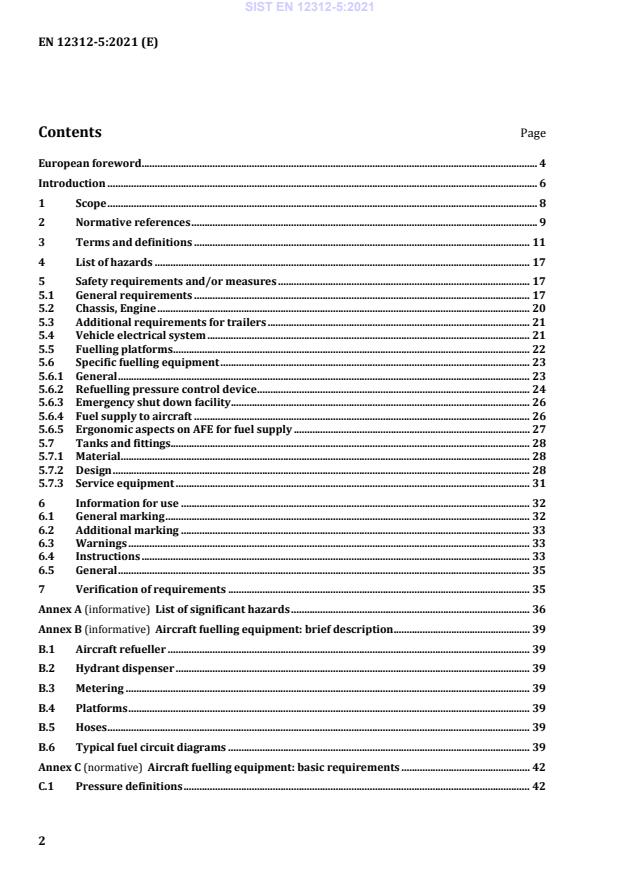
Contents Page
European foreword . 4
Introduction . 6
1 Scope . 8
2 Normative references . 9
3 Terms and definitions . 11
4 List of hazards . 17
5 Safety requirements and/or measures . 17
5.1 General requirements . 17
5.2 Chassis, Engine . 20
5.3 Additional requirements for trailers . 21
5.4 Vehicle electrical system . 21
5.5 Fuelling platforms . 22
5.6 Specific fuelling equipment . 23
5.6.1 General . 23
5.6.2 Refuelling pressure control device . 24
5.6.3 Emergency shut down facility . 26
5.6.4 Fuel supply to aircraft . 26
5.6.5 Ergonomic aspects on AFE for fuel supply . 27
5.7 Tanks and fittings. 28
5.7.1 Material . 28
5.7.2 Design . 28
5.7.3 Service equipment . 31
6 Information for use . 32
6.1 General marking . 32
6.2 Additional marking . 33
6.3 Warnings . 33
6.4 Instructions . 33
6.5 General . 35
7 Verification of requirements . 35
Annex A (informative) List of significant hazards . 36
Annex B (informative) Aircraft fuelling equipment: brief description . 39
B.1 Aircraft refueller . 39
B.2 Hydrant dispenser . 39
B.3 Metering . 39
B.4 Platforms . 39
B.5 Hoses . 39
B.6 Typical fuel circuit diagrams . 39
Annex C (normative) Aircraft fuelling equipment: basic requirements . 42
C.1 Pressure definitions . 42
C.2 Filtration . 42
Annex D (normative) Ancillary equipment to access the aircraft fuelling panel (refuelling
ladder) . 43
D.1 General . 43
D.2 Categories of ancillary equipment: . 43
D.2.1 Category 1: Stair type step . 43
D.2.2 Category 2: Portable, foldable stepladder . 43
D.2.3 Category 3: Mobile stepladder with platform . 43
D.2.4 Category 4: Towable fuelling platform with access . 43
D.3 Additional requirements . 44
D.3.1 Additional requirements for all categories . 44
D.3.2 Additional requirements for portable, foldable stepladders (category 2) . 44
D.3.3 Additional requirements for mobile stepladder with platform (category 3) . 45
D.3.4 Additional requirements for towable fuelling platform with access (category 4) . 45
Annex E (informative) Requirements in ADR . 47
Annex ZA (informative) Relationship between this European Standard and the essential
requirements of EU Directive 2006/42/EC aimed to be covered . 48
Bibliography . 52
European foreword
This document (EN 12312-5:2021) has been prepared by Technical Committee CEN/TC 274 “Aircraft
ground support equipment”, the secretariat of which is held by DIN.
This European Standard shall be given the status of a national standard, either by publication of an
identical text or by endorsement, at the latest by September 2021, and conflicting national standards
shall be withdrawn at the latest by September 2021.
Attention is drawn to the possibility that some of the elements of this document may be the subject of
patent rights. CEN shall not be held responsible for identifying any or all such patent rights.
This document supersedes EN 12312-5:2005+A1:2009.
This document has been prepared under a mandate given to CEN by the European Commission and the
European Free Trade Association, and supports essential requirements of EU Directive 2006/42/EC on
machinery.
For relationship with EU Directive 2006/42/EC on machinery, see informative Annex ZA, which is an
integral part of this document.
EN 12312, Aircraft ground support equipment — Specific requirements, consists of the following parts:
— Part 1: Passenger stairs;
— Part 2: Catering vehicles;
— Part 3: Conveyor belt vehicles;
— Part 4: Passenger boarding bridges;
— Part 5: Aircraft fuelling equipment (this document);
— Part 6: Deicers and de-icing/anti-icing equipment;
— Part 7: Air-craft movement equipment;
— Part 8: Maintenance or service stairs and platforms;
— Part 9: Container/Pallet loaders;
— Part 10: Container/Pallet transfer transporters;
— Part 11: Container/Pallet dollies and loose load trailers;
— Part 12: Potable water service equipment;
— Part 13: Lavatory service equipment;
— Part 14: Disabled/incapacitated passenger boarding vehicles;
— Part 15: Baggage and equipment tractors;
— Part 16: Air start equipment;
— Part 17: Air conditioning equipment;
— Part 18: Nitrogen or Oxygen units;
— Part 19: Aircraft jacks, axle jacks and hydraulic tail stanchions;
— Part 20: Electrical ground power units.
Annexes C and D are normative; Annexes A, B, E and ZA are informative.
The main changes compared to the previous edition EN 12312-5:2005+A1:2009 are the following ones:
a) Amendment A1:2009 was incorporated;
b) the Introduction was updated in relation to the deviation from recommended criteria;
c) the Scope was updated to cover reasonably foreseeable misuse;
d) Clause 2, Normative references, was updated;
e) the list of hazards was updated to exclude hazards due to traffic and repair and was moved to
Annex A;
f) Clause 5, Safety requirements and/or measures, was completely revised and changed;
g) Subclause 5.6.5 Ergonomic aspects on AFE for fuel supply, was added
h) Subclause 6.1, Marking, and Subclause 6.2 Additional marking, were changed;
i) Clause 7, Verification of requirements, was updated;
j) Annex D, Ancillary equipment to access the aircraft fuelling panel (refuelling ladder), was added;
k) Annex ZA referring to the Machinery Directive 98/37/EC was replaced by Annex ZA referring to the
new Machinery Directive 2006/42/EC.
According to the CEN-CENELEC Internal Regulations, the national standards organisations of the
following countries are bound to implement this European Standard: Austria, Belgium, Bulgaria,
Croatia, Cyprus, Czech Republic, Denmark, Estonia, Finland, France, Germany, Greece, Hungary, Iceland,
Ireland, Italy, Latvia, Lithuania, Luxembourg, Malta, Netherlands, Norway, Poland, Portugal, Republic of
North Macedonia, Romania, Serbia, Slovakia, Slovenia, Spain, Sweden, Switzerland, Turkey and the
United Kingdom.
Introduction
This document specifies health and safety requirements, as well as some functional and performance
requirements for aircraft fuelling equipment (AFE) intended for use on all aircraft types commonly in
service in civil air transport.
The minimum essential criteria are considered to be of primary importance in providing safe,
serviceable, economical and practical AFE. Deviations should occur only after careful consideration,
extensive testing, risk assessment and thorough service evaluation have shown alternative methods or
conditions to be satisfactory. Such deviations are outside the scope of this document and a
manufacturer should be able to demonstrate an equivalent level of protection.
The machinery concerned and the extent to which hazards, hazardous situations and events are
covered are indicated in the Scope of this document.
This document is a type-C standard as stated in EN ISO 12100:2010.
This document is of relevance, in particular, for the following stakeholder groups representing the
market players with regard to machinery safety:
— machine manufacturers (small, medium and large enterprises);
— health and safety bodies (regulators, accident prevention organizations, market surveillance, etc.).
Others can be affected by the level of machinery safety achieved with the means of the document by the
above-mentioned stakeholder groups:
— machine users/employers (small, medium and large enterprises);
— machine users/employees (e.g. trade unions, organizations for people with special needs);
— service providers, e.g. for maintenance (small, medium and large enterprises);
— consumers (in case of machinery intended for use by consumers).
The above-mentioned stakeholder groups have been given the possibility to participate at the drafting
process of this document.
The machinery concerned and the extent to which hazards, hazardous situations or hazardous events
are covered are indicated in the Scope of this document.
When provisions of this type-C standard are different from those which are stated in type-A or type-B
standards, the provisions of this type-C standard take precedence over the provisions of the other
standards for machines that have been designed and built according to the provisions of this type-C
standard. Deviations from requirements do not fall within the presumption of conformity given by the
document.
In general, the European Agreement concerning the International Carriage of Dangerous Goods by Road
(ADR) is not applicable to AFE as they are not deemed to be used on public roads. However, certain
requirements have been added in an informative Annex E.
The use of AFE on public roads is not intended with the following exceptions:
a) transportation of fuel from tank farms to refuelling areas out of the airport premises;
b) maintenance purposes with empty cargo tanks.
NOTE This could include the need of local traffic derogation (see EN 1915-1:2013, Introduction, f) —
negotiation).
The intended functions of AFE are:
c) loading fuel from the tank farm and/or a hydrant system to the AFE;
d) storage and transportation of fuel;
e) fuelling from the AFE to the aircraft;
f) filtration of the fuel;
g) metering the fuel for a transfer of custody;
h) defuelling the aircraft to the AFE;
i) flushing fuel from hydrant systems;
j) unloading AFE to the tank farm after defuelling of an aircraft;
k) transferring fuel from one AFE to another.
1 Scope
This document specifies the technical requirements to minimize the hazards listed in Clause 4 which
can arise during the commissioning, operation and maintenance of AFE when used as intended,
including misuse reasonably foreseeable by the manufacturer, when carried out in accordance with the
specifications given by the manufacturer or his authorized representative. It also takes into account
some performance requirements recognized as essential by authorities, aircraft and ground support
equipment (GSE) manufacturers as well as airlines, airports and fuelling companies.
This document applies to all types of aircraft fuelling equipment:
a) aircraft refuellers,
b) hydrant dispensers,
c) defuellers,
d) hydrant pit servicing vehicles,
e) pit cleaner vehicles, and
f) stationary dispensing units
intended to service aircraft with aviation fuels and to be operated on airfields, heliports and other
aircraft refuelling related areas such as maintenance bases.
This document does not apply to:
g) AFE whose only power source for aircraft refuelling is directly applied manual effort,
h) hydrant systems, tank farms, pipework and underground tanks,
i) specific hazards due to the operation of the AFE in a potentially explosive atmosphere, and
j) built-in fire extinguisher systems.
No extra requirements on noise and vibration are provided other than those in
EN 1915-3:2004+A1:2009 and EN 1915-4:2004+A1:2009.
NOTE EN 1915-3:2004+A1:2009 and EN 1915-4:2004+A1:2009 provide the general GSE vibration and noise
requirements.
This document does not deal with hazards in respect to a standard automotive chassis and from other
vehicles on the apron.
This document is not applicable to AFE which are manufactured before the date of publication of this
document by CEN.
This part of the EN 12312 series when used in conjunction with EN 1915-1:2013,
EN 1915-2:2001+A1:2009, EN 1915-3:2004+A1:2009 (for vehicles) and EN 1915-4:2004+A1:2009
provides the requirements for AFE.
2 Normative references
The following documents are referred to in the text in such a way that some or all of their content
constitutes requirements of this document. For dated references, only the edition cited applies. For
undated references, the latest edition of the referenced document (including any amendments) applies.
EN 131-1:2015+A1:2019, Ladders — Part 1: Terms, types, functional sizes
EN 131-2:2010+A2:2017, Ladders — Part 2: Requirements, testing, marking
EN 131-3:2018, Ladders — Part 3: Marking and user instructions
EN 131-7:2013, Ladders — Part 7: Mobile ladders with platform
EN 764-1:2015+A1:2016, Pressure equipment — Part 1: Vocabulary
EN 1915-1:2013, Aircraft ground support equipment — General requirements — Part 1: Basic safety
requirements
EN 1915-2:2001+A1:2009, Aircraft ground support equipment — General requirements — Part 2:
Stability and strength requirements, calculations and test methods
EN 1915-3:2004+A1:2009, Aircraft ground support equipment — General requirements — Part 3:
Vibration measurement methods and reduction
EN 1915-4:2004+A1:2009, Aircraft ground support equipment — General requirements — Part 4: Noise
measurement methods and reduction
EN 13082:2008+A1:2012, Tanks for transport of dangerous goods — Service equipment for tanks —
Vapour transfer valve
EN 13094:2020, Tanks for the transport of dangerous goods — Metallic gravity-discharge tanks — Design
and construction
EN 13308:2002, Tanks for transport of dangerous goods — Service equipment for tanks — Non pressure
balanced footvalve
EN 13316:2002, Tanks for transport of dangerous goods — Service equipment for tanks — Pressure
balanced footvalve
EN 14183:2003, Step stools
EN 14595:2016, Tanks for transport of dangerous goods — Service equipment — Breather device
EN 14596:2018, Tanks for transport of dangerous goods — Service equipment for tanks — Emergency
pressure relief valve
EN 16257:2012, Tanks for the transport of dangerous goods — Service equipment — Footvalve sizes
other than 100 mm dia (nom)
EN 16522:2014, Tanks for transport of dangerous goods — Service equipment for tanks — Flame
arresters for breather devices
EN IEC 60079-0:2018, Explosive atmospheres — Part 0: Equipment — General requirements
(IEC 60079-0:2017)
EN ISO 1825:2017, Rubber hoses and hose assemblies for aircraft ground fuelling and defuelling —
Specification (ISO 1825:2017)
EN ISO 12100:2010, Safety of machinery — General principles for design — Risk assessment and risk
reduction (ISO 12100:2010)
EN ISO 13849-1:2015, Safety of machinery — Safety-related parts of control systems — Part 1: General
principles for design (ISO 13849-1:2015)
EN ISO 13850:2015, Safety of machinery — Emergency stop function — Principles for design (ISO
13850:2015)
ISO 45:1990, Aircraft — Pressure refuelling connections
ISO 46:1973, Aircraft — Fuel nozzle grounding plugs and sockets
ISO 102:1990, Aircraft — Gravity filling orifices
ISO 1102:2001, Commercial road vehicles — 50 mm drawbar eye — Interchangeability
ISO 1728:2006, Road vehicles — Pneumatic braking connections between motor vehicles and towed
vehicles — Interchangeability
ISO 3584:2020, Road vehicles — Clevis couplings — Interchangeability
ISO 8755:2001, Commercial road vehicles — 40 mm drawbar eye — Interchangeability
DIN 51130:2014, Testing of floor coverings — Determination of the anti-slip property — Workrooms and
fields of activities with slip danger — Walking method — Ramp test
EI 1529:2014, Aviation fuelling hose and hose assemblies
EI 1542:2012, Identification markings for dedicated aviation fuel manufacturing and distribution
facilities, airport storage and mobile fuelling equipment
EI 1584:2017, Four-inch hydrant system components and arrangements
EI 1596:2013, Design and construction of aviation fuel filter vessels
SAE AS 5877B, Detailed Specification for Aircraft Pressure Refueling Nozzle
Published by: SAE National (US) Society of Automotive Engineers http://www.sae.org/.
3 Terms and definitions
For the purposes of this document, the terms and definitions given in EN ISO 12100:2010 and
EN 1915-1:2013 and the following apply.
ISO and IEC maintain terminological databases for use in standardization at the following addresses:
— IEC Electropedia: available at http://www.electropedia.org/
— ISO Online browsing platform: available at https://www.iso.org/obp
3.1
aircraft fuelling equipment
AFE
equipment used to handle aviation fuels on an airfield, including:
— aircraft refuellers;
— hydrant dispensers;
— defuellers;
— hydrant pit servicing vehicles;
— pit cleaner vehicles;
— stationary dispensing units
3.2
aircraft fuel control panel
aircraft mounted panel, used to control fuel distribution and quantities in aircraft tanks
3.3
aircraft refueller
self-propelled or towable vehicle designed to carry aviation fuel and capable of refuelling aircraft by
means of an on-board pump
Note 1 to entry: Some aircraft refuellers are also capable of defuelling aircraft.
3.4
aircraft refuelling adapter
aircraft mounted adapter to which the pressure refuelling nozzle is connected
Note 1 to entry: A similar adapter may be used to connect loading hoses to an aircraft refueller.
3.5
aircraft refuelling pressure
fuel pressure allowed by the aircraft manufacturer or airline operator at the aircraft manifold during
fuel flow
3.6
aviation fuels
hydrocarbon type liquids used as fuel in an aircraft engine
3.6.1
jet fuel
kerosene type distillate fuel used in turbine engines
3.6.2
aviation gasoline
Avgas
gasoline for use in piston type aircraft engines
3.7
baffle
non liquid tight, transverse partition in a cargo tank
Note 1 to entry: If the baffle is fitted longitudinally it is called “a longitudinal baffle”.
3.8
baffled area
part of the cargo tank between two baffles or between baffle and tank end
3.9
battery master switch
switch fitted close to the vehicle battery for isolating circuits of the AFE’s electrical system
3.10
bonding cable
electrically conducting cable/wire to equalize electrical potential
EXAMPLE: between AFE and aircraft, aircraft refueller and loading facility
3.11
bonding point
designated attachment point for the bonding cable to ensure good electrical continuity
3.12
bottom loading
loading an aircraft refueller or cargo tank into the bottom of the tank through a closed system
3.13
bottom loading adapter
self-sealing device to which the loading hose or arm is connected
3.14
bulk meter
means of measuring the quantity of fuel passed through it
3.15
cargo tank
tank for the carrying of aviation fuels, having a liquid capacity of more than 1 000 l, mounted
permanently or otherwise secured on an AFE
3.16
chassis
3.16.1
self-propelled chassis
part of the vehicle which comprises the driver’s or operator’s cabin, the engine and transmission
including the fuel, intake and exhaust systems, the wheels, axles, suspension system, braking system
and other parts of the running gear, the fifth wheel assembly (for towing a semi-trailer) or the drawbar
coupling (for towing drawbar trailers), the lights and electrical system that are usually fitted by the
manufacturer of the chassis and the frame on which it is built
3.16.2
trailer chassis
part of the trailer which comprises the running gear (wheels, axles, suspension system and braking
system), the drawbar or A frame, that part of the assembly fitted to the trailer to connect to the tractor
fifth wheel (the rubbing plate), the lights and electrical system and the frame on which the tank and/or
equipment is fitted
3.17
closed circuit overwing/trigger nozzle
nozzle connected mechanically to the fuel filling orifice which is vented to the atmosphere
3.18
compartment
liquid tight division in a cargo tank
3.19
hold to run system
deadman system
system consisting of a hold to run (deadman) valve and a hold to run (deadman) control which ensures
human control while operating
3.20
defueller
vehicle designed to defuel but not to refuel aircraft
3.21
defuelling
function of removing fuel from an aircraft into a vehicle, usually through the aircraft refuelling adapters,
which is subdivided into:
— pressure defuelling: when aircraft pumps are used to pump the fuel from the tanks of the aircraft to
the AFE;
— suction defuelling: when AFE’s pump is used to draw the fuel from the aircraft
Note 1 to entry: A combination of both may be used.
3.22
filtration equipment
device installed on the AFE through which the aviation fuel passes for removal of particulate matter
and/or water
3.23
fuel sense pressure
pressure measured in a refuelling system downstream of the pressure control device used as a
reference for the pressure control device
Note 1 to entry: See also Pressure Control System (3.40).
3.24
hose end pressure control valve
HEPCV
pressure regulator mounted on the refuelling nozzle to limit pressure at its outlet and to control surge
pressure limits at the aircraft fuelling adapter
3.25
hydrant dispenser
self-propelled or towable vehicle used to refuel aircraft requiring an external fuel supply with the
hydrant system as pressure source
Note 1 to entry: Hydrant dispensers can be fitted with a boost pump where hydrant pressure is insufficient to
provide adequate flow rates into the aircraft.
Note 2 to entry: A hydrant cart is considered as a hydrant dispenser.
3.26
hydrant pit box
box set in the operational area which contains the hydrant pit valve or the low point or vent valve
3.27
hydrant pit coupler
device fitted to the intake hose to connect the hose to the hydrant pit valve
Note 1 to entry: The coupler may be fitted with additional devices such as deadman control, pressure control
and an excess flow limiter.
3.28
hydrant pit servicing vehicle
AFE designed to flush and test hydrant pit valves in situ as well as to flush and vent low and high points
on the hydrant system
3.29
hydrant pit valve
valve set in a hydrant pit box, equipped with an emergency shut-off device, to which the hydrant pit
coupler can be attached
Note 1 to entry: The hydrant pit valve may be fitted with additional devices such as deadman control, pressure
control valve or excess flow limiter.
3.30
hydrant system
system of tanks, stationary pumps, valves, filters and pipework to supply fuel to the operational area
where aircraft are refuelled
3.31
in-line pressure control valve
ILPCV
valve installed in the AFE pipework or at the hydrant pit coupler to control fuel pressure
Note 1 to entry: It may also incorporate the deadman function.
3.32
intake hose
hose for fuel flow from the hydrant pit valve to the AFE
3.33
interlock override switch
device to render the interlock inoperative in emergency situations
3.34
vehicle movement interlock
device which prevents a vehicle being moved when components are not in their secured positions
3.35
internal stop valve
valve designed for loading or discharging of fuel fitted in the bottom of a cargo tank
3.36
operational area
part of an airfield used for servicing aircraft
3.37
overwing/trigger nozzle
nozzle used for non-pressure fuelling and hand held in an open fuel filling orifice giving access to the
aircraft fuel tank
3.38
partition
liquid tight, transverse closure between compartments of a cargo tank
3.39
power take-off
device fitted to the vehicle to provide power to auxiliary services such as a hydraulic pump or fuel pump
3.40
pressure control system
system fitted to AFE or hydrant pit valves to limit the pressure of fuel delivered to aircraft
3.41
pressure refuelling nozzle
quick disconnect device, used in pressure refuelling, fitted to the hose end, connecting hose and aircraft
fuelling adapter
3.42
refuelling
3.42.1
pressure refuelling
underwing refuelling
refuelling under positive pressure through a nozzle directly connected to the aircraft fuelling adapter
3.42.2
overwing refuelling
non-pressure refuelling
refuelling at atmospheric pressure through an overwing/trigger nozzle and entered into a fuel filling
orifice
3.43
refuelling platform
fixed or moveable platform to enable the operator to gain access to the aircraft fuel control panel and
aircraft refuelling adapters
Note 1 to entry: This may be an elevating platform, an extending structure or both, and may be part of or
remote from an AFE.
3.44
rigid vehicle
self-propelled chassis to which an aviation fuel tank is permanently attached
3.45
self-loading/dual purpose refueller
vehicle equipped to be self-loaded from the hydrant system or fitted out as a dual purpose vehicle that
can also be used as a hydrant dispenser, i.e. hydrant sourced fuel is delivered directly to the aircraft and
not via the cargo tank
Note 1 to entry: In both cases, the refuellers are fitted with an intake hose and nozzle to connect to the hydrant
pit valve.
3.46
specific fuelling equipment
part of the AFE comprising the fuel handling components, including, but not limited to:
— cargo tank,
— deadman systems,
— filtration,
— hoses,
— metering equipment,
— pipework,
— pressure control,
— pumps,
— sampling devices,
— valves
3.47
static dissipator additive
SDA
additive added to the fuel to increase its electrical conductivity
Note 1 to entry: Also known as conductivity improver or anti-static additive.
3.48
stationary dispensing unit
underground rising platform and/or fixed unit designed to refuel aircraft
3.49
surge pressure
pressure generated by the sudden deceleration of a liquid within a hydraulic or fuel system
3.50
vacuum breaker
valve mounted in a system to allow automatic or manual relief of negative pressures
3.51
intermediate connecting point
connecting point meant for connecting refuellers to fuelling hoses on a towable fuelling platform
4 List of hazards
The list of risks and hazards (given in Table A.1 of Annex A) is based on EN ISO 12100:2010 and
contains the hazards and hazardous situations, as far as they are dealt with in this document, identified
by risk assessment as significant for aircraft fuelling equipment (AFE) and which require action to
eliminate or reduce risks. Not covered are hazards due to the traffic and repair.
5 Safety requirements and/or measures
5.1 General requirements
5.1.1 Aircraft fuelling equipment shall conform to the relevant requirements of EN 1915-1:2013,
EN 1915-2:2001+A1:2009, EN 1915-3:2004+A1:2009 and EN 1915-4:2004+A1:2009 unless otherwise
specified in this document. It shall also conform to the specific requirements of this document.
Machinery shall comply with the safety requirements and/or protective/risk reduction measures of this
clause. In addition, the machine shall be designed according to the principles of EN ISO 12100:2010 for
relevant but not significant hazards which are not dealt with by this document.
5.1.2 The minimum design temperature range shall be −20 °C to +50 °C. Where the AFE is likely to be
subjected to more severe conditions, the design temperature range shall be negotiated, see
EN 1915-1:2013, Introduction, f) — negotiation.
5.1.3 Vehicles shall not exceed an overall height of 3,6 m and an overall width of 3,6 m in driving
configuration.
Devices which protrude outside of the contour of the vehicle, e.g. intake hose holders, support brackets
etc., shall be of removable construction.
5.1.4 AFE with a design related maximum allowable speed shall be equipped with a speed limiter set
to 25 km/h.
All other AFE, capable of travelling at higher speeds, shall be equipped with a speed limiter set to the
speed limit according to regulations at the airport of use. It shall be possible to override this speed
limiter with specific means.
5.1.5 All AFE shall be fitted with a means, e.g. interlock, to prevent movement when any of the
following conditions apply:
a) pit couplers or nozzles are not stowed on the AFE;
b) mobile pipework section, e.g. connected to deck hose and intake hose, is not in rest position;
c) a loading hose is connected to the AFE;
d) the bonding wire is not stowed on the AFE;
e) refuelling platforms including their access devices are not in the fully lowered and/or stowed
position;
f) folding railings are not fully lowered;
g) power take-off is engaged;
h) fuelling cabinet hinged doors or canopies are open;
i) round spouts of overwing nozzles for refuelling Jet fuel are not stowed on the vehicle;
j) stowage for overwing nozzles with selective oval spout shall be designed to allow stowage only if
the oval spout is fitted.
The corresponding safety circuit shall achieve Performance Level “a” at least, according to
EN ISO 13849-1:2015.
As a minimum the interlock shall apply the parking brake.
A yellow flashing warning light, visible both from inside and outside the driver's cabin, shall be
provided in the driver’s cabin which remains illuminated as long as all of the interlock protected
components are not properly stowed or lowered. The yellow flashing light shall have a brightness of at
least 200 lm.
In case of emergency, it shall be possible to override any interlocking system by using an interlock
override device, e.g. key switch, to prevent misuse. A red warning light shall be installed to indicate that
the system is in emergency override mode. An audible warning outside the driver’s cabin shall be
provided if interlock is overridden.
An air pressure drop shall not lead to an interlock system failure. The activation of the break system by
the interlock system shall be deactivated automatically at speeds in excess of 6 km/h. Visual and
acoustical warnings of application of the interlock shall be provided whenever the interlock is engaged.
When interlock is activated and parking brake is not applied, the vehicle shall not be able to set in
motion with engine power.
Audible alarm shall be given inside the driver’s cabin in the case the driver’s cabin door is opened and
parking brake is not applied.
5.1.6 Stability and strength calculations shall be carried out in accordance with
EN 1915-2:2001+A1:2009.
5.1.7 AFE shall be designed for the intended fuel grade(s). It shall carry only one grade of aviation
fuel.
5.1.8 For aircraft refuellers, the height of the centre of gravity of the rated weight shall not be greater
than 95 % of the distance between the outer wall of the supporting tyres measured at the outside of
their contact with the ground.
5.1.9 Where built-in fire extinguisher systems are not provided, provision shall be made on all
moveable AFE for the fitting of at least two dry chemical type fire extinguishers of classes A, B and C of a
minimum capacity of 6 kg each, accessible from the ground.
In addition, a CO fire extinguisher may be located in the driver’s cabin.
5.1.10 Mechanical protection shall be provided for the rear light assemblies of towing vehicles and
trailers to reduce the risk of damage to the lens unit.
5.1.11 Standing areas, walkways and means of access shall have a durable slip-resistant floor, with a
minimum R13 slip-resistance classification and V 10 drainage classification.
Slip resistance and drainage classifications shall be measured in accordance with DIN 51130:2014,
Table 3 and Table 4.
NOTE This applies e.g. to the access to the tank top, the standing areas on the top of the tank, the access to the
platform and the platforms.
5.1.12 Minimizing the fuel hoses abrasion hazard on the fuelling platform shall be considered: where
required, this can be achieved by e.g. R11 slip-resistance classification of the floor or by local
protections of a non-abrasive material on likely hoses path.
5.1.13 All metallic components mounted on the chassis shall be bonded together and to the chassis,
with the exception of the lanyard connection which, where fitted, shall be insulated.
A bonding cable shall be provided on the AFE to connect between the aircraft and the AFE. The
termination fitted to the end of the cable for connection to the aircraft shall be designed to make a
proper and firm contact, without damaging the aircraft attachment point. The resistance, when
measured between the termination and the AFE chassis, shall not exceed 25 Ω.
The cable shall be made readily visible to personnel working in the vicinity by yellow colour.
Bonding points shall be provided on AFE to permit connection of a bonding cable from its loading
facility. Bonding points shall be provided on every draining point of the AFE.
5.1.14 AFE shall be fitted with at least one compartment for e.g. personal equipment (e.g. gloves,
googles), antispill and sampling equipment. The size and position of the compartment and separation of
clean and used items are subject to negotiation between customer and manufacturer.
5.1.15 A means for rinsing eyes should be provided on the AFE. Adequate means shall be negotiated
(see EN 1915-1:2013, Introduction, f) — negotiation).
5.1.16 The following shall be provided:
a) a lighting of the control panel;
b) a stowage for the dead-man control reachable from the ground;
c) a stowage facility where means to lift the cover of the hydrant pit is provided.
5.1.17 Any control of the AFE and any stowage of ancillary equipment shall be operable between hip
and shoulder heights, with exceptions, i.e. drain and sample points from water sump of tank and filter,
gauges check.
5.1.18 Any ancillary equipment for refuelling to aircraft shall give access to adaptor on aircrafts and
provide a safe workplace. The stowage of this kind of ancillary equipment shall be negotiated
(see EN 1915-1:2013, Introduction, f) — negotiation).
5.1.19 No equipment shall obstruct direct access to the AFE for refuelling operation.
5.2 Chassis, Engine
5.2.1 Where commercially available chassis are used, due account of the imposed loads and speeds
shall be taken and the chassis modified or reinforced where necessary to suit the conditions of use of
the completed vehicle. Any alteration or modification of the chassis shall be carried out in accordance
with the chassis bodybuilder instructions or clearance certificate of manufacturer.
5.2.2 The vehicle tyres s
...
Questions, Comments and Discussion
Ask us and Technical Secretary will try to provide an answer. You can facilitate discussion about the standard in here.
Loading comments...