

SIST EN 10371:2021
(Main)Metallic materials - Small punch test method
General Information
- Abstract
This document specifies the small punch method of testing metallic materials and the estimation of tensile, creep and fracture mechanical material properties from cryogenic up to high temperatures.
- Status
- Published
- Publication Date
- 09-May-2021
- Technical Committee
- PKG - Testing of metallic materials
- Current Stage
- 6060 - National Implementation/Publication (Adopted Project)
- Start Date
- 30-Apr-2021
- Due Date
- 05-Jul-2021
- Completion Date
- 10-May-2021



Overview
EN 10371:2021 - Metallic materials - Small punch test method is the CEN standard that specifies the small punch (SP) and small punch creep (SPC) testing techniques for metallic materials across temperatures from cryogenic up to high temperatures. The standard defines the test pieces, apparatus, test procedures and the interpretation of force–deflection and creep–deflection data to estimate tensile, creep and fracture-related material properties when only small amounts of material are available.
Key topics and technical requirements
- Scope and purpose: Standardizes the SP and SPC methods for estimating tensile strength, proof strength, ductile–brittle transition (DBTT), fracture toughness and creep properties from small disc-shaped specimens.
- Specimens: Defines a circular, disc-shaped test piece and permits other geometries only when the active cylindrical area and clamped zone are equivalent.
- Apparatus: Requirements for the testing machine, punch (hemispherical tip or ball), specimen holder, force application and measurement, displacement/deflection measurement and accurate test temperature control.
- Test methods:
- Small punch (SP) test: constant crosshead displacement rate; records force–deflection (F(u) or F(v)) curves.
- Small punch creep (SPC) test: constant applied force; records deflection-time (u(t)) or displacement-time (v(t)) curves.
- Characteristic outputs: Maximum force, small punch energy (integral up to um), normalized energy, pop-in detection (brittle events), creep rupture time tr.
- Data quality and calibration: Addresses machine compliance, displacement measurement (Annex A), and temperature measurement/control procedures (Annex B).
- Interpretation & estimations: Informative annexes provide methods to estimate uniaxial tensile strength (Rm), proof strength (Rp0.2), DBTT (TSP), fracture toughness, and creep properties from SP/SPC results.
- Reporting: Defines required test report contents and post-test examination (Annex H).
Applications and users
- When to use: Ideal for material batches with limited volume, assessment of aged or irradiated components, weld zone characterization and R&D material screening.
- Who uses it: Materials testing laboratories, metallurgists, nuclear and aerospace engineers, failure analysis teams, research institutes and manufacturers needing mechanical property estimates from small specimens.
- Benefits: Minimizes material consumption, reduces handling of hazardous (irradiated) samples, and enables localized property assessment (e.g., in-service components or welds).
Related standards
Normative and related references in EN 10371:2021 include:
- EN ISO 6892-1 / EN ISO 6892-2 (tensile testing)
- EN ISO 204 (uniaxial creep testing)
- EN ISO 148-1 (Charpy)
- EN ISO 7500-1 / EN ISO 7500-2 (machine calibration/verification)
- EN 60584-1 (thermocouples)
- EN ISO 9513, EN ISO 286-2, ISO 2768-1
EN 10371:2021 is essential for anyone performing or interpreting small punch testing of metallic materials and for bridging small-specimen results to conventional mechanical property metrics.
Relations
- Effective Date
- 19-Aug-2026
- Effective Date
- 22-Jul-2026
- Refers
SIST EN 60584-1:2014 - Thermocouples - Part 1: EMF specifications and tolerances (IEC 60584-1:2013) - Effective Date
- 09-Feb-2026
- Effective Date
- 28-Jan-2026
- Effective Date
- 28-Jan-2026
- Effective Date
- 28-Jan-2026
- Effective Date
- 28-Jan-2026
- Effective Date
- 28-Jan-2026
- Effective Date
- 28-Jan-2026
- Effective Date
- 28-Jan-2026
- Effective Date
- 28-Jan-2026
- Effective Date
- 28-Jan-2026
- Effective Date
- 02-Mar-2016
Get Certified
Connect with accredited certification bodies for this standard

Element Materials Technology
Materials testing and product certification.

Inštitut za kovinske materiale in tehnologije
Institute of Metals and Technology. Materials testing, metallurgical analysis, NDT.
Sponsored listings
Frequently Asked Questions
SIST EN 10371:2021 is a standard published by the Slovenian Institute for Standardization (SIST). Its full title is "Metallic materials - Small punch test method". This standard covers: This document specifies the small punch method of testing metallic materials and the estimation of tensile, creep and fracture mechanical material properties from cryogenic up to high temperatures.
This document specifies the small punch method of testing metallic materials and the estimation of tensile, creep and fracture mechanical material properties from cryogenic up to high temperatures.
SIST EN 10371:2021 is classified under the following ICS (International Classification for Standards) categories: 77.040.10 - Mechanical testing of metals. The ICS classification helps identify the subject area and facilitates finding related standards.
SIST EN 10371:2021 has the following relationships with other standards: It is inter standard links to SIST EN ISO 6892-2:2026, SIST ISO 2768-1:1999, SIST EN 60584-1:2014, SIST EN 12631:1999, SIST EN ISO 6892-1:2020, SIST EN ISO 7500-1:2018, SIST EN ISO 204:2023, SIST EN ISO 148-1:2017, SIST EN ISO 6892-2:2018, SIST EN ISO 286-2:2010, SIST EN ISO 7500-2:2007, SIST EN ISO 9513:2013, SIST CWA 15627:2008. Understanding these relationships helps ensure you are using the most current and applicable version of the standard.
SIST EN 10371:2021 is available in PDF format for immediate download after purchase. The document can be added to your cart and obtained through the secure checkout process. Digital delivery ensures instant access to the complete standard document.
Standards Content (Sample)
SLOVENSKI STANDARD
01-junij-2021
Kovinski materiali - Preskusna metoda z uporabo majhnega bata
Metallic materials - Small punch test method
Small punch test für metallische Werkstoffe
Matériaux métalliques - Méthode d’essai de micro-emboutissage
Ta slovenski standard je istoveten z: EN 10371:2021
ICS:
77.040.10 Mehansko preskušanje kovin Mechanical testing of metals
2003-01.Slovenski inštitut za standardizacijo. Razmnoževanje celote ali delov tega standarda ni dovoljeno.
EN 10371
EUROPEAN STANDARD
NORME EUROPÉENNE
April 2021
EUROPÄISCHE NORM
ICS 77.040.10
English Version
Metallic materials - Small punch test method
Matériaux métalliques - Méthode d'essai de micro- Metallische Werkstoffe - Small-Punch-Test
emboutissage
This European Standard was approved by CEN on 11 January 2021.
CEN members are bound to comply with the CEN/CENELEC Internal Regulations which stipulate the conditions for giving this
European Standard the status of a national standard without any alteration. Up-to-date lists and bibliographical references
concerning such national standards may be obtained on application to the CEN-CENELEC Management Centre or to any CEN
member.
This European Standard exists in three official versions (English, French, German). A version in any other language made by
translation under the responsibility of a CEN member into its own language and notified to the CEN-CENELEC Management
Centre has the same status as the official versions.
CEN members are the national standards bodies of Austria, Belgium, Bulgaria, Croatia, Cyprus, Czech Republic, Denmark, Estonia,
Finland, France, Germany, Greece, Hungary, Iceland, Ireland, Italy, Latvia, Lithuania, Luxembourg, Malta, Netherlands, Norway,
Poland, Portugal, Republic of North Macedonia, Romania, Serbia, Slovakia, Slovenia, Spain, Sweden, Switzerland, Turkey and
United Kingdom.
EUROPEAN COMMITTEE FOR STANDARDIZATION
COMITÉ EUROPÉEN DE NORMALISATION
EUROPÄISCHES KOMITEE FÜR NORMUNG
CEN-CENELEC Management Centre: Rue de la Science 23, B-1040 Brussels
© 2021 CEN All rights of exploitation in any form and by any means reserved Ref. No. EN 10371:2021 E
worldwide for CEN national Members.
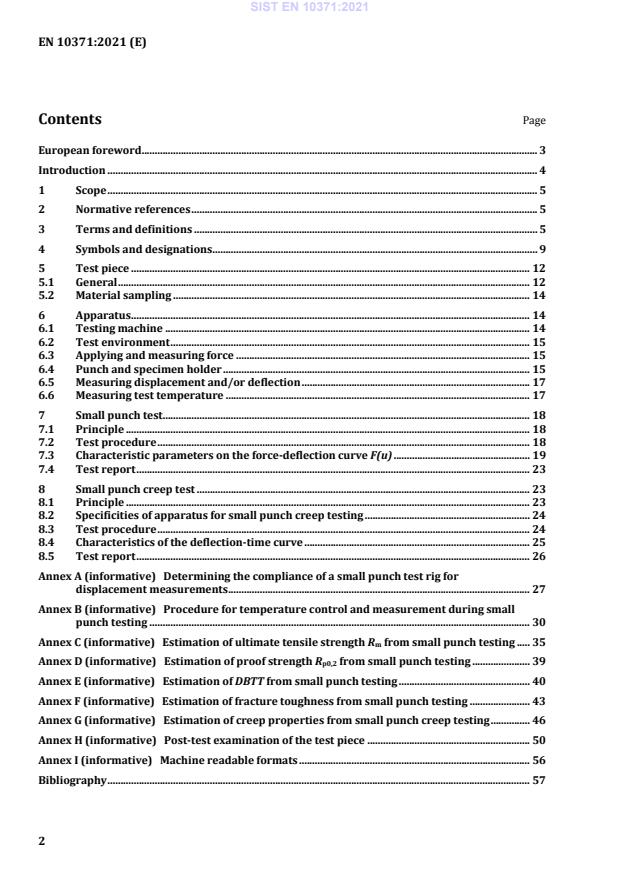
Contents Page
European foreword . 3
Introduction . 4
1 Scope . 5
2 Normative references . 5
3 Terms and definitions . 5
4 Symbols and designations . 9
5 Test piece . 12
5.1 General . 12
5.2 Material sampling . 14
6 Apparatus . 14
6.1 Testing machine . 14
6.2 Test environment . 15
6.3 Applying and measuring force . 15
6.4 Punch and specimen holder . 15
6.5 Measuring displacement and/or deflection . 17
6.6 Measuring test temperature . 17
7 Small punch test. 18
7.1 Principle . 18
7.2 Test procedure . 18
7.3 Characteristic parameters on the force-deflection curve F(u) . 19
7.4 Test report . 23
8 Small punch creep test . 23
8.1 Principle . 23
8.2 Specificities of apparatus for small punch creep testing . 24
8.3 Test procedure . 24
8.4 Characteristics of the deflection-time curve . 25
8.5 Test report . 26
Annex A (informative) Determining the compliance of a small punch test rig for
displacement measurements . 27
Annex B (informative) Procedure for temperature control and measurement during small
punch testing . 30
from small punch testing . 35
Annex C (informative) Estimation of ultimate tensile strength Rm
Annex D (informative) Estimation of proof strength R from small punch testing . 39
p0,2
Annex E (informative) Estimation of DBTT from small punch testing . 40
Annex F (informative) Estimation of fracture toughness from small punch testing . 43
Annex G (informative) Estimation of creep properties from small punch creep testing . 46
Annex H (informative) Post-test examination of the test piece . 50
Annex I (informative) Machine readable formats . 56
Bibliography . 57
European foreword
This document (EN 10371:2021) has been prepared by Technical Committee CEN/TC 459/SC 1 “Test
methods for steel (other than chemical analysis)”, the secretariat of which is held by AFNOR.
This European Standard shall be given the status of a national standard, either by publication of an
identical text or by endorsement, at the latest by October 2021, and conflicting national standards shall
be withdrawn at the latest by October 2021.
Attention is drawn to the possibility that some of the elements of this document may be the subject of
patent rights. CEN shall not be held responsible for identifying any or all such patent rights.
According to the CEN-CENELEC Internal Regulations, the national standards organisations of the
following countries are bound to implement this European Standard: Austria, Belgium, Bulgaria, Croatia,
Cyprus, Czech Republic, Denmark, Estonia, Finland, France, Germany, Greece, Hungary, Iceland, Ireland,
Italy, Latvia, Lithuania, Luxembourg, Malta, Netherlands, Norway, Poland, Portugal, Republic of North
Macedonia, Romania, Serbia, Slovakia, Slovenia, Spain, Sweden, Switzerland, Turkey and the United
Kingdom.
Introduction
This document describes small punch testing of metallic materials.
While it is recognized that the small punch test technique is not equivalent to uniaxial testing and cannot
currently replace uniaxial and fracture mechanics tests with larger specimens, it allows estimation of the
values normally obtained using classical standard size uniaxial or fracture mechanics specimens.
The small punch technique is especially useful when only small amounts of material are available as in
the case of experimental material batches, or for assessing aging of components where the extraction of
classical specimen types would require expensive repairs. Other areas of interest for small punch testing
are the characterization of irradiated materials, where small specimens minimize laboratory staff
exposure to radiation or the investigation of different zones in welds.
1 Scope
This document specifies the small punch method of testing metallic materials and the estimation of
tensile, creep and fracture mechanical material properties from cryogenic up to high temperatures.
2 Normative references
The following documents are referred to in the text in such a way that some or all of their content
constitutes requirements of this document. For dated references, only the edition cited applies. For
undated references, the latest edition of the referenced document (including any amendments) applies.
EN 60584-1, Thermocouples - Part 1: EMF specifications and tolerances (IEC 60584 1)
EN ISO 148-1, Metallic materials - Charpy pendulum impact test - Part 1: Test method (ISO 148-1)
EN ISO 204, Metallic materials - Uniaxial creep testing in tension - Method of test (ISO 204)
EN ISO 286-2, Geometrical product specifications (GPS) - ISO code system for tolerances on linear sizes -
Part 2: Tables of standard tolerance classes and limit deviations for holes and shafts (ISO 286-2)
EN ISO 6892-1, Metallic materials - Tensile testing - Part 1: Method of test at room temperature
(ISO 6892-1)
EN ISO 6892-2, Metallic materials - Tensile testing - Part 2: Method of test at elevated temperature
(ISO 6892-2)
EN ISO 7500-1, Metallic materials - Calibration and verification of static uniaxial testing machines - Part 1:
Tension/compression testing machines - Calibration and verification of the force-measuring system
(ISO 7500-1)
EN ISO 7500-2, Metallic materials - Verification of static uniaxial testing machines - Part 2: Tension creep
testing machines - Verification of the applied force (ISO 7500-2)
EN ISO 9513, Metallic materials - Calibration of extensometer systems used in uniaxial testing (ISO 9513)
ISO 2768-1, General tolerances - Part 1: Tolerances for linear and angular dimensions without individual
tolerance indications
3 Terms and definitions
For the purposes of this document, the following terms and definitions apply.
ISO and IEC maintain terminological databases for use in standardization at the following addresses:
• IEC Electropedia: available at http://www.electropedia.org/
• ISO Online browsing platform: available at https://www.iso.org/obp
3.1
punch
single solid rod with a hemispherical tip or a cylindrical rod combined with a ball is used to punch through
the centre of the disc shaped test piece
Note 1 to entry: The hemispherical portion of the punch or the ball shall have a sufficient hardness to ensure
rigidity so as not to be deformed during the test. Ultra-hard ball-bearing balls can be used for that application. The
compliance of the punch will affect the displacement measurement (see 3.5).
3.2
test piece
circular, disc shaped piece of the material under investigation
Note 1 to entry: The testing of other geometries is admissible according to this document if the active part of the
specimen has a flat cylindrical shape and the clamped area is equal to or larger than that of the specimens included
in this document.
3.3
small punch (SP) test
when the punch tip/ball is pushed through the specimen with constant displacement rate of the cross
head, ẇ and the force, F is measured as a function of deflection, u / displacement, v
Note 1 to entry: The test can be used for estimating tensile and fracture material properties. If displacement is
used, consideration of machine compliance is necessary (Annex A).
3.4
small punch creep (SPC) test
when the punch tip/ball is pushed through the specimen under constant force, F and the deflection, u /
displacement, v is measured as a function of time
Note 1 to entry: The test can be used for estimating uniaxial creep properties.
3.5
displacement, v of the punch tip
distance by which the punch tip has moved after initial contact with the specimen surface
3.6
crosshead displacement
w
distance by which the cross head has moved after initial contact of the punch tip with the specimen
surface
3.7
deflection
u
distance by which the point at the centre of the specimen on the surface opposite to the point of contact
between the punch and the specimen has moved after initial contact of the punch tip with the test piece
3.8
creep-deflection curve
u(t)
data record of deflection, u as a function of time, t for a given applied force, F from a small punch creep
test
Note 1 to entry: The loading period is part of the creep deflection curve. t = 0, F = 0 (or F = preload) refers to the
point in time when loading is started.
3.9
creep-displacement curve
v(t)
data record of displacement, v as a function of time, t for a given applied force, F from a small punch creep
test
Note 1 to entry: The loading period is part of the creep displacement curve. t=0, F=0 (or F=preload) refers to the
point in time when loading is started.
3.10
force-deflection curve
F(u)
record of the force, F required to keep the punch moving at constant crosshead displacement rate, ẇ as a
function of the deflection
3.11
force-displacement curve
F(v)
record of the force, F required to keep the punch moving at constant crosshead displacement rate, ẇ as a
function of the displacement of the punch tip
Note 1 to entry: If the displacement is not measured at the punch tip, but derived from the displacement of the
crosshead or at another point along the force line, the displacement signal needs to be corrected for compliance.
For details, refer to Annex A.
3.12
ductile to brittle transition temperature
DBTT
temperature where the fracture behaviour of a given material changes from brittle to ductile as defined
in EN ISO 148-1
3.13
small punch ductile to brittle transition temperature
T
SP
characteristic temperature at which the fracture behaviour in a small punch test changes from brittle to
ductile (Annex E)
3.14
small punch energy
E
SP
integral of the force-deflection curve up to the deflection at maximum force, u
m
Note 1 to entry: This energy is used for determining TSP. In the case of pop-ins, the integration is carried out up
to the first significant pop-in (Annex E).
Note 2 to entry: Instead of deflection, displacement is allowed to be used.
Note 3 to entry: In the case of ductile materials, failure has not yet occurred when the maximum force, Fm is
reached. However, limiting the integration to deflection at maximum force, um allows harmonized treatment of
ductile and brittle failure.
3.15
normalized small punch energy
E
n
E normalized by the maximum force F
SP m
3.16
upper shelf energy
E
US
some materials like ferritic/martensitic steels show a distinct transition of E (T) from a lower to a higher
SP
level at a given temperature, T , the higher level of E (T) is called upper shelf energy, E
SP SP US
3.17
lower shelf energy
E
LS
some materials like ferritic/martensitic steels show a distinct transition of E (T) from a lower to a higher
SP
level at a given temperature, T , the lower level of E (T) is called lower shelf energy, E
SP SP LS
3.18
pop-in significant for E calculation
SP
event during a SP test where the force in the F(u) or F(v) curves drops quasi instantaneously and rises
again
Note 1 to entry: A pop-in is indicative for brittle failure.
Note 2 to entry: For calculating E a significant pop-in is defined as a drop of the force by 10% of the maximum
SP,
force, F in the test at any point (Annex E).
m
3.19
creep rupture time from uniaxial testing
t
u
time to rupture for a test piece maintained at the specified temperature, T and initial stress, R as defined
in EN ISO 204
Note 1 to entry: The symbol t in a uniaxial creep test may have as superscript the specified temperature in
u
degrees Celsius and as subscript the initial stress, R in mega pascals.
3.20
creep rupture time from small punch testing
t
r
time to rupture for a test piece maintained at the specified temperature, T and constant force F in a small
punch creep test
Note 1 to entry: The symbol t in a uniaxial creep test may have as superscript the specified temperature in
r
degrees Celsius and as subscript the force, F in newtons.
3.21
proof strength
R
p
proof strength determined from uniaxial tensile testing as defined in EN ISO 6892-1 and EN ISO 6892-2
or estimated from small punch testing (Annex D)
Note 1 to entry: The symbol is followed by a suffix giving the prescribed percentage of strain, for example R .
p0,2
3.22
yield strength
R R
eL, eH
lower and higher yield strength determined from uniaxial tensile testing as defined in EN ISO 6892-1 and
EN ISO 6892-2 or estimated from small punch testing (Annex D)
3.23
tensile strength
R
m
stress corresponding to maximum force in uniaxial tensile testing as defined in EN ISO 6892-1 and
EN ISO 6892-2 or estimated from small punch testing (Annex C)
3.24
plane strain fracture toughness
K
Ic
crack-extension resistance under conditions of crack-tip plane-strain, expressed as a critical value of
stress intensity factor
3.25
plane strain J-integral fracture toughness
J
Ic
crack-extension resistance under conditions of crack-tip plane strain, expressed as a critical value of J-
integral, J
Ic
3.26
effective fracture strain
ε
f
natural logarithm of the ratio from the initial specimen thickness h and the thickness after testing close
to the fracture surface, h (Annex H)
f
4 Symbols and designations
For the purposes of this document, the following symbols and designations apply.
NOTE This list only includes the most pertinent symbols. Less important symbols that are only used in a
specific context are not listed.
Symbol Unit Designation Reference
A % Total uniform elongation of the uniaxial tensile test Annex C
gt
A, B mm Parameters in the tanh fit of E (T) Annex E
n
A , B - Parameters in the tanh-fit of ε (T) Annex E
ε ε f
α - Transfer factor between Τ and Τ : Τ = α Τ Annex E
SP CVN SP CVN
α - Transfer factor between Τ and Τ : Τ = α Τ Annex E
ε SP,ε CVN SP,ε ε CVN
β - Correlation factor for estimation of R Annex C
Rm m
C K Parameter in the tanh fit of E (T) Annex E
n
C K Parameter in the tanh-fit of ε (T) Annex E
ε f
CP mm/N Compliance of punch and push rod Annex A
d mm Diameter of the punch tip Clause 6
D mm Diameter of the receiving hole (lower die) Clause 6
DBTT °C, K Ductile to brittle transition temperature Annex E
Symbol Unit Designation Reference
D mm Diameter of the test piece Clause 5
S
E mJ Lower shelf energy Annex E
LS
EMF - Electromotive force Annex B
E mm E normalised by F Annex E
n SP m
E mJ Small punch energy Annex E
SP
E mJ Upper shelf energy Annex E
US
ELS mJ Lower shelf energy Annex E
E GPa Young's modulus Annex A
Y
ε - Effective fracture strain ε = ln(h /h ) Annex E
f f 0 f
ε - Effective fracture strain in the lower shelf Annex E
LS
Estimated uniaxial minimum strain rate corresponding to
ε min 1/h Annex G
minimum deflection rate in a SPC test
ε - Effective fracture strain in the upper shelf Annex E
US
F N Force applied to the specimen Clause 7,
Clause 8
F N Elastic-plastic transition force in a small punch test Clause 7,
e
Annex D
F N Maximum of F during the test Annex C,
m
Annex E
F N Force at deflection u or displacement v used for estimating Annex C
i i i,
R
m
h mm Thickness of the test piece Clause 5
h mm Initial thickness of the test piece (at the beginning of the Clause 5
test)
h mm Final thickness of the test piece adjacent to the fracture area Annex E,
f
Annex H
J N/mm Plane strain J-integral fracture toughness Annex F
Ic
0,5
K MPa m Plane strain fracture toughness Annex F
Ic
L mm Length of the chamfer in the receiving hole Clause 6
Ψ N/MPa Force to stress ratio in SPC Annex G
r mm Radius of the punch tip Clause 6
R mm Radius of the receiving hole (lower die) Clause 6
R MPa Initial stress in a uniaxial creep test Annex G
Symbol Unit Designation Reference
R μm Surface roughness (of the test piece) Clause 5
a
R MPa Ultimate tensile strength Annex C
m
R MPa Proof strength Annex D
p
σ MPa Equivalent stress Annex G
T °C, K Test temperature Clause 6,
Clause 7,
Clause 8,
Annex B
T °C, K Charpy transition temperature defined at 50 % of upper Annex E
CVN
shelf energy (see EN ISO 148-1)
t h Rupture time of SPC test Annex G
r
Τ °C, K Ductile to brittle transition temperature as determined from Annex E
SP
SP testing
T °C, K T determined from fracture strain Annex E
SP,ε SP
t h Rupture time in uniaxial creep testing Annex G
u
u mm Deflection of the specimen Clause 7,
Clause 8
u mm Deflection at F Annex D
e e
u mm Characteristic deflection used for estimating R Annex C
i m
u mm Deflection at F Annex C,
m m
Annex E
u mm Annex G
min Deflection at minimum deflection rate in a SPC test
u
min
mm/h Deflection rate Annex G
u
mm/h Minimum deflection rate in a SPC test Annex G
u
min
u mm Deflection at first significant pop-in Annex E
p1
v mm Displacement of the ball/punch tip Clause 7,
Clause 8
v mm Characteristic displacement used for estimating R Annex C
i m
v mm Displacement at first significant pop-in Annex E
p1
v mm Displacement at rupture Annex G
r
w mm Displacement of the crosshead Annex A
5 Test piece
5.1 General
The test pieces that should be used are circular discs with a diameter of D = 8 mm and an initial thickness
S
of h = 0,5 mm. The use of other specimen shapes is admissible according to this document provided the
thickness and surface finish requirements are met and they can be properly clamped.
The use of smaller test pieces (D = 3 mm, h = 0,25 mm) is also admissible according to this document.
S 0
This allows the use of specimens adapted to the size of a TEM specimen holder.
For obtaining macroscopic material properties a representative volume element shall be contained in the
specimen thickness. The specimen should contain at least 5 grains in thickness cross-section, but some
exceptions can be accepted for coarse-grain, directionally solidified or single crystal materials.
These cases shall be reported accordingly; the recommended correlations for tensile and fracture
estimations might not apply.
To eliminate the influence of surface damage, the specimen should be machined to a minimal thickness
of h +0,1 mm and then should be ground from both sides on abrasive paper with a recommended
abrasive grit size designation P320 followed by fine grinding (P1200) to reach the final thickness with a
tolerance of no more than 1 %. Grinding on both faces shall be done with minimal 0,03 mm material
removal from each side of the test piece. Since the test piece is clamped during test, the tolerance of its
diameter, D is not critical, but it shall not be less than the value indicated in Table 1 to ensure sufficient
S
clamping. The thickness of the test disc specimen shall be measured at four positions around the
perimeter at 90° intervals from each other and in the centre. Each measurement shall be within the
specifications. The diameter shall be measured in two positions at 90° from each other.
Table 1 — Required test piece dimensions, tolerances and surface roughness
D [mm] h [mm] Ra [µm]
S 0
Ø 8 0 0,50 +0,005 < 0,25
−0,1 −0,005
Ø 3 0 0,25 +0,0025 < 0,25
−0,025 −0,0025
Orientation of the test piece shall be defined by Figure 1 in the test report.
Key
L longitudinal direction (i.e. rolling direction)
T transverse direction
S short transverse direction
C circumferential direction
R radial direction
NOTE The specimens are classified so that the letter designating the axis falls together with the axis along
which the force is applied. Because of the multiaxial stress state, the directions tested in a SP test do not coincide
with the force axis.
Figure 1 — Orientation of SP specimen
5.2 Material sampling
A major benefit of the small punch test method is that it enables estimation of actual mechanical
properties of operating components or structural materials without affecting their integrity and
operational performance. Sampling of the material can be done by a minimally invasive, virtually non-
destructive manner. It means that testing material is removed from the component without requirements
for its repair due to the small volume of the extracted material that is necessary for the small punch
specimen manufacture. Current standardized mechanical tests, on the other hand, require relatively large
volumes of material that cannot be extracted from in-service equipment without repair after the material
removal.
For the material sampling, existing mechanical or electric discharge machining (EDM) extraction
techniques can be used. As a universal system for the sampling of different devices without any significant
impact on the component surface and without necessity to repair or modify the component, a Scoop
Cutter Sampling technique can be used. The unique hemispherical liquid cooled cutter used in the scoop
sampler is able to remove sufficient volume of material without mechanical distortion or thermal
degradation of the component. The principle of the sampling by this machine is schematically shown in
Figure 2 [1]-[3].
Figure 2 — Schematic view of abrasive-edged spinning cutter [2]
6 Apparatus
6.1 Testing machine
Universal testing machines are often used for SP testing (Clause 7) whereas SPC tests are mainly
conducted on test specific dead-weight machines (Clause 8). In both test types, a disc-shaped test piece
is clamped between an upper and a lower part of the specimen holder. A hemispherical punch or ball
deforms the disc specimen until fracture is indicated by force drop (SP) or sudden rise in
deflection/displacement (SPC).
For both test types, the testing machine shall apply a force perpendicular to the surface of the test piece
while preventing inadvertent tilting of the punch and misalignment of the specimen. Prior to the test, the
machine should be visually examined to ensure that the punch, specimen holder, universal joints and
associated equipment are in a good state of repair.
6.2 Test environment
6.2.1 General
When oxidation of the specimen becomes an issue for a given temperature and expected test duration,
testing needs to be carried out in inert environment or vacuum.
6.2.2 Heating/cooling system
Small punch tests can be performed in a wide temperature range, i.e. cryogenic to high temperature. In
all cases, the measurement of the true test temperature is of great importance (Annex B and Annex G).
At cryogenic temperatures attention should be paid to ensure that the deflection/displacement
measurement and the true applied force are not affected by ice forming.
6.3 Applying and measuring force
In a SP and SPC test, the force shall be applied smoothly and without shock.
In SP testing (and SPC with force measurement), the force measuring system shall comply with the
requirements given in EN ISO 7500-1 class 1 or better. For static dead-weight machines (without force
measurement), the requirements are given in EN ISO 7500-2.
It is important to ensure the true force applied on the specimen is known, i.e. the friction losses and
similar effects of lead-throughs, pulleys and levers shall be accounted for.
6.4 Punch and specimen holder
Two different types of punching solutions can be used. Both a punch with a hemispherical tip or a ball
can be used as shown in Figure 3. The test setup dimensions for the specimen holder that comply with
the standard specimen (Table 1) are given in Table 2.
The general tolerance for the manufacture of the specimen holder is tolerance class “f” (fine) in
accordance with ISO 2768-1. The receiving hole, the chamfer and the hemispherical punch / balls have a
tolerance requirement of H6 according to EN ISO 286-2. An example of a specimen holder is shown in
Figure 4.
The specimen holder surfaces shall be plane and perpendicular to the force direction. The surfaces
affecting the specimen position and clamping shall be clean and free from oxide build-up, corrosion and
dirt. The working surfaces of the upper and lower part of the specimen holder shall have a good oxidation
resistance at the test temperatures. The specimen holder itself or a separate fixture shall ensure sufficient
clamping, i.e. ensure that the specimen cannot bend upwards. In the case of clamping fixtures with several
tightening bolts, it is important to alternate the tightening on opposing sides to avoid uneven clamping.
Over-clamping shall be avoided since initial plastic deformation might influence the test result. For better
repeatability of clamping a torque wrench should be used to ensure a consistent torsional load.
In high temperature SPC testing oxidation and wear of the punch is a concern, especially if metallic
punches are used. It is recommended to frequently check hemispherical punches to ensure that wear has
not affected the required tolerances.
Key
A the punch
B the specimen
C the punch-ball
D a ceramic rod for deflection measurement (and temperature E)
E the location where a thermocouple can be integrated into the ceramic deflection rod
Figure 3 — Test set-up and specimen
Table 2 — Required test set-up dimensions
Required test set-up Punch radius Chamfer length
dimensions for the
diameter of the
receiving hole
Test piece D [mm] r [mm] L [mm]
Standard 4 1,25 0,2
Miniature 1,75 0,5 0,2
NOTE Other punch radiuses have historically been used (e.g. 1,0 mm). The use of a differing punch size is
acceptable for ensuring consistency during prolonged test campaigns. However, the evaluation of material
behaviour in these cases cannot be performed with the correlations given in this document. The use of other punch
sizes is discouraged to ensure future comparability of SP and SPC test results.
It is recommended that the material used for the specimen holder should have a similar coefficient of
thermal expansion to the test specimen as to minimize stresses from thermal expansion. If there is a
marked difference in the thermal expansion coefficient between the punch, disc and specimen holder
materials, any effect of thermal loading shall be carefully evaluated.
The shallow recess for fixing the specimen position shall allow for the tolerance of the specimen
( 8 see Clause 5) to ensure that the specimen will lie flat and not in a tilted position, e.g. ∅8G6 (see
−01,
Figure 4b).
(a) (b)
Figure 4 — Example of specimen holder (a) and drawing (b)
6.5 Measuring displacement and/or deflection
In SP and SPC tests, the displacement (or deflection) shall be measured using an extensometer, which
meets the performance requirements of class 1 or better of EN ISO 9513 or by other means which ensure
the same accuracy. The extensometer can be directly in contact with the bottom of the test piece
(deflection) and/or attached to the loading rod/punch (displacement). Also, non-contact methods like
optical or laser extensometers can be used.
The extensometer shall be calibrated over an appropriate range depending on the expected failure
displacement/deflection, for instance 0 mm to 5 mm.
The extensometer shall be calibrated at intervals not exceeding 1 year. If the predicted test duration
exceeds the date of the expiry of the calibration certificate, then the extensometer shall be recalibrated
prior to commencement of the test.
6.6 Measuring test temperature
The thermocouple(s) defining the test temperature is recommended to be in contact with the specimen.
The preferred location is underneath the specimen in the clamped region or measured from below with
a thermocouple integrated into the ceramic rod employed for deflection measurement. It is also allowed
to have the test temperature sensor located elsewhere in close proximity of the specimen as long as the
true specimen temperature can be derived within tolerances. In all cases the temperature should be
calibrated against an instrumented SP test specimen as described in Annex B. If a large temperature
gradient across the specimen or through the thickness is found, correcting action shall be taken.
The permitted deviations between the indicated temperature, T and the specified test temperature, T
i
during a test are given in Table 3.
Table 3 — Permitted deviations between T and T
i
Specified test temperature, Permitted deviation between T and
i
T
T
°C
°C
T < 600 ±2
600 < T ≤ 800 ±3
800 < T ≤ 1 000 ±4
1 000 < T ≤ 1 100 ±5
For temperatures greater than 1 100°C, the permitted values shall be defined according to target
application and in agreement between the parties concerned.
7 Small punch test
7.1 Principle
The test methods of this part of the standard cover the SP test of metallic materials. According to the
definition of Clause 3, the SP test shall be performed at a constant displacement rate of the crosshead, ẇ,
of the testing machine. The direct output of the test is the force-deflection curve, F(u) or alternatively the
force-displacement curve F(v). Several characteristic parameters can be derived from these curves.
Specifically, the elastic-plastic transition force, F , the deflection at F , u (or alternatively the punch tip
e e e
displacement at F , v ), the maximum force during the test F , the deflection at F , u (or alternatively the
e e m m m
punch tip displacement at F , v ), the deflection/displacement at the onset of plastic instability u /v , the
m m i i
force at the onset of plastic instability, Fi the force at ui or vi and the energy up to Fm, ESP, can be obtained
from test curves. These parameters, together with post-test examinations of the test pieces (Annex H) are
the basis of the correlations that allow the ultimate tensile strength, R (Annex C), the proof strength, R
m p
(Annex D), the ductile to brittle transition temperature, T (Annex E) and fracture toughness (Annex F)
SP
to be estimated.
7.2 Test procedure
7.2.1 Test piece placement
The test piece shall be clean and be clamped between the upper and lower die of the specimen holder in
the testing device following the requirements of 6.4. If the testing temperature is different from room
temperature, the test shall be kept at the target temperature at least for 10 min or longer if required by
the soaking of the test equipment before starting the test. Temperature should be controlled according
to Annex B.
7.2.2 Preload
The SP test starts when the force applied to the specimen increases. From a practical point of view the
application of a preload may be useful. The maximum allowable value for this preload is 10 % of F .
e
7.2.3 Displacement rate
The SP test shall be performed by applying a constant displacement rate of the cross head of the testing
machine, ẇ. A displacement rate, ẇ, of 0,2 mm/min to 2,0 mm/min should be used.
NOTE 0,5 mm/min has been used for testing and establishing material correlations for steels in this document.
7.2.4 Test monitoring
During the test, both force, F and deflection, u, shall be measured following Clause 6. Alternatively, the
displacement of the punch tip v can be used. This displacement of the punch tip, v, can be derived from
the displacement of the cross head of the testing machine, w, by correcting this value for the compliance
of the device in the force line (Annex A). The frequency of data sampling should be adapted to obtain at
least 500 data points per test.
7.2.5 Test termination
The test is considered to be finished after a drop of the force to less than 0,8 F .
m
NOTE Force fluctuations in the excess of 20 % can occur at the lowest load levels in the very beginning of a test
that could affect automatically programmed test termination. To avoid premature test termination, a small preload
can be applied (see 7.2.2).
7.3 Characteristic parameters on the force-deflection curve F(u)
7.3.1 Elastic-plastic transition force, F
e
The transition between elastic and plastic conditions in a SP test can be characterized by means of the
force, F . This force can be used for estimating yield strength, R of the material (Annex D). The methods
e p
for F determination are described below. When reporting F values, the method used for its
e e
determination shall always be indicated.
can be obtained as the force, f (Figure 5). This f , can be determined by fitting a
Bilinear method- Fe A A
bilinear function f(u) from the origin of the curve through the points A and B as follows:
f
A
u for 0≤
A
u
A
f u = (1)
( )
ff−
B A
uu− + f for u ≤≤u u
( )
AA A B
uu−
BA
This bilinear function can be easily adjusted by varying f , f and u parameters and minimizing the error
A B A
as follows:
u
B
err F u− f u du (2)
( ) ( )
∫
For u , a fixed value equal to h is recommended (Table 1).
B 0
Trilinear method- Alternatively, when recording displacement, v instead of deflection, u, F can be
e
obtained as the force, f (Figure 6). This f , can be determined by fitting a trilinear function f(v) from the
A A
origin of the curve though the points, 0, A and B as follows:
0 for 0≤
f
A
(3)
fv v− v for v≤
( ) ( )
0 0 A
vv−
A0
ff−
B A
vv− + f for v ≤≤v v
( )
AA A B
vv−
BA
=
=
This trilinear function can be easily adjusted by varying f , f , v and v parameters and minimizing the
A B 0 A
error as follows:
v
B
(4)
err F v− f v dv
( ) ( )
∫
For v , a fixed value equal to h is recommended (Table 1).
B 0
Figure 5 — Determination of F and u by means of the bilinear method
e e
=
Figure 6 — Determination of F and v by means of the trilinear method (Force-displacement
e e
curves)
Figure 7 — Determination of F , u , F , u and E
m m i i SP
7.3.2 Deflection at F , u
e e
u is defined as the deflection corresponding to F (Figure 5).
e e
NOTE If displacement, v is recorded instead of deflection, u, v values can be obtained (Figure 6). v values
e e
cannot be interchanged with ue values.
7.3.3 Force at the onset of plastic instability, F
i
F is the force at the onset of plastic instability at displacement, v or deflection, u (C.3, Figure C.2).
i i i
7.3.4 Maximum force during the test, F
m
F can be directly obtained as the maximum force measured during the test (Figure 7). F is used in some
m m
of the available correlations for the estimation of ultimate tensile strength, R (Annex C).
m
7.3.5 Deflection at Fm, um
u is defined as the deflection corresponding to F (Figure 7). u is used in some of the available
m m m
correlations for ultimate tensile strength estimation R (Annex C).
m
NOTE If displacement, v is recorded instead of deflection, u, vm values can be obtained. vm values cannot be
interchanged with um values.
7.3.6 Small punch energy, ESP
E , is the area under the force-deflection curve, F(u) (Figure 7). E values are used for the determination
SP SP
of T (Annex E). E values can also be used as a qualitative estimation of the fracture resistance of the
SP SP
material.
NOTE If displacement, v is recorded instead of deflection, u, ESP values can be calculated in a similar way, but
cannot be interchanged with those obtained from F(u) curves.
7.4 Test report
The test report shall contain the following requirements:
— Reference to document EN 10371;
— Material and specimen identification;
— Test piece description, including: initial dimensions, orientation, preparation, surface condition and
special features if any;
— Description of the test setup (chamfer; radius; machine identifier);
— Test conditions, including: testing temperature, preload, displacement rate and environment;
— Force-deflection curve, F(u). Alternatively, force-displacement curve, F(v) can be reported;
— F and u , (or v ) indicating the method(s) used for their determination;
e e e
— F and u (or v );
m m m
— E ;
SP
— Post-test examination results (Annex H);
— Any other aspect of interest or incidence during the test.
NOTE Standard data formats are available (see Annex I).
8 Small punch creep test
8.1 Principle
This procedure is specific to tests performed on small disc specimens (Clause 5) employing a punch and
ball or a solid rod with a hemispherical tip under constant force conditions. Two main forms of data can
be generated in the form of i) deflection vs. time, u(t) from each individual test and ii) equivalent stress
) from a collection of tests. Additional analysis may then be performed to calculate
v
...