


SIST EN ISO 11997-3:2023
(Main)Paints and varnishes - Determination of resistance to cyclic corrosion conditions - Part 3: Testing of coating systems on materials and components in automotive construction (ISO 11997-3:2022)
Paints and varnishes - Determination of resistance to cyclic corrosion conditions - Part 3: Testing of coating systems on materials and components in automotive construction (ISO 11997-3:2022)
This document specifies a method based on a cyclic corrosion test for testing the corrosion protection of automobiles using coating systems on aluminium, steel or galvanized steel.
The test method uses corrosive conditions (temperature and humidity ramps and salt spray) to create realistic corrosion patterns. These corrosion patterns are typical for automobiles, and they are comparable in the case of sufficiently similar protective coating systems. In particular, the accelerated test investigates the delamination/corrosion creep that results from defined artificial damage to a coating. Investigations of surface and edge corrosion or investigations of adhesive specimens or components are also covered. This cyclic corrosion test is also suitable for testing corrosion in flanged areas or near gaps.
This document was developed for the assessment of coated substrates (test specimens, bodywork and mounted parts) in the automotive industry. Other applications, such as components with unpainted metallic coatings, were not part of the scope of the standardization work. This document was originally developed for coating systems on aluminium, steel or galvanized steel but it can also be used for the assessment of the corrosion resistance of coating systems on other metals and their alloys.
Beschichtungsstoffe - Bestimmung der Beständigkeit bei zyklischen Korrosionsbedingungen - Teil 3: Prüfung von Beschichtungssystemen auf Werkstoffen und Bauteilen im Automobilbau (ISO 11997-3:2022)
Dieses Dokument legt ein Verfahren zum Prüfen des Korrosionsschutzes von Automobilen durch Beschichtungssysteme auf Aluminium, Stahl oder verzinktem Stahl mittels eines Korrosionswechseltests fest.
Bei dem Prüfverfahren werden unter korrosiven Bedingungen (Temperatur- und Feuchterampen, Salznebel) realistische Korrosionsbilder erzeugt. Diese Korrosionsbilder sind automobiltypisch und bei hinreichend ähnlichen Korrosionsschutzsystemen vergleichbar. Die Kurzprüfung bildet insbesondere die von einer definiert angebrachten Beschichtungsverletzung ausgehende Enthaftung/Unterwanderung ab. Die Untersuchung der Flächen- und Kantenkorrosion sowie von Klebeproben oder Bauteilen wird ebenfalls beschrieben. Dieser Korrosionswechseltest ist auch für die Prüfung der Korrosion in Flansch- und Spaltbereichen geeignet.
Dieses Dokument wurde für die Beurteilung von beschichteten Substraten (Probenkörper, Karosserien und Anbauteilen) der Automobilindustrie entwickelt. Andere Anwendungen, wie z. B. Bauteile mit unlackierten Metallbeschichtungen, waren bei der Normungsarbeit nicht Teil des Anwendungsbereiches. Dieses Dokument wurde ursprünglich für Beschichtungssysteme auf Aluminium, Stahl oder verzinktem Stahl entwickelt, kann aber auch für die Bewertung der Korrosionsbeständigkeit von Beschichtungssystemen auf anderen Metallen und deren Legierungen verwendet werden.
Peintures et vernis - Détermination de la résistance aux conditions cycliques de corrosion - Partie 3: Essais de systèmes de revêtements sur matériaux et composants en construction automobile (ISO 11997-3:2022)
Le présent document spécifie une méthode fondée sur un essai de corrosion cyclique permettant d’évaluer la protection contre la corrosion fournie par des systèmes de revêtements appliqués sur l’aluminium, l’acier ou l’acier galvanisé dans l’industrie automobile.
Les conditions de corrosion (rampes de température et d’humidité et brouillard salin) mises en œuvre dans la méthode d'essai sont destinées à obtenir des modèles de corrosion réalistes. Ces modèles de corrosion sont caractéristiques de l’industrie automobile et peuvent être comparés les uns aux autres lorsque les systèmes de revêtements protecteurs se ressemblent suffisamment. En particulier, l’essai accéléré étudie le décollement/fluage dû à la corrosion résultant de dommages artificiels déterminés causés à un revêtement. Sont également étudiés la corrosion de surface et la corrosion des arêtes, ainsi que les éprouvettes ou pièces adhésives. Cet essai de corrosion cyclique convient également pour évaluer la corrosion dans les zones comportant des brides ou à proximité des entrefers.
Le présent document a été élaboré pour l’évaluation des subjectiles revêtus (éprouvettes d’essai, carrosserie et pièces montées) dans l’industrie automobile. D’autres applications (par exemple celles qui utilisent des pièces pourvues de revêtements métalliques non peints) n’entrent pas dans le domaine d’application du travail de normalisation. Le présent document a été élaboré, à l’origine, pour des systèmes de revêtements sur aluminium, acier ou acier galvanisé; il peut toutefois être utilisé également pour évaluer la résistance à la corrosion de systèmes de revêtements sur d’autres métaux et leurs alliages.
Barve in laki - Ugotavljanje odpornosti proti cikličnim korozijskim pogojem - 3. del: Preskušanje premaznih sistemov na materialih in sestavnih delih v avtomobilski industriji (ISO 11997-3:2022)
Ta dokument določa metodo za preskušanje protikorozijske zaščite avtomobilov z uporabo premaznih sistemov na aluminiju, jeklu ali pocinkanem jeklu, ki temelji na preskusu ciklične korozije.
S preskusno metodo se v korozivnih pogojih (povečanje temperature in vlažnosti ter slana megla) ustvarijo realistični korozijski vzorci. Ti korozijski vzorci so značilni za avtomobile in so primerljivi, če so si zaščitni premazni sistemi zadosti podobni. S pospešenim preskusom se zlasti ugotavlja razslojitev/korozijsko lezenje, ki je posledica opredeljene umetne poškodbe premaza. Zajeto je tudi preiskovanje površinske korozije in korozije robov oziroma lepilnih vzorcev ali sestavnih delov. Ta preskus ciklične korozije je primeren tudi za preskušanje korozije na delih s prirobnicami ali v bližini rež.
Dokument je bil pripravljen za ocenjevanje podlag s premazom (preskušancev, karoserije in vgrajenih delov) v avtomobilski industriji. Druge vrste uporabe, kot so sestavni deli z nebarvanim kovinskim premazom, niso bile zajete v standardizacijskem delu. Dokument je bil prvotno pripravljen za premazne sisteme na aluminiju, jeklu ali pocinkanem jeklu, vendar ga je mogoče uporabiti tudi za ocenjevanje odpornosti premaznih sistemov na drugih kovinah in njihovih zlitinah proti koroziji.
General Information
- Status
- Published
- Public Enquiry End Date
- 02-Aug-2023
- Publication Date
- 08-Nov-2023
- Technical Committee
- IBLP - Paints and varnishes
- Current Stage
- 6060 - National Implementation/Publication (Adopted Project)
- Start Date
- 02-Nov-2023
- Due Date
- 07-Jan-2024
- Completion Date
- 09-Nov-2023
Overview
EN ISO 11997-3:2023 (Paints and varnishes - Determination of resistance to cyclic corrosion conditions - Part 3) specifies a laboratory method to evaluate the corrosion protection provided by coating systems used in automotive construction. Based on a cyclic corrosion test combining salt spray, temperature ramps and humidity ramps, the standard generates realistic, accelerated corrosion patterns for coated aluminium, steel and galvanized steel substrates. It is intended for assessment of coated substrates, bodywork and mounted parts; testing of unpainted metallic coatings was not part of the original scope.
Key topics and requirements
- Cyclic corrosion procedure: Alternating salt spray, humidity and temperature cycles to reproduce automotive-like corrosion mechanisms.
- Scope of materials: Developed for aluminium, steel and galvanized steel; applicable to other metals and alloys with caution.
- Damage and delamination assessment: Focus on evaluating delamination / corrosion creep originating from defined artificial damage (scribes), surface and edge corrosion, and behaviour near flanges or gaps.
- Specimen types: Test specimens, bodywork components and adhesive-mounted parts can be evaluated; flanged areas and gaps are explicitly covered.
- Apparatus: Corrosion test chamber materials must resist salt spray and condensate and must not influence test action.
- Evaluation and reporting: Results use agreed criteria between contracting parties; the standard references ISO grading methods (e.g., ISO 4628 series) for assessing defects such as rusting, delamination and filiform corrosion.
- Safety and quality: Users are responsible for safe handling of corrosive media and equipment. The document includes provisions for test specimen preparation, chamber corrosivity evaluation, precision and required test reporting.
Applications and users
EN ISO 11997-3:2023 is directly applicable in contexts where automotive-level corrosion performance needs verification:
- Automotive OEMs - validation of body-in-white coatings and mounted parts.
- Tier suppliers - qualification and incoming inspection of painted components.
- Coating manufacturers - R&D for formulation improvement and comparative performance testing.
- Independent test laboratories - standardized corrosion testing for client certification and batch validation.
- Materials and corrosion engineers - failure analysis, design-for-corrosion and selection of protective coatings.
Related standards
Relevant referenced standards include:
- ISO 9227 (salt spray tests)
- ISO 4628 series (evaluation of coating degradation)
- ISO 17872 (scribe mark guidelines)
- ISO 2409, ISO 20567-1
EN ISO 11997-3:2023 provides a harmonized, automotive-focused cyclic corrosion method that helps manufacturers and labs produce comparable, realistic corrosion resistance data for coated automotive components.


Frequently Asked Questions
SIST EN ISO 11997-3:2023 is a standard published by the Slovenian Institute for Standardization (SIST). Its full title is "Paints and varnishes - Determination of resistance to cyclic corrosion conditions - Part 3: Testing of coating systems on materials and components in automotive construction (ISO 11997-3:2022)". This standard covers: This document specifies a method based on a cyclic corrosion test for testing the corrosion protection of automobiles using coating systems on aluminium, steel or galvanized steel. The test method uses corrosive conditions (temperature and humidity ramps and salt spray) to create realistic corrosion patterns. These corrosion patterns are typical for automobiles, and they are comparable in the case of sufficiently similar protective coating systems. In particular, the accelerated test investigates the delamination/corrosion creep that results from defined artificial damage to a coating. Investigations of surface and edge corrosion or investigations of adhesive specimens or components are also covered. This cyclic corrosion test is also suitable for testing corrosion in flanged areas or near gaps. This document was developed for the assessment of coated substrates (test specimens, bodywork and mounted parts) in the automotive industry. Other applications, such as components with unpainted metallic coatings, were not part of the scope of the standardization work. This document was originally developed for coating systems on aluminium, steel or galvanized steel but it can also be used for the assessment of the corrosion resistance of coating systems on other metals and their alloys.
This document specifies a method based on a cyclic corrosion test for testing the corrosion protection of automobiles using coating systems on aluminium, steel or galvanized steel. The test method uses corrosive conditions (temperature and humidity ramps and salt spray) to create realistic corrosion patterns. These corrosion patterns are typical for automobiles, and they are comparable in the case of sufficiently similar protective coating systems. In particular, the accelerated test investigates the delamination/corrosion creep that results from defined artificial damage to a coating. Investigations of surface and edge corrosion or investigations of adhesive specimens or components are also covered. This cyclic corrosion test is also suitable for testing corrosion in flanged areas or near gaps. This document was developed for the assessment of coated substrates (test specimens, bodywork and mounted parts) in the automotive industry. Other applications, such as components with unpainted metallic coatings, were not part of the scope of the standardization work. This document was originally developed for coating systems on aluminium, steel or galvanized steel but it can also be used for the assessment of the corrosion resistance of coating systems on other metals and their alloys.
SIST EN ISO 11997-3:2023 is classified under the following ICS (International Classification for Standards) categories: 87.040 - Paints and varnishes. The ICS classification helps identify the subject area and facilitates finding related standards.
SIST EN ISO 11997-3:2023 is available in PDF format for immediate download after purchase. The document can be added to your cart and obtained through the secure checkout process. Digital delivery ensures instant access to the complete standard document.
Standards Content (Sample)
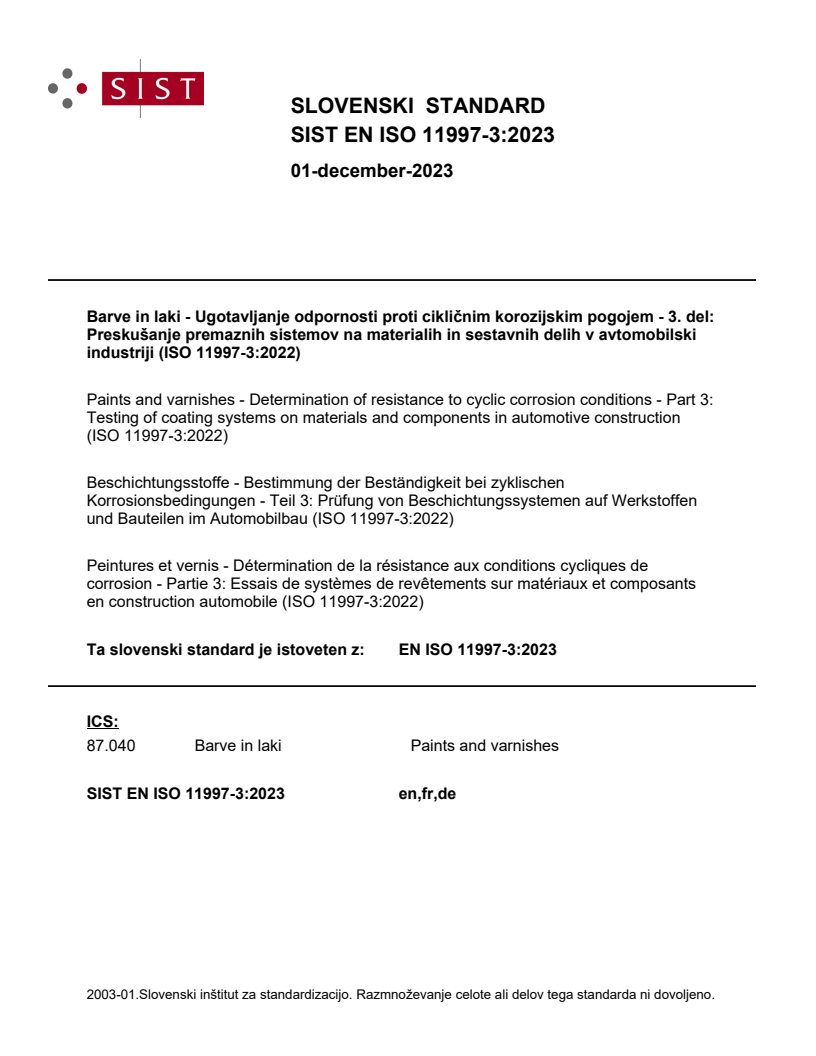
SLOVENSKI STANDARD
01-december-2023
Barve in laki - Ugotavljanje odpornosti proti cikličnim korozijskim pogojem - 3. del:
Preskušanje premaznih sistemov na materialih in sestavnih delih v avtomobilski
industriji (ISO 11997-3:2022)
Paints and varnishes - Determination of resistance to cyclic corrosion conditions - Part 3:
Testing of coating systems on materials and components in automotive construction
(ISO 11997-3:2022)
Beschichtungsstoffe - Bestimmung der Beständigkeit bei zyklischen
Korrosionsbedingungen - Teil 3: Prüfung von Beschichtungssystemen auf Werkstoffen
und Bauteilen im Automobilbau (ISO 11997-3:2022)
Peintures et vernis - Détermination de la résistance aux conditions cycliques de
corrosion - Partie 3: Essais de systèmes de revêtements sur matériaux et composants
en construction automobile (ISO 11997-3:2022)
Ta slovenski standard je istoveten z: EN ISO 11997-3:2023
ICS:
87.040 Barve in laki Paints and varnishes
2003-01.Slovenski inštitut za standardizacijo. Razmnoževanje celote ali delov tega standarda ni dovoljeno.
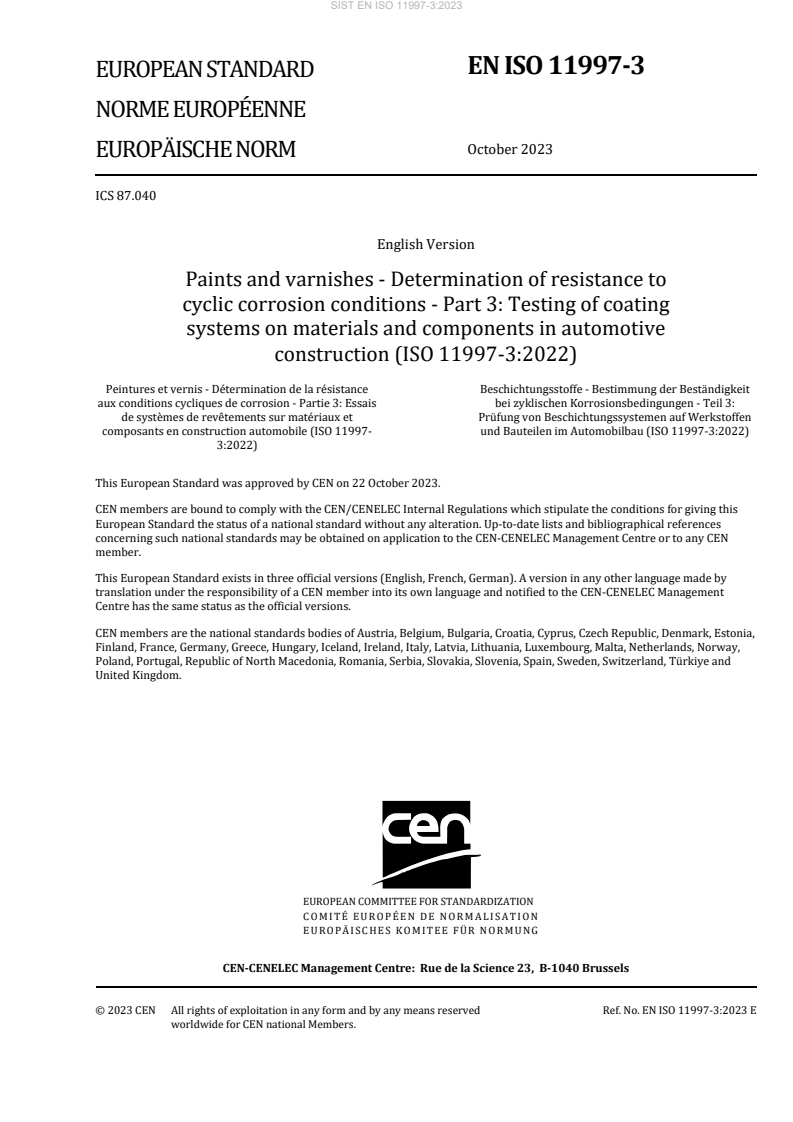
EN ISO 11997-3
EUROPEAN STANDARD
NORME EUROPÉENNE
October 2023
EUROPÄISCHE NORM
ICS 87.040
English Version
Paints and varnishes - Determination of resistance to
cyclic corrosion conditions - Part 3: Testing of coating
systems on materials and components in automotive
construction (ISO 11997-3:2022)
Peintures et vernis - Détermination de la résistance Beschichtungsstoffe - Bestimmung der Beständigkeit
aux conditions cycliques de corrosion - Partie 3: Essais bei zyklischen Korrosionsbedingungen - Teil 3:
de systèmes de revêtements sur matériaux et Prüfung von Beschichtungssystemen auf Werkstoffen
composants en construction automobile (ISO 11997- und Bauteilen im Automobilbau (ISO 11997-3:2022)
3:2022)
This European Standard was approved by CEN on 22 October 2023.
CEN members are bound to comply with the CEN/CENELEC Internal Regulations which stipulate the conditions for giving this
European Standard the status of a national standard without any alteration. Up-to-date lists and bibliographical references
concerning such national standards may be obtained on application to the CEN-CENELEC Management Centre or to any CEN
member.
This European Standard exists in three official versions (English, French, German). A version in any other language made by
translation under the responsibility of a CEN member into its own language and notified to the CEN-CENELEC Management
Centre has the same status as the official versions.
CEN members are the national standards bodies of Austria, Belgium, Bulgaria, Croatia, Cyprus, Czech Republic, Denmark, Estonia,
Finland, France, Germany, Greece, Hungary, Iceland, Ireland, Italy, Latvia, Lithuania, Luxembourg, Malta, Netherlands, Norway,
Poland, Portugal, Republic of North Macedonia, Romania, Serbia, Slovakia, Slovenia, Spain, Sweden, Switzerland, Türkiye and
United Kingdom.
EUROPEAN COMMITTEE FOR STANDARDIZATION
COMITÉ EUROPÉEN DE NORMALISATION
EUROPÄISCHES KOMITEE FÜR NORMUNG
CEN-CENELEC Management Centre: Rue de la Science 23, B-1040 Brussels
© 2023 CEN All rights of exploitation in any form and by any means reserved Ref. No. EN ISO 11997-3:2023 E
worldwide for CEN national Members.
Contents Page
European foreword . 3
European foreword
The text of ISO 11997-3:2022 has been prepared by Technical Committee ISO/TC 35 "General test
methods for paints and varnishes” of the International Organization for Standardization (ISO) and has
been taken over as EN ISO 11997-3:2023 by Technical Committee CEN/TC 139 “Paints and varnishes”
the secretariat of which is held by DIN.
This European Standard shall be given the status of a national standard, either by publication of an
identical text or by endorsement, at the latest by April 2024, and conflicting national standards shall be
withdrawn at the latest by April 2024.
Attention is drawn to the possibility that some of the elements of this document may be the subject of
patent rights. CEN shall not be held responsible for identifying any or all such patent rights.
Any feedback and questions on this document should be directed to the users’ national standards body.
A complete listing of these bodies can be found on the CEN website.
According to the CEN-CENELEC Internal Regulations, the national standards organizations of the
following countries are bound to implement this European Standard: Austria, Belgium, Bulgaria,
Croatia, Cyprus, Czech Republic, Denmark, Estonia, Finland, France, Germany, Greece, Hungary, Iceland,
Ireland, Italy, Latvia, Lithuania, Luxembourg, Malta, Netherlands, Norway, Poland, Portugal, Republic of
North Macedonia, Romania, Serbia, Slovakia, Slovenia, Spain, Sweden, Switzerland, Türkiye and the
United Kingdom.
Endorsement notice
The text of ISO 11997-3:2022 has been approved by CEN as EN ISO 11997-3:2023 without any
modification.
INTERNATIONAL ISO
STANDARD 11997-3
First edition
2022-07
Paints and varnishes — Determination
of resistance to cyclic corrosion
conditions —
Part 3:
Testing of coating systems on
materials and components in
automotive construction
Peintures et vernis — Détermination de la résistance aux conditions
cycliques de corrosion —
Partie 3: Essais de systèmes de revêtements sur matériaux et
composants en construction automobile
Reference number
ISO 11997-3:2022(E)
ISO 11997-3:2022(E)
© ISO 2022
All rights reserved. Unless otherwise specified, or required in the context of its implementation, no part of this publication may
be reproduced or utilized otherwise in any form or by any means, electronic or mechanical, including photocopying, or posting on
the internet or an intranet, without prior written permission. Permission can be requested from either ISO at the address below
or ISO’s member body in the country of the requester.
ISO copyright office
CP 401 • Ch. de Blandonnet 8
CH-1214 Vernier, Geneva
Phone: +41 22 749 01 11
Email: copyright@iso.org
Website: www.iso.org
Published in Switzerland
ii
ISO 11997-3:2022(E)
Contents Page
Foreword .iv
Introduction .v
1 Scope . 1
2 Normative references . 1
3 Terms and definitions . 2
4 Principle . 2
5 Apparatus and test equipment . 2
6 Test specimen preparation . 4
7 Procedure .4
7.1 Test conditions – Test procedure . 4
7.2 Interruption of the test . 7
7.3 Positioning of test specimens in the chamber . 7
8 Method for evaluating chamber corrosivity . 8
9 Ev a luat ion . 8
10 Precision . 8
11 Test report . 9
Annex A (informative) Preparation and post-treatment of the mass-loss coupons.10
Annex B (normative) Climate data settings of the daily cycles .11
Annex C (informative) Sample of specified data for the programming of climate data .14
Annex D (informative) Details of interlaboratory testing .15
Annex E (informative) Additional information on the test specimen .22
Bibliography .23
iii
ISO 11997-3:2022(E)
Foreword
ISO (the International Organization for Standardization) is a worldwide federation of national standards
bodies (ISO member bodies). The work of preparing International Standards is normally carried out
through ISO technical committees. Each member body interested in a subject for which a technical
committee has been established has the right to be represented on that committee. International
organizations, governmental and non-governmental, in liaison with ISO, also take part in the work.
ISO collaborates closely with the International Electrotechnical Commission (IEC) on all matters of
electrotechnical standardization.
The procedures used to develop this document and those intended for its further maintenance are
described in the ISO/IEC Directives, Part 1. In particular, the different approval criteria needed for the
different types of ISO documents should be noted. This document was drafted in accordance with the
editorial rules of the ISO/IEC Directives, Part 2 (see www.iso.org/directives).
Attention is drawn to the possibility that some of the elements of this document may be the subject of
patent rights. ISO shall not be held responsible for identifying any or all such patent rights. Details of
any patent rights identified during the development of the document will be in the Introduction and/or
on the ISO list of patent declarations received (see www.iso.org/patents).
Any trade name used in this document is information given for the convenience of users and does not
constitute an endorsement.
For an explanation of the voluntary nature of standards, the meaning of ISO specific terms and
expressions related to conformity assessment, as well as information about ISO's adherence to
the World Trade Organization (WTO) principles in the Technical Barriers to Trade (TBT), see
www.iso.org/iso/foreword.html.
This document was prepared by Technical Committee ISO/TC 35, Paints and varnishes, Subcommittee
SC 9, General test methods for paints and varnishes.
A list of all parts in the ISO 11997 series can be found on the ISO website.
Any feedback or questions on this document should be directed to the user’s national standards body. A
complete listing of these bodies can be found at www.iso.org/members.html.
iv
ISO 11997-3:2022(E)
Introduction
[9] [10]
This document was prepared on the basis of SEP 1850 and VDA 233-102 .
v
INTERNATIONAL STANDARD ISO 11997-3:2022(E)
Paints and varnishes — Determination of resistance to
cyclic corrosion conditions —
Part 3:
Testing of coating systems on materials and components in
automotive construction
1 Scope
This document specifies a method based on a cyclic corrosion test for testing the corrosion protection
of automobiles using coating systems on aluminium, steel or galvanized steel.
The test method uses corrosive conditions (temperature and humidity ramps and salt spray) to
create realistic corrosion patterns. These corrosion patterns are typical for automobiles, and they are
comparable in the case of sufficiently similar protective coating systems. In particular, the accelerated
test investigates the delamination/corrosion creep that results from defined artificial damage to
a coating. Investigations of surface and edge corrosion or investigations of adhesive specimens or
components are also covered. This cyclic corrosion test is also suitable for testing corrosion in flanged
areas or near gaps.
This document was developed for the assessment of coated substrates (test specimens, bodywork and
mounted parts) in the automotive industry. Other applications, such as components with unpainted
metallic coatings, were not part of the scope of the standardization work. This document was originally
developed for coating systems on aluminium, steel or galvanized steel but it can also be used for the
assessment of the corrosion resistance of coating systems on other metals and their alloys.
2 Normative references
The following documents are referred to in the text in such a way that some or all of their content
constitutes requirements of this document. For dated references, only the edition cited applies. For
undated references, the latest edition of the referenced document (including any amendments) applies.
ISO 2409, Paints and varnishes — Cross-cut test
ISO 3574, Cold-reduced carbon steel sheet of commercial and drawing qualities
ISO 4618, Paints and varnishes — Terms and definitions
ISO 4628-1, Paints and varnishes — Evaluation of degradation of coatings — Designation of quantity
and size of defects, and of intensity of uniform changes in appearance — Part 1: General introduction and
designation system
ISO 4628-2, Paints and varnishes — Evaluation of degradation of coatings — Designation of quantity
and size of defects, and of intensity of uniform changes in appearance — Part 2: Assessment of degree of
blistering
ISO 4628-3, Paints and varnishes — Evaluation of degradation of coatings — Designation of quantity and
size of defects, and of intensity of uniform changes in appearance — Part 3: Assessment of degree of rusting
ISO 4628-4, Paints and varnishes — Evaluation of degradation of coatings — Designation of quantity
and size of defects, and of intensity of uniform changes in appearance — Part 4: Assessment of degree of
cracking
ISO 11997-3:2022(E)
ISO 4628-5, Paints and varnishes — Evaluation of degradation of coatings — Designation of quantity and
size of defects, and of intensity of uniform changes in appearance — Part 5: Assessment of degree of flaking
ISO 4628-8, Paints and varnishes — Evaluation of degradation of coatings — Designation of quantity
and size of defects, and of intensity of uniform changes in appearance — Part 8: Assessment of degree of
delamination and corrosion around a scribe or other artificial defect
ISO 4628-10, Paints and varnishes — Evaluation of degradation of coatings — Designation of quantity
and size of defects, and of intensity of uniform changes in appearance — Part 10: Assessment of degree of
filiform corrosion
ISO 9227:2017, Corrosion tests in artificial atmospheres — Salt spray tests
ISO 17872, Paints and varnishes — Guidelines for the introduction of scribe marks through coatings on
metallic panels for corrosion testing
ISO 20567-1, Paints and varnishes — Determination of stone-chip resistance of coatings — Part 1: Multi-
impact testing
3 Terms and definitions
For the purposes of this document, the terms and definitions given in ISO 4618 apply.
ISO and IEC maintain terminology databases for use in standardization at the following addresses:
— ISO Online browsing platform: available at https:// www .iso .org/ obp
— IEC Electropedia: available at https:// www .electropedia .org/
4 Principle
WARNING — This document may involve hazardous materials, operations and equipment. This
document does not purport to address all of the safety concerns, if any, associated with its use.
It is the responsibility of the user of this document to establish appropriate safety and health
practices and determine the applicability of regulatory limitations prior to use.
The test specimens are tested in a cyclic test that involves salt spray, humidity ramps and temperature
ramps. In this way, realistic corrosion patterns are created for coated substrates of steel, galvanized
steel and aluminium. The results of the tests are assessed based on subjective criteria that are agreed
beforehand between the contractual partners.
5 Apparatus and test equipment
The typical laboratory and glass or plastics apparatus, together with the following.
5.1 Corrosion test chamber
All parts of the test chamber that come into contact with salt spray, condensate or test solutions shall
be made of a material that is resistant to attack by the test solutions and does not itself affect the action
of the test solutions or the salt spray/condensate on the test specimens.
The test may be carried out in separate chambers as long as the climatic conditions for the cycles are
met. Chambers that can perform all conditions are available and recommended.
Test chambers shall consist of a cooling unit, heating, pressure equalization as well as the necessary
measurement and control equipment to set and maintain the climate data described in Annex B
(temperature ±2 °C, relative humidity ±5 %) as measured at a reference point in the closed chamber
at defined temperature/relative humidity values. When passing through temperature ramps in phases
with constant relative humidity, deviations in relative humidity of −8 % to +5 % are permitted.
ISO 11997-3:2022(E)
The test chamber shall be designed in such a way that no drops fall from the ceiling or side walls onto
the test specimens positioned below them. A test solution that has already been sprayed shall not be
returned to the storage container.
The usable space for the test and/or the space for positioning the test specimens and test specimen
holders is only that part of the test chamber that is outside of the direct spray jet. In this space, it is
possible to demonstrate that there is a uniform distribution of the spray jet in accordance with 5.4.
The holders for the test specimens are to be produced from a durable, non-metallic non-conductive
material. The holder should be designed as such that the gathering of test solution on the holder
is prevented as much as possible. No conductive bridge is allowed between test specimens. If it
is necessary to hang up test specimens, the material used shall be a durable, non-metallic and non-
conductive material. The connection points on the test specimen should be at least 20 mm to the left or
right from the scribe.
5.2 Spray nozzle(s)
Nozzles that are suitable for the temperature range of the test and that fulfil the conditions in 5.4 are
used to generate the spray. Nozzles that use compressed air (see 5.5) to atomize the droplets shall be
used. It is necessary to set the flow rate to be constant so that it is within the limits specified in 5.4. It is
to be noted that the spray jet shall not point directly at the test specimens to be tested. The number and
arrangement of the spray nozzles are to be selected in such a way that the specifications in 5.4 for the
usable space are fulfilled.
The spray nozzles shall be made from a durable material such as glass or plastic.
5.3 Test solution
The initial solution in the storage container is a preparation of NaCl in distilled, demineralized or
deionized water with a maximum conductivity of 20 μS/cm at (25 ± 2) °C in accordance with ISO 9227
but having a NaCl concentration of 10 g/l. The purity of sodium chloride shall be as specified in ISO 9227.
This solution is to be used in such a way that the sodium chloride concentration of the sprayed and
collected test solution is (10 ± 1) g/l, as this can deviate from the prepared solution depending on the
chamber. The density of a corresponding solution is (1,005 ± 0,000 5) g/cm at 25 °C. The pH value
(6,5 to 7,2) is to be maintained. Use hydrochloric acid or sodium hydroxide to adjust the pH if necessary.
WARNING — Hydrochloric acid (CAS No. 7647-01-0) solution is toxic, corrosive, irritating and
very toxic to aquatic life. Refer to Safety Data Sheet for details. Handling of hydrochloric acid
solution shall be restricted to skilled personnel or conducted under their control. Care shall be
taken in the disposal of this solution.
WARNING — Sodium hydroxide (CAS No. 1310-73-2) solution is toxic, corrosive and irritating.
Refer to Safety Data Sheet for details. Handling of sodium hydroxide solution shall be restricted
to skilled personnel or conducted under their control. Care shall be taken in the disposal of this
solution.
5.4 Quantity and distribution of the spray
The quantity of test solution to be sprayed over a defined period of time in accordance with 5.3 is
selected in such a way that (3,0 ± 1,0) ml/h of sprayed solution is collected on average in each of the
collecting devices that are used. The collected quantity in the test chamber should be controlled when
the chamber is loaded with specimens in a manner similar to the test procedure. A period of at least
16 h of constant salt spray operation is recommended before the test and during regular checks of the
salt spray phase.
ISO 11997-3:2022(E)
Glass or plastic funnels with a diameter of 100 mm which are fitted into a measuring cylinder made of
glass or plastic using a plug are examples of suitable collecting devices.
NOTE Funnels made of glass or plastic that have their pipe sections inside measuring cylinders have proven
themselves to be suitable collecting devices. Funnels with a diameter of 100 mm have a collection area of
approximately 80 cm .
To demonstrate the uniform distribution of the spray, at least two of the collecting devices – depending
on the size of the chamber – shall be placed in the zone where the test specimens are usually placed.
In the case of very large chambers (walk-in chambers), at least one collection device is to be used for
every 4 m of positioning area.
For calibration purposes and for the verification of the uniform distribution of the spray, follow the
procedure specified in ISO 9227:2017, 6.5.
5.5 Compressed air
The compressed air used to generate the salt spray shall be free of oil and solid contaminants. It shall be
at a suitable pressure depending upon the type of spray nozzle and adjusted so that the collection rate
of sprayed solution in the chamber and the concentration of sprayed solution collected are kept within
the specified limits.
NOTE Humidification of the spray air can be necessary to prevent evaporation of the spray during the test.
Saturation towers as described in ISO 9227 represent one common method to humidify the air.
5.6 Mass-loss coupons to demonstrate constant test conditions.
To test the apparatus, use at least three mass-loss coupons with dimensions of 150 mm × 70 mm and a
thickness of (0,9 ± 0,2) mm, made of CR4 steel in accordance with ISO 3574 with practically fault-free
surfaces (roughness Ra = 0,9 µm to 1,4 µm).
At least five mass-loss coupons should be used when the test chamber is being commissioned.
5.7 Balance, accurate to at least 0,001 g.
6 Test specimen preparation
If not otherwise specified, apply an artificial defect (prior damage) to the coating, for example:
— scribe in accordance with ISO 17872;
— stone impact in accordance with ISO 20567-1;
— cross cut in accordance with ISO 2409.
7 Procedure
7.1 Test conditions – Test procedure
The test duration is six test cycles (6 weeks), if not otherwise agreed. A test cycle lasts 7 days. It consists
of daily cycles A, B and C, the sequence of which is specified as shown in Figure 1.
IS
...
Questions, Comments and Discussion
Ask us and Technical Secretary will try to provide an answer. You can facilitate discussion about the standard in here.
Loading comments...