


SIST EN 17725:2025
(Main)Plant biostimulants - Determination of the quantity (indicated by mass or volume)
Plant biostimulants - Determination of the quantity (indicated by mass or volume)
This document specifies the methods to be used for the determination of quantity of plant biostimulants sold or offered for sale.
This document specifies the methods to be used for the determination of quantity of solid and liquid forms of plant biostimulants in packages, containers or in bulk.
This document is not applicable to the quantity determination of: inorganic, organic and organo-mineral fertilizers, liming materials, inhibitors, soil improvers and growing media.
This document is applicable to the blends of fertilizing products where a blend is a mix of at least two of the following component EU fertilising products categories: Fertilizers and Plant Biostimulants, and where the following category Plant Biostimulants is the highest % in the blend by mass or volume, or in the case of liquid form by dry mass. If Plant Biostimulants is not the highest % in the blend, the European Standard for the highest % of the blend applies. In case a blend of fertilizing products is composed of components in equal quantity or in case the component EU fertilising products used for the blend have identical formulations , the user decides which standard to apply.
Pflanzen-Biostimulanzien - Bestimmung der Menge (durch Angabe der Masse oder des Volumens)
In diesem Dokument werden die Verfahren festgelegt, die bei der Bestimmung der Menge von verkauften oder zum Verkauf angebotenen Pflanzen-Biostimulanzien zu verwenden sind.
In diesem Dokument werden die Verfahren festgelegt, die zur Bestimmung der Menge von in fester und flüssiger Form und in Packungen, Behältern oder als loses Produkt vorliegenden Pflanzen-Biostimulanzien zu verwenden sind.
Dieses Dokument ist nicht anwendbar auf die Bestimmung der Menge von: anorganischen, organischen und organisch-mineralischen Düngemitteln, Kalkdüngern, Hemmstoffen, Bodenverbesserungsmitteln und Kultur¬substraten.
Dieses Dokument ist für die Mischungen von Düngeprodukten anwendbar, in denen eine Mischung aus mindestens zwei der folgenden Kategorien von Komponenten-EU Düngeprodukten besteht: Düngemittel und Pflanzen-Biostimulanzien und wenn die folgende Kategorie Pflanzen-Biostimulanzien prozentual den höchsten Massen- oder Volumenanteil in der Mischung bzw., bei flüssiger Form, den höchsten Trocken-masseanteil aufweist. Wenn Pflanzen-Biostimulanzien nicht den höchsten prozentualen Anteil in der Mischung ausmachen, ist die für den höchsten prozentualen Anteil geltende Europäische Norm anwendbar. Falls eine Düngemittelmischung aus Komponenten gleicher Menge besteht oder falls die für die Mischung verwendeten Komponenten-EU Düngeprodukte identische Formulierungen haben, entscheidet der Anwender, welche Norm angewendet wird.
Biostimulants des végétaux - Détermination de la quantité (indiquée en masse ou en volume)
Le présent document spécifie les méthodes à utiliser pour la détermination de la quantité de biostimulants des végétaux vendus ou proposés à la vente.
Le présent document spécifie les méthodes à utiliser pour la détermination de la quantité de biostimulants des végétaux sous forme solide et liquide dans des emballages, des conteneurs ou en vrac.
Le présent document ne s’applique pas à la détermination de la quantité de ce qui suit : engrais inorganiques, organiques et organo-minéraux, amendements minéraux basiques, inhibiteurs, amendements du sol et supports de culture.
Le présent document est applicable aux mélanges de fertilisants constitués d’au moins deux composants appartenant aux catégories de fertilisants UE suivantes : engrais et biostimulants des végétaux et, dans lesquels la catégorie Biostimulants des végétaux représente le % le plus élevé du mélange en masse ou en volume, ou dans le cas d’un liquide, en masse sèche. Si les biostimulants des végétaux ne représentent pas le % le plus élevé du mélange, la Norme européenne relative au composant représentant le % le plus élevé du mélange s’applique. Dans le cas où un mélange de fertilisants contient des composants en quantité égale ou dans le cas où les composants des fertilisants UE utilisés pour le mélange ont des formulations identiques, l’utilisateur décide quelle norme appliquer.
Rastlinski biostimulanti - Določanje količine (izražene kot masa ali prostornina)
Ta dokument določa metode za določanje količine rastlinskih biostimulantov,
ki so že bili prodani ali so v prodaji.
Ta dokument določa metode za določanje količine trdnih in tekočih rastlinskih biostimulantov v pakiranjih, posodah ali v razsutem stanju.
Ta dokument se ne uporablja za določanje količine anorganskih, organskih in organsko-mineralnih gnojil, sredstev za apnenje, inhibitorjev, izboljševalcev tal in rastnih subtratov.
Ta dokument se uporablja za mešanice sredstev za gnojenje, ki vsebujejo najmanj dve od naslednjih kategorij sredstev za gnojenje EU: gnojila in rastlinski biostimulanti,
pri čemer rastlinski biostimulanti predstavljajo največji masni ali prostorninski odstotek mešanice ali, v primeru tekoče oblike, odstotek suhe mase. Če rastlinski biostimulanti ne predstavljajo največjega odstotka v mešanici, se uporablja evropski standard za največji odstotek mešanice. Če vsebuje mešanica sredstev za gnojenje sestavine v enakih količinah ali če imajo posamezna sredstva za gnojenje EU, uporabljena za mešanico, enake formulacije1, standard za uporabo izbere uporabnik.
General Information
- Status
- Published
- Public Enquiry End Date
- 02-Jun-2023
- Publication Date
- 06-Jan-2025
- Technical Committee
- KAT - Soil quality
- Current Stage
- 6060 - National Implementation/Publication (Adopted Project)
- Start Date
- 20-Dec-2024
- Due Date
- 24-Feb-2025
- Completion Date
- 07-Jan-2025
Relations
- Effective Date
- 01-Feb-2025
Overview
EN 17725:2024 - published by CEN - specifies standardised methods for the determination of the quantity (expressed as mass or volume) of plant biostimulants sold or offered for sale. It covers solid and liquid forms in packages, containers and bulk consignments and supports compliance with EU market rules, including links to Regulation (EU) 2019/1009. The standard is intended to ensure declared nominal quantities are met and to strengthen confidence in the biostimulant supply chain.
Key topics and technical requirements
- Scope and applicability
- Applies to plant biostimulants in liquid (solutions, suspensions, gels) and solid forms.
- Excludes inorganic, organic and organo‑mineral fertilizers, liming materials, inhibitors, soil improvers and growing media.
- Applies to blends of fertilising products when plant biostimulants are the largest component by mass or volume (or by dry mass for liquids); otherwise the standard for the dominant category applies.
- Quantity declaration
- The actual quantity must be at least the nominal quantity stated on the package or documentation.
- Methods of determination
- Weighing procedures for products sold by mass using suitable non‑automatic or automatic weighing instruments compliant with EN 45501:2015.
- Specific procedures for packages up to 25 kg (gross weighing and averaging container mass - typically 10 empty containers) and for containers >25 kg (reduced empty‑container sample size).
- Bulk and loose delivery methods: vehicle tare/gross weighing, continuous totalising instruments (beltweighers, rail weighbridges to specified accuracy classes) and draft survey procedure for ship deliveries.
- Checks and calibration: instruments must be accuracy‑checked (test weights per OIML recommendations) with tolerance criteria (e.g., one third of maximum error).
- Supporting information
- Requirements for equipment checks, precision, test reports and records.
- Annexes cover scale intervals, repeatability/reproducibility data and relationship with EU legislation (Annex ZA).
Practical applications and users
- Who uses it
- Manufacturers and packers of plant biostimulants for product labelling and quality control.
- Testing and metrology laboratories conducting quantity verification.
- Regulators, market surveillance authorities and customs verifying compliance with declared mass/volume.
- Logistics providers and bulk handlers using vehicle/ship/rail weighing systems.
- Practical benefits
- Ensures accurate net quantity declarations, reduces disputes in trade, and helps demonstrate conformity with the EU Fertilising Products Regulation (FPR).
- Provides harmonised, auditable procedures for weighing, calibration checks and reporting.
Related standards
- EN 17702-1:2024 - Sampling and sample preparation (Part 1: Sampling)
- EN 17724:2024 - Terminology for plant biostimulants
- EN 45501:2015 - Metrological aspects of non‑automatic weighing instruments
Keywords: EN 17725:2024, plant biostimulants, quantity determination, mass, volume, CEN, EU fertilising products, weighing procedures.

Frequently Asked Questions
SIST EN 17725:2025 is a standard published by the Slovenian Institute for Standardization (SIST). Its full title is "Plant biostimulants - Determination of the quantity (indicated by mass or volume)". This standard covers: This document specifies the methods to be used for the determination of quantity of plant biostimulants sold or offered for sale. This document specifies the methods to be used for the determination of quantity of solid and liquid forms of plant biostimulants in packages, containers or in bulk. This document is not applicable to the quantity determination of: inorganic, organic and organo-mineral fertilizers, liming materials, inhibitors, soil improvers and growing media. This document is applicable to the blends of fertilizing products where a blend is a mix of at least two of the following component EU fertilising products categories: Fertilizers and Plant Biostimulants, and where the following category Plant Biostimulants is the highest % in the blend by mass or volume, or in the case of liquid form by dry mass. If Plant Biostimulants is not the highest % in the blend, the European Standard for the highest % of the blend applies. In case a blend of fertilizing products is composed of components in equal quantity or in case the component EU fertilising products used for the blend have identical formulations , the user decides which standard to apply.
This document specifies the methods to be used for the determination of quantity of plant biostimulants sold or offered for sale. This document specifies the methods to be used for the determination of quantity of solid and liquid forms of plant biostimulants in packages, containers or in bulk. This document is not applicable to the quantity determination of: inorganic, organic and organo-mineral fertilizers, liming materials, inhibitors, soil improvers and growing media. This document is applicable to the blends of fertilizing products where a blend is a mix of at least two of the following component EU fertilising products categories: Fertilizers and Plant Biostimulants, and where the following category Plant Biostimulants is the highest % in the blend by mass or volume, or in the case of liquid form by dry mass. If Plant Biostimulants is not the highest % in the blend, the European Standard for the highest % of the blend applies. In case a blend of fertilizing products is composed of components in equal quantity or in case the component EU fertilising products used for the blend have identical formulations , the user decides which standard to apply.
SIST EN 17725:2025 is classified under the following ICS (International Classification for Standards) categories: 65.080 - Fertilizers. The ICS classification helps identify the subject area and facilitates finding related standards.
SIST EN 17725:2025 has the following relationships with other standards: It is inter standard links to SIST-TS CEN/TS 17725:2023. Understanding these relationships helps ensure you are using the most current and applicable version of the standard.
SIST EN 17725:2025 is associated with the following European legislation: EU Directives/Regulations: 2019/1009; Standardization Mandates: M/564, M/564 AMD 1, M/XXX. When a standard is cited in the Official Journal of the European Union, products manufactured in conformity with it benefit from a presumption of conformity with the essential requirements of the corresponding EU directive or regulation.
You can purchase SIST EN 17725:2025 directly from iTeh Standards. The document is available in PDF format and is delivered instantly after payment. Add the standard to your cart and complete the secure checkout process. iTeh Standards is an authorized distributor of SIST standards.
Standards Content (Sample)
SLOVENSKI STANDARD
01-februar-2025
Nadomešča:
SIST-TS CEN/TS 17725:2023
Rastlinski biostimulanti - Določanje količine (izražene kot masa ali prostornina)
Plant biostimulants - Determination of the quantity (indicated by mass or volume)
Pflanzen-Biostimulanzien - Bestimmung der Menge (durch Angabe der Masse oder des
Volumens)
Biostimulants des végétaux - Détermination de la quantité (indiquée en masse ou en
volume)
Ta slovenski standard je istoveten z: EN 17725:2024
ICS:
65.080 Gnojila Fertilizers
2003-01.Slovenski inštitut za standardizacijo. Razmnoževanje celote ali delov tega standarda ni dovoljeno.
EN 17725
EUROPEAN STANDARD
NORME EUROPÉENNE
November 2024
EUROPÄISCHE NORM
ICS 65.080 Supersedes CEN/TS 17725:2022
English Version
Plant biostimulants - Determination of the quantity
(indicated by mass or volume)
Biostimulants des végétaux - Détermination de la Pflanzen-Biostimulanzien - Bestimmung der Menge
quantité (indiquée en masse ou en volume) (durch Angabe der Masse oder des Volumens)
This European Standard was approved by CEN on 26 August 2024.
CEN members are bound to comply with the CEN/CENELEC Internal Regulations which stipulate the conditions for giving this
European Standard the status of a national standard without any alteration. Up-to-date lists and bibliographical references
concerning such national standards may be obtained on application to the CEN-CENELEC Management Centre or to any CEN
member.
This European Standard exists in three official versions (English, French, German). A version in any other language made by
translation under the responsibility of a CEN member into its own language and notified to the CEN-CENELEC Management
Centre has the same status as the official versions.
CEN members are the national standards bodies of Austria, Belgium, Bulgaria, Croatia, Cyprus, Czech Republic, Denmark, Estonia,
Finland, France, Germany, Greece, Hungary, Iceland, Ireland, Italy, Latvia, Lithuania, Luxembourg, Malta, Netherlands, Norway,
Poland, Portugal, Republic of North Macedonia, Romania, Serbia, Slovakia, Slovenia, Spain, Sweden, Switzerland, Türkiye and
United Kingdom.
EUROPEAN COMMITTEE FOR STANDARDIZATION
COMITÉ EUROPÉEN DE NORMALISATION
EUROPÄISCHES KOMITEE FÜR NORMUNG
CEN-CENELEC Management Centre: Rue de la Science 23, B-1040 Brussels
© 2024 CEN All rights of exploitation in any form and by any means reserved Ref. No. EN 17725:2024 E
worldwide for CEN national Members.
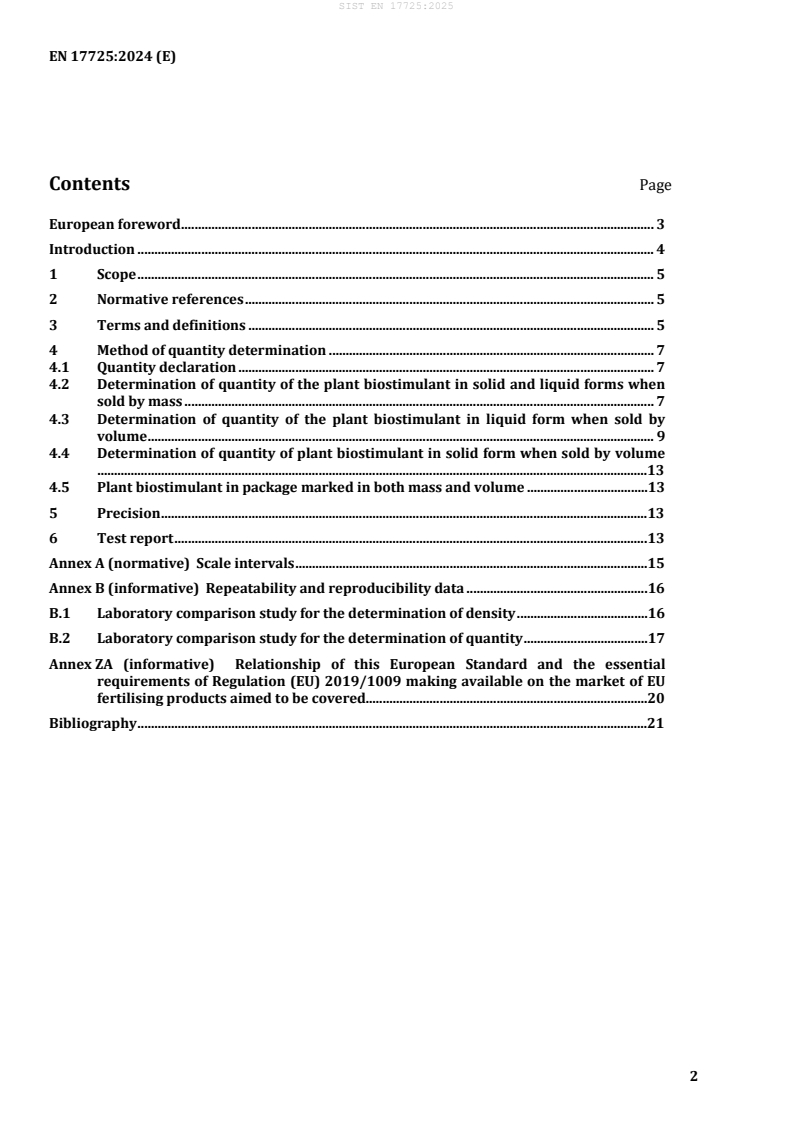
Contents Page
European foreword . 3
Introduction . 4
1 Scope . 5
2 Normative references . 5
3 Terms and definitions . 5
4 Method of quantity determination . 7
4.1 Quantity declaration . 7
4.2 Determination of quantity of the plant biostimulant in solid and liquid forms when
sold by mass . 7
4.3 Determination of quantity of the plant biostimulant in liquid form when sold by
volume . 9
4.4 Determination of quantity of plant biostimulant in solid form when sold by volume
....................................................................................................................................................................13
4.5 Plant biostimulant in package marked in both mass and volume .13
5 Precision .13
6 Test report .13
Annex A (normative) Scale intervals .15
Annex B (informative) Repeatability and reproducibility data .16
B.1 Laboratory comparison study for the determination of density .16
B.2 Laboratory comparison study for the determination of quantity .17
Annex ZA (informative) Relationship of this European Standard and the essential
requirements of Regulation (EU) 2019/1009 making available on the market of EU
fertilising products aimed to be covered.20
Bibliography .21
European foreword
This document (EN 17725:2024) has been prepared by Technical Committee CEN/TC 455 “Plant
Biostimulants”, the secretariat of which is held by AFNOR.
This European Standard shall be given the status of a national standard, either by publication of an
identical text or by endorsement, at the latest by May 2025, and conflicting national standards shall be
withdrawn at the latest by May 2025.
Attention is drawn to the possibility that some of the elements of this document may be the subject of
patent rights. CEN shall not be held responsible for identifying any or all such patent rights.
This document supersedes CEN/TS 17725:2022.
— Clauses 4 and Clause 6 have been updated in order to express requirements;
— Annex ZA has been added.
This document has been prepared under a standardization request addressed to CEN by the European
Commission. The Standing Committee of the EFTA States subsequently approves these requests for its
Member States.
For the relationship with EU Legislation, see informative Annex ZA, which is an integral part of this
document.
Any feedback and questions on this document should be directed to the users’ national standards body.
A complete listing of these bodies can be found on the CEN website.
According to the CEN-CENELEC Internal Regulations, the national standards organisations of the
following countries are bound to implement this European Standard: Austria, Belgium, Bulgaria, Croatia,
Cyprus, Czech Republic, Denmark, Estonia, Finland, France, Germany, Greece, Hungary, Iceland, Ireland,
Italy, Latvia, Lithuania, Luxembourg, Malta, Netherlands, Norway, Poland, Portugal, Republic of North
Macedonia, Romania, Serbia, Slovakia, Slovenia, Spain, Sweden, Switzerland, Türkiye and the United
Kingdom.
Introduction
The European Committee for Standardization (CEN) was requested by the European Commission (EC) to
draft European Standards or European Standardization deliverables to support the implementation of
Regulation (EU) 2019/1009 of 5 June 2019 [1] laying down rules on the making available on the market
of EU fertilising products (“FPR” or “Fertilising Products Regulation”).
This standardization request, presented as SR M/564 and relevant amendments, also contributes to the
Communication on “Innovating for Sustainable Growth: A Bio economy for Europe”. The interest in plant
biostimulants has increased significantly in Europe as a valuable tool to use in agriculture.
Standardization was identified as having an important role in order to promote the use of biostimulants.
The work of CEN/TC 455 seeks to improve the reliability of the supply chain, thereby improving the
confidence of farmers, industry, and consumers in biostimulants, and will promote and support
commercialisation of the European biostimulant industry.
WARNING — Persons using this document should be familiar with normal laboratory practice. This
document does not purport to address all of the safety problems, if any, associated with its use. It is the
responsibility of the user to establish appropriate safety and health practices and to ensure compliance
with any national regulatory conditions.
IMPORTANT — It is absolutely essential that tests conducted in accordance with this document be
carried out by suitably trained staff.
1 Scope
This document specifies the methods to be used for the determination of quantity of plant biostimulants
sold or offered for sale.
This document specifies the methods to be used for the determination of quantity of solid and liquid
forms of plant biostimulants in packages, containers or in bulk.
This document is not applicable to the quantity determination of: inorganic, organic and organo-mineral
fertilizers, liming materials, inhibitors, soil improvers and growing media.
This document is applicable to the blends of fertilizing products where a blend is a mix of at least two of
the following component EU fertilising products categories: Fertilizers and Plant Biostimulants, and
where the following category Plant Biostimulants is the highest % in the blend by mass or volume, or in
the case of liquid form by dry mass. If Plant Biostimulants is not the highest % in the blend, the European
Standard for the highest % of the blend applies. In case a blend of fertilizing products is composed of
components in equal quantity or in case the component EU fertilising products used for the blend have
identical formulations , the user decides which standard to apply.
2 Normative references
The following documents are referred to in the text in such a way that some or all of their content
constitutes requirements of this document. For dated references, only the edition cited applies. For
undated references, the latest edition of the referenced document (including any amendments) applies.
EN 17702-1:2024, Plant biostimulants — Sampling and sample preparation — Part 1: Sampling
EN 17724:2024, Plant biostimulants — Terminology
EN 45501:2015, Metrological aspects of non-automatic weighing instruments
3 Terms and definitions
For the purposes of this document, the terms and definitions given in EN 17724:2024 and the following
apply.
ISO and IEC maintain terminology databases for use in standardization at the following addresses:
• ISO Online browsing platform: available at https://www.iso.org/obp
• IEC Electropedia: available at https://www.electropedia.org/
3.1
liquid form
suspension or solution
Note 1 to entry: “Based on Regulation (EU) 2019/1009 [1], Chapter 1, Article 2, (6).
An example of such a blend is a product with 2 claimed functions consisting of a non-microbial plant biostimulant
and an organic fertilizer composed of 1kg/kg of plant biostimulant from seaweed.
3.2
suspension
two-phase dispersion in which solid particles are maintained in suspension in the liquid phase
Note 1 to entry: “Based on Regulation (EU) 2019/1009 [1], Chapter 1, Article 2, (6).
3.3
solution
liquid that is free of solid particles, or a gel and includes pastes
Note 1 to entry: “Liquids” include plant biostimulants in liquid form and solutions.
Note 2 to entry: The definition is based on Regulation (EU) 2019/1009 [1], Chapter 1, Article 2, (6).
3.4
solid form
form characterized by structural rigidity and resistance to changes of shape or volume and in which
atoms are tightly bound to each other, either in a regular geometric lattice (crystalline solids) or in an
irregular manner (an amorphous solid)
Note 1 to entry: The definition is based on Regulation (EU) 2019/1009 [1], Chapter 1, Article 2, (7).
3.5
weighing instrument
instrument serving to determine the mass of a body by using the action of gravity on that body
3.6
non-automatic weighing instrument
weighing instrument requiring the intervention of an operator during the weighing process to decide that
the weighing result is acceptable
3.7
nominal quantity
declared mass or volume of the contents of a package or container indicated on or with the package or in
documentation associated with the contents
3.8
net quantity
actual mass or volume of the contents of a package
3.9
gross quantity
mass or volume of the package
3.10
bulk
plant biostimulant that is not in a package
3.11
package
container and plant biostimulant contained therein which is ready for delivery or delivered and where
the packaging remains with the material after delivery
3.12
container
object in which a plant biostimulant is delivered
EXAMPLE Bottle, box, bag, intermediate bulk container, road tanker, lorry.
4 Method of quantity determination
4.1 Quantity declaration
The quantity in terms of mass or volume of a plant biostimulant shall be at least the nominal quantity
stated on the container or documentation associated with the plant biostimulant.
NOTE National regulations that specify the unit of measurement (weight or volume) used for the quantity
declaration exist.
4.2 Determination of quantity of the plant biostimulant in solid and liquid forms when
sold by mass
4.2.1 Apparatus
A suitable weighing instrument.
“Suitable” means of a type sufficiently accurate to determine the actual quantity of the plant biostimulant
(gross weight) and mass of the packaging used so that a net quantity of the contents can be determined.
“Suitable type” means an instrument that complies with the requirements of EN 45501:2015.
“Sufficiently accurate” means that the scale intervals and sensitivity of the instrument are appropriate to
detect the quantity of the plant biostimulant and of the package/wrapping. This will depend on the
nominal quantity of the plant biostimulant being weighed.
An indication of appropriate maximum scale interval is given in Annex A.
4.2.2 Equipment checks
Before using the weighing instrument to establish the quantity of a plant biostimulant, the machine shall
be checked for accuracy with weights (such as those which comply with OIML R111 (www.oiml.org)).
The accuracy tolerance shall be one third of the maximum error for the weighing instrument to be used.
The tests laid down in EN 45501:2015 shall be used.
A record of the results of the tests shall be kept.
Because half a graduation can be read on an analogue indicator weighing instrument mass display, digital
instruments shall need to indicate 50 % of those for an analogue graduation.
4.2.3 Method
4.2.3.1 Packages up to 25 kg
The package shall be placed on the weighing plate of the weighing instrument and the mass shown (x)
shall be recorded.
Weigh 10 randomly selected empty containers (non-destructive testing) or, if empty containers are not
available, empty 10 randomly selected containers already weighed after ensuring no plant biostimulant
remains in or on the containers (destructive testing).
NOTE Because of the small mass of the containers, a more sensitive weighing instrument can be used for this
operation (see Annex A).
Record the masses and obtain an average mass of the containers (y). Record the calculation and result.
Subtract the mean mass of the container from the gross quantity of each packed plant biostimulant and
calculate and record each net quantity (z) using Formula (1).
z xy−
(1)
where
z is the net quantity by mass of the contents of an individual package in g;
x is the gross quantity by mass of an individual package in g;
y is the mean mass of the empty containers in g.
4.2.3.2 Packages/containers more than 25 kg
These are containers which cannot be manually handled and require larger capacity weighing
instruments to ascertain their gross weight.
The weighing instrument used shall be suitable for the mass of the plant biostimulant in the container in
accordance with 4.2.1 and Annex A.
Otherwise, the procedure given in 4.2.3.1 above shall be followed with the exception of the number of
empty containers to be weighed which shall be reduced to 5.
4.2.3.3 Plant biostimulant sold loose and in bulk
4.2.3.3.1 Plant biostimulant to be delivered in transport containers
The plant biostimulant shall be loaded into some type of transport (vehicle, large container or other
suitable method of containing the plant biostimulant). Use a weighing instrument suitable for the amount
in the consignment in accordance with 4.2.1 and Annex A. The transport shall be weighed empty and the
mass (m ) recorded. The plant biostimulant shall then be placed in the transport container and the gross
t
quantity (m ) recorded. The net quantity (m ) of the plant biostimulant shall then be calculated using
g n
Formula (2).
m mm−
(2)
n gt
where
m is the net quantity of the plant biostimulant in g;
n
m is the gross quantity of the plant biostimulant and transport container in g;
g
m is the mass of the transport container empty in g.
t
4.2.3.3.2 Plant biostimulant to be delivered in large quantities
One of the following methods shall be used.
Method 1 (using road vehicles)
If the plant biostimulant is loaded or discharged using a number of road vehicles each should be dealt
with in accordance with 4.2.3.3.1 above and the individual net masses totalled together.
=
=
Method 2 (using an automatic weighing instrument)
If the plant biostimulant is delivered by ship or by rail, the quantity may be determined at the point of
loading or unloading by the use of a continuous automatic totalising weighing instrument, i.e. a
beltweigher, or a totalising rail weighbridge which complies with Directive 2014/32/EU, Annex VIII,
Chapter V, accuracy class 0,5 or more accurate for beltweighers and Annex VIII, Chapter VI, accuracy class
0,5 or more accurate for rail weighbridges. Any measuring instrument used shall be checked regularly
for accuracy according to national regulations (if any).
Method 3 (draft survey procedure)
If the plant biostimulant is delivered by ship, the quantity of plant biostimulant can also be determined
using the draft survey method.
The survey shall be carried out by a competent and independent surveyor experienced in carrying out
such surveys.
The draft survey determines the quantity by mass of plant biostimulant being carried by the ship.
4.3 Determination of quantity of the plant biostimulant in liquid form when sold by
volume
4.3.1 Apparatus
Weighing instrument capable of weighing to the nearest 0,1 g. Sampling equipment according to
EN 17702-1:2024 shall be used. Density kit – 250 ml brim measure and strike, 250 ml density
bottle/container or graduated pipette capable of measuring to the nearest 0,1 ml and beaker.
Water bath at 20 °C ± 1 °C.
Density meter capable of reading to six decimal places.
4.3.2 Equipment check
Check all weighing equipment for accuracy as detailed in 4.2.2.
4.3.3 Determination of density
4.3.3.1 General
Take a representative sample of the liquid plant biostimulant, after thorough mixing, using a method
given in EN 17702-1:2024 The quantity of the sample shall be at least 250 ml.
Where the container of the plant biostimulant is below 250 ml the whole contents of a number of
containers shall be used to make up the 250 ml sample.
For a density check to be carried out, the liquid plant biostimulant shall be brought to and kept at
20 °C ± 1 °C during the determination process.
The method used for the determination of the density of the plant biostimulant will be determined by the
physical nature of the plant biostimulant. Some plant biostimulants contain solid matter in suspension.
SG (Specific Gravity) bottles with fine overflow holes and density meters where the sampling tube is small
bore are not suitable to determine the density of this type of plant biostimulant. Methods using different
types of equipment are listed below; the most appropriate method shall be used.
4.3.3.2 Manual methods
A Class 1 weighing instrument (that complies with the requirements of EN 45501:2015) capable of
weighing to 0,1 g shall be used for all mass determination in respect of density calculation.
Method 1 - Weigh either a 250 ml brim measure with strike, or a 250 ml density bottle/container, or a
beaker on suitable weighing equipment and
...
Die Norm SIST EN 17725:2025 bietet eine umfassende und präzise Anleitung zur Bestimmung der Menge von Pflanzenbiostimulanzien, die verkauft oder zum Verkauf angeboten werden. Der Fokus dieser Norm liegt auf den Methoden zur Quantifizierung von festen und flüssigen Formen von Pflanzenbiostimulanzien, sowohl in Verpackungen als auch in Containern oder in loser Schüttung. Ein herausragendes Merkmal dieser Norm ist ihre klare Abgrenzung: Sie ist nicht anwendbar auf die Mengenbestimmung von anorganischen, organischen und organo-mineralischen Düngemitteln, liming Materialien, Inhibitoren, Bodenverbesserungsmitteln und Kultursubstraten. Dies sorgt für eine spezifische Fokussierung auf Pflanzenbiostimulanzien und hilft, Verwirrungen mit anderen Düngemitteltypen zu vermeiden. Die Norm behandelt auch spezifische Mischungen von Düngemittelprodukten, bei denen Pflanzenbiostimulanzien den höchsten Anteil (in % nach Masse oder Volumen) enthalten müssen, um die Richtlinien dieser Norm zu befolgen. Dies stellt sicher, dass Anwender und Produzenten Klarheit über die Anwendung der richtigen Standards für ihre Produkte haben, besonders in komplexen Mischungen. Insgesamt trägt die SIST EN 17725:2025 erheblich zur Standardisierung im Bereich der Pflanzenbiostimulanzien bei. Sie bietet eine robuste Grundlage für die Qualitätssicherung und Transparenz auf dem Markt, was für die Hersteller und Konsumenten von Pflanzenbiostimulanzien von entscheidender Bedeutung ist. Durch die genaue Festlegung der Messmethoden werden konsistente Ergebnisse erzielt, die Vertrauen in die ausgezeichneten Eigenschaften und die Wirksamkeit dieser Produkte fördern.
SIST EN 17725:2025 표준은 식물 생물자극제의 양을 질량 또는 부피로 측정하기 위한 방법을 규정하고 있습니다. 이 문서는 패키지, 용기 또는 벌크 상태에서 판매되거나 판매를 위해 제공되는 고체 및 액체 형태의 식물 생물자극제를 포함하여 양의 결정 방법을 명시합니다. 이 표준의 주요 강점 중 하나는 다양한 형태의 식물 생물자극제를 포함하는 명확한 정의와 체계적인 접근 방식을 제공한다는 것입니다. 이를 통해 사용자는 고체와 액체 형태의 생물자극제를 효과적으로 평가할 수 있으며, 품질 관리 및 규정 준수를 쉽게 할 수 있습니다. 또한, 이 표준은 오직 식물 생물자극제에 국한되며, 무기, 유기 및 유기-광물 비료, 석회 재료, 억제제, 토양 개량제 및 성장 매체와 같은 다른 물질의 양 결정에는 적용되지 않는 점은 매우 중요합니다. 이로 인해 사용자들은 혼동 없이 특정 목적에 적합한 기준을 선택할 수 있습니다. 또한, 이 표준은 비료 제품 블렌드에 대해서도 규정을 두고 있어, 최소 두 가지의 유럽 비료 제품 카테고리에 해당하는 구성요소가 혼합된 경우에도 적절히 적용할 수 있도록 하고 있습니다. 블렌드에서 식물 생물자극제가 가장 큰 비율을 차지하는 경우, 이 표준을 적용할 수 있으며, 이는 사용자에게 유연성을 제공합니다. SIST EN 17725:2025 표준은 식물 생물자극제의 상업적 거래와 관련하여 필수적인 요소로, 현재 농업 및 원예 분야의 중요한 요구사항을 충족하는 데 매우 적합합니다. 이 표준은 기술적으로 타당하며, 시장의 요구에 부합하는 정확한 양 측정을 통해 생물자극제의 효율성을 극대화할 수 있도록 합니다.
La norme SIST EN 17725:2025 est un document essentiel pour l'industrie des biostimulants végétaux, car elle définit des méthodes précises pour la détermination de la quantité de biostimulants vendu ou proposé à la vente. Son champ d'application est clairement défini, s'appliquant spécifiquement aux formes solides et liquides de biostimulants végétaux, que ce soit dans des emballages, des conteneurs ou en vrac. Cette spécificité assure une grande clarté pour les producteurs et distributeurs dans le secteur. Une des forces majeures de cette norme réside dans sa capacité à standardiser les méthodes de quantification qui, jusqu'à présent, pouvaient varier considérablement d'un producteur à l'autre. Cela permet non seulement d'assurer la transparence et la confiance dans les opérations commerciales, mais également de garantir que les consommateurs reçoivent des informations précises sur les produits qu'ils achètent. En excluant explicitement les fertilisants inorganiques, organiques et organo-minéraux, ainsi que les matériaux de chaulage, les améliorants de sol et les milieux de culture, la norme se concentre clairement sur les biostimulants, renforçant ainsi sa pertinence dans un contexte de marché en pleine évolution. La norme est également pertinente pour les mélanges de produits fertilisants, en précisant que lorsque le biostimulant est la composante dominante par masse ou volume, il doit être pris en compte selon ses propres critères. Cela offre une flexibilité qui est cruciale dans le développement de produits complexes et répond à la réalité des formulations modernes. De plus, elle précise les conditions sous lesquelles un utilisateur peut choisir quelle norme appliquer en cas de quantités égales, renforçant le pouvoir décisionnel des acteurs du marché tout en maintenant des standards de qualité clairs. En somme, la SIST EN 17725:2025 s'affirme comme une norme indispensable dans le secteur des biostimulants végétaux, alliant rigueur et praticité. Sa mise en œuvre pourrait significativement contribuer à l'harmonisation des pratiques dans la détermination de la quantité de ces produits, favorisant ainsi un marché plus compétitif et transparent.
SIST EN 17725:2025は、植物バイオスティミュラントの数量を決定するための具体的な方法を定めている重要な標準です。この標準の適用範囲は、植物バイオスティミュラントが販売または販売のために提供される場合の数量の測定手法を明示し、固体および液体の形態における製品がパッケージやコンテナ、バルクで存在する際の数量を評価するための指針を提供します。 本標準の強みは、その明確な規定により、業界全体での共通理解を促進する点にあります。特に、植物バイオスティミュラントの分類や計量方法についての詳細な指示があるため、生産者や販売者は自社製品のラベル表示やマーケティング戦略を適切に構築することが可能です。また、特定の条件下での調整も明記されていることから、複数の肥料製品が混合された場合の標準適用の判断においても柔軟性を持たせている点が評価できます。 また、この標準は、事業者に植物バイオスティミュラントの適切な取り扱いを促すことで、さらなる市場の透明性と消費者の信頼性を向上させる役割を果たしています。従って、SIST EN 17725:2025は、植物バイオスティミュラント関連の商取引における基本的かつ不可欠な指導原則といえるでしょう。 さらに、この標準が適用されない物質(無機肥料、有機肥料、土壌改良材など)が明確に定義されていることは、使用者に対して誤解を避けるための重要な要素です。これにより、関係者は本標準を正しく適用し、また他の関連標準との相違点を把握することで、安定的なビジネス運営が可能となります。 SIST EN 17725:2025の関連性は、持続可能な農業実践が求められる現代において、植物バイオスティミュラントの規制や品質管理がますます重要視される中で高まっています。この標準は、業界のニーズに応える内容となっており、今後の農業生産性向上に寄与することが期待されます。
The SIST EN 17725:2025 standard provides a comprehensive framework for the determination of the quantity of plant biostimulants, whether they are in solid or liquid form. This standard is particularly significant because it delineates the specific methods required to quantify such products offered for sale, ensuring consistency and reliability in the measurement process. One of the key strengths of this standard is its clear definition of the applicable scope, which focuses specifically on plant biostimulants while explicitly excluding inorganic, organic, and organo-mineral fertilizers, among other categories. By narrowing its focus, the standard enhances the precision of measurements and fosters better regulatory compliance within the industry. This specificity is critical for stakeholders in agriculture and horticulture who rely on accurate measurements for efficacy and safety. Additionally, the SIST EN 17725:2025 addresses blends of fertilizing products, which is a common scenario in the market. The standard provides guidelines on when it is appropriate to apply methods from the plant biostimulants standard versus other fertilizers. This is particularly relevant as the market increasingly sees products that combine various types of fertilizing ingredients. By detailing how to determine dominance in blends, the standard helps maintain clarity in regulation and ensures that users are informed about which standards to apply. The growing emphasis on plant biostimulants in sustainable agriculture underscores the relevance of this standard. With increased awareness of the benefits of biostimulants in improving crop resilience and promoting sustainable farming practices, the clarity offered by this standard can significantly aid manufacturers and users alike in navigating compliance and enhancing the quality of products available in the market. In summary, the SIST EN 17725:2025 standard is a vital resource for accurately determining the quantity of plant biostimulants, offering robust guidelines that facilitate compliance while supporting the growing demand for improved agricultural practices. Its focused scope, detailed methodology for blends, and relevance to current agricultural trends reinforce its importance in the field.
Questions, Comments and Discussion
Ask us and Technical Secretary will try to provide an answer. You can facilitate discussion about the standard in here.
Loading comments...