

SIST EN 2848:2014
(Main)Aerospace series - Acrylonitrile-butadiene rubber (NBR) - Fuel and synthetic oil resistant - Hardness 80 IRHD
- Abstract
This European Standard specifies the properties of acrylonitrile-butadiene rubber (NBR) ), fuel and synthetic oil resistant, hardness 80 IRHD, for aerospace applications.
- Status
- Published
- Publication Date
- 09-Jan-2014
- Technical Committee
- I13 - Imaginarni 13
- Current Stage
- 6060 - National Implementation/Publication (Adopted Project)
- Start Date
- 03-Jan-2014
- Due Date
- 10-Mar-2014
- Completion Date
- 10-Jan-2014



SIST EN 2848:2014 is the Slovenian standard identical to EN 2848:2013 for aerospace materials. It specifies acrylonitrile-butadiene rubber (NBR) that is resistant to fuel and synthetic oil and graded at hardness 80 IRHD, so suppliers and users can define and test this material for aerospace applications.
What does SIST EN 2848:2014 specify?
SIST EN 2848:2014 specifies the properties of an NBR material for aerospace use, together with the main test framework used to check those properties. It is focused on one material grade and its resistance to fuels and synthetic oils.
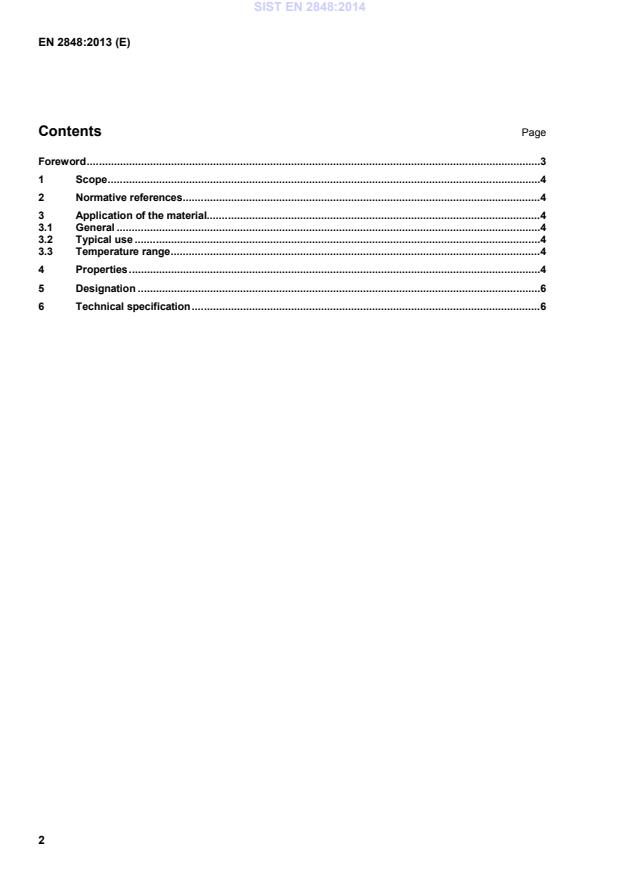
The standard is organized into:
- Scope
- Normative references
- Application of the material
- Properties
- Designation
- Technical specification
Clause 3 gives the intended use and service temperature range. Clause 4 points to the property tables, and Clauses 5 and 6 cover designation and the technical specification framework. The standard uses Table 1 for property tests and Table 2 for liquid-exposure tests.
What are the key requirements of SIST EN 2848:2014?
SIST EN 2848:2014 is built around property testing, liquid-resistance testing, and controlled use of the material in aerospace applications. In practice, that means the material is not approved just by description - it has to meet the specified tests and be checked in the right application.
- Clause 3.1 says suitability for a specific application shall be confirmed by complementary tests on the finished product. This matters because the listed properties come from standard test specimens, so the final part still needs verification in its real shape and process condition.
- Clause 3.2 identifies the typical use as applications needing resistance to petroleum-based fuels and diester-based lubricants. That helps buyers and engineers check that the material matches the service media.
- Clause 3.3 gives the service temperature range for continuous and intermittent use. This is the key design limit for deciding whether the elastomer can survive the thermal environment.
- Clause 4 says the property requirements are given in Table 1 and Table 2 according to EN 3207. This means the material specification and the test reporting need to be read together with EN 3207.
- Clause 4 distinguishes qualification from batch acceptance. For qualification, all tests are performed; for batch acceptance, only the tests marked with footnote "a" are required. This is important for both initial approval and routine production control.
- Table 1 covers the main property checks such as hardness, density, tensile strength, elongation at break, low-temperature behavior, compression set, ozone resistance, and corrosion and adhesion on metals. In practice, these are the checks that show whether the compound has the right mechanical and environmental behavior.
- Table 2 covers exposure in Air, Liquid B and Liquid No. 1 according to ISO 1817 and compares the permitted change in properties after immersion. This is the main check for resistance to fluids.
- Clause 5 gives a designation example, and Clause 6 points users to EN 3207 for the technical specification. That helps purchasing and quality teams write the correct material identification in orders and specifications.
What terms does SIST EN 2848:2014 define?
SIST EN 2848:2014 uses a small set of key terms and abbreviations rather than a separate definitions clause.
- NBR - acrylonitrile-butadiene rubber, the elastomer covered by the standard.
- IRHD - the hardness scale used to state the material hardness grade.
- Qualification - the full test program used to establish that the material meets the standard.
- Batch acceptance - the routine test set used to accept a production batch.
- Complementary tests - additional tests on the finished product used to confirm suitability for a specific application.
- TR10 - the low-temperature test result listed in Table 1 for cold performance.
- Liquid B - one of the ISO 1817 test liquids used for immersion resistance testing.
Who uses SIST EN 2848:2014?
SIST EN 2848:2014 is used by aerospace material engineers, elastomer compounders, test laboratories, quality managers, and buyers who specify rubber parts. It is also relevant to certification and qualification teams that need a common basis for material approval, batch release, and fluid-resistance testing.
What changed in SIST EN 2848:2014 from the previous edition?
SIST EN 2848:2014 is identified as EN 2848:2013. The standard text provided here does not add change notes beyond that identification.
Which standards are used with SIST EN 2848:2014?
SIST EN 2848:2014 uses these normative references:
- EN 3207 - provides the technical specification framework used for the property tables and the technical specification clause.
- ISO 1629 - gives the rubber and latices nomenclature, including the NBR symbol.
- ISO 1817 - provides the method for determining the effect of liquids, used for the immersion tests in Table 2.
What does the SIST EN 2848:2014 document contain?
SIST EN 2848:2014 contains the specification basis for an aerospace NBR material grade, with the service range and the intended fluid environment. It also contains the property tables that support qualification and batch acceptance.
The document includes Table 1 for test methods and property requirements, and Table 2 for liquid exposure conditions and permitted property changes. It also includes a designation example and a short technical specification pointer to EN 3207.
For practical use, the standard is mainly a materials and quality-control reference. It supports supplier qualification, incoming inspection, batch release, and specification of fuel- and oil-resistant rubber for aerospace parts.
Relations
- Effective Date
- 25-Aug-2026
- Effective Date
- 28-Jan-2026
- Effective Date
- 28-Jan-2026
- Effective Date
- 09-Feb-2026
- Effective Date
- 09-Feb-2026
- Effective Date
- 09-Feb-2026
- Effective Date
- 09-Feb-2026
- Effective Date
- 09-Feb-2026
- Effective Date
- 28-Jan-2026
Get Certified
Connect with accredited certification bodies for this standard

BUREAU VERITAS Certification Germany
Bureau Veritas certification in Germany.

Element Materials Technology
Materials testing and product certification.

AQMS Ltd.
AQMS provides ISO certification to SMEs across the UK.
Sponsored listings
Frequently Asked Questions
SIST EN 2848:2014 is a standard published by the Slovenian Institute for Standardization (SIST). Its full title is "Aerospace series - Acrylonitrile-butadiene rubber (NBR) - Fuel and synthetic oil resistant - Hardness 80 IRHD". This standard covers: This European Standard specifies the properties of acrylonitrile-butadiene rubber (NBR) ), fuel and synthetic oil resistant, hardness 80 IRHD, for aerospace applications.
This European Standard specifies the properties of acrylonitrile-butadiene rubber (NBR) ), fuel and synthetic oil resistant, hardness 80 IRHD, for aerospace applications.
SIST EN 2848:2014 is classified under the following ICS (International Classification for Standards) categories: 49.025.40 - Rubber and plastics. The ICS classification helps identify the subject area and facilitates finding related standards.
SIST EN 2848:2014 has the following relationships with other standards: It is inter standard links to SIST ISO 1629:2000, SIST EN 3207:2001, SIST EN ISO 15681-2:2005, SIST-TS CLC IEC/TS 60034-30-2:2021, SIST EN 60034-30-1:2014, SIST EN 50598-2:2015, SIST EN 61800-9-1:2017, SIST EN 61800-9-2:2017, SIST EN 17038-2:2019. Understanding these relationships helps ensure you are using the most current and applicable version of the standard.
SIST EN 2848:2014 is available in PDF format for immediate download after purchase. The document can be added to your cart and obtained through the secure checkout process. Digital delivery ensures instant access to the complete standard document.
Standards Content (Sample)
2003-01.Slovenski inštitut za standardizacijo. Razmnoževanje celote ali delov tega standarda ni dovoljeno.Luft- und Raumfahrt - Acrylinitril-Butadien-Elastomer (NBR) - Beständig gegen Brennstoffe und synthetische Öle - Härte 80 IRHDSérie aérospatiale - Élastomère acrylonitrile butadiène (NBR) - Résistant aux carburants et aux huiles synthétiques - Dureté 80 DIDCAerospace series - Acrylonitrile-butadiene rubber (NBR) - Fuel and synthetic oil resistant - Hardness 80 IRHD49.025.40Guma in polimerni materialiRubber and plasticsICS:Ta slovenski standard je istoveten z:EN 2848:2013SIST EN 2848:2014en01-februar-2014SIST EN 2848:2014SLOVENSKI
STANDARD
EUROPEAN STANDARD NORME EUROPÉENNE EUROPÄISCHE NORM
EN 2848
February 2013 ICS 49.025.40 English Version
Aerospace series - Acrylonitrile-butadiene rubber (NBR) - Fuel and synthetic oil resistant - Hardness 80 IRHD
Série aérospatiale - Élastomère acrylonitrile butadiène (NBR) - Résistant aux carburants et aux huiles synthétiques - Dureté 80 DIDC
Luft- und Raumfahrt - Acrylinitril-Butadien-Elastomer (NBR) - Beständig gegen Brennstoffe und synthetische Öle - Härte 80 IRHD This European Standard was approved by CEN on 3 November 2012.
CEN members are bound to comply with the CEN/CENELEC Internal Regulations which stipulate the conditions for giving this European Standard the status of a national standard without any alteration. Up-to-date lists and bibliographical references concerning such national standards may be obtained on application to the CEN-CENELEC Management Centre or to any CEN member.
This European Standard exists in three official versions (English, French, German). A version in any other language made by translation under the responsibility of a CEN member into its own language and notified to the CEN-CENELEC Management Centre has the same status as the official versions.
CEN members are the national standards bodies of Austria, Belgium, Bulgaria, Croatia, Cyprus, Czech Republic, Denmark, Estonia, Finland, Former Yugoslav Republic of Macedonia, France, Germany, Greece, Hungary, Iceland, Ireland, Italy, Latvia, Lithuania, Luxembourg, Malta, Netherlands, Norway, Poland, Portugal, Romania, Slovakia, Slovenia, Spain, Sweden, Switzerland, Turkey and United Kingdom.
EUROPEAN COMMITTEE FOR STANDARDIZATION
COMITÉ EUROPÉEN DE NORMALISATION EUROPÄISCHES KOMITEE FÜR NORMUNG
Management Centre:
Avenue Marnix 17,
B-1000 Brussels © 2013 CEN All rights of exploitation in any form and by any means reserved worldwide for CEN national Members. Ref. No. EN 2848:2013: ESIST EN 2848:2014
...