

SIST EN 16105:2023
(Main)Paints and varnishes - Laboratory method for determination of release of regulated dangerous substances from coatings in intermittent contact with water
General Information
- Abstract
This document specifies a laboratory method to determine the leaching behaviour of substances from coatings into water over defined time intervals.
The release of substances from coatings under natural conditions cannot be determined with this method.
This method can be applied to renders, when condition (4) of the Scope of CEN/TS 16637-1 is fulfilled.
(4) It is assumed that intermittent contact with water (e.g. exposure to rainwater) is tested — by convention — as permanent contact. For some coatings, (e.g. some renders with organic binders according to EN 15824) in intermittent contact to water, physical and chemical properties might be altered in permanent contact with water. These products are not covered by the Technical Specification CEN/TS 16637-1 since the test method in CEN/TS 16637-2 is not appropriate for these construction products.
- Status
- Published
- Public Enquiry End Date
- 02-May-2021
- Publication Date
- 22-Mar-2023
- Technical Committee
- IBLP - Paints and varnishes
- Current Stage
- 6060 - National Implementation/Publication (Adopted Project)
- Start Date
- 08-Mar-2023
- Due Date
- 13-May-2023
- Completion Date
- 23-Mar-2023



Overview
EN 16105:2023 - Paints and varnishes: Laboratory method for determination of release of regulated dangerous substances from coatings in intermittent contact with water - specifies a wetting/drying immersion test to quantify leaching of substances from coatings into water over defined time intervals. The method produces eluates for chemical analysis (e.g., target substances such as biocides) and reports leaching as mass released per surface area (specific emission). This edition (approved Dec 2022) supersedes EN 16105:2011.
Important limits:
- This laboratory method does not determine release under natural outdoor conditions.
- It can apply to renders only when the conditions of CEN/TS 16637‑1 (condition (4)) are met.
Key topics and technical requirements
- Test concept: Repeated immersion/drying cycles simulate intermittent water contact. An immersion cycle is defined as 1 h immersion → 4 h drying → 1 h immersion.
- Leachant: Deionised water, pH (6 ± 1), temperature (23 ± 2 °C).
- Specimens: Minimum two replicate test specimens containing the target substance plus one control specimen (coating without target substance or substrate alone). Minimum test surface: 100 cm².
- Sample preparation & conditioning:
- Representative sampling per EN ISO 15528.
- Coatings applied to inert, planar substrates (examples: XPS, EPS). Reverse and edge sealing of absorptive substrates recommended.
- Condition specimens ≥7 days at (23 ± 2) °C and (50 ± 5) % RH (EN 23270).
- Apparatus & setup:
- Immersion container inert to target substances (glass, PTFE coated), water column ≥10 mm, volume scaled to 25 L per m² exposed area (e.g., 250 mL for 100 cm²).
- Calibrated analytical balance, pH meter, dimensional measurement devices, suitable bottles for eluate collection.
- Measurements & reporting:
- Analyse eluates from each immersion or merged eluates for defined target substances.
- Report concentrations and convert to specific emissions (mg/m²).
- Include test conditions, substrate, coating mass applied, and uncertainty assessment in the test report.
Applications
- Environmental risk assessment and regulatory compliance for coatings and additives (e.g., biocides).
- Product development and formulation screening to compare leaching behaviour.
- Laboratory-based emission quantification for safety data and product declarations.
- Input to lifecycle and environmental impact analyses where controlled leaching data are required.
Who uses this standard
- Coatings manufacturers and formulators
- Accredited testing laboratories and quality control units
- Environmental assessors and consultants
- Regulators and compliance teams evaluating hazardous substance release
- Architects and specifiers requiring documented leaching data for building materials
Related standards and references
- EN 23270 - conditioning temperatures and humidities
- EN ISO 15528 - sampling of paints and varnishes
- EN ISO 4618 - terminology (definitions such as biocide, coating)
- CEN/TS 16637‑1 and EN 15824 - applicability notes for renders and certain construction products
- Biocidal Products Directive references for biocide lists
Keywords: EN 16105, paints and varnishes, leaching test, coatings, laboratory method, regulated dangerous substances, immersion cycle, eluate, specific emission, environmental risk assessment.
Relations
- Effective Date
- 01-May-2023
- Effective Date
- 28-Jan-2026
- Effective Date
- 28-Jan-2026
Frequently Asked Questions
SIST EN 16105:2023 is a draft published by the Slovenian Institute for Standardization (SIST). Its full title is "Paints and varnishes - Laboratory method for determination of release of regulated dangerous substances from coatings in intermittent contact with water". This standard covers: This document specifies a laboratory method to determine the leaching behaviour of substances from coatings into water over defined time intervals. The release of substances from coatings under natural conditions cannot be determined with this method. This method can be applied to renders, when condition (4) of the Scope of CEN/TS 16637-1 is fulfilled. (4) It is assumed that intermittent contact with water (e.g. exposure to rainwater) is tested — by convention — as permanent contact. For some coatings, (e.g. some renders with organic binders according to EN 15824) in intermittent contact to water, physical and chemical properties might be altered in permanent contact with water. These products are not covered by the Technical Specification CEN/TS 16637-1 since the test method in CEN/TS 16637-2 is not appropriate for these construction products.
This document specifies a laboratory method to determine the leaching behaviour of substances from coatings into water over defined time intervals. The release of substances from coatings under natural conditions cannot be determined with this method. This method can be applied to renders, when condition (4) of the Scope of CEN/TS 16637-1 is fulfilled. (4) It is assumed that intermittent contact with water (e.g. exposure to rainwater) is tested — by convention — as permanent contact. For some coatings, (e.g. some renders with organic binders according to EN 15824) in intermittent contact to water, physical and chemical properties might be altered in permanent contact with water. These products are not covered by the Technical Specification CEN/TS 16637-1 since the test method in CEN/TS 16637-2 is not appropriate for these construction products.
SIST EN 16105:2023 is classified under the following ICS (International Classification for Standards) categories: 87.040 - Paints and varnishes. The ICS classification helps identify the subject area and facilitates finding related standards.
SIST EN 16105:2023 has the following relationships with other standards: It is inter standard links to SIST EN 16105:2011, SIST EN ISO 15528:2020, SIST EN 23270:1997. Understanding these relationships helps ensure you are using the most current and applicable version of the standard.
SIST EN 16105:2023 is available in PDF format for immediate download after purchase. The document can be added to your cart and obtained through the secure checkout process. Digital delivery ensures instant access to the complete standard document.
Standards Content (Sample)
SLOVENSKI STANDARD
01-maj-2023
Nadomešča:
SIST EN 16105:2011
Barve in laki - Laboratorijska metoda za ugotavljanje sproščanja reguliranih
nevarnih snovi iz premazov ob občasnem stiku z vodo
Paints and varnishes - Laboratory method for determination of release of regulated
dangerous substances from coatings in intermittent contact with water
Beschichtungsstoffe - Laborverfahren zur Bestimmung der Freisetzung von Substanzen
aus Beschichtungen in intermittierendem Kontakt mit Wasser
Peintures et vernis - Méthode de laboratoire pour la détermination de la libération de
substances dangereuses réglementées provenant de revêtements en contact avec l’eau
par intermittence
Ta slovenski standard je istoveten z: EN 16105:2023
ICS:
87.040 Barve in laki Paints and varnishes
2003-01.Slovenski inštitut za standardizacijo. Razmnoževanje celote ali delov tega standarda ni dovoljeno.
EN 16105
EUROPEAN STANDARD
NORME EUROPÉENNE
January 2023
EUROPÄISCHE NORM
ICS 87.040 Supersedes EN 16105:2011
English Version
Paints and varnishes - Laboratory method for
determination of release of regulated dangerous
substances from coatings in intermittent contact with
water
Peintures et vernis - Méthode de laboratoire pour la Beschichtungsstoffe - Laborverfahren zur Bestimmung
détermination de la libération de substances der Freisetzung von Substanzen aus Beschichtungen in
dangereuses réglementées provenant de revêtements intermittierendem Kontakt mit Wasser
en contact avec l'eau par intermittence
This European Standard was approved by CEN on 25 December 2022.
CEN members are bound to comply with the CEN/CENELEC Internal Regulations which stipulate the conditions for giving this
European Standard the status of a national standard without any alteration. Up-to-date lists and bibliographical references
concerning such national standards may be obtained on application to the CEN-CENELEC Management Centre or to any CEN
member.
This European Standard exists in three official versions (English, French, German). A version in any other language made by
translation under the responsibility of a CEN member into its own language and notified to the CEN-CENELEC Management
Centre has the same status as the official versions.
CEN members are the national standards bodies of Austria, Belgium, Bulgaria, Croatia, Cyprus, Czech Republic, Denmark, Estonia,
Finland, France, Germany, Greece, Hungary, Iceland, Ireland, Italy, Latvia, Lithuania, Luxembourg, Malta, Netherlands, Norway,
Poland, Portugal, Republic of North Macedonia, Romania, Serbia, Slovakia, Slovenia, Spain, Sweden, Switzerland, Türkiye and
United Kingdom.
EUROPEAN COMMITTEE FOR STANDARDIZATION
COMITÉ EUROPÉEN DE NORMALISATION
EUROPÄISCHES KOMITEE FÜR NORMUNG
CEN-CENELEC Management Centre: Rue de la Science 23, B-1040 Brussels
© 2023 CEN All rights of exploitation in any form and by any means reserved Ref. No. EN 16105:2023 E
worldwide for CEN national Members.
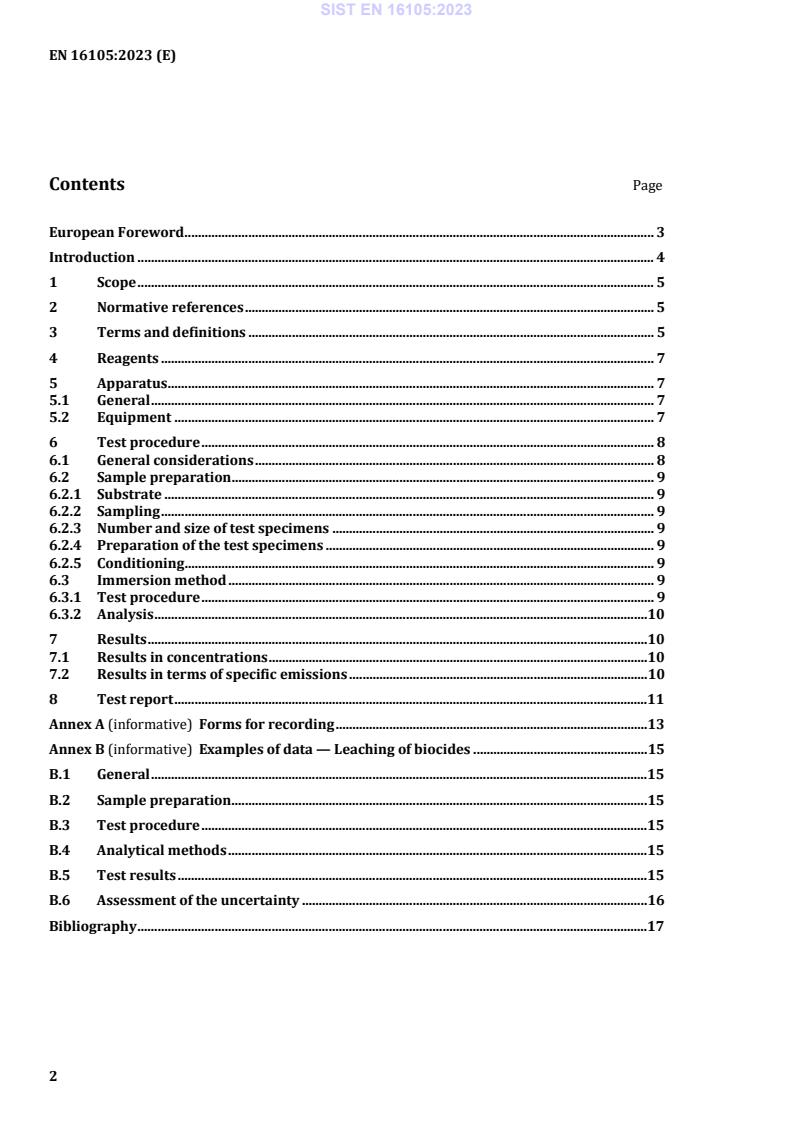
Contents Page
European Foreword . 3
Introduction . 4
1 Scope . 5
2 Normative references . 5
3 Terms and definitions . 5
4 Reagents . 7
5 Apparatus . 7
5.1 General . 7
5.2 Equipment . 7
6 Test procedure . 8
6.1 General considerations . 8
6.2 Sample preparation . 9
6.2.1 Substrate . 9
6.2.2 Sampling . 9
6.2.3 Number and size of test specimens . 9
6.2.4 Preparation of the test specimens . 9
6.2.5 Conditioning . 9
6.3 Immersion method . 9
6.3.1 Test procedure . 9
6.3.2 Analysis .10
7 Results .10
7.1 Results in concentrations .10
7.2 Results in terms of specific emissions .10
8 Test report .11
Annex A (informative) Forms for recording .13
Annex B (informative) Examples of data — Leaching of biocides .15
B.1 General .15
B.2 Sample preparation .15
B.3 Test procedure .15
B.4 Analytical methods .15
B.5 Test results .15
B.6 Assessment of the uncertainty .16
Bibliography .17
European Foreword
This document (EN 16105:2023) has been prepared by Technical Committee CEN/TC 139 “Paints and
Vanishes” the secretariat of which is held by DIN.
This European Standard shall be given the status of a national standard, either by publication of an
identical text or by endorsement, at the latest by July 2023, and conflicting national standards shall be
withdrawn at the latest by July 2023.
Attention is drawn to the possibility that some of the elements of this document may be the subject of
patent rights. CEN shall not be held responsible for identifying any or all such patent rights.
This document supersedes EN 16105:2011.
The main changes compared to the previous edition are as follows:
— the Scope has been amended;
— in 6.3.1 tolerances have been added;
— normative references have been updated.
Any feedback and questions on this document should be directed to the users’ national standards body.
A complete listing of these bodies can be found on the CEN website.
According to the CEN-CENELEC Internal Regulations, the national standards organisations of the
following countries are bound to implement this European Standard: Austria, Belgium, Bulgaria, Croatia,
Cyprus, Czech Republic, Denmark, Estonia, Finland, France, Germany, Greece, Hungary, Iceland, Ireland,
Italy, Latvia, Lithuania, Luxembourg, Malta, Netherlands, Norway, Poland, Portugal, Republic of North
Macedonia, Romania, Serbia, Slovakia, Slovenia, Spain, Sweden, Switzerland, Türkiye and the United
Kingdom.
Introduction
Leaching of substances from coatings into water needs to be quantified to enable an environmental risk
assessment for the use of substances in coating materials. Substances can be leached from coatings,
particularly by driving rain, and transferred into the environment.
1 Scope
This document specifies a laboratory method to determine the leaching behaviour of substances from
coatings into water over defined time intervals.
The release of substances from coatings under natural conditions cannot be determined with this
method.
This method can be applied to renders, when condition (4) of the Scope of CEN/TS 16637-1 is fulfilled.
(4) It is assumed that intermittent contact with water (e.g. exposure to rainwater) is tested — by
convention — as permanent contact. For some coatings, (e.g. some renders with organic binders
according to EN 15824) in intermittent contact to water, physical and chemical properties might be
altered in permanent contact with water. These products are not covered by the Technical Specification
CEN/TS 16637-1 since the test method in CEN/TS 16637-2 is not appropriate for these construction
products.
2 Normative references
The following documents are referred to in the text in such a way that some or all of their content
constitutes requirements of this document. For dated references, only the edition cited applies. For
undated references, the latest edition of the referenced document (including any amendments) applies.
EN 23270, Paints and varnishes and their raw materials - Temperatures and humidities for conditioning
and testing (ISO 3270)
EN ISO 15528, Paints, varnishes and raw materials for paints and varnishes - Sampling (ISO 15528)
3 Terms and definitions
For the purposes of this document, the following terms and definitions apply.
ISO and IEC maintain terminology databases for use in standardization at the following addresses:
— ISO Online browsing platform: available at https://www.iso.org/obp
— IEC Electropedia: available at https://www.electropedia.org/
3.1
substance
single chemical element or compound, or a complex structure of compounds, that is contained in the
coating and can potentially be extracted from the coating via water contact
3.2
target substance
substance of interest which has to be defined
Note 1 to entry: One or more target substances may be defined, which shall be quantified in the merged eluates
and for which results shall be given according to Clause 6. For example, biocides can be the target substances (see
Annex B).
3.3
biocide
additive added to a coating material to prevent organisms responsible for microbiological degradation
from attacking a substrate, a coating material or a film thereof
Note 1 to entry: A list of biocides is given in Annex I and IA of the Biocidal Products Directive 98/8/EC (Directive
98/8/EC of the European Parliament and of the Council of 16 February 1998 concerning the placing of biocidal
products on the market – BPD).
[SOURCE: EN ISO 4618:2014, 2.27 modified: Note 1 to entry has been added]
3.4
coating
layer formed from a single or multiple application of a coating material to a substrate
Note 1 to entry: The use of the term “coating” for “coating material” is deprecated.
[SOURCE: EN ISO 4618:2014, 2.50.1]
3.5
coating material
product, in liquid, paste or powder form, that, when applied to a substrate, forms a layer possessing
protective, decorative and/or other specific properties
[SOURCE: EN ISO 4618:2014, 2.51]
3.6
test specimen
body to be tested consisting of substrate with coating
3.7
emission
release of substances from a coating, which pass through the external surface of the coating under specific
conditions into the environment
Note 1 to entry: The emission is expressed in units of released mass per surface area, i.e. milligrams per square
metre.
3.8
leaching
release of substances from a coating, which pass through the external surface of the coating under specific
conditions into water
Note 1 to entry: The leaching is expressed in units of released mass per surface area, i.e. milligrams per square
metre.
3.9
immersion
exposure of test specimen to the leachant
3.10
immersion cycle
i
sequence consisting of 1 h immersion, 4 h drying and 1 h immersion
Note 1 to entry: i is the running number of immersion cycles.
3.11
eluate
solution obtained by one immersion
3.12
merged eluate
solution obtained at a specific immersion cycle, consisting of the eluates of the two immersions
3.13
specific emission
E
released mass of a target substance from a coating through the surface during a specific immersion cycle
Note 1 to entry: The unit is mass per surface area, i.e. milligrams per square metre.
3.14
leachant
liquid that is brought into contact with the test specimen in the leaching procedure
Note 1 to entry: Standard leachant as specified in 4.1.
4 Reagents
4.1 Standard leachant
Deionised water with a pH-value of (6 ± 1) and a water temperature of (23 ± 2) °C shall be used.
5 Apparatus
5.1 General
Check the materials and equipment specified in 5.2.1 to 5.2.6 before use for proper operation and absence
of interfering e
...