


kSIST FprEN IEC 61308:2026
(Main)High-frequency dielectric heating installations - Test methods for the determination of power output
Hochfrequente dielektrische Erwärmungsanlagen - Prüfverfahren für die Bestimmung der Ausgangsleistung
Installations de chauffage diélectrique à haute fréquence - Méthodes d'essai pour la détermination de la puissance de sortie
Inštalacije za visokofrekvenčno dielektrično segrevanje - Preskusne metode za ugotavljanje izhodne moči
General Information
- Status
- Not Published
- Public Enquiry End Date
- 31-Jul-2025
- Technical Committee
- I09 - Imaginarni 09
- Current Stage
- 5020 - Formal vote (FV) (Adopted Project)
- Start Date
- 09-Jun-2026
- Due Date
- 28-Jul-2026

Relations
- Effective Date
- 18-Feb-2025
Overview
kSIST FprEN IEC 61308:2026 defines standardized test methods for determining the power output of high-frequency dielectric heating installations. Developed by the Slovenian Institute for Standardization (SIST) and aligned with IEC guidance, this standard is essential for manufacturers and users of industrial heating equipment operating at frequencies from 100 kHz to 300 MHz. Its primary objective is to ensure reliable, repeatable assessment of power output for high-frequency dielectric heating generators and systems, promoting uniformity and safety across the industry. The document specifically targets industrial applications and excludes household, commercial, laboratory, and medical equipment.
Key Topics
- Scope of Application: The standard is applicable to industrial high-frequency (HF) dielectric heating equipment, notably HF generators either provided as standalone units or integrated into systems.
- Test Load Types: Methods use various test loads to simulate real operating conditions:
- Calorimetric load
- Lamp load
- Matched resistive load
- Wet-sand load
- Output Power Measurement Methods:
- Calorimetric method for loads ≥1 kW
- Lamp-load temperature method for loads up to 1 kW
- Matched resistive load method for direct power measurement
- Wet-sand load and plastic welding electrode test for specific equipment
- Accuracy Requirements: The standard specifies measurement accuracy, typically within ±5% for calorimetric and lamp methods, and ±2.5% to ±5% for matched resistive load measurements.
- Classifications: Differentiates between:
- Type A: Separate generator and applicator systems
- Type B: Integrated generator and applicator systems
Applications
High-frequency dielectric heating installations are widely used in industrial sectors for applications such as:
- Plastic Welding: Ensuring consistent power output for reliable, high-quality welds in plastic materials.
- Material Processing: Precise control and consistency in heating enables effective processing of a variety of industrial materials.
- Specialized Industrial Ovens: Used for drying, bonding, forming, or curing processes.
- Quality Control & Equipment Validation: The defined test methods enable manufacturers and users to verify power output, ensure compliance with safety standards, and maintain equipment performance over time.
By adhering to the methodologies in kSIST FprEN IEC 61308:2026, stakeholders benefit from:
- Repeatable and Comparable Power Output Measurements: Facilitating product development, system integration, and end-user assurance.
- Support for Equipment Maintenance and Performance Optimization: Allowing ongoing assessment and adjustment for optimal function and safety.
- Compliance with Regulatory and Safety Requirements: Demonstrating conformity with internationally recognized standards, such as those related to electromagnetic disturbance (per CISPR11).
Related Standards
Organizations implementing high-frequency dielectric heating installations should consider these associated standards:
- IEC 60519-6:2022 - Safety in installations for electroheating and electromagnetic processing – Part 6: Particular requirements for high-frequency dielectric and microwave equipment.
- CISPR11:2024 - Industrial, scientific and medical equipment – Radio-frequency disturbance characteristics – Limits and methods of measurement.
- IEC 60050-841 - International Electrotechnical Vocabulary – Industrial electroheat.
These documents collectively support the safety, electromagnetic compatibility, and reliability of industrial high-frequency electroheating processes.
Adoption of kSIST FprEN IEC 61308:2026 enhances confidence in power output assessments for high-frequency dielectric heating, ensuring robust industrial performance and global competitiveness for equipment manufacturers and users.
Get Certified
Connect with accredited certification bodies for this standard

DVS-ZERT GmbH
German welding certification society.
CARES (UK Certification Authority for Reinforcing Steels)
UK certification for reinforcing steels and construction.
EWF/IIW (European/International Welding Federation)
International welding personnel certification.
Sponsored listings
Frequently Asked Questions
kSIST FprEN IEC 61308:2026 is a draft published by the Slovenian Institute for Standardization (SIST). Its full title is "High-frequency dielectric heating installations - Test methods for the determination of power output". This standard covers: High-frequency dielectric heating installations - Test methods for the determination of power output
High-frequency dielectric heating installations - Test methods for the determination of power output
kSIST FprEN IEC 61308:2026 is classified under the following ICS (International Classification for Standards) categories: 25.180.10 - Electric furnaces. The ICS classification helps identify the subject area and facilitates finding related standards.
kSIST FprEN IEC 61308:2026 has the following relationships with other standards: It is inter standard links to SIST EN 61308:2006. Understanding these relationships helps ensure you are using the most current and applicable version of the standard.
kSIST FprEN IEC 61308:2026 is available in PDF format for immediate download after purchase. The document can be added to your cart and obtained through the secure checkout process. Digital delivery ensures instant access to the complete standard document.
Standards Content (Sample)
SLOVENSKI STANDARD
oSIST prEN IEC 61308:2025
01-julij-2025
Inštalacije za visokofrekvenčno dielektrično segrevanje - Preskusne metode za
ugotavljanje izhodne moči
High-frequency dielectric heating installations - Test methods for the determination of
power output
Hochfrequente dielektrische Erwärmungsanlagen - Prüfverfahren für die Bestimmung
der Ausgangsleistung
Installations de chauffage diélectrique à haute fréquence - Méthodes d'essai pour la
détermination de la puissance de sortie
Ta slovenski standard je istoveten z: prEN IEC 61308:2025
ICS:
25.180.10 Električne peči Electric furnaces
oSIST prEN IEC 61308:2025 en
2003-01.Slovenski inštitut za standardizacijo. Razmnoževanje celote ali delov tega standarda ni dovoljeno.
oSIST prEN IEC 61308:2025
oSIST prEN IEC 61308:2025
27/1207/CDV
COMMITTEE DRAFT FOR VOTE (CDV)
PROJECT NUMBER:
IEC 61308 ED3
DATE OF CIRCULATION: CLOSING DATE FOR VOTING:
2025-06-13 2025-09-05
SUPERSEDES DOCUMENTS:
27/1201/CD, 27/1204/CC
IEC TC 27 : INDUSTRIAL ELECTROHEATING AND ELECTROMAGNETIC PROCESSING
SECRETARIAT: SECRETARY:
Poland Mrs Mariola Nowecka
OF INTEREST TO THE FOLLOWING COMMITTEES: HORIZONTAL FUNCTION(S):
ASPECTS CONCERNED:
Safety
SUBMITTED FOR CENELEC PARALLEL VOTING NOT SUBMITTED FOR CENELEC PARALLEL VOTING
Attention IEC-CENELEC parallel voting
The attention of IEC National Committees, members of
CENELEC, is drawn to the fact that this Committee Draft for
Vote (CDV) is submitted for parallel voting.
The CENELEC members are invited to vote through the
CENELEC online voting system.
This document is still under study and subject to change. It should not be used for reference purposes.
Recipients of this document are invited to submit, with their comments, notification of any relevant patent rights of which they
are aware and to provide supporting documentation.
Recipients of this document are invited to submit, with their comments, notification of any relevant “In Some Countries”
clauses to be included should this proposal proceed. Recipients are reminded that the CDV stage is the final stage for
submitting ISC clauses. (SEE AC/22/2007 OR NEW GUIDANCE DOC).
TITLE:
High-frequency dielectric heating installations - Test methods for the determination of power output
PROPOSED STABILITY DATE: 2030
NOTE FROM TC/SC OFFICERS:
electronic file, to make a copy and to print out the content for the sole purpose of preparing National Committee positions.
You may not copy or "mirror" the file or printed version of the document, or any part of it, for any other purpose without
permission in writing from IEC.
oSIST prEN IEC 61308:2025
IEC 61308 ED3 © IEC 2025 2
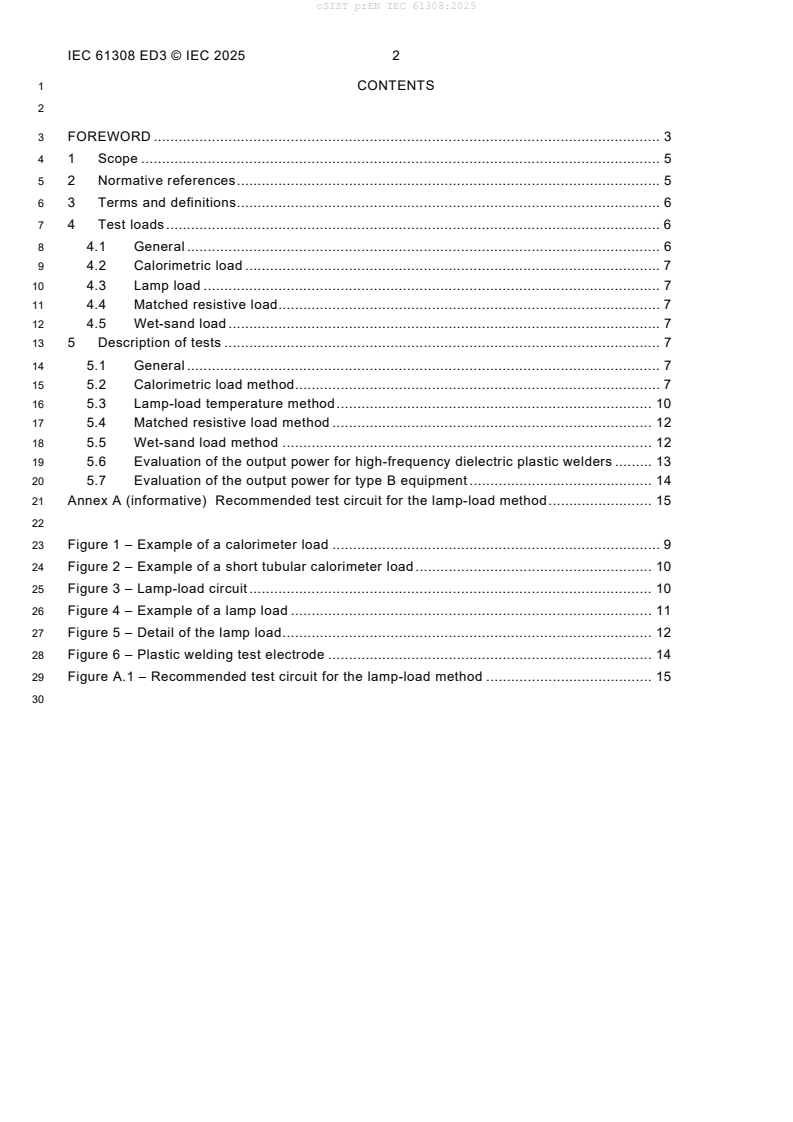
1 CONTENTS
3 FOREWORD . 3
4 1 Scope . 5
5 2 Normative references . 5
6 3 Terms and definitions . 6
7 4 Test loads . 6
8 4.1 General . 6
9 4.2 Calorimetric load . 7
10 4.3 Lamp load . 7
11 4.4 Matched resistive load . 7
12 4.5 Wet-sand load . 7
13 5 Description of tests . 7
14 5.1 General . 7
15 5.2 Calorimetric load method . 7
16 5.3 Lamp-load temperature method . 10
17 5.4 Matched resistive load method . 12
18 5.5 Wet-sand load method . 12
19 5.6 Evaluation of the output power for high-frequency dielectric plastic welders . 13
20 5.7 Evaluation of the output power for type B equipment . 14
21 Annex A (informative) Recommended test circuit for the lamp-load method . 15
23 Figure 1 – Example of a calorimeter load . 9
24 Figure 2 – Example of a short tubular calorimeter load . 10
25 Figure 3 – Lamp-load circuit . 10
26 Figure 4 – Example of a lamp load . 11
27 Figure 5 – Detail of the lamp load . 12
28 Figure 6 – Plastic welding test electrode . 14
29 Figure A.1 – Recommended test circuit for the lamp-load method . 15
oSIST prEN IEC 61308:2025
IEC 61308 ED3 © IEC 2025 3
INTERNATIONAL ELECTROTECHNICAL COMMISSION
____________
HIGH-FREQUENCY DIELECTRIC HEATING INSTALLATIONS –
TEST METHODS FOR THE DETERMINATION
OF POWER OUTPUT
FOREWORD
1) The International Electrotechnical Commission (IEC) is a worldwide organization for standardization comprising all national
electrotechnical committees (IEC National Committees). The object of IEC is to promote international co-operation on all
questions concerning standardization in the electrical and electronic fields. To this end and in addition to other activities,
IEC publishes International Standards, Technical Specifications, Technical Reports, Publicly Available Specifications (PAS)
and Guides (hereafter referred to as "IEC Publication(s)"). Their preparation is entrusted to technical committees; any IEC
National Committee interested in the subject dealt with may participate in this preparatory work. International, governmental
and non-governmental organizations liaising with the IEC also participate in this preparation. IEC collaborates closely with
the International Organization for Standardization (ISO) in accordance with conditions determined by agreement between
the two organizations.
2) The formal decisions or agreements of IEC on technical matters express, as nearly as possible, an international consensus
of opinion on the relevant subjects since each technical committee has representation from all interested IEC National
Committees.
3) IEC Publications have the form of recommendations for international use and are accepted by IEC National Committees in
that sense. While all reasonable efforts are made to ensure that the technical content of IEC Publications is accurate, IEC
cannot be held responsible for the way in which they are used or for any misinterpretation by any end user.
4) In order to promote international uniformity, IEC National Committees undertake to apply IEC Publications transparently to
the maximum extent possible in their national and regional publications. Any divergence between any IEC Publication and
the corresponding national or regional publication shall be clearly indicated in the latter.
5) IEC itself does not provide any attestation of conformity. Independent certification bodies provide conformity assessment
services and, in some areas, access to IEC marks of conformity. IEC is not responsible for any services carried out by
independent certification bodies.
6) All users should ensure that they have the latest edition of this publication.
7) No liability shall attach to IEC or its directors, employees, servants or agents including individual experts and members of
its technical committees and IEC National Committees for any personal injury, property damage or other damage of any
nature whatsoever, whether direct or indirect, or for costs (including legal fees) and expenses arising out of the publication,
use of, or reliance upon, this IEC Publication or any other IEC Publications.
8) Attention is drawn to the Normative references cited in this publication. Use of the referenced publications is indispensable
for the correct application of this publication.
9) IEC draws attention to the possibility that the implementation of this document may involve the use of (a) patent(s). IEC
takes no position concerning the evidence, validity or applicability of any claimed patent rights in respect thereof. As of the
date of publication of this document, IEC had not received notice of (a) patent(s), which may be required to implement this
document. However, implementers are cautioned that this may not represent the latest information, which may be obtained
from the patent database available at https://patents.iec.ch [and/or] www.iso.org/patents.IEC shall not be held responsible
for identifying any or all such patent rights.
This International Standard IEC 61308 has been prepared by IEC technical committee 27: Industrial
electroheating and electromagnetic processing. It is an International Standard.
This third edition replaces the cancelled second edition published in 2005 and constitutes a technical
revision.
The text of this International Standard is based on the following documents:
Draft Report on voting
27/XX/FDIS 27/XX/RVD
Full information on the voting for its approval can be found in the report on voting indicated in the above
table.
oSIST prEN IEC 61308:2025
IEC 61308 ED3 © IEC 2025 4
The language used for the development of this International Standard is English
This document was drafted in accordance with ISO/IEC Directives, Part 2, and developed in accordance
with ISO/IEC Directives, Part 1 and ISO/IEC Directives, IEC Supplement, [and the ISO/IEC Directives,
JTC 1 Supplement] available at www.iec.ch/members_experts/refdocs. The main document types
developed by IEC are described in greater detail at www.iec.ch/publications.
The committee has decided that the contents of this document will remain unchanged until the stability
date indicated on the IEC website under webstore.iec.ch in the data related to the specific document.
At this date, the document will be
• reconfirmed,
• withdrawn,
• replaced by a revised edition, or
• amended.
oSIST prEN IEC 61308:2025
IEC 61308 ED3 © IEC 2025 5
HIGH-FREQUENCY DIELECTRIC HEATING INSTALLATIONS –
TEST METHODS FOR THE DETERMINATION
OF POWER OUTPUT
1 Scope
This International Standard specifies test methods for the determination of available high frequency
power output in equipment for industrial heating and processing of materials. It is in particular applicable
to HF generators made available to users as separate units.
This document is basically applicable to equipment operating in the frequency range 100 kHz to 300
MHz, as defined in IEC 60519-1:2020, with the following limitations.
– This document does not apply to induction heating, which it is possible to carry out in the lower part
of the specified frequency band.
– The ISM centre frequencies for dielectric heating and processing of industrial interest are
narrow bands about 6,78 MHz, 13,56 MHz, 27,12 MHz and 40,68 MHz.
– This document is not applicable to:
• appliances for household and similar use;
• commercial use;
• laboratory use;
• medical high frequency equipment.
NOTE 1 The following criteria are suitable for determination of the classification as industrial equipment:
– commercial equipment is typically designed and planned for series production of many identical units,
– industrial equipment is typically produced in small series or even as single units. The processed goods are consumed or
ready for final use at the end of the heating process.
NOTE 2 Heating a workload with dielectric parameters which change significantly in time and/or with temperature, the value of
the output power obtained with the actual charge may be different from that obtained with the test load specified in this standard.
NOTE 3 For equipment working in designated ISM bands it is required that the frequency remains within the ISM bands
according to CISPR11, but the resonant frequency of the circuit varies with the change of dielectric parameters of the load.
Therefore, the value of the mean output power in the work cycle can be much lower than the value obtained under the test
conditions. This value depends upon the response of the tuning system.
This standard relates to equipment normally operating under continuous rated conditions.
2 Normative references
The following documents are referred to in the text in such a way that some or all of their content
constitutes requirements of this document. For dated references, only the edition cited applies. For
undated references, the latest edition of the referenced document (including any amendments) applies.
IEC 60050-841:2004, International Electrotechnical Vocabulary – Part 841: Industrial electroheat
NOTE Since chapter 841 in IEV is under revision, no references to the 2004 version are given in this standard. (CISPR 2024).
oSIST prEN IEC 61308:2025
IEC 61308 ED3 © IEC 2025 6
IEC 60519-6:2022, Safety in installations for electroheating and electromagnetic processing –Part 6:
Particular requirements for high frequency dielectric and microwave heating and processing equipment
CISPR11:2024, Industrial, scientific and medical equipment - Radio-frequency disturbance
characteristics - Limits and methods of measurement
3 Terms and definitions
For the purposes of this document, the following terms and definitions apply.
ISO and IEC maintain terminology databases for use in standardization at the following addresses:
• IEC Electropedia: available at https://www.electropedia.org/
• ISO Online browsing platform: available at https://www.iso.org/obp
Terms and definitions listed in different documents:
For the purposes of this document, the terms and definitions given in IEC60519-1 ED 6 and/or
IEC60519-6 ED 4 apply. In particular, the definition of test load in IEC60519-6 ED 4, 3.3.104 shall be
noted as well as of normal operation in IEC 60519-1 ED6, 3.2.6.
NOTE Some terms in this document have the same or similar definitions in IEC 60050 (IEV). If different, those in this standard
apply.
3.1
type A equipment
equipment with the high frequency converter or generator independent of, or separable from, the
applicator to which the high-frequency power is provided.
EXAMPLE 1 The separation is by a coaxial line feeder or alternative means.
3.2
type B equipment
equipment with the high frequency converter or
...