

SIST EN ISO 8980-3:2022/A1:2026
(Amendment)Ophthalmic optics - Uncut finished spectacle lenses - Part 3: Transmittance specifications and test methods - Amendment 1 (ISO 8980 3:2022/Amd 1:2026)
- Status
- Published
- Public Enquiry End Date
- 29-Jun-2025
- Publication Date
- 16-Sep-2026
- Technical Committee
- VAZ - Healthcare
- Current Stage
- 6060 - National Implementation/Publication (Adopted Project)
- Start Date
- 04-Sep-2026
- Due Date
- 09-Nov-2026
- Completion Date
- 17-Sep-2026


SIST EN ISO 8980-3:2022/A1:2026 is the Slovenian adoption of EN ISO 8980-3:2022/A1:2026, aligned with ISO 8980-3:2022/Amd 1:2026. It updates the transmittance specifications and test methods for uncut finished spectacle lenses, including claims about attenuation of solar radiation and wavelength cut, so it is relevant to lens makers, laboratories, suppliers and anyone checking declared optical performance.
What does SIST EN ISO 8980-3:2022/A1:2026 specify?
SIST EN ISO 8980-3:2022/A1:2026 amends EN ISO 8980-3:2022 for uncut and unmounted finished spectacle lenses. In practice, it keeps the focus on transmittance properties, while adding clearer provisions for performance claims and for the way those claims are reported and measured.
The amendment touches these parts of the base standard:
| Part of the document | What this amendment addresses |
|---|---|
| Scope | Expands the wording to cover requirements and claims |
| Clause 3 | Adds a definition for wavelength cut |
| Clause 6.7 | Adds requirements for claimed wavelength cut |
| Clause 7.2 | Revises uncertainty and measurement conditions |
| Clause 7.3 | Updates the clause headings |
| Clause 8 | Broadens the information that must be supplied |
| Annex G | Adds informative background on wavelength-cut measurement |
What are the key requirements of SIST EN ISO 8980-3:2022/A1:2026?
SIST EN ISO 8980-3:2022/A1:2026 makes the standard more specific about what a manufacturer may claim and how that claim is checked. The practical effect is that a lens claim now needs to be tied to a defined measurement method, measurement uncertainty and product information.
Claimed wavelength cut
Clause 6.7 applies when a lens is claimed to have a wavelength cut at a nominated wavelength. The lens has to meet the transmittance limit at that nominated wavelength and also remain below the low-transmittance limit over the short-wavelength region immediately below it. This matters because the claim is not just a label - it has to be backed by a repeatable spectral measurement.
Clause 6.7 also says the claimed performance must still be satisfied after ultraviolet irradiation as specified elsewhere in the standard. For users, that means the claim has to remain valid after the lens has been exposed to the stated UV test condition.
Measurement uncertainty and test setup
Clause 7.2 tightens the uncertainty rules for spectral transmittance measurements. The allowed uncertainty depends on the measured transmittance level, with tighter limits for low-transmittance values. The requirement uses a 95 % confidence level, so laboratories need a controlled measurement system and a documented uncertainty approach.
Clause 7.2.2 gives the specific method for wavelength-cut claims. It calls for a spectrophotometer or equivalent device with wavelength accuracy and resolution suited to the task, operation across the UV-visible range used by the standard, and a narrow spectral bandwidth. In practice, this means the instrument must be able to resolve the short-wavelength edge properly, or the measured cut can shift.
The measurement is made on a plano lens of a specified thickness at the reference point, with the beam normal to the front surface. If a different thickness is used, that thickness has to be stated. For manufacturers and labs, this is important because thickness and geometry affect the result and must be controlled if results are to be comparable.
Information supplied with the lens
Clause 8 expands how the required information may be provided. The manufacturer or supplier may give it on the package, in an accompanying document, or through other separate information, including digital means such as a QR or data matrix code. The clause also adds claimed absorption or transmittance properties under the relevant clause references. This helps buyers, dispensers and inspectors trace the claim back to the product.
Why Annex G matters
Informative Annex G explains why wavelength-cut measurements can vary. It highlights the influence of lens thickness, lens geometry and spectrophotometer characteristics such as stray light and bandwidth. For readers, Annex G is useful background when comparing results between instruments or when validating a test method.
What terms does SIST EN ISO 8980-3:2022/A1:2026 define?
- Wavelength cut - the lowest wavelength at which spectral transmittance rises to a specified level.
- Spectral transmittance - the fraction of light transmitted by the lens at each wavelength, used to assess filtering behavior.
- Transmittance properties - the optical characteristics that describe how much light or radiation passes through the lens.
- Spectrophotometer - the instrument used to measure spectral transmittance over the required wavelength range.
- Full width at half maximum (FWHM) - the bandwidth measure used here to limit the spectral width of the measurement beam.
- Ultraviolet (UV) irradiation - the UV exposure used to verify that a wavelength-cut claim still holds after irradiation.
- Plano lens - a lens with no optical power, used here as the stated reference form for measurement.
Who uses SIST EN ISO 8980-3:2022/A1:2026?
SIST EN ISO 8980-3:2022/A1:2026 is used by spectacle-lens manufacturers, optical test laboratories, quality managers and conformity assessors. Manufacturers use it to define and support transmittance claims. Laboratories use it to measure spectral transmittance and wavelength cut. Buyers, suppliers and auditors use it to check whether product information and test results match the claimed optical performance.
What changed in SIST EN ISO 8980-3:2022/A1:2026 from the previous edition?
SIST EN ISO 8980-3:2022/A1:2026 modifies EN ISO 8980-3:2022 by:
- changing the scope wording so it covers requirements and claims;
- adding the term wavelength cut;
- adding Clause 6.7 for claimed wavelength cut;
- revising the uncertainty and measurement rules in Clause 7.2;
- adding detailed instrument and setup conditions for wavelength-cut claims;
- broadening Clause 8 so product information may be supplied digitally;
- adding informative Annex G on factors affecting wavelength-cut measurement.
Which standards are used with SIST EN ISO 8980-3:2022/A1:2026?
- EN ISO 8980-3:2022 - the base European Standard that this amendment modifies.
- ISO 8980-3:2022/Amd 1:2026 - the International Amendment that is adopted in this document.
- ISO/IEC Guide 98-3 - gives general guidance for evaluating measurement uncertainty.
- ISO 18526-2:2020, Annex B - provides lens-specific advice on uncertainty evaluation.
What does the SIST EN ISO 8980-3:2022/A1:2026 document contain?
The amendment contains targeted text changes rather than a full restatement of the standard. It updates the scope, adds one definition, adds a new requirements clause for wavelength-cut claims, and revises the measurement and reporting provisions.
Clause 7.2.2 gives the practical test conditions for spectral transmittance measurements used for wavelength-cut claims, including instrument range, resolution, bandwidth and lens positioning. Annex G gives explanatory background on how lens thickness and instrument characteristics influence the measured cut-off.
Clause 8 updates the information a manufacturer or supplier must provide and allows that information to be supplied in printed or digital form. This makes the standard easier to use in production, labeling, incoming inspection and laboratory reporting.
Relations
- Effective Date
- 01-Oct-2026
Get Certified
Connect with accredited certification bodies for this standard

BSI Group
BSI (British Standards Institution) is the business standards company that helps organizations make excellence a habit.

TÜV Rheinland
TÜV Rheinland is a leading international provider of technical services.

TÜV SÜD
TÜV SÜD is a trusted partner of choice for safety, security and sustainability solutions.
Sponsored listings
Frequently Asked Questions
SIST EN ISO 8980-3:2022/A1:2026 is a amendment published by the Slovenian Institute for Standardization (SIST). Its full title is "Ophthalmic optics - Uncut finished spectacle lenses - Part 3: Transmittance specifications and test methods - Amendment 1 (ISO 8980 3:2022/Amd 1:2026)". This standard covers: Ophthalmic optics - Uncut finished spectacle lenses - Part 3: Transmittance specifications and test methods - Amendment 1 (ISO 8980 3:2022/Amd 1:2026)
Ophthalmic optics - Uncut finished spectacle lenses - Part 3: Transmittance specifications and test methods - Amendment 1 (ISO 8980 3:2022/Amd 1:2026)
SIST EN ISO 8980-3:2022/A1:2026 is classified under the following ICS (International Classification for Standards) categories: 11.040.70 - Ophthalmic equipment. The ICS classification helps identify the subject area and facilitates finding related standards.
SIST EN ISO 8980-3:2022/A1:2026 has the following relationships with other standards: It is inter standard links to SIST EN ISO 8980-3:2022. Understanding these relationships helps ensure you are using the most current and applicable version of the standard.
SIST EN ISO 8980-3:2022/A1:2026 is available in PDF format for immediate download after purchase. The document can be added to your cart and obtained through the secure checkout process. Digital delivery ensures instant access to the complete standard document.
Standards Content (Sample)
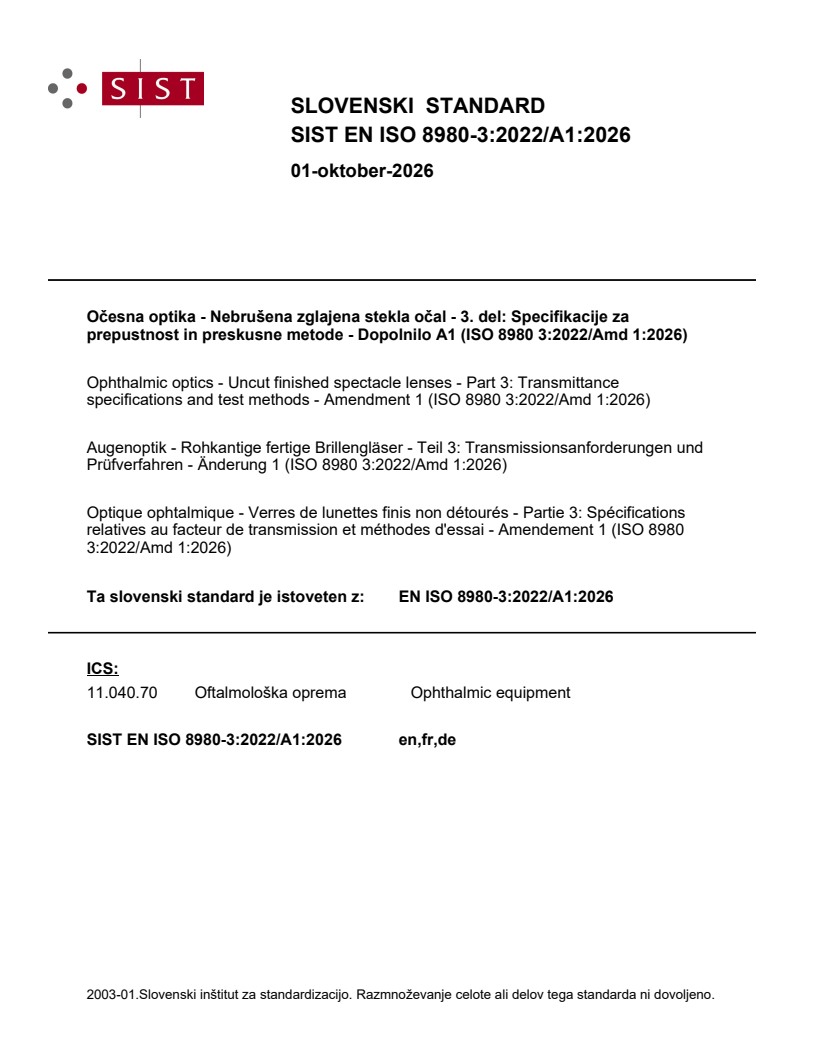
SLOVENSKI STANDARD
01-oktober-2026
Očesna optika - Nebrušena zglajena stekla očal - 3. del: Specifikacije za
prepustnost in preskusne metode - Dopolnilo A1 (ISO 8980 3:2022/Amd 1:2026)
Ophthalmic optics - Uncut finished spectacle lenses - Part 3: Transmittance
specifications and test methods - Amendment 1 (ISO 8980 3:2022/Amd 1:2026)
Augenoptik - Rohkantige fertige Brillengläser - Teil 3: Transmissionsanforderungen und
Prüfverfahren - Änderung 1 (ISO 8980 3:2022/Amd 1:2026)
Optique ophtalmique - Verres de lunettes finis non détourés - Partie 3: Spécifications
relatives au facteur de transmission et méthodes d'essai - Amendement 1 (ISO 8980
3:2022/Amd 1:2026)
Ta slovenski standard je istoveten z: EN ISO 8980-3:2022/A1:2026
ICS:
11.040.70 Oftalmološka oprema Ophthalmic equipment
2003-01.Slovenski inštitut za standardizacijo. Razmnoževanje celote ali delov tega standarda ni dovoljeno.
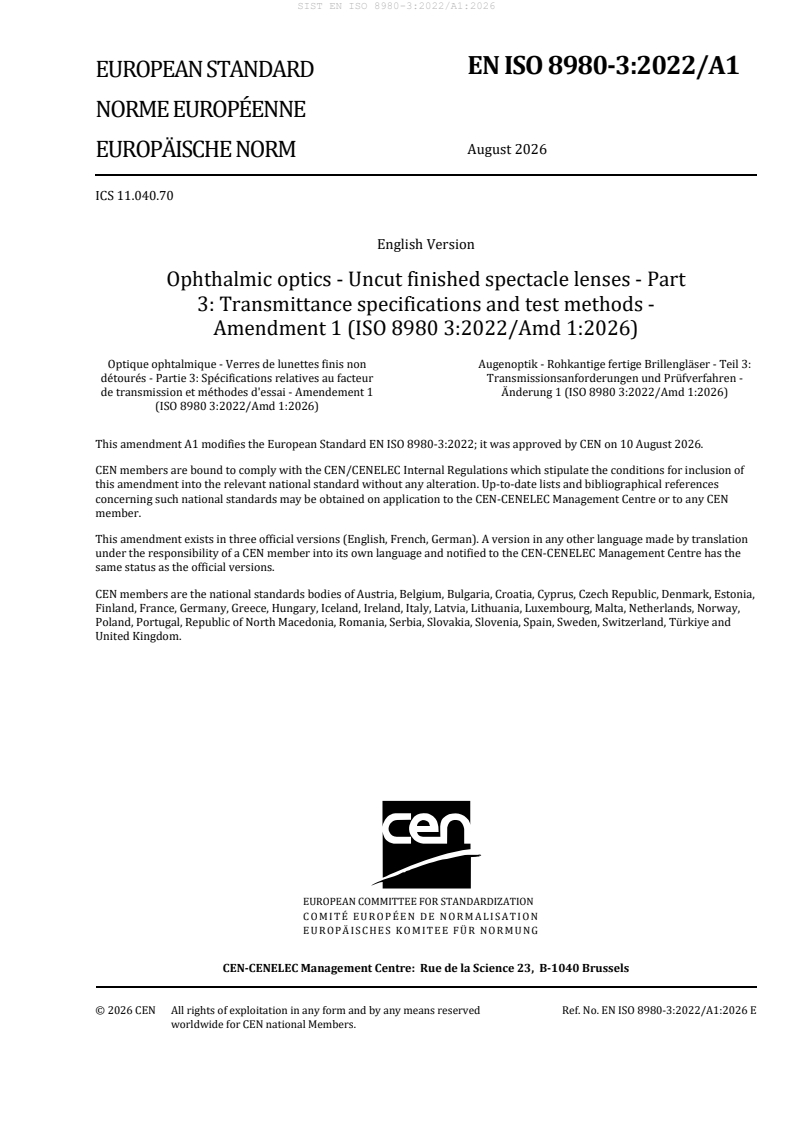
EN ISO 8980-3:2022/A1
EUROPEAN STANDARD
NORME EUROPÉENNE
August 2026
EUROPÄISCHE NORM
ICS 11.040.70
English Version
Ophthalmic optics - Uncut finished spectacle lenses - Part
3: Transmittance specifications and test methods -
Amendment 1 (ISO 8980 3:2022/Amd 1:2026)
Optique ophtalmique - Verres de lunettes finis non Augenoptik - Rohkantige fertige Brillengläser - Teil 3:
détourés - Partie 3: Spécifications relatives au facteur Transmissionsanforderungen und Prüfverfahren -
de transmission et méthodes d'essai - Amendement 1 Änderung 1 (ISO 8980 3:2022/Amd 1:2026)
(ISO 8980 3:2022/Amd 1:2026)
This amendment A1 modifies the European Standard EN ISO 8980-3:2022; it was approved by CEN on 10 August 2026.
CEN members are bound to comply with the CEN/CENELEC Internal Regulations which stipulate the conditions for inclusion of
this amendment into the relevant national standard without any alteration. Up-to-date lists and bibliographical references
concerning such national standards may be obtained on application to the CEN-CENELEC Management Centre or to any CEN
member.
This amendment exists in three official versions (English, French, German). A version in any other language made by translation
under the responsibility of a CEN member into its own language and notified to the CEN-CENELEC Management Centre has the
same status as the official versions.
CEN members are the national standards bodies of Austria, Belgium, Bulgaria, Croatia, Cyprus, Czech Republic, Denmark, Estonia,
Finland, France, Germany, Greece, Hungary, Iceland, Ireland, Italy, Latvia, Lithuania, Luxembourg, Malta, Netherlands, Norway,
Poland, Portugal, Republic of North Macedonia, Romania, Serbia, Slovakia, Slovenia, Spain, Sweden, Switzerland, Türkiye and
United Kingdom.
EUROPEAN COMMITTEE FOR STANDARDIZATION
COMITÉ EUROPÉEN DE NORMALISATION
EUROPÄISCHES KOMITEE FÜR NORMUNG
CEN-CENELEC Management Centre: Rue de la Science 23, B-1040 Brussels
© 2026 CEN All rights of exploitation in any form and by any means reserved Ref. No. EN ISO 8980-3:2022/A1:2026 E
worldwide for CEN national Members.
Contents Page
European foreword . 3
European foreword
This document (EN ISO 8980-3:2022/A1:2026) has been prepared by Technical Committee ISO/TC 172
"Optics and photonics" in collaboration with Technical Committee CEN/TC 170 “Ophthalmic optics” the
secretariat of which is held by DIN.
This Amendment to the European Standard EN ISO 8980-3:2022 shall be given the status of a national
standard, either by publication of an identical text or by endorsement, at the latest by February 2027,
and conflicting national standards shall be withdrawn at the latest by February 2027.
Attention is drawn to the possibility that some of the elements of this document may be the subject of
patent rights. CEN shall not be held responsible for identifying any or all such patent rights.
Any feedback and questions on this document should be directed to the users’ national standards
body/national committee. A complete listing of these bodies can be found on the CEN website.
According to the CEN-CENELEC Internal Regulations, the national standards organizations of the
following countries are bound to implement this European Standard: Austria, Belgium, Bulgaria,
Croatia, Cyprus, Czech Republic, Denmark, Estonia, Finland, France, Germany, Greece, Hungary, Iceland,
Ireland, Italy, Latvia, Lithuania, Luxembourg, Malta, Netherlands, Norway, Poland, Portugal, Republic of
North Macedonia, Romania, Serbia, Slovakia, Slovenia, Spain, Sweden, Switzerland, Türkiye and the
United Kingdom.
Endorsement notice
The text of ISO 8980-3:2022/Amd 1:2026 has been approved by CEN as EN ISO 8980-3:2022/A1:2026
without any modification.
International
Standard
ISO 8980-3
Fourth edition
Ophthalmic optics — Uncut finished
2022-06
spectacle lenses —
AMENDMENT 1
Part 3:
2026-08
Transmittance specifications and
test methods
AMENDMENT 1
Optique ophtalmique — Verres de lunettes finis non détourés —
Partie 3: Spécifications relatives au facteur de transmission et
méthodes d'essai
AMENDEMENT 1
Reference number
ISO 8980-3:2022/Amd.1:2026(en) © ISO 2026
ISO 8980-3:2022/Amd.1:2026(en)
© ISO 2026
All rights reserved. Unless otherwise specified, or required in the context of its implementation, no part of this publication may
be reproduced or utilized otherwise in any form or by any means, electronic or mechanical, including photocopying, or posting on
the internet or an intranet, without prior written permission. Permission can be requested from either ISO at the address below
or ISO’s member body in the country of the requester.
ISO copyright office
CP 401 • Ch. de Blandonnet 8
CH-1214 Vernier, Geneva
Phone: +41 22 749 01 11
Email: copyright@iso.org
Website: www.iso.org
Published in Switzerland
ii
ISO 8980-3:2022/Amd.1:2026(en)
Foreword
ISO (the International Organization for Standardization) is a worldwide federation of national standards
bodies (ISO member bodies). The work of preparing International Standards is normally carried out through
ISO technical committees. Each member body interested in a subject for which a technical committee
has been established has the right to be represented on that committee. International organizations,
governmental and non-governmental, in liaison with ISO, also take part in the work. ISO collaborates closely
with the International Electrotechnical Commission (IEC) on all matters of electrotechnical standardization.
The procedures used to develop this document and those intended for its further maintenance are described
in the ISO/IEC Directives, Part 1. In particular, the different approval criteria needed for the different types
of ISO documents should be noted. This document was drafted in accordance with the editorial rules of the
ISO/IEC Directives, Part 2 (see www.iso.org/directives).
ISO draws attention to the possibility that the implementation of this document may involve the use of (a)
patent(s). ISO takes no position concerning the evidence, validity or applicability of any claimed patent
rights in respect thereof. As of the date of publication of this document, ISO had not received notice of (a)
patent(s) which may be required to implement this document. However, implementers are cautioned that
this may not represent the latest information, which may be obtained from the patent database available at
www.iso.org/patents. ISO shall not be held responsible for identifying any or all such patent rights.
Any trade name used in this document is information given for the convenience of users and does not
constitute an endorsement.
For an explanation of the voluntary nature of standards, the meaning of ISO specific terms and expression
...