


SIST EN 12463:2015
(Main)Food processing machinery - Filling machines and auxiliary machines - Safety and hygiene requirements
Food processing machinery - Filling machines and auxiliary machines - Safety and hygiene requirements
1.1 General
This European Standard applies for:
- filling machines with cylinder with piston,
- filling machines with feed intake hopper with and without loading device,
- auxiliary machines for filling machines.
This document does not apply to filling machines with cylinder and manual operation.
This document applies to machines which process e.g. meat, cheese and other pasty substances, excluding dry or frozen materials. They pumps food stuff into casings or bring it to a following process. And also to the combinable appliances or auxiliary machines with which a wide range of additional functions can be implemented. For example: portioning, depositing, mincing, coextruding, dividing and forming.
This document deals with all significant hazards, hazardous situations and events relevant to filling machines, fitting appliances and auxiliary machines, such as twisting and hanging devices, mincing devices, forming devices, etc., when they are used as intended and under the conditions foreseen by the manufacturer and also the reasonable foreseeable misuse (see Clause 4).
These significant hazards, hazardous situations and events exist during the whole life of filling machines.
This document covers the following auxiliary machines, auxiliary devices and interchangeable equipment:
a) auxiliary machines:
1) portioning machine;
2) twisting machine;
3) mincing machine;
4) calibrating machine;
5) separation machine;
6) hanging machine;
7) co-extrusion machine;
8) tying machine;
9) grouping machine;
10) filling stream divider machine;
11) depositing machine;
12) forming machine;
13) peeling machine;
14) (casing-) spooling machine;
15) evacuating machine;
16) loading machine;
17) insertion machine;
18) handling machine (for full smoke sticks, single products or product groups);
b) auxiliary devices / modules:
1) portioning device / module;
2) twisting device / module;
3) mincing device / module;
4) calibrating device / module;
5) separating device / module;
6) hanging device / module;
7) co-extrusion device / module;
8) tying device / module;
9) filling stream divider device / module;
10) depositor device / module;
11) forming device / module;
12) peeling device / module;
13) (casing-) spooling device / module;
14) casing loading device / module;
15) evacuation device / module;
16) casing closing device / module;
17) loading device / module;
18) ejector device / module;
c) interchangeable equipment:
1) linking gear box;
2) holding device;
3) mincing attachment;
4) nozzles;
5) casing brakes;
6) separating unit;
7) reservoir / infeed hopper;
8) depositor;
9) voider unit;
10) dosing valve;
11) grinding sets;
12) forming inserts.
This document is not applicable to filling machines and auxiliary machines which are manufactured before the date of publication of this document by CEN.
Filling machines described in this document are no forming, filling and sealing machines as described in EN 415 3. Clipping machines are not covered by this document.
1.2 Types of filling machines and auxiliary machines covered by this standard
1.2.1 Filling machines with cylinder with piston
Filling machines with cylinder consist of piston, closing cover, machine frame accessory drive parts and electrical and hydraulic components (see Figure 1).
The material being processed will be fed by hand into the cylinder.
Filling machines with cylinder can be fitted with a dividing device.
1.2.2 Filling machines with feed intake hopper with and without loading device
Filling machines with feed intake hopper (with or without infeed auger, see Figure 2) consist of feeder on discharge side of the feed intake hopper, machine frame, accessory drive parts and electric, electronic or pneumatic components, depending on machine type.
The material being processed will be fed by hand or a loading device into the feeding hopper of the filling machine.
(...)
Nahrungsmittelmaschinen - Füllmaschinen und Vorsatzmaschinen - Sicherheits- und Hygieneanforderungen
1.1 Allgemeines
Diese Europäische Norm gilt für:
Füllmaschinen mit Zylinder mit Kolben;
Füllmaschinen mit Einfülltrichter mit oder ohne Beschickungseinrichtung;
Vorsatzmaschinen für Füllmaschinen.
Diese Europäische Norm ist nicht auf Füllmaschinen mit Zylinder und Handbetrieb anwendbar.
Diese Europäische Norm gilt für Maschinen zur Verarbeitung von pastösen oder leicht gefrorenen Produkten (z. B. Fleisch, Käse), ausgenommen getrocknete oder tiefgefrorene Materialien. Nahrungsmittel werden in Umhüllungen gepumpt oder zur Weiterverarbeitung transportiert. Diese Europäische Norm gilt auch für kombinierbare Geräte oder Vorsatzmaschinen, mit deren Hilfe ein großer Bereich von zusätzlichen Funktionen ausgeführt werden kann, zum Beispiel: Portionieren, Ablegen, Zerkleinern, Koextrudieren, Abteilen und Formen.
Diese Europäische Norm behandelt alle signifikanten Gefährdungen, Gefährdungssituationen und Gefährdungs¬ereignisse, die auf Füllmaschinen, Anschlussgeräte und Vorsatzmaschinen, wie Abdreh- und Aufhänge¬einrichtungen, Zerkleinerungseinrichtungen, Formeinrichtungen, usw. zutreffen, wenn sie be-stimmungsgemäß und unter Bedingungen von durch den Hersteller vernünftigerweise vorhersehbaren Fehlanwendungen verwendet werden (siehe Abschnitt 4).
Diese signifikanten Gefährdungen, Gefährdungssituationen und Gefährdungsereignisse können während der gesamten Lebensdauer der Füllmaschinen auftreten.
Diese Europäische Norm ist anwendbar auf die folgenden Vorsatzmaschinen, Vorsatzeinrichtungen und auswechselbare Ausrüstung:
a) Vorsatzmaschinen:
1) Portioniermaschine;
2) Abdrehmaschine;
3) Zerkleinerungsmaschine;
4) Kalibriermaschine;
5) Separiermaschine;
6) Aufhängemaschine;
7) Koextrusionsmaschine;
8) Verschnürmaschine;
9) Gruppiermaschine;
10) Füllstromteiler;
11) Einlegemaschine;
12) Formmaschine;
13) Pellmaschine;
14) (Darm-)Aufziehmaschine;
15) Evakuiermaschine;
16) Beschickungsmaschine;
17) Einlegemaschine;
18) Produkthandlingmaschine (für komplette Rauchstöcke, Einzelportionen oder Produktgruppen);
b) Vorsatzeinrichtungen/Module:
1) Portioniereinrichtung/-modul;
2) Abdreheinrichtung/-modul;
3) Zerkleinerungseinrichtung/-modul;
4) Kalibriereinrichtung/-modul;
5) Separiereinrichtung/-modul;
6) Aufhängevorrichtung/-modul;
7) Koextrusionseinrichtung/-modul;
8) Verschnüreinrichtung/-modul;
9) Füllstromteiler-Einrichtung/-modul;
10) Einlegeeinrichtung/-modul;
11) Formeinrichtung/-modul;
12) Pellvorrichtung/-modul;
13) (Darm-)Aufzieheinrichtung/-modul;
14) Darm-Beladungseinrichtung/-modul;
15) Evakuiereinrichtung/-modul;
16) Darmschweißzange/-modul;
17) Beschickungseinrichtung/-modul;
18) Ausstoßeinrichtung/-modul;
c) auswechselbare Ausrüstung:
1) Abdrehgetriebe;
2) Haltevorrichtung;
3) Vorsatzwolf;
4) Füllrohre;
5) Darmbremsen;
6) Separiereinrichtung;
7) Reservoir/Einlauftrichter;
8) Einleger;
9) Verdränger;
10) Dosierventil;
11) Zerkleinerungsvorsätze;
12) Formeinsätze.
Diese Europäische Norm gilt nicht für Füllmaschinen und Vorsatzmaschinen, die hergestellt wurden, bevor CEN dieses Dokument veröffentlichte.
Die in dieser Europäischen Norm behandelten Füllmaschinen sind keine Form-, Füll- und Verschließmaschinen im Sinne der EN 415 3. Clipmaschinen werden in dieser Norm nicht behandelt.
1.2 In dieser Norm behandelte Bauarten von Füllmaschinen und Vorsatzmaschinen
1.2.1 Füllmaschinen mit Zylinder mit Kolben
Füllmaschinen mit Zylinder bestehen aus Kolben, Verschlussdeckel, Maschinenständer, Antriebe für Zubehörteile und elektrischen und hydraulischen Komponenten (siehe Bild 1).
Das zu verarbeitende Füllgut wird von Hand in den Zylinder eingegeben.
Füllmaschinen mit Zylinder können mit einer Abteileinrichtung ausgerüstet sein.
Machines pour les produits alimentaires - Machines à pousser et machines auxiliares - Prescriptions relatives à la sécurité et l'hygiène
1.1 Généralités
La présente Norme européenne s'applique aux :
- machines à pousser à cylindre et piston ;
- machines à pousser avec trémie d’alimentation, avec et sans dispositif de chargement ;
- machines auxiliaires pour machines à pousser.
La présente Norme européenne ne s'applique pas aux machines à pousser à cylindre et fonctionnement manuel.
La présente Norme européenne s'applique aux machines qui traitent des produits pâteux ou légèrement congelés (par exemple, la viande, le fromage), à l'exception des produits secs ou surgelés. Elles amènent par aspiration les aliments dans des enveloppes ou les dirigent au process suivant. La présente Norme européenne s'applique également aux appareils combinables ou aux machines auxiliaires avec lesquels de nombreuses fonctions peuvent être mises en œuvre, par exemple : portionnement, garnissage, hachage, coextrusion séparation et formage.
La présente Norme européenne traite de tous les phénomènes dangereux, situations et événements dangereux significatifs spécifiques aux machines à pousser, aux appareils d'ajustement et aux machines auxiliaires, tels que les dispositifs de torsion et de suspension, les dispositifs de hachage et les dispositifs de formage, etc., lorsqu'ils sont utilisés normalement et dans des conditions de mauvaises utilisation raisonnablement prévisibles par le fabricant (voir l'Article 4).
Ces phénomènes dangereux significatifs, situations et événements dangereux existent tout au long de la durée de vie des machines à pousser.
La présente Norme européenne couvre les machines auxiliaires, dispositifs auxiliaires et équipements interchangeables suivants :
a) machines auxiliaires ;
1) machine à portionner ;
2) machine de torsion ;
3) machine de hachage ;
4) machine de calibrage ;
5) machine de séparation ;
6) machine de suspension ;
7) machine de coextrusion ;
8) machine à ficeler ;
9) machine à fardeler ;
10) machine à séparer le produit traité ;
11) machine à garnir ;
12) machine à former ;
13) machine à éplucher ;
14) machines à enrouler (pour enveloppes) ;
15) machine d'évacuation ;
16) machine de chargement ;
17) machine d'insertion ;
18) machine de manutention (pour bâtons de fumage entiers, produits individuels ou groupes de produits) ;
b) dispositifs/modules auxiliaires :
1) dispositif/module de portionnement ;
2) dispositif/module de torsion ;
3) dispositif/module de hachage ;
4) dispositif/module d'étalonnage ;
5) dispositif/module de séparation ;
6) dispositif/module de suspension ;
7) dispositif/module de coextrusion ;
8) dispositif/module de ficelage ;
9) dispositif/module séparateur du produit traité ;
10) dispositif/module de garnissage ;
11) dispositif/module de formage ;
12) dispositif/module d'épluchage ;
13) dispositif/module d'enroulement (pour enveloppes) ;
14) dispositif/module de chargement d'enveloppes ;
15) dispositif/module d'évacuation ;
16) dispositif/module de fermeture d'enveloppes ;
17) dispositif/module de chargement ;
18) dispositif/module d'éjection ;
c) équipements interchangeables :
1) boîte de transmission ;
2) dispositif de maintien ;
3) attache de machine de hachage ;
4) buses ;
5) freins d'enveloppes ;
6) unité de séparation ;
7) bac / trémie d'alimentation
8) garnisseur ;
9) unité de mise sous vide ;
10) valve de dosage ;
11) dispositifs de broyage ;
12) inserts de formage.
La présente Norme européenne ne s'applique pas aux machines à pousser et machines auxiliaires fabriquées avant la date de publication du présent document par le CEN.
Les machines à pousser, décrites dans la présente Norme européenne, ne sont pas les machines à former, à pousser et à emballer décrites dans l'EN 415 3. Les machines à attacher ne sont pas couvertes par la présente norme.
Stroji za predelavo hrane - Polnilniki in pomožni stroji - Varnostne in higienske zahteve
Ta dokument se uporablja za:
– polnilnike z valjem in batom,
– polnilnike z lijakom za polnjenje, glavnim dovodom in napravo za polnjenje,
– pomožne stroje za polnilnike.
Ta dokument se ne uporablja za polnilnike z valjem in ročnim upravljanjem.
Ta dokument obravnava vse večje nevarnosti, nevarne situacije in primere v zvezi s stroji in napravami, kadar se uporabljajo, kot je predvideno, in pod pogoji, ki jih razumno predvidi proizvajalec, ter tudi razumno predvidljivo napačno uporabo.
Te večje nevarnosti, nevarne situacije in primeri obstajajo v celotni življenjski dobi polnilnikov.
Ta dokument ne velja za polnilnike in pomožne stroje, ki so bili izdelani pred datumom, ko je CEN objavil ta dokument.
Polnilniki, opisani v tem dokumentu, niso oblikovalne, polnilne in zapiralne naprave, ki so opisane v standardu EN 415-3. Ta dokument ne zajema naprav za prirezovanje.
General Information
- Status
- Withdrawn
- Public Enquiry End Date
- 31-Jul-2012
- Publication Date
- 04-Dec-2014
- Withdrawal Date
- 21-Apr-2021
- Technical Committee
- VSN - Safety of machinery
- Current Stage
- 9900 - Withdrawal (Adopted Project)
- Start Date
- 03-Mar-2021
- Due Date
- 26-Mar-2021
- Completion Date
- 22-Apr-2021
Relations
- Effective Date
- 01-Jan-2015
- Effective Date
- 20-Jan-2021





Frequently Asked Questions
SIST EN 12463:2015 is a standard published by the Slovenian Institute for Standardization (SIST). Its full title is "Food processing machinery - Filling machines and auxiliary machines - Safety and hygiene requirements". This standard covers: 1.1 General This European Standard applies for: - filling machines with cylinder with piston, - filling machines with feed intake hopper with and without loading device, - auxiliary machines for filling machines. This document does not apply to filling machines with cylinder and manual operation. This document applies to machines which process e.g. meat, cheese and other pasty substances, excluding dry or frozen materials. They pumps food stuff into casings or bring it to a following process. And also to the combinable appliances or auxiliary machines with which a wide range of additional functions can be implemented. For example: portioning, depositing, mincing, coextruding, dividing and forming. This document deals with all significant hazards, hazardous situations and events relevant to filling machines, fitting appliances and auxiliary machines, such as twisting and hanging devices, mincing devices, forming devices, etc., when they are used as intended and under the conditions foreseen by the manufacturer and also the reasonable foreseeable misuse (see Clause 4). These significant hazards, hazardous situations and events exist during the whole life of filling machines. This document covers the following auxiliary machines, auxiliary devices and interchangeable equipment: a) auxiliary machines: 1) portioning machine; 2) twisting machine; 3) mincing machine; 4) calibrating machine; 5) separation machine; 6) hanging machine; 7) co-extrusion machine; 8) tying machine; 9) grouping machine; 10) filling stream divider machine; 11) depositing machine; 12) forming machine; 13) peeling machine; 14) (casing-) spooling machine; 15) evacuating machine; 16) loading machine; 17) insertion machine; 18) handling machine (for full smoke sticks, single products or product groups); b) auxiliary devices / modules: 1) portioning device / module; 2) twisting device / module; 3) mincing device / module; 4) calibrating device / module; 5) separating device / module; 6) hanging device / module; 7) co-extrusion device / module; 8) tying device / module; 9) filling stream divider device / module; 10) depositor device / module; 11) forming device / module; 12) peeling device / module; 13) (casing-) spooling device / module; 14) casing loading device / module; 15) evacuation device / module; 16) casing closing device / module; 17) loading device / module; 18) ejector device / module; c) interchangeable equipment: 1) linking gear box; 2) holding device; 3) mincing attachment; 4) nozzles; 5) casing brakes; 6) separating unit; 7) reservoir / infeed hopper; 8) depositor; 9) voider unit; 10) dosing valve; 11) grinding sets; 12) forming inserts. This document is not applicable to filling machines and auxiliary machines which are manufactured before the date of publication of this document by CEN. Filling machines described in this document are no forming, filling and sealing machines as described in EN 415 3. Clipping machines are not covered by this document. 1.2 Types of filling machines and auxiliary machines covered by this standard 1.2.1 Filling machines with cylinder with piston Filling machines with cylinder consist of piston, closing cover, machine frame accessory drive parts and electrical and hydraulic components (see Figure 1). The material being processed will be fed by hand into the cylinder. Filling machines with cylinder can be fitted with a dividing device. 1.2.2 Filling machines with feed intake hopper with and without loading device Filling machines with feed intake hopper (with or without infeed auger, see Figure 2) consist of feeder on discharge side of the feed intake hopper, machine frame, accessory drive parts and electric, electronic or pneumatic components, depending on machine type. The material being processed will be fed by hand or a loading device into the feeding hopper of the filling machine. (...)
1.1 General This European Standard applies for: - filling machines with cylinder with piston, - filling machines with feed intake hopper with and without loading device, - auxiliary machines for filling machines. This document does not apply to filling machines with cylinder and manual operation. This document applies to machines which process e.g. meat, cheese and other pasty substances, excluding dry or frozen materials. They pumps food stuff into casings or bring it to a following process. And also to the combinable appliances or auxiliary machines with which a wide range of additional functions can be implemented. For example: portioning, depositing, mincing, coextruding, dividing and forming. This document deals with all significant hazards, hazardous situations and events relevant to filling machines, fitting appliances and auxiliary machines, such as twisting and hanging devices, mincing devices, forming devices, etc., when they are used as intended and under the conditions foreseen by the manufacturer and also the reasonable foreseeable misuse (see Clause 4). These significant hazards, hazardous situations and events exist during the whole life of filling machines. This document covers the following auxiliary machines, auxiliary devices and interchangeable equipment: a) auxiliary machines: 1) portioning machine; 2) twisting machine; 3) mincing machine; 4) calibrating machine; 5) separation machine; 6) hanging machine; 7) co-extrusion machine; 8) tying machine; 9) grouping machine; 10) filling stream divider machine; 11) depositing machine; 12) forming machine; 13) peeling machine; 14) (casing-) spooling machine; 15) evacuating machine; 16) loading machine; 17) insertion machine; 18) handling machine (for full smoke sticks, single products or product groups); b) auxiliary devices / modules: 1) portioning device / module; 2) twisting device / module; 3) mincing device / module; 4) calibrating device / module; 5) separating device / module; 6) hanging device / module; 7) co-extrusion device / module; 8) tying device / module; 9) filling stream divider device / module; 10) depositor device / module; 11) forming device / module; 12) peeling device / module; 13) (casing-) spooling device / module; 14) casing loading device / module; 15) evacuation device / module; 16) casing closing device / module; 17) loading device / module; 18) ejector device / module; c) interchangeable equipment: 1) linking gear box; 2) holding device; 3) mincing attachment; 4) nozzles; 5) casing brakes; 6) separating unit; 7) reservoir / infeed hopper; 8) depositor; 9) voider unit; 10) dosing valve; 11) grinding sets; 12) forming inserts. This document is not applicable to filling machines and auxiliary machines which are manufactured before the date of publication of this document by CEN. Filling machines described in this document are no forming, filling and sealing machines as described in EN 415 3. Clipping machines are not covered by this document. 1.2 Types of filling machines and auxiliary machines covered by this standard 1.2.1 Filling machines with cylinder with piston Filling machines with cylinder consist of piston, closing cover, machine frame accessory drive parts and electrical and hydraulic components (see Figure 1). The material being processed will be fed by hand into the cylinder. Filling machines with cylinder can be fitted with a dividing device. 1.2.2 Filling machines with feed intake hopper with and without loading device Filling machines with feed intake hopper (with or without infeed auger, see Figure 2) consist of feeder on discharge side of the feed intake hopper, machine frame, accessory drive parts and electric, electronic or pneumatic components, depending on machine type. The material being processed will be fed by hand or a loading device into the feeding hopper of the filling machine. (...)
SIST EN 12463:2015 is classified under the following ICS (International Classification for Standards) categories: 67.260 - Plants and equipment for the food industry. The ICS classification helps identify the subject area and facilitates finding related standards.
SIST EN 12463:2015 has the following relationships with other standards: It is inter standard links to SIST EN 12463:2004+A1:2011, SIST EN 12463:2021. Understanding these relationships helps ensure you are using the most current and applicable version of the standard.
SIST EN 12463:2015 is associated with the following European legislation: EU Directives/Regulations: 2006/42/EC; Standardization Mandates: M/396. When a standard is cited in the Official Journal of the European Union, products manufactured in conformity with it benefit from a presumption of conformity with the essential requirements of the corresponding EU directive or regulation.
SIST EN 12463:2015 is available in PDF format for immediate download after purchase. The document can be added to your cart and obtained through the secure checkout process. Digital delivery ensures instant access to the complete standard document.
Standards Content (Sample)
2003-01.Slovenski inštitut za standardizacijo. Razmnoževanje celote ali delov tega standarda ni dovoljeno.Stroji za predelavo hrane - Polnilniki in pomožni stroji - Varnostne in higienske zahteveNahrungsmittelmaschinen - Füllmaschinen und Vorsatzmaschinen - Sicherheits- und HygieneanforderungenMachines pour les produits alimentaires - Machines à pousser et machines auxiliares - Prescriptions relatives à la sécurité et l'hygièneFood processing machinery - Filling machines and auxiliary machines - Safety and hygiene requirements67.260Tovarne in oprema za živilsko industrijoPlants and equipment for the food industryICS:Ta slovenski standard je istoveten z:EN 12463:2014SIST EN 12463:2015en,fr,de01-januar-2015SIST EN 12463:2015SLOVENSKI
STANDARDSIST EN 12463:2004+A1:20111DGRPHãþD
EUROPEAN STANDARD NORME EUROPÉENNE EUROPÄISCHE NORM
EN 12463
November 2014 ICS 67.260 Supersedes EN 12463:2004+A1:2011English Version
Food processing machinery - Filling machines and auxiliary machines - Safety and hygiene requirements
Machines pour les produits alimentaires - Machines à pousser et machines auxiliaires - Prescriptions relatives à la sécurité et l'hygiène
Nahrungsmittelmaschinen - Füllmaschinen und Vorsatzmaschinen - Sicherheits- und Hygieneanforderungen This European Standard was approved by CEN on 13 September 2014.
CEN members are bound to comply with the CEN/CENELEC Internal Regulations which stipulate the conditions for giving this European Standard the status of a national standard without any alteration. Up-to-date lists and bibliographical references concerning such national standards may be obtained on application to the CEN-CENELEC Management Centre or to any CEN member.
This European Standard exists in three official versions (English, French, German). A version in any other language made by translation under the responsibility of a CEN member into its own language and notified to the CEN-CENELEC Management Centre has the same status as the official versions.
CEN members are the national standards bodies of Austria, Belgium, Bulgaria, Croatia, Cyprus, Czech Republic, Denmark, Estonia, Finland, Former Yugoslav Republic of Macedonia, France, Germany, Greece, Hungary, Iceland, Ireland, Italy, Latvia, Lithuania, Luxembourg, Malta, Netherlands, Norway, Poland, Portugal, Romania, Slovakia, Slovenia, Spain, Sweden, Switzerland, Turkey and United Kingdom.
EUROPEAN COMMITTEE FOR STANDARDIZATION
COMITÉ EUROPÉEN DE NORMALISATION EUROPÄISCHES KOMITEE FÜR NORMUNG
CEN-CENELEC Management Centre:
Avenue Marnix 17,
B-1000 Brussels © 2014 CEN All rights of exploitation in any form and by any means reserved worldwide for CEN national Members. Ref. No. EN 12463:2014 ESIST EN 12463:2015
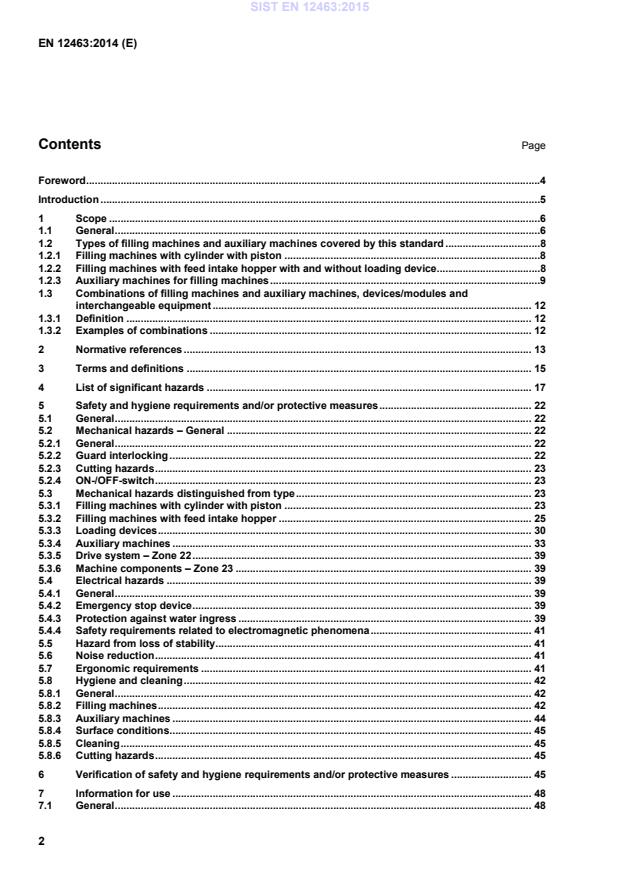
Noise test code for filling machines and auxiliary machines (grade 2) . 53 A.1 Determination of the emission sound pressure level . 53 A.2 Installation and mounting conditions . 53 A.3 Operating conditions . 53 A.4 Measurement . 53 A.5 Information to be recorded . 54 A.6 Information to be reported. 54 A.7 Declaration and verification of the noise emission values . 54 Annex B (normative)
Design principles to ensure the cleanability of filling machines and auxiliary machines . 55 B.1 Definitions . 55 B.2 Materials of construction . 56 B.3 Design . 56 Bibliography . 62
Key Key 1 filling horn 1 feed intake hopper 2 dividing device 2 feeder 3 closing cover 3 filling horn 4 piston 4 ON / OFF switch, hood 5 cylinder 5 step 6 drive mechanism 6 intermediate step 7 ON / OFF switch, hood 7 drive mechanism
8 mast-type loading device
9 transport car
10 fixing device
11 loading device Figure 1 — Filling machine with cylinder and piston Figure 2 — Filling machine with feed intake hopper and loading device
1.2.3 Auxiliary machines for filling machines Auxiliary machines consist of a drive system and at least of one of the following devices for filling, portioning, twisting, displacing, forming, mincing (e.g. see Figures 3 to 8). Auxiliary machines do not operate independently. These machines will be actuated directly or by filling machines. Auxiliary machines will be switched on or off by knee-operated lever switches or hand operated switches and/or remote control signals. Auxiliary machines can be fitted with: — dividing device, — hanging device. SIST EN 12463:2015
Key
1 inlet
2 outlet
3 feeder
Figure 3 — Auxiliary twisting device Figure 4 — Auxiliary portioning and hanging device
Figure 5 — Auxiliary portioning and hanging device Figure 6 — Auxiliary portioning and hanging device
Key 1 inlet
4 base 2 outlet 5 forming device 3 forming device 6 conveyor belt Figure 7 — Auxiliary forming devices
Key Key 1 drive shaft 1 drive shaft 2 set of cutting tools 2 cutting tools 3 feed intake canal 3 feed intake canal 4 nut/plate 4 locking/plate a) Driven by the filling machines b) With direct drive Figure 8 — Auxiliary mincing machine SIST EN 12463:2015
Key A filling machine D twisting module F separating module B loading device (optional) E calibrating module G hanging module (optional) C mincing device (optional)
a) Filling machine with auxiliary machines consisting of different modules SIST EN 12463:2015
Key A filling machine H linking gear box I holding device (optional) B loading device (optional)
C mincing device (optional)
b) Filling machine with interchangeable equipment
machine machine/device may be acc. to other standards machine/device may be acc. to other standards
Key A filling machine M clipper CS separate control system K metal detector N evacuation module
L reject valve (optional) O floor hopper
c) Filling machine with attached machines Figure 9 — Examples of combinations 2 Normative references The following documents, in whole or in part, are normatively referenced in this document and are indispensable for its application. For dated references, only the edition cited applies. For undated references, the latest edition of the referenced document (including any amendments) applies. EN 574, Safety of machinery — Two-hand control devices — Functional aspects — Principles for design SIST EN 12463:2015
(IEC 60204-1:2005, modified) EN 60529, Degrees of protection provided by enclosures (IP Code) (IEC 60529) EN 61496-1, Safety of machinery — Electro-sensitive protective equipment — Part 1: General requirements and tests (IEC 61496-1) EN ISO 3744:2010, Acoustics — Determination of sound power levels and sound energy levels of noise sources using sound pressure — Engineering methods for an essentially free field over a reflecting plane (ISO 3744:2010) EN ISO 4871, Acoustics v Declaration and verification of noise emission values of machinery and equipment (ISO 4871) EN ISO 11201:2010, Acoustics — Noise emitted by machinery and equipment — Determination of emission sound pressure levels at a work station and at other specified positions in an essentially free field over a reflecting plane with negligible environmental corrections (ISO 11201:2010) EN ISO 11688-1, Acoustics — Recommended practice for the design of low-noise machinery and equipment — Part 1: Planning (ISO/TR 11688-1) EN ISO 12100:2010, Safety of machinery — General principles for design — Risk assessment and risk reduction (ISO 12100:2010) EN ISO 13849-1, Safety of machinery — Safety-related parts of control systems — Part 1: General principles for design (ISO 13849-1) EN ISO 13855, Safety of machinery — Positioning of safeguards with respect to the approach speeds of parts of the human body (ISO 13855) EN ISO 13857:2008, Safety of machinery — Safety distances to prevent hazard zones being reached by upper and lower limbs (ISO 13857:2008) EN ISO 14119:2013, Safety of machinery — Interlocking devices associated with guards — Principles for design and selection (ISO 14119:2013) EN ISO 14122-3, Safety of machinery — Permanent means of access to machinery — Part 3: Stairs, stepladders and guard-rails (ISO 14122-3) SIST EN 12463:2015
Key Key 1 zone 1 4 zone 4 9 zone 9 2 zone 2 5 zone 5 10 zone 10 3 zone 3 6 zone 6 22 zone 22 22 zone 22 7 zone 7 23 zone 23
8 zone 8
Figure 10 — Filling machine with cylinder with piston – Danger zones Figure 11 — Filling machine with feed intake hopper – Danger zones SIST EN 12463:2015
Key 11 zone 11 12 zone 12 13 zone 13 14 zone 14 22 zone 22 Figure 12 — Auxiliary, twisting and hanging device – Danger zones SIST EN 12463:2015
Key Key 15 zone 15 16 zone 16 22 zone 22 17 zone 17
18 zone 18 Figure 13 — Auxiliary twisting device – Danger zones Figure 14 — Auxiliary, dividing and hanging device – Danger zones
Key 19 zone 19 20 zone 20 Figure 15 — Auxiliary forming devices – danger zones SIST EN 12463:2015
Key Key 21 zone 21 21 zone 21 22 zone 22 22 zone 22 Figure 16 — Auxiliary mincing machine driven by the filling machine Figure 17 — Auxiliary mincing machine with direct drive 5 Safety and hygiene requirements and/or protective measures 5.1 General Filling machines and auxiliary machines shall comply with the safety requirements and/or protective measures of this clause. In addition, they shall be designed according to the principles of EN ISO 12100 for hazards relevant but not significant, which are not dealt with by this document. If auxiliary machines are installed on the machine, the manufacturer shall carry out a risk assessment. This specific risk assessment shall be part of the general risk assessment of the machine. Where reducing the risk is by the physical arrangement or positioning of the machine the manufacturer shall include in the Information for use a reference to the reduction means to be provided, and to any limiting value of the requirement, and, if appropriate, to the means of verification. The stopping time shall be less than or equal to 1 s from safety device actuation. In this case restarting shall only be possible by actuating the starting control. The safety related parts of the control system shall present at least a performance level “c” in accordance with EN ISO 13849-1. 5.2 Mechanical hazards – General 5.2.1 General Filling machines and auxiliary machines shall be designed and constructed in accordance with the conditions mentioned below. Fixing systems for fixed guards, or for demountable parts of the machine casing when they are designed as fixed guards, shall remain attached to the guards or to the machine when the guards are removed. 5.2.2 Guard interlocking The interlocking devices shall be built inside the machine housing and shall comply with EN ISO 14119:2013, 4.2 and Clause 7. SIST EN 12463:2015
D ≤ 46 mm, then L ≥ 100 mm; —
46 mm < D ≤ 60 mm, then L ≥ 120 mm. See Figure 18. 5.3.1.1.4 An interlocking of the cover is not needed if the recess in the piston will be larger than the discharge opening in the cylinderI the inclination . ≥ 50°, the width B ≥ 70 mm and the radius of curvature R ≥ 10 mm (see Figure 18). The piston shall be not allowed to twist in relation to the discharge opening. This can be achieved e.g. by a piston rod (see no. 6 in Figure 18). 5.3.1.1.5 It shall not be possible to move the piston out of the cylinder with the drive mechanism. For the removal of the piston, there shall exist a special tool. SIST EN 12463:2015
D ≤ 46 mm : L ≥ 100 mm or 46 mm < D ≤ 60 mm : L ≥ 120 mm B ≥
70 mm R ≥
10 mm . ≥
50° Key 1 fill horn 2 dividing device 3 recess in the piston 4 cylinder 5 piston 6 piston gain rod Figure 18 — Filling machine with cylinder with piston and dividing device – Safety dimensions 5.3.1.2 Zone 2 5.3.1.2.1 General At filling machines with dividing device the access to the danger point at the piston in the cylinder and at the dividing device in the discharge port on the side of the cylinder and filling horn shall be prevented or restricted. This shall be achieved e.g. by the observance of all following measures: 5.3.1.2.2 For a piston without recess there shall exist at the edge of the cylinder a movable, interlocked cover, which prevents the upward motion of the piston, if the cover is opened. At the discharge opening there shall exist an interlocked filling horn, to prevent the operation of the machine without filling horn. 5.3.1.2.3 An interlocking of the movable cover is not needed if: — the safety distance L and the diameter D of the discharge opening between the side of the cylinder and the dividing device meets the requirements of 5.3.1.1.3, SIST EN 12463:2015
...
2003-01.Slovenski inštitut za standardizacijo. Razmnoževanje celote ali delov tega standarda ni dovoljeno.Stroji za predelavo hrane - Polnilniki in pomožni stroji - Varnostne in higienske zahteveNahrungsmittelmaschinen - Füllmaschinen und Vorsatzmaschinen - Sicherheits- und HygieneanforderungenMachines pour les produits alimentaires - Machines à pousser et machines auxiliares - Prescriptions relatives à la sécurité et l'hygièneFood processing machinery - Filling machines and auxiliary machines - Safety and hygiene requirements67.260Tovarne in oprema za živilsko industrijoPlants and equipment for the food industryICS:Ta slovenski standard je istoveten z:EN 12463:2014SIST EN 12463:2015en,fr,de01-januar-2015SIST EN 12463:2015SLOVENSKI
STANDARDSIST EN 12463:2004+A1:20111DGRPHãþD
EUROPÄISCHE NORM EUROPEAN STANDARD NORME EUROPÉENNE
EN 12463
November 2014 ICS 67.260 Ersatz für EN 12463:2004+A1:2011Deutsche Fassung
Nahrungsmittelmaschinen - Füllmaschinen und Vorsatzmaschinen - Sicherheits- und Hygieneanforderungen
Food processing machinery - Filling machines and auxiliary machines - Safety and hygiene requirements
Machines pour les produits alimentaires - Machines à pousser et machines auxiliaires - Prescriptions relatives à la sécurité et l'hygiène Diese Europäische Norm wurde vom CEN am 13. September 2014 angenommen.
Die CEN-Mitglieder sind gehalten, die CEN/CENELEC-Geschäftsordnung zu erfüllen, in der die Bedingungen festgelegt sind, unter denen dieser Europäischen Norm ohne jede Änderung der Status einer nationalen Norm zu geben ist. Auf dem letzten Stand befindliche Listen dieser nationalen Normen mit ihren bibliographischen Angaben sind beim Management-Zentrum des CEN-CENELEC oder bei jedem CEN-Mitglied auf Anfrage erhältlich.
Diese Europäische Norm besteht in drei offiziellen Fassungen (Deutsch, Englisch, Französisch). Eine Fassung in einer anderen Sprache, die von einem CEN-Mitglied in eigener Verantwortung durch Übersetzung in seine Landessprache gemacht und dem Management-Zentrum mitgeteilt worden ist, hat den gleichen Status wie die offiziellen Fassungen.
CEN-Mitglieder sind die nationalen Normungsinstitute von Belgien, Bulgarien, Dänemark, Deutschland, der ehemaligen jugoslawischen Republik Mazedonien, Estland, Finnland, Frankreich, Griechenland, Irland, Island, Italien, Kroatien, Lettland, Litauen, Luxemburg, Malta, den Niederlanden, Norwegen, Österreich, Polen, Portugal, Rumänien, Schweden, der Schweiz, der Slowakei, Slowenien, Spanien, der Tschechischen Republik, der Türkei, Ungarn, dem Vereinigten Königreich und Zypern.
EUROPÄISCHES KOMITEE FÜR NORMUNG EUROPEAN COMMITTEE FOR STANDARDIZATION
COMITÉ EUROPÉEN DE NORMALISATION
CEN-CENELEC Management-Zentrum:
Avenue Marnix 17,
B-1000 Brüssel © 2014 CEN Alle Rechte der Verwertung, gleich in welcher Form und in welchem Verfahren, sind weltweit den nationalen Mitgliedern von CEN vorbehalten.Ref. Nr. EN 12463:2014 DSIST EN 12463:2015
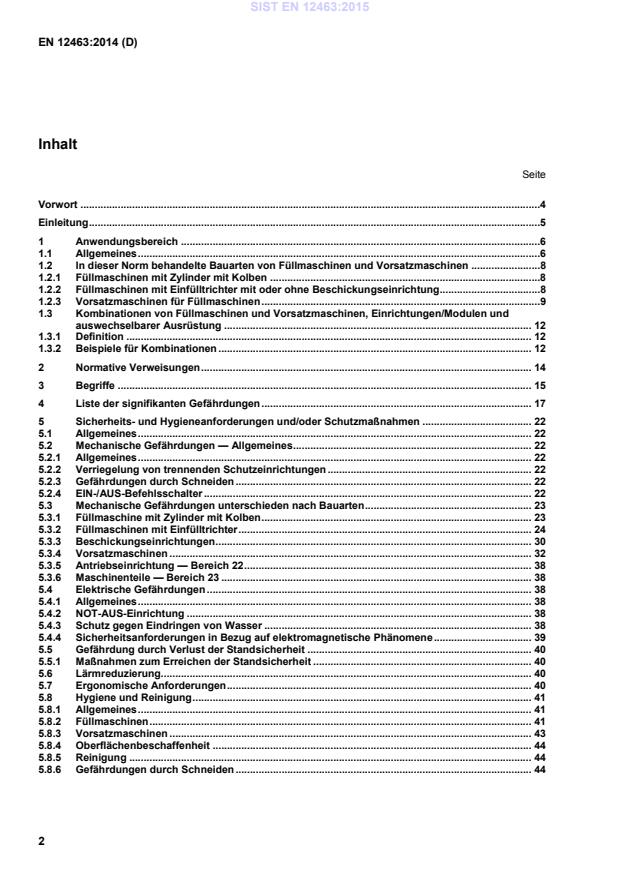
Seite Vorwort .4 Einleitung .5 1 Anwendungsbereich .6 1.1 Allgemeines .6 1.2 In dieser Norm behandelte Bauarten von Füllmaschinen und Vorsatzmaschinen .8 1.2.1 Füllmaschinen mit Zylinder mit Kolben .8 1.2.2 Füllmaschinen mit Einfülltrichter mit oder ohne Beschickungseinrichtung.8 1.2.3 Vorsatzmaschinen für Füllmaschinen .9 1.3 Kombinationen von Füllmaschinen und Vorsatzmaschinen, Einrichtungen/Modulen und auswechselbarer Ausrüstung . 12 1.3.1 Definition . 12 1.3.2 Beispiele für Kombinationen . 12 2 Normative Verweisungen . 14 3 Begriffe . 15 4 Liste der signifikanten Gefährdungen . 17 5 Sicherheits- und Hygieneanforderungen und/oder Schutzmaßnahmen . 22 5.1 Allgemeines . 22 5.2 Mechanische Gefährdungen — Allgemeines . 22 5.2.1 Allgemeines . 22 5.2.2 Verriegelung von trennenden Schutzeinrichtungen . 22 5.2.3 Gefährdungen durch Schneiden . 22 5.2.4 EIN-/AUS-Befehlsschalter . 22 5.3 Mechanische Gefährdungen unterschieden nach Bauarten . 23 5.3.1 Füllmaschine mit Zylinder mit Kolben . 23 5.3.2 Füllmaschinen mit Einfülltrichter . 24 5.3.3 Beschickungseinrichtungen . 30 5.3.4 Vorsatzmaschinen . 32 5.3.5 Antriebseinrichtung — Bereich 22 . 38 5.3.6 Maschinenteile — Bereich 23 . 38 5.4 Elektrische Gefährdungen . 38 5.4.1 Allgemeines . 38 5.4.2 NOT-AUS-Einrichtung . 38 5.4.3 Schutz gegen Eindringen von Wasser . 38 5.4.4 Sicherheitsanforderungen in Bezug auf elektromagnetische Phänomene . 39 5.5 Gefährdung durch Verlust der Standsicherheit . 40 5.5.1 Maßnahmen zum Erreichen der Standsicherheit . 40 5.6 Lärmreduzierung. 40 5.7 Ergonomische Anforderungen . 40 5.8 Hygiene und Reinigung . 41 5.8.1 Allgemeines . 41 5.8.2 Füllmaschinen . 41 5.8.3 Vorsatzmaschinen . 43 5.8.4 Oberflächenbeschaffenheit . 44 5.8.5 Reinigung . 44 5.8.6 Gefährdungen durch Schneiden . 44 SIST EN 12463:2015
Regeln für die Geräuschmessung an Füllmaschinen und Vorsatzmaschinen (Verfahren der Genauigkeitsklasse 2) . 51 A.1 Bestimmung des Emissions-Schalldruckpegels . 51 A.2 Installations- und Aufstellungsbedingungen . 51 A.3 Betriebsbedingungen . 51 A.4 Messung . 51 A.5 Aufzuzeichnende Information . 52 A.6 Anzugebende Informationen . 52 A.7 Angabe und Überprüfung der Geräuschemissionswerte . 52 Anhang B (normativ)
Gestaltungsgrundsätze, um die Reinigbarkeit von Füllmaschinen und Vorsatzmaschinen sicherzustellen . 53 B.1 Begriffe . 53 B.1.1 Allgemeines . 53 B.2 Konstruktionswerkstoffe . 54 B.2.1 Allgemeines . 54 B.2.2 Werkstoffart . 54 B.3 Gestaltung . 54 B.3.1 Allgemeines . 54 B.3.2 Lebensmittelbereich . 54 B.3.3 Spritzbereich . 56 B.3.4 Nicht-Lebensmittelbereich . 58 B.3.5 Auf dem Fußboden stehende Maschinen — Bewegliche Maschinen . 58 Anhang ZA (informativ)
Zusammenhang zwischen dieser Europäischen Norm und den grundlegenden Anforderungen der EU-Richtlinie 2006/42/EG (Maschinenrichtlinie) . 59 Literaturhinweise . 60
Legende 1 Füllrohr 2 Abteileinrichtung 3 Verschlussdeckel 4 Kolben 5 Zylinder 6 Antrieb 7 EIN-/AUS-Schalter, Abdeckhaube Legende 1 Einfülltrichter 2 Förderwerk 3 Füllrohr 4 EIN-/AUS-Schalter, Abdeckhaube 5 Auftritt 6 Zwischenauftritt 7 Antrieb 8 Mastbeschickungseinrichtung 9 Transportwagen 10 Feststelleinrichtung 11 Beschickungseinrichtung Bild 1 — Füllmaschine mit Zylinder und Kolben Bild 2 — Füllmaschine mit Einfülltrichter und Beschickungseinrichtung 1.2.3 Vorsatzmaschinen für Füllmaschinen Vorsatzmaschinen bestehen aus einem Antriebssystem und mindestens einer der folgenden Einrichtungen zum Füllen, Portionieren, Abdrehen, Verdrängen, Formen, Zerkleinern (siehe z. B Bilder 3 bis 8). Vorsatz-maschinen arbeiten nicht unabhängig. Diese Maschinen werden direkt oder von Füllmaschinen angetrieben. Vorsatzmaschinen werden über kniebetätigte Hebelschalter oder handbetätigte Schalter und/oder Fernsteuer-signale ein- und ausgeschaltet. Vorsatzmaschinen können ausgerüstet sein mit: Abteileinrichtung, Aufhängeeinrichtung. SIST EN 12463:2015
Legende 1 Einlauf 2 Auslauf 3 Förderwerk
Bild 3 — Vorsatz-Abdreheinrichtung Bild 4 — Vorsatz-Portionier- und Aufhängeeinrichtung
Bild 5 — Vorsatz-Portionier- und Aufhängeeinrichtung Bild 6 — Vorsatz-Portionier- und Aufhängeeinrichtung
Legende 1 Einlauf 2 Auslauf 3 Formeinrichtung 4 Gestell 5 Formstelle 6 Transportband Bild 7 — Vorsatz-Formeinrichtungen
Legende 1 Antriebswelle 2 Schneidsatz 3 Einfüllkanal 4 Verschlussmutter/Lochscheibe Legende 1 Antriebswelle 2 Schneidsatz 3 Einfüllkanal 4 Verschlussmutter/Lochscheibe a) Antrieb durch die Füllmaschinen b) mit direktem Antrieb Bild 8 — Vorsatzwolf
Legende A Füllmaschine D Abdrehmodul F Trennmodul B Beschickungseinrichtung (optional) E Kalibriermodul G Aufhängemodul (optional) C Zerkleinerungseinrichtung (optional)
a) Füllmaschine mit Vorsatzmaschinen aus unterschiedlichen Modulen SIST EN 12463:2015
Legende A Füllmaschine H Abdrehgetriebe I Halteeinrichtung B Beschickungseinrichtung (optional)
C Zerkleinerungseinrichtung (optional)
b) Füllmaschine mit auswechselbarer Ausrüstung
Maschine Maschine/Einrichtung
die anderen Normen entsprechen kann Maschine/Einrichtung die anderen Normen entsprechen kann
Legende A Füllmaschine M Clipmaschine CS separate Steuerung K Metalldetektor N Evakuiermodul
L Auswerfventil (optional) O Bodentrichter
c) Füllmaschine mit angeschlossenen Maschinen Bild 9 — Beispiele für Kombinationen
Teil 2: Hygieneanforderungen EN 60204-1:2006, Sicherheit von Maschinen — Elektrische Ausrüstung von Maschinen — Teil 1: Allgemeine Anforderungen (IEC 60204-1:2005, modifiziert) EN 60529, Schutzarten durch Gehäuse (IP-Code) (IEC 60529) EN 61496-1, Sicherheit von Maschinen — Berührungslos wirkende Schutzeinrichtungen — Teil 1: Allgemeine Anforderungen und Prüfungen (IEC 61496-1) EN ISO 3744:2010, Akustik — Bestimmung der Schallleistungs- und Schallenergiepegel von Geräuschquellen aus Schalldruckmessungen — Hüllflächenverfahren der Genauigkeitsklasse 2 für ein im Wesentlichen freies Schallfeld über einer reflektierenden Ebene (ISO 3744:2010) EN ISO 4871, Akustik — Angabe und Nachprüfung von Geräuschemissionswerten von Maschinen und Geräten (ISO 4871) EN ISO 11201:2010, Akustik — Geräuschabstrahlung von Maschinen und Geräten — Bestimmung von Emissions-Schalldruckpegeln am Arbeitsplatz und an anderen festgelegten Orten in einem im Wesentlichen freien Schallfeld über einer reflektierenden Ebene mit vernachlässigbaren Umgebungskorrekturen (ISO 11201:2010) EN ISO 11688-1, Akustik — Richtlinien für die Konstruktion lärmarmer Maschinen und Geräte —
Teil 1: Planung (ISO/TR 11688-1) EN ISO 12100:2010, Sicherheit von Maschinen — Allgemeine Gestaltungsleitsätze — Risikobeurteilung und Risikominderung (ISO 12100:2010) EN ISO 13849-1, Sicherheit von Maschinen — Sicherheitsbezogene Teile von Steuerungen —
Teil 1: Allgemeine Gestaltungsleitsätze (ISO 13849-1) EN ISO 13855, Sicherheit von Maschinen — Anordnung von Schutzeinrichtungen im Hinblick auf Annäherungsgeschwindigkeiten von Körperteilen (ISO 13855) SIST EN 12463:2015
Teil 3: Treppen, Treppenleitern und Geländer (ISO 14122-3) 3 Begriffe Für die Anwendung dieses Dokuments gelten die Begriffe nach EN ISO 12100:2010 und die folgenden Begriffe. 3.1 Abdreheinrichtung Einrichtung, um eine Portion von der nächsten durch Verdrehen zu trennen 3.2 Abteileinrichtung Einrichtung, um das Produkt in Portionen zu teilen Anmerkung 1 zum Begriff: Die häufigsten in Füllmaschinen mit Zylinder mit Kolben verwendeten Einrichtungen sind Drehschieber und Ventilplatte. 3.3 Aufhängeeinrichtung Einrichtung, um das Produkt aufzuhängen oder zu transportieren 3.4 Aufhänger bewegliche Einrichtung, um das Produkt auf eine Aufhängeeinrichtung aufzubringen 3.5 Ausstoßeinrichtung Auszieheinrichtung Einrichtung zum Lösen von Schneidsatz und Arbeitsschnecke 3.6 Ausziehklaue Werkzeug zum Lösen von Schneidsatz und Arbeitsschnecke 3.7 Beschickungseinrichtung Einrichtung zum Anheben und Kippen von Transportwagen 3.8 Darmbremse Einrichtung zum Zurückhalten und Bremsen der Produkthülle auf dem Füllrohr 3.9 Darmklammer Einrichtung, um die geraffte Produkthülle zu zentrieren und festzuhalten 3.10 Einfülltrichter Behälter zur Aufnahme von zu verarbeitenden Produkten mit Sicherheitsfunktion SIST EN 12463:2015
Bereich 7 — Raum unter dem Transportwagen (siehe Bild 11) Bereich 8 — Bewegungsprofil des Transport-wagens (siehe Bild 11) Bereich 9 — Antriebselemente und (wo ver-wendet) Riemenscheiben, Ketten oder Drahtseile (siehe Bild 11) Bereich 10 — Entladebereich (siehe Bild 11) 5.3.3 Bereich 11 — Darmklammer (siehe Bild 12) Bereich 12 — Portionier-, Abdreh- und Ver-drängereinrichtung (siehe Bild 12) Bereich 13 — Aufhänger (siehe Bild 12) Bereich 14 — Transporteinrichtung (siehe Bild 12) Bereich 15 — Förderwerk (siehe Bild 13) Bereich 16 — Revolverkopf oder schwenkbares Abdrehgetriebe (siehe Bild 14) Bereich 17 — Füllrohr und Darmbremse (siehe Bild 14) Bereich 18 — Trenn- und Schneideeinrichtung (siehe Bild 14) Bereich 19 und 20 — Formeinrichtung, umlaufendes Transportband und Antriebs- und Umlenkrolle (siehe Bild 15) Bereich 21 — Auslauf am Vorsatzwolf, umlaufendes Messer hinter der Lochscheibe (siehe Bilder 16 und 17) Bereich 22 — Antriebe sich drehender Maschinenteile (siehe Bilder 10 bis 17) 5.3.4 Bereich 23 — Unbeabsichtigtes Zufallen von schließenden und beabsichtigtes Schließen von Maschinenteilen (siehe Bild 11) 5.3.6 Elektrische Gefährdungen Elektrischer Schlag bei direkter oder indirekter Berührung mit spannungsführenden Komponenten Äußere Einflüsse auf die elektrische Ausrüstung (z. B. Reinigung mit Wasser) 5.4 Gefährdungen durch Verlust der Standfestigkeit gesamte Maschine und, falls verwendet, die Beschickungseinrichtung oder die Vorsatz-maschine 5.5 Gefährdungen durch Lärm Füllmaschinen und Vorsatzmaschinen erzeugen Lärm 5.6 SIST EN 12463:2015
Legende 1 Bereich 1 2 Bereich 2 3 Bereich 3 22 Bereich 22 Legende 4 Bereich 4 5 Bereich 5 6 Bereich 6 7 Bereich 7 8 Bereich 8
9 Bereich 9 10 Bereich 10 22 Bereich 22 23 Bereich 23 Bild 10 — Füllmaschine mit Zylinder mit Kolben — Gefahrbereiche Bild 11 — Füllmaschine mit Einfülltrichter — Gefahrbereiche
Legende 11 Bereich 11 12 Bereich 12 13 Bereich 13 14 Bereich 14 22 Bereich 22 Bild 12 — Vorsatz-Abdreh- und Aufhängeeinrichtung — Gefahrbereiche
Legende 15 Bereich 15 22 Bereich 22 Legende 16 Bereich 16 17 Bereich 17 18 Bereich 18 Bild 13 — Vorsatz-Abdrehmaschine — Gefahrbereiche Bild 14 — Vorsatz-Abteil- und Aufhängeeinrichtung — Gefahrbereiche SIST EN 12463:2015
Legende 19 Bereich 19 20 Bereich 20 Bild 15 — Vorsatz-Formeinrichtungen — Gefahrbereiche
Legende 21 Bereich 21 22 Bereich 22 Legende 21 Bereich 21 22 Bereich 22 Bild 16 — Vorsatzwolf mit Antrieb durch die Füllmaschine Bild 17 — Vorsatzwolf mit direktem Antrieb
EN ISO 14119:2013, 4.2 und Abschnitt 7, entsprechen. 5.2.3 Gefährdungen durch Schneiden Kolben und Förderwerk müssen regelmäßig ausgebaut werden. Diese Bauteile sind scharfkantig, was besondere Maßnahmen erfordert. Für diese Bauteile müssen die Hersteller Möglichkeiten zur Verwendung einer Hilfsvorrichtung für Montage und Demontage vorsehen, um den Kontakt mit der Hand zu verhindern, und einen Behälter oder einen Rundumschutz bereit stellen, der vor scharfen Kanten der Werkzeuge während Handhabung und Transport schützt. Eine Erklärung zum Gebrauch dieser Schutzvorrichtungen muss Bestandteil der Benutzerinformation sein. 5.2.4 EIN-/AUS-Befehlsschalter An Füllmaschinen müssen EIN- und AUS-Befehlsschalter vorhanden sein. Die Befehlsschalter müssen an der Bedienerseite der Maschinen angeordnet sein (siehe Bild 1 und Bild 2). Der EIN-Befehlsschalter muss gegen unbeabsichtigtes Einschalten (z. B. durch Schutzkragen) gesichert sein. SIST EN 12463:2015
Der Sicherheitsabstand L zwischen Zylinder und Abteileinrichtung sowie zwischen Abteil-einrichtung und Füllrohrseite muss, bei einem Durchmesser D der Auslauföffnung, wie folgt sein (siehe Bild 18): D ≤ 46 mm, dann L ≥ 100 mm 46 mm < D ≤ 60 mm, dann L ≥ 120 mm. 5.3.1.1.4 Eine Verriegelung des beweglichen Deckels ist nicht notwendig, wenn die Aussparung im Kolben größer als die Auslauföffnung im Zylinder, die Neigung α ≥ 50°, die Breite B ≥ 70 mm bei einem Rundungs-radius R ≥ 10 mm ist (siehe Bild 18). Der Kolben darf sich gegenüber der Auslauföffnung nicht verdrehen können. Dies kann z. B. durch eine Kolbenführungsstange erreicht werden (siehe 6 von Bild 18). 5.3.1.1.5 Der Kolben darf nicht mit dem Antrieb aus dem Zylinder herausgefahren werden können. Für den Ausbau des Kolbens muss ein Spezialwerkzeug vorhanden sein.
D ≤ 46 mm : L ≥ 100 mm oder 46 mm < D ≤ 60 mm : L ≥ 120 mm B ≥ 70 mm R ≥ 10 mm α ≥ 50° Legende 1 Füllrohr 2 Abteileinrichtung 3 Aussparung im Kolben 4 Zylinder 5 Kolben 6 Kolbenverdrehstange Bild 18 — Füllmaschine mit Zylinder mit Kolben und Abteileinrichtung — Sicherheitsmaße SIST EN 12463:2015
...
Questions, Comments and Discussion
Ask us and Technical Secretary will try to provide an answer. You can facilitate discussion about the standard in here.
Loading comments...