


SIST EN 1051-1:2004
(Main)Glass in building - Glass blocks and glass pavers - Part 1: Definitions and description
Glass in building - Glass blocks and glass pavers - Part 1: Definitions and description
This standard specifies regulations for the methods of manufacture and quality control referring to factory made glass blocks and glass pavers. Glass Blocks are used for the construction of building parts like non-bearing walls They have to be used in such a way that they only support their own weight in parallel with the visible surfaces and horizontal load, generated by wind and by impact loads perpendicular to the visible surfaces.
Glas in Bauwesen - Glassteine und Betongläser - Teil 1: Begriffe und Beschreibung
Diese Norm legt Anforderungen für die Herstellungsverfahren und die Prüfung der Beschaffenheit werksgefertigter Glassteine und Betongläser fest. Glassteine werden für die Herstellung nichttragendeer wandartiger Bauteile verwendet. Sie sind derart einzubauen, dass nur Eigengewicht parallel (siehe Bild 5) und Horizontallast aus Wind sowie Stossbeanspruchung senkrecht zu den Sichtflächen aufzunehmen sind.
Verre dans la construction - Briques de verre et dalles de verre - Partie 1: Définitions et descriptions
La présente Norme européenne spécifie la forme/profil, les tolérances dimensionnelles et les caractéristiques du matériau des briques de verre et des dalles de verre destinées à être utilisées dans les bâtiments.
Steklo v stavbah – Stekleni zidaki in stekleni tlakovci – 1. del: Definicije in opis
General Information
- Status
- Published
- Publication Date
- 31-Aug-2004
- Technical Committee
- STV - Steklo, svetloba in razsvetljava v gradbeništvu
- Current Stage
- 6060 - National Implementation/Publication (Adopted Project)
- Start Date
- 01-Sep-2004
- Due Date
- 01-Sep-2004
- Completion Date
- 01-Sep-2004
- Directive
- 89/106/EEC - Construction products
Overview
EN 1051-1:2003 - Glass in building: Glass blocks and glass pavers - Part 1: Definitions and description is a CEN (European) standard that defines terminology, manufacturing and quality-control requirements for factory-made glass blocks (vertical, non-load-bearing wall elements) and glass pavers (horizontal glass units used in floors or in reinforced concrete panels). The standard sets material, dimensional, optical and compressive‑strength criteria, and describes the test methods and acceptance rules (normative annexes).
Key topics and technical requirements
- Scope and definitions: Clear definitions for glass blocks, glass pavers and types of visual faults (spot faults, opaque inclusions, linear/extended faults).
- Material: Products shall be manufactured from soda‑lime silicate glass in accordance with EN 572‑1. Edge coatings (if used) must be compatible and bonded to the glass.
- Forms and shapes: Typical forms include square, rectangular and circular units; examples and common formats are shown in Annex C.
- Dimensional tolerances:
- Three tolerance classes (I, II, III): ±1.0 mm, ±1.5 mm and ±2.0 mm respectively.
- Squareness: 90° ± 2°.
- Surface bulges ≤ 2.0 mm; depressions ≤ 1.0 mm.
- Non‑alignment allowances for pressed/fused edges (per 100 mm limits).
- Mass:
- Nominal mass declared; measured mass tolerance ±10%.
- Mass measured twice to 10 g accuracy and averaged.
- Compressive strength and breakage tests:
- Test equipment to EN ISO 7500‑1 (class 2); loading rate 0.2–0.4 MN/m²·s.
- Glass blocks: specified compressive strength requirements (see Annex A) - test uses a 10 mm ±2 mm levelling mortar layer (prepared per EN 196‑1 using Portland cement EN 197‑1) and 7 d curing before test. Average and minimum single values are defined.
- Glass pavers: compressive strength classification and test method described in Annex B (stamp, rubber plates, base plate arrangement).
- Optical/visual acceptance:
- Inspection under diffuse daylight, specimen lit from underneath and viewed at ~3 m perpendicular to visible face.
- Visual faults are acceptable only if not visible under these conditions.
Applications and who uses this standard
- Practical uses: Specification, production control and acceptance of glass blocks used in non‑bearing walls, and glass pavers used in horizontal panels (including trafficked panels).
- Primary users:
- Manufacturers and quality managers of glass blocks/pavers
- Architects and façade/flooring specifiers
- Building product testing labs and compliance officers
- Construction contractors and façade installers
- Standards bodies and certification organizations
Related standards
- EN 572‑1 (soda‑lime silicate glass properties)
- EN ISO 7500‑1 (verification of testing machines)
- EN 196‑1 and EN 197‑1 (mortars and cement for levelling layers)
- ISO 48 (rubber hardness for test pads)
Keywords: EN 1051-1:2003, glass blocks, glass pavers, glass in building, dimensional tolerances, compressive strength, soda lime silicate glass, CEN standard, quality control, optical requirements.



Frequently Asked Questions
SIST EN 1051-1:2004 is a standard published by the Slovenian Institute for Standardization (SIST). Its full title is "Glass in building - Glass blocks and glass pavers - Part 1: Definitions and description". This standard covers: This standard specifies regulations for the methods of manufacture and quality control referring to factory made glass blocks and glass pavers. Glass Blocks are used for the construction of building parts like non-bearing walls They have to be used in such a way that they only support their own weight in parallel with the visible surfaces and horizontal load, generated by wind and by impact loads perpendicular to the visible surfaces.
This standard specifies regulations for the methods of manufacture and quality control referring to factory made glass blocks and glass pavers. Glass Blocks are used for the construction of building parts like non-bearing walls They have to be used in such a way that they only support their own weight in parallel with the visible surfaces and horizontal load, generated by wind and by impact loads perpendicular to the visible surfaces.
SIST EN 1051-1:2004 is classified under the following ICS (International Classification for Standards) categories: 01.040.81 - Glass and ceramics industries (Vocabularies); 81.040.20 - Glass in building. The ICS classification helps identify the subject area and facilitates finding related standards.
SIST EN 1051-1:2004 is associated with the following European legislation: EU Directives/Regulations: 305/2011, 89/106/EEC; Standardization Mandates: M/119, M/135. When a standard is cited in the Official Journal of the European Union, products manufactured in conformity with it benefit from a presumption of conformity with the essential requirements of the corresponding EU directive or regulation.
SIST EN 1051-1:2004 is available in PDF format for immediate download after purchase. The document can be added to your cart and obtained through the secure checkout process. Digital delivery ensures instant access to the complete standard document.
Standards Content (Sample)
2003-01.Slovenski inštitut za standardizacijo. Razmnoževanje celote ali delov tega standarda ni dovoljeno.Steklo v stavbah – Stekleni zidaki in stekleni tlakovci – 1. del: Definicije in opisGlas in Bauwesen - Glassteine und Betongläser - Teil 1: Begriffe und BeschreibungVerre dans la construction - Briques de verre et dalles de verre - Partie 1: Définitions et descriptionsGlass in building - Glass blocks and glass pavers - Part 1: Definitions and description81.040.20Steklo v gradbeništvuGlass in building01.040.81Glass and ceramics industries (Vocabularies)ICS:Ta slovenski standard je istoveten z:EN 1051-1:2003SIST EN 1051-1:2004en01-september-2004SIST EN 1051-1:2004SLOVENSKI
STANDARD
EUROPEAN STANDARDNORME EUROPÉENNEEUROPÄISCHE NORMEN 1051-1January 2003ICS 81.040.20; 91.100.25English versionGlass in building - Glass blocks and glass pavers - Part 1:Definitions and descriptionGlas in Bauwesen - Glassteine und Betongläser - Teil 1:Begriffe und BeschreibungThis European Standard was approved by CEN on 21 November 2002.CEN members are bound to comply with the CEN/CENELEC Internal Regulations which stipulate the conditions for giving this EuropeanStandard the status of a national standard without any alteration. Up-to-date lists and bibliographical references concerning such nationalstandards may be obtained on application to the Management Centre or to any CEN member.This European Standard exists in three official versions (English, French, German). A version in any other language made by translationunder the responsibility of a CEN member into its own language and notified to the Management Centre has the same status as the officialversions.CEN members are the national standards bodies of Austria, Belgium, Czech Republic, Denmark, Finland, France, Germany, Greece,Hungary, Iceland, Ireland, Italy, Luxembourg, Malta, Netherlands, Norway, Portugal, Slovakia, Spain, Sweden, Switzerland and UnitedKingdom.EUROPEAN COMMITTEE FOR STANDARDIZATIONCOMITÉ EUROPÉEN DE NORMALISATIONEUROPÄISCHES KOMITEE FÜR NORMUNGManagement Centre: rue de Stassart, 36
B-1050 Brussels© 2003 CENAll rights of exploitation in any form and by any means reservedworldwide for CEN national Members.Ref. No. EN 1051-1:2003 ESIST EN 1051-1:2004
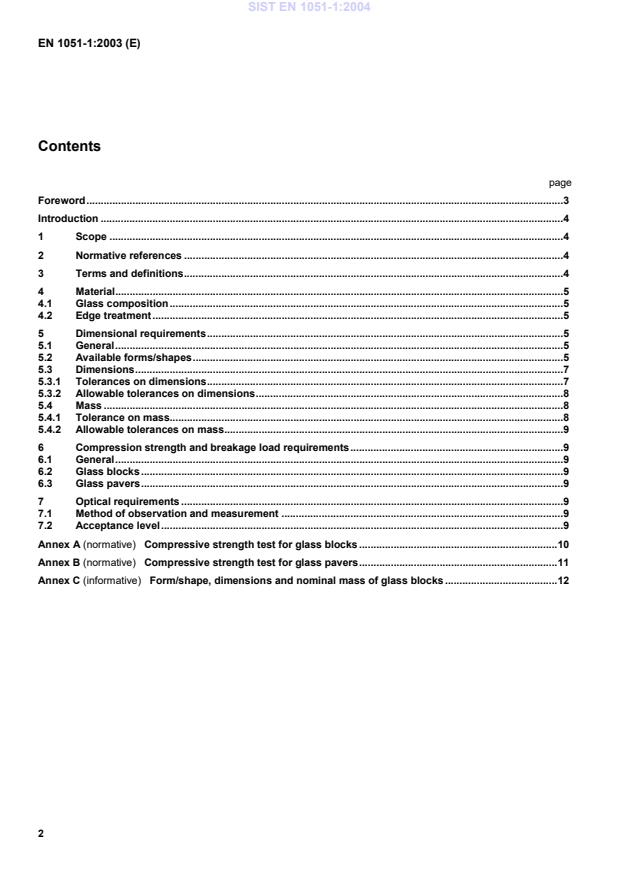
Compressive strength test for glass blocks.10Annex B (normative)
Compressive strength test for glass pavers.11Annex C (informative)
Form/shape, dimensions and nominal mass of glass blocks.12SIST EN 1051-1:2004
Glass blocks are usually manufactured by fusing or bonding together two or more units under applied pressure to forman airtight seal.SIST EN 1051-1:2004
Glass pavers can be produced as a single piece, or by fusing or bonding together two or more units to form an airtightseal.3.3visual faultsfaults that alter the visual quality of the glass. They include spot faults, opaque inclusions and linear/extended faults3.4spot faultstransparent/translucent faults, e.g. bubbles, etc., that are in the glass3.5opaque inclusionsopaque bodies, e.g. refractory, frit, etc., which are either in the glass or on the surface3.6linear/extended faultsthese faults can be on or in the glass, in the form of deposits, marks or scratches that occupy an extended length orarea4 Material4.1
...
Questions, Comments and Discussion
Ask us and Technical Secretary will try to provide an answer. You can facilitate discussion about the standard in here.
Loading comments...