

SIST EN IEC 61810-10:2021
(Main)Electromechanical elementary relays - Part 10: Additional functional aspects and safety requirements for high-capacity relays
General Information
- Abstract
IEC 61810-10:2019, with functional and safety aspects, applies to electromechanical elementary relays (non-specified time all-or-nothing relays) with high capability requirements like breaking or short circuit capabilities and similar for incorporation into low-voltage equipment. These relays may have a specific design to extinguish the electric arc between contacts (e.g. by magnetic blow-out), or use an insulation coordination not covered by IEC 61810-1 (e.g. by gas filled contact chambers), or require safety assessments not covered by IEC 61810-1 (e.g. for higher loads).
It defines additional requirements for high-capacity relays with generic performance intended for use in applications in smart grids, electric vehicles and other applications where, for example, battery charge/discharge switching is used, such as:
• electrical energy storage (EES) systems,
• solar photovoltaic energy systems,
• electric road vehicles (EV) and electric industrial trucks,
• power electronic systems and equipment,
• secondary cells and batteries,
• road vehicles.
Compliance with the requirements of this standard is verified by the type tests indicated.
- Status
- Published
- Publication Date
- 03-May-2021
- Technical Committee
- ISS EIT.ERE - All-or-nothing electrical relays
- Current Stage
- 6060 - National Implementation/Publication (Adopted Project)
- Start Date
- 15-Apr-2021
- Due Date
- 20-Jun-2021
- Completion Date
- 04-May-2021



Overview
EN IEC 61810-10:2019 (IEC 61810-10:2019) specifies additional functional aspects and safety requirements for high-capacity electromechanical elementary relays. It complements IEC 61810‑1 by addressing relays with high breaking or short‑circuit capability, special arc‑extinguishing designs (for example magnetic blow‑out), gas‑filled contact chambers or insulation coordination and safety assessments not covered in Part 1. Compliance is verified by the type tests indicated in the standard.
Keywords: electromechanical elementary relays, high-capacity relays, EN IEC 61810-10:2019, safety requirements, insulation coordination, breaking capacity.
Key topics and technical requirements
- Scope and applicability: Relays intended for incorporation into low‑voltage equipment where enhanced breaking, making or short‑circuit performance is needed (e.g., battery switching, power electronics).
- Functional aspects: Definition of basic operating functions, influence quantities and rated values specific to high‑capacity relays.
- Safety and insulation: Additional requirements for clearances, creepage distances and solid insulation when insulation coordination goes beyond IEC 61810‑1.
- Arc control and contact design: Requirements covering relays that employ arc‑extinguishing methods (magnetic blow‑out, gas‑filled chambers).
- Electrical and mechanical endurance: Type tests for dielectric strength (AC/DC), electrical endurance under high loads, mechanical endurance and heating behavior.
- Terminations and sealing: Tests and marking requirements for terminals, sealing (leak‑rate/long‑term stability) and suitability for standard soldering processes.
- Fire and thermal resistance: Glow‑wire, ball pressure and heat/fire resistance testing for use in demanding environments.
- Special tests and annexes: Informative and normative annexes include short‑circuit capacity testing, photovoltaic system tests, road‑vehicle tests, and risk assessment guidance.
- Verification: Conformity is determined through the type testing procedures and documentation requirements specified in the standard.
Applications and practical value
EN IEC 61810-10 targets high‑capacity relay designs used where robust switching of large currents or batteries is required. Typical applications:
- Electrical energy storage (EES) and battery charge/discharge switching
- Solar photovoltaic (PV) energy systems
- Electric vehicles (EV) and industrial electric trucks
- Power electronic equipment and converters
- Road vehicles and secondary cells/batteries
Practical value: ensures safe integration of high‑capacity relays into low‑voltage systems, reduces risk of arc‑related failures, standardizes testing for breaking and short‑circuit performance, and supports certification and product selection for demanding energy and mobility applications.
Who uses this standard
- Relay manufacturers and designers developing high‑capacity electromechanical relays
- Test laboratories performing type tests and safety verification
- System integrators and OEMs in EV, PV, EES and power‑electronics markets
- Compliance and safety engineers responsible for low‑voltage equipment certification
Related standards
- IEC/EN 61810‑1 (Electromechanical elementary relays – Part 1)
- IEC 60664‑1 / EN 60664‑1 (Insulation coordination)
- IEC 60947‑1 (Low‑voltage switchgear)
- ISO 16750 (Road vehicle environmental testing) These related standards are referenced for insulation, environmental and testing practices.
Relations
- Effective Date
- 09-Feb-2026
- Effective Date
- 03-Feb-2026
- Effective Date
- 03-Feb-2026
- Effective Date
- 03-Feb-2026
- Effective Date
- 03-Feb-2026
- Effective Date
- 03-Feb-2026
- Effective Date
- 03-Feb-2026
- Effective Date
- 03-Feb-2026
- Effective Date
- 03-Feb-2026
- Effective Date
- 03-Feb-2026
- Effective Date
- 03-Feb-2026
- Effective Date
- 03-Feb-2026
- Refers
SIST EN 60068-2-27:2009 - Environmental testing -- Part 2-27: Tests - Test Ea and guidance: Shock - Effective Date
- 03-Feb-2026
- Effective Date
- 15-Sep-2026
- Effective Date
- 03-Feb-2026
Get Certified
Connect with accredited certification bodies for this standard

IMQ S.p.A. (Certification)
Italian electrical product certification.

SLG Prüf- und Zertifizierungs GmbH
German testing and certification body.

UL Solutions
Global safety science company with testing, inspection and certification.
Sponsored listings
Frequently Asked Questions
SIST EN IEC 61810-10:2021 is a standard published by the Slovenian Institute for Standardization (SIST). Its full title is "Electromechanical elementary relays - Part 10: Additional functional aspects and safety requirements for high-capacity relays". This standard covers: IEC 61810-10:2019, with functional and safety aspects, applies to electromechanical elementary relays (non-specified time all-or-nothing relays) with high capability requirements like breaking or short circuit capabilities and similar for incorporation into low-voltage equipment. These relays may have a specific design to extinguish the electric arc between contacts (e.g. by magnetic blow-out), or use an insulation coordination not covered by IEC 61810-1 (e.g. by gas filled contact chambers), or require safety assessments not covered by IEC 61810-1 (e.g. for higher loads). It defines additional requirements for high-capacity relays with generic performance intended for use in applications in smart grids, electric vehicles and other applications where, for example, battery charge/discharge switching is used, such as: • electrical energy storage (EES) systems, • solar photovoltaic energy systems, • electric road vehicles (EV) and electric industrial trucks, • power electronic systems and equipment, • secondary cells and batteries, • road vehicles. Compliance with the requirements of this standard is verified by the type tests indicated.
IEC 61810-10:2019, with functional and safety aspects, applies to electromechanical elementary relays (non-specified time all-or-nothing relays) with high capability requirements like breaking or short circuit capabilities and similar for incorporation into low-voltage equipment. These relays may have a specific design to extinguish the electric arc between contacts (e.g. by magnetic blow-out), or use an insulation coordination not covered by IEC 61810-1 (e.g. by gas filled contact chambers), or require safety assessments not covered by IEC 61810-1 (e.g. for higher loads). It defines additional requirements for high-capacity relays with generic performance intended for use in applications in smart grids, electric vehicles and other applications where, for example, battery charge/discharge switching is used, such as: • electrical energy storage (EES) systems, • solar photovoltaic energy systems, • electric road vehicles (EV) and electric industrial trucks, • power electronic systems and equipment, • secondary cells and batteries, • road vehicles. Compliance with the requirements of this standard is verified by the type tests indicated.
SIST EN IEC 61810-10:2021 is classified under the following ICS (International Classification for Standards) categories: 29.120.70 - Relays. The ICS classification helps identify the subject area and facilitates finding related standards.
SIST EN IEC 61810-10:2021 has the following relationships with other standards: It is inter standard links to SIST EN ISO 3950:2016, SIST EN 60068-2-64:2008, SIST EN 61000-1-2:2016, SIST EN 60664-1:2007, SIST EN IEC 60068-2-14:2024, SIST EN 60664-3:2017, SIST EN 60999-1:2001, SIST EN IEC 60068-2-17:2024, SIST EN IEC 60270:2025, SIST EN 60947-1:2007, SIST EN 60060-1:2011, SIST EN 61810-1:2015, SIST EN 60068-2-27:2009, kSIST FprEN IEC 61810-7-19:2026, SIST EN IEC 61810-4:2021. Understanding these relationships helps ensure you are using the most current and applicable version of the standard.
SIST EN IEC 61810-10:2021 is available in PDF format for immediate download after purchase. The document can be added to your cart and obtained through the secure checkout process. Digital delivery ensures instant access to the complete standard document.
Standards Content (Sample)
SLOVENSKI STANDARD
01-junij-2021
Elektromehanski osnovni releji - 10. del: Dodatni funkcionalni vidiki in varnostne
zahteve za visoko zmogljive releje
Electromechanical elementary relays - Part 10: Additional functional aspects and safety
requirements for high-capacity relays
Ta slovenski standard je istoveten z: EN IEC 61810-10:2019
ICS:
29.120.70 Releji Relays
2003-01.Slovenski inštitut za standardizacijo. Razmnoževanje celote ali delov tega standarda ni dovoljeno.
EUROPEAN STANDARD EN IEC 61810-10
NORME EUROPÉENNE
EUROPÄISCHE NORM
September 2019
ICS 29.120.70
English Version
Electromechanical elementary relays - Part 10: Additional
functional aspects and safety requirements for high-capacity
relays
(IEC 61810-10:2019)
Relais électromécaniques élémentaires - Partie 10: Aspects Elektromechanische Elementarrelais - Teil 10:
fonctionnels et exigences de sécurité supplémentaires pour Hochleistungsrelais - Zusätzliche funktionale Aspekte und
les relais à grande capacité Sicherheitsanforderungen
(IEC 61810-10:2019) (IEC 61810-10:2019)
This European Standard was approved by CENELEC on 2019-08-15. CENELEC members are bound to comply with the CEN/CENELEC
Internal Regulations which stipulate the conditions for giving this European Standard the status of a national standard without any alteration.
Up-to-date lists and bibliographical references concerning such national standards may be obtained on application to the CEN-CENELEC
Management Centre or to any CENELEC member.
This European Standard exists in three official versions (English, French, German). A version in any other language made by translation
under the responsibility of a CENELEC member into its own language and notified to the CEN-CENELEC Management Centre has the
same status as the official versions.
CENELEC members are the national electrotechnical committees of Austria, Belgium, Bulgaria, Croatia, Cyprus, the Czech Republic,
Denmark, Estonia, Finland, France, Germany, Greece, Hungary, Iceland, Ireland, Italy, Latvia, Lithuania, Luxembourg, Malta, the
Netherlands, Norway, Poland, Portugal, Republic of North Macedonia, Romania, Serbia, Slovakia, Slovenia, Spain, Sweden, Switzerland,
Turkey and the United Kingdom.
European Committee for Electrotechnical Standardization
Comité Européen de Normalisation Electrotechnique
Europäisches Komitee für Elektrotechnische Normung
CEN-CENELEC Management Centre: Rue de la Science 23, B-1040 Brussels
© 2019 CENELEC All rights of exploitation in any form and by any means reserved worldwide for CENELEC Members.
Ref. No. EN IEC 61810-10:2019 E
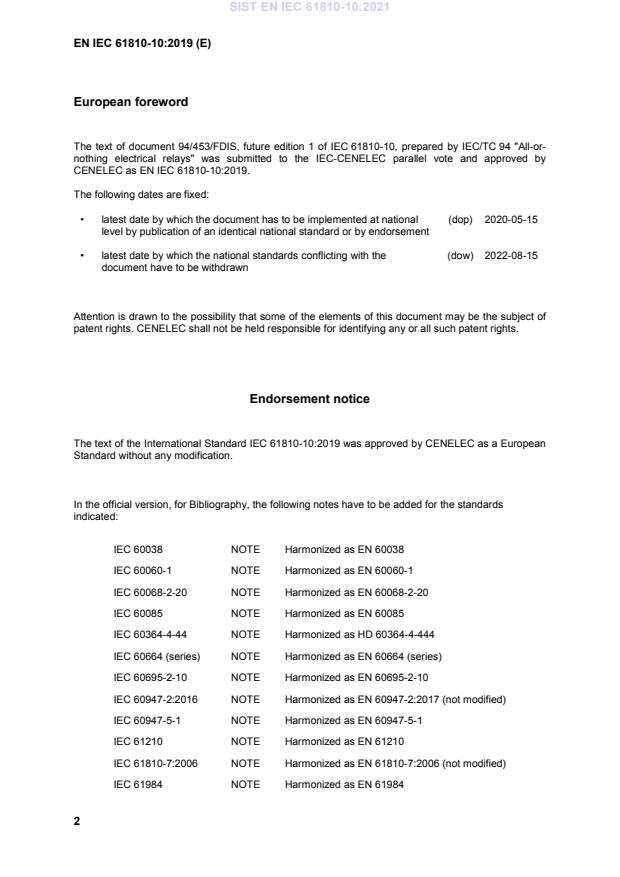
European foreword
The text of document 94/453/FDIS, future edition 1 of IEC 61810-10, prepared by IEC/TC 94 "All-or-
nothing electrical relays" was submitted to the IEC-CENELEC parallel vote and approved by
CENELEC as EN IEC 61810-10:2019.
The following dates are fixed:
• latest date by which the document has to be implemented at national (dop) 2020-05-15
level by publication of an identical national standard or by endorsement
• latest date by which the national standards conflicting with the (dow) 2022-08-15
document have to be withdrawn
Attention is drawn to the possibility that some of the elements of this document may be the subject of
patent rights. CENELEC shall not be held responsible for identifying any or all such patent rights.
Endorsement notice
The text of the International Standard IEC 61810-10:2019 was approved by CENELEC as a European
Standard without any modification.
In the official version, for Bibliography, the following notes have to be added for the standards
indicated:
IEC 60038 NOTE Harmonized as EN 60038
IEC 60060-1 NOTE Harmonized as EN 60060-1
IEC 60068-2-20 NOTE Harmonized as EN 60068-2-20
IEC 60085 NOTE Harmonized as EN 60085
IEC 60364-4-44 NOTE Harmonized as HD 60364-4-444
IEC 60664 (series) NOTE Harmonized as EN 60664 (series)
IEC 60695-2-10 NOTE Harmonized as EN 60695-2-10
IEC 60947-2:2016 NOTE Harmonized as EN 60947-2:2017 (not modified)
IEC 60947-5-1 NOTE Harmonized as EN 60947-5-1
IEC 61210 NOTE Harmonized as EN 61210
IEC 61810-7:2006 NOTE Harmonized as EN 61810-7:2006 (not modified)
IEC 61984 NOTE Harmonized as EN 61984
Annex ZA
(normative)
Normative references to international publications
with their corresponding European publications
The following documents are referred to in the text in such a way that some or all of their content
constitutes requirements of this document. For dated references, only the edition cited applies. For
undated references, the latest edition of the referenced document (including any amendments)
applies.
NOTE 1 Where an International Publication has been modified by common modifications, indicated by (mod), the relevant
EN/HD applies.
NOTE 2 Up-to-date information on the latest versions of the European Standards listed in this annex is available here:
www.cenelec.eu.
Publication Year Title EN/HD Year
IEC 60028 - International standard of resistance for copper - -
IEC 60060-1 2010 High-voltage test techniques - Part 1: General definitions EN 60060-1 2010
and test requirements
IEC 60068-2-14 - Environmental testing - Part 2: Tests - Test N: Change of - -
temperature
IEC 60068-2-17 - Basic environmental testing procedures - Part 2-17: Tests EN 60068-2-17 -
- Test Q: Sealing
IEC 60068-2-27 - Environmental testing - Part 2-27: Tests - Test Ea and EN 60068-2-27 -
guidance: Shock
IEC 60068-2-64 2008 Environmental testing - Part 2-64: Tests - Test Fh: EN 60068-2-64 2008
Vibration, broadband random and guidance
IEC 60270 - High-voltage test techniques - Partial discharge EN 60270 -
measurements
IEC 60664-1 2007 Insulation coordination for equipment within low-voltage EN 60664-1 2007
systems - Part 1: Principles, requirements and tests
IEC 60664-3 2016 Insulation coordination for equipment within low-voltage EN 60664-3 2017
systems - Part 3: Use of coating, potting or moulding for
protection against pollution
IEC 60947-1 2007 Low-voltage switchgear and controlgear - Part 1: General EN 60947-1 2007
rules
IEC 60999-1 - Connecting devices - Electrical copper conductors - EN 60999-1 -
Safety requirements for screw-type and screwless-type
clamping units - Part 1: General requirements and
particular requirements for clamping units for conductors
2 2
from 0,2 mm up to 35 mm (included)
IEC 60099-2 - Connecting devices - Electrical copper conductors - EN 60999-2 -
Safety requirements for screw-type and screwless-type
clamping units - Part 2: Particular requirements for
clamping units for conductors above 35 mm up to 300
mm (included)
IEC 61810-1 2015 Electromechanical elementary relays - Part 1: General EN 61810-1 2015
and safety requirements
ISO 16750-1 2019 Road vehicles - Environmental conditions and testing for - -
electrical and electronic equipment - Part 1: General
ISO 16750-2 2012 Road vehicles - Environmental conditions and testing for - -
electrical and electronic equipment - Part 2: Electrical
loads
IEC 61810-10 ®
Edition 1.0 2019-07
INTERNATIONAL
STANDARD
NORME
INTERNATIONALE
Electromechanical elementary relays –
Part 10: Additional functional aspects and safety requirements for high-capacity
relays
Relais électromécaniques élémentaires –
Partie 10: Aspects fonctionnels et exigences de sécurité supplémentaires pour
les relais à grande capacité
INTERNATIONAL
ELECTROTECHNICAL
COMMISSION
COMMISSION
ELECTROTECHNIQUE
INTERNATIONALE
ICS 29.120.70 ISBN 978-2-8322-7148-3
– 2 – IEC 61810-10:2019 © IEC 2019
CONTENTS
FOREWORD . 4
1 Scope . 6
2 Normative references . 6
3 Terms and definitions . 7
4 Influence quantities . 8
5 Rated values . 8
6 General provisions for testing . 8
7 Documentation and marking . 9
8 Heating . 9
9 Basic operating function . 11
10 Dielectric strength . 12
11 Electrical endurance . 14
12 Mechanical endurance . 14
13 Clearances, creepage distances and solid insulation . 14
14 Terminations . 18
15 Sealing . 18
16 Heat and fire resistance . 19
17 Special tests . 19
Annex A (normative) Explanations regarding relays . 20
Annex B (informative) Inductive contact loads . 21
Annex C (normative) Test set-up . 24
Annex D (informative) Special loads . 25
Annex E (normative) Heating test arrangement . 26
Annex F (normative) Measurement of clearances and creepage distances . 27
Annex G (normative) Relation between rated impulse voltage, nominal voltage and
overvoltage category . 28
Annex H (normative) Pollution degrees . 30
Annex I (normative) Proof tracking test . 31
Annex J (informative) Schematic diagram of families of terminations . 32
Annex K (normative) Glow-wire test . 33
Annex L (normative) Ball pressure test . 34
Annex M (informative) Needle flame test . 35
Annex N (informative) Resistance for standard soldering processes . 36
Annex O (informative) Risk assessment . 37
Annex P (informative) Mechanical properties of terminals . 38
Annex Q (normative) Long-term stability of the sealing (leak rate evaluation) . 44
Annex R (informative) Short-circuit capacity . 46
Annex S (informative) Special tests for applications – Photovoltaic systems . 49
Annex T (informative) Special tests for applications – Road vehicles . 53
Bibliography . 62
Figure 1 – Test procedure of system evaluation . 18
IEC 61810-10:2019 © IEC 2019 – 3 –
Figure P.1 – Test equipment for flexion test . 42
Figure Q.1 – Temperature cycle . 44
Figure R.1 – Short-circuit capacity test circuit . 47
Figure T.1 – Short voltage drop for system with nominal voltages . 55
Figure T.2 – Supply voltage profile for the reset test . 56
Figure T.3 – PSD of acceleration versus frequency . 59
Figure T.4 – PSD of acceleration versus frequency . 60
Table 1 – Type testing . 9
Table 2 – Required relay data . 9
Table 3 – Test conductor for test current above 400 A and up to 800 A inclusive
dependent on the current carried by the terminal . 11
Table 4 – Test copper bars for test current above 400 A and up to 1 000 A inclusive
dependent on the current carried by the terminal . 11
Table 5 – Dielectric strength – AC. 12
Table 6 – Dielectric strength – DC . 13
Table 7 – Minimum clearances in air for insulation coordination . 15
Table B.1 – Verification of the making and breaking capacity (abnormal conditions) . 21
Table B.2 – Verification of the making and breaking capacity (normal conditions) . 22
Table B.3 – Electrical endurance test . 23
Table G.1 – Correspondence between the nominal voltage of the supply system and
the equipment rated impulse withstand voltage, in case of overvoltage protection by
surge-arresters according to IEC 61810-1 . 28
Table P.1 – Tightening torques for the verification of the mechanical strength of screw-
type terminals . 39
Table P.2 – Test values for flexion and pull-out tests for round copper conductors . 41
Table P.3 – Test values for pull-out test for flat copper conductors . 43
Table S.1 – Special tests for photovoltaic system . 50
Table S.2 – Number of operating cycles . 51
Table S.3 – Special tests . 52
Table T.1 – Special test for road vehicles . 53
Table T.2 – Supply voltage for U = 12 V system devices . 57
N
Table T.3 – Supply voltage for U = 24 V system devices . 57
N
Table T.4 – Values for PSD and frequency . 59
Table T.5 – Values for PSD and frequency . 60
Table T.6 – Values for PSD and frequency, additional test in case of natural
frequencies, f , of DUT below 30 Hz . 61
n
– 4 – IEC 61810-10:2019 © IEC 2019
INTERNATIONAL ELECTROTECHNICAL COMMISSION
____________
ELECTROMECHANICAL ELEMENTARY RELAYS –
Part 10: Additional functional aspects and safety
requirements for high-capacity relays
FOREWORD
1) The International Electrotechnical Commission (IEC) is a worldwide organization for standardization comprising
all national electrotechnical committees (IEC National Committees). The object of IEC is to promote
international co-operation on all questions concerning standardization in the electrical and electronic fields. To
this end and in addition to other activities, IEC publishes International Standards, Technical Specifications,
Technical Reports, Publicly Available Specifications (PAS) and Guides (hereafter referred to as "IEC
Publication(s)"). Their preparation is entrusted to technical committees; any IEC National Committee interested
in the subject dealt with may participate in this preparatory work. International, governmental and non-
governmental organizations liaising with the IEC also participate in this preparation. IEC collaborates closely
with the International Organization for Standardization (ISO) in accordance with conditions determined by
agreement between the two organizations.
2) The formal decisions or agreements of IEC on technical matters express, as nearly as possible, an international
consensus of opinion on the relevant subjects since each technical committee has representation from all
interested IEC National Committees.
3) IEC Publications have the form of recommendations for international use and are accepted by IEC National
Committees in that sense. While all reasonable efforts are made to ensure that the technical content of IEC
Publications is accurate, IEC cannot be held responsible for the way in which they are used or for any
misinterpretation by any end user.
4) In order to promote international uniformity, IEC National Committees undertake to apply IEC Publications
transparently to the maximum extent possible in their national and regional publications. Any divergence
between any IEC Publication and the corresponding national or regional publication shall be clearly indicated in
the latter.
5) IEC itself does not provide any attestation of conformity. Independent certification bodies provide conformity
assessment services and, in some areas, access to IEC marks of conformity. IEC is not responsible for any
services carried out by independent certification bodies.
6) All users should ensure that they have the latest edition of this publication.
7) No liability shall attach to IEC or its directors, employees, servants or agents including individual experts and
members of its technical committees and IEC National Committees for any personal injury, property damage or
other damage of any nature whatsoever, whether direct or indirect, or for costs (including legal fees) and
expenses arising out of the publication, use of, or reliance upon, this IEC Publication or any other IEC
Publications.
8) Attention is drawn to the Normative references cited in this publication. Use of the referenced publications is
indispensable for the correct application of this publication.
9) Attention is drawn to the possibility that some of the elements of this IEC Publication may be the subject of
patent rights. IEC shall not be held responsible for identifying any or all such patent rights.
The International Standards of the IEC 61810 have been prepared by IEC technical committee
94: All-or-nothing electrical relays.
The text of this International Standard is based on the following documents:
FDIS Report on voting
94/453/FDIS 94/458/RVD
Full information on the voting for the approval of this International Standard can be found in
the report on voting indicated in the above table.
This document has been drafted in accordance with the ISO/IEC Directives, Part 2.
IEC 61810-10:2019 © IEC 2019 – 5 –
A list of all parts of IEC 61810 series, published under the general title Electromechanical
elementary relays, can be found on the IEC website.
This International Standard is to be used in conjunction with IEC 61810-1:2015.
The committee has decided that the contents of this document will remain unchanged until the
stability date indicated on the IEC website under "http://webstore.iec.ch" in the data related to
the specific document. At this date, the document will be
• reconfirmed,
• withdrawn,
• replaced by a revised edition, or
• amended.
– 6 – IEC 61810-10:2019 © IEC 2019
ELECTROMECHANICAL ELEMENTARY RELAYS –
Part 10: Additional functional aspects and safety
requirements for high-capacity relays
1 Scope
This part of IEC 61810, with functional and safety aspects, applies to electromechanical
elementary relays (non-specified time all-or-nothing relays) with high capability requirements
like breaking or short circuit capabilities and similar for incorporation into low-voltage
equipment. These relays may have a specific design to extinguish the electric arc between
contacts (e.g. by magnetic blow-out), or use an insulation coordination not covered by
IEC 61810-1 (e.g. by gas filled contact chambers), or require safety assessments not covered
by IEC 61810-1 (e.g. for higher loads).
It defines additional requirements for high-capacity relays with generic performance intended
for use in applications in smart grids, electric vehicles and other applications where, for
example, battery charge/discharge switching is used, such as:
• electrical energy storage (EES) systems,
• solar photovoltaic energy systems,
• electric road vehicles (EV) and electric industrial trucks,
• power electronic systems and equipment,
• secondary cells and batteries,
• road vehicles.
Compliance with the requirements of this standard is verified by the type tests indicated.
2 Normative references
The following documents are referred to in the text in such a way that some or all of their
content constitutes requirements of this document. For dated references, only the edition
cited applies. For undated references, the latest edition of the referenced document (including
any amendments) applies.
IEC 60028, International standard of resistance for copper
IEC 60060-1:2010, High-voltage test techniques – Part 1: General definitions and test
requirements
IEC 60068-2-14, Environmental testing – Part 2-14: Tests – Test N: Change of temperature
IEC 60068-2-17, Basic environmental testing procedures – Part 2-17: Tests – Test Q: Sealing
IEC 60068-2-27, Environmental testing – Part 2-27: Tests – Test Ea and guidance: Shock
IEC 60068-2-64:2008, Environmental testing – Part 2-64: Tests – Test Fh: Vibration,
broadband random and guidance
IEC 60270, High-voltage test techniques – Partial discharge measurements
IEC 61810-10:2019 © IEC 2019 – 7 –
IEC 60664-1:2007, Insulation coordination for equipment within low-voltage systems – Part 1:
Principles, requirements and tests
IEC 60664-3:2016, Insulation coordination for equipment within low-voltage systems – Part 3:
Use of coating, potting or moulding for protection against pollution
IEC 60947-1:2007, Low-voltage switchgear and controlgear – Part 1: General rules
IEC 60999-1, Connecting devices – Electrical copper conductors – Safety requirements for
screw-type and screwless-type clamping units – Part 1: General requirements and particular
2 2
requirements for clamping units for conductors from 0,2 mm up to 35 mm (included)
IEC 60999-2, Connecting devices – Electrical copper conductors – Safety requirements for
screw-type and screwless-type clamping units – Part 2: Particular requirements for clamping
2 2
units for conductors above 35 mm up to 300 mm (included)
IEC 61810-1:2015, Electromechanical elementary relays – Part 1: General and safety
requirements
ISO 16750-1:2018, Road vehicles – Environmental conditions and testing for electrical and
electronic equipment – Part 1: General
ISO 16750-2:2012, Road vehicles – Environmental conditions and testing for electrical and
electronic equipment – Part 2: Electrical loads
3 Terms and definitions
For the purposes of this document, the terms and definitions given in IEC 61810-1 and the
following apply.
ISO and IEC maintain terminological databases for use in standardization at the following
addresses:
• IEC Electropedia: available at http://www.electropedia.org/
• ISO Online browsing platform: available at http://www.iso.org/obp
NOTE In the text of this document, the term "relay" is used instead of "elementary relay" to improve the
readability.
3.5 Terms and definitions related to contacts
Addition to IEC 61810-1:2015:
3.5.23
polarity of contact
indication of which terminal of a contact is to be connected to the positive supply and which to
the negative
3.5.24
arcing time
interval of time between the instant of the initiation of the arc in a pole or
a fuse and the instant of final arc extinction in that pole or that fuse
[SOURCE: IEC 60050-441:1984, 441-17-37]
– 8 – IEC 61810-10:2019 © IEC 2019
4 Influence quantities
Clause 4 of IEC 61810-1 is applicable.
5 Rated values
Clause 5 of IEC 61810-1 is applicable, except as follows.
5.6 Electrical endurance
Recommended number of cycles: 1; 2; 5; 10; 20; 50; 100; 200; 500; 1 000; 2 000; 3 000;
5 000; 6 000; 10 000; 20 000; 25 000; 30 000; 50 000;100 000; 200 000; 300 000; 500 000;
etc.
5.7 Frequency of operation
Recommended frequencies: 180/h; 360/h; 720/h; 900/h and multiples thereof.
0,05 Hz; 0,1 Hz; 0,2 Hz; 0,25 Hz and multiples thereof.
5.8 Contact loads
a) Resistive loads, recommended values
Current: 0,1 A; 0,5 A; 1 A; 2 A; 3 A; 5 A; 6 A; 8 A; 10 A; 12 A; 16 A; 20 A; 25 A; 30 A;
35 A; 60 A; 100 A, 120 A; 150 A; 200 A; 300 A; 400 A; 600 A; 800 A; 1 000 A (AC/DC).
Voltage: 4,5 V; 5 V; 12 V; 24 V; 36 V; 42 V; 48 V; 110 V; 125 V; 230 V; 250 V; 300 V;
380 V; 400 V; 480 V; 500 V; 575 V; 600 V; 690 V; 1 000 V (AC/DC); 1 200 V DC; 1 500 V
DC.
b) Recommended inductive loads: see Annex B.
c) Recommended capacitive loads: see Annex D of IEC 61810-1:2015.
6 General provisions for testing
Clause 6 of IEC 61810-1 is applicable, except as follows.
Deviating from IEC 61810-1, the specimens shall be grouped in 8 inspection lots, and the
related tests shall be taken from Table 1 of this document.
Table 1 of this document replaces Table 3 of IEC 61810-1:2015.
IEC 61810-10:2019 © IEC 2019 – 9 –
Table 1 – Type testing
Inspection Tests Clause Additional references
lot
1 Marking and documentation 7 IEC 60417
Heating (all coil voltages) 8 IEC 60085
Basic operating function (all coil voltages) 9
2 Dielectric strength 10
3 Electrical endurance (per contact load and contact material) 11
4 Mechanical endurance 12
5 Clearances, creepage distances and distances through solid 13 IEC 60664-1
insulation
6 Insulation coordination evaluation as a system (if applicable) 13.6 IEC 60060-1
Screw type terminals and screwless terminals (if applicable) 14.2 IEC 60999-1
Flat quick-connect terminations (if applicable) 14.3 IEC 61210
Solder terminals (if applicable) 14.4 IEC 60068-2-20
Sockets (if applicable) 14.5 IEC 61984
Alternative termination types (if applicable) 14.6
Sealing (if applicable) 15 IEC 60068-2-17
7 Heat and fire resistance 16 IEC 60695-2-10
8 Leaking test (sealed relay only) Annex Q IEC 60068-2-14
IEC 60068-2-17
NOTE The number of coil voltages in inspection lot 1 to be tested can be reduced under certain conditions
explained in Clauses 8 and 9.
Beside the defined minimum requirements, deviations of test conditions and procedures could be specified by the
manufacturer in the inspection lot 8.
7 Documentation and marking
Clause 7 of IEC 61810-1:2015 is applicable with the additions given in Table 2 of this
document.
Table 2 – Required relay data
N° Data Notes Place of indication
2d Coil polarity N/A in case of non-polarized coil Relay and/or catalogue or
instruction sheet
3h Classification of load and polarity Relay and/or catalogue or
For DC only use:+, -
of contacts instruction sheet
For AC/DC use: +/∼, -/∼, ∼
5l Limited short circuit capacity Specify the fuses or current Catalogue or instruction sheet
limiting device (if applicable)
8 Heating
Clause 8 of IEC 61810-1:2015 is applicable with the following changes/additions.
– 10 – IEC 61810-10:2019 © IEC 2019
8.4.4 Screw and screwless type terminals
The electrical interconnections between the relays are made with bare rigid conductors
(= default, however the usage of flexible conductors is allowed if defined from the
manufacturer; this shall be stated in the documentation and in the test report) in accordance
with Table 10 of IEC 61810-1:2015 with a maximum of 400 A, and in accordance with Table 3
with a maximum of 800 A. The connections of the relay to the voltage or current source(s) are
realized with flexible conductors in accordance with Table 10 of IEC 61810-1:2015 with a
maximum of 400 A, and in accordance with Table 3 with a maximum of 800 A. The electrical
interconnections between the relays are made with copper bars in accordance with Table 4
with a maximum of 1 000 A. Any fixture to hold the flexible-connected test samples in place is
not allowed to have any impact on the results.
The temperature rise at the terminals shall not exceed 45 K. This may be verified without the
temperature rise influence of the relay contacts and the coil (e.g. bridged or short-circuited or
soldered relay contacts).
8.4.5 Alternative termination types
The electrical interconnections between the relays are made with bare rigid conductors in
accordance with Table 10 of IEC 61810-1:2015 with a maximum of 400 A, and in accordance
with Table 3 with a maximum of 800 A. The connections of the relay to the voltage or current
source(s) are realized with flexible conductors in accordance with Table 10 of IEC 61810-
1:2015 with a maximum of 400 A, and in accordance with Table 3 with a maximum of 800 A.
The electrical interconnections between the relays are made with copper bars in accordance
with Table 4 with a maximum of 1 000 A.
The temperature rise at the terminals shall not exceed 45 K. This may be verified without the
temperature rise influence of the relay contacts and the coil (e.g. bridged or short-circuited or
soldered relay contacts).
8.4.6 Sockets
The maximum steady-state temperature limits permissible for the connections between relay
and socket as well as for the insulating materials of both relay and socket adjacent to the
connection shall not be exceeded.
The electrical interconnections between the sockets are made with conductors in accordance
with Table 10 of IEC 61810-1:2015 with a maximum of 400 A, and in accordance with Table 3
with a maximum of 800 A. The connections of the sockets to the voltage or current source(s)
are realized with flexible conductors in accordance with Table 10 of IEC 61810-1:2015 with a
maximum of 400 A, and in accordance with Table 3 with a maximum of 800 A.
The electrical interconnections between the sockets are made with copper bars in accordance
with Table 4 with a maximum of 1 000 A.
The mounting distance between sockets shall be specified by the manufacturer.
IEC 61810-10:2019 © IEC 2019 – 11 –
Table 3 – Test conductor for test current above 400 A and up to 800 A
inclusive dependent on the current carried by the terminal
a b,c,d,e
Current carried by the terminal Conductor
A
Above Up to and including Number Size Number Size
mm kcmil
400 500 2 150 2 250
500 630 2 185 2 350
630 800 2 240 3 300
a
The value of test current shall be greater than the first value in the first column and less than or equal to the
second value in that column
b
For convenience of testing and with the manufacturer’s consent, smaller conductors than those given for a
stated test current may be used.
c
The tables give alternative sizes for conductors in the metric and AWG/kcmil system and for bars in
millimetres and inches. Comparison between AWG/kcmil and metric sizes is given in Table 1 of
IEC 60947-1:2007.
d
Either of the two conductors specified for a given test current range may be used.
e
When a dimension of a wire is not available, the next smallest available standard wire size shall be used.
f
Minimum conductor length for testing is 1 400 mm .
NOTE This table is based on Table 10 of IEC 60947-1:2007.
Table 4 – Test copper bars for test current above 400 A and up to 1 000 A
inclusive dependent on the current carried by the terminal
a b,c,d,e
Current carried by the terminal 2 set copper bars
A
Above Up to and including Number Dimension Dimension
mm inches
400 500 2 30 × 5 1 × 0,250
500 630 2 40 × 5 1,25 × 0,250
630 800 2 50 × 5 1,5 × 0,250
800 1 000 2 60 × 5 2 × 0,250
a
The value of test current shall be greater than the first value in the first column and less than or equal to the
second value in that column
b
For convenience of testing and with the manufacturer’s consent, smaller conductors than those given for a
stated test current may be used.
c
Either of the two conductors specified for a given test current range may be used.
d
Bars are assumed to be arranged with their long faces vertical. Arrangements with long faces horizontal may
be used if specified by the manufacturer.
e
Minimum conductor length for testing is 1 400 mm (including the length of flexible conductors).
f
The tables give alternative sizes for bars in millimetres and inches.
NOTE This table is based on Table 11 of IEC 60947-1:2007.
9 Basic operating function
Clause 9 of IEC 61810-1:2015 is applicable.
– 12 – IEC 61810-10:2019 © IEC 2019
10 Dielectric strength
Clause 10 of IEC 61810-1:2015 is applicable with the following changes/additions: Table 5
and Table 6 of this document replace Table 13 and Table 14 of IEC 61810-1:2015.
Table 5 – Dielectric strength – AC
a b
Test voltage depending on the rated voltage of the circuit (RMS values)
c
50 V to 100 V to 200 V 230 V / 400 V 400 V / 400/ > 480 V
Up to and
120 V
3 V
120 V to 240 V 277 V / 480 V
including
50 V
480 V / 480/
125 V to 250 V
3 V
e f
Insulation or
disconnection to
d
g
be tested
L L
L
L
L
E E
L N
L
E
L E
E
L – E L – E L – E L – L L – E L – L L – E L – L L – E
V V V V V
Functional 500 1 300 1 300 1 500 1 500 1 700 1 700 1 700 U + 1 200 V
n
h
insulation (rounded)
i
Basic insulation 500 1 300 1 300 --- 1 500 --- 1 700 --- U + 1 200 V
n
(rounded)
Basic insulation 500 1 000 + 2 times rated voltage
(Test procedure B)
Supplementary --- 1 300 1 300 --- 1 500 --- 1 700 --- U + 1 200 V
n
i
insulation (rounded)
Reinforced or 500 2 600 2 600 --- 3 000 --- 3 400 --- 2 ×
i
double insulation (U + 1 200 V)
n
(rounded)
Micro- 400 400 400 500 500 700 700 700 U + 250V
n
j
disconnection
Full-disconnection 500 1 300 1 300 1 500 1 500 1 700 1 700 1 700 U + 1 200 V
n
(rounded)
a
The high-voltage transformer used for the test shall be designed so that, when the output terminals are short-
circuited after the output voltage has been adjusted to the test voltage, the output current is at least 200 mA.
The overcurrent relay shall not trip when the output current is less than 3 mA. Care shall be taken to ensure
that the RMS value of the test voltage is measured within ±3 %.
b
For functional, basic and supplementary insulation as well as for full disconnection, the values are derived
from the formula U + 1 200 V (rounded). The reinforced level from 50 V up is consequently two times higher.
n
For micro-disconnection, the values are derived from the formula U + 250 V (rounded), with U being the
n n
nominal voltage of the supply system.
c
Up to and including 50 V: not to be connected direct to the supply mains. No temporary overvoltages in
accordance with IEC 60364-4-44 are expected to occur.
d
Single-phase system, mid-point earthed.
e
Three-phase system, mid-point earthed.
f
Three-phase system, one phase earthed.
g
Special components which might render the test impractical such as light emitting diodes, free-running
diodes, varistors are disconnected at one pole, or bridged, or removed, as appropriate to the insulation being
tested.
h
An example is the insulation between contacts necessary for proper function only.
i
For the test of basic, supplementary and reinforced insulation, all live parts are connected together and care
shall be taken to ensure that all moving parts are in the most unfavourable position.
j
Contact gap ensuring proper function of the contact (covers also micro-interruption).
IEC 61810-10:2019 © IEC 2019 – 13 –
Table 6 – Dielectric strength – DC
a b
Test voltage depending on the rated voltage of the circuit
c
Above 120 V to 250 V 240 V to 480 V > 480V
Up to and
50 V up
125 V to 250 V
including
to
50 V
including
120 V
Insulation or
disconnection
= = = = = =
d
to be tested
L L L L
L L
E E
E E
L – E L – E L – E L – L L – E L – L L – E
V V V
Functional 500 1 300 1 300 1 500 1 500 1 700 U + 1 200 V
n
e
insulation (rounded)
Basic 500 1 300 1 300 --- 1 500 --- U + 1 200 V
n
f
insulation (rounded)
Basic insulation 500 1 000 + 2 times rated voltage
(Test procedure
B)
Supplementary --- 1 300 1 300 --- 1 500 --- U + 1 200 V
n
f
insulation (rounded)
Reinforced or 500 2 600 2 600 --- 3 000 --- 2 × (U + 1 200 V)
n
double (rounded)
f
insulation
Micro- 400 400 400 500 500 700 U + 250 V
n
g
disconnection
Full- 500 1 300 1 300 1 500 1 500 1 700 U + 1 200 V
n
disconnection (rounded)
a
The high-voltage transformer used for the test shall be designed so that, when the output terminals are short-
circuited after the output voltage has been adjusted to the test voltage, the output current is at least 200 mA.
The overcurrent relay shall not trip when the output current is less than 3 mA. Care shall be taken that the
value of the test voltage is measured within ±3 %.
b
For functional, basic and supplementary insulation, as well as for full disconnection, the values are derived
from the formula U + 1 200 V (rounded). The reinforced level from 50 V up is consequently two times higher.
n
For micro-disconnection, the values are derived from the formula U + 250 V (rounded), with U being the
n
n
nominal voltage of the supply system.
c
Up to and including 50 V: Not to be connected direct to the supply mains. No temporary overvoltages
according to IEC 60364-4-44 are expected to occur.
d
Special components which might render the test impractical such as light emitting diodes, free-running diodes,
varistors are disconnected at one pole, or bridged, or removed, as appropriate to the insulation being tested.
e
An example is the insulation between contacts necessary for proper function only.
f
For the test of basic, supplementary and reinforced insulation, all live parts are connected together and care
shall be taken to ensure that all moving parts are in the most unfavourable position.
g
Contact gap ensuring proper function of the contact (covers also micro-interruption).
– 14 – IEC 61810-10:2019 © IEC 2019
11 Electrical endurance
Clause 11 of IEC 61810-1:2015 is applicable with the following changes/additions.
11.1 General
If the relay has a defined polarity of a contact, the manufacturer shall specify an appropriate
schematics for contact loading for the test, which may deviate from the schematics of Table
16 of IEC 61810-1:2015.
The heating test after the electrical endurance is mandatory if prescribed by the relevant
product application annex of this document (e.g. Annex S for photovoltaic systems), or by
application standards (e.g. IEC 60730-1 or IEC 60669-1).
11.2 Overload test
For the overload test, a number of cycles specified by the manufacturer is allowed.
11.3 Severity
The first detected temporary malfunction is defined as a failure (Severity A in accordance with
4.30.2 of IEC 61810-7:2006).
12 Mechanical endurance
Clause 12 of IEC 61810-1:2015 is applicable with Table 5 and Table 6.
13 Clearances, creepage distances and solid insulation
Clause 13 of IEC 61810-1:2015 is applicable with the following changes/additions.
13.1 General provisions
The first two sentences of this subclause of IEC 61810-1:2015 are deleted and replaced by:
The requirements and tests indicated in this clause are based on IEC 60664-1 and
additionally allow the evaluation of the insulation evaluation as a system based on
IEC 60060-1.
13.1.b) the third bullet point is changed as following:
– the partial discharge test under 5.8.5 of IEC 60664-3:2016 is required for peak
voltages above 700 V;
13.2 Clearances and creepage distances
Table 18 of IEC 61810-1:2015 is replaced by the following Table 7.
IEC 61810-10:2019 © IEC 2019 – 15 –
Table 7 – Minimum clearances in air for insulation coordination
c d
Minimum clearances up to 2 000 m above sea level
Impulse withstand
e
Pollution degree
a
voltage
1 2 3
kV mm mm mm
b c
0,33 0,01 0,2 0,8
c
0,40 0,02 0,2 0,8
b c
0,50 0,04 0,2 0,8
0,60 0,06 0,2 0,8
b
0,80 0,10 0,2 0,8
1,0 0,15 0,2 0,8
1,2 0,25 0,8
b
1,5 0,5 0,8
2,0 1,0
b
2,5 1,5
3,0 2,0
b
4,0 3,0
5,0 4,0
b
6,0 5,5
b
8,0 8,0
10 11
b
12 14
b
15 18
b
18 22
b
20 25
a
This voltage is
– for basic insulation directly exposed to or significantly influenced by transient overvoltages from the low-
voltage mains: the rated impulse voltage of the equipment;
– for other basic insulation: the highest impulse voltage that can occur in the circuit;
– for reinforced insulation, see footnotes a and b of Table 17 of IEC 61810-1:2015.
In special cases, intermediate values derived by interpolation may be u
...