

SIST EN 2632:2006
(Main)Aerospace series - Aluminium alloy AL-P7075 - T73511 - Extruded bar and section - a or D
- Abstract
This standard specifies the requirements relating to:
Aluminium alloy AL-P7075-
T73511
Extruded bar and section
a or D
for aerospace application.
This standard may also be used to supply material in the T73510 condition if specified by the purchaser on the order and the product is marked accordingly.
- Status
- Published
- Publication Date
- 30-Jun-2006
- Technical Committee
- I13 - Imaginarni 13
- Current Stage
- 6060 - National Implementation/Publication (Adopted Project)
- Start Date
- 01-Jul-2006
- Due Date
- 01-Jul-2006
- Completion Date
- 01-Jul-2006
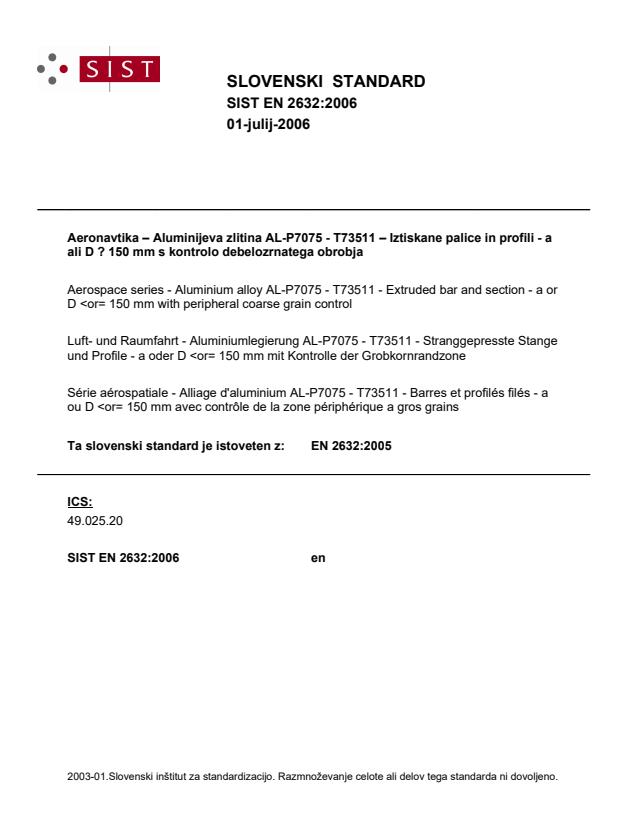

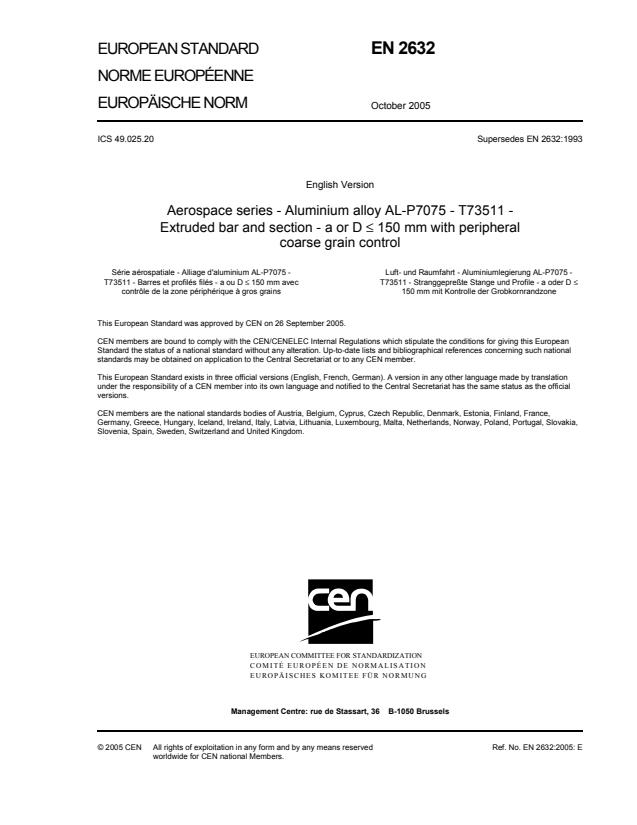
SIST EN 2632:2006 is a SIST European standard for aerospace aluminium alloy AL-P7075 in the T73511 condition. It specifies requirements for extruded bar and section with a or D ≤ 150 mm and peripheral coarse grain control, and it can also be used for T73510 supply when the purchaser orders that condition and the product is marked accordingly.
What does SIST EN 2632:2006 specify?
SIST EN 2632:2006 sets the requirements for a specific wrought aluminium product for aerospace applications. Its scope is narrow: AL-P7075, extruded bar and section, limited size, and controlled peripheral coarse grain.
The document is organized with a short front matter, Clause 1 on scope, Clause 2 on normative references, and then requirement tables that cover composition, heat treatment, properties, inspection and qualification. The standard is tied to EN 4400-3 for the product specification and test methods, so it works as a material-specific rule set rather than a general aluminium handbook.
What are the key requirements of SIST EN 2632:2006?
Material, form and supply condition
SIST EN 2632:2006 applies to aluminium alloy AL-P7075 in extruded bar and section form for aerospace use, with a or D ≤ 150 mm. This matters because the standard is intended for a defined product geometry, not for sheet, plate or larger sections.
The standard uses the T73511 condition as its main supply condition, and it also allows T73510 if the purchaser specifies it and the product is marked accordingly. That means the order and product marking must match the condition actually supplied.
A note in the document allows an addition of Zr + Ti only by agreement with the purchaser. In practice, that means chemistry changes cannot be assumed from the base alloy designation alone.
Composition and processing
Clause 1 and the material table define the chemical composition limits for the alloying elements and impurities. The production route is extruded, and the relevant technical specification is EN 4400-3.
For a buyer or quality manager, this links the material identity, manufacturing route and acceptance basis. It is the combination that separates compliant aerospace stock from generic aluminium extrusion.
Heat treatment and delivery condition
The standard gives the heat-treatment route for the delivery condition, including solution treatment, water quenching, controlled stretching and ageing. These steps are the basis for the temper, so they affect strength, ductility and subsequent performance in service.
The document also identifies delivery condition codes and a use condition. In practice, this is the part that must be matched to the order, the mill certificate and the marking on the product.
Mechanical and physical properties
The property table sets minimum proof stress, tensile strength and elongation values by size range, and the test direction is longitudinal. That matters because acceptance depends on the product size: the allowable property levels change across the diameter and thickness ranges up to 150 mm.
The standard also gives requirements for electrical conductivity and links marginal conductivity results to proof stress or stress corrosion performance. For users, this provides a quick check on heat-treatment condition and material consistency.
Inspection and quality checks
SIST EN 2632:2006 covers stress corrosion, external defects, internal defects, batch uniformity, extrusion back-end defect, peripheral coarse grain, marking inspection and dimensional inspection. The peripheral coarse grain requirement is set to Level A.
These checks are important because aerospace buyers need both mechanical performance and process control. The document also points to EN 4400-3 for test samples, test pieces and product qualification, with the qualification programme agreed between manufacturer and purchaser.
What terms does SIST EN 2632:2006 define?
- AL-P7075 - the aluminium alloy designation used for this product standard.
- T73511 - the principal heat-treatment and temper condition covered by the standard.
- T73510 - an alternative use condition that may be supplied only when ordered and marked accordingly.
- WQ - water quench, the rapid cooling step after solution treatment.
- Rp0,2 - 0.2% proof stress, used to measure resistance to permanent deformation.
- Rm - tensile strength, the maximum stress reached in a tensile test.
- γ - electrical conductivity, used here as a condition check for the material.
Who uses SIST EN 2632:2006?
SIST EN 2632:2006 is used by aerospace material suppliers, extrusion mills, purchasers, quality departments and test laboratories. It is most useful when ordering, producing, certifying or receiving aluminium bar and section that must meet a defined aerospace temper and inspection regime.
It also helps inspectors and qualification teams because it ties the product to specific property tests, defect checks and the EN 4400-3 technical specification.
What changed in SIST EN 2632:2006 from the previous edition?
SIST EN 2632:2006 supersedes EN 2632:1993.
Which standards are used with SIST EN 2632:2006?
- EN 4258 - gives the general organization of metallic materials standards for aerospace and explains how the EN standards in this series relate to each other.
- EN 4400-3 - provides the technical specification for aluminium and aluminium alloy wrought products, including the test and inspection references used throughout this standard.
- EN 4500-2 - gives the drafting and presentation rules used to prepare aluminium, aluminium alloy and magnesium alloy material standards.
What does the SIST EN 2632:2006 document contain?
The document contains a specification table for alloy designation, composition, manufacturing route, size limit, technical specification and delivery condition. It also includes the heat-treatment route, use condition, test sample and test piece references, and the size-dependent property requirements.
Further tables cover electrical conductivity, stress corrosion, external and internal defects, batch uniformity, extrusion back-end defect, peripheral coarse grain, marking inspection, dimensional inspection and product qualification. The notes clarify purchaser agreement for Zr + Ti addition and the link between use condition and marking.
Relations
- Effective Date
- 01-Jul-2006
- Effective Date
- 28-Jan-2026
Get Certified
Connect with accredited certification bodies for this standard

BUREAU VERITAS Certification Germany
Bureau Veritas certification in Germany.

Element Materials Technology
Materials testing and product certification.

AQMS Ltd.
AQMS provides ISO certification to SMEs across the UK.
Sponsored listings
Frequently Asked Questions
SIST EN 2632:2006 is a standard published by the Slovenian Institute for Standardization (SIST). Its full title is "Aerospace series - Aluminium alloy AL-P7075 - T73511 - Extruded bar and section - a or D <or= 150 mm with peripheral coarse grain control". This standard covers: This standard specifies the requirements relating to: Aluminium alloy AL-P7075- T73511 Extruded bar and section a or D <or= 150 mm with peripheral coarse grain control for aerospace application. This standard may also be used to supply material in the T73510 condition if specified by the purchaser on the order and the product is marked accordingly.
This standard specifies the requirements relating to: Aluminium alloy AL-P7075- T73511 Extruded bar and section a or D <or= 150 mm with peripheral coarse grain control for aerospace application. This standard may also be used to supply material in the T73510 condition if specified by the purchaser on the order and the product is marked accordingly.
SIST EN 2632:2006 is classified under the following ICS (International Classification for Standards) categories: 49.025.20 - Aluminium. The ICS classification helps identify the subject area and facilitates finding related standards.
SIST EN 2632:2006 has the following relationships with other standards: It is inter standard links to SIST EN 2632:2001, SIST EN 4258:2024. Understanding these relationships helps ensure you are using the most current and applicable version of the standard.
SIST EN 2632:2006 is available in PDF format for immediate download after purchase. The document can be added to your cart and obtained through the secure checkout process. Digital delivery ensures instant access to the complete standard document.
Standards Content (Sample)
2003-01.Slovenski inštitut za standardizacijo. Razmnoževanje celote ali delov tega standarda ni dovoljeno.Aerospace series - Aluminium alloy AL-P7075 - T73511 - Extruded bar and section - a or D
STANDARDSIST EN 2632:200601-julij-2006
EUROPEAN STANDARD NORME EUROPÉENNE EUROPÄISCHE NORM
EN 2632
October 2005 ICS 49.025.20 Supersedes EN 2632:1993 English Version
Aerospace series - Aluminium alloy AL-P7075 - T73511 - Extruded bar and section - a or D ≤ 150 mm with peripheral coarse grain control
Série aérospatiale - Alliage d'aluminium AL-P7075 - T73511 - Barres et profilés filés - a ou D ≤ 150 mm avec contrôle de la zone périphérique à gros grains
Luft- und Raumfahrt - Aluminiumlegierung AL-P7075 - T73511 - Stranggepreßte Stange und Profile - a oder D ≤ 150 mm mit Kontrolle der Grobkornrandzone This European Standard was approved by CEN on 26 September 2005.
CEN members are bound to comply with the CEN/CENELEC Internal Regulations which stipulate the conditions for giving this European Standard the status of a national standard without any alteration. Up-to-date lists and bibliographical references concerning such national standards may be obtained on application to the Central Secretariat or to any CEN member.
This European Standard exists in three official versions (English, French, German). A version in any other language made by translation under the responsibility of a CEN member into its own language and notified to the Central Secretariat has the same status as the official versions.
CEN members are the national standards bodies of Austria, Belgium, Cyprus, Czech Republic, Denmark, Estonia, Finland, France, Germany, Greece, Hungary, Iceland, Ireland, Italy, Latvia, Lithuania, Luxembourg, Malta, Netherlands, Norway, Poland, Portugal, Slovakia, Slovenia, Spain, Sweden, Switzerland and United Kingdom.
EUROPEAN COMMITTEE FOR STANDARDIZATION
COMITÉ EUROPÉEN DE NORMALISATION EUROPÄISCHES KOMITEE FÜR NORMUNG
Management Centre: rue de Stassart, 36
B-1050 Brussels © 2005 CEN All rights of exploitation in any form and by any means reserved worldwide for CEN national Members. Ref. No. EN 2632:2005: E
...