

oSIST prEN 13497:2026
(Main)Thermal insulation products for building applications - Determination of the resistance to impact of external thermal insulation composite systems (ETICS)
- Abstract
This document specifies the equipment and procedure for determining the resistance to impact of ETICS kits with renders.
- Status
- Not Published
- Public Enquiry End Date
- 26-Nov-2026
- Technical Committee
- TOP - Thermal insulation
- Current Stage
- 4020 - Public enquire (PE) (Adopted Project)
- Start Date
- 06-Oct-2026
- Due Date
- 23-Feb-2027

oSIST prEN 13497:2026 is the Slovenian standard published by SIST as an identical version of draft European Standard prEN 13497. It specifies the equipment and procedure for determining the resistance to impact of external thermal insulation composite systems (ETICS) kits with renders, so laboratories can assess hard-body impact resistance and report visible damage and crack width.
What does oSIST prEN 13497:2026 specify?
oSIST prEN 13497:2026 applies to ETICS kits with renders used in buildings. Clause 1 gives the scope, and Clauses 2 to 10 cover the references, terms, test principle, apparatus, specimen preparation, procedure, result assessment, measurement accuracy and test report.
The document is organized as a practical test method rather than a product specification. That means it tells the user how to prepare the specimen, how to strike it, what to inspect, and what to record.
What are the key requirements of oSIST prEN 13497:2026?
Impact principle and apparatus
oSIST prEN 13497:2026 uses a hard body impact method in which a steel ball falls onto the surface of the ETICS specimen. The selected impact energy and corresponding drop height come from Table 1, so the test can be matched to the severity level needed for the product or application.
Clause 5 specifies the main apparatus: a defined steel ball, a crack measuring gauge, a flat specimen support that must not absorb impact energy, and an optional tube to guide the ball. In practice, this matters because the setup has to create a repeatable impact and avoid extra effects such as rebound or support deflection.
Specimens and conditioning
Clause 6 requires a specimen large enough to allow several impacts at separated positions. The specimen consists of the thermal insulation and the rendering system, and it is prepared according to the system holder’s instructions.
oSIST prEN 13497:2026 gives two conditioning routes, including sealing of edges or the reverse side where needed, warm and humid conditioning, wet exposure, and drying before testing. This is important because impact resistance can change after moisture and climate exposure, so the conditioning must reflect the intended use.
Procedure, examination and report
Clause 7 requires testing at controlled temperature and repeated impacts at different positions on the same specimen. The impacts must be kept away from specimen edges, joints and previous impact points, and any rebound of the ball must be prevented.
Clause 8 sets the visual assessment. The operator checks the impacted zones from the outside and, if needed, from the rear face after careful removal of the insulation. Delamination, visible reinforcement, crack widths above the stated limit, spalling and measurable deformation are all reported, and crack width is measured with the gauge from Clause 5.
Clause 10 makes the report traceable. It requires the laboratory details, specimen identification, conditioning history, test conditions, impact energy used, observations, photos of each impact zone and key product data for the coats, reinforcement and insulation.
What terms does oSIST prEN 13497:2026 define?
- ETICS - external thermal insulation composite system, the facade insulation system being tested.
- Rendering system - the layered outer build-up over the insulation, including the coats that may crack or delaminate.
- Base coat - the reinforced layer beneath the finishing layer.
- Finishing layer - the outer exposed layer struck by the steel ball.
- Reinforcement - the reinforcing component in the base coat whose visibility after impact is treated as damage.
- Crack measuring gauge - the tool used to measure the width of impact cracks in fine steps.
Who uses oSIST prEN 13497:2026?
Manufacturers and system holders of ETICS kits use this document to check how their render systems respond to impact. Test laboratories use it to prepare specimens, run the drop test and write the report in a consistent way.
Certification bodies, technical assessors and quality managers use the results when comparing systems for building applications. Designers and buyers can use the outcome to judge whether a facade system is suitable for locations where impact resistance matters.
What changed in oSIST prEN 13497:2026 from the previous edition?
oSIST prEN 13497:2026 supersedes EN 13497:2018+A1:2021. The foreword states that Clause 7.2 and Clause 8 were revised, Figure 3 was added, and the document was editorially revised.
Which standards are used with oSIST prEN 13497:2026?
| Standard | What it contributes |
|---|---|
| EN 1607 | Tensile strength perpendicular to faces of the thermal insulation product |
| EN 16383 | Hygrothermal behaviour test cycles for ETICS kits |
| EN 17237 | ETICS with renders specification and the test plan referenced in the report |
| EN ISO 9229 | Vocabulary used for thermal insulation terms |
| EN ISO 29470 | Apparent density of the thermal insulating product |
| ISO 3290-1 | Steel ball requirements for the impact apparatus |
What does the oSIST prEN 13497:2026 document contain?
The document contains the full impact test method, the apparatus requirements and the specimen preparation and conditioning routes. It also includes Table 1 for matching impact energy with ball size, mass and drop height, plus Figure 1 for the crack gauge, Figure 2 for the water-submersion arrangement, and Figure 3 for an example of the test setup.
It is also a reporting document. Clause 10 lists the laboratory, specimen, conditioning and result details that must be captured so the test can be repeated and the outcome compared across laboratories.
Relations
- Effective Date
- 03-Dec-2025
Get Certified
Connect with accredited certification bodies for this standard

DIBt (Deutsches Institut für Bautechnik)
German Institute for Building Technology.
DIN CERTCO
DIN Group product certification.

Aboma Certification B.V.
Specialized in construction, metal, and transport sectors.
Sponsored listings
Frequently Asked Questions
oSIST prEN 13497:2026 is a draft published by the Slovenian Institute for Standardization (SIST). Its full title is "Thermal insulation products for building applications - Determination of the resistance to impact of external thermal insulation composite systems (ETICS)". This standard covers: This document specifies the equipment and procedure for determining the resistance to impact of ETICS kits with renders.
This document specifies the equipment and procedure for determining the resistance to impact of ETICS kits with renders.
oSIST prEN 13497:2026 is classified under the following ICS (International Classification for Standards) categories: 91.100.60 - Thermal and sound insulating materials. The ICS classification helps identify the subject area and facilitates finding related standards.
oSIST prEN 13497:2026 has the following relationships with other standards: It is inter standard links to SIST EN 13497:2018+A1:2021. Understanding these relationships helps ensure you are using the most current and applicable version of the standard.
oSIST prEN 13497:2026 is available in PDF format for immediate download after purchase. The document can be added to your cart and obtained through the secure checkout process. Digital delivery ensures instant access to the complete standard document.
Standards Content (Sample)
SLOVENSKI STANDARD
01-november-2026
Toplotnoizolacijski proizvodi za uporabo v gradbeništvu - Ugotavljanje odpornosti
proti udarcem kontaktnih fasadnih toplotnoizolacijskih sistemov (ETICS)
Thermal insulation products for building applications - Determination of the resistance to
impact of external thermal insulation composite systems (ETICS)
Wärmedämmstoffe für das Bauwesen - Bestimmung der Schlagfestigkeit von
außenseitigen Wärmedämm-Verbundsystemen (WDVS)
Produits isolants thermiques pour le bâtiment - Détermination de la résistance au choc
des systèmes composites d’isolation thermique par l’extérieur (ETICS)
Ta slovenski standard je istoveten z: prEN 13497
ICS:
91.100.60 Materiali za toplotno in Thermal and sound insulating
zvočno izolacijo materials
2003-01.Slovenski inštitut za standardizacijo. Razmnoževanje celote ali delov tega standarda ni dovoljeno.
DRAFT
EUROPEAN STANDARD
NORME EUROPÉENNE
EUROPÄISCHE NORM
October 2026
ICS 91.100.60 Will supersede EN 13497:2018+A1:2021
English Version
Thermal insulation products for building applications -
Determination of the resistance to impact of external
thermal insulation composite systems (ETICS)
Produits isolants thermiques pour le bâtiment - Wärmedämmstoffe für das Bauwesen - Bestimmung
Détermination de la résistance au choc des systèmes der Schlagfestigkeit von außenseitigen Wärmedämm-
composites d'isolation thermique par l'extérieur Verbundsystemen (WDVS)
(ETICS)
This draft European Standard is submitted to CEN members for enquiry. It has been drawn up by the Technical Committee
CEN/TC 88.
If this draft becomes a European Standard, CEN members are bound to comply with the CEN/CENELEC Internal Regulations
which stipulate the conditions for giving this European Standard the status of a national standard without any alteration.
This draft European Standard was established by CEN in three official versions (English, French, German). A version in any other
language made by translation under the responsibility of a CEN member into its own language and notified to the CEN-CENELEC
Management Centre has the same status as the official versions.
CEN members are the national standards bodies of Austria, Belgium, Bulgaria, Croatia, Cyprus, Czech Republic, Denmark, Estonia,
Finland, France, Germany, Greece, Hungary, Iceland, Ireland, Italy, Latvia, Lithuania, Luxembourg, Malta, Netherlands, Norway,
Poland, Portugal, Republic of North Macedonia, Romania, Serbia, Slovakia, Slovenia, Spain, Sweden, Switzerland, Türkiye and
United Kingdom.
Recipients of this draft are invited to submit, with their comments, notification of any relevant patent rights of which they are
aware and to provide supporting documentation.
Warning : This document is not a European Standard. It is distributed for review and comments. It is subject to change without
notice and shall not be referred to as a European Standard.
EUROPEAN COMMITTEE FOR STANDARDIZATION
COMITÉ EUROPÉEN DE NORMALISATION
EUROPÄISCHES KOMITEE FÜR NORMUNG
CEN-CENELEC Management Centre: Rue de la Science 23, B-1040 Brussels
© 2026 CEN All rights of exploitation in any form and by any means reserved Ref. No. prEN 13497:2026 E
worldwide for CEN national Members.
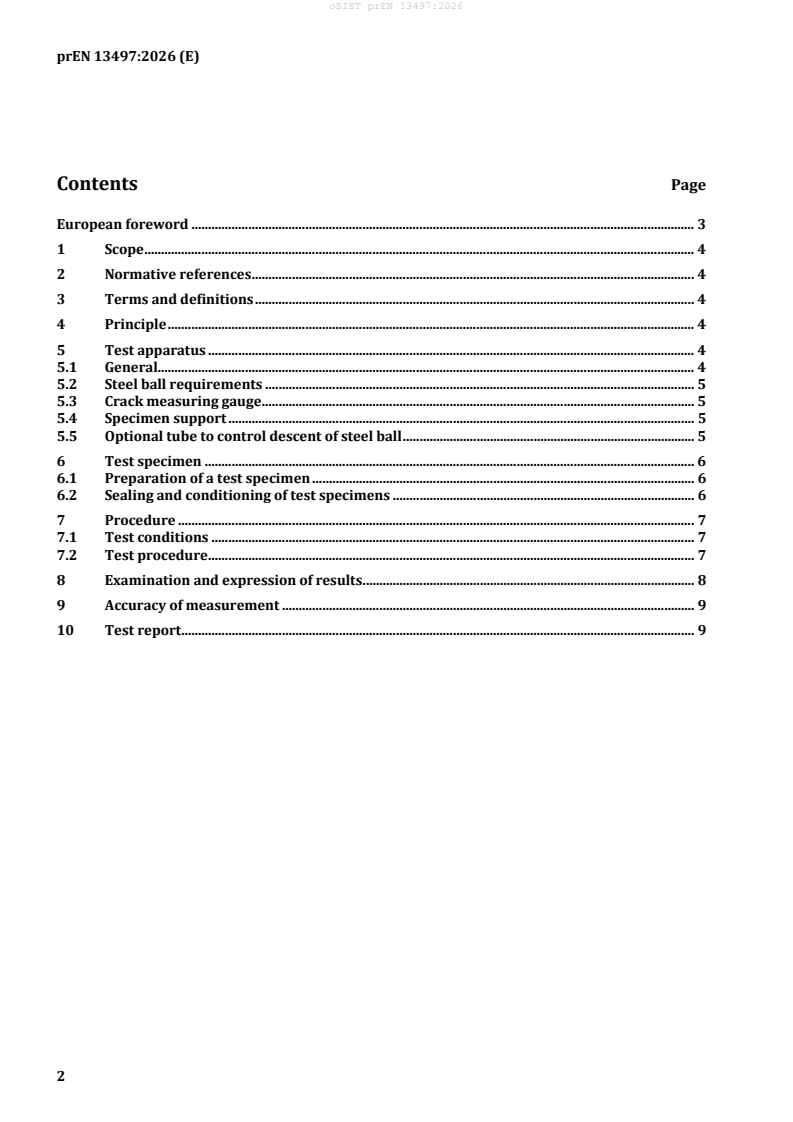
Contents Page
European foreword . 3
1 Scope . 4
2 Normative references . 4
3 Terms and definitions . 4
4 Principle . 4
5 Test apparatus . 4
5.1 General. 4
5.2 Steel ball requirements . 5
5.3 Crack measuring gauge . 5
5.4 Specimen support . 5
5.5 Optional tube to control descent of steel ball . 5
6 Test specimen . 6
6.1 Preparation of a test specimen . 6
6.2 Sealing and conditioning of test specimens . 6
7 Procedure . 7
7.1 Test conditions . 7
7.2 Test procedure . 7
8 Examination and expression of results . 8
9 Accuracy of measurement . 9
10 Test report . 9
European foreword
This document (prEN 13497:2026) has been prepared by Technical Committee CEN/TC 88 “Thermal
insulating materials and products”, the secretariat of which is held by DIN.
This document is currently submitted to the CEN Enquiry.
This document will supersede EN 13497:2018+A1:2021.
EN 13497:2018+A1:2021:
— subclause 7.2 and Clause 8 were revised;
— Figure 3 was included in Clause 8;
— the document was revised editorially.
This document has been drafted for applications in buildings, but can also be used in other areas where
it is relevant.
Any feedback and questions on this document should be directed to the users’ national standards body.
A complete listing of these bodies can be found on the CEN website.
1 Scope
This document specifies the equipment and procedure for determining the resistance to impact of ETICS
kits with renders.
2 Normative references
The following documents are referred to in the text in such a way that some or all of their content
constitutes requirements of this document. For dated references, only the edition cited applies. For
undated references, the latest edition of the referenced document (including any amendments) applies.
EN 1607, Thermal insulating products for building applications — Determination of tensile strength
perpendicular to faces
EN 16383, Thermal insulation products for building applications — Determination of the hygrothermal
behaviour of external thermal insulation composite kits with a rendering system (ETICS kits)
EN 17237, Thermal insulation products for buildings — External thermal insulation composite systems
with renders (ETICS) —Specification
EN ISO 9229, Thermal insulation — Vocabulary (ISO 9229)
EN ISO 29470, Thermal insulating products for building applications — Determination of the apparent
density (ISO 29470)
ISO 3290-1, Rolling bearings — Balls — Part 1: Steel balls
3 Terms and definitions
For the purposes of this document, the terms and definitions given in EN ISO 9229 and EN 17237 apply.
ISO and IEC maintain terminology databases for use in standardization at the following addresses:
— ISO Online browsing platform: available at https://www.iso.org/obp/
— IEC Electropedia: available at https://www.electropedia.org/
4 Principle
The impact resistance of an ETICS kit is the hard body impact resistance, determined by means of a steel
ball falling onto the surface of the kit. The energy level and corresponding dropping height is selected
from Table 1. Any damages occurring are visibly assessed (e.g. the reinforcement has become visible from
the external surface, the finishing coat or the rendering system has visibly delaminated or been
perforated) and cracks widths are measured.
5 Test apparatus
5.1 General
For the test a steel ball is dropped from a specified height onto the surface of the test specimen (see
Table 1). A second impact (rebound) by the ball shall be avoided.
To be published. Stage at the time of publication: prEN 17237:2018.
5.2 Steel ball requirements
Balls made of cutlery grade steel, AISI/SE Type 440 C and grade G100 according to ISO 3290-1 with the
weights and nominal diameters given in Table 1.
5.3 Crack measuring gauge
For measurement of the width of any cracks formed as a result of the impact of the steel ball onto the
surface of the test specimen. The gauge shall be capable measuring from 0,05 mm and b
...