

SIST EN 60749-1:2004
(Main)Semiconductor devices - Mechanical and climatic test methods -- Part 1: General
- Abstract
Applicable to semiconductor devices (discrete devices and integrated circuits) and establishes provisions common to all the other parts of the series.
- Status
- Published
- Publication Date
- 30-Jun-2004
- Technical Committee
- I11 - Imaginarni 11
- Current Stage
- 6060 - National Implementation/Publication (Adopted Project)
- Start Date
- 01-Jul-2004
- Due Date
- 01-Jul-2004
- Completion Date
- 01-Jul-2004



SIST EN 60749-1:2004 is the Slovenian adoption of EN 60749-1, based on IEC 60749-1:2002, for semiconductor devices. It sets the general rules used with the mechanical and climatic test methods in the EN 60749 series, so readers can apply the same test conditions and measurement practices to discrete devices and integrated circuits.
What does SIST EN 60749-1:2004 specify?
SIST EN 60749-1:2004 specifies the common provisions that apply across the other parts of the EN 60749 series. It is the general part for mechanical and climatic test methods for semiconductor devices, and it is intended to be used together with the specific test-method parts.
The document applies to:
- discrete semiconductor devices
- integrated circuits
It is organized into these main clauses:
- Clause 1 - Scope
- Clause 2 - Normative references
- Clause 3 - Terms, definitions and letter symbols
- Clause 4 - Standard atmospheric conditions
- Clause 5 - Electrical measurements
- Clause 6 - Use of electrically defective devices
It also includes:
- Annex A - Cross-references index
- Annex ZA - Normative references to international publications with corresponding European publications
| Annex | What it covers |
|---|---|
| Annex A | Cross-references from IEC 60749-1 to the individual EN 60749 test-method parts |
| Annex ZA | Normative references and their European publication equivalents |
What are the key requirements of SIST EN 60749-1:2004?
SIST EN 60749-1:2004 mainly sets the conditions under which environmental tests and related measurements are carried out, so the later test parts can be applied consistently.
Standard atmospheric conditions
Clause 4 states the atmospheric conditions for tests and recoveries, unless a specific method says otherwise. This matters because temperature, humidity and air pressure can affect device behaviour and test repeatability.
For electrical measurements, and for recoveries followed by measurements, Clause 4 uses a narrower ambient range than general testing. The specimens must also be allowed to reach temperature equilibrium before measurement, and the ambient temperature during measurement has to be recorded in the test report. In practice, this means the lab must control the room and document the actual measurement environment.
Clause 4 also says the devices should not be exposed to draughts, illumination or other influences that could introduce error. That helps prevent unstable readings and inconsistent results between test runs.
Electrical measurements
Clause 5 ties the measured characteristics to the relevant part of IEC 60747 or IEC 60748, specifically to the acceptance and reliability provisions for the device category. In practice, you do not choose arbitrary parameters - you check the characteristics that the companion device standard assigns to that category.
Clause 5 also points to the table of conditions for endurance tests in the relevant IEC 60747 or IEC 60748 part. That means the actual measurement setup is not defined here in detail, but is taken from the device-specific standard.
For initial measurements, the manufacturer may decide not to perform them when only upper and/or lower specification limits are used as criteria. When individual device values are the criterion, initial measurements are required. This matters for quality planning because it affects whether a test starts with a full baseline check.
Final measurements are required at the end of a test sequence when the test is part of a sub-group in a relevant specification. That keeps multi-step environmental test programs aligned with the intended acceptance flow.
Use of electrically defective devices
Clause 6 allows electrically defective devices to be used for certain tests, such as solderability or lead fatigue. In practice, that avoids wasting good parts on tests where electrical functionality is not the point of the test.
What terms does SIST EN 60749-1:2004 define?
SIST EN 60749-1:2004 relies on the terms and letter symbols used in IEC 60747 and IEC 60748, and for general terminology it refers to the IEC 60050 series.
- Standard atmospheric conditions - The defined temperature, humidity and air-pressure ranges used for tests and measurements.
- Electrical measurements - The checks made on device characteristics before, during or after environmental testing.
- Initial measurements - Measurements taken before a test, when the applicable specification requires a baseline.
- Final measurements - Measurements taken after the test sequence, when the method or specification calls for end-of-sequence verification.
- Acceptance and reliability - The clause in the relevant device standard that identifies which characteristics must be checked.
- Procurement specification - The buying specification that governs when it conflicts with this standard.
- Discrete devices - Separate semiconductor components covered by the standard.
- Integrated circuits - Semiconductor circuits covered by the standard.
Who uses SIST EN 60749-1:2004?
SIST EN 60749-1:2004 is used by semiconductor manufacturers, reliability laboratories, test engineers and quality teams that run mechanical or climatic qualification and verification tests. It is also relevant to buyers and procurement specialists who need to specify which test basis applies to a device order. The standard is used when writing test plans, choosing measurement conditions, and deciding how to report environmental test results.
What changed in SIST EN 60749-1:2004 from the previous edition?
SIST EN 60749-1:2004 belongs to the EN 60749 series that supersedes EN 60749:1999 plus its amendments. The earlier standard grouped the test methods in one document, while this series splits them into separate stand-alone parts with sequential numbering and independent updating.
Which standards are used with SIST EN 60749-1:2004?
SIST EN 60749-1:2004 refers to these companion standards:
- IEC 60050 (all parts) - provides the International Electrotechnical Vocabulary used for general terminology.
- IEC 60747 (all parts) - provides the discrete-device standard family, including acceptance and reliability provisions and measurement conditions.
- IEC 60748 (all parts) - provides the integrated-circuit standard family, including acceptance and reliability provisions and measurement conditions.
What does the SIST EN 60749-1:2004 document contain?
SIST EN 60749-1:2004 contains the general framework for the EN 60749 test-method series. It sets the environmental conditions for testing and measurements, links electrical checks to the relevant device standards, and explains when initial, monitored and final measurements are used.
Annex A gives a cross-reference index from this general part to the individual EN 60749 test-method parts. Annex ZA lists the normative international publications and their European equivalents, which helps users identify the referenced companion standards when applying the document in practice.
Relations
- Effective Date
- 07-Jun-2022
- Effective Date
- 09-Feb-2026
- Refers
SIST EN 849:1999 - Transportable gas cylinders - Cylinder valves - Specification and type testing - Effective Date
- 09-Feb-2026
- Effective Date
- 03-Feb-2026
- Effective Date
- 03-Feb-2026
- Effective Date
- 03-Feb-2026
- Effective Date
- 03-Feb-2026
- Effective Date
- 03-Feb-2026
- Effective Date
- 03-Feb-2026
- Effective Date
- 13-May-2010
Frequently Asked Questions
SIST EN 60749-1:2004 is a standard published by the Slovenian Institute for Standardization (SIST). Its full title is "Semiconductor devices - Mechanical and climatic test methods -- Part 1: General". This standard covers: Applicable to semiconductor devices (discrete devices and integrated circuits) and establishes provisions common to all the other parts of the series.
Applicable to semiconductor devices (discrete devices and integrated circuits) and establishes provisions common to all the other parts of the series.
SIST EN 60749-1:2004 is classified under the following ICS (International Classification for Standards) categories: 31.080.01 - Semiconductor devices in general. The ICS classification helps identify the subject area and facilitates finding related standards.
SIST EN 60749-1:2004 has the following relationships with other standards: It is inter standard links to SIST EN 60749:2002 + A1:2002, SIST EN 12228:2003, SIST EN 849:1999, SIST EN 62047-4:2010, SIST EN 62572-3:2012, SIST EN 61760-1:2006, SIST EN 61760-2:2007, SIST EN 62149-2:2009, SIST EN 61804-4:2016, SIST EN 60749:2002 + A1:2002. Understanding these relationships helps ensure you are using the most current and applicable version of the standard.
SIST EN 60749-1:2004 is available in PDF format for immediate download after purchase. The document can be added to your cart and obtained through the secure checkout process. Digital delivery ensures instant access to the complete standard document.
Standards Content (Sample)
SLOVENSKI SIST EN 60749-1:2004
STANDARD
julij 2004
Semiconductor devices - Mechanical and climatic test methods - Part 1: General
(IEC 60749-1:2002)
ICS 31.080.01 Referenčna številka
© Standard je založil in izdal Slovenski inštitut za standardizacijo. Razmnoževanje ali kopiranje celote ali delov tega dokumenta ni dovoljeno
EUROPEAN STANDARD EN 60749-1
NORME EUROPÉENNE
EUROPÄISCHE NORM June 2003
ICS 31.080.01 Supersedes EN 60749:1999 + A1:2000 + A2:2001
English version
Semiconductor devices -
Mechanical and climatic test methods
Part 1: General
(IEC 60749-1:2002)
Dispositifs à semiconducteurs - Halbleiterbauelemente -
Méthodes d'essais mécaniques Mechanische und klimatische Prüfverfahren
et climatiques Teil 1: Allgemeines
Partie 1: Généralités (IEC 60749-1:2002)
(CEI 60749-1:2002)
This European Standard was approved by CENELEC on 2002-09-24. CENELEC members are bound to
comply with the CEN/CENELEC Internal Regulations which stipulate the conditions for giving this European
Standard the status of a national standard without any alteration.
Up-to-date lists and bibliographical references concerning such national standards may be obtained on
application to the Central Secretariat or to any CENELEC member.
This European Standard exists in three official versions (English, French, German). A version in any other
language made by translation under the responsibility of a CENELEC member into its own language and
notified to the Central Secretariat has the same status as the official versions.
CENELEC members are the national electrotechnical committees of Austria, Belgium, Czech Republic,
Denmark, Finland, France, Germany, Greece, Hungary, Iceland, Ireland, Italy, Luxembourg, Malta,
Netherlands, Norway, Portugal, Slovakia, Spain, Sweden, Switzerland and United Kingdom.
CENELEC
European Committee for Electrotechnical Standardization
Comité Européen de Normalisation Electrotechnique
Europäisches Komitee für Elektrotechnische Normung
Central Secretariat: rue de Stassart 35, B - 1050 Brussels
© 2003 CENELEC - All rights of exploitation in any form and by any means reserved worldwide for CENELEC members.
Ref. No. EN 60749-1:2003 E
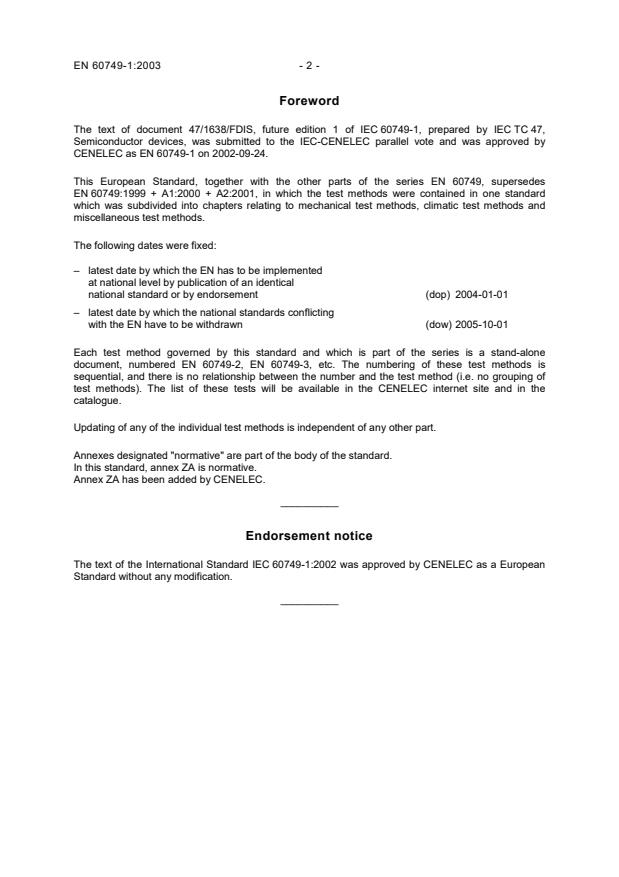
Foreword
The text of document 47/1638/FDIS, future edition 1 of IEC 60749-1, prepared by IEC TC 47,
Semiconductor devices, was submitted to the IEC-CENELEC parallel vote and was approved by
CENELEC as EN 60749-1 on 2002-09-24.
This European Standard, together with the other parts of the series EN 60749, supersedes
EN 60749:1999 + A1:2000 + A2:2001, in which the test methods were contained in one standard
which was subdivided into chapters relating to mechanical test methods, climatic test methods and
miscellaneous test methods.
The following dates were fixed:
– latest date by which the EN has to be implemented
at national level by publication of an identical
national standard or by endorsement (dop) 2004-01-01
– latest date by which the national standards conflicting
with the EN have to be withdrawn (dow) 2005-10-01
Each test method governed by this standard and which is part of the series is a stand-alone
document, numbered EN 60749-2, EN 60749-3, etc. The numbering of these test methods is
sequential, and there is no relationship between the number and the test method (i.e. no grouping of
test methods). The list of these tests will be available in the CENELEC internet site and in the
catalogue.
Updating of any of the individual test methods is independent of any other part.
Annexes designated "normative" are part of the body of the standard.
In this standard, annex ZA is normative.
Annex ZA has been added by CENELEC.
__________
Endorsement notice
The text of the International Standard IEC 60749-1:2002 was approved by CENELEC as a European
Standard without any modification.
__________
- 3 - EN 60749-1:2003
Annex ZA
(normative)
Normative references to international publications
with their corresponding European publications
This European Standard incorporates by dated or undated reference, provisions from other
publications. These normative references are cited at the appropriate places in the text and the
publications are listed hereafter. For dated references, subsequent amendments to or revisions of any
of these publications apply to this European Standard only when incorporated in it by amendment or
revision. For undated references the latest edition of the publication referred to applies (including
amendments).
NOTE When an international publication has been modified by common modifications, indicated by (mod), the relevant
EN/HD applies.
Publication Year Title EN/HD Year
IEC 60050 Series International Electrotechnical - -
Vocabulary (IEV)
IEC 60747 Series Semiconductor devices - Discrete EN 60747 Series
devices
IEC 60748 Series Semiconductor devices - Integrated - -
circuits
NORME CEI
INTERNATIONALE IEC
60749-1
INTERNATIONAL
Première édition
STANDARD
First edition
2002-08
Dispositifs à semiconducteurs –
Méthodes d'essais mécaniques et climatiques –
Partie 1:
Généralités
Semiconductor devices –
Mechanical and climatic test methods –
Part 1:
General
IEC 2002 Droits de reproduction réservés Copyright - all rights reserved
Aucune partie de cette publication ne peut être reproduite ni No part of this publication may be reproduced or utilized in any
utilisée sous quelque forme que ce soit et par aucun procédé, form or by any means, electronic or mechanical, including
électronique ou mécanique, y compris la photocopie et les photocopying and microfilm, without permission in writing from
microfilms, sans l'accord écrit de l'éditeur. the publisher.
International Electrotechnical Commission, 3, rue de Varembé, PO Box 131, CH-1211 Geneva 20, Switzerland
Telephone: +41 22 919 02 11 Telefax: +41 22 919 03 00 E-mail: inmail@iec.ch Web: www.iec.ch
CODE PRIX
H
Commission Electrotechnique Internationale PRICE CODE
International Electrotechnical Commission
Международная Электротехническая Комиссия
Pour prix, voir catalogue en vigueur
For price, see current catalogue
60749-1 © IEC:2002 – 3 –
CONTENTS
FOREWORD . 5
INTRODUCTION .9
1 Scope .11
2 Normative references.11
3 Terms, definitions and letter symbols.11
4 Standard atmospheric conditions .11
5 Electrical measurements.13
6 Use of electrically defective devices .13
60749-1 © IEC:2002 – 5 –
INTERNATIONAL ELECTROTECHNICAL COMMISSION
____________
SEMICONDUCTOR DEVICES –
MECHANICAL AND CLIMATIC TEST METHODS –
Part 1: General
FOREWORD
1) The IEC (International Electrotechnical Commission) is a worldwide organization for standardization comprising
all national electrotechnical committees (IEC National Committees). The object of the IEC is to promote
international co-operation on all questions concerning standardization in the electrical and electronic fields. To
this end and in addition to other activities, the IEC publishes International Standards. Their preparation is
entrusted to technical committees; any IEC National Committee interested in the subject dealt with may
participate in this preparatory work. International, governmental and non-governmental organizations liaising
with the IEC also participate in this preparation. The IEC collaborates closely with the International
Organization for Standardization (ISO) in accordance with conditions determined by agreement between the
two organizations.
2) The formal decisions or agreements of the IEC on technical matters express, as
...