Furniture - Ranked seating - Requirements for safety, strength and durability

This European Standard specifies requirements determining the safety, structural strength and durability of all types of seating that are permanently fastened to the floor and/or wall, whether in bench or individual seat form.
This standard does not apply to linked seating not fastened to the floor and/or walls and street furniture.
It does not include requirements for resistance to ageing, degradation, flammability, the effect of ambient temperature and the durability of upholstery materials.
The standard has two annexes:
-   Annex A (normative) Additional test methods;
-   Annex B (informative) Test severity in relation to application.

Möbel - Festmontiertes Reihengestühl - Anforderungen an die Sicherheit, Festigkeit und Dauerhaltbarkeit

Diese Europäische Norm legt Anforderungen zur Bestimmung der Sicherheit, der Festigkeit der Konstruktion und der Dauerhaltbarkeit aller Arten von Gestühl fest, die dauerhaft am Boden und/oder an der Wand befestigt sind, ob als Sitzreihenbank oder als Einzelsitz.
Diese Norm gilt nicht für eine Reihenbestuhlung, die nicht am Boden und/oder an Wänden befestigt ist, und nicht für Straßenmöbel.
Sie enthält keine Anforderungen an die Alterungsbeständigkeit, Verwitterung, Entflammbarkeit, Einfluss der Umgebungstemperatur und die Dauerhaltbarkeit von Polstermaterialien.
Diese Norm enthält zwei Anhänge:
-   Anhang A (normativ) Zusätzliche Prüfverfahren;
-   Anhang B (informativ) Prüfstufe in Bezug auf den Anwendungsbereich.

Ameublement - Sièges en rangées - Exigences de sécurité, de résistance et de durabilité

La présente Norme européenne fixe les exigences relatives à la détermination de la sécurité, de la résistance et de la durabilité de la structure de tous les types de sièges qui sont fixés de façon permanente au sol et/ou au mur, soit en banquettes, soit individuellement.
La présente Norme ne s'applique pas aux sièges assemblés entre eux non fixés au sol et/ou au mur, ni au mobilier urbain.
Elle n'inclut pas d'exigences relatives à la résistance au vieillissement, à la dégradation, à l'inflammabilité ou aux effets dus à la température ambiante, ni d'exigences relatives à la durabilité des matériaux de rembourrage.
La norme comporte deux annexes :
-   Annexe A (normative) Méthodes d'essai complémentaires ;
-   Annexe B (informative) Niveaux d'essai en fonction de l’usage.

Pohištvo - Vrstni sedeži - Zahteve za varnost, trdnost in trajnost

Ta evropski standard določa preskusne metode in zahteve za določanje strukturne trdnosti in trajnosti vseh vrst vrstnih sedežev (npr. sedeži na stadionih in v dvoranah), ki so trajno pritrjeni v tla in/ali stene, in sicer kot klopi ali posamezni sedeži. Priložena je tabela preskusov s štirimi obremenitvami. Ta standard se uporablja za trajno pritrjene sedeže v vrstah, vendar se ne uporablja za povezane pokončne sedeže, ki niso pritrjeni v tla in/ali stene. Ugotavljanje staranja, razgradnje in učinka izpostavljenosti okoljskim temperaturam ni vključeno.

General Information

Status
Published
Public Enquiry End Date
30-Apr-2014
Publication Date
19-Feb-2017
Technical Committee
POH - Furniture
Current Stage
6060 - National Implementation/Publication (Adopted Project)
Start Date
02-Feb-2017
Due Date
09-Apr-2017
Completion Date
20-Feb-2017

Relations

Effective Date
01-Mar-2017

Overview

EN 12727:2016 - published by CEN - sets European requirements for the safety, structural strength and durability of ranked seating that is permanently fastened to the floor and/or wall (bench or individual-seat installations). The standard covers design safeguards, test regimes and documentation for fixed seating used in public and institutional buildings. It excludes linked seating not fixed to floor/walls, street furniture, and does not address ageing, flammability, ambient temperature effects or upholstery material durability.

Key Topics and Requirements

  • Scope and applicability
    • Applies to fixed ranked seating; bench or individual seats permanently fastened to floor and/or wall.
    • Excludes linked non-fixed seating and street furniture.
  • Safety design
    • Minimize injury risks: rounded/chamfered accessible edges, no burrs or sharp edges, capped ends of hollow components where required.
    • Movable/adjustable parts must prevent inadvertent operation and user injury.
    • No unintended loosening of load-bearing parts; lubricated parts must prevent user staining.
  • Shear and squeeze point control
    • Defines accessible parts and prohibited shear/squeeze gaps (critical ranges) during normal use and when powered mechanisms are present.
    • Some shear/squeeze points during setting up/folding are acceptable if user control is assumed.
  • Strength and durability testing
    • Test methods reference EN 1728:2012 (seating test methods).
    • Includes a structured test sequence: static loads (seat, seat front edge, back rest), combined seat/back durability, impact tests (seat, back, armrests), armrest load and durability, tipping seat operation, and auxiliary writing surface tests.
    • Test severity is defined in four levels (1–4) with specified loads and cycle counts.
  • Documentation
    • Required user information (intended use, assembly, maintenance) in local language.
    • Test report content requirements (reference to standard, tested specimen, observed defects, results, test severity, facility, date).

Practical Applications

EN 12727:2016 is intended for fixed seating installations in:

  • Theatres, concert halls, cinemas and auditoria
  • Stadiums and sports halls
  • Airports and transport terminals
  • Educational institutions (lecture halls, colleges)
  • Places of worship, courtrooms and lecture rooms

Use the standard to verify durability and safety before procurement, installation or certification of fixed seating.

Who uses this standard

  • Seating manufacturers and designers (product development, compliance)
  • Test laboratories and certification bodies (type and endurance testing)
  • Architects, specifiers and procurement officers (technical requirements and selection)
  • Facility managers and safety engineers (maintenance and lifecycle planning)

Related standards

  • Normative reference: EN 1728:2012 - Furniture - Seating - Test methods for the determination of strength and durability
  • EN 12727 includes Annex A (normative additional test method for backrest forward durability) and Annex B (informative guidance on test severity by application).

Frequently Asked Questions

SIST EN 12727:2017 is a standard published by the Slovenian Institute for Standardization (SIST). Its full title is "Furniture - Ranked seating - Requirements for safety, strength and durability". This standard covers: This European Standard specifies requirements determining the safety, structural strength and durability of all types of seating that are permanently fastened to the floor and/or wall, whether in bench or individual seat form. This standard does not apply to linked seating not fastened to the floor and/or walls and street furniture. It does not include requirements for resistance to ageing, degradation, flammability, the effect of ambient temperature and the durability of upholstery materials. The standard has two annexes: - Annex A (normative) Additional test methods; - Annex B (informative) Test severity in relation to application.

This European Standard specifies requirements determining the safety, structural strength and durability of all types of seating that are permanently fastened to the floor and/or wall, whether in bench or individual seat form. This standard does not apply to linked seating not fastened to the floor and/or walls and street furniture. It does not include requirements for resistance to ageing, degradation, flammability, the effect of ambient temperature and the durability of upholstery materials. The standard has two annexes: - Annex A (normative) Additional test methods; - Annex B (informative) Test severity in relation to application.

SIST EN 12727:2017 is classified under the following ICS (International Classification for Standards) categories: 97.140 - Furniture. The ICS classification helps identify the subject area and facilitates finding related standards.

SIST EN 12727:2017 has the following relationships with other standards: It is inter standard links to SIST EN 12727:2001. Understanding these relationships helps ensure you are using the most current and applicable version of the standard.

You can purchase SIST EN 12727:2017 directly from iTeh Standards. The document is available in PDF format and is delivered instantly after payment. Add the standard to your cart and complete the secure checkout process. iTeh Standards is an authorized distributor of SIST standards.

Standards Content (Sample)


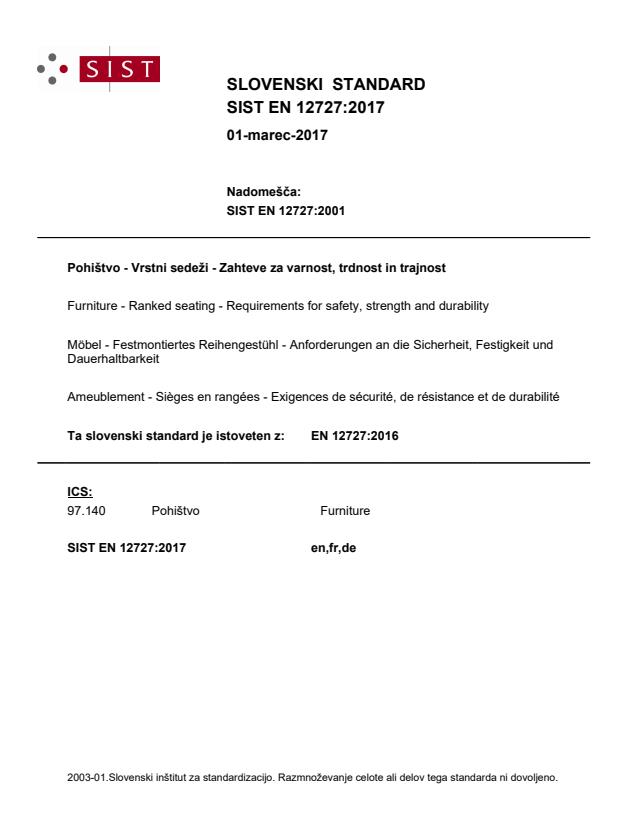
2003-01.Slovenski inštitut za standardizacijo. Razmnoževanje celote ali delov tega standarda ni dovoljeno.Pohištvo - Vrstni sedeži - Zahteve za varnost, trdnost in trajnostMöbel - Festmontiertes Reihengestühl - Anforderungen an die Sicherheit, Festigkeit und DauerhaltbarkeitAmeublement - Sièges en rangées - Exigences de sécurité, de résistance et de durabilitéFurniture - Ranked seating - Requirements for safety, strength and durability97.140PohištvoFurnitureICS:Ta slovenski standard je istoveten z:EN 12727:2016SIST EN 12727:2017en,fr,de01-marec-2017SIST EN 12727:2017SLOVENSKI
STANDARDSIST EN 12727:20011DGRPHãþD

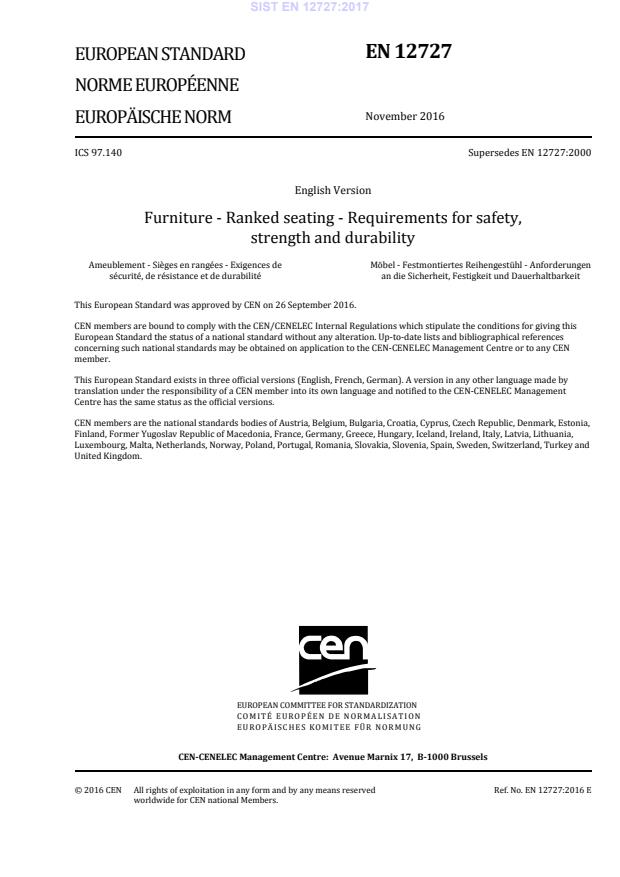
EUROPEAN STANDARD NORME EUROPÉENNE EUROPÄISCHE NORM
EN 12727
November
t r s x ICS
{ yä s v r Supersedes EN
s t y t yã t r r rEnglish Version
Furniture æ Ranked seating æ Requirements for safetyá strength and durability Ameublement æ Sièges en rangées æ Exigences de sécuritéá de résistance et de durabilité
Möbel æ Festmontiertes Reihengestühl æ Anforderungen an die Sicherheitá Festigkeit und Dauerhaltbarkeit This European Standard was approved by CEN on
t x September
t r s xä
egulations which stipulate the conditions for giving this European Standard the status of a national standard without any alterationä Upætoædate lists and bibliographical references concerning such national standards may be obtained on application to the CENæCENELEC Management Centre or to any CEN memberä
translation under the responsibility of a CEN member into its own language and notified to the CENæCENELEC Management Centre has the same status as the official versionsä
CEN members are the national standards bodies of Austriaá Belgiumá Bulgariaá Croatiaá Cyprusá Czech Republicá Denmarká Estoniaá Finlandá Former Yugoslav Republic of Macedoniaá Franceá Germanyá Greeceá Hungaryá Icelandá Irelandá Italyá Latviaá Lithuaniaá Luxembourgá Maltaá Netherlandsá Norwayá Polandá Portugalá Romaniaá Slovakiaá Sloveniaá Spainá Swedená Switzerlandá Turkey andUnited Kingdomä
EUROPEAN COMMITTEE FOR STANDARDIZATION COMITÉ EUROPÉEN DE NORMALISATION EUROPÄISCHES KOMITEE FÜR NORMUNG
CEN-CENELEC Management Centre:
Avenue Marnix 17,
B-1000 Brussels
t r s x CEN All rights of exploitation in any form and by any means reserved worldwide for CEN national Membersä Refä Noä EN
s t y t yã t r s x ESIST EN 12727:2017

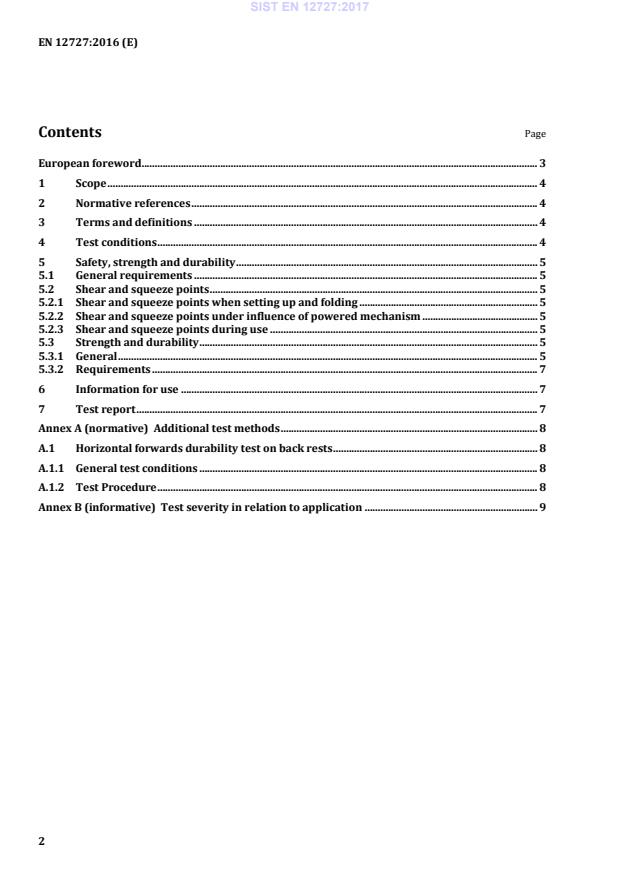
Additional test methods . 8 A.1 Horizontal forwards durability test on back rests . 8 A.1.1 General test conditions . 8 A.1.2 Test Procedure . 8 Annex B (informative)
Test severity in relation to application . 9
...

Questions, Comments and Discussion

Ask us and Technical Secretary will try to provide an answer. You can facilitate discussion about the standard in here.

Loading comments...

SIST EN 12727:2017 표준은 바닥 및/또는 벽에 영구적으로 고정된 모든 유형의 좌석에 대한 안전성, 구조적 강도 및 내구성을 결정하는 요구사항을 규정하고 있습니다. 이 표준은 벤치형 또는 개별 좌석 형태의 가구에 적용되며, 다양한 사용 환경에서의 신뢰성을 보장합니다. SIST EN 12727:2017의 강점 중 하나는 체계적인 안전 및 강도 요구사항을 제시함으로써, 소비자와 제조사 모두에게 명확한 기준을 제공한다는 점입니다. 이러한 표준화는 제품의 품질을 일관되게 유지하는 데 기여하며, 사용자가 안심하고 사용할 수 있는 환경을 조성합니다. 또한, 이 표준은 두 개의 부록을 포함하고 있어, 각각의 부록에서 추가적인 시험 방법과 자극의 심각성에 대한 정보를 제공합니다. 이러한 심도 있는 내용은 제조사가 제품의 설계를 맞춤화하거나 개선하는 데 실질적인 도움을 줍니다. SIST EN 12727:2017은 특정한 요구사항에 대한 실질적인 지침을 제공함으로써, 바닥에 고정된 좌석가구의 안전성과 내구성을 강화하는 데 필수적인 역할을 합니다. 따라서 이 표준은 해당 분야에서 매우 중요한 문서로 자리잡고 있으며, 실질적인 적용에 있어 높은 관련성을 지니고 있습니다.

La norme SIST EN 12727:2017 établit un cadre essentiel pour la sécurité, la résistance et la durabilité du mobilier, spécifiquement pour les sièges à fixation permanente au sol et/ou au mur, sous forme de bancs ou de sièges individuels. Cette norme européenne définit des exigences claires qui assurent non seulement la sécurité des utilisateurs, mais également la solidité structurelle des dispositifs de sièges, un aspect crucial dans des environnements publics et industriels. L'un des points forts de cette norme est son application à toutes les types de sièges fixés de manière permanente, ce qui en fait un document de référence fondamental pour les fabricants et les concepteurs de mobilier. En se concentrant sur la sécurité et la durabilité, la norme garantit une protection efficace dans des contextes d'utilisation variés, contribuant ainsi à minimiser les risques potentiels d'accidents. Un autre aspect significatif est la présence des annexes. L'Annexe A, qui propose des méthodes de test supplémentaires, présente un complément vital aux exigences principales, permettant d'évaluer la performance des sièges selon des critères diversifiés. L'Annexe B, qui est informative, fournit des précisions sur la sévérité des tests en rapport avec les applications spécifiques, ajoutant une dimension pratique à la mise en œuvre de la norme. Il est important de noter que cette norme ne couvre pas certains aspects, tels que la résistance au vieillissement, la dégradation, l'inflammabilité, ou encore l'effet de température ambiante sur les matériaux d'ameublement. Bien que cela puisse sembler une limite, cela permet de concentrer les efforts sur des exigences essentielles pour la sécurité et la durabilité des sièges fixés. En somme, la norme SIST EN 12727:2017 se révèle être un instrument précieux dans le secteur du mobilier, soulignant l'importance d'un cadre normatif rigoureux pour garantir la sécurité et la performance des sièges fixes, tout en répondant aux besoins variés des utilisateurs.

Die Norm SIST EN 12727:2017 legt umfassende Anforderungen für Sitzmöbel mit rangierter Sitzgelegenheit fest, die dauerhaft am Boden und/oder an Wänden befestigt sind. Diese europäische Norm ist von zentraler Bedeutung für Hersteller und Anbieter von Möbeln, da sie sicherstellt, dass diese Produkte sowohl in Bezug auf Sicherheit als auch auf strukturelle Festigkeit und Haltbarkeit den geforderten Standards entsprechen. Die Stärken dieser Norm liegen in ihrer klaren Definition des Anwendungsbereichs, der es ermöglicht, die Anforderungen spezifisch auf die verschiedenen Arten von Sitzgelegenheiten anzuwenden. Insbesondere wird durch die Festlegung von Anforderungen zur Sicherheit und Stabilität sichergestellt, dass Nutzer vor möglichen Gefahren geschützt sind. Die Norm umfasst sowohl Bänke als auch individuelle Sitzmöglichkeiten, was ihren Anwendungsbereich erheblich erweitert und eine Vielzahl von Umgebungen abdeckt, in denen solche Möbelstücke eingesetzt werden können. Die zusätzlichen Testmethoden im Anhang A bieten weiterführende Richtlinien zur Durchführung von Prüfungen, um die Sicherheit und Langlebigkeit dieser Produkte zu gewährleisten. Diese normativen zusätzlichen Testverfahren stärken die Kompetenz der Hersteller, Produkte zu entwickeln und anzubieten, die den europäischen Sicherheitsstandards entsprechen. Anhang B liefert informative Einblicke in die Testschwere in Relation zur Anwendung, was eine praxisnahe Orientierung für die Hersteller bietet. Eine wesentliche Relevanz der Norm ergibt sich aus der Tatsache, dass sie nicht nur für die Herstellung von Sitzmöbeln wichtig ist, sondern auch für deren Zulassung in öffentlichen und gewerblichen Einrichtungen. Dies fördert das Vertrauen der Verbraucher in die Sicherheit und Qualität von Möbeln, die in stark frequentierten Bereichen eingesetzt werden. Es ist jedoch zu beachten, dass die Norm nicht für verbundenes Mobiliar gilt, das nicht fest am Boden oder an den Wänden befestigt ist, noch schließt sie Anforderungen an die Beständigkeit gegen Alterung, Abbau, Entflammbarkeit, temperaturempfindliche Wirkungen oder die Haltbarkeit von Polstermaterialien ein. Diese Einschränkungen sollten in der Designsprache und -umsetzung berücksichtigt werden, um vollständige Transparenz für die Kunden zu gewährleisten. Insgesamt bietet die SIST EN 12727:2017 eine solide Grundlage für die Sicherheit, Festigkeit und Haltbarkeit von Sitzmöbeln und stellt sicher, dass alle relevanten Faktoren berücksichtigt werden, um sowohl Hersteller als auch Verbraucher bestmöglich zu unterstützen.

SIST EN 12727:2017は、家具に関する重要な欧州規格であり、ランク付き座席の安全性、構造的強度、および耐久性に関する要件を明確に定義しています。この標準は、床や壁に永続的に固定されているすべてのタイプの座席に適用されますが、ベンチ形式または個別の座席形式に限りません。具体的に述べると、この標準は、最終ユーザーに対して安全で耐久性のある家具を提供するための必須要件を網羅しています。 本規格の強みは、実際に使用される環境において座席の性能を保証するための具体的な基準を提供している点にあります。特に、構造的強度や耐久性に関する要件は、安全性を最優先に考慮して設計されており、使用者が安心して利用できる家具の設計・製造に寄与します。また、附属書Aにおいて提供される追加試験方法は、基準の信頼性を高め、さまざまな使用条件における製品性能を確認するための有用な手段です。 しかし、この標準は、床や壁に固定されていないリンク式座席や街の家具には適用されないことを明示しています。また、劣化、可燃性、環境温度の影響、裏地材料の耐久性に関する要件は含まれていないため、これらの側面に関しては他の規格や基準を参照する必要があります。この点を理解することが、製品開発において重要です。 全体として、SIST EN 12727:2017は、家具業界にとって価値のある規格であり、特にランク付き座席に関して安全性と耐久性を確保するための優れた基盤を提供しています。この標準は、製品の信頼性を確立するために必要不可欠な要素であり、使用者の期待に応えるための指針として機能します。

The SIST EN 12727:2017 standard is a significant document that provides comprehensive requirements for the safety, strength, and durability of ranked seating. Its scope is explicitly defined, applying to all types of seating that are permanently fastened to the floor and/or wall, whether in bench or individual seat formats. This clear delineation ensures that manufacturers, designers, and builders have a solid framework to follow when creating safe and durable seating solutions for various environments. One of the strengths of this standard lies in its rigorous approach to safety and structural integrity. By outlining specific requirements, the standard helps to mitigate risks associated with seating, ensuring that products can withstand the stresses and strains of daily use. This is especially crucial in public spaces, such as auditoriums, waiting areas, and educational institutions, where the safety of users is paramount. Moreover, the inclusion of two annexes adds depth to the standard. Annex A provides normative additional test methods that can be employed to evaluate the performance of seating, facilitating a more comprehensive assessment of strength and safety. Meanwhile, Annex B offers informative guidance on test severity in relation to application, which aids manufacturers in understanding how to tailor their products to the environments in which they will be used. While the standard does not address certain factors like resistance to ageing, degradation, flammability, the effects of ambient temperature, or the durability of upholstery materials, its focused approach allows for a more in-depth examination of critical concerns surrounding safety and structural resilience. This specialization makes the SIST EN 12727:2017 particularly relevant for stakeholders in the furniture industry who prioritize these aspects. Overall, SIST EN 12727:2017 serves as a valuable benchmark for evaluating ranked seating, making it an indispensable reference for ensuring compliance and enhancing product quality in a competitive marketplace. Its specific focus on safety, structural strength, and durability underscores the importance of these elements in the design and construction of permanent seating solutions.