

SIST EN 2046:2004
(Main)Aerospace series - Hexagonal bars, drawn in aluminium and aluminium alloys - Tolerance class h 11 - Width across flats 7 mm < a < 50 mm - Dimensions
- Abstract
This standard specifies the dimensions and tolerances of:
Hexagonal bars, drawn
in aluminium and aluminium alloys
Tolerance class h 11
Width across flats 7 mm < a < 50 mm
for aerospace applications.
- Status
- Published
- Publication Date
- 30-Apr-2004
- Technical Committee
- I08 - Imaginarni 08
- Current Stage
- 6060 - National Implementation/Publication (Adopted Project)
- Start Date
- 01-May-2004
- Due Date
- 01-May-2004
- Completion Date
- 01-May-2004

SIST EN 2046:2004 is a Slovenian standard for aerospace-series hexagonal bars drawn in aluminium and aluminium alloys. It specifies the dimensions and tolerances for bars with width across flats from 7 mm to 50 mm in tolerance class h 11, so users can order, make, and inspect the bars to a common geometry.
What does SIST EN 2046:2004 specify?
SIST EN 2046:2004 specifies the dimensional characteristics of drawn hexagonal bars for aerospace applications. In practice, it is the reference for the bar shape, the size range, the permitted deviations, and the way some geometric checks are handled.
The document is organized into a short set of clauses that move from scope to references, then to form, recommended dimensions and mass, and finally tolerances.
| Clause | Content |
|---|---|
| 1 | Scope |
| 2 | Normative references |
| 3 | Form |
| 4 | Recommended dimensions and mass |
| 5 | Tolerances |
Figure 1 shows the hexagonal form. Tables 1 to 6 then give the dimensional data, mass information, and tolerance values used for ordering and inspection.
What are the key requirements of SIST EN 2046:2004?
SIST EN 2046:2004 sets out the bar geometry first, then the size-related data and tolerance checks. For a buyer or quality manager, the practical point is that the standard gives the minimum information needed to specify the product and verify conformance.
Form and size range
Clause 3 refers to Figure 1 for the hexagonal form, and the scope limits the bars to width across flats from 7 mm to 50 mm. That tells the supplier and inspector exactly which product family is covered.
Clause 4.1 links nominal width across flats to linear mass in Table 1. The table is useful when estimating stock weight, transport load, or machining allowance.
Clause 4.2 says the order shall state whether bars are supplied in fixed lengths or random lengths. If random lengths are ordered, the minimum and maximum lengths have to be specified on the order, which matters for cutting plans and stock control.
Dimensional tolerances
Clause 5.1.1 gives the tolerance class for width across flats in Table 2. This is the main size-control requirement, because the hexagon has to fit the intended application and processing route.
Clause 5.1.2 gives length tolerances for bars supplied in fixed lengths in Table 3. In practice, this is what the receiving inspection team uses to decide whether delivered bars are within the ordered cut length.
Clause 5.1.3 gives corner radii in Table 4. This matters because corner shape affects fit, appearance, and downstream machining.
Geometric tolerances and measurement
Clause 5.2.1 covers straightness. The measurement method and symbols are taken from EN 3848, and Table 5 gives the tolerance values. For users, that means straightness is controlled using the same aerospace measurement approach as other semi-finished metallic products.
Clause 5.2.2 covers twist. Again, EN 3848 provides the method and symbol, and Table 6 gives the tolerance values. This is important when the bar must be aligned, machined, or used where rotational deviation matters.
Clause 5.2.3 states that surface flatness is included in the width across flats tolerance, with the measurement method also taken from EN 3848. That means flat-face quality is checked as part of the size control rather than as a separate acceptance item.
What terms does SIST EN 2046:2004 define?
SIST EN 2046:2004 uses a small set of technical terms that are central to ordering and inspection.
- Width across flats - the distance across the opposite flat faces of the hexagonal bar.
- Tolerance class h 11 - the dimensional tolerance designation used for the width across flats.
- Linear mass - the mass of the bar per unit length, given for nominal sizes in Table 1.
- Straightness deviation - the allowed departure from a straight bar, measured in line with EN 3848.
- Twist - the rotational deviation along the length of the bar, also measured using EN 3848.
- Surface flatness - the flatness condition of the bar faces, treated as part of the width across flats tolerance.
Who uses SIST EN 2046:2004?
SIST EN 2046:2004 is used by aerospace material suppliers, manufacturers, purchasers, and inspection teams. It supports ordering, receiving inspection, dimensional verification, and product acceptance for drawn aluminium and aluminium-alloy hexagonal bars.
It is also relevant to quality managers who need a clear acceptance basis, and to engineers who need a standard bar geometry for design or machining.
What changed in SIST EN 2046:2004 from the previous edition?
SIST EN 2046:2004 is identified as identical to EN 2046:2001.
Which standards are used with SIST EN 2046:2004?
SIST EN 2046:2004 cites two normative references that support how the bar is measured and how the series is organized.
- EN 3848 - gives the method of measuring form deviations, including the symbols used for straightness and twist.
- EN 4258 - defines the general organization of aerospace metallic material standards and the links between standard types and their use.
What does the SIST EN 2046:2004 document contain?
SIST EN 2046:2004 contains one figure and six tables that carry the practical content of the standard. Figure 1 shows the hexagonal form, while Table 1 relates nominal width across flats to linear mass. Tables 2 to 6 cover the size tolerance, length tolerance, corner radii, straightness, and twist.
The document also states the measurement basis for straightness, twist, and surface flatness through EN 3848. That makes it useful for design specification, purchasing, and inspection planning, because the reader can see what to order and how it will be checked.
Relations
- Effective Date
- 28-Jan-2026
- Effective Date
- 28-Jan-2026
- Referred By
SIST EN 2319:2018 - Aerospace series - Aluminium alloy 2024- - T3510 - Drawn bar - a ≤ 75 mm - Effective Date
- 28-Jan-2026
- Effective Date
- 28-Jan-2026
- Effective Date
- 28-Jan-2026
Get Certified
Connect with accredited certification bodies for this standard

BUREAU VERITAS Certification Germany
Bureau Veritas certification in Germany.

Element Materials Technology
Materials testing and product certification.

AQMS Ltd.
AQMS provides ISO certification to SMEs across the UK.
Sponsored listings
Frequently Asked Questions
SIST EN 2046:2004 is a standard published by the Slovenian Institute for Standardization (SIST). Its full title is "Aerospace series - Hexagonal bars, drawn in aluminium and aluminium alloys - Tolerance class h 11 - Width across flats 7 mm < a < 50 mm - Dimensions". This standard covers: This standard specifies the dimensions and tolerances of: Hexagonal bars, drawn in aluminium and aluminium alloys Tolerance class h 11 Width across flats 7 mm < a < 50 mm for aerospace applications.
This standard specifies the dimensions and tolerances of: Hexagonal bars, drawn in aluminium and aluminium alloys Tolerance class h 11 Width across flats 7 mm < a < 50 mm for aerospace applications.
SIST EN 2046:2004 is classified under the following ICS (International Classification for Standards) categories: 49.025.20 - Aluminium. The ICS classification helps identify the subject area and facilitates finding related standards.
SIST EN 2046:2004 has the following relationships with other standards: It is inter standard links to SIST EN 3848:2002, SIST EN 4258:2024, SIST EN 2319:2018, SIST EN 2320:2019, SIST EN 2699:2019. Understanding these relationships helps ensure you are using the most current and applicable version of the standard.
SIST EN 2046:2004 is available in PDF format for immediate download after purchase. The document can be added to your cart and obtained through the secure checkout process. Digital delivery ensures instant access to the complete standard document.
Standards Content (Sample)
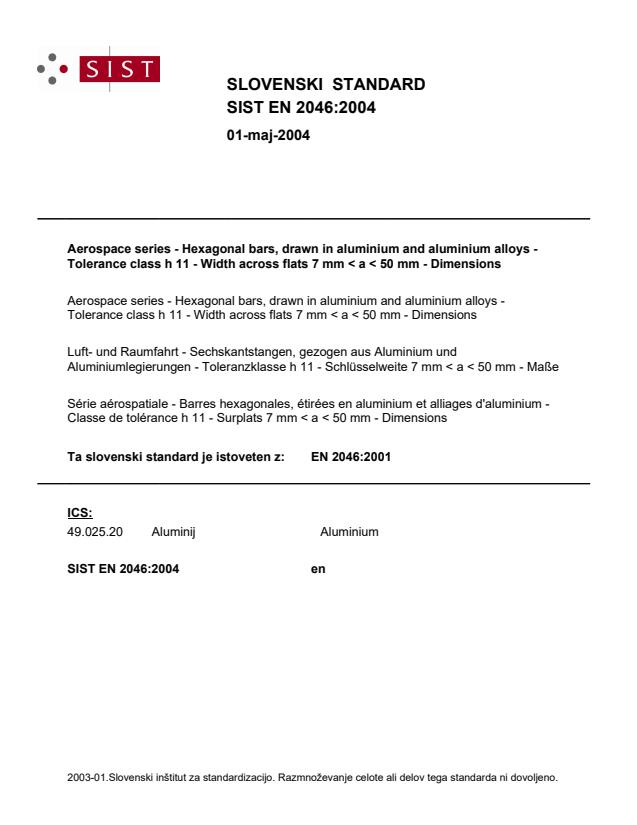
2003-01.Slovenski inštitut za standardizacijo. Razmnoževanje celote ali delov tega standarda ni dovoljeno.Aerospace series - Hexagonal bars, drawn in aluminium and aluminium alloys - Tolerance class h 11 - Width across flats 7 mm < a < 50 mm - DimensionsLuft- und Raumfahrt - Sechskantstangen, gezogen aus Aluminium und Aluminiumlegierungen - Toleranzklasse h 11 - Schlüsselweite 7 mm < a < 50 mm - MaßeSérie aérospatiale - Barres hexagonales, étirées en aluminium et alliages d'aluminium - Classe de tolérance h 11 - Surplats 7 mm < a < 50 mm - DimensionsAerospace series - Hexagonal bars, drawn in aluminium and aluminium alloys - Tolerance class h 11 - Width across flats 7 mm < a < 50 mm - Dimensions49.025.20AluminijAluminiumICS:Ta slovenski standard je istoveten z:EN 2046:2001SIST EN 2046:2004en01-maj-2004SIST EN 2046:2004SLOVENSKI
STANDARD
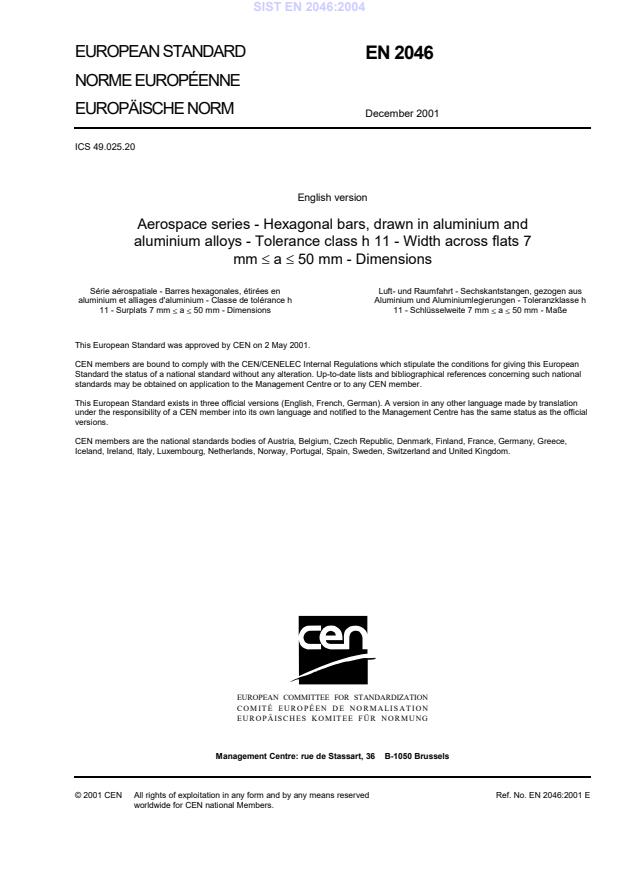
EUROPEAN STANDARDNORME EUROPÉENNEEUROPÄISCHE NORMEN 2046December 2001ICS 49.025.20English versionAerospace series - Hexagonal bars, drawn in aluminium andaluminium alloys - Tolerance class h 11 - Width across flats 7mm
a
50 mm - DimensionsSérie aérospatiale - Barres hexagonales, étirées enaluminium et alliages d'aluminium - Classe de tolérance h11 - Surplats 7 mm
a
50 mm - DimensionsLuft- und Raumfahrt - Sechskantstangen, gezogen ausAluminium und Aluminiumlegierungen - Toleranzklasse h11 - Schlüsselweite 7 mm
a
50 mm - MaßeThis European Standard was approved by CEN on 2 May 2001.CEN members are bound to comply with the CEN/CENELEC Internal Regulations which stipulate the conditions for giving this EuropeanStandard the status of a national standard without any alteration. Up-to-date lists and bibliographical references concerning such nationalstandards may be obtained on application to the Management Centre or to any CEN member.This European Standard exists in three official versions (English, French, German). A version in any other language made by translationunder the responsibility of a CEN member into its own language and notified to the Management Centre has the same status as the officialversions.CEN members are the national standards bodies of Austria, Belgium, Czech Republic, Denmark, Finland, France, Germany, Greece,Iceland, Ireland, Italy, Luxembourg, Netherlands, Norway, Portugal, Spain, Sweden, Switzerland and United Kingdom.EUROPEAN COMMITTEE FOR STANDARDIZATIONCOMITÉ EUROPÉEN DE NORMALISATIONEUROPÄISCHES KOMITEE FÜR NORMUNGManagement Centre: rue de Stassart, 36
B-1050 Brussels© 2001 CENAll rights of exploitation in any form and by any means reservedworldwide for CEN national Members.Ref. No. EN 2046:2001 ESIST EN 2046:2004
...