

SIST EN 299:2009
(Main)Oil pressure atomizing nozzles - Determination of the angle and spray characteristics
- Abstract
This European Standard specifies a method for the determination of the spray characteristic and the index angle of oil pressure atomizing nozzles.
- Status
- Published
- Publication Date
- 16-Nov-2009
- Technical Committee
- OGS - Heating for buildings
- Current Stage
- 6060 - National Implementation/Publication (Adopted Project)
- Start Date
- 08-Oct-2009
- Due Date
- 13-Dec-2009
- Completion Date
- 17-Nov-2009



SIST EN 299:2009 is the Slovenian standard identical to EN 299:2009, published as a European Standard by CEN. It specifies a test method for determining the spray characteristic and the index angle of oil pressure atomizing nozzles. The document is for engineers, laboratories, manufacturers, and buyers who need a repeatable way to describe nozzle spray pattern and spray angle.
What does SIST EN 299:2009 specify?
SIST EN 299:2009 specifies how to determine the spray characteristic and the index angle of oil pressure atomizing nozzles. In practice, that means it gives one agreed test method for comparing nozzles that may look similar in name but behave differently in spray distribution.
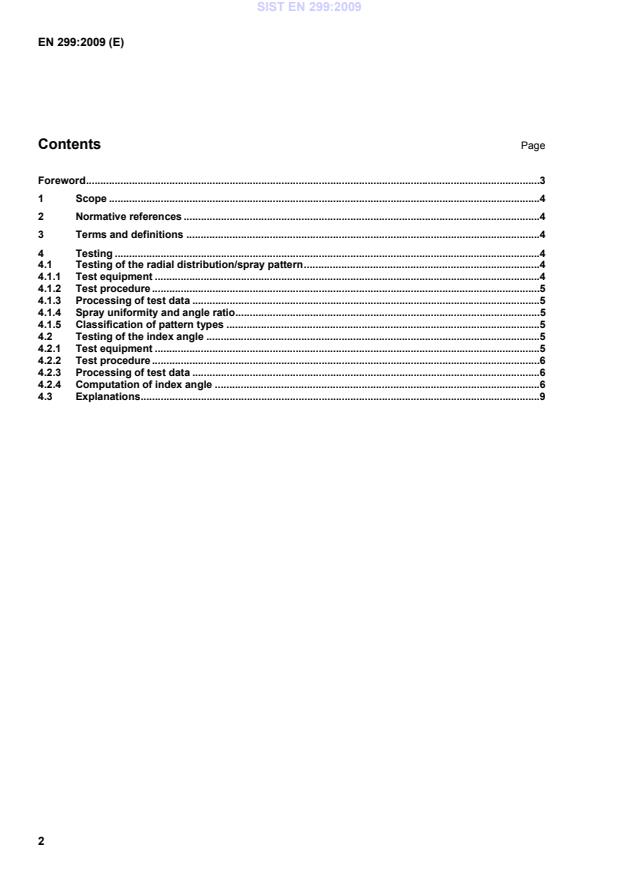
The document is organized into Scope, Normative references, Terms and definitions, and Testing. Clause 4 is the main technical part and is split into testing of the radial distribution/spray pattern and testing of the index angle, followed by explanations.
What are the key requirements of SIST EN 299:2009?
SIST EN 299:2009 focuses on a controlled spray test using a radial patternator and a reference oil. The key idea is to measure how liquid is distributed across the spray cone, then turn those measurements into a spray pattern classification and an index angle.
Test setup and operating conditions
Clause 4.1.1 specifies a radial patternator with 14 concentric dividers and graduated collection cylinders. The nozzle holder is vertically adjustable so the stated distance between the nozzle orifice and the divider edges can be maintained. In practice, this is what makes results comparable between tests and between laboratories.
Clause 4.1.2 requires the nozzle to be mounted with an axial distance of 50 mm and the test to be run with reference oil as specified by EN 293. Each test must atomize at least 80 ml, and enough liquid must be collected to give representative cylinder readings. This matters because too little collected liquid would make the distribution data unreliable.
Measuring the spray distribution
Clause 4.1.3 requires the collected liquid volumes to be recorded, tabulated, and converted into cumulative percentage volumes. The cumulative values are then related to the plane angles of the patternator compartments. In practice, this gives a radial profile of the spray that can be shown in tabular or graphical form.
Clause 4.1.4 uses the 50 % and 80 % cumulative volume angles to describe spray uniformity. Clause 4.1.5 classifies the spray pattern into four indices - I, II, III, and IV - from solid to hollow based on the 50 % / 80 % angle ratio. That helps users compare nozzles by pattern type, not only by nominal angle.
Determining the index angle
Clause 4.2 defines the index angle quantitatively as the 80 % angle. The angle is calculated by interpolation between the two patternator positions that bracket the chosen cumulative volume. This gives a reproducible result from measured data rather than from visual judgment.
Clause 4.2.1 to 4.2.3 point back to the same test equipment, procedure, and data processing used for spray distribution. The document also gives an example calculation and angle-marking ranges in Table 2, which helps users check whether the tested angle aligns with the marked angle.
What terms does SIST EN 299:2009 define?
- Radial spray distribution - the change in liquid flux from the nozzle axis to the edge of the conical spray pattern at a specified distance.
- Index angle - the Y plane angle of the conical spray, determined from a specified cumulative volume such as 80 %.
- Cumulative volume - the collected liquid volume expressed as a percentage of the total volume, moving outward from the spray axis.
- Radial patternator - the device with concentric annular compartments and collection cylinders used to measure spray distribution.
- Index - an arbitrary number used to group oil burner nozzles with similar spray patterns.
- Spray pattern - the practical form of the spray, described here as solid, semi-solid, semi-hollow, or hollow through the angle ratio.
Who uses SIST EN 299:2009?
SIST EN 299:2009 is used by manufacturers and test laboratories working on oil pressure atomizing nozzles and burner components. It is also relevant to quality control teams, technical purchasers, and design engineers who need to specify or verify spray behavior. The standard is especially useful in the liquid and solid fuel burners field, where nozzle pattern and angle affect burner performance and repeatability.
What changed in SIST EN 299:2009 from the previous edition?
SIST EN 299:2009 supersedes EN 299:1998. The main change stated in the document is that the test equipment in Figure 1 is now dimensioned.
Which standards are used with SIST EN 299:2009?
- EN 293 - provides the reference oil used in the test and is the normative reference for applying this document.
What does the SIST EN 299:2009 document contain?
The document contains a defined test method, a set of terms, a calculation method for the index angle, and a spray-pattern classification based on the 50 % / 80 % angle ratio. Figures 1 and 2 show the radial patternator and test arrangement, with dimensions given in millimetres. Table 1 classifies spray patterns, Table 2 links angle marking to tested angle ranges, and Table 3 gives an example of collected volumes, cumulative percentages, and plane angles.
Clause 4.3 explains why visual observation, photography, or a goniometer can give inconsistent angle measurements. That explanation is useful for users who need a method that supports design checks, testing, and product comparison with less operator dependence.
Relations
- Effective Date
- 01-Dec-2009
- Effective Date
- 28-Jan-2026
Get Certified
Connect with accredited certification bodies for this standard

DNV
DNV is an independent assurance and risk management provider.

Lloyd's Register
Lloyd's Register is a global professional services organisation specialising in engineering and technology.
DNV Energy Systems
Energy and renewable energy certification.
Sponsored listings
Frequently Asked Questions
SIST EN 299:2009 is a standard published by the Slovenian Institute for Standardization (SIST). Its full title is "Oil pressure atomizing nozzles - Determination of the angle and spray characteristics". This standard covers: This European Standard specifies a method for the determination of the spray characteristic and the index angle of oil pressure atomizing nozzles.
This European Standard specifies a method for the determination of the spray characteristic and the index angle of oil pressure atomizing nozzles.
SIST EN 299:2009 is classified under the following ICS (International Classification for Standards) categories: 27.060.10 - Liquid and solid fuel burners. The ICS classification helps identify the subject area and facilitates finding related standards.
SIST EN 299:2009 has the following relationships with other standards: It is inter standard links to SIST EN 299:2000, SIST EN 293:2000. Understanding these relationships helps ensure you are using the most current and applicable version of the standard.
SIST EN 299:2009 is available in PDF format for immediate download after purchase. The document can be added to your cart and obtained through the secure checkout process. Digital delivery ensures instant access to the complete standard document.
Standards Content (Sample)
2003-01.Slovenski inštitut za standardizacijo. Razmnoževanje celote ali delov tega standarda ni dovoljeno.]QDþLOQRVWLÖldruckzerstäuberdüsen - Prüfung der Sprühcharakteristik und des WinkelsGicleurs sans retour pour brûleurs à fioul domestique à pulvérisation - Détermination de l'angle et des caractéristiques de pulvérisationOil pressure atomizing nozzles - Determination of the angle and spray characteristics27.060.10JRULYRLiquid and solid fuel burnersICS:Ta slovenski standard je istoveten z:EN 299:2009SIST EN 299:2009en,fr,de01-december-2009SIST EN 299:2009SLOVENSKI
STANDARDSIST EN 299:20001DGRPHãþD
EUROPEAN STANDARDNORME EUROPÉENNEEUROPÄISCHE NORMEN 299August 2009ICS 27.060.10Supersedes EN 299:1998
English VersionOil pressure atomizing nozzles - Determination of the angle andspray characteristicsGicleurs sans retour pour brûleurs à fioul domestique àpulvérisation - Détermination de l'angle et descaractéristiques de pulvérisationÖldruckzerstäuberdüsen - Prüfung der Sprühcharakteristikund des WinkelsThis European Standard was approved by CEN on 23 July 2009.CEN members are bound to comply with the CEN/CENELEC Internal Regulations which stipulate the conditions for giving this EuropeanStandard the status of a national standard without any alteration. Up-to-date lists and bibliographical references concerning such nationalstandards may be obtained on application to the CEN Management Centre or to any CEN member.This European Standard exists in three official versions (English, French, German). A version in any other language made by translationunder the responsibility of a CEN member into its own language and notified to the CEN Management Centre has the same status as theofficial versions.CEN members are the national standards bodies of Austria, Belgium, Bulgaria, Cyprus, Czech Republic, Denmark, Estonia, Finland,France, Germany, Greece, Hungary, Iceland, Ireland, Italy, Latvia, Lithuania, Luxembourg, Malta, Netherlands, Norway, Poland, Portugal,Romania, Slovakia, Slovenia, Spain, Sweden, Switzerland and United Kingdom.EUROPEAN COMMITTEE FOR STANDARDIZATIONCOMITÉ EUROPÉEN DE NORMALISATIONEUROPÄISCHES KOMITEE FÜR NORMUNGManagement Centre:
Avenue Marnix 17,
B-1000 Brussels© 2009 CENAll rights of exploitation in any form and by any means reservedworldwide for CEN national Members.Ref. No. EN 299:2009: ESIST EN 299:2009
The main change from the previous edition is that the test equipment in Figure 1 is now dimensioned.
According to the CEN/CENELEC Internal Regulations, the national standards organizations of the following countries are bound to implement this European Standard: Austria, Belgium, Bulgaria, Cyprus, Czech Republic, Denmark, Estonia, Finland, France, Germany, Greece, Hungary, Iceland, Ireland, Italy, Latvia, Lithuania, Luxembourg, Malta, Netherlands, Norway, Poland, Portugal, Romania, Slovakia, Slovenia, Spain, Sweden, Switzerland and the United Kingdom. SIST EN 299:2009
...