


SIST EN 12952-1:2016
(Main)Water-tube boilers and auxiliary installations - Part 1: General
Water-tube boilers and auxiliary installations - Part 1: General
1.1 General
This European Standard applies to water-tube boilers with volumes in excess of two litres for the generation of steam and/or hot water at a maximum allowable pressure PS greater than 0,5 bar and with a temperature in excess of 110 °C as well as auxiliary installations (other plant equipment).
The purpose of this European Standard is to ensure that the necessary essential safety requirements according to Annex I of the Pressure Equipment Directive are fulfilled in order to guarantee the safety of water tube boilers.
This aim will be achieved by:
- the proper application of the design, manufacturing, testing and inspection methods and techniques,
- the provision of protective measures against hazards, which cannot be eliminated, and
- the provision of information on residual hazards and other measures to reduce risk,
which are incorporated in the various parts of this European Standard.
The requirements of this European Standard take account of pressure-related hazards, which apply to water tube boilers, including failure of pressure-retaining components due to overheating.
This standard recognizes that it is not possible to cover all the combinations of situations that might arise.
1.2 Boiler assembly
For the purpose of this European Standard, the boiler assembly includes:
- the water-tube boiler including all the pressure parts from the feedwater inlet (including the inlet valve) up to and including the steam and/or hot water outlet (including the outlet valve or, if there is no valve, the first circumferential weld or flange downsteam of the outlet header);
- all superheaters, reheaters, economizers, that are not capable of isolation from the main system by interposing shut-off valves, associated safety accessories and interconnecting piping;
- additionally, the piping that is connected to the boiler involved in services such as draining, venting, desuperheating, etc., up to and including the first isolating valve in the tubing line downstream of the boiler;
- reheaters which are independently fired, and are separately provided with their safety accessories including all control and safety systems.
The following equipment and components can be integrated in the assembly at the discretion of the manufacturer:
- isolatable superheaters, reheaters, economizers and related interconnecting piping;
- the heat supply or firing system;
- the means of preparing and feeding the fuel to the boiler including the control systems;
- the means of providing the boiler with feedwater including the control system;
- the pressure expansion vessels and tanks of hot water generating plant.
1.3 Other plant equipment
a) The boiler supporting structural steelwork, the thermal insulation and/or brickwork and the casing;
b) the means of providing the boiler with air including the forced draught fans and air pre-heaters which are heated by the gases of combustion;
c) the facilities for moving flue gases through the boiler up to the stack inlet, including the induced draught fans and the air pollution reducing equipment located in the flue gas removal path;
d) all other equipment necessary for the operation of the boiler plant.
1.4 Exclusions
This European Standard does not apply to the following types of boiler plant:
a) boilers other than stationary boilers;
b) shell type boilers;
c) electrical boilers;
d) nuclear primary circuits, the failure of which can cause an emission of radioactivity.
Wasserrohrkessel und Anlagenkomponenten - Teil 1: Allgemeines
1.1 Allgemeines
Diese Europäische Norm gilt für Wasserrohrkessel mit einem Volumen von mehr als zwei Liter zur Erzeugung von Dampf und/oder Heißwasser mit einem zulässigen Druck von mehr als 0,5 bar und einer Temperatur über 110 °C sowie andere Anlagenkomponenten.
Zweck dieser Europäischen Norm ist die Sicherstellung der Sicherheit von Wasserrohrkesseln durch Erfüllung der erforderlichen grundlegenden Sicherheitsanforderungen nach Anhang I der Druckgeräterichtlinie.
Dieses Ziel wird erreicht durch:
die sachgemäße Anwendung der Konstruktions , Fertigungs , Prüf und Kontrollverfahren und techniken;
die Festlegung von Schutzmaßnahmen gegen Gefahren, die nicht beseitigt werden können und
die Festlegung von Hinweisen auf Restgefahren und andere Maßnahmen zur Risikoverringerung,
die in den verschiedenen Teilen dieser Europäischen Normen Reihe festgelegt sind.
Die Anforderungen dieser Europäischen Norm berücksichtigen die für Wasserrohrkessel zutreffenden druckbedingten Gefahren sowie das überhitzungsbedingte Versagen drucktragender Bauteile.
Zu beachten ist, dass es nicht möglich ist, in dieser Norm alle Kombinationen von Situationen abzudecken, die auftreten können.
1.2 Dampfkesselbaugruppe
Für die Anwendung dieser Norm umfasst die Dampfkesselbaugruppe:
den Wasserrohrkessel einschließlich aller drucktragenden Teile vom Speisewassereintritt (einschließlich Eintrittsarmatur) bis einschließlich des Dampf und/oder Heißwasseraustritts (einschließlich Austritts-armatur oder, falls dort keine Armatur vorhanden ist, der ersten Rundnaht oder dem ersten Flansch nach dem Sammler);
alle Überhitzer, Zwischenüberhitzer, Speisewasservorwärmer, das dazugehörige Sicherheitszubehör und angeschlossene Verbindungsleitungen, die vom Hauptsystem nicht durch zwischengeschaltete Absperrarmaturen abgetrennt werden können;
weiterhin die mit dem Dampfkessel verbundenen Rohrleitungen für die Entwässerung, Entlüftung, Dampfkühlung usw., bis einschließlich des ersten Absperrventils in der Rohrleitung nach dem Dampfkessel;
Zwischenüberhitzer, die unabhängig beheizt werden und mit einem eigenen Sicherheitszubehör einschließlich aller Überwachungs und Sicherheitssysteme ausgerüstet sind.
Folgende Bauteile können nach Wahl des Herstellers in die Dampfkesselbaugruppe integriert werden:
absperrbare Überhitzer, Zwischenüberhitzer, Speisewasservorwärmer und dazugehörige Verbindungs-leitungen;
Einrichtungen zur Wärmeversorgung oder Beheizung;
Einrichtungen zur Aufbereitung und Zuleitung des Brennstoffs zum Dampfkessel einschließlich der Überwachungssysteme;
Einrichtungen zur Versorgung des Dampfkessels mit Speisewasser einschließlich der Überwachungs-systeme;
Druckausdehnungsgefäße und Ausdehnungsbehälter für Anlagen zur Heißwassererzeugung.
1.3 Andere Anlagenausrüstungen
a) Das Kesselgerüst aus Stahl, die Wärmedämmung und/oder die Ausmauerung und die Ummantelung;
b) die Einrichtungen zur Luftversorgung des Dampfkessels einschließlich der Gebläse und der mit Rauchgas beheizten Luftvorwärmer;
c) die Einrichtungen zur Rauchgasführung bis zum Schornsteineintritt einschließlich der Saugzuganlagen und der in die Rauchgasführung eingebauten Anlagen zur Verminderung der Luftverunreinigungen;
d) alle anderen Einrichtungen, die für den Betrieb der Dampfkesselanlage notwendig sind.
1.4 Ausschlüsse
Diese Europäische Norm gilt nicht für folgende Arten von Dampfkesselanlagen:
a) nicht-stationäre Dampfkessel;
b) Großwasserraumkessel einschließlich der Dampfkessel mit elektrischer Beheizung;
c) nukleare Primärkreisläufe, bei denen ein Versagen zur Emission von Radioaktivität führen kann.
Chaudières à tubes d'eau et installations auxiliaires - Partie 1 : Généralités
1.1 Généralités
La présente Norme européenne s'applique aux installations équipées de chaudières à tubes d'eau ayant un volume supérieur à 2 litres pour la production de vapeur et/ou d'eau surchauffée à une pression admissible supérieure à 0,5 bar et à une température supérieure à 110 C° ainsi qu'aux installations auxiliaires (autres que des équipements d'installation).
La présente Norme européenne vise à s'assurer que les exigences essentielles nécessaires de sécurité selon l'Annexe I de la Directive Équipements sous pression sont satisfaites, afin de garantir la sécurité des chaudières à tubes d'eau.
Cet objectif doit être atteint grâce à :
- l'application elle-même des méthodes et techniques de conception, fabrication, essai et contrôle ;
- l'application de mesures de protection contre les phénomènes dangereux, qui ne peuvent être écartés, et
- la transmission d'informations sur les risques résiduels et autres mesures visant à réduire les risques,
qui sont incluses dans plusieurs parties de la présente Norme européenne.
Les prescriptions de la présente Norme européenne tiennent compte des phénomènes dangereux liés à la pression concernant les chaudières à tubes d'eau, y compris la défaillance des composants sous pression en raison d'une surchauffe.
La présente norme admet qu'il n'est pas possible de couvrir toutes les combinaisons de situations susceptibles de se produire.
1.2 Ensemble chaudière
Pour les besoins de la présente norme, l'ensemble chaudière comporte :
- La chaudière à tubes d'eau, y compris l'ensemble des parties sous pression, depuis la tubulure d'entrée d'eau d'alimentation (incluant la robinetterie d'entrée) jusqu'à et y compris le collecteur de sortie de la vapeur ou de l'eau surchauffée (incluant la robinetterie de sortie ; ou si elle n'existe pas, la première soudure bout à bout ou bride en aval du collecteur de sortie).
- Tous les surchauffeurs, resurchauffeurs et économiseurs qui ne sont pas aptes à être isolés de l'installation principale par interposition de robinets de sectionnement, d'accessoires de sécurité associés et de tuyauteries de liaison.
- En complément, les tuyauteries reliées à la chaudière qui sont impliquées dans les fonctions de service telles que la purge, l'évent, la désurchauffe, etc., jusqu’à et y compris le premier robinet d’isolement rencontré sur la ligne de tuyauterie en aval de la chaudière.
- Les resurchauffeurs, qui sont soumis indépendamment à la flamme et fournis séparément avec leurs accessoires de sécurité, y compris tous les systèmes de commande et de sécurité.
Les composants suivants peuvent être intégrés dans l'assemblage au choix du fabricant :
- les surchauffeurs isolables, les resurchauffeurs, les économiseurs et les tuyauteries de liaison associées ;
- la source de chaleur ou l'équipement de chauffe ;
- les moyens de préparation et d'alimentation en carburant de la chaudière y compris les systèmes de commande ;
- les moyens d'alimentation en eau de la chaudière, y compris les systèmes de commande ;
- les vases et réservoirs d’expansion de l'installation de production d'eau surchauffée ;
Vodocevni kotli in pomožne napeljave - 1. del: Splošno
Ta evropski standard velja za vodocevne kotle s prostornino, večjo od 2 l, za izdelavo pare in/ali vroče vode pri dovoljenem tlaku, večjem od 0,5 bara, in s temperaturo, večjo od 110 °C, ter drugo opremo v obratu. Namen tega standarda je čim bolj zmanjšati nevarnosti, povezane z delovanjem vodocevnih kotlov, in zagotoviti ustrezno zaščito za omejitev nevarnosti, ki so še prisotne pri delovanju kotla.
General Information
Relations
Overview
EN 12952-1:2015 - published by CEN - defines the general requirements for water‑tube boilers and auxiliary installations. It applies to water‑tube boilers with internal volumes > 2 litres used to generate steam and/or hot water at a maximum allowable pressure (PS) > 0.5 bar and temperatures above 110 °C. The standard’s primary purpose is to ensure compliance with the essential safety requirements of the Pressure Equipment Directive (Annex I) and to harmonize design, manufacturing, testing and inspection practices for safe boiler operation.
Key topics and requirements
- Scope and applicability
- Covers the boiler assembly from the feedwater inlet up to the steam/hot‑water outlet (including valves or first downstream flange/weld).
- Includes non‑isolatable superheaters, reheaters, economizers, associated safety accessories and interconnecting piping.
- Specifies piping up to the first isolating valve downstream for services such as draining, venting and desuperheating.
- Identifies optional components that manufacturers may integrate (firing systems, feedwater systems, pressure expansion vessels, isolatable heat exchangers).
- Safety objective
- Ensures essential safety requirements are met by applying proper design, manufacturing, testing and inspection methods.
- Requires protective measures where hazards cannot be eliminated and information on residual hazards and risk‑reduction measures.
- Addresses pressure‑related hazards including failure of pressure‑retaining components due to overheating.
- Boiler assembly and other plant equipment
- Defines included and associated equipment: structural supports, thermal insulation, air supply devices (fans, air pre‑heaters), flue gas handling (induced draught fans, flue‑gas cleaning) and all necessary operational equipment.
- Exclusions
- Excludes non‑stationary boilers, shell‑type boilers, electrical boilers and nuclear primary circuits subject to radioactive release concerns.
- Series interdependency
- Part 1 is the general part of the EN 12952 series and is intended to be used in conjunction with Parts 2–18 (materials, design, construction, inspection, firing systems, safeguards, feedwater quality, flue‑gas cleaning, acceptance tests, operating instructions, etc.).
Applications - who uses it
- Boiler manufacturers and fabricators for compliant design and construction
- Designers and engineers specifying pressure parts and assemblies
- Purchasers and project managers for procurement and acceptance criteria
- Notified bodies / inspection authorities / user inspectorates for conformity assessment
- Plant operators and maintenance teams to understand assembly boundaries, safety accessories and documentation requirements
Related standards and regulatory context
- Part of the EN 12952 series (Parts 2–18 cover materials, design, workmanship, testing and specific firing and safety systems).
- Harmonized to support the essential requirements of EU Directive 2014/68/EU (Pressure Equipment Directive).
- Normative references include EN 764 and other EN 12952 parts relevant for materials, construction and inspection.
Keywords: EN 12952-1:2015, water-tube boilers, boiler safety, CEN standard, Pressure Equipment Directive, boiler design, boiler testing, boiler inspection, steam generation.
Frequently Asked Questions
SIST EN 12952-1:2016 is a standard published by the Slovenian Institute for Standardization (SIST). Its full title is "Water-tube boilers and auxiliary installations - Part 1: General". This standard covers: 1.1 General This European Standard applies to water-tube boilers with volumes in excess of two litres for the generation of steam and/or hot water at a maximum allowable pressure PS greater than 0,5 bar and with a temperature in excess of 110 °C as well as auxiliary installations (other plant equipment). The purpose of this European Standard is to ensure that the necessary essential safety requirements according to Annex I of the Pressure Equipment Directive are fulfilled in order to guarantee the safety of water tube boilers. This aim will be achieved by: - the proper application of the design, manufacturing, testing and inspection methods and techniques, - the provision of protective measures against hazards, which cannot be eliminated, and - the provision of information on residual hazards and other measures to reduce risk, which are incorporated in the various parts of this European Standard. The requirements of this European Standard take account of pressure-related hazards, which apply to water tube boilers, including failure of pressure-retaining components due to overheating. This standard recognizes that it is not possible to cover all the combinations of situations that might arise. 1.2 Boiler assembly For the purpose of this European Standard, the boiler assembly includes: - the water-tube boiler including all the pressure parts from the feedwater inlet (including the inlet valve) up to and including the steam and/or hot water outlet (including the outlet valve or, if there is no valve, the first circumferential weld or flange downsteam of the outlet header); - all superheaters, reheaters, economizers, that are not capable of isolation from the main system by interposing shut-off valves, associated safety accessories and interconnecting piping; - additionally, the piping that is connected to the boiler involved in services such as draining, venting, desuperheating, etc., up to and including the first isolating valve in the tubing line downstream of the boiler; - reheaters which are independently fired, and are separately provided with their safety accessories including all control and safety systems. The following equipment and components can be integrated in the assembly at the discretion of the manufacturer: - isolatable superheaters, reheaters, economizers and related interconnecting piping; - the heat supply or firing system; - the means of preparing and feeding the fuel to the boiler including the control systems; - the means of providing the boiler with feedwater including the control system; - the pressure expansion vessels and tanks of hot water generating plant. 1.3 Other plant equipment a) The boiler supporting structural steelwork, the thermal insulation and/or brickwork and the casing; b) the means of providing the boiler with air including the forced draught fans and air pre-heaters which are heated by the gases of combustion; c) the facilities for moving flue gases through the boiler up to the stack inlet, including the induced draught fans and the air pollution reducing equipment located in the flue gas removal path; d) all other equipment necessary for the operation of the boiler plant. 1.4 Exclusions This European Standard does not apply to the following types of boiler plant: a) boilers other than stationary boilers; b) shell type boilers; c) electrical boilers; d) nuclear primary circuits, the failure of which can cause an emission of radioactivity.
1.1 General This European Standard applies to water-tube boilers with volumes in excess of two litres for the generation of steam and/or hot water at a maximum allowable pressure PS greater than 0,5 bar and with a temperature in excess of 110 °C as well as auxiliary installations (other plant equipment). The purpose of this European Standard is to ensure that the necessary essential safety requirements according to Annex I of the Pressure Equipment Directive are fulfilled in order to guarantee the safety of water tube boilers. This aim will be achieved by: - the proper application of the design, manufacturing, testing and inspection methods and techniques, - the provision of protective measures against hazards, which cannot be eliminated, and - the provision of information on residual hazards and other measures to reduce risk, which are incorporated in the various parts of this European Standard. The requirements of this European Standard take account of pressure-related hazards, which apply to water tube boilers, including failure of pressure-retaining components due to overheating. This standard recognizes that it is not possible to cover all the combinations of situations that might arise. 1.2 Boiler assembly For the purpose of this European Standard, the boiler assembly includes: - the water-tube boiler including all the pressure parts from the feedwater inlet (including the inlet valve) up to and including the steam and/or hot water outlet (including the outlet valve or, if there is no valve, the first circumferential weld or flange downsteam of the outlet header); - all superheaters, reheaters, economizers, that are not capable of isolation from the main system by interposing shut-off valves, associated safety accessories and interconnecting piping; - additionally, the piping that is connected to the boiler involved in services such as draining, venting, desuperheating, etc., up to and including the first isolating valve in the tubing line downstream of the boiler; - reheaters which are independently fired, and are separately provided with their safety accessories including all control and safety systems. The following equipment and components can be integrated in the assembly at the discretion of the manufacturer: - isolatable superheaters, reheaters, economizers and related interconnecting piping; - the heat supply or firing system; - the means of preparing and feeding the fuel to the boiler including the control systems; - the means of providing the boiler with feedwater including the control system; - the pressure expansion vessels and tanks of hot water generating plant. 1.3 Other plant equipment a) The boiler supporting structural steelwork, the thermal insulation and/or brickwork and the casing; b) the means of providing the boiler with air including the forced draught fans and air pre-heaters which are heated by the gases of combustion; c) the facilities for moving flue gases through the boiler up to the stack inlet, including the induced draught fans and the air pollution reducing equipment located in the flue gas removal path; d) all other equipment necessary for the operation of the boiler plant. 1.4 Exclusions This European Standard does not apply to the following types of boiler plant: a) boilers other than stationary boilers; b) shell type boilers; c) electrical boilers; d) nuclear primary circuits, the failure of which can cause an emission of radioactivity.
SIST EN 12952-1:2016 is classified under the following ICS (International Classification for Standards) categories: 27.060.30 - Boilers and heat exchangers. The ICS classification helps identify the subject area and facilitates finding related standards.
SIST EN 12952-1:2016 has the following relationships with other standards: It is inter standard links to SIST EN 12952-1:2002, oSIST prEN 12952-1:2024. Understanding these relationships helps ensure you are using the most current and applicable version of the standard.
SIST EN 12952-1:2016 is associated with the following European legislation: EU Directives/Regulations: 2014/68/EU, 97/23/EC; Standardization Mandates: M/071. When a standard is cited in the Official Journal of the European Union, products manufactured in conformity with it benefit from a presumption of conformity with the essential requirements of the corresponding EU directive or regulation.
You can purchase SIST EN 12952-1:2016 directly from iTeh Standards. The document is available in PDF format and is delivered instantly after payment. Add the standard to your cart and complete the secure checkout process. iTeh Standards is an authorized distributor of SIST standards.
Standards Content (Sample)
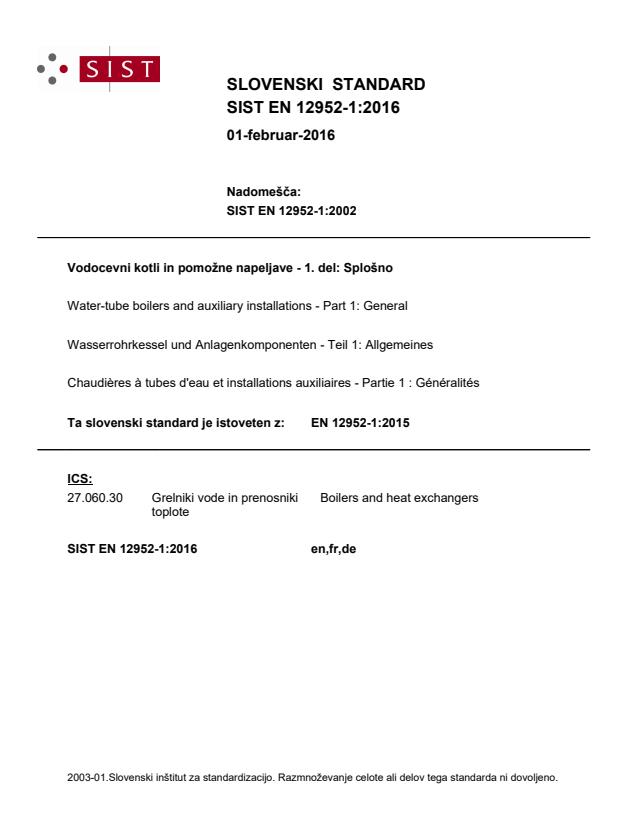
2003-01.Slovenski inštitut za standardizacijo. Razmnoževanje celote ali delov tega standarda ni dovoljeno.Vodocevni kotli in pomožne napeljave - 1. del: SplošnoWasserrohrkessel und Anlagenkomponenten - Teil 1: AllgemeinesChaudières à tubes d'eau et installations auxiliaires - Partie 1 : GénéralitésWater-tube boilers and auxiliary installations - Part 1: General27.060.30Grelniki vode in prenosniki toploteBoilers and heat exchangersICS:Ta slovenski standard je istoveten z:EN 12952-1:2015SIST EN 12952-1:2016en,fr,de01-februar-2016SIST EN 12952-1:2016SLOVENSKI
STANDARDSIST EN 12952-1:20021DGRPHãþD
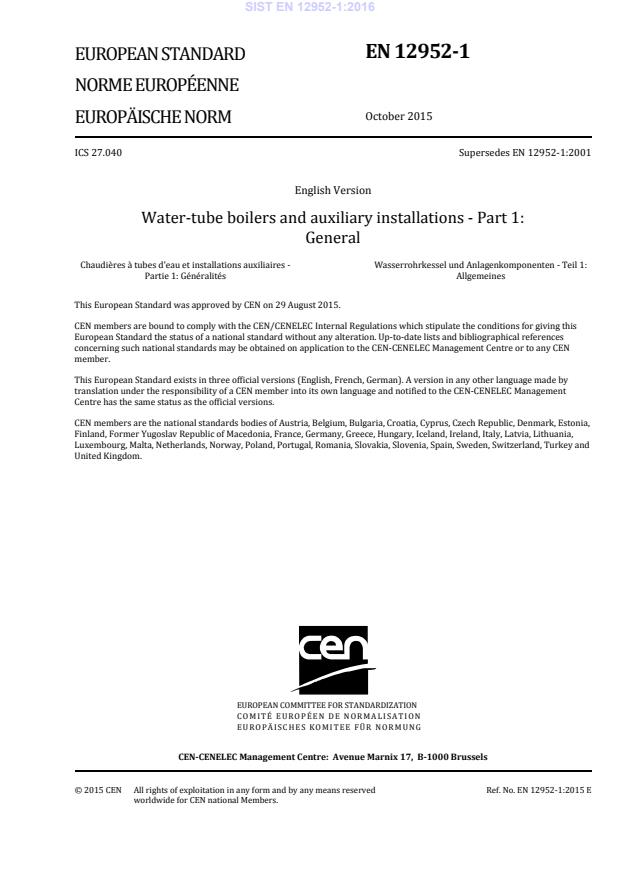
EUROPEAN STANDARD NORME EUROPÉENNE EUROPÄISCHE NORM
EN 12952-1
October
t r s w ICS
t yä r v r Supersedes EN
s t { w tæ sã t r r sEnglish Version
Waterætube boilers and auxiliary installations æ Part
sã General Chaudières à tubes d 5eau et installations auxiliaires æ Partie
sã Généralités
Wasserrohrkessel und Anlagenkomponenten æ Teil
sã Allgemeines This European Standard was approved by CEN on
t { August
t r s wä
egulations which stipulate the conditions for giving this European Standard the status of a national standard without any alterationä Upætoædate lists and bibliographical references concerning such national standards may be obtained on application to the CENæCENELEC Management Centre or to any CEN memberä
translation under the responsibility of a CEN member into its own language and notified to the CENæCENELEC Management Centre has the same status as the official versionsä
CEN members are the national standards bodies of Austriaá Belgiumá Bulgariaá Croatiaá Cyprusá Czech Republicá Denmarká Estoniaá Finlandá Former Yugoslav Republic of Macedoniaá Franceá Germanyá Greeceá Hungaryá Icelandá Irelandá Italyá Latviaá Lithuaniaá Luxembourgá Maltaá Netherlandsá Norwayá Polandá Portugalá Romaniaá Slovakiaá Sloveniaá Spainá Swedená Switzerlandá Turkey and United Kingdomä
EUROPEAN COMMITTEE FOR STANDARDIZATION COMITÉ EUROPÉEN DE NORMALISATION EUROPÄISCHES KOMITEE FÜR NORMUNG
CEN-CENELEC Management Centre:
Avenue Marnix 17,
B-1000 Brussels
t r s w CEN All rights of exploitation in any form and by any means reserved worldwide for CEN national Membersä Refä Noä EN
s t { w tæ sã t r s w ESIST EN 12952-1:2016
Significant technical changes between this European Standard and the previous edition . 13 Annex ZA (informative)
Relationship between this European Standard and the Essential Requirements of EU Directive 2014/68/EU . 14 Bibliography . 15
...
SIST EN 12952-1:2016は、水管ボイラーおよび補助設備に関する欧州標準の重要な部分であり、その適用範囲は、2リットルを超える容量を持ち、最大許容圧力が0.5バールを超え、温度が110℃を超える蒸気および/または温水を生成する水管ボイラーに適用されます。この標準はまた、必要な安全要件を満たすことで、水管ボイラーの安全を保証することを目的としています。 この標準の強みは、設計、製造、試験および検査方法の適切な適用、除去できない危険に対する保護措置の提供、残留リスクに関する情報の提供が含まれている点です。このような包括的なアプローチにより、圧力関連の危険が考慮されており、特に過熱による圧力保持部品の故障など、水管ボイラーの特性に基づいています。また、この標準は、発生する可能性があるすべての状況を網羅することが不可能であることを認識しており、そのため一定の柔軟性を持たせています。 ボイラーの組み立てには、水管ボイラー自体から各種の安全アクセサリー、相互接続パイプまで広範囲にわたる要素が含まれ、特に製造者の裁量により統合可能な機器やコンポーネントが列挙されています。このため、標準に従った設計は一律ではなく、製造者によるカスタマイズが可能です。 この標準の relevancy(関連性)は、特に水管ボイラーを使用する産業において非常に高く、適切な運用を確保するための基盤として機能しています。補助設備や他のプラント設備についても言及され、全体のシステムとしての一体感が確保されています。特に、温度や圧力に関連する危険性を軽減するための具体的な対策が含まれている点は、本標準に対する信頼性を高めています。 一方で、特定のタイプのボイラー(例えば、移動式ボイラーや電気ボイラーなど)に適用されないことが明記されており、この点も標準のクリアな範囲の設定として評価されます。これにより、ユーザーは適切な情報を得ることができ、規制遵守の一助となります。以上の要素から、SIST EN 12952-1:2016は水管ボイラーに関する重要な標準であり、その基本的な目的と範囲は実際の運用において極めて実用的で有益であるといえます。
The SIST EN 12952-1:2016 standard provides a comprehensive framework for water-tube boilers and auxiliary installations, specifically focusing on general safety and operational requirements. This European Standard is crucial for ensuring that water-tube boilers with volumes exceeding two liters, operating at pressures greater than 0.5 bar and temperatures above 110 °C, meet essential safety guidelines as outlined in the Pressure Equipment Directive's Annex I. One of the significant strengths of this standard is its detailed approach to safety. By clearly delineating the design, manufacturing, testing, and inspection methods necessary for the safe operation of water-tube boilers, it lays a solid foundation for manufacturers and operators to prevent hazards associated with pressure systems. Furthermore, the standard addresses the inevitability of some residual hazards, providing guidance on risk reduction and protective measures, thereby enhancing the safety margins for boiler operations. The scope of the standard extends beyond just the boiler itself, encompassing various auxiliary installations and components essential for the complete assembly of these systems. This thorough approach helps to clarify which parts are included in the boiler assembly, such as pressure parts, safety accessories, and necessary piping for functions like draining and venting. The inclusion of independently fired reheaters and the option for manufacturers to integrate additional components, such as isolatable superheaters and systems for supplying fuel and feedwater, demonstrates the standard's adaptability and relevance to modern boiler technologies. Moreover, the SIST EN 12952-1:2016 delineates exclusions from its applicability, ensuring that users clearly understand the boundaries of the standard's relevance. By excluding stationary boilers, shell-type boilers, electrical boilers, and nuclear primary circuits from its scope, the standard maintains a focused approach on the specific challenges and characteristics of water-tube boiler systems. In summary, the SIST EN 12952-1:2016 standard serves as an essential tool for ensuring the safety and performance of water-tube boilers and their auxiliary installations. Its detailed clarity, robust safety requirements, and consideration for operational complexities underscore its significance in the field of pressure equipment regulation, making it a vital reference for manufacturers and operators within the industry.
SIST EN 12952-1:2016 표준은 2리터 이상의 부피를 가진 워터 튜브 보일러와 그 보조 설치에 대한 일반적인 요구사항을 규정하고 있습니다. 이 표준은 최대 허용 압력 PS가 0.5바를 초과하고, 온도가 110°C를 초과하는 증기 및/또는 온수를 생산하는 보일러를 대상으로 하며, 부가적인 안전 기준을 충족하는 것을 목표로 합니다. 이 표준의 주된 강점은 설계, 제조, 시험 및 검사 방법의 적절한 적용을 통해 워터 튜브 보일러의 안전성을 보장하는 것입니다. 안전성 요구사항의 부합을 보장하기 위해 위험 요소에 대한 보호 조치를 제공하고, 잔여 위험에 대한 정보를 포함하여 위험을 줄이기 위한 다양한 조치를 포함하고 있습니다. 이러한 강력한 요소들은 다양한 위험 관련 상황을 고려하여 종합적으로 적용됩니다. 또한, 이 표준은 보일러 조립의 범위를 상세히 정의하고 있으며, 이는 보일러의 모든 압력 부품을 포함하여 보일러와 연결된 배관 및 안전 장치까지입니다. 이와 함께, 사용자가 선택할 수 있는 통합 장비와 구성 요소도 명시되어 있어, 제조자가 자율적으로 설계할 수 있는 여지를 제공합니다. SIST EN 12952-1:2016의 관련성은 압력 장비 지침 부속서 I에 따라 안전 요구사항을 충족하는데 중점을 두고 있다는 점에서 매우 높습니다. 이는 워터 튜브 보일러와 관련된 주요 안전 규정을 제공함으로써, 산업 전반의 안전성을 향상시키며, 사용자와 운영자의 안전을 보장하는 데 기여합니다. 종합적으로 볼 때, SIST EN 12952-1:2016 표준은 워터 튜브 보일러 및 보조 장치의 설계와 운영에 있어 필수적인 기준을 제공하며, 안전하고 효율적인 시스템 구현을 위한 중요한 틀을 마련하고 있습니다.
Die SIST EN 12952-1:2016 ist eine bedeutende europäische Norm, die sich speziell mit Wasserrohrkesseln und deren Hilfseinrichtungen beschäftigt. Ihr Anwendungsbereich erstreckt sich auf Wasserrohrkessel mit einem Volumen von mehr als zwei Litern, die zur Erzeugung von Dampf und/oder heißem Wasser bei einem maximal zulässigen Druck von mehr als 0,5 bar und Temperaturen über 110 °C ausgelegt sind. Damit stellt die Norm sicher, dass die wesentlichen Sicherheitsanforderungen gemäß Anhang I der Druckgeräterichtlinie erfüllt werden, was für die Sicherheit der Wasserrohrkessel von entscheidender Bedeutung ist. Ein herausragender Aspekt dieser Norm ist die detaillierte Methodik, die sie für das Design, die Herstellung, die Prüfung und die Inspektion vorschreibt. Diese Methoden gewährleisten, dass potenzielle Gefahren, die nicht eliminiert werden können, durch geeignete Schutzmaßnahmen adressiert werden. Auch die Informationen über Restgefahren und Maßnahmen zur Risikominderung sind in den verschiedenen Teilen dieser Norm integriert, was einen umfassenden Sicherheitsansatz widerspiegelt. Ein weiterer Vorteil der SIST EN 12952-1:2016 ist, dass sie spezifische Anforderungen an die Baugruppen der Kessel definiert. Die Norm umfasst nicht nur den Wasserrohrkessel selbst, sondern auch alle damit verbundenen Komponenten wie Überhitzer, Nachheizer und sicherheitsrelevante Zubehörteile. Darüber hinaus werden auch die Rohrleitungen, die mit dem Kessel verbunden sind, in den Geltungsbereich eingeschlossen, was eine ganzheitliche Betrachtung des Systems ermöglicht. Die Norm erkennt an, dass es nicht möglich ist, alle möglichen Kombinationsszenarien abzudecken, die in der Praxis auftreten können. Dennoch bietet sie einen soliden Rahmen, um sicherheitsrelevante Druckgefahren zu adressieren, insbesondere in Bezug auf das Versagen druckhaltender Komponenten durch Überhitzung. Dies zeigt die Relevanz der Norm für die Sicherheitstechnik in der Kesselindustrie. Die SIST EN 12952-1:2016 auszuwählen, bedeutet, in die Sicherheit und Effizienz von Wasserrohrkesseln sowie deren Hilfseinrichtungen zu investieren. Dies ist nicht nur für Hersteller, sondern auch für Betreiber von großer Bedeutung, da die Norm hilft, die Betriebssicherheit und die Einhaltung regulatorischer Anforderungen sicherzustellen. Die umfassende Betrachtung von Kesselanlagen und die Berücksichtigung mehrerer sicherheitsrelevanter Aspekte machen diese Norm zu einem unverzichtbaren Bestandteil der Kesseltechnik.
La norme SIST EN 12952-1:2016, intitulée "Chaudières à tubes d'eau et installations auxiliaires - Partie 1 : Général", est essentielle pour garantir la sécurité et la performance des chaudières à tubes d'eau. Son champ d'application est clairement défini, s'appliquant aux chaudières dont le volume dépasse deux litres et qui génèrent de la vapeur ou de l'eau chaude à des pressions supérieures à 0,5 bar et à des températures dépassant 110 °C, en plus des installations auxiliaires. Cette norme se distingue par plusieurs points forts. Premièrement, elle s'assure que les exigences essentielles de sécurité, conformes à l'Annexe I de la Directive sur les équipements sous pression, sont respectées, ce qui est primordial pour assurer un fonctionnement sécuritaire des chaudières à tubes d'eau. Deuxièmement, elle met en avant l'application appropriée des méthodes de conception, de fabrication, d'essai et d'inspection. Cela garantit que les chaudières et leurs composants sont conçus et montés conformément aux meilleures pratiques de l'industrie. Un autre aspect remarquable de cette norme est son approche proactive dans la gestion des risques. Elle fournit des mesures de protection contre les dangers non éliminables et des informations concernant les dangers résiduels, ainsi que des mesures destinées à réduire les risques. Cela montre la pertinence de la norme dans un contexte où les enjeux de sécurité sont cruciaux. De plus, la norme prend en compte des risques liés à la pression, notamment les défaillances de composants de maintien de la pression dues à la surchauffe, soulignant ainsi son exhaustivité face aux divers scénarios qui pourraient survenir lors de l'exploitation de chaudières à tubes d'eau. Il est également digne de mention que cette norme inclut les assemblages de chaudières, ce qui comprend une large gamme de composants, tels que les économiseurs, les dispositifs de sécurité associés, et les systèmes de tuyauterie interconnectés. Cette intégration favorise une compréhension globale des installations et contribue à une meilleure sécurité opérationnelle. En résumé, la norme SIST EN 12952-1:2016 est d'une grande pertinence pour l'industrie des chaudières à tubes d'eau, offrant un cadre normatif qui renforce la sécurité, optimise les méthodes de conception et de fabrication, tout en prenant en considération les divers risques associés à l'exploitation de ces équipements.
Questions, Comments and Discussion
Ask us and Technical Secretary will try to provide an answer. You can facilitate discussion about the standard in here.
Loading comments...