

SIST ISO 3951-1:2023
(Main)Sampling procedures for inspection by variables - Part 1: Specification for single sampling plans indexed by acceptance quality limit (AQL) for lot-by-lot inspection for a single quality characteristic and a single AQL
General Information
- Abstract
This document specifies single sampling plans for lot-by-lot inspection under the following conditions:
a) where the inspection procedure is applied to a continuing series of lots of discrete products, all supplied by one producer using one production process;
b) where only a single quality characteristic, x, of these products is taken into consideration, which is measurable on a continuous scale;
c) where production is under statistical control and the quality characteristic, x, is distributed according to a normal distribution or a close approximation to the normal distribution;
d) where a contract or standard defines a lower specification limit, L, an upper specification limit, U, or both. An item is qualified as conforming if its measured quality characteristic, x, satisfies as appropriate one of the following inequalities:
1) x ≥ L (i.e. the lower specification limit is not violated);
2) x ≤ U (i.e. the upper specification limit is not violated);
3) x ≥ L and x ≤ U (i.e. neither the lower nor the upper specification limit is violated).
Inequalities 1) and 2) are cases with a single specification limit, and 3) is a case with double specification limits.
Where double specification limits apply, it is assumed in this document that conformity to both specification limits is equally important to the integrity of the product. In such cases, it is appropriate to apply a single AQL to the combined percentage of a product outside the two specification limits. This is referred to as combined control.
- Status
- Published
- Publication Date
- 12-Mar-2023
- Technical Committee
- ISTM - Statistical methods
- Current Stage
- 6060 - National Implementation/Publication (Adopted Project)
- Start Date
- 07-Mar-2023
- Due Date
- 12-May-2023
- Completion Date
- 13-Mar-2023
Buy Documents


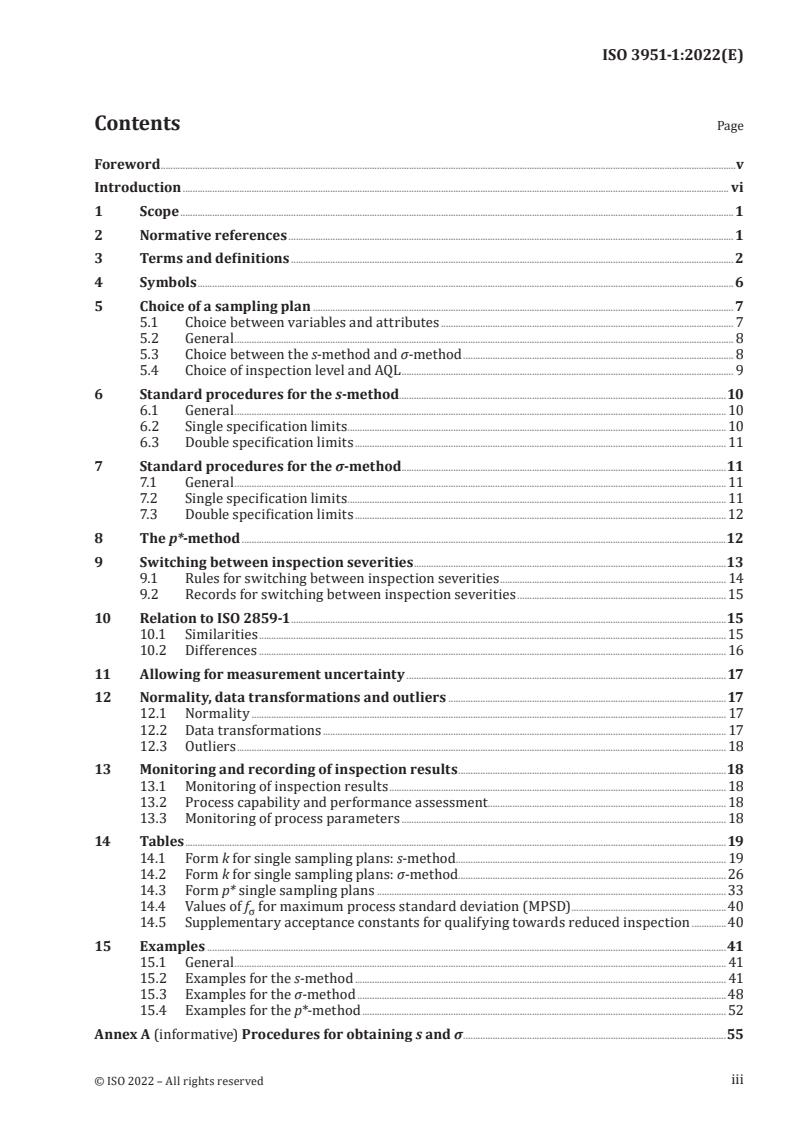
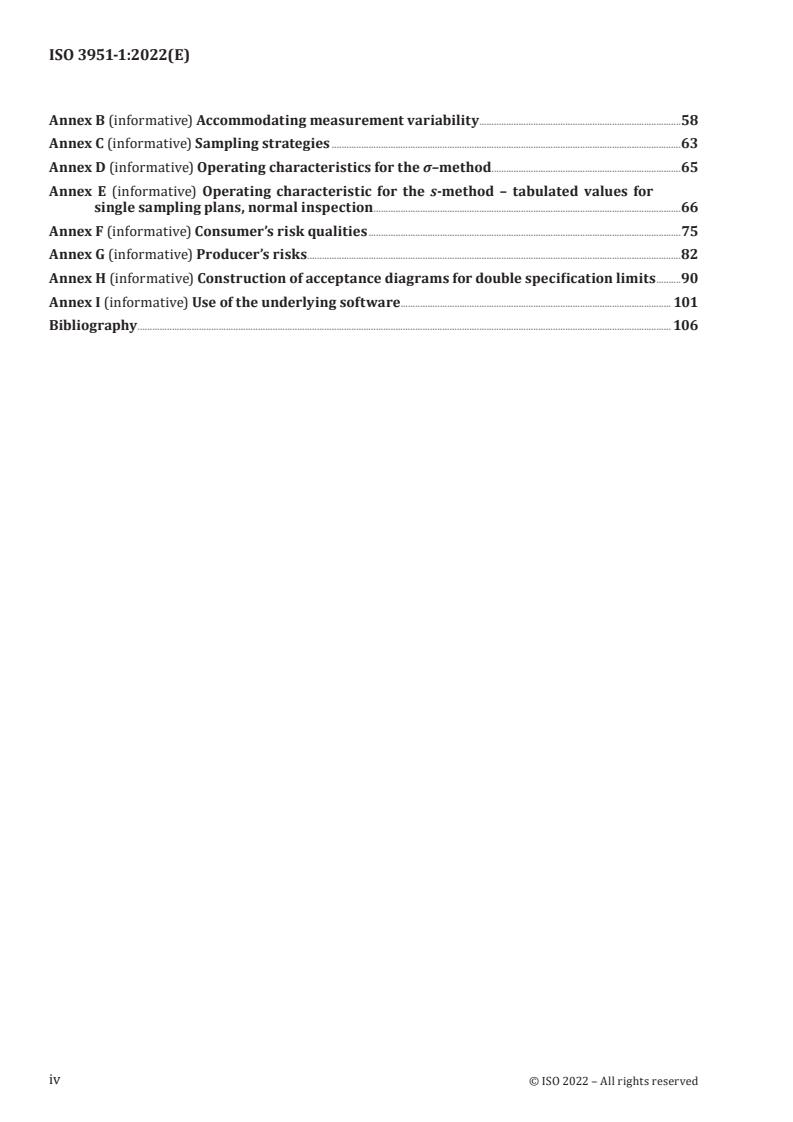
ISO 3951-1:2022 - Sampling procedures for inspection by variables — Part 1: Specification for single sampling plans indexed by acceptance quality limit (AQL) for lot-by-lot inspection for a single quality characteristic and a single AQL Released:18. 08. 2022
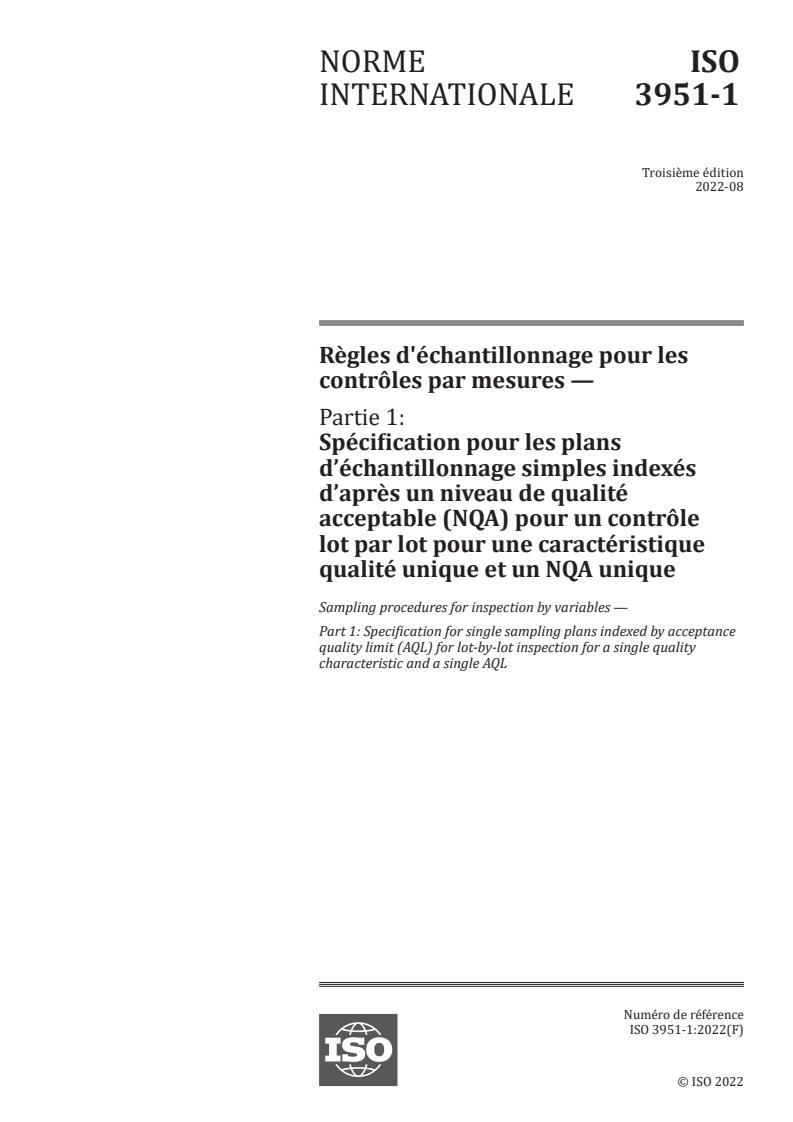
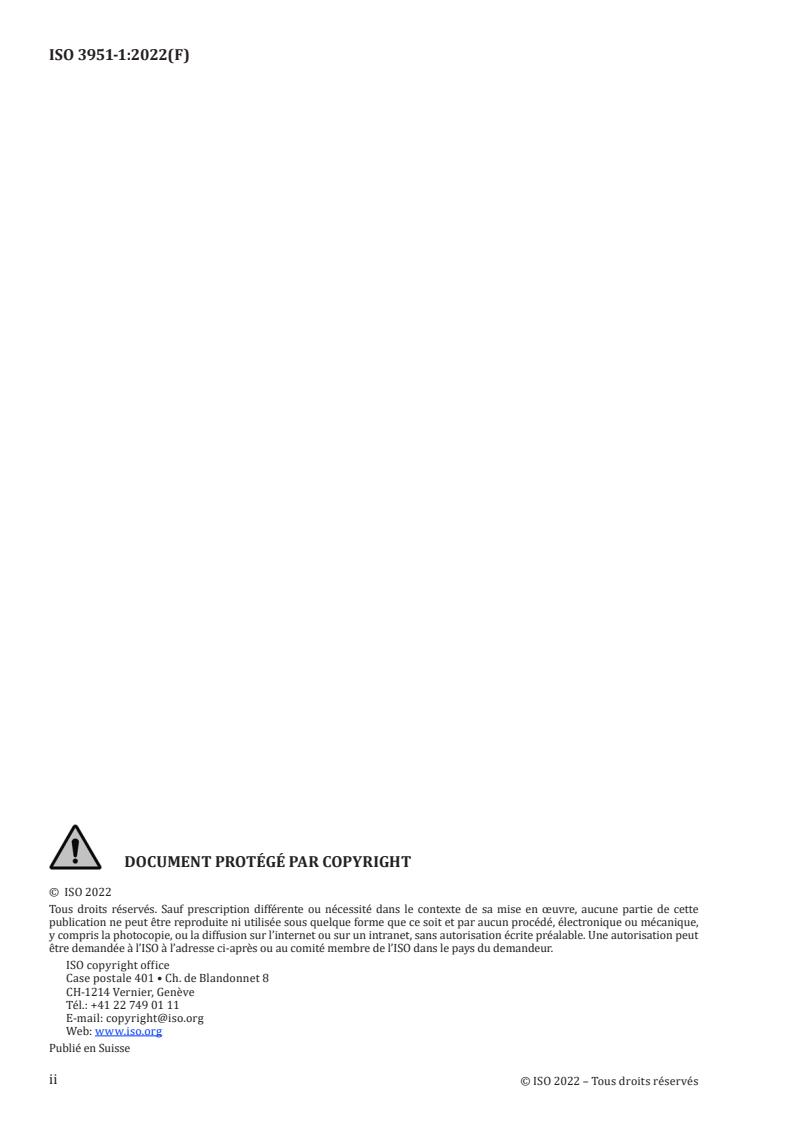
ISO 3951-1:2022 - Sampling procedures for inspection by variables — Part 1: Specification for single sampling plans indexed by acceptance quality limit (AQL) for lot-by-lot inspection for a single quality characteristic and a single AQL Released:18. 08. 2022
Overview
SIST ISO 3951-1:2023 - "Sampling procedures for inspection by variables - Part 1" specifies single sampling plans indexed by Acceptance Quality Limit (AQL) for lot‑by‑lot inspection when a single, continuously measurable quality characteristic is of interest. It is the Slovenian adoption of ISO 3951-1:2022 and is intended for a continuing series of lots from a single producer and production process. Key assumptions include production under statistical control and that the quality characteristic is approximately normally distributed.
Keywords: SIST ISO 3951-1:2023, sampling procedures for inspection by variables, single sampling plans, AQL, lot-by-lot inspection, variables sampling.
Key Topics and Requirements
- Scope and applicability
- Applied to discrete products from one producer and one process.
- Covers a single quality characteristic and a single AQL.
- Specification limits
- Supports single specification limits (lower L or upper U) or double specification limits (L and U).
- For double limits, conformity is judged by combined control of items outside either limit using a single AQL.
- Sampling methods
- s‑method: for unknown standard deviation estimated from sample.
- σ‑method: for known process standard deviation.
- p‑method*: alternative approach included in the document.
- Operational rules
- Defines normal, tightened and reduced inspection and switching rules to respond to quality trends (tighten on deterioration; reduce when quality is consistently good).
- Statistical assumptions & safeguards
- Assumes normal distribution or close approximation; includes guidance on normality, data transformations and outliers.
- Procedures to allow for measurement uncertainty (introduced in the latest edition).
- Tables, examples and annexes
- Complete tables for plan selection, operating characteristic information, examples and guidance on calculating s and σ.
Practical Applications and Users
Who uses this standard:
- Quality engineers and production managers setting acceptance sampling schemes.
- Suppliers and buyers defining contractual inspection plans.
- Third‑party inspectors and conformity assessment bodies.
- Manufacturing industries with continuous series of lots (automotive, electronics, medical devices, components).
Typical applications:
- Lot acceptance decisions where a measurable characteristic (e.g., dimension, weight, tensile strength) is critical.
- Situations seeking to balance consumer protection (detect deterioration) with inspection cost reduction (reduced sampling for good performance).
- Integrating variables sampling into a quality management system and process capability monitoring.
Related Standards
- ISO 3951‑2 (more comprehensive AQL treatments)
- ISO 2859‑1 (attributes sampling; relation and differences discussed)
- ISO 10576‑1 (measurement error considerations)
SIST ISO 3951-1:2023 provides a practical, statistically grounded framework for variables‑based lot inspection, helping organizations implement AQL‑indexed single sampling plans aligned with modern quality control practice.
Relations
- Effective Date
- 25-Aug-2026
- Effective Date
- 25-Aug-2026
- Effective Date
- 25-Aug-2026
- Effective Date
- 25-Aug-2026
- Effective Date
- 25-Aug-2026
- Effective Date
- 25-Aug-2026
- Effective Date
- 14-Oct-2017
Buy Documents
ISO 3951-1:2022 - Sampling procedures for inspection by variables — Part 1: Specification for single sampling plans indexed by acceptance quality limit (AQL) for lot-by-lot inspection for a single quality characteristic and a single AQL Released:18. 08. 2022
ISO 3951-1:2022 - Sampling procedures for inspection by variables — Part 1: Specification for single sampling plans indexed by acceptance quality limit (AQL) for lot-by-lot inspection for a single quality characteristic and a single AQL Released:18. 08. 2022
Get Certified
Connect with accredited certification bodies for this standard

BSI Group
BSI (British Standards Institution) is the business standards company that helps organizations make excellence a habit.

Bureau Veritas
Bureau Veritas is a world leader in laboratory testing, inspection and certification services.

DNV
DNV is an independent assurance and risk management provider.
Sponsored listings
Frequently Asked Questions
SIST ISO 3951-1:2023 is a standard published by the Slovenian Institute for Standardization (SIST). Its full title is "Sampling procedures for inspection by variables - Part 1: Specification for single sampling plans indexed by acceptance quality limit (AQL) for lot-by-lot inspection for a single quality characteristic and a single AQL". This standard covers: This document specifies single sampling plans for lot-by-lot inspection under the following conditions: a) where the inspection procedure is applied to a continuing series of lots of discrete products, all supplied by one producer using one production process; b) where only a single quality characteristic, x, of these products is taken into consideration, which is measurable on a continuous scale; c) where production is under statistical control and the quality characteristic, x, is distributed according to a normal distribution or a close approximation to the normal distribution; d) where a contract or standard defines a lower specification limit, L, an upper specification limit, U, or both. An item is qualified as conforming if its measured quality characteristic, x, satisfies as appropriate one of the following inequalities: 1) x ≥ L (i.e. the lower specification limit is not violated); 2) x ≤ U (i.e. the upper specification limit is not violated); 3) x ≥ L and x ≤ U (i.e. neither the lower nor the upper specification limit is violated). Inequalities 1) and 2) are cases with a single specification limit, and 3) is a case with double specification limits. Where double specification limits apply, it is assumed in this document that conformity to both specification limits is equally important to the integrity of the product. In such cases, it is appropriate to apply a single AQL to the combined percentage of a product outside the two specification limits. This is referred to as combined control.
This document specifies single sampling plans for lot-by-lot inspection under the following conditions: a) where the inspection procedure is applied to a continuing series of lots of discrete products, all supplied by one producer using one production process; b) where only a single quality characteristic, x, of these products is taken into consideration, which is measurable on a continuous scale; c) where production is under statistical control and the quality characteristic, x, is distributed according to a normal distribution or a close approximation to the normal distribution; d) where a contract or standard defines a lower specification limit, L, an upper specification limit, U, or both. An item is qualified as conforming if its measured quality characteristic, x, satisfies as appropriate one of the following inequalities: 1) x ≥ L (i.e. the lower specification limit is not violated); 2) x ≤ U (i.e. the upper specification limit is not violated); 3) x ≥ L and x ≤ U (i.e. neither the lower nor the upper specification limit is violated). Inequalities 1) and 2) are cases with a single specification limit, and 3) is a case with double specification limits. Where double specification limits apply, it is assumed in this document that conformity to both specification limits is equally important to the integrity of the product. In such cases, it is appropriate to apply a single AQL to the combined percentage of a product outside the two specification limits. This is referred to as combined control.
SIST ISO 3951-1:2023 is classified under the following ICS (International Classification for Standards) categories: 03.120.30 - Application of statistical methods. The ICS classification helps identify the subject area and facilitates finding related standards.
SIST ISO 3951-1:2023 has the following relationships with other standards: It is inter standard links to SIST EN ISO 9073-14:2023, SIST EN ISO 9073-13:2023, SIST EN 3675:2023, SIST EN 14620-4:2025, SIST EN ISO 9073-18:2024, SIST EN ISO 9073-3:2023, SIST ISO 3951-1:2014. Understanding these relationships helps ensure you are using the most current and applicable version of the standard.
SIST ISO 3951-1:2023 is available in PDF format for immediate download after purchase. The document can be added to your cart and obtained through the secure checkout process. Digital delivery ensures instant access to the complete standard document.
Standards Content (Sample)
SLOVENSKI STANDARD
01-april-2023
Postopki vzorčenja za kontrolo po številskih spremenljivkah - 1. del: Specifikacija
enojnih vzorčnih načrtov, razvrščenih po prevzemni meji kakovosti (AQL), za
kontrolo zaporednih partij za posamezno karakteristiko kakovosti in posamezno
AQL
Sampling procedures for inspection by variables - Part 1: Specification for single
sampling plans indexed by acceptance quality limit (AQL) for lot-by-lot inspection for a
single quality characteristic and a single AQL
Règles d'échantillonnage pour les contrôles par mesures — Partie 1: Spécification pour
les plans d’échantillonnage simples indexés d’après un niveau de qualité acceptable
(NQA) pour un contrôle lot par lot pour une caractéristique qualité unique et un NQA
unique
Ta slovenski standard je istoveten z: ISO 3951-1:2022
ICS:
03.120.30 Uporaba statističnih metod Application of statistical
methods
2003-01.Slovenski inštitut za standardizacijo. Razmnoževanje celote ali delov tega standarda ni dovoljeno.
INTERNATIONAL ISO
STANDARD 3951-1
Third edition
2022-08
Sampling procedures for inspection by
variables —
Part 1:
Specification for single sampling plans
indexed by acceptance quality limit
(AQL) for lot-by-lot inspection for a
single quality characteristic and a
single AQL
Règles d'échantillonnage pour les contrôles par mesures —
Partie 1: Spécification pour les plans d’échantillonnage simples
indexés d’après un niveau de qualité acceptable (NQA) pour un
contrôle lot par lot pour une caractéristique qualité unique et
un NQA unique
Reference number
© ISO 2022
All rights reserved. Unless otherwise specified, or required in the context of its implementation, no part of this publication may
be reproduced or utilized otherwise in any form or by any means, electronic or mechanical, including photocopying, or posting on
the internet or an intranet, without prior written permission. Permission can be requested from either ISO at the address below
or ISO’s member body in the country of the requester.
ISO copyright office
CP 401 • Ch. de Blandonnet 8
CH-1214 Vernier, Geneva
Phone: +41 22 749 01 11
Email: copyright@iso.org
Website: www.iso.org
Published in Switzerland
ii
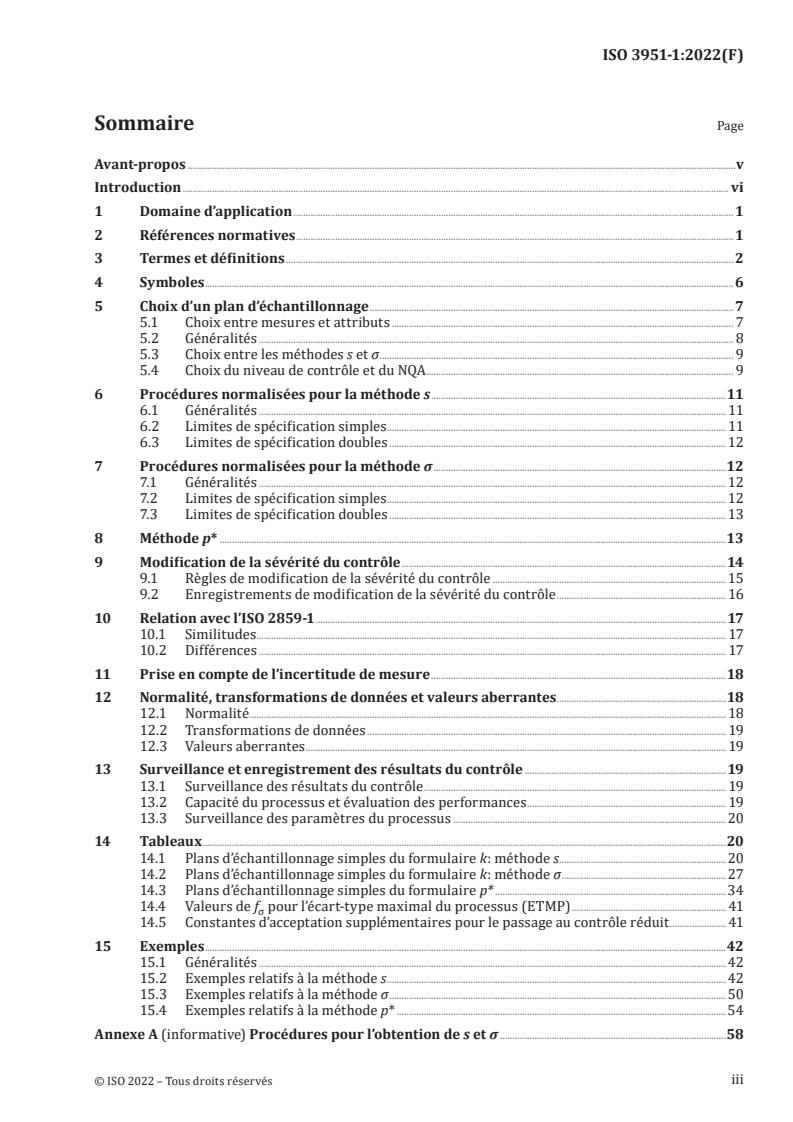
Contents Page
Foreword .v
Introduction . vi
1 Scope . 1
2 Normative references . 1
3 Terms and definitions . 2
4 Symbols . 6
5 Choice of a sampling plan . 7
5.1 Choice between variables and attributes . 7
5.2 General . 8
5.3 Choice between the s-method and σ-method . 8
5.4 Choice of inspection level and AQL . 9
6 Standard procedures for the s-method.10
6.1 General . 10
6.2 Single specification limits . . 10
6.3 Double specification limits . 11
7 Standard procedures for the σ-method .11
7.1 General . 11
7.2 Single specification limits . . 11
7.3 Double specification limits .12
8 The p*-method .12
9 Switching between inspection severities .13
9.1 Rules for switching between inspection severities . 14
9.2 Records for switching between inspection severities . 15
10 Relation to ISO 2859-1 .15
10.1 Similarities . 15
10.2 Differences . 16
11 Allowing for measurement uncertainty .17
12 Normality, data transformations and outliers .17
12.1 Normality . 17
12.2 Data transformations . 17
12.3 Outliers . 18
13 Monitoring and recording of inspection results .18
13.1 Monitoring of inspection results . 18
13.2 Process capability and performance assessment . 18
13.3 Monitoring of process parameters . 18
14 Tables .19
14.1 Form k for single sampling plans: s-method. 19
14.2 Form k for single sampling plans: σ-method. 26
14.3 Form p* single sampling plans . 33
14.4 Values of f for maximum process standard deviation (MPSD) .40
σ
14.5 Supplementary acceptance constants for qualifying towards reduced inspection .40
15 Examples .41
15.1 General . 41
15.2 Examples for the s-method . 41
15.3 Examples for the σ-method .48
15.4 Examples for the p*-method . 52
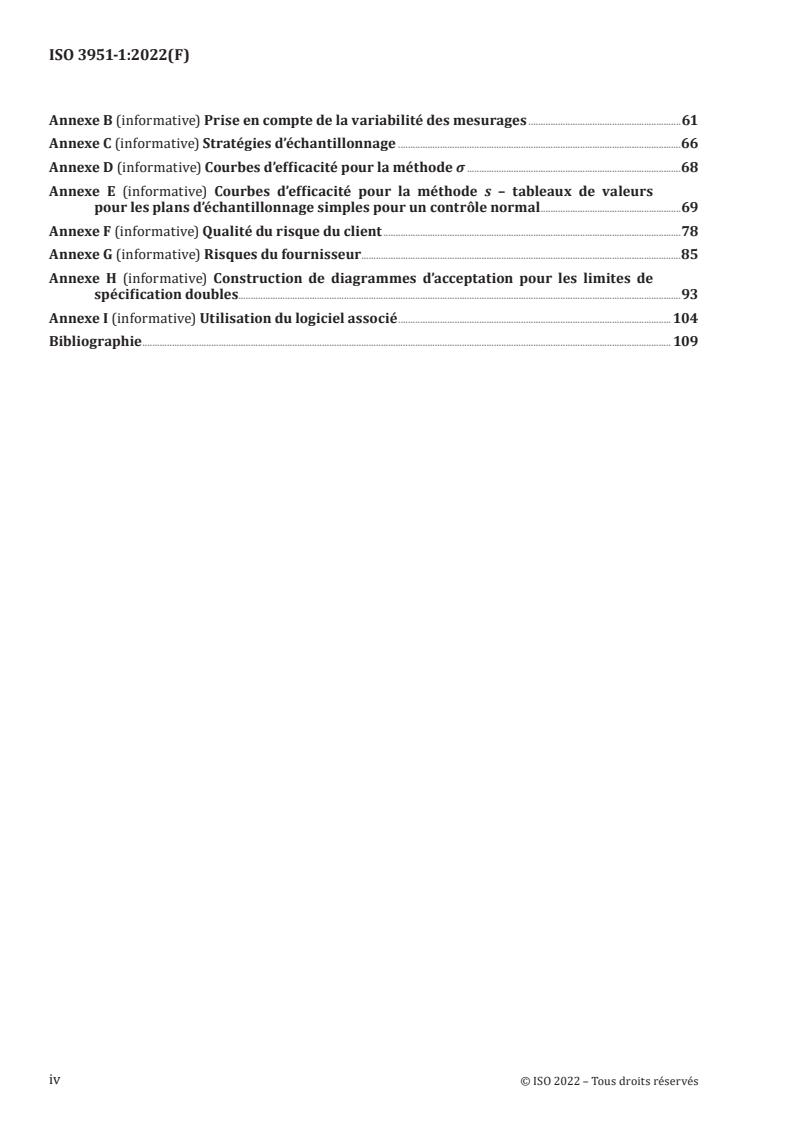
Annex A (informative) Procedures for obtaining s and σ.55
iii
Annex B (informative) Accommodating measurement variability .58
Annex C (informative) Sampling strategies .63
Annex D (informative) Operating characteristics for the σ–method .65
Annex E (informative) Operating characteristic for the s-method – tabulated values for
single sampling plans, normal inspection .66
Annex F (informative) Consumer’s risk qualities .75
Annex G (informative) Producer’s risks.82
Annex H (informative) Construction of acceptance diagrams for double specification limits .90
Annex I (informative) Use of the underlying software. 101
Bibliography . 106
iv
Foreword
ISO (the International Organization for Standardization) is a worldwide federation of national standards
bodies (ISO member bodies). The work of preparing International Standards is normally carried out
through ISO technical committees. Each member body interested in a subject for which a technical
committee has been established has the right to be represented on that committee. International
organizations, governmental and non-governmental, in liaison with ISO, also take part in the work.
ISO collaborates closely with the International Electrotechnical Commission (IEC) on all matters of
electrotechnical standardization.
The procedures used to develop this document and those intended for its further maintenance are
described in the ISO/IEC Directives, Part 1. In particular, the different approval criteria needed for the
different types of ISO documents should be noted. This document was drafted in accordance with the
editorial rules of the ISO/IEC Directives, Part 2 (see www.iso.org/directives).
Attention is drawn to the possibility that some of the elements of this document may be the subject of
patent rights. ISO shall not be held responsible for identifying any or all such patent rights. Details of
any patent rights identified during the development of the document will be in the Introduction and/or
on the ISO list of patent declarations received (see www.iso.org/patents).
Any trade name used in this document is information given for the convenience of users and does not
constitute an endorsement.
For an explanation of the voluntary nature of standards, the meaning of ISO specific terms and
expressions related to conformity assessment, as well as information about ISO's adherence to
the World Trade Organization (WTO) principles in the Technical Barriers to Trade (TBT), see
www.iso.org/iso/foreword.html.
This document was prepared by Technical Committee ISO/TC 69, Applications of statistical methods,
Subcommittee SC 5, Acceptance sampling.
This third edition cancels and replaces the second edition (ISO 3591-1:2013), which has been technically
revised.
The main changes are as follows:
— procedures have been introduced to accommodate measurement uncertainty;
— many of the sampling plans have been adjusted to improve the match between their operating
characteristic curves and the operating characteristic curves of the corresponding plans for single
sampling by attributes in ISO 2859-1.
A list of all parts in the ISO 3951 series can be found on the ISO website.
Any feedback or questions on this document should be directed to the user’s national standards body. A
complete listing of these bodies can be found at www.iso.org/members.html.
v
Introduction
This document specifies an acceptance sampling system of single sampling plans for inspection by
variables. It is indexed in terms of the acceptance quality limit (AQL). A more comprehensive and
technical treatment of the AQL scheme is given in ISO 3951-2. This document is complementary to
ISO 2859-1.
The objectives of the methods laid down in this document are to ensure that lots of acceptable quality
have a high probability of acceptance and that the probability of not accepting inferior lots is as high as
practicable. This is achieved by means of the switching rules, which provide the following:
a) an automatic protection to the consumer (by means of a switch to tightened inspection or
discontinuation of sampling inspection) should a deterioration in quality be detected; and
b) an incentive (at the discretion of the responsible authority) to reduce inspection costs (by means of
a switch to a smaller sample size) should consistently good quality be achieved.
In this document, the acceptance of a lot is implicitly determined from an estimate of the percentage of
nonconforming items in the process, based on a random sample of items from the lot.
This document is intended for application to a continuing series of lots of discrete products all supplied
by one producer using one production process. If there are different producers or production processes,
this document is applied to each one separately.
This document is intended for application to a single quality characteristic that is measurable on
a continuous scale and is normally distributed. For two or more such quality characteristics, see
ISO 3951-2. For information on normality and data transformations, see Clause 12.
It is assumed in the body of this document that measurement error is negligible (see ISO 10576-1:2003).
For information on allowing for measurement error, see Annex B.
For double specification limits, this document covers combined control. For other types of control, refer
to ISO 3951-2.
CAUTION — The procedures in this document are not suitable for application to lots that have
been screened for nonconforming items.
Inspection by variables for nonconforming items, as described in this document, includes several
possible modes, the combination of which leads to a presentation that may appear quite complex to the
user:
— unknown standard deviation, or originally unknown then estimated with fair precision, or known
since the start of inspection;
— a single specification limit, or combined control of double specification limits;
— normal inspection, tightened inspection, or reduced inspection.
The choice of the most suitable variables plan, if one exists, requires experience, judgement, and some
knowledge of both statistics and the product to be inspected. Clause 5 of this document is intended
to help those responsible for specifying sampling plans in making this choice. They suggest the
considerations that should be kept in mind when deciding whether a variables plan is suitable and the
choices to be made when selecting an appropriate standard plan.
The basic definitions and notations are provided in Clauses 3 and 4. The basic operational rules are
contained in Clauses 5 through 9. Clause 10 informs about the relations between this document and
the attributes sampling standard ISO 2859-1. Clauses 11, 12 and 13 provide background on accounting
for measurement uncertainty, the normality assumption, and monitoring of inspection results and
the underlying process. All tables needed for the sampling procedure can be found in Clause 14 and
examples for the s–method and the σ–method for both one and two specification limits can be found in
Clause 15.
vi
Nine annexes are provided. Annex A indicates how the sample standard deviation, s, and the presumed
known value of the process standard deviation, σ, should be determined. Annex B provides procedures
for accommodating measurement uncertainty. Annex C shows five different sampling strategies.
Annex D gives the general formula for the operating characteristic of the σ–method and provides tables
with values of the operating characteristics of single sampling plans with known σ. Annex E gives the
general formula for the operating characteristic of the s–method and provides tables with values of the
operating characteristics of single sampling plans with unknown σ. Annex F provides the statistical
theory underlying the calculation of the consumer’s risk qualities, together with tables showing these
quality levels for normal, tightened, and reduced inspection, as well as for the s–method and σ–method.
Annex G provides similar information for the producer’s risks. Annex H give details of how Acceptance
diagrams for double specification limits are constructed, Annex I shows the use of the underlying
software (R package to support implementation of this document).
vii
INTERNATIONAL STANDARD ISO 3951-1:2022(E)
Sampling procedures for inspection by variables —
Part 1:
Specification for single sampling plans indexed by
acceptance quality limit (AQL) for lot-by-lot inspection for
a single quality characteristic and a single AQL
1 Scope
This document specifies single sampling plans for lot-by-lot inspection under the following conditions:
a) where the inspection procedure is applied to a continuing series of lots of discrete products, all
supplied by one producer using one production process;
b) where only a single quality characteristic, x, of these products is taken into consideration, which is
measurable on a continuous scale;
c) where production is under statistical control and the quality characteristic, x, is distributed
according to a normal distribution or a close approximation to the normal distribution;
d) where a contract or standard defines a lower specification limit, L, an upper specification limit,
U, or both. An item is qualified as conforming if its measured quality characteristic, x, satisfies as
appropriate one of the following inequalities:
1) x ≥ L (i.e. the lower specification limit is not violated);
2) x ≤ U (i.e. the upper specification limit is not violated);
3) x ≥ L and x ≤ U (i.e. neither the lower nor the upper specification limit is violated).
Inequalities 1) and 2) are cases with a single specification limit, and 3) is a case with double specification
limits.
Where double specification limits apply, it is assumed in this document that conformity to both
specification limits is equally important to the integrity of the product. In such cases, it is appropriate
to apply a single AQL to the combined percentage of a product outside the two specification limits. This
is referred to as combined control.
2 Normative references
The following documents are referred to in the text in such a way that some or all of their content
constitutes requirements of this document. For dated references, only the edition cited applies. For
undated references, the latest edition of the referenced document (including any amendments) applies.
ISO 2859-1, Sampling procedures for inspection by attributes — Part 1: Sampling schemes indexed by
acceptance quality limit (AQL) for lot-by-lot inspection
ISO 3534-1, Statistics — Vocabulary and symbols — Part 1: General statistical terms and terms used in
probability
ISO 3534-2, Statistics — Vocabulary and symbols — Part 2: Applied statistics
ISO 3951-2, Sampling procedures for inspection by variables — Part 2: General specification for single
sampling plans indexed by acceptance quality limit (AQL) for lot-by-lot inspection of independent quality
characteristics
3 Terms and definitions
For the purposes of this document, the terms and definitions given in ISO 2859-1, ISO 3534-1 and
ISO 3534-2 and the following apply.
ISO and IEC maintain terminological databases for use in standardization at the following addresses:
— ISO Online browsing platform: available at https:// www .iso .org/ obp
— IEC Electropedia: available at https:// www .electropedia .org/
3.1
inspection by variables
inspection by measuring the magnitude(s) of a characteristic(s) of an item
[SOURCE: ISO 3534-2:2006, 4.1.4]
3.2
sampling inspection
inspection of selected items in the group under consideration
[SOURCE: ISO 3534-2:2006, 4.1.6]
3.3
acceptance sampling inspection
acceptance inspection where the acceptability is determined by means of sampling inspection (3.2)
[SOURCE: ISO 3534-2:2006, 4.1.8]
3.4
acceptance sampling inspection by variables
acceptance sampling inspection (3.3) in which the acceptance of the process is determined statistically
from measurements from inspection by variables (3.1)
[SOURCE: ISO 3534-2:2006, 4.2.11 modified — “on specified quality characteristics of each item in a
sample from a lot” has been replaced by “from inspection by variables”]
3.5
process fraction nonconforming
rate at which nonconforming items are generated by a process
Note 1 to entry: It is expressed as a proportion.
3.6
acceptance quality limit
AQL
(acceptance sampling) worst tolerable quality level (3.7)
Note 1 to entry: This concept only applies when an acceptance sampling scheme with rules for switching and for
discontinuation, such as ISO 2859-1 and ISO 3951, is used.
Note 2 to entry: See 5.4.
[SOURCE: ISO 3534-2:2006, 4.6.15 modified — Notes 2 to 4 to entry have been deleted and Note 1 to
entry has been added.]
3.7
quality level
quality expressed as the fraction nonconforming
[SOURCE: ISO 3534-2:2006, 4.6.16 modified — “or rate of number of nonconformities” has been
removed”.]
3.8
limiting quality
LQ
quality level (3.7), when a lot is considered in isolation, which, for the purposes of acceptance sampling
inspection (3.3), is limited to a low probability of acceptance
Note 1 to entry: In this document: 10 %.
[SOURCE: ISO 3534-2:2006, 4.6.13, modified — Note 1 to entry has been added.]
3.9
nonconformity
non-fulfilment of a requirement
[SOURCE: ISO 3534-2:2006, 3.1.11]
3.10
nonconforming unit
unit with one or more nonconformities
[SOURCE: ISO 3534-2:2006, 1.2.15]
3.11
p*-method acceptance sampling plan
ˆ
acceptance sampling (3.3) plan by variables where the the estimated fraction nonconforming p is
compared to the maximum acceptable value p*.
Note 1 to entry: The method is applicable to both the s-method (3.12) and the σ-method (3.13) and gives equivalent
results. It has the advantage that it deals directly with the fraction nonconforming.
3.12
s–method acceptance sampling plan
acceptance sampling (3.3) plan by variables using the sample standard deviation
Note 1 to entry: See Clause 6.
[SOURCE: ISO 3534-2:2006, 4.3.10 modified — “s method” has been replaced by “s-method” and
“acceptance sampling plan” has been added]
3.13
σ–method acceptance sampling plan
acceptance sampling (3.3) plan by variables using the presumed value of the process standard deviation
Note 1 to entry: See Clause 7.
[SOURCE: ISO 3534-2:2006, 4.3.9 modified — “sigma method” has been replaced by “σ-method” and
“acceptance sampling plan” has been added]
3.14
specification limit
conformance boundary specified for a characteristic
[SOURCE: ISO 3534-2:2006, 3.1.3, modified — "limiting value stated" has been replaced with
"conformance boundary specified".]
3.15
lower specification limit
L
specification limit (3.14) that defines the lower conformance boundary
[SOURCE: ISO 3534 2:2006, 3.1.5, modified — "limiting value" has been replaced with "conformance
boundary".]
3.16
upper specification limit
U
specification limit (3.14) that defines the upper conformance boundary
[SOURCE: ISO 3534-2:2006, 3.1.4, modified — "limiting value" has been replaced with "conformance
boundary".]
3.17
combined control
requirement when both upper and lower limits are specified for the quality characteristic and an AQL
(3.6) that applies to the combined percent nonconforming beyond the two limits is given
Note 1 to entry: See 5.4.
Note 2 to entry: The use of combined control implies that nonconformity beyond either specification limit (3.14) is
believed to be of equal, or at least roughly equal, importance to the lack of integrity of the product.
3.18
form k acceptance constant
k
constant depending on the specified value of the acceptance quality limit (3.6) and the sample size, used
in the criteria for accepting the lot in an acceptance sampling (3.3) plan by variables
Note 1 to entry: See Clause 6 and Clause 7.
[SOURCE: ISO 3534-2:2006, 4.4.4, modified — "acceptability constant" has been replaced with
"acceptance constant". The original Note 1 to entry has been deleted, a new Note 1 to entry has been
added.]
3.19
form p* acceptance constant
p*
constant depending on the specified value of the acceptance quality limit (3.6) and the sample size, used
in the criteria for accepting the lot in an acceptance sampling (3.3) plan by variables
[SOURCE: ISO 3534-2:2006, 4.4.4, modified — "acceptability constant" has been replaced with
"acceptance constant". The original Note 1 to entry has been deleted, a new Note 1 to entry has been
added.]
3.20
quality statistic
Q
function of the specification limit (3.14), the sample mean and the sample or process standard deviation,
used in assessing the acceptance of a lot
Note 1 to entry: For the case of a single specification limit, the lot can be accepted or rejected on the result of
comparing Q with the form k acceptance constant (3.18).
Note 2 to entry: See Clause 6 and Clause 7.
[SOURCE: ISO 3534-2:2006, 4.4.9, modified — In the Note 1 to entry, "may be sentenced" has been
replaced with " can be accepted or rejected". Note 2 to entry has been added.]
3.21
lower quality statistic
Q
L
function of the lower specification limit (3.15), the sample mean, and the sample or process standard
deviation
Note 1 to entry: For a single lower specification limit, the lot can be accepted or rejected on the result of comparing
Q with the form k acceptance constant (3.18).
L
Note 2 to entry: See Clause 4, Clause 6, and Clause 7.
[SOURCE: ISO 3534-2:2006, 4.4.11, modified — Note 2 to entry has been added.]
3.22
upper quality statistic
Q
U
function of the upper specification limit (3.16), the sample mean, and the sample or process standard
deviation
Note 1 to entry: For a single upper specification limit, the lot can be accepted or rejected on the result of
comparing Q with the form k acceptance constant (3.18).
U
Note 2 to entry: See Clause 4, Clause 6, and Clause 7.
[SOURCE: ISO 3534-2:2006, 4.4.10, modified — Note 2 to entry has been added.]
3.23
maximum process standard deviation
MPSD
σ
max
largest process standard deviation for a given sample size code letter and AQL (3.6) for which it is
possible to satisfy the acceptance criterion for a double specification limit under all inspection severities
(i.e. normal, tightened and reduced) when the process variability is known
Note 1 to entry: The MPSD depends on whether the double specification limits are combined, separate or complex,
but does not depend on the inspection severity.
Note 2 to entry: See 5.2.
[SOURCE: ISO 3534-2:2006, 4.4.8, modified — Note 2 to entry has been added.]
3.24
switching rule
instruction within an acceptance sampling (3.3) scheme for changing from one acceptance sampling
plan to another of greater or lesser severity based on demonstrated quality history
Note 1 to entry: Normal, tightened, or reduced inspection or discontinuation of inspection are examples of
‘severity of sampling’.
Note 2 to entry: See Clause 9.
[SOURCE: ISO 3534-2:2006, 4.3.4, modified — Note 2 to entry has been added.]
3.25
measurement
set of operations to determine the value of some quantity
[SOURCE: ISO 3534-2:2006, 3.2.1, modified — "having the object of determining a value of a quantity"
has been replaced with " to determine the value of some quantity". Notes 1 and 2 to entry have been
deleted.]
4 Symbols
f factor that relates the maximum process standard deviation to the difference between
σ
U and L (see 14.5)
the distribution of the standard beta distribution with parameters α and β . In this
Fx()
BETA αβ,
()
document αβ== n 21− throughout.
the distribution function of the non-central t-distribution with ν degrees of freedom
Fx()
t()νδ,
and non-centrality parameter δ
K the upper p-quantile of the standardized normal distribution i.e. x such that
p
1−Φ()xp= , which corresponds to the process fraction nonconforming p
k form k acceptance constant for use with a single quality characteristic and a single
specification limit (see 14.1 for the s–method acceptance sampling plan or 14.2 for the
σ–method acceptance sampling plan)
L lower specification limit (as a subscript to a variable, it denotes its value at L)
M unknown process mean
N lot size (number of items in a lot)
n sample size (number of items in a sample)
ˆ
p estimate of the process fraction nonconforming
pˆ estimate of the process fraction nonconforming below the lower specification limit
L
ˆ estimate of the process fraction nonconforming above the upper specification limit
p
U
form p* acceptance constant i.e. the maximum acceptable value for the estimate of the
*
p
process fraction nonconforming
P probability of acceptance
a
Φ()x
the distribution function of the standardized normal distribution
Q quality statistic
Q lower quality statistic
L
NOTE Q is defined as ()xL− s when the process standard deviation is unknown, and
L
as ()xL− σ when it is presumed to be known.
Q upper quality statistic
U
NOTE Q is defined as ()Ux− s when the process standard deviation is unknown, and
U
as ()Ux− σ when it is presumed to be known.
S sample standard deviation of the measured values of the quality characteristic (also
an estimate of the standard deviation of the process), i.e.
n
()xx−
∑ j
j=1
s=
n−1
(See Annex A.)
σ
process standard deviation
NOTE σ , the square of the process standard deviation, is known as the process
variance.
σ
maximum process standard deviation (MPSD)
max
σ
weighted root mean square of s
root
U upper specification limit (as a suffix to a variable, it denotes its value at U)
th
x measured value of the quality characteristic for the j item of the sample
j
x
the arithmetic mean of the measured values of the quality characteristic in the sam-
ple, i.e.
n
x
∑ j
j=1
x=
n
5 Choice of a sampling plan
5.1 Choice between variables and attributes
The first question to consider is whether it is desirable to inspect variables rather than attributes. The
following points should be taken into account.
a) In terms of economics, it is necessary to compare the total cost of the relatively simple inspection
of a larger number of items by means of an attributes scheme with the generally more elaborate
procedure required by a variables scheme, which is usually more time-consuming and costly per
item.
b) In terms of the knowledge gained, the advantage lies with inspection by variables as the information
obtained indicates more precisely the quality of the product. Therefore, earlier warning can be
given if the quality is slipping.
c) An attributes scheme can be more readily understood and accepted. For example, two phenomena
of variables sampling are difficult to understand:
1) lots containing 100 % conforming items can be rejected, occasionally even with a high
probability (see example 3 in 15.1);
2) there are cases of larger AQL and smaller lot size where lots containing 100 % nonconforming
items are accepted.
d) From a comparison of the size of the samples required for the same AQL from standard plans
for inspection by attributes, such as from ISO 2859-1, and the standard plans in this document,
the smallest samples are generally required by the σ–method (used when the process standard
deviation is presumed to be known). The sample sizes for the s-method (used when the process
standard deviation is presumed to be unknown) are larger than for the σ-method but are, in
general, substantially smaller than for sampling by attributes.
e) Inspection by variables is particularly appropriate in conjunction with the use of control charts for
variables.
f) Variables sampling has a substantial advantage when the inspection process is expensive, for
example, in the case of destructive testing.
g) A variables scheme becomes relatively more complicated to operate as the number of measurements
to be taken on each item increases.
NOTE For two or more quality characteristics, that need to be treated together using a single AQL, this
document does not apply. See ISO 3951-2 for details.
5.2 General
The sampling schemes found in this document, with their rules for switching and for discontinuation of
sampling inspection, are designed to encourage suppliers to keep the process fraction nonconforming
consistently better than the respective AQLs.
Otherwise, there is a high risk that the inspection severity be switched to tightened inspection, under
which the criteria for lot acceptance become more demanding. Once on tightened inspection, unless
action is taken to improve the process, it is very likely that the rule requiring discontinuation of
sampling inspection be invoked pending such improvement.
The following procedures shall be followed before starting an inspection by variables:
a) check that an AQL has been designated, and that it is one of the preferred AQLs for use with this
document (see Clause 5). If it is not, then the sampling tables of this document are not applicable;
NOTE If an AQL other than a preferred AQL is designated, then this document is only applicable under
the advice of a statistical expert.
b) check that the inspection level to be used has been designated. If none has been given, the inspection
level II shall be used (see 5.4);
c) determine the quality characteristic x and an upper limit U and/or a lower limit L for x;
d) for a quality characteristic with double specification limits, check that nonconformities beyond
each limit are of equal importance. If this is not the case, refer to ISO 3951-2;
NOTE If the lot size, the inspection level, U, L or the AQL change during the process, the user might need
to stop and begin again with 5.1.
e) check whether the s–method (Clause 6) is to be used initially or whether the standard deviation is
stable and known, in which case the σ–method (Clause 7) should be used (see 5.3);
f) for the σ–method and a quality characteristic with double specification limits, a process capability
study in the following sense should be done:
1) enter Table 11 in 14.4 with the AQL to determine the value of the factor f ;
σ
2) calculate the maximum allowable value of the process standard deviation using the formula
σ =−()UL f ;
max σ
3) If σ exceeds σ , the process is not capable and sampling inspection is pointless until it is
max
demonstrated that the process variability has been adequately reduced.
g) obtain the sample size code letter with the inspection limit (normally level II) and the lot size from
Table 1.
5.3 Choice between the s-method and σ-method
If the inspection by variables method as proposed in this document is chosen, the decision shall be
made whether to use the s–method or the σ–method. The σ–method is the more economical in terms of
sample size, but before this method can be applied, it is necessary to have a reliable value of σ, usually
obtained from previous process analyses.
In the case that no reliable assumptions on the value of σ can be made, it shall be necessary to begin
with the s–method, but subject to the agreement of the responsible authority and provided the quality
remains satisfactory, the operational rules of this document permit a change to the σ–method and
consequently the use of a smaller sample size.
If the variability is under control, a reliable estimation for the process standard deviation can be made
from the observed data, in which case it may be economical to change to the σ–method. The size of the
sample is generally smaller and the acceptance criterion is simpler using the σ–method (see Clause 7).
On the other hand, it shall still be necessary to calculate the sample standard deviation, s, for record
and continued monitoring purposes of the product quality and to keep the pattern or control charts up
to date (see Clause 13). Methods of determining s and σ are given in Annex A.
In case of using the σ–method, it is recommended to perform, periodically and systematically,
comparisons of observed data, i.e. observed process standard deviations with the assumption made on
σ. In the framework of continued monitoring, this can be done in several ways:
— use of descriptive, graphical methods, e.g. pattern charts;
— use of statistical control charts;
— descriptive numerical analysis; or
— statistical tests, e.g. Bartlett’s test for the comparison of variances.
If based on these analyses there is doubt in the reliability of the assumptions made on σ, it can be
necessary to switch to the s-method.
5.4 Choice of inspection level and AQL
The AQL is the quality level that is the worst tolerable nonconforming process fraction when a
continuing series of lots is submitted for acceptance sampling. Although individual lots determined to
be of “bad” quality may be accepted by the AQL with fairly high probability, the designation of an AQL
does not suggest that this is a desirable quality level.
The AQL, together with the sample size code letter, is used to index the sampling plans in this document.
For a standard sampling plan, the inspection level, in conjunction with the size of the lots and the AQL,
determines the size of the sample to be taken and governs the severity of the inspection. The appropriate
operating characteristic from Annex E shows the extent of the risk that is involved in such a plan.
The 16 AQLs given in this document, ranging in value from 0,01 % to 10 % nonconforming, are
described as “preferred AQLs”. They are only preferred in the sense that they are the AQL values used
in the tabulations and charts. It follows that, if for any product or service, an AQL other than a preferred
AQL is designated, then this document is only applicable under the advice of a statistical expert.
The AQL to be used shall be designated in the product specification or in the contract, or by the
responsible authority. Where both upper and lower specification limits are given, this document
addresses only the case of an overall AQL applying to the combined percent nonconforming beyond the
two limits; this is known as “combined control.” (See ISO 3951-2 for “separate” and “complex” control of
double specification limits.)
From the definition of the AQL, it follows that the desired protection can only be ensured when a
continuing series of lots is provided for inspection.
The designation of an AQL shall not imply that the supplier has the right to supply knowingly any
nonconforming product.
The choice of inspection level and AQL is governed by a number of factors but is mainly a balance
between the total cost of inspection and the consequences of nonconforming items passing into service.
Three inspection levels, I, II, and III, are given in Table 1 for general use. Inspection level II shall be used
unless special circumstances indicate that another level is more appropriate. Level I may be used when
less discrimination is
...
INTERNATIONAL ISO
STANDARD 3951-1
Third edition
2022-08
Sampling procedures for inspection by
variables —
Part 1:
Specification for single sampling plans
indexed by acceptance quality limit
(AQL) for lot-by-lot inspection for a
single quality characteristic and a
single AQL
Règles d'échantillonnage pour les contrôles par mesures —
Partie 1: Spécification pour les plans d’échantillonnage simples
indexés d’après un niveau de qualité acceptable (NQA) pour un
contrôle lot par lot pour une caractéristique qualité unique et
un NQA unique
Reference number
© ISO 2022
All rights reserved. Unless otherwise specified, or required in the context of its implementation, no part of this publication may
be reproduced or utilized otherwise in any form or by any means, electronic or mechanical, including photocopying, or posting on
the internet or an intranet, without prior written permission. Permission can be requested from either ISO at the address below
or ISO’s member body in the country of the requester.
ISO copyright office
CP 401 • Ch. de Blandonnet 8
CH-1214 Vernier, Geneva
Phone: +41 22 749 01 11
Email: copyright@iso.org
Website: www.iso.org
Published in Switzerland
ii
Contents Page
Foreword .v
Introduction . vi
1 Scope . 1
2 Normative references . 1
3 Terms and definitions . 2
4 Symbols . 6
5 Choice of a sampling plan . 7
5.1 Choice between variables and attributes . 7
5.2 General . 8
5.3 Choice between the s-method and σ-method . 8
5.4 Choice of inspection level and AQL . 9
6 Standard procedures for the s-method.10
6.1 General . 10
6.2 Single specification limits . . 10
6.3 Double specification limits . 11
7 Standard procedures for the σ-method .11
7.1 General . 11
7.2 Single specification limits . . 11
7.3 Double specification limits .12
8 The p*-method .12
9 Switching between inspection severities .13
9.1 Rules for switching between inspection severities . 14
9.2 Records for switching between inspection severities . 15
10 Relation to ISO 2859-1 .15
10.1 Similarities . 15
10.2 Differences . 16
11 Allowing for measurement uncertainty .17
12 Normality, data transformations and outliers .17
12.1 Normality . 17
12.2 Data transformations . 17
12.3 Outliers . 18
13 Monitoring and recording of inspection results .18
13.1 Monitoring of inspection results . 18
13.2 Process capability and performance assessment . 18
13.3 Monitoring of process parameters . 18
14 Tables .19
14.1 Form k for single sampling plans: s-method. 19
14.2 Form k for single sampling plans: σ-method. 26
14.3 Form p* single sampling plans . 33
14.4 Values of f for maximum process standard deviation (MPSD) .40
σ
14.5 Supplementary acceptance constants for qualifying towards reduced inspection .40
15 Examples .41
15.1 General . 41
15.2 Examples for the s-method . 41
15.3 Examples for the σ-method .48
15.4 Examples for the p*-method . 52
Annex A (informative) Procedures for obtaining s and σ.55
iii
Annex B (informative) Accommodating measurement variability .58
Annex C (informative) Sampling strategies .63
Annex D (informative) Operating characteristics for the σ–method .65
Annex E (informative) Operating characteristic for the s-method – tabulated values for
single sampling plans, normal inspection .66
Annex F (informative) Consumer’s risk qualities .75
Annex G (informative) Producer’s risks.82
Annex H (informative) Construction of acceptance diagrams for double specification limits .90
Annex I (informative) Use of the underlying software. 101
Bibliography . 106
iv
Foreword
ISO (the International Organization for Standardization) is a worldwide federation of national standards
bodies (ISO member bodies). The work of preparing International Standards is normally carried out
through ISO technical committees. Each member body interested in a subject for which a technical
committee has been established has the right to be represented on that committee. International
organizations, governmental and non-governmental, in liaison with ISO, also take part in the work.
ISO collaborates closely with the International Electrotechnical Commission (IEC) on all matters of
electrotechnical standardization.
The procedures used to develop this document and those intended for its further maintenance are
described in the ISO/IEC Directives, Part 1. In particular, the different approval criteria needed for the
different types of ISO documents should be noted. This document was drafted in accordance with the
editorial rules of the ISO/IEC Directives, Part 2 (see www.iso.org/directives).
Attention is drawn to the possibility that some of the elements of this document may be the subject of
patent rights. ISO shall not be held responsible for identifying any or all such patent rights. Details of
any patent rights identified during the development of the document will be in the Introduction and/or
on the ISO list of patent declarations received (see www.iso.org/patents).
Any trade name used in this document is information given for the convenience of users and does not
constitute an endorsement.
For an explanation of the voluntary nature of standards, the meaning of ISO specific terms and
expressions related to conformity assessment, as well as information about ISO's adherence to
the World Trade Organization (WTO) principles in the Technical Barriers to Trade (TBT), see
www.iso.org/iso/foreword.html.
This document was prepared by Technical Committee ISO/TC 69, Applications of statistical methods,
Subcommittee SC 5, Acceptance sampling.
This third edition cancels and replaces the second edition (ISO 3591-1:2013), which has been technically
revised.
The main changes are as follows:
— procedures have been introduced to accommodate measurement uncertainty;
— many of the sampling plans have been adjusted to improve the match between their operating
characteristic curves and the operating characteristic curves of the corresponding plans for single
sampling by attributes in ISO 2859-1.
A list of all parts in the ISO 3951 series can be found on the ISO website.
Any feedback or questions on this document should be directed to the user’s national standards body. A
complete listing of these bodies can be found at www.iso.org/members.html.
v
Introduction
This document specifies an acceptance sampling system of single sampling plans for inspection by
variables. It is indexed in terms of the acceptance quality limit (AQL). A more comprehensive and
technical treatment of the AQL scheme is given in ISO 3951-2. This document is complementary to
ISO 2859-1.
The objectives of the methods laid down in this document are to ensure that lots of acceptable quality
have a high probability of acceptance and that the probability of not accepting inferior lots is as high as
practicable. This is achieved by means of the switching rules, which provide the following:
a) an automatic protection to the consumer (by means of a switch to tightened inspection or
discontinuation of sampling inspection) should a deterioration in quality be detected; and
b) an incentive (at the discretion of the responsible authority) to reduce inspection costs (by means of
a switch to a smaller sample size) should consistently good quality be achieved.
In this document, the acceptance of a lot is implicitly determined from an estimate of the percentage of
nonconforming items in the process, based on a random sample of items from the lot.
This document is intended for application to a continuing series of lots of discrete products all supplied
by one producer using one production process. If there are different producers or production processes,
this document is applied to each one separately.
This document is intended for application to a single quality characteristic that is measurable on
a continuous scale and is normally distributed. For two or more such quality characteristics, see
ISO 3951-2. For information on normality and data transformations, see Clause 12.
It is assumed in the body of this document that measurement error is negligible (see ISO 10576-1:2003).
For information on allowing for measurement error, see Annex B.
For double specification limits, this document covers combined control. For other types of control, refer
to ISO 3951-2.
CAUTION — The procedures in this document are not suitable for application to lots that have
been screened for nonconforming items.
Inspection by variables for nonconforming items, as described in this document, includes several
possible modes, the combination of which leads to a presentation that may appear quite complex to the
user:
— unknown standard deviation, or originally unknown then estimated with fair precision, or known
since the start of inspection;
— a single specification limit, or combined control of double specification limits;
— normal inspection, tightened inspection, or reduced inspection.
The choice of the most suitable variables plan, if one exists, requires experience, judgement, and some
knowledge of both statistics and the product to be inspected. Clause 5 of this document is intended
to help those responsible for specifying sampling plans in making this choice. They suggest the
considerations that should be kept in mind when deciding whether a variables plan is suitable and the
choices to be made when selecting an appropriate standard plan.
The basic definitions and notations are provided in Clauses 3 and 4. The basic operational rules are
contained in Clauses 5 through 9. Clause 10 informs about the relations between this document and
the attributes sampling standard ISO 2859-1. Clauses 11, 12 and 13 provide background on accounting
for measurement uncertainty, the normality assumption, and monitoring of inspection results and
the underlying process. All tables needed for the sampling procedure can be found in Clause 14 and
examples for the s–method and the σ–method for both one and two specification limits can be found in
Clause 15.
vi
Nine annexes are provided. Annex A indicates how the sample standard deviation, s, and the presumed
known value of the process standard deviation, σ, should be determined. Annex B provides procedures
for accommodating measurement uncertainty. Annex C shows five different sampling strategies.
Annex D gives the general formula for the operating characteristic of the σ–method and provides tables
with values of the operating characteristics of single sampling plans with known σ. Annex E gives the
general formula for the operating characteristic of the s–method and provides tables with values of the
operating characteristics of single sampling plans with unknown σ. Annex F provides the statistical
theory underlying the calculation of the consumer’s risk qualities, together with tables showing these
quality levels for normal, tightened, and reduced inspection, as well as for the s–method and σ–method.
Annex G provides similar information for the producer’s risks. Annex H give details of how Acceptance
diagrams for double specification limits are constructed, Annex I shows the use of the underlying
software (R package to support implementation of this document).
vii
INTERNATIONAL STANDARD ISO 3951-1:2022(E)
Sampling procedures for inspection by variables —
Part 1:
Specification for single sampling plans indexed by
acceptance quality limit (AQL) for lot-by-lot inspection for
a single quality characteristic and a single AQL
1 Scope
This document specifies single sampling plans for lot-by-lot inspection under the following conditions:
a) where the inspection procedure is applied to a continuing series of lots of discrete products, all
supplied by one producer using one production process;
b) where only a single quality characteristic, x, of these products is taken into consideration, which is
measurable on a continuous scale;
c) where production is under statistical control and the quality characteristic, x, is distributed
according to a normal distribution or a close approximation to the normal distribution;
d) where a contract or standard defines a lower specification limit, L, an upper specification limit,
U, or both. An item is qualified as conforming if its measured quality characteristic, x, satisfies as
appropriate one of the following inequalities:
1) x ≥ L (i.e. the lower specification limit is not violated);
2) x ≤ U (i.e. the upper specification limit is not violated);
3) x ≥ L and x ≤ U (i.e. neither the lower nor the upper specification limit is violated).
Inequalities 1) and 2) are cases with a single specification limit, and 3) is a case with double specification
limits.
Where double specification limits apply, it is assumed in this document that conformity to both
specification limits is equally important to the integrity of the product. In such cases, it is appropriate
to apply a single AQL to the combined percentage of a product outside the two specification limits. This
is referred to as combined control.
2 Normative references
The following documents are referred to in the text in such a way that some or all of their content
constitutes requirements of this document. For dated references, only the edition cited applies. For
undated references, the latest edition of the referenced document (including any amendments) applies.
ISO 2859-1, Sampling procedures for inspection by attributes — Part 1: Sampling schemes indexed by
acceptance quality limit (AQL) for lot-by-lot inspection
ISO 3534-1, Statistics — Vocabulary and symbols — Part 1: General statistical terms and terms used in
probability
ISO 3534-2, Statistics — Vocabulary and symbols — Part 2: Applied statistics
ISO 3951-2, Sampling procedures for inspection by variables — Part 2: General specification for single
sampling plans indexed by acceptance quality limit (AQL) for lot-by-lot inspection of independent quality
characteristics
3 Terms and definitions
For the purposes of this document, the terms and definitions given in ISO 2859-1, ISO 3534-1 and
ISO 3534-2 and the following apply.
ISO and IEC maintain terminological databases for use in standardization at the following addresses:
— ISO Online browsing platform: available at https:// www .iso .org/ obp
— IEC Electropedia: available at https:// www .electropedia .org/
3.1
inspection by variables
inspection by measuring the magnitude(s) of a characteristic(s) of an item
[SOURCE: ISO 3534-2:2006, 4.1.4]
3.2
sampling inspection
inspection of selected items in the group under consideration
[SOURCE: ISO 3534-2:2006, 4.1.6]
3.3
acceptance sampling inspection
acceptance inspection where the acceptability is determined by means of sampling inspection (3.2)
[SOURCE: ISO 3534-2:2006, 4.1.8]
3.4
acceptance sampling inspection by variables
acceptance sampling inspection (3.3) in which the acceptance of the process is determined statistically
from measurements from inspection by variables (3.1)
[SOURCE: ISO 3534-2:2006, 4.2.11 modified — “on specified quality characteristics of each item in a
sample from a lot” has been replaced by “from inspection by variables”]
3.5
process fraction nonconforming
rate at which nonconforming items are generated by a process
Note 1 to entry: It is expressed as a proportion.
3.6
acceptance quality limit
AQL
(acceptance sampling) worst tolerable quality level (3.7)
Note 1 to entry: This concept only applies when an acceptance sampling scheme with rules for switching and for
discontinuation, such as ISO 2859-1 and ISO 3951, is used.
Note 2 to entry: See 5.4.
[SOURCE: ISO 3534-2:2006, 4.6.15 modified — Notes 2 to 4 to entry have been deleted and Note 1 to
entry has been added.]
3.7
quality level
quality expressed as the fraction nonconforming
[SOURCE: ISO 3534-2:2006, 4.6.16 modified — “or rate of number of nonconformities” has been
removed”.]
3.8
limiting quality
LQ
quality level (3.7), when a lot is considered in isolation, which, for the purposes of acceptance sampling
inspection (3.3), is limited to a low probability of acceptance
Note 1 to entry: In this document: 10 %.
[SOURCE: ISO 3534-2:2006, 4.6.13, modified — Note 1 to entry has been added.]
3.9
nonconformity
non-fulfilment of a requirement
[SOURCE: ISO 3534-2:2006, 3.1.11]
3.10
nonconforming unit
unit with one or more nonconformities
[SOURCE: ISO 3534-2:2006, 1.2.15]
3.11
p*-method acceptance sampling plan
ˆ
acceptance sampling (3.3) plan by variables where the the estimated fraction nonconforming p is
compared to the maximum acceptable value p*.
Note 1 to entry: The method is applicable to both the s-method (3.12) and the σ-method (3.13) and gives equivalent
results. It has the advantage that it deals directly with the fraction nonconforming.
3.12
s–method acceptance sampling plan
acceptance sampling (3.3) plan by variables using the sample standard deviation
Note 1 to entry: See Clause 6.
[SOURCE: ISO 3534-2:2006, 4.3.10 modified — “s method” has been replaced by “s-method” and
“acceptance sampling plan” has been added]
3.13
σ–method acceptance sampling plan
acceptance sampling (3.3) plan by variables using the presumed value of the process standard deviation
Note 1 to entry: See Clause 7.
[SOURCE: ISO 3534-2:2006, 4.3.9 modified — “sigma method” has been replaced by “σ-method” and
“acceptance sampling plan” has been added]
3.14
specification limit
conformance boundary specified for a characteristic
[SOURCE: ISO 3534-2:2006, 3.1.3, modified — "limiting value stated" has been replaced with
"conformance boundary specified".]
3.15
lower specification limit
L
specification limit (3.14) that defines the lower conformance boundary
[SOURCE: ISO 3534 2:2006, 3.1.5, modified — "limiting value" has been replaced with "conformance
boundary".]
3.16
upper specification limit
U
specification limit (3.14) that defines the upper conformance boundary
[SOURCE: ISO 3534-2:2006, 3.1.4, modified — "limiting value" has been replaced with "conformance
boundary".]
3.17
combined control
requirement when both upper and lower limits are specified for the quality characteristic and an AQL
(3.6) that applies to the combined percent nonconforming beyond the two limits is given
Note 1 to entry: See 5.4.
Note 2 to entry: The use of combined control implies that nonconformity beyond either specification limit (3.14) is
believed to be of equal, or at least roughly equal, importance to the lack of integrity of the product.
3.18
form k acceptance constant
k
constant depending on the specified value of the acceptance quality limit (3.6) and the sample size, used
in the criteria for accepting the lot in an acceptance sampling (3.3) plan by variables
Note 1 to entry: See Clause 6 and Clause 7.
[SOURCE: ISO 3534-2:2006, 4.4.4, modified — "acceptability constant" has been replaced with
"acceptance constant". The original Note 1 to entry has been deleted, a new Note 1 to entry has been
added.]
3.19
form p* acceptance constant
p*
constant depending on the specified value of the acceptance quality limit (3.6) and the sample size, used
in the criteria for accepting the lot in an acceptance sampling (3.3) plan by variables
[SOURCE: ISO 3534-2:2006, 4.4.4, modified — "acceptability constant" has been replaced with
"acceptance constant". The original Note 1 to entry has been deleted, a new Note 1 to entry has been
added.]
3.20
quality statistic
Q
function of the specification limit (3.14), the sample mean and the sample or process standard deviation,
used in assessing the acceptance of a lot
Note 1 to entry: For the case of a single specification limit, the lot can be accepted or rejected on the result of
comparing Q with the form k acceptance constant (3.18).
Note 2 to entry: See Clause 6 and Clause 7.
[SOURCE: ISO 3534-2:2006, 4.4.9, modified — In the Note 1 to entry, "may be sentenced" has been
replaced with " can be accepted or rejected". Note 2 to entry has been added.]
3.21
lower quality statistic
Q
L
function of the lower specification limit (3.15), the sample mean, and the sample or process standard
deviation
Note 1 to entry: For a single lower specification limit, the lot can be accepted or rejected on the result of comparing
Q with the form k acceptance constant (3.18).
L
Note 2 to entry: See Clause 4, Clause 6, and Clause 7.
[SOURCE: ISO 3534-2:2006, 4.4.11, modified — Note 2 to entry has been added.]
3.22
upper quality statistic
Q
U
function of the upper specification limit (3.16), the sample mean, and the sample or process standard
deviation
Note 1 to entry: For a single upper specification limit, the lot can be accepted or rejected on the result of
comparing Q with the form k acceptance constant (3.18).
U
Note 2 to entry: See Clause 4, Clause 6, and Clause 7.
[SOURCE: ISO 3534-2:2006, 4.4.10, modified — Note 2 to entry has been added.]
3.23
maximum process standard deviation
MPSD
σ
max
largest process standard deviation for a given sample size code letter and AQL (3.6) for which it is
possible to satisfy the acceptance criterion for a double specification limit under all inspection severities
(i.e. normal, tightened and reduced) when the process variability is known
Note 1 to entry: The MPSD depends on whether the double specification limits are combined, separate or complex,
but does not depend on the inspection severity.
Note 2 to entry: See 5.2.
[SOURCE: ISO 3534-2:2006, 4.4.8, modified — Note 2 to entry has been added.]
3.24
switching rule
instruction within an acceptance sampling (3.3) scheme for changing from one acceptance sampling
plan to another of greater or lesser severity based on demonstrated quality history
Note 1 to entry: Normal, tightened, or reduced inspection or discontinuation of inspection are examples of
‘severity of sampling’.
Note 2 to entry: See Clause 9.
[SOURCE: ISO 3534-2:2006, 4.3.4, modified — Note 2 to entry has been added.]
3.25
measurement
set of operations to determine the value of some quantity
[SOURCE: ISO 3534-2:2006, 3.2.1, modified — "having the object of determining a value of a quantity"
has been replaced with " to determine the value of some quantity". Notes 1 and 2 to entry have been
deleted.]
4 Symbols
f factor that relates the maximum process standard deviation to the difference between
σ
U and L (see 14.5)
the distribution of the standard beta distribution with parameters α and β . In this
Fx()
BETA αβ,
()
document αβ== n 21− throughout.
the distribution function of the non-central t-distribution with ν degrees of freedom
Fx()
t()νδ,
and non-centrality parameter δ
K the upper p-quantile of the standardized normal distribution i.e. x such that
p
1−Φ()xp= , which corresponds to the process fraction nonconforming p
k form k acceptance constant for use with a single quality characteristic and a single
specification limit (see 14.1 for the s–method acceptance sampling plan or 14.2 for the
σ–method acceptance sampling plan)
L lower specification limit (as a subscript to a variable, it denotes its value at L)
M unknown process mean
N lot size (number of items in a lot)
n sample size (number of items in a sample)
ˆ
p estimate of the process fraction nonconforming
pˆ estimate of the process fraction nonconforming below the lower specification limit
L
ˆ estimate of the process fraction nonconforming above the upper specification limit
p
U
form p* acceptance constant i.e. the maximum acceptable value for the estimate of the
*
p
process fraction nonconforming
P probability of acceptance
a
Φ()x
the distribution function of the standardized normal distribution
Q quality statistic
Q lower quality statistic
L
NOTE Q is defined as ()xL− s when the process standard deviation is unknown, and
L
as ()xL− σ when it is presumed to be known.
Q upper quality statistic
U
NOTE Q is defined as ()Ux− s when the process standard deviation is unknown, and
U
as ()Ux− σ when it is presumed to be known.
S sample standard deviation of the measured values of the quality characteristic (also
an estimate of the standard deviation of the process), i.e.
n
()xx−
∑ j
j=1
s=
n−1
(See Annex A.)
σ
process standard deviation
NOTE σ , the square of the process standard deviation, is known as the process
variance.
σ
maximum process standard deviation (MPSD)
max
σ
weighted root mean square of s
root
U upper specification limit (as a suffix to a variable, it denotes its value at U)
th
x measured value of the quality characteristic for the j item of the sample
j
x
the arithmetic mean of the measured values of the quality characteristic in the sam-
ple, i.e.
n
x
∑ j
j=1
x=
n
5 Choice of a sampling plan
5.1 Choice between variables and attributes
The first question to consider is whether it is desirable to inspect variables rather than attributes. The
following points should be taken into account.
a) In terms of economics, it is necessary to compare the total cost of the relatively simple inspection
of a larger number of items by means of an attributes scheme with the generally more elaborate
procedure required by a variables scheme, which is usually more time-consuming and costly per
item.
b) In terms of the knowledge gained, the advantage lies with inspection by variables as the information
obtained indicates more precisely the quality of the product. Therefore, earlier warning can be
given if the quality is slipping.
c) An attributes scheme can be more readily understood and accepted. For example, two phenomena
of variables sampling are difficult to understand:
1) lots containing 100 % conforming items can be rejected, occasionally even with a high
probability (see example 3 in 15.1);
2) there are cases of larger AQL and smaller lot size where lots containing 100 % nonconforming
items are accepted.
d) From a comparison of the size of the samples required for the same AQL from standard plans
for inspection by attributes, such as from ISO 2859-1, and the standard plans in this document,
the smallest samples are generally required by the σ–method (used when the process standard
deviation is presumed to be known). The sample sizes for the s-method (used when the process
standard deviation is presumed to be unknown) are larger than for the σ-method but are, in
general, substantially smaller than for sampling by attributes.
e) Inspection by variables is particularly appropriate in conjunction with the use of control charts for
variables.
f) Variables sampling has a substantial advantage when the inspection process is expensive, for
example, in the case of destructive testing.
g) A variables scheme becomes relatively more complicated to operate as the number of measurements
to be taken on each item increases.
NOTE For two or more quality characteristics, that need to be treated together using a single AQL, this
document does not apply. See ISO 3951-2 for details.
5.2 General
The sampling schemes found in this document, with their rules for switching and for discontinuation of
sampling inspection, are designed to encourage suppliers to keep the process fraction nonconforming
consistently better than the respective AQLs.
Otherwise, there is a high risk that the inspection severity be switched to tightened inspection, under
which the criteria for lot acceptance become more demanding. Once on tightened inspection, unless
action is taken to improve the process, it is very likely that the rule requiring discontinuation of
sampling inspection be invoked pending such improvement.
The following procedures shall be followed before starting an inspection by variables:
a) check that an AQL has been designated, and that it is one of the preferred AQLs for use with this
document (see Clause 5). If it is not, then the sampling tables of this document are not applicable;
NOTE If an AQL other than a preferred AQL is designated, then this document is only applicable under
the advice of a statistical expert.
b) check that the inspection level to be used has been designated. If none has been given, the inspection
level II shall be used (see 5.4);
c) determine the quality characteristic x and an upper limit U and/or a lower limit L for x;
d) for a quality characteristic with double specification limits, check that nonconformities beyond
each limit are of equal importance. If this is not the case, refer to ISO 3951-2;
NOTE If the lot size, the inspection level, U, L or the AQL change during the process, the user might need
to stop and begin again with 5.1.
e) check whether the s–method (Clause 6) is to be used initially or whether the standard deviation is
stable and known, in which case the σ–method (Clause 7) should be used (see 5.3);
f) for the σ–method and a quality characteristic with double specification limits, a process capability
study in the following sense should be done:
1) enter Table 11 in 14.4 with the AQL to determine the value of the factor f ;
σ
2) calculate the maximum allowable value of the process standard deviation using the formula
σ =−()UL f ;
max σ
3) If σ exceeds σ , the process is not capable and sampling inspection is pointless until it is
max
demonstrated that the process variability has been adequately reduced.
g) obtain the sample size code letter with the inspection limit (normally level II) and the lot size from
Table 1.
5.3 Choice between the s-method and σ-method
If the inspection by variables method as proposed in this document is chosen, the decision shall be
made whether to use the s–method or the σ–method. The σ–method is the more economical in terms of
sample size, but before this method can be applied, it is necessary to have a reliable value of σ, usually
obtained from previous process analyses.
In the case that no reliable assumptions on the value of σ can be made, it shall be necessary to begin
with the s–method, but subject to the agreement of the responsible authority and provided the quality
remains satisfactory, the operational rules of this document permit a change to the σ–method and
consequently the use of a smaller sample size.
If the variability is under control, a reliable estimation for the process standard deviation can be made
from the observed data, in which case it may be economical to change to the σ–method. The size of the
sample is generally smaller and the acceptance criterion is simpler using the σ–method (see Clause 7).
On the other hand, it shall still be necessary to calculate the sample standard deviation, s, for record
and continued monitoring purposes of the product quality and to keep the pattern or control charts up
to date (see Clause 13). Methods of determining s and σ are given in Annex A.
In case of using the σ–method, it is recommended to perform, periodically and systematically,
comparisons of observed data, i.e. observed process standard deviations with the assumption made on
σ. In the framework of continued monitoring, this can be done in several ways:
— use of descriptive, graphical methods, e.g. pattern charts;
— use of statistical control charts;
— descriptive numerical analysis; or
— statistical tests, e.g. Bartlett’s test for the comparison of variances.
If based on these analyses there is doubt in the reliability of the assumptions made on σ, it can be
necessary to switch to the s-method.
5.4 Choice of inspection level and AQL
The AQL is the quality level that is the worst tolerable nonconforming process fraction when a
continuing series of lots is submitted for acceptance sampling. Although individual lots determined to
be of “bad” quality may be accepted by the AQL with fairly high probability, the designation of an AQL
does not suggest that this is a desirable quality level.
The AQL, together with the sample size code letter, is used to index the sampling plans in this document.
For a standard sampling plan, the inspection level, in conjunction with the size of the lots and the AQL,
determines the size of the sample to be taken and governs the severity of the inspection. The appropriate
operating characteristic from Annex E shows the extent of the risk that is involved in such a plan.
The 16 AQLs given in this document, ranging in value from 0,01 % to 10 % nonconforming, are
described as “preferred AQLs”. They are only preferred in the sense that they are the AQL values used
in the tabulations and charts. It follows that, if for any product or service, an AQL other than a preferred
AQL is designated, then this document is only applicable under the advice of a statistical expert.
The AQL to be used shall be designated in the product specification or in the contract, or by the
responsible authority. Where both upper and lower specification limits are given, this document
addresses only the case of an overall AQL applying to the combined percent nonconforming beyond the
two limits; this is known as “combined control.” (See ISO 3951-2 for “separate” and “complex” control of
double specification limits.)
From the definition of the AQL, it follows that the desired protection can only be ensured when a
continuing series of lots is provided for inspection.
The designation of an AQL shall not imply that the supplier has the right to supply knowingly any
nonconforming product.
The choice of inspection level and AQL is governed by a number of factors but is mainly a balance
between the total cost of inspection and the consequences of nonconforming items passing into service.
Three inspection levels, I, II, and III, are given in Table 1 for general use. Inspection level II shall be used
unless special circumstances indicate that another level is more appropriate. Level I may be used when
less discrimination is needed, and level III when greater discrimination is required. Four additional
special levels, S-1, S-2, S-3, and S-4, are also given in Table 1 and may be used when relatively small
sample sizes are necessary and larger sampling risks can be tolerated, or when very high process
capability has been demonstrated.
Table 1 — Sample size code letters and inspection levels
Lot or batch size Special inspection levels General inspection levels
S-1 S-2 S-3 S-4 I II III
2 to 8 B B B B B B B
9 to 15 B B B B B B C
16 to 25 B B B B B C D
26 to 50 B B B C C D E
51 to 90 B B C C C E F
91 to 150 B B C D D F G
151 to 280 B C D E E G H
281 to 500 B C D E F H J
501 to 1 200 C C E F G J K
1 201 to 3 200 C D E G H K L
3 201 to 10 000 C D F G J L M
10 001 to 35 000 C D F H K M N
35 001 to 150 000 D E G J L N P
150 000 to 500 000 D E G J M P Q
500 000 and over D E H K N Q R
NOTE The sample size code letters and inspection levels in this document correspond to those given in ISO 2859-1 and
ISO 3951-2.
6 Standard procedures for the s-method
6.1 General
The s-method shall be used if information about the process standard deviation is missing or
unreliable. Using the s-method, the standard deviation is estimated directly from each sample. As soon
as the conditions for the use of the σ-method are warranted, one may switch from the s-method to the
σ-method (see 5.3).
6.2 Single specification limits
Before starting the inspection by variables, see Clause 5.
The procedure for a single specificatio
...
NORME ISO
INTERNATIONALE 3951-1
Troisième édition
2022-08
Règles d'échantillonnage pour les
contrôles par mesures —
Partie 1:
Spécification pour les plans
d’échantillonnage simples indexés
d’après un niveau de qualité
acceptable (NQA) pour un contrôle
lot par lot pour une caractéristique
qualité unique et un NQA unique
Sampling procedures for inspection by variables —
Part 1: Specification for single sampling plans indexed by acceptance
quality limit (AQL) for lot-by-lot inspection for a single quality
characteristic and a single AQL
Numéro de référence
DOCUMENT PROTÉGÉ PAR COPYRIGHT
© ISO 2022
Tous droits réservés. Sauf prescription différente ou nécessité dans le contexte de sa mise en œuvre, aucune partie de cette
publication ne peut être reproduite ni utilisée sous quelque forme que ce soit et par aucun procédé, électronique ou mécanique,
y compris la photocopie, ou la diffusion sur l’internet ou sur un intranet, sans autorisation écrite préalable. Une autorisation peut
être demandée à l’ISO à l’adresse ci-après ou au comité membre de l’ISO dans le pays du demandeur.
ISO copyright office
Case postale 401 • Ch. de Blandonnet 8
CH-1214 Vernier, Genève
Tél.: +41 22 749 01 11
E-mail: copyright@iso.org
Web: www.iso.org
Publié en Suisse
ii
Sommaire Page
Avant-propos .v
Introduction . vi
1 Domaine d’application . 1
2 Références normatives .1
3 Termes et définitions . 2
4 Symboles . 6
5 Choix d’un plan d’échantillonnage .7
5.1 Choix entre mesures et attributs . 7
5.2 Généralités . 8
5.3 Choix entre les méthodes s et σ . . 9
5.4 Choix du niveau de contrôle et du NQA . 9
6 Procédures normalisées pour la méthode s .11
6.1 Généralités . 11
6.2 Limites de spécification simples . 11
6.3 Limites de spécification doubles .12
7 Procédures normalisées pour la méthode σ .12
7.1 Généralités .12
7.2 Limites de spécification simples .12
7.3 Limites de spécification doubles . 13
8 Méthode p* .13
9 Modification de la sévérité du contrôle .14
9.1 Règles de modification de la sévérité du contrôle . 15
9.2 Enregistrements de modification de la sévérité du contrôle . 16
10 Relation avec l’ISO 2859-1 .17
10.1 Similitudes . 17
10.2 Différences . 17
11 Prise en compte de l’incertitude de mesure .18
12 Normalité, transformations de données et valeurs aberrantes .18
12.1 Normalité. 18
12.2 Transformations de données . 19
12.3 Valeurs aberrantes . 19
13 Surveillance et enregistrement des résultats du contrôle .19
13.1 Surveillance des résultats du contrôle . 19
13.2 Capacité du processus et évaluation des performances . 19
13.3 Surveillance des paramètres du processus . 20
14 Tableaux .20
14.1 Plans d’échantillonnage simples du formulaire k: méthode s . 20
14.2 Plans d’échantillonnage simples du formulaire k: méthode σ . 27
14.3 Plans d’échantillonnage simples du formulaire p* .34
14.4 Valeurs de f pour l’écart-type maximal du processus (ETMP) . 41
σ
14.5 Constantes d’acceptation supplémentaires pour le passage au contrôle réduit . 41
15 Exemples .42
15.1 Généralités . 42
15.2 Exemples relatifs à la méthode s . 42
15.3 Exemples relatifs à la méthode σ . 50
15.4 Exemples relatifs à la méthode p* .54
Annexe A (informative) Procédures pour l’obtention de s et σ .58
iii
Annexe B (informative) Prise en compte de la variabilité des mesurages .61
Annexe C (informative) Stratégies d’échantillonnage .66
Annexe D (informative) Courbes d’efficacité pour la méthode σ .68
Annexe E (informative) Courbes d’efficacité pour la méthode s – tableaux de valeurs
pour les plans d’échantillonnage simples pour un contrôle normal .69
Annexe F (informative) Qualité du risque du client .78
Annexe G (informative) Risques du fournisseur.85
Annexe H (informative) Construction de diagrammes d’acceptation pour les limites de
spécification doubles.93
Annexe I (informative) Utilisation du logiciel associé . 104
Bibliographie . 109
iv
Avant-propos
L’ISO (Organisation internationale de normalisation) est une fédération mondiale d’organismes
nationaux de normalisation (comités membres de l’ISO). L’élaboration des Normes internationales est
en général confiée aux comités techniques de l’ISO. Chaque comité membre intéressé par une étude
a le droit de faire partie du comité technique créé à cet effet. Les organisations internationales,
gouvernementales et non gouvernementales, en liaison avec l’ISO participent également aux travaux.
L’ISO collabore étroitement avec la Commission électrotechnique internationale (IEC) en ce qui
concerne la normalisation électrotechnique.
Les procédures utilisées pour élaborer le présent document et celles destinées à sa mise à jour sont
décrites dans les Directives ISO/IEC, Partie 1. Il convient, en particulier, de prendre note des différents
critères d’approbation requis pour les différents types de documents ISO. Le présent document
a été rédigé conformément aux règles de rédaction données dans les Directives ISO/IEC, Partie 2
(voir www.iso.org/directives).
L’attention est appelée sur le fait que certains des éléments du présent document peuvent faire l’objet de
droits de propriété intellectuelle ou de droits analogues. L’ISO ne saurait être tenue pour responsable
de ne pas avoir identifié de tels droits de propriété et averti de leur existence. Les détails concernant
les références aux droits de propriété intellectuelle ou autres droits analogues identifiés lors de
l’élaboration du document sont indiqués dans l’Introduction et/ou dans la liste des déclarations de
brevets reçues par l’ISO (voir www.iso.org/brevets).
Les appellations commerciales éventuellement mentionnées dans le présent document sont données
pour information, par souci de commodité, à l’intention des utilisateurs et ne sauraient constituer un
engagement.
Pour une explication de la nature volontaire des normes, la signification des termes et expressions
spécifiques de l’ISO liés à l’évaluation de la conformité, ou pour toute information au sujet de l’adhésion
de l’ISO aux principes de l’Organisation mondiale du commerce (OMC) concernant les obstacles
techniques au commerce (OTC), voir le lien suivant: www.iso.org/iso/fr/avant-propos.
Le présent document a été élaboré par le comité technique ISO/TC 69, Application des méthodes
statistiques, sous-comité SC 5, Échantillonnage en vue d’acceptation.
Cette troisième édition annule et remplace la deuxième édition (ISO 3591-1:2013), qui a fait l’objet d’une
révision technique.
Les principales modifications sont les suivantes:
— des procédures ont été introduites pour tenir compte de l’incertitude de mesure;
— de nombreux plans d’échantillonnage ont été modifiés pour améliorer la correspondance entre leurs
courbes d’efficacité et les courbes d’efficacité des plans correspondants pour un échantillonnage
simple par attributs dans l’ISO 2859-1.
Une liste de toutes les parties de la série ISO 3951 se trouve sur le site web de l’ISO.
Il convient que l’utilisateur adresse tout retour d’information ou toute question concernant le présent
document à l’organisme national de normalisation de son pays. Une liste exhaustive desdits organismes
se trouve à l’adresse www.iso.org/fr/members.html.
v
Introduction
Le présent document spécifie un système d’échantillonnage pour acceptation des plans d’échantillonnage
simples pour un contrôle par mesures. Il est indexé d’après le niveau de qualité acceptable (NQA). Un
traitement plus exhaustif et technique de la procédure NQA est décrit dans l’ISO 3951-2. Le présent
document est complémentaire de l’ISO 2859-1.
Les objectifs des méthodes spécifiées dans le présent document sont de s’assurer que des lots d’une
qualité acceptable ont une forte probabilité d’être acceptés et que des lots de qualité inférieure ont
une probabilité d’être refusés aussi forte que possible. Ce résultat est obtenu au moyen des règles de
modification du contrôle qui apportent:
a) une protection automatique du client (en passant à un contrôle renforcé ou en arrêtant le contrôle
par échantillonnage) en cas de détection d’une dégradation de la qualité; et
b) une incitation (à la discrétion de l’autorité responsable) à réduire les coûts de contrôle (en passant
à un effectif d’échantillon plus réduit) lorsqu’une bonne qualité est régulièrement atteinte.
Dans le présent document, l’acceptation d’un lot est implicitement déterminée par une estimation du
pourcentage d’individus non conformes dans le processus, à partir d’un échantillon aléatoire d’individus
issus du lot.
Ce document est destiné à des séries continues de lots de produits distincts, tous fournis par un même
producteur utilisant un processus de production unique. S’il y a plusieurs producteurs ou processus de
production, ce document s’applique séparément à chacun d’eux.
Ce document est destiné à s’appliquer à une seule caractéristique qualité mesurable sur une échelle
continue et présentant une distribution normale. Lorsqu’il y a plusieurs caractéristiques qualité,
voir l’ISO 3951-2. Pour de plus amples informations sur la normalité et les transformations de données,
voir l’Article 12.
Le présent document part de l’hypothèse que l’erreur de mesurage est négligeable
(voir l’ISO 10576-1:2003). Pour de plus amples informations sur la prise en compte de l’erreur de
mesurage, voir l’Annexe B.
Pour les limites de spécification doubles, le présent document traite du contrôle combiné. Pour les
autres types de contrôles, se reporter à l’ISO 3951-2.
ATTENTION — Les procédures du présent document ne sont pas adaptées pour des lots
précédemment épurés de leurs individus non conformes.
Le contrôle par mesures pour les individus non conformes, tel que décrit dans le présent document,
comprend plusieurs modes possibles, dont la combinaison amène à une présentation qui peut sembler
relativement complexe à l’utilisateur:
— écart-type inconnu ou initialement inconnu, puis estimé avec une bonne précision ou connu dès le
début du contrôle;
— limite de spécification simple ou contrôle combiné de limites de spécification doubles;
— contrôle normal, renforcé ou réduit.
Le choix du plan par mesures le plus adapté, s’il existe, réclame de l’expérience, du jugement et une
certaine connaissance des statistiques et du produit à contrôler. L’Article 5 du présent document est
destiné à faciliter la tâche des personnes en charge de définir des plans d’échantillonnage. Il suggère
les éléments qu’il convient de garder à l’esprit lors de la décision de l’adéquation d’un plan par mesures,
en considérant les choix à faire pour la sélection d’un plan normalisé adapté.
Les définitions de base et les notations sont fournies aux Articles 3 et 4. Les règles opérationnelles de
base sont décrites aux Articles 5 à 9. L’Article 10 indique les relations entre le présent document et la
norme d’échantillonnage par attributs ISO 2859-1. Les Articles 11, 12 et 13 fournissent des informations
vi
de base sur la prise en compte de l’incertitude de mesure, l’hypothèse de normalité et la surveillance
des résultats du contrôle et du processus sous-jacent. Tous les tableaux nécessaires à la procédure
d’échantillonnage sont fournis à l’Article 14 et des exemples pour les méthodes s et σ pour les limites de
spécification simple et double sont donnés à l’Article 15.
Neuf annexes sont jointes. L’Annexe A indique la façon dont il convient de déterminer l’écart-type
de l’échantillon, s, et la valeur présumée de l’écart-type du processus, σ. L’Annexe B présente les
procédures permettant d’intégrer l’incertitude de mesure. L’Annexe C expose cinq différentes stratégies
d’échantillonnage. L’Annexe D donne la formule générale pour la courbe d’efficacité de la méthode σ et
fournit des tableaux contenant les valeurs des courbes d’efficacité des plans d’échantillonnage simples
avec σ connu. L’Annexe E donne la formule générale pour la courbe d’efficacité de la méthode s et fournit
des tableaux contenant les valeurs des courbes d’efficacité des plans d’échantillonnage simples avec σ
inconnu. L’Annexe F expose la théorie statistique sous-tendant le calcul de la qualité du risque du client,
avec des tableaux présentant ces niveaux de qualité pour des contrôles normaux, renforcés et réduits,
ainsi que pour les méthodes s et σ. L’Annexe G des informations similaires concernant les risques du
fournisseur. L’Annexe H détaille la construction des diagrammes d’acceptation pour les limites de
spécification doubles. L’Annexe I présente l’utilisation du logiciel associé au présent document (progiciel
R facilitant la mise en œuvre du présent document).
vii
NORME INTERNATIONALE ISO 3951-1:2022(F)
Règles d'échantillonnage pour les contrôles par mesures —
Partie 1:
Spécification pour les plans d’échantillonnage simples
indexés d’après un niveau de qualité acceptable (NQA)
pour un contrôle lot par lot pour une caractéristique
qualité unique et un NQA unique
1 Domaine d’application
Le présent document spécifie des plans d’échantillonnage simples pour un contrôle lot par lot dans les
conditions suivantes:
a) lorsque la procédure de contrôle est appliquée à une série continue de lots de produits distincts,
tous fournis par un même producteur utilisant un procédé de production unique;
b) lorsqu’une seule caractéristique qualité x de ces produits est prise en compte et qu’elle est
mesurable sur une échelle continue;
c) lorsque la production est statistiquement maîtrisée et que la caractéristique qualité x est distribuée
selon une loi normale ou une approximation proche d’une distribution normale;
d) lorsqu’un contrat ou une norme définit une limite de spécification inférieure, L, une limite de
spécification supérieure, U, ou les deux. Un individu est qualifié de conforme si sa caractéristique
qualité mesurée x satisfait à la condition appropriée parmi les inégalités suivantes:
1) x ≥ L (c’est-à-dire que la limite de spécification inférieure n’est pas dépassée);
2) x ≤ U (c’est-à-dire que la limite de spécification supérieure n’est pas dépassée);
3) x ≥ L et x ≤ U (c’est-à-dire qu’aucune des limites de spécification inférieure et supérieure n’est
dépassée).
Les conditions 1) et 2) sont des cas à limite de spécification simple et 3) est un cas à limite de
spécification double.
Lorsque la limite de spécification double s’applique, le présent document présume que la conformité aux
deux limites de spécification présente la même importance pour l’intégrité du produit. Dans ce cas, il
est approprié d’appliquer un seul NQA au pourcentage combiné d’un produit situé hors des deux limites
de spécification. Le contrôle est alors dit combiné.
2 Références normatives
Les documents suivants sont cités dans le texte de sorte qu’ils constituent, pour tout ou partie de leur
contenu, des exigences du présent document. Pour les références datées, seule l’édition citée s’applique.
Pour les références non datées, la dernière édition du document de référence s’applique (y compris les
éventuels amendements).
ISO 2859-1, Règles d'échantillonnage pour les contrôles par attributs — Partie 1: Procédures
d'échantillonnage pour les contrôles lot par lot, indexés d'après le niveau de qualité acceptable (NQA)
ISO 3534-1, Statistique — Vocabulaire et symboles — Partie 1: Termes statistiques généraux et termes
utilisés en calcul des probabilités
ISO 3534-2, Statistique — Vocabulaire et symboles — Partie 2: Statistique appliquée
ISO 3951-2, Règles d'échantillonnage pour les contrôles par mesures — Partie 2: Spécification générale pour
les plans d'échantillonnage simples indexés d'après une limite de qualité acceptable (LQA) pour le contrôle
lot par lot de caractéristiques-qualité indépendantes
3 Termes et définitions
Pour les besoins du présent document, les termes et définitions de l’ISO 2859-1, l’ISO 3534-1, l’ISO 3534-2
ainsi que les suivants, s’appliquent.
L’ISO et l’IEC tiennent à jour des bases de données terminologiques destinées à être utilisées en
normalisation, consultables aux adresses suivantes:
— ISO Online browsing platform: disponible à l’adresse https:// www .iso .org/ obp;
— IEC Electropedia: disponible à l’adresse https:// www .electropedia .org/ .
3.1
contrôle par mesures
contrôle qui consiste à mesurer la valeur d’une caractéristique d’un individu
[SOURCE: ISO 3534-2:2006, 4.1.4]
3.2
contrôle par échantillonnage
contrôle des individus sélectionnés dans le groupe considéré
[SOURCE: ISO 3534-2:2006, 4.1.6]
3.3
contrôle par échantillonnage pour acceptation
contrôle pour acceptation où l’acceptabilité est déterminée par les moyennes du contrôle par
échantillonnage (3.2)
[SOURCE: ISO 3534-2:2006, 4.1.8]
3.4
contrôle par échantillonnage pour acceptation par mesures
contrôle par échantillonnage pour acceptation (3.3) dans lequel l’acceptabilité d’un processus est
déterminée statistiquement à partir des mesures d’un contrôle par mesures (3.1)
[SOURCE: ISO 3534-2:2006, 4.2.11 modifié — « des caractéristiques qualité spécifiées de chaque
individu dans un échantillon d’un lot » a été remplacé par « d’un contrôle par mesures »]
3.5
proportion de non-conformes d’un processus
taux d’individus non conformes générés par un processus
Note 1 à l'article: Il est exprimé en proportion.
3.6
niveau de qualité acceptable
NQA
(échantillonnage pour acceptation) plus mauvais niveau de qualité (3.7) tolérable
Note 1 à l'article: Ce concept ne s’applique que dans le cas où un programme d’échantillonnage pour acceptation
comportant des règles de modification et de suspension de contrôle, telles que définies dans l’ISO 2859-1 et
l’ISO 3951, est utilisé.
Note 2 à l'article: Voir 5.4.
[SOURCE: ISO 3534-2:2006, 4.6.15 modifié — Les Notes 2 à 4 à l’article ont été supprimées et la Note 1 à
l’article a été ajoutée]
3.7
niveau de qualité
qualité exprimée en proportion de non-conformes
[SOURCE: ISO 3534-2:2006, 4.6.16 modifié — « ou en nombre de non-conformités par 100 unités » a été
supprimé]
3.8
qualité limite
QL
pour un lot considéré isolément, niveau de qualité (3.7) qui, en contrôle par échantillonnage pour
acceptation (3.3), correspond à une probabilité d’acceptation relativement faible
Note 1 à l'article: Dans le présent document: 10 %.
[SOURCE: ISO 3534-2:2006, 4.6.13, modifié — La Note 1 à l’article a été ajoutée]
3.9
non-conformité
non-satisfaction d’une exigence
[SOURCE: ISO 3534-2:2006, 3.1.11]
3.10
unité non conforme
unité avec une ou plusieurs non-conformités
[SOURCE: ISO 3534-2:2006, 1.2.15]
3.11
plan d’échantillonnage pour acceptation selon la méthode p*
plan de contrôle par échantillonnage pour acceptation (3.3) par mesures où la proportion estimée de
ˆ
non-conformes p est comparée à la valeur maximale acceptable p*
Note 1 à l'article: Le plan est applicable aux deux méthodes s (3.12) et σ (3.13) et donne des résultats équivalents.
Il présente l’avantage de traiter directement la proportion de non-conformes.
3.12
plan d’échantillonnage pour acceptation selon la méthode s
plan de contrôle par échantillonnage pour acceptation (3.3) par mesures qui utilise l’écart-type de
l’échantillon
Note 1 à l'article: Voir l’Article 6.
[SOURCE: ISO 3534-2:2006, 4.3.10 modifié — « s method » a été remplacé par « s-method » dans la
version anglaise et « plan de contrôle par échantillonnage pour acceptation » a été ajouté]
3.13
plan d’échantillonnage pour acceptation selon la méthode σ
plan de contrôle par échantillonnage pour acceptation (3.3) par mesures qui utilise la valeur présumée
de l’écart-type du processus
Note 1 à l'article: Voir l’Article 7.
[SOURCE: ISO 3534-2:2006, 4.3.9 modifié — « méthode sigma » a été remplacé par « méthode σ » et
« plan de contrôle par échantillonnage pour acceptation » a été ajouté]
3.14
limite de spécification
limite de conformité spécifiée pour une caractéristique
[SOURCE: ISO 3534-2:2006, 3.1.3, modifié — « valeur limite spécifiée » a été remplacé par « limite de
conformité spécifiée »]
3.15
limite de spécification inférieure
L
limite de spécification (3.14) qui définit la limite de conformité inférieure
[SOURCE: ISO 3534-2:2006, 3.1.5, modifié — « valeur limite » a été remplacé par « limite de conformité »]
3.16
limite de spécification supérieure
U
limite de spécification (3.14) qui définit la limite de conformité supérieure
[SOURCE: ISO 3534-2:2006, 3.1.4, modifié — « valeur limite » a été remplacé par « limite de conformité »]
3.17
contrôle combiné
exigence lorsque les limites supérieure et inférieure sont toutes deux spécifiées pour la caractéristique
qualité et qu’un NQA (3.6) s’applique au pourcentage combiné de non-conformes au-delà des deux
limites
Note 1 à l'article: Voir 5.4.
Note 2 à l'article: L’utilisation du contrôle combiné implique que les non-conformités au-delà de l’une ou l’autre
des limites de spécification (3.14) sont considérées comme d’importance égale ou quasi égale par rapport au
manque d’intégrité du produit.
3.18
constante d’acceptation du formulaire k
k
constante dépendant de la valeur spécifiée du niveau de qualité acceptable (3.6) et de l’effectif de
l’échantillon, utilisée comme critère pour l’acceptation du lot dans un plan de contrôle par échantillonnage
pour acceptation (3.3) par mesures
Note 1 à l'article: Voir les Articles 6 et 7.
[SOURCE: ISO 3534-2:2006, 4.4.4, modifié — « constante d’acceptabilité » a été remplacé par « constante
d’acceptation du formulaire k ». La Note 1 à l’article d’origine a été supprimée et une nouvelle Note 1 à
l’article a été ajoutée]
3.19
constante d’acceptation du formulaire p*
p*
constante dépendant de la valeur spécifiée du niveau de qualité acceptable (3.6) et de l’effectif de
l’échantillon, utilisée comme critère pour l’acceptation du lot dans un plan de contrôle par échantillonnage
pour acceptation (3.3) par mesures
[SOURCE: ISO 3534-2:2006, 4.4.4, modifié — « constante d’acceptabilité » a été remplacé par « constante
d’acceptation du formulaire k ». La Note 1 à l’article d’origine a été supprimée et une nouvelle Note 1 à
l’article a été ajoutée]
3.20
statistique de qualité
Q
fonction de la limite de spécification (3.14), moyenne de l’échantillon et écart-type de l’échantillon ou du
processus, utilisée pour évaluer l’acceptabilité d’un lot
Note 1 à l'article: Dans le cas d’une limite de spécification simple, le lot peut être accepté ou rejeté en fonction du
résultat de la comparaison de Q avec la constante d’acceptation du formulaire k (3.18).
Note 2 à l'article: Voir les Articles 6 et 7.
[SOURCE: ISO 3534-2:2006, 4.4.9, modifié — Dans la Note 1 à l’article, « peut être évalué » a été remplacé
par « peut être accepté ou rejeté ». La Note 2 à l’article a été ajoutée]
3.21
statistique de qualité inférieure
Q
L
fonction de la limite de spécification inférieure (3.15), la moyenne de l’échantillon et l’écart-type de
l’échantillon ou du processus
Note 1 à l'article: Dans le cas d’une limite de spécification simple inférieure, le lot peut être accepté ou rejeté en
fonction du résultat de la comparaison de Q avec la constante d’acceptation du formulaire k (3.18).
L
Note 2 à l'article: Voir les Articles 4, 6 et 7.
[SOURCE: ISO 3534-2:2006, 4.4.11, modifié — La Note 2 à l’article a été ajoutée]
3.22
statistique de qualité supérieure
Q
U
fonction de la limite de spécification supérieure (3.16), la moyenne de l’échantillon et l’écart-type de
l’échantillon ou du processus
Note 1 à l'article: Dans le cas d’une limite de spécification simple supérieure, le lot peut être accepté ou rejeté en
fonction du résultat de la comparaison de Q avec la constante d’acceptation du formulaire k (3.18).
U
Note 2 à l'article: Voir les Articles 4, 6 et 7.
[SOURCE: ISO 3534-2:2006, 4.4.10, modifié — La Note 2 à l’article a été ajoutée]
3.23
écart-type maximal du processus
ETMP
σ
max
plus grand écart-type du processus pour une lettre code d’effectif d’échantillon et un NQA (3.6) donnés
pour lequel il est possible de satisfaire le critère d’acceptation pour une limite de spécification double
sous toutes les sévérités de contrôle (par exemple normal, réduit et renforcé) quand la variabilité du
processus est connue
Note 1 à l'article: L’ETMP est dépendant du fait que les limites de spécification doubles sont combinées, séparées
ou complexes mais ne dépend pas de la sévérité du contrôle.
Note 2 à l'article: Voir 5.2.
[SOURCE: ISO 3534-2:2006, 4.4.8, modifié — La Note 2 à l’article a été ajoutée]
3.24
règle de modification du contrôle
instruction, dans un programme de contrôle par échantillonnage pour acceptation (3.3), pour le passage
d’un plan d’échantillonnage pour acceptation à un autre plan plus sévère ou moins sévère, en se fondant
sur des informations antérieures relatives à la qualité
Note 1 à l'article: Les contrôles normal, réduit ou renforcé ou l‘interruption de contrôle sont des exemples de
« sévérité d’un échantillonnage ».
Note 2 à l'article: Voir l’Article 9.
[SOURCE: ISO 3534-2:2006, 4.3.4, modifié — La Note 2 à l’article a été ajoutée]
3.25
mesurage
ensemble d’opérations ayant pour but de déterminer la valeur d’une grandeur
[SOURCE: ISO 3534-2:2006, 3.2.1, modifié — « ayant pour but de déterminer une valeur d’une grandeur »
a été remplacé par « ayant pour but de déterminer la valeur d’une grandeur ». Les Notes 1 et 2 à l’article
ont été supprimées.]
4 Symboles
f facteur qui associe l’écart-type maximal du processus à la différence entre U et L (voir 14.5)
σ
fonction de répartition de la loi bêta normale avec les paramètres α et β . Dans la tota-
Fx
()
BETA()αβ,
lité du présent document: αβ== n 21−
fonction de répartition de la distribution t non centrée avec ν degrés de liberté et le
Fx()
t νδ,
()
paramètre de non-centralité δ
K quantile p supérieur de la loi normale centrée réduite, c’est-à-dire x de telle sorte que
p
1−Φ()xp= , qui correspond à la proportion de non-conformes du processus p
k constante d’acceptation du formulaire k à utiliser avec une caractéristique qualité simple
et une limite de spécification simple (voir 14.1 pour le plan d’échantillonnage pour
acceptation selon la méthode s ou 14.2 pour le plan d’échantillonnage pour acceptation
selon la méthode σ)
L limite de spécification inférieure (en indice d’une variable, indique sa valeur en L)
M moyenne du processus inconnue
N effectif d’un lot (nombre d’individus dans un lot)
n effectif d’un échantillon (nombre d’individus dans un échantillon)
pˆ
estimation de la proportion de non-conformes d’un processus
estimation de la proportion de non-conformes d’un processus au-dessous de la limite
ˆ
p
L
de spécification inférieure
estimation de la proportion de non-conformes d’un processus au-dessus de la limite de
ˆ
p
U
spécification supérieure
constante d’acceptation du formulaire p*, c’est-à-dire la valeur maximale acceptable pour
*
p
l’estimation de la proportion de non-conformes d’un processus
P probabilité d’acceptation
a
Φ()x fonction de répartition de la loi normale centrée réduite
Q statistique de qualité
Q statistique de qualité inférieure
L
NOTE Q est définie par ()xL− s lorsque l’écart-type du processus est inconnu, et par
L
()xL− σ lorsqu’il est présumé connu.
Q statistique de qualité supérieure
U
NOTE Q est définie par ()Ux− s lorsque l’écart-type du processus est inconnu, et par
U
()Ux− σ lorsqu’il est présumé connu.
S écart-type de l’échantillon pour les valeurs mesurées des caractéristiques qualité (éga-
lement une estimation de l’écart-type du processus), c’est-à-dire
n
()xx−
∑ j
j=1
s=
n−1
(voir Annexe A)
σ
écart-type du processus
NOTE σ , le carré de l’écart-type du processus, est également appelé « variance » du
processus.
σ
écart-type maximal du processus (ETMP)
max
σ
moyenne quadratique pondérée de s
quad
U limite de spécification supérieure (en suffixe d’une variable, indique sa valeur en U)
ème
x valeur mesurée de la caractéristique qualité du j individu de l’échantillon
j
x
la moyenne arithmétique des valeurs mesurées de la caractéristique qualité dans l’échan-
tillon, c’est-à-dire:
n
x
∑ j
j=1
x=
n
5 Choix d’un plan d’échantillonnage
5.1 Choix entre mesures et attributs
La première étape consiste à déterminer s’il est souhaitable d’effectuer un contrôle par mesures plutôt
que par attributs. Il convient de prendre en compte les points suivants:
a) en termes économiques, il est nécessaire de comparer le coût total d’un contrôle relativement simple
d’un grand nombre d’individus selon un programme d’attributs, avec le coût total de la procédure
généralement plus élaborée qu’impose un programme de mesures – souvent plus chronophage et
onéreux par individu;
b) en matière de gain de connaissances, l’avantage réside du côté du contrôle par mesures qui procure
des informations plus précises sur la qualité du produit. Par conséquent, un avertissement plus
précoce peut être donné en cas de dérive de la qualité;
c) un programme d’attributs peut être plus facilement compris et accepté. Par exemple,
deux phénomènes d’échantillonnage par mesures sont difficiles à appréhender:
1) des lots contenant 100 % d’individus conformes peuvent être rejetés, parfois même avec une
forte probabilité (voir l’exemple 3 du 15.1);
2) il existe des cas de NQA supérieur et d’effectif de lot inférieur où des lots contenant 100 %
d’individus non conformes sont acceptés;
d) en comparant les effectifs d’échantillons requis pour un même NQA selon des plans normalisés de
contrôle par attributs, tels que ceux de l’ISO 2859-1, et selon les plans normalisés de contrôle par
mesures du présent document, les échantillons les plus petits sont généralement ceux requis pour
la méthode σ (utilisée lorsque l’écart-type du processus est présumé connu). En outre, les effectifs
d’échantillons requis par la méthode s (utilisée lorsque l’écart-type du processus est présumé
inconnu) sont supérieurs à ceux requis pour la méthode σ mais ils sont, en général, nettement
inférieurs à ceux d’un échantillonnage par attributs;
e) le contrôle par mesures est particulièrement adapté lorsqu’il est conjointement utilisé avec des
cartes de contrôle par mesures;
f) l’échantillonnage par mesures offre un avantage conséquent lorsque le processus de contrôle est
coûteux, par exemple dans le cas d’essais destructifs;
g) un plan par mesures devient relativement plus complexe à manipuler quand le nombre de
mesurages à prendre sur chaque individu augmente.
NOTE Lorsque le nombre de caractéristiques qualité qui doivent nécessairement être traitées conjointement
en utilisant un seul NQA est supérieur ou égal à deux, le présent document ne s’applique pas. Voir l’ISO 3951-2
pour de plus amples détails.
5.2 Généralités
Les programmes d’échantillonnage spécifiés dans le présent document, avec leurs règles de modification
et d’interruption du contrôle, sont conçus pour encourager les fournisseurs à maintenir la proportion
de non-conformes du processus régulièrement au-dessus des NQA respectifs.
Faute de quoi, il y a un risque élevé de devoir passer à un contrôle renforcé, où les critères d’acceptation
deviennent plus exigeants. Une fois en contrôle renforcé, à moins qu’une action ne soit menée pour
améliorer le processus, il est alors très probable que la règle imposant l’interruption du contrôle par
échantillonnage soit invoquée.
Les procédures suivantes doivent être appliquées avant de commencer un contrôle par mesures:
a) vérifier qu’un NQA a été défini et qu’il est l’un des NQA préférés du présent document
(voir l’Article 5). Dans le cas contraire, les tableaux d’échantillonnage du présent document ne sont
alors pas applicables;
NOTE Si le NQL désigné n’est pas l’un des NQL préférés, le présent document n’est alors applicable qu’en
sollicitant l’avis d’un statisticien.
b) vérifier que le niveau de contrôle à appliquer a été défini. Sinon, le niveau II doit être appliqué
(voir 5.4);
c) déterminer la caractéristique qualité x et une limite supérieure U et/ou inférieure L pour x;
d) en cas de caractéristique qualité à limites de spécification doubles, vérifier que les non-conformités
au-delà de chaque limite sont d’égale importance. Sinon, se reporter à l’ISO 3951-2;
NOTE En cas de variation de l’effectif du lot, du niveau de contrôle, de U, de L ou du NQL au cours du
processus, l’utilisateur peut être amené à arrêter et redémarrer en 5.1.
e) vérifier si la méthode s (Article 6) doit être utilisée pour commencer ou si l’écart-type est stable et
connu, auquel cas il convient d’appliquer (voir 5.3) la méthode σ (Article 7);
f) pour la méthode σ et dans le cas d’une caractéristique qualité à limites de spécification doubles,
il convient de mener une étude d’aptitude du processus en procédant de la façon suivante:
1) entrer le NQA dans le Tableau 11 du 14.4 afin de déterminer la valeur du facteur f ;
σ
2) calculer la valeur maximale tolérable pour l’écart-type du processus en utilisant la formule
σ =−()UL f ;
max σ
3) si σ excède σ , le processus n’est pas capable de satisfaire aux exigences et le contrôle par
max
échantillonnage est interrompu tant qu’il n’est pas démontré que la variabilité du processus a
été suffisamment réduite;
g) à partir du Tableau 1, déterminer la lettre code d’effectif d’échantillon avec la limite de contrôle
(normalement le niveau II) et l’effectif du lot.
5.3 Choix entre les méthodes s et σ
Si la méthode de contrôle par mesures proposée dans le présent document est choisie, il faut décider
si la méthode s ou σ doit être utilisée. La méthode σ est la plus économique en matière d’effectif
d’échantillon, mais avant de pouvoir l’appliquer, il est nécessaire de déterminer une valeur fiable de σ,
en se basant généralement sur les analyses de processus antérieures.
Si aucune hypothèse fiable ne peut être formulée sur la valeur de σ, il faut nécessairement commencer
avec la méthode s mais, sous réserve d’accord de l’autorité compétente et à condition que la qualité
reste satisfaisante, les règles opérationnelles du présent document permettent de passer ensuite à la
méthode σ, et donc d’utiliser un effectif d’échantillon plus petit.
Si la variabilité est maîtrisée, il est possible d’établir une estimation fiable de l’écart-type du processus
à partir des données observées, auquel cas le passage à la méthode σ peut présenter un intérêt
économique. L’effectif de l’échantillon est généralement plus petit et le critère d’acceptation plus simple
en utilisant la méthode σ (voir l’Article 7).
Par ailleurs, il reste nécessaire de calculer l’écart-type de l’échantillon, s, à des fins d’enregistrement et
de surveillance continue de la qualité du produit ainsi que pour l’actualisation du modèle ou des cartes
de contrôle (voir l’Article 13). Les méthodes de détermination de s et σ sont décrites à l’Annexe A.
En cas d’utilisation de la méthode σ, il est recommandé d’effectuer des comparaisons périodiques
et systématiques des données observées, c’est-à-dire les écarts-types observés du processus,
avec l’hypothèse formulée pour σ. Dans le cadre de la surveillance continue, cette comparaison peut
être réalisée de plusieurs façons:
— méthodes graphiques descriptives (modèles de cartes, par exemple);
— cartes de contrôle statistique;
— analyse numérique descriptive; ou
— tests statistiques (test de Bartlett, par exemple, pour la comparaison des variances).
Si, sur la base de ces analyses, il subsiste un doute sur la fiabilité des hypothèses formulées pour σ,
il peut s’avérer nécessaire de passer à la méthode s.
5.4 Choix du niveau de contrôle et du NQA
Le NQA est le niveau de qualité qui, dans le cas d’un contrôle par échantillonnage pour acceptation
d’une série continue de lots, constitue la plus mauvaise proportion tolérable de non-conformes du
processus. Bien que des lots individuels déterminés comme étant de «
...