

kSIST FprEN IEC 60794-1-128:2026
(Main)Optical fibre cables - Part 1-128: Generic specification - Basic optical cable test procedures - Mechanical tests methods - Cable and fibre mechanical reliability test, Method E28
- Status
- Not Published
- Public Enquiry End Date
- 31-Jul-2025
- Technical Committee
- MOC - Mobile Communications
- Current Stage
- 5020 - Formal vote (FV) (Adopted Project)
- Start Date
- 15-Oct-2026
- Due Date
- 03-Dec-2026
- Completion Date
- 16-Oct-2026

kSIST FprEN IEC 60794-1-128:2026 is the Slovenian standard based on IEC work for optical fibre cables, published through SIST. It specifies Method E28, a mechanical reliability test for optical cables and fibres, for telecom cables, similar equipment cables, and cables that combine optical fibres with electrical conductors. In practice, it tells laboratories and manufacturers how to load a cable over a corner, how long to test it, and what counts as failure.
What does kSIST FprEN IEC 60794-1-128:2026 specify?
kSIST FprEN IEC 60794-1-128:2026 specifies test procedures for the mechanical reliability of optical cables and fibres. Its scope covers optical fibre cables for use with telecommunication equipment and devices using similar techniques, and it also applies to cables that include both optical fibres and electrical conductors.
The document is organized into a short front matter section and five clauses:
- Clause 1 - Scope
- Clause 2 - Normative references
- Clause 3 - Terms and definitions
- Clause 4 - General requirements
- Clause 5 - Method E28: Cable and fibre mechanical reliability test
Clause 5 is the practical core of the document. It sets out the object of the test, sample requirements, apparatus, procedure, pass-fail requirement, and the information that must be specified or reported.
What are the key requirements of kSIST FprEN IEC 60794-1-128:2026?
kSIST FprEN IEC 60794-1-128:2026 defines a long-duration mechanical test that combines bending and tension. The test is meant to accelerate damage that can happen in service, so it is mainly useful for judging whether a cable can survive repeated or sustained mechanical stress.
Clause 4 and the overall test framework
Clause 4 points users to IEC 60794-1-2 as the general guide for test methods of all types. That matters because users are expected to apply the general requirements and definitions from that companion document when running Method E28.
Clause 5.1 - What the test is for
Method E28 simulates simultaneous tension and bending by placing a cable over a corner and loading it above the long-term residual load. The method is intended for small fibre-count cables, especially simplex and duplex types, although other small fibre counts may also be tested.
Clause 5.2 - Sample preparation
The cable sample must be long enough for the apparatus, the test section, the attachment arrangement, and any optical test method used during the test. In practice, this means the test piece has to fit the rig and still leave enough usable length for measurement and handling.
Clause 5.3 - Apparatus
The apparatus holds the cable over a 90-degree bend and applies tension with a hanging mass. The corner is controlled with a metal pin, and the cable and fibres have to remain well coupled so the sheath does not stretch or bunch.
Clause 5.4 - Procedure
The horizontal part of the cable is anchored so the sheath stays stable and the cable elements move together. The vertical leg carries a mass equal to 1.5 times the long-term rated load, applied gradually, and the test runs for 30 days.
Clause 5.5 - Failure criterion
Fibre breakage or visible cracking on the outer sheath is a failure. That gives laboratories and buyers a simple pass-fail judgment for qualification or product verification.
Clauses 5.6 and 5.7 - What must be stated and reported
The detail specification has to state the cable type, long-term rated load, any different test load, and any different test time. The report has to include those details and, where relevant, temperature, sample length, the attachment method at both ends, and any deviations from the procedure.
What does kSIST FprEN IEC 60794-1-128:2026 use as key terms?
- Optical cable - In this document, the term also covers optical fibre units and microduct fibre units.
- Long-term rated load - The reference load used to define the test stress.
- Test load - The actual load applied during the test, which may differ from the long-term rated load if the specification says so.
- Method E28 - The named mechanical reliability test covered by Clause 5.
- Simplex cable - A small fibre-count cable type commonly tested with this method.
- Duplex cable - Another common small fibre-count cable type for which the method is intended.
- Figure-8 mandrel - One attachment or retaining arrangement used to keep the fibre and cable elements coupled during loading.
Who uses kSIST FprEN IEC 60794-1-128:2026?
kSIST FprEN IEC 60794-1-128:2026 is used by optical fibre cable manufacturers, test laboratories, quality teams, and specification writers. It is relevant to telecom equipment supply chains and to products that combine optical fibres with electrical conductors. Buyers and technical approvers use it when they need a clear mechanical reliability test for small fibre-count cables.
What changed in kSIST FprEN IEC 60794-1-128:2026 from the previous edition?
kSIST FprEN IEC 60794-1-128:2026 partially cancels and replaces IEC 60794-1-21:2020. The same test is identified there as Method E28.
Which standards are used with kSIST FprEN IEC 60794-1-128:2026?
- IEC 60794-1-2 - Provides the general guidance for test methods, and Clause 4 points users to it for general requirements and definitions.
What does the kSIST FprEN IEC 60794-1-128:2026 document contain?
The document contains a foreword, five clauses, one figure, and a bibliography. Figure 1 shows the mechanical reliability test apparatus, including the corner pin and the cable retention arrangement. Clause 5 gives the test object, sample conditions, apparatus, procedure, failure criterion, and the details to specify and report.
For a lab, the document is mainly a test setup and reporting standard. For a cable designer or buyer, it provides the named Method E28 and the information needed to write a product specification or compare test results.
Relations
- Effective Date
- 09-Sep-2025
- Effective Date
- 09-Sep-2025
Get Certified
Connect with accredited certification bodies for this standard

ANCE
Mexican certification and testing association.

Intertek Slovenia
Intertek testing, inspection, and certification services in Slovenia.

LNE (Laboratoire National de Métrologie et d'Essais)
French national laboratory for metrology and testing.
Sponsored listings
Frequently Asked Questions
kSIST FprEN IEC 60794-1-128:2026 is a draft published by the Slovenian Institute for Standardization (SIST). Its full title is "Optical fibre cables - Part 1-128: Generic specification - Basic optical cable test procedures - Mechanical tests methods - Cable and fibre mechanical reliability test, Method E28". This standard covers: Optical fibre cables - Part 1-128: Generic specification - Basic optical cable test procedures - Mechanical tests methods - Cable and fibre mechanical reliability test, Method E28
Optical fibre cables - Part 1-128: Generic specification - Basic optical cable test procedures - Mechanical tests methods - Cable and fibre mechanical reliability test, Method E28
kSIST FprEN IEC 60794-1-128:2026 is classified under the following ICS (International Classification for Standards) categories: 33.180.10 - Fibres and cables. The ICS classification helps identify the subject area and facilitates finding related standards.
kSIST FprEN IEC 60794-1-128:2026 has the following relationships with other standards: It is inter standard links to SIST EN 60794-1-21:2015/A1:2020, SIST EN 60794-1-21:2015. Understanding these relationships helps ensure you are using the most current and applicable version of the standard.
kSIST FprEN IEC 60794-1-128:2026 is available in PDF format for immediate download after purchase. The document can be added to your cart and obtained through the secure checkout process. Digital delivery ensures instant access to the complete standard document.
Standards Content (Sample)
SLOVENSKI STANDARD
oSIST prEN IEC 60794-1-128:2025
01-julij-2025
Optični kabli - 1-128. del: Splošna specifikacija - Osnovni preskusni postopki za
optične kable - Mehanske preskusne metode - Preizkus mehanske zanesljivosti
kablov in vlaken, metoda E28
Optical fibre cables - Part 1-128: Generic specification - Basic optical cable test
procedures - Mechanical tests methods - Cable and fibre mechanical reliability test,
Method E28
Câbles à fibres optiques - Partie 1-128: Spécification générique - Procédures
fondamentales d’essais des câbles optiques - Méthodes d’essais mécaniques - Essai de
fiabilité mécanique des câbles et des fibres, Méthode E28
Ta slovenski standard je istoveten z: prEN IEC 60794-1-128:2025
ICS:
33.180.10 (Optična) vlakna in kabli Fibres and cables
oSIST prEN IEC 60794-1-128:2025 en
2003-01.Slovenski inštitut za standardizacijo. Razmnoževanje celote ali delov tega standarda ni dovoljeno.
oSIST prEN IEC 60794-1-128:2025
oSIST prEN IEC 60794-1-128:2025
86A/2575/CDV
COMMITTEE DRAFT FOR VOTE (CDV)
PROJECT NUMBER:
IEC 60794-1-128 ED1
DATE OF CIRCULATION: CLOSING DATE FOR VOTING:
2025-06-13 2025-09-05
SUPERSEDES DOCUMENTS:
86A/2529/CD, 86A/2571/CC
IEC SC 86A : FIBRES AND CABLES
SECRETARIAT: SECRETARY:
France Mr Laurent Gasca
OF INTEREST TO THE FOLLOWING COMMITTEES: HORIZONTAL FUNCTION(S):
ASPECTS CONCERNED:
SUBMITTED FOR CENELEC PARALLEL VOTING NOT SUBMITTED FOR CENELEC PARALLEL VOTING
Attention IEC-CENELEC parallel voting
The attention of IEC National Committees, members of
CENELEC, is drawn to the fact that this Committee Draft
for Vote (CDV) is submitted for parallel voting.
The CENELEC members are invited to vote through the
CENELEC online voting system.
This document is still under study and subject to change. It should not be used for reference purposes.
Recipients of this document are invited to submit, with their comments, notification of any relevant patent rights of
which they are aware and to provide supporting documentation.
Recipients of this document are invited to submit, with their comments, notification of any relevant “In Some
Countries” clauses to be included should this proposal proceed. Recipients are reminded that the CDV stage is
the final stage for submitting ISC clauses. (SEE AC/22/2007 OR NEW GUIDANCE DOC).
TITLE:
Optical fibre cables - Part 1-128: Generic specification - Basic optical cable test procedures -
Mechanical tests methods – Cable and fibre mechanical reliability test, Method E28
PROPOSED STABILITY DATE: 2028
NOTE FROM TC/SC OFFICERS:
download this electronic file, to make a copy and to print out the content for the sole purpose of preparing National
Committee positions. You may not copy or "mirror" the file or printed version of the document, or any part of it,
for any other purpose without permission in writing from IEC.
oSIST prEN IEC 60794-1-128:2025
2 IEC CDV 60794-1-128 ED1 © IEC 2025
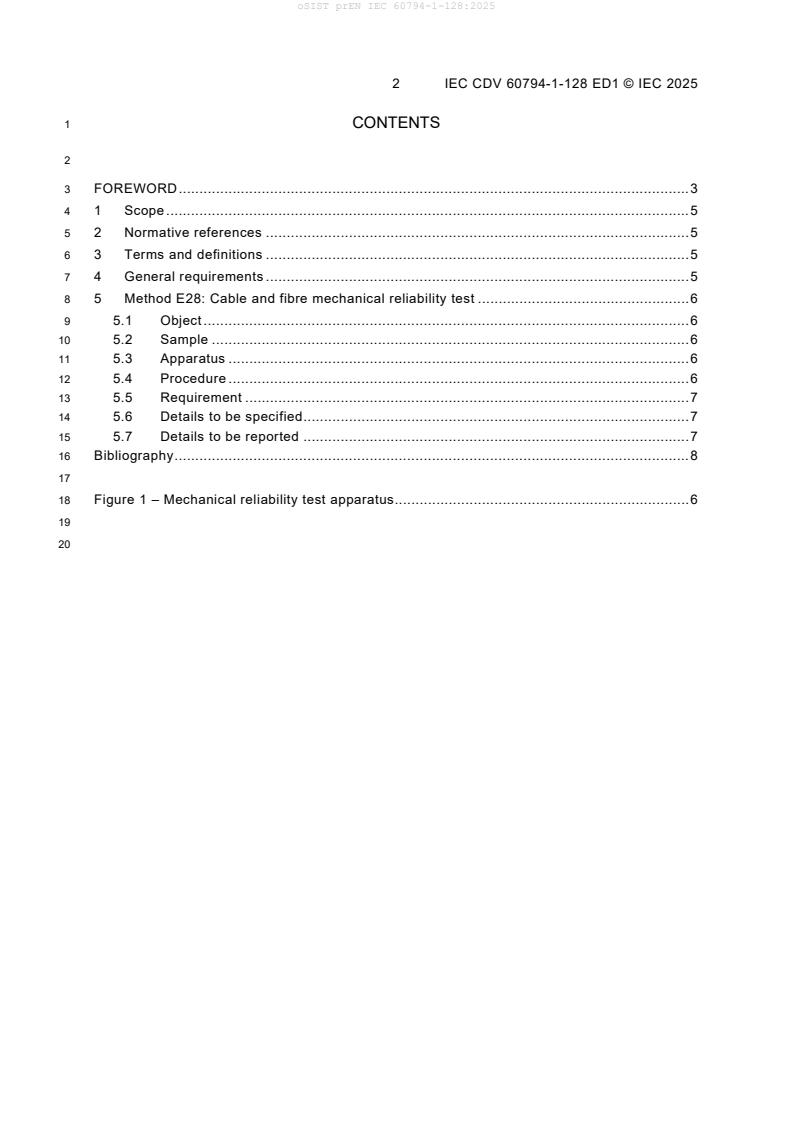
1 CONTENTS
3 FOREWORD . 3
4 1 Scope . 5
5 2 Normative references . 5
6 3 Terms and definitions . 5
7 4 General requirements . 5
8 5 Method E28: Cable and fibre mechanical reliability test . 6
9 5.1 Object . 6
10 5.2 Sample . 6
11 5.3 Apparatus . 6
12 5.4 Procedure . 6
13 5.5 Requirement . 7
14 5.6 Details to be specified . 7
15 5.7 Details to be reported . 7
16 Bibliography . 8
18 Figure 1 – Mechanical reliability test apparatus . 6
oSIST prEN IEC 60794-1-128:2025
IEC CDV 60794-1-128 ED1 © IEC 2025 3
21 INTERNATIONAL ELECTROTECHNICAL COMMISSION
22 ____________
24 OPTICAL FIBRE CABLES –
26 Part 1-128: Generic specification –
27 Basic optical cable test procedures –
28 Mechanical test methods – Cable and fibre mechanical reliability test,
29 Method E28
31 FOREWORD
32 1) The International Electrotechnical Commission (IEC) is a worldwide organization for standardization comprising
33 all national electrotechnical committees (IEC National Committees). The object of IEC is to promote international
34 co-operation on all questions concerning standardization in the electrical and electronic fields. To this end and
35 in addition to other activities, IEC publishes International Standards, Technical Specifications, Technical Reports,
36 Publicly Available Specifications (PAS) and Guides (hereafter referred to as “IEC Publication(s)”). Their
37 preparation is entrusted to technical committees; any IEC National Committee interested in the subject dealt with
38 may participate in this preparatory work. International, governmental and non-governmental organizations liaising
39 with the IEC also participate in this preparation. IEC collaborates closely with the International Organization for
40 Standardization (ISO) in accordance with conditions determined by agreement between the two organizations.
41 2) The formal decisions or agreements of IEC on technical matters express, as nearly as possible, an international
42 consensus of opinion on the relevant subjects since each technical committee has representation from all
43 interested IEC National Committees.
44 3) IEC Publications have the form of recommendations for international use and are accepted by IEC National
45 Committees in that sense. While all reasonable efforts are made to ensure that the technical content of IEC
46 Publications is accurate, IEC cannot be held responsible for the way in which they are used or for any
47 misinterpretation by any end user.
48 4) In order to promote international uniformity, IEC National Committees undertake to apply IEC Publications
49 transparently to the maximum extent possible in their national and regional publications. Any divergence between
50 any IEC Publication and the corresponding national or regional publication shall be clearly indicated in the latter.
51 5) IEC itself does not provide any attestation of conformity. Independent certification bodies provide conformity
52 assessment services and, in some areas, access to IEC marks of conformity. IEC is not responsible for any
53 services carried out by independent certification bodies.
54 6) All users should ensure that they have the latest edition of this publication.
55 7) No liability shall attach to IEC or its directors, employees, servants or agents including individual experts and
56 members of its technical committees and IEC National Committees for any personal injury, property damage or
57 other damage of any nature whatsoever, whether direct or indirect, or for costs (including legal fees) and
58 e
...