

oSIST prEN IEC 62310-1:2026
(Main)Static transfer systems (STS) - Part 1: General and safety requirements
General Information
- Abstract
- Status
- Not Published
- Public Enquiry End Date
- 14-Jun-2026
- Technical Committee
- MOV - Measuring equipment for electromagnetic quantities
- Current Stage
- 4020 - Public enquire (PE) (Adopted Project)
- Start Date
- 31-Mar-2026
- Due Date
- 18-Aug-2026
- Completion Date
- 08-Jul-2026

Overview
oSIST prEN IEC 62310-1:2026 sets out the general and safety requirements for static transfer systems (STS) used in low voltage power distribution networks. Developed by CLC in alignment with IEC standards, this document provides a comprehensive framework to ensure the safe operation, installation, testing, and maintenance of STS. It harmonizes requirements with IEC 62477-1:2022 and incorporates guidance to reduce risks associated with fire, electric shock, and mechanical hazards in both public and restricted access areas.
This second edition of the standard introduces important updates and clarifies technical details, supporting a consistent approach to safety and integration for STS equipment across applications.
Key Topics
- Scope & Applicability
- Applies to movable, stationary, or built-in STS in low voltage (≤1000 V AC) systems.
- Covers both pluggable and permanently connected equipment intended for use in areas accessible to ordinary or skilled persons.
- Safety Requirements
- Specifies protection measures against electric shock, short-circuit, overload, backfeed, and environmental effects.
- Provides requirements on AC power isolation to ensure safe servicing and maintenance.
- Backfeed & Neutral Management
- Mandates robust backfeed protection to mitigate the risk of voltage returning to disconnected terminals.
- Addresses management of neutral connections, particularly in multi-source systems, to prevent objectionable current and unintended operation of residual current devices (RCDs).
- Testing & Compliance
- Outlines detailed testing procedures for short-circuit withstand, insulation, impulse voltage, leakage current, and more.
- Adds sample and routine tests to verify compliance during production and integration.
- Product Marking and Information
- Requires clear marking and comprehensive instructions for installation, commissioning, and safe use.
Applications
Static transfer systems (STS) compliant with oSIST prEN IEC 62310-1:2026 are integral to ensuring uninterruptible power supplies and high-availability power networks. Key applications include:
- Data centers and critical IT infrastructure where fast, reliable source transfer is necessary to avoid power interruption.
- Industrial and manufacturing settings that require automatic or manual switching between power sources for safety or continuity reasons.
- Healthcare and emergency facilities reliant on stable power for sensitive equipment.
- Electric utilities and distributed networks deploying STS for network redundancy and load balancing.
Implementing this standard helps organizations achieve a higher level of electrical safety, equipment reliability, and compliance with international best practices for static transfer systems.
Related Standards
Organizations working with STS should be aware of the following related standards:
- IEC 62477-1:2022 - Safety requirements for power electronic converter systems and equipment.
- IEC 62310-2:2006 - Electromagnetic compatibility (EMC) requirements for static transfer systems.
- IEC 60947-6-1 - Transfer switching equipment requirements (for devices not covered by this standard).
- IEC 62040 series - Uninterruptible power systems (UPS), covering integrated automatic switching devices.
- IEC 61140 - Protection against electric shock; basic requirements for safety measures.
Adhering to oSIST prEN IEC 62310-1:2026 ensures compatibility and harmonization with these core standards in the design, installation, and operation of safe and effective static transfer systems.
Keywords: static transfer systems, STS, general safety requirements, oSIST prEN IEC 62310-1:2026, low voltage distribution, power electronic systems, backfeed protection, electrical safety, uninterruptible power supply, CLC standard.
Relations
- Revises
SIST EN 62310-1:2006 - Static transfer systems (STS) -- Part 1: General and safety requirements - Effective Date
- 26-Jan-2023
- Revised
SIST EN 62310-1:2006 - Static transfer systems (STS) -- Part 1: General and safety requirements - Effective Date
- 26-Jul-2021
Get Certified
Connect with accredited certification bodies for this standard

IMQ S.p.A. (Certification)
Italian electrical product certification.

SLG Prüf- und Zertifizierungs GmbH
German testing and certification body.

UL Solutions
Global safety science company with testing, inspection and certification.
Sponsored listings
Frequently Asked Questions
oSIST prEN IEC 62310-1:2026 is a draft published by the Slovenian Institute for Standardization (SIST). Its full title is "Static transfer systems (STS) - Part 1: General and safety requirements". This standard covers: Static transfer systems (STS) - Part 1: General and safety requirements
Static transfer systems (STS) - Part 1: General and safety requirements
oSIST prEN IEC 62310-1:2026 is classified under the following ICS (International Classification for Standards) categories: 29.240.99 - Other equipment related to power transmission and distribution networks. The ICS classification helps identify the subject area and facilitates finding related standards.
oSIST prEN IEC 62310-1:2026 has the following relationships with other standards: It is inter standard links to SIST EN 62310-1:2006, SIST EN 62310-1:2006. Understanding these relationships helps ensure you are using the most current and applicable version of the standard.
oSIST prEN IEC 62310-1:2026 is associated with the following European legislation: EU Directives/Regulations: 2014/35/EU; Standardization Mandates: M/511. When a standard is cited in the Official Journal of the European Union, products manufactured in conformity with it benefit from a presumption of conformity with the essential requirements of the corresponding EU directive or regulation.
oSIST prEN IEC 62310-1:2026 is available in PDF format for immediate download after purchase. The document can be added to your cart and obtained through the secure checkout process. Digital delivery ensures instant access to the complete standard document.
Standards Content (Sample)
SLOVENSKI STANDARD
01-junij-2026
Sistemi s statičnim prenosom (STS) - 1. del: Splošne in varnostne zahteve
Static transfer systems (STS) - Part 1: General and safety requirements
Statische Transferschalter (STS) - Teil 1: Allgemeine und Sicherheitsanforderungen
Systèmes de transfert statique (STS) - Partie 1: Exigences générales et règles de
sécurité
Ta slovenski standard je istoveten z: prEN IEC 62310-1:2026
ICS:
29.240.99 Druga oprema v zvezi z Other equipment related to
omrežji za prenos in power transmission and
distribucijo električne energije distribution networks
2003-01.Slovenski inštitut za standardizacijo. Razmnoževanje celote ali delov tega standarda ni dovoljeno.
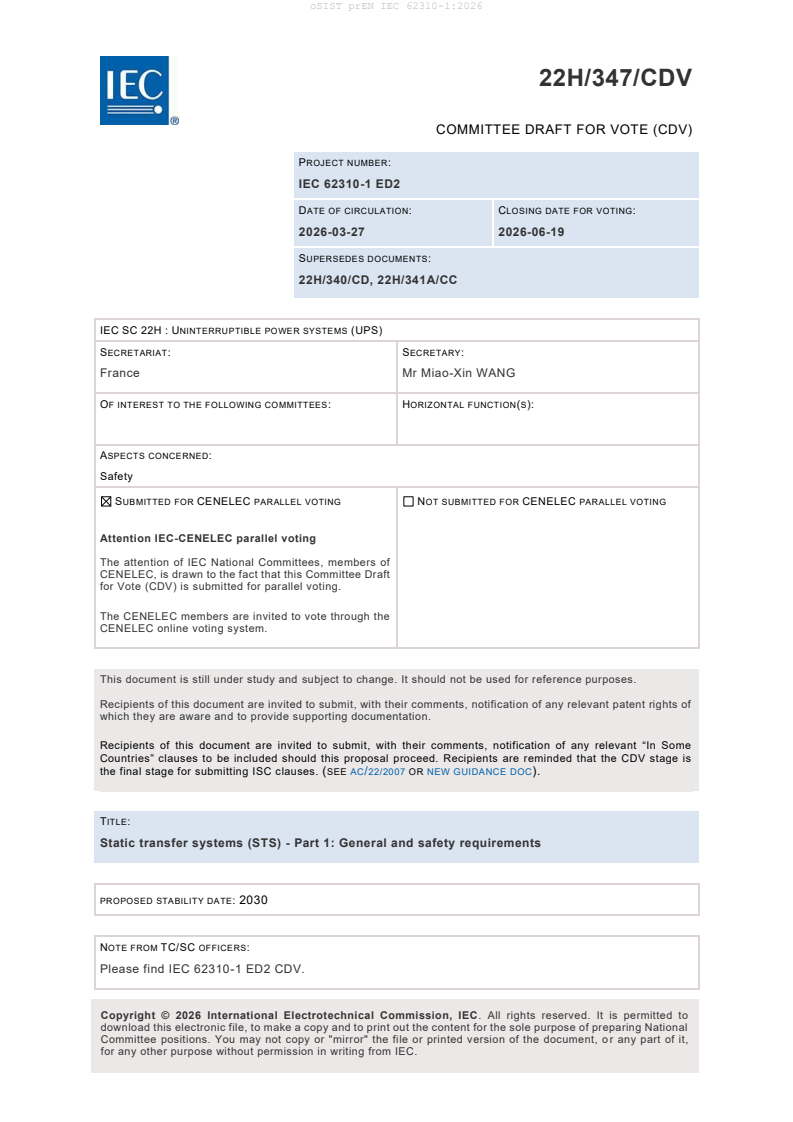
22H/347/CDV
COMMITTEE DRAFT FOR VOTE (CDV)
PROJECT NUMBER:
IEC 62310-1 ED2
DATE OF CIRCULATION: CLOSING DATE FOR VOTING:
2026-03-27 2026-06-19
SUPERSEDES DOCUMENTS:
22H/340/CD, 22H/341A/CC
IEC SC 22H : UNINTERRUPTIBLE POWER SYSTEMS (UPS)
SECRETARIAT: SECRETARY:
France Mr Miao-Xin WANG
OF INTEREST TO THE FOLLOWING COMMITTEES: HORIZONTAL FUNCTION(S):
ASPECTS CONCERNED:
Safety
SUBMITTED FOR CENELEC PARALLEL VOTING NOT SUBMITTED FOR CENELEC PARALLEL VOTING
Attention IEC-CENELEC parallel voting
The attention of IEC National Committees, members of
CENELEC, is drawn to the fact that this Committee Draft
for Vote (CDV) is submitted for parallel voting.
The CENELEC members are invited to vote through the
CENELEC online voting system.
This document is still under study and subject to change. It should not be used for reference purposes.
Recipients of this document are invited to submit, with their comments, notification of any relevant patent rights of
which they are aware and to provide supporting documentation.
Recipients of this document are invited to submit, with their comments, notification of any relevant “In Some
Countries” clauses to be included should this proposal proceed. Recipients are reminded that the CDV stage is
the final stage for submitting ISC clauses. (SEE AC/22/2007 OR NEW GUIDANCE DOC).
TITLE:
Static transfer systems (STS) - Part 1: General and safety requirements
PROPOSED STABILITY DATE: 2030
NOTE FROM TC/SC OFFICERS:
Please find IEC 62310-1 ED2 CDV.
download this electronic file, to make a copy and to print out the content for the sole purpose of preparing National
Committee positions. You may not copy or "mirror" the file or printed version of the document, o r any part of it,
for any other purpose without permission in writing from IEC.
IEC CDV 62310-1 ED2 © IEC 2026
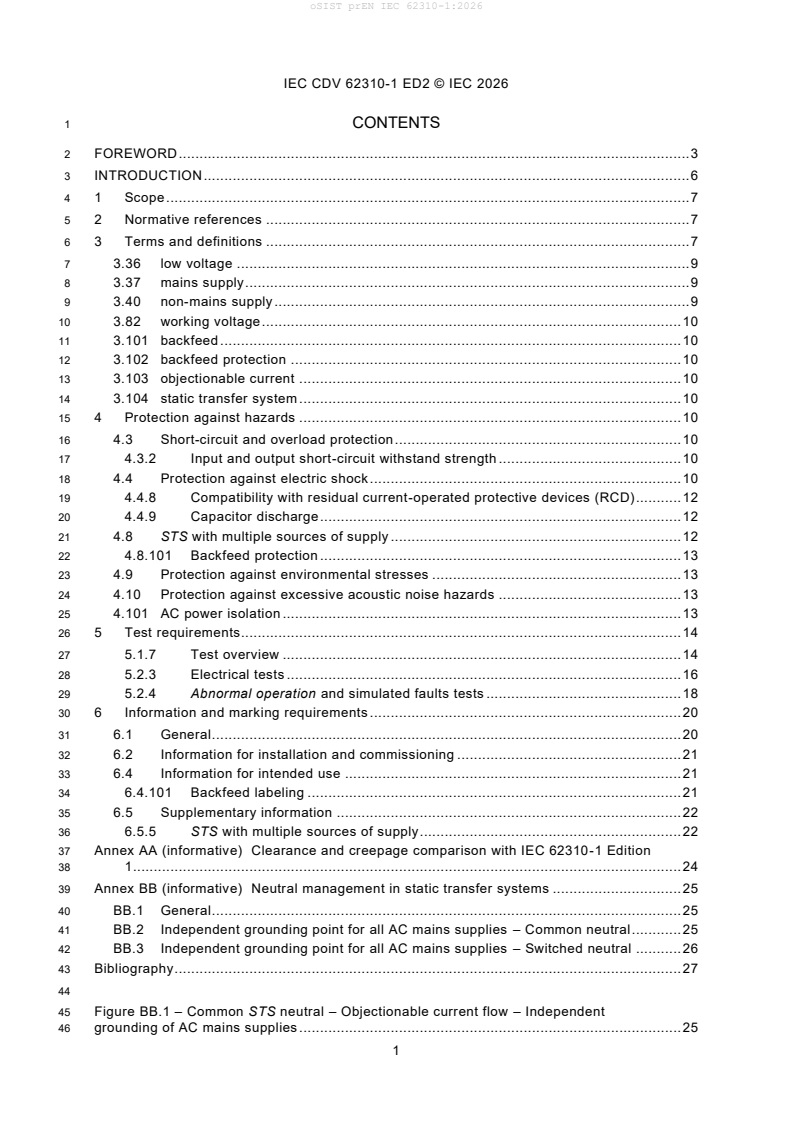
1 CONTENTS
2 FOREWORD . 3
3 INTRODUCTION . 6
4 1 Scope . 7
5 2 Normative references . 7
6 3 Terms and definitions . 7
7 3.36 low voltage . 9
8 3.37 mains supply . 9
9 3.40 non-mains supply . 9
10 3.82 working voltage . 10
11 3.101 backfeed . 10
12 3.102 backfeed protection . 10
13 3.103 objectionable current . 10
14 3.104 static transfer system . 10
15 4 Protection against hazards . 10
16 4.3 Short-circuit and overload protection . 10
17 4.3.2 Input and output short-circuit withstand strength . 10
18 4.4 Protection against electric shock . 10
19 4.4.8 Compatibility with residual current-operated protective devices (RCD) . 12
20 4.4.9 Capacitor discharge . 12
21 4.8 STS with multiple sources of supply . 12
22 4.8.101 Backfeed protection . 13
23 4.9 Protection against environmental stresses . 13
24 4.10 Protection against excessive acoustic noise hazards . 13
25 4.101 AC power isolation . 13
26 5 Test requirements. 14
27 5.1.7 Test overview . 14
28 5.2.3 Electrical tests . 16
29 5.2.4 Abnormal operation and simulated faults tests . 18
30 6 Information and marking requirements . 20
31 6.1 General . 20
32 6.2 Information for installation and commissioning . 21
33 6.4 Information for intended use . 21
34 6.4.101 Backfeed labeling . 21
35 6.5 Supplementary information . 22
36 6.5.5 STS with multiple sources of supply. 22
37 Annex AA (informative) Clearance and creepage comparison with IEC 62310-1 Edition
38 1 . 24
39 Annex BB (informative) Neutral management in static transfer systems . 25
40 BB.1 General . 25
41 BB.2 Independent grounding point for all AC mains supplies – Common neutral . 25
42 BB.3 Independent grounding point for all AC mains supplies – Switched neutral . 26
43 Bibliography . 27
45 Figure BB.1 – Common STS neutral – Objectionable current flow – Independent
46 grounding of AC mains supplies . 25
IEC CDV 62310-1 ED2 © IEC 2026
47 Figure BB.2 – Switched STS neutral – Objectionable current flow – Independent
48 grounding of AC mains supplies . 26
50 Table 1 – Alphabetical list of terms . 8
51 Table 101 – Overvoltage categories . 11
52 Table 23 – Test overview . 14
53 Table 32 – AC short-time withstand current test, minimum STS requirements . 19
54 Table 40 – Marking location . 20
IEC CDV 62310-1 ED2 © IEC 2026
57 INTERNATIONAL ELECTROTECHNICAL COMMISSION
58 ____________
60 STATIC TRANSFER SYSTEMS (STS)
62 Part 1: General and safety requirements
66 FOREWORD
67 1) The International Electrotechnical Commission (IEC) is a worldwide organization for standardization comprising
68 all national electrotechnical committees (IEC National Committees). The object of IEC is to promote international
69 co-operation on all questions concerning standardization in the electrical and electronic fields. To this end and
70 in addition to other activities, IEC publishes International Standards, Technical Specifications, Technical Reports,
71 Publicly Available Specifications (PAS) and Guides (hereafter referred to as "IEC Publication(s)"). Their
72 preparation is entrusted to technical committees; any IEC National Committee interested in the subject dealt with
73 may participate in this preparatory work. International, governmental and non-governmental organizations liaising
74 with the IEC also participate in this preparation. IEC collaborates closely with the International Organization for
75 Standardization (ISO) in accordance with conditions determined by agreement between the two organizations.
76 2) The formal decisions or agreements of IEC on technical matters express, as nearly as possible, an international
77 consensus of opinion on the relevant subjects since each technical committee has representation from all
78 interested IEC National Committees.
79 3) IEC Publications have the form of recommendations for international use and are accepted by IEC National
80 Committees in that sense. While all reasonable efforts are made to ensure that the technical content of IEC
81 Publications is accurate, IEC cannot be held responsible for the way in which they are used or for any
82 misinterpretation by any end user.
83 4) In order to promote international uniformity, IEC National Committees undertake to apply IEC Publications
84 transparently to the maximum extent possible in their national and regional publications. Any divergence between
85 any IEC Publication and the corresponding national or regional publication shall be clearly indicated in the latter.
86 5) IEC itself does not provide any attestation of conformity. Independent certification bodies provide conformity
87 assessment services and, in some areas, access to IEC marks of conformity. IEC is not responsible for any
88 services carried out by independent certification bodies.
89 6) All users should ensure that they have the latest edition of this publication.
90 7) No liability shall attach to IEC or its directors, employees, servants or agents including individual experts and
91 members of its technical committees and IEC National Committees for any personal injury, property damage or
92 other damage of any nature whatsoever, whether direct or indirect, or for costs (including legal fees) and
93 expenses arising out of the publication, use of, or reliance upon, this IEC Publication or any other IEC
94 Publications.
95 8) Attention is drawn to the Normative references cited in this publication. Use of the referenced publications is
96 indispensable for the correct application of this publication.
97 9) IEC draw attention to the possibility that the implementation of this document may involve the use of (a) patent(s).
98 IEC take no position concerning the evidence, validity or applicability of any claimed patent rights in respect
99 thereof. As of the date of publication of this document, IEC had not received notice of (a) patent(s), which may
100 be required to implement this document. However, implementers are cautioned that this may not represent the
101 latest information, which may be obtained from the patent database available at https://patents.iec.ch. IEC shall
102 not be held responsible for identifying any or all such patent rights.
103 IEC 62310-1 has been prepared by subcommittee 22H: Uninterruptible Power Systems, of IEC
104 technical committee 22: Power electronic systems and equipment. It is an International
105 Standard.
106 This 2.0 edition cancels and replaces the 1.0 edition published in march 2005. This edition
107 constitutes a technical revision.
108 This edition includes the following significant technical changes with respect to the previous
109 edition:
IEC CDV 62310-1 ED2 © IEC 2026
110 a) the reference document has been changed from IEC 60950-1:2005 (Information technology
111 equipment – Safety – Part 1: General requirements) to IEC 62477-1:2022 (Safety
112 requirements for power electronic converter systems and equipment – Part 1: General);
113 b) addition of Table 101, minimum overvoltage categories in 4.4.7.1.4;
114 c) add line-to-line voltage for components bridging insulation in 4.4.7.1.8;
115 d) compatibility with residual current operated protective devices (RCD) and expanded
116 requirement for 4 poles STS in 4.4.8;
117 e) STS with multiple sources of supply in 4.8;
118 f) protection against environmental stresses added in 4.9;
119 g) backfeed protection, previously in IEC 62310-3:2008, 5.2.9 and Annex G is added in
120 4.8.101;
121 h) AC power isolation, previously in IEC 62310-3:2008, 5.2.1 is added in 4.101;
122 i) short-time withstand current test method added in 5.2.4.4.3.2;
123 j) clearance and creepage comparison from Edition 1 to Edition 2 in Annex AA;
124 k) neutral management, previously in IEC 62310-3:2008, Annex D is added in Annex BB.
125 The text of this International Standard is based on the following documents:
Draft Report on voting
XX/XX/FDIS XX/XX/RVD
127 Full information on the voting for its approval can be found in the report on voting indicated in
128 the above table.
129 The language used for the development of this International Standard is English.
130 The provisions of the general rules dealt within IEC 62477-1:2022 are only applicable to this
131 document insofar as they are specifically cited. Clauses and subclauses of IEC 62477 -1:2022
132 that are applicable in this document are identified by reference to IEC 62477-1:2022, for
133 example, "Clause 4 of IEC 62477-1:2022 applies, except as follows".
134 The exceptions are then listed.
135 The exceptions can take the form of a deletion, a replacement or an addition of subclauses,
136 tables, figures or annexes.
137 Subclauses, tables and figures that are additional to those of IEC 62477-1:2022 are, in this
138 document, identified by a suffix in the format of X.10x, for example 4.3.101.
139 Annexes that are additional to those of IEC 62477-1:2022 are, in this document, lettered AA,
140 BB, etc.
141 This document was drafted in accordance with ISO/IEC Directives, Part 2, and developed in
142 accordance with ISO/IEC Directives, Part 1 and ISO/IEC Directives, IEC Supplement, and
143 ISO/IEC Directives, IEC Supplement available at www.iec.ch/members_experts/refdocs. The
144 main document types developed by IEC are described in greater detail at
145 www.iec.ch/publications.
146 A list of all the parts in the IEC 62477 series, published under the general title Safety
147 requirements for power electronic convertor systems and equipment can be found on the IEC
148 website.
149 A list of all the parts in the IEC 62310 series, published under the general title Static transfer
150 systems (STS) can be found on the IEC website.
IEC CDV 62310-1 ED2 © IEC 2026
151 In this document, terms in italic are defined in Clause 3.
152 NOTE Due to the requirement in ISO/IEC directive part 2 the defined term is in singular. In this document also the
153 plural is in italic.
154 The committee has decided that the contents of this document will remain unchanged until the
155 stability date indicated on the IEC website under webstore.iec.ch in the data related to the
156 specific document. At this date, the document will be
157 • reconfirmed,
158 • withdrawn,
159 • replaced by a revised edition, or
160 • amended.
IMPORTANT – The 'colour inside' logo on the cover page of this publication indicates
that it contains colours which are considered to be useful for the correct understanding
of its contents. Users should therefore print this document using a colour printer.
IEC CDV 62310-1 ED2 © IEC 2026
163 INTRODUCTION
164 IEC technical sub-committee 22H: Uninterruptible Power Systems (UPS) carefully considered
165 the relevance of each paragraph of IEC 62477-1:2022 in static transfer systems (STS)
166 applications. This part of IEC 62310 utilizes IEC 62477-1:2022 as a reference document (RD).
167 It adds, replaces or modifies requirements as relevant. This is because product-specific topics
168 not covered by the reference document are the responsibility of the technical committee using
169 the reference document.
170 IEC 62477-1:2022 relates to products that include power electronic converters, with a rated
171 system voltage not exceeding 1 000 V AC or 1 500 V DC. It specifies requirements to reduce
172 risks of fire, electric shock, thermal, energy and mechanical hazards, except functional safety
173 as defined in all parts of IEC 61508 series. The objectives of this document are to establish a
174 common terminology and basis for the safety requirements of products that contain power
175 electronic converters across several IEC technical committees.
176 IEC 62477-1:2022 has been developed with the intention
177 • to be used as a reference document for product committees inside TC 22 in the development
178 of product standards for power electronic converter systems and equipment,
179 • to replace IEC 62103 as a product family standard providing minimum requirements for
180 safety aspects of power electronic converter systems and equipment in apparatus for which
181 no product standard exists, and
182 NOTE The scope of IEC 62103 contains reliability and electromagnetic compatibility aspects, which are not covered
183 by this document.
184 • to be used as a reference document for product committees outside TC 22 in the
185 development of product standards of power electronic converter systems and equipment
186 intended renewable energy sources. TC 82, TC 88, TC 105, TC 114 and TC 121, in
187 particular, have been identified as relevant technical committees at the time of publication.
188 The reference document IEC 62477-1:2022, being a group safety standard, will not take
189 precedence over this product-specific standard according to IEC Guide 104. IEC Guide 104
190 provides information about the responsibility of product committees to use group safety
191 standards for the development of their own product standards.
IEC CDV 62310-1 ED2 © IEC 2026
193 STATIC TRANSFER SYSTEMS (STS)
195 Part 1: General and safety requirements
196 1 Scope
197 This part of IEC 62310 applies to movable, stationary, fixed, open type or built-in STS for use
198 in low voltage distribution systems and that are intended to be installed in an area accessible
199 by an ordinary person or in a restricted access area as applicable. STS is intended to operate
200 on fixed frequency, single phase or multi-phase system, with rated voltage not exceeding
201 1 000 V AC. It applies to pluggable and to permanently connected STS, whether consisting of
202 a system of interconnected units or of independent units, subject to installing, operating and
203 maintaining the STS in the manner prescribed by the manufacturer.
204 This document specifies requirements to ensure safety for the ordinary person who comes into
205 contact with the STS and, where specifically stated, for the skilled person. The objective is to
206 reduce risks of fire, electric shock, thermal, energy and mechanical hazards during use and
207 operation and, where specifically stated, during service and maintenance.
208 This part of IEC 62310 includes requirements for the switching elements, their control and
209 protective elements, where applicable. This part of IEC 62310 also includes information for the
210 overall integration of the STS and its accessories into the low voltage AC power distribution
211 system.
212 Components or devices necessary for the operation, control, protection and isolation (e.g.
213 circuit breakers, fuses, transformers, relays, etc.) of an STS should comply with the
214 requirements of the relevant IEC standards and are not covered by this part of IEC 62310.
215 This document is harmonized with the applicable parts of group safety publication IEC 62477 -
216 1:2022 for power electronic converter systems and contains additional requirements relevant to
217 STS.
218 This document does not apply to:
219 • devices for DC source switching
220 • transfer switching equipment (TSE) covered by IEC 60947-6-1
221 • the automatic switching devices integrated into UPS covered by IEC 62040 series
222 2 Normative references
223 Clause 2 of IEC 62477-1:2022 applies, except as follows:
224 Add the following normative references:
225 IEC 62310-2:2006, static transfer systems (STS) - Part 2: Electromagnetic compatibility (EMC)
226 requirements
227 IEC 62477-1:2022, Safety requirements for power electronic converter systems and equipment
228 – Part 1: General
229 3 Terms and definitions
230 Clause 3 of IEC 62477-1:2022 applies, except as follows:
IEC CDV 62310-1 ED2 © IEC 2026
231 Replace table 1 of IEC 62477-1:2022 with the following table:
232 Table 1 – Alphabetical list of terms
Terms Term number Terms Term number
62310-1 62477-1 62310-1 62477-1
abnormal operating 3.1 objectionable current 3.103
condition
abnormal operation
accessible 3.2 open type STS 3.41
accessory 3.3 ordinary person 3.43
adjacent circuit 3.4 output short-circuit current 3.44
backfeed 3.101 overcurrent protective device 3.45
(OCPD)
backfeed protection 3.102 overvoltage category (OVC) 3.46
basic insulation 3.5 PE 3.47
basic protection 3.6 PE conductor 3.49
class I equipment 3.7 peak withstand current (I ) 3.48
pk
class II equipment 3.8 permanently connected 3.50
equipment
class III equipment 3.9 pluggable equipment type A 3.51
clearance 3.10 pluggable equipment type B 3.52
commissioning test 3.11 pollution degree 3.53
component 3.12 port 3.54
conditional short-circuit 3.13 power electronic converter 3.55
current (I ) (PEC)
cc
creepage distance 3.14 power electronic converter 3.56
system (PECS)
decisive voltage class
3.15 power semiconductor device 3.57
(DVC)
de-energized 3.16 prospective short-circuit 3.58
current (Icp)
direct plug-in equipment 3.18 protective equipotential 3.59
bonding
double insulation 3.17 protective impedance 3.60
DVC As 3.19 reinforced insulation 3.62
DVC B 3.20 restricted access area 3.63
DVC C 3.21 routine test 3.64
IEC CDV 62310-1 ED2 © IEC 2026
electric breakdown 3.22 sample test 3.65
electrical insulation 3.23 service access area 3.66
electrically protective 3.61 short-circuit backup protection 3.67
screening
electronic power 3.24 short-circuit protective device 3.68
conversion (SCPD)
enclosure 3.25 short-time withstand current 3.69
(I )
cw
enhanced protection 3.26 single fault condition 3.70
fault protection 3.27 skilled person 3.71
field wiring terminal 3.28 solid insulation 3.72
fire enclosure 3.29 static transfer system (STS) 3.104
functional insulation 3.30 supplementary insulation 3.73
general access area 3.42 surge protective device (SPD) 3.74
hand-held equipment 3.31 system 3.75
hazardous live part 3.32 system voltage 3.76
impulse withstand voltage 3.34 temporary overvoltage 3.77
installation 3.33 touch current 3.78
live part 3.35 type test 3.79
low voltage (LV) 3.36 ventricular fibrillation 3.80
mains supply 3.37 visual inspection 3.81
minimum required 3.38 working voltage 3.82
prospective short-circuit
current (I )
cp,mr
movable equipment 3.39 zone of equipotential bonding 3.83
non-mains supply 3.40
234 Add the following modified or new terms and definitions, and new notes
235 3.36
236 low voltage
237 LV
238 set of voltage levels used for the distribution of electricity and whose upper limit is generally
239 accepted to be 1 000 V for alternating current
240 [SOURCE: IEC 60050-601:1985, 601-01-26]
241 3.37
242 mains supply
243 low voltage AC power distribution system for supplying power to STS
244 3.40
245 non-mains supply
246 low voltage AC power network that is not energized directly from the AC mains supply
247 Note 1 to entry: Examples of non-mains supplies are those which are isolated by a transformer or supplied by a
248 generator, solar arrays, wind generator, tidal wave systems or similar sources not directly connected to the low
249 voltage AC power distribution system.
IEC CDV 62310-1 ED2 © IEC 2026
250 3.82
251 working voltage
252 AC voltage, at rated supply conditions (without tolerances) and worst-case operating conditions,
253 including RMS, recurring peak and mean values that occurs by design in a circuit or across
254 protection means
255 3.101
256 backfeed
257 condition in which a voltage or energy from one of its sources is available at the other source
258 Note 1 to entry : the feeding back might depend on the operating mode and can be either directly or during a single -
259 fault condition
260 3.102
261 backfeed protection
262 control scheme that reduces the risk of electric shock due to backfeed
263 [SOURCE IEC 62040-1:2017]
264 3.103
265 objectionable current
266 load current that, during normal operation and/or transfers, flows in paths other than those
267 intended and creates interference to the proper sensing and operation of ground-fault residual
268 current devices (RCDs)
269 3.104
270 static transfer system
271 STS
272 system that transfers a load, either by static means or by a combination of static and
273 electromechanical means, between a preferred source and an alternate source.
274 Note 1 to entry: the transfer may be automatic and/or manual
275 Note 2 to entry: the transfer may be with or without interruption
276 4 Protection against hazards
277 Clause 4 of IEC 62477-1:2022 applies, except as follows:
278 4.3 Short-circuit and overload protection
279 Subclause 4.3 of IEC 62477-1:2022 applies, except as follows:
280 Change 4.3.2 title as follows:
281 4.3.2 Input and output short-circuit withstand strength
282 Subclauses 4.3.2.4 and 4.3.2.5 of IEC 62477-1:2022 do not apply.
283 4.4 Protection against electric shock
284 Subclause 4.4 of IEC 62477-1:2022 applies, except as follows:
IEC CDV 62310-1 ED2 © IEC 2026
285 4.4.7.1.4 Overvoltage category (OVC)
286 Subclause 4.4.7.1.4 of IEC 62477-1:2022 applies, except as follows:
287 After the fifth paragraph, add the following text:
288 As a minimum, the STS shall be suitable for installation in environments presenting overvoltage
289 categories listed in Table 101.
290 Table 101 – Overvoltage categories
Rated STS current I (r.m.s.) Overvoltage category
a
A OVC
I 16 II
b
16 I 75 II
b
75 I 400 II
400 I 500 III
500 I III
NOTE the OVC to which the critical load is subjected is that of the STS input. This can be reduced through
overvoltage reduction techniques (see IEC 62477-1:2022, Annex I).
a
The OVC specified represent those of typical installations in accordance with 4.4.7.1.4. Different OVC can
apply under special conditions (see IEC 62477-1:2022, Annex I).
b
OVC II can be selected if the STS is not subjected to special requirements with regard to reliability and
availability, otherwise OVC III shall be selected.
291 4.4.7.1.6 Determination of impulse withstand voltage and temporary overvoltage
292 Subclause 4.4.7.1.6 of IEC 62477-1:2022 applies except as follows:
293 Add the following text after the second paragraph:
294 DC system voltage values are not applicable to STS.
295 4.4.7.1.7.1 For mains supply
296 Subclause 4.4.7.1.7.1 of IEC 62477-1:2022 applies, except as follows:
297 The third paragraph does not apply.
298 4.4.7.1.7.2 For non-mains supply
299 Subclause 4.4.7.1.7.2 of IEC 62477-1:2022 is replaced by the following:
300 For STS supplied by non-mains supply, the system voltage is the RMS value of the supply.
301 4.4.7.1.8 Components bridging insulation
302 Subclause 4.4.7.1.8 of IEC 62477-1:2022 applies, except as follows:
303 Add the following text before the first paragraph:
304 For STS to be connected to IT systems, components connected between line and earth shall
305 be rated for the line-to-line voltage.
IEC CDV 62310-1 ED2 © IEC 202
...