


SIST EN ISO 16256:2021
(Main)Clinical laboratory testing and in vitro diagnostic test systems - Broth micro-dilution reference method for testing the in vitro activity of antimicrobial agents against yeast fungi involved in infectious diseases (ISO 16256:2021)
Clinical laboratory testing and in vitro diagnostic test systems - Broth micro-dilution reference method for testing the in vitro activity of antimicrobial agents against yeast fungi involved in infectious diseases (ISO 16256:2021)
This document describes a method for testing the susceptibility to antifungal agents of yeasts, including Candida spp. and Cryptococcus neoformans, that cause infections. The reference method described here has not been used in studies of the yeast forms of dimorphic fungi, such as Blastomyces dermatitidis and/or Histoplasma capsulatum variety capsulatum. Moreover, testing filamentous fungi (moulds) introduces several additional problems in standardization not addressed by the current procedure. Those methods are beyond the scope of this document.
This document describes the broth micro-dilution reference method, which can be implemented by either of two pathways. One pathway involves visual determination of MICs (CLSI method)[1][5]; the second pathway involves spectrophotometric determination of MICs (EUCAST method)[2][10]. The MIC reflects the activity of the drug under the described test conditions and can be interpreted for clinical management purposes by taking into account other factors, such as drug pharmacology or antifungal resistance mechanisms. In addition, MIC distributions can be used to define wild type or non-wild type fungal populations. Clinical interpretation of the MIC value is beyond the scope of this document; interpretive category breakpoints specific to the CLSI- and EUCAST-derived methods can be found by consulting the latest interpretive tables provided by the organizations[5][15]. Routine susceptibility testing methods or diagnostic test devices can be compared with this reference method in order to ensure comparable and reliable results for validation or registration purposes.
Labormedizinische Untersuchungen und In-vitro-Diagnostika-Systeme - Referenzmethode zur Testung der In-vitro-Aktivität von antimikrobiellen Substanzen gegen Pilze, die Infektionskrankheiten verursachen (ISO 16256:2021)
Dieses Dokument beschreibt eine Methode zur Empfindlichkeitsprüfung von Sprosspilzen gegen Antimykotika, einschließlich Candida spp. und Cryptococcus neoformans, die Infektionen verursachen. Das hier beschriebene Referenzverfahren wurde nicht bei Untersuchungen der Hefeformen dimorpher Pilze, wie z. B. Blastomyces dermatitidis und/oder Histoplasma capsulatum Varietät capsulatum angewendet. Außerdem führt die Prüfung von fadenförmigen Pilzen (Schimmelpilzen) zu verschiedenen zusätzlichen Problemen hinsichtlich der Standardisierung, die in dem vorliegenden Verfahren nicht behandelt werden. Diese Methoden liegen außerhalb des Anwendungsbereiches dieses Dokuments.
Dieses Dokument beschreibt die Referenzmethode der Bouillon-Mikrodilution, die auf eine von zwei Weisen umgesetzt werden kann. Eine Weise umfasst die visuelle Bestimmung von MHKs (CLSI Methode) [1] [5]; die zweite die spektrophotometrische Bestimmung von MHKs (EUCAST Methode) [2 10]. Die MHK spiegelt die Aktivität des Wirkstoffs unter den beschriebenen Prüfbedingungen wider und kann unter Berücksichtigung anderer Faktoren, wie z. B. der Pharmakologie des Wirkstoffs oder antimykotischer Resistenzmechanismen, für die Zwecke der klinischen Behandlung interpretiert werden. Die Verteilung der MHK Werte kann zudem dazu dienen, Wildtyp-Pilzpopulationen von Nicht-Wildtyp-Pilzpopulationen zu unterscheiden. Die klinische Interpretation der MHK Werte fällt nicht in den Anwendungsbereich dieses Dokuments; erläuternde Grenzwerte für die Kategorien, die für die von CLSI und EUCAST abgeleiteten Methoden spezifisch sind, können durch Hinzuziehen der von den Organisationen bereitgestellten aktuellen Interpretationstabellen [5 15] ermittelt werden. Die Routinemethoden oder Diagnosegeräte zur Empfindlichkeitsprüfung können mit dieser Referenzmethode verglichen werden, um vergleichbare und zuverlässige Ergebnisse für Validierungs- oder Registrierungszwecke sicherzustellen.
WARNUNG — Die Anwendung dieses Dokuments kann mit der Anwendung gefährlicher Stoffe, Verfahrensschritte und Ausrüstungsgegenstände verbunden sein. Dieses Dokument erhebt nicht den Anspruch, dass alle mit seiner Anwendung verbundenen Sicherheitsprobleme angesprochen werden. Es liegt in der Verantwortung des Anwenders dieses Dokuments, geeignete Vorkehrungen für den Arbeits- und Gesundheitsschutz zu treffen und vor der Anwendung die Anwendbarkeit einschränkender Vorschriften zu bestimmen.
Laboratoires d’analyses de biologie médicale et systèmes de diagnostic in vitro - Méthode de référence de microdilution en milieu liquide pour soumettre à essai l’activité in vitro des agents antimicrobiens par rapport aux levures impliquées dans les maladies infectieuses (ISO 16256:2021)
Le présent document décrit une méthode d’essai de la sensibilité aux agents antifongiques des levures pathogènes, dont Candida spp. et Cryptococcus neoformans. La méthode de référence décrite ici n’a pas été utilisée dans des études sur les phases levures de champignons dimorphes tels que Blastomyces dermatitidis et/ou Histoplasma capsulatum variété capsulatum. En outre, les essais sur les champignons filamenteux (moisissures) posent d’autres problèmes de normalisation qui ne sont pas traités par le présent mode opératoire. Ces méthodes vont au-delà du domaine d’application du présent document.
Le présent document décrit la méthode de référence de microdilution en milieu liquide qui peut être réalisée de deux façons. La première implique une détermination visuelle de la CMI (méthode CLSI)[1][5]; la seconde implique une détermination spectrophotométrique de la CMI (méthode EUCAST)[2][10]. La CMI reflète l’activité de l’agent antimicrobien dans les conditions d’essai décrites et peut, avec d’autres facteurs tels que la pharmacologie de l’agent ou les mécanismes de résistance antifongique, servir dans la prise de décision de traitement clinique. Par ailleurs, les CMI peuvent servir à définir les populations en types sauvage ou non sauvage. L’interprétation clinique de la CMI sort du domaine d’application du présent document. Des critères d’interprétation catégoriels spécifiques aux méthodes du CLSI et de l’EUCAST sont donnés dans les derniers tableaux d’interprétation édités par ces organismes[5][15]. Dans le cadre d’une validation ou d’un enregistrement, les méthodes d’essai de sensibilité de routine ou les dispositifs de diagnostic peuvent être comparés avec la présente méthode de référence, afin de garantir des résultats comparables et fiables.
Klinično laboratorijsko preskušanje ter diagnostični preskusni sistemi in vitro - Referenčna metoda za preskušanje aktivnosti in vitro antimikrobnih snovi proti glivam kvasovkam, ki povzročajo infekcijske bolezni (ISO 16256:2021)
General Information
- Status
- Published
- Public Enquiry End Date
- 19-Apr-2021
- Publication Date
- 15-Nov-2021
- Technical Committee
- VAZ - Healthcare
- Current Stage
- 6060 - National Implementation/Publication (Adopted Project)
- Start Date
- 04-Nov-2021
- Due Date
- 09-Jan-2022
- Completion Date
- 16-Nov-2021
Relations
- Effective Date
- 01-Dec-2021
Overview
EN ISO 16256:2021 - Clinical laboratory testing and in vitro diagnostic test systems - specifies the broth micro-dilution reference method for determining the in vitro activity of antimicrobial (antifungal) agents against yeast fungi that cause infectious diseases. This European adoption of ISO 16256:2021 provides a standardized reference procedure to measure minimum inhibitory concentrations (MICs) for organisms such as Candida spp. and Cryptococcus neoformans. The standard does not cover dimorphic yeast forms (e.g., Blastomyces, Histoplasma) or filamentous fungi (moulds).
Key topics and technical requirements
- Test method: Broth micro-dilution using disposable micro-dilution trays; title includes “broth micro-dilution” to emphasize the procedure.
- Two reading pathways:
- Visual determination of MICs (aligned with CLSI methods)
- Spectrophotometric determination of MICs (aligned with EUCAST methods)
- Medium specification: Detailed guidance on RPMI-1640 formulation shown to give reproducible antifungal susceptibility results.
- Antifungal agents: Preparation of stock and working solutions; the 2021 edition adds newer agents (e.g., isavuconazole, rezafungin) to testing and QC ranges.
- Inoculum and incubation: Procedures for inoculum preparation, inoculation of trays, and incubation conditions for both reading pathways.
- Reading and interpretation: How to determine MICs; clinical interpretation and clinical breakpoints are outside the document’s scope - users should consult CLSI and EUCAST interpretive tables for breakpoints.
- Quality control (QC): QC strains and procedures to validate test performance and ensure reproducibility.
- Annexes and references: Informative annexes for RPMI-1640 composition, McFarland standards, and an updated bibliography relevant to antifungal susceptibility testing.
Applications and who uses it
- Clinical microbiology laboratories performing antifungal susceptibility testing for patient management and resistance surveillance.
- Regulatory and diagnostic developers validating or registering routine susceptibility tests and in vitro diagnostic devices against a recognized reference method.
- Research and pharmaceutical labs comparing new antifungal agents or conducting epidemiological studies of antifungal resistance.
- Public health and surveillance programs tracking MIC distributions to define wild-type vs non-wild-type populations.
Related standards and guidance
- CLSI and EUCAST method documents and interpretive breakpoint tables for clinical category assignment (susceptible, intermediate, resistant) - consult the latest tables from these organizations.
- ISO/TC 212 and CEN/TC 140 guidance on in vitro diagnostic test systems and standardization practices.
EN ISO 16256:2021 is essential for consistent, reproducible antifungal susceptibility testing by broth micro-dilution and supports harmonized laboratory practice across clinical, regulatory and research settings.


Frequently Asked Questions
SIST EN ISO 16256:2021 is a standard published by the Slovenian Institute for Standardization (SIST). Its full title is "Clinical laboratory testing and in vitro diagnostic test systems - Broth micro-dilution reference method for testing the in vitro activity of antimicrobial agents against yeast fungi involved in infectious diseases (ISO 16256:2021)". This standard covers: This document describes a method for testing the susceptibility to antifungal agents of yeasts, including Candida spp. and Cryptococcus neoformans, that cause infections. The reference method described here has not been used in studies of the yeast forms of dimorphic fungi, such as Blastomyces dermatitidis and/or Histoplasma capsulatum variety capsulatum. Moreover, testing filamentous fungi (moulds) introduces several additional problems in standardization not addressed by the current procedure. Those methods are beyond the scope of this document. This document describes the broth micro-dilution reference method, which can be implemented by either of two pathways. One pathway involves visual determination of MICs (CLSI method)[1][5]; the second pathway involves spectrophotometric determination of MICs (EUCAST method)[2][10]. The MIC reflects the activity of the drug under the described test conditions and can be interpreted for clinical management purposes by taking into account other factors, such as drug pharmacology or antifungal resistance mechanisms. In addition, MIC distributions can be used to define wild type or non-wild type fungal populations. Clinical interpretation of the MIC value is beyond the scope of this document; interpretive category breakpoints specific to the CLSI- and EUCAST-derived methods can be found by consulting the latest interpretive tables provided by the organizations[5][15]. Routine susceptibility testing methods or diagnostic test devices can be compared with this reference method in order to ensure comparable and reliable results for validation or registration purposes.
This document describes a method for testing the susceptibility to antifungal agents of yeasts, including Candida spp. and Cryptococcus neoformans, that cause infections. The reference method described here has not been used in studies of the yeast forms of dimorphic fungi, such as Blastomyces dermatitidis and/or Histoplasma capsulatum variety capsulatum. Moreover, testing filamentous fungi (moulds) introduces several additional problems in standardization not addressed by the current procedure. Those methods are beyond the scope of this document. This document describes the broth micro-dilution reference method, which can be implemented by either of two pathways. One pathway involves visual determination of MICs (CLSI method)[1][5]; the second pathway involves spectrophotometric determination of MICs (EUCAST method)[2][10]. The MIC reflects the activity of the drug under the described test conditions and can be interpreted for clinical management purposes by taking into account other factors, such as drug pharmacology or antifungal resistance mechanisms. In addition, MIC distributions can be used to define wild type or non-wild type fungal populations. Clinical interpretation of the MIC value is beyond the scope of this document; interpretive category breakpoints specific to the CLSI- and EUCAST-derived methods can be found by consulting the latest interpretive tables provided by the organizations[5][15]. Routine susceptibility testing methods or diagnostic test devices can be compared with this reference method in order to ensure comparable and reliable results for validation or registration purposes.
SIST EN ISO 16256:2021 is classified under the following ICS (International Classification for Standards) categories: 11.100.10 - In vitro diagnostic test systems. The ICS classification helps identify the subject area and facilitates finding related standards.
SIST EN ISO 16256:2021 has the following relationships with other standards: It is inter standard links to SIST EN ISO 16256:2013. Understanding these relationships helps ensure you are using the most current and applicable version of the standard.
SIST EN ISO 16256:2021 is available in PDF format for immediate download after purchase. The document can be added to your cart and obtained through the secure checkout process. Digital delivery ensures instant access to the complete standard document.
Standards Content (Sample)
SLOVENSKI STANDARD
01-december-2021
Nadomešča:
SIST EN ISO 16256:2013
Klinično laboratorijsko preskušanje ter diagnostični preskusni sistemi in vitro -
Referenčna metoda za preskušanje aktivnosti in vitro antimikrobnih snovi proti
glivam kvasovkam, ki povzročajo infekcijske bolezni (ISO 16256:2021)
Clinical laboratory testing and in vitro diagnostic test systems - Broth micro-dilution
reference method for testing the in vitro activity of antimicrobial agents against yeast
fungi involved in infectious diseases (ISO 16256:2021)
Labormedizinische Untersuchungen und In-vitro-Diagnostika-Systeme -
Referenzmethode zur Testung der In-vitro-Aktivität von antimikrobiellen Substanzen
gegen Pilze, die Infektionskrankheiten verursachen (ISO 16256:2021)
Laboratoires d’analyses de biologie médicale et systèmes de diagnostic in vitro -
Méthode de référence de microdilution en milieu liquide pour soumettre à essai l’activité
in vitro des agents antimicrobiens par rapport aux levures impliquées dans les maladies
infectieuses (ISO 16256:2021)
Ta slovenski standard je istoveten z: EN ISO 16256:2021
ICS:
11.100.10 Diagnostični preskusni In vitro diagnostic test
sistemi in vitro systems
2003-01.Slovenski inštitut za standardizacijo. Razmnoževanje celote ali delov tega standarda ni dovoljeno.
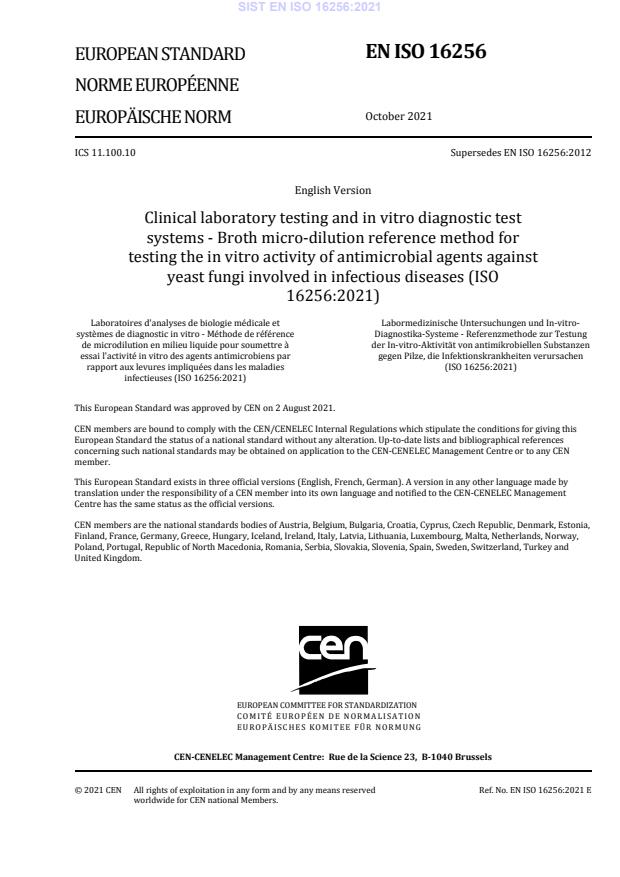
EN ISO 16256
EUROPEAN STANDARD
NORME EUROPÉENNE
October 2021
EUROPÄISCHE NORM
ICS 11.100.10 Supersedes EN ISO 16256:2012
English Version
Clinical laboratory testing and in vitro diagnostic test
systems - Broth micro-dilution reference method for
testing the in vitro activity of antimicrobial agents against
yeast fungi involved in infectious diseases (ISO
16256:2021)
Laboratoires d'analyses de biologie médicale et Labormedizinische Untersuchungen und In-vitro-
systèmes de diagnostic in vitro - Méthode de référence Diagnostika-Systeme - Referenzmethode zur Testung
de microdilution en milieu liquide pour soumettre à der In-vitro-Aktivität von antimikrobiellen Substanzen
essai l'activité in vitro des agents antimicrobiens par gegen Pilze, die Infektionskrankheiten verursachen
rapport aux levures impliquées dans les maladies (ISO 16256:2021)
infectieuses (ISO 16256:2021)
This European Standard was approved by CEN on 2 August 2021.
CEN members are bound to comply with the CEN/CENELEC Internal Regulations which stipulate the conditions for giving this
European Standard the status of a national standard without any alteration. Up-to-date lists and bibliographical references
concerning such national standards may be obtained on application to the CEN-CENELEC Management Centre or to any CEN
member.
This European Standard exists in three official versions (English, French, German). A version in any other language made by
translation under the responsibility of a CEN member into its own language and notified to the CEN-CENELEC Management
Centre has the same status as the official versions.
CEN members are the national standards bodies of Austria, Belgium, Bulgaria, Croatia, Cyprus, Czech Republic, Denmark, Estonia,
Finland, France, Germany, Greece, Hungary, Iceland, Ireland, Italy, Latvia, Lithuania, Luxembourg, Malta, Netherlands, Norway,
Poland, Portugal, Republic of North Macedonia, Romania, Serbia, Slovakia, Slovenia, Spain, Sweden, Switzerland, Turkey and
United Kingdom.
EUROPEAN COMMITTEE FOR STANDARDIZATION
COMITÉ EUROPÉEN DE NORMALISATION
EUROPÄISCHES KOMITEE FÜR NORMUNG
CEN-CENELEC Management Centre: Rue de la Science 23, B-1040 Brussels
© 2021 CEN All rights of exploitation in any form and by any means reserved Ref. No. EN ISO 16256:2021 E
worldwide for CEN national Members.
Contents Page
European foreword . 3
European foreword
This document (EN ISO 16256:2021) has been prepared by Technical Committee ISO/TC 212 "Clinical
laboratory testing and in vitro diagnostic test systems" in collaboration with Technical Committee
CEN/TC 140 “In vitro diagnostic medical devices” the secretariat of which is held by DIN.
This European Standard shall be given the status of a national standard, either by publication of an
identical text or by endorsement, at the latest by April 2022, and conflicting national standards shall be
withdrawn at the latest by October 2024.
Attention is drawn to the possibility that some of the elements of this document may be the subject of
patent rights. CEN shall not be held responsible for identifying any or all such patent rights.
This document supersedes EN ISO 16256:2012.
Any feedback and questions on this document should be directed to the users’ national standards
body/national committee. A complete listing of these bodies can be found on the CEN website.
According to the CEN-CENELEC Internal Regulations, the national standards organizations of the
following countries are bound to implement this European Standard: Austria, Belgium, Bulgaria,
Croatia, Cyprus, Czech Republic, Denmark, Estonia, Finland, France, Germany, Greece, Hungary, Iceland,
Ireland, Italy, Latvia, Lithuania, Luxembourg, Malta, Netherlands, Norway, Poland, Portugal, Republic of
North Macedonia, Romania, Serbia, Slovakia, Slovenia, Spain, Sweden, Switzerland, Turkey and the
United Kingdom.
Endorsement notice
The text of ISO 16256:2021 has been approved by CEN as EN ISO 16256:2021 without any modification.
INTERNATIONAL ISO
STANDARD 16256
Second edition
2021-10
Clinical laboratory testing and in
vitro diagnostic test systems — Broth
micro-dilution reference method
for testing the in vitro activity of
antimicrobial agents against yeast
fungi involved in infectious diseases
Laboratoires d’analyses de biologie médicale et systèmes de
diagnostic in vitro — Méthode de référence de microdilution en
milieu liquide pour soumettre à essai l’activité in vitro des agents
antimicrobiens par rapport aux levures impliquées dans les maladies
infectieuses
Reference number
ISO 16256:2021(E)
ISO 16256:2021(E)
© ISO 2021
All rights reserved. Unless otherwise specified, or required in the context of its implementation, no part of this publication may
be reproduced or utilized otherwise in any form or by any means, electronic or mechanical, including photocopying, or posting on
the internet or an intranet, without prior written permission. Permission can be requested from either ISO at the address below
or ISO’s member body in the country of the requester.
ISO copyright office
CP 401 • Ch. de Blandonnet 8
CH-1214 Vernier, Geneva
Phone: +41 22 749 01 11
Email: copyright@iso.org
Website: www.iso.org
Published in Switzerland
ii
ISO 16256:2021(E)
Contents Page
Foreword .iv
Introduction . vi
1 Scope . 1
2 Normative references . 1
3 Terms and definitions . 1
4 Test procedures . 3
4.1 General . 3
4.1.1 Trays and method . 3
4.1.2 Conditions for use of disposable micro-dilution trays . 3
4.2 Medium . 3
4.2.1 General . 3
4.2.2 Visual reading pathway. 3
4.2.3 Spectrophotometric reading pathway . 4
4.3 Antifungal agents . 4
4.3.1 General . 4
4.3.2 Preparation of stock solutions . 4
4.3.3 Preparation of working solutions . 5
4.4 Preparation of broth micro-dilution trays . 6
4.4.1 Preparation for tests read visually – Visual reading pathway . 6
4.4.2 Preparation for tests read by spectrophotometer - Spectrophometric
reading pathway . 6
4.5 Storage of micro-dilution trays. 6
4.6 Preparation of inoculum . 7
4.6.1 General . 7
4.6.2 Preparation of inoculum for visual test reading . 7
4.6.3 Preparation of inoculum for spectrophotometric test reading . 7
4.7 Inoculation of micro-dilution trays . 7
4.8 Incubation of micro-dilution trays . 8
4.8.1 General . 8
4.8.2 Visual pathway . 8
4.8.3 Spectrophotometric pathway . 8
4.9 Reading MIC results . 8
4.9.1 General . 8
4.9.2 Visual reading method . 8
4.9.3 Spectrophotometric reading methods . 8
4.10 Interpretation of MICs . 9
5 Quality Control (QC) . 9
Annex A (informative) RPMI-1640 medium .12
Annex B (informative) McFarland 0,5 barium sulfate turbidity standard .14
Bibliography .15
iii
ISO 16256:2021(E)
Foreword
ISO (the International Organization for Standardization) is a worldwide federation of national standards
bodies (ISO member bodies). The work of preparing International Standards is normally carried out
through ISO technical committees. Each member body interested in a subject for which a technical
committee has been established has the right to be represented on that committee. International
organizations, governmental and non-governmental, in liaison with ISO, also take part in the work.
ISO collaborates closely with the International Electrotechnical Commission (IEC) on all matters of
electrotechnical standardization.
The procedures used to develop this document and those intended for its further maintenance are
described in the ISO/IEC Directives, Part 1. In particular, the different approval criteria needed for the
different types of ISO documents should be noted. This document was drafted in accordance with the
editorial rules of the ISO/IEC Directives, Part 2 (see www.iso.org/directives).
Attention is drawn to the possibility that some of the elements of this document may be the subject of
patent rights. ISO shall not be held responsible for identifying any or all such patent rights. Details of
any patent rights identified during the development of the document will be in the Introduction and/or
on the ISO list of patent declarations received (see www.iso.org/patents).
Any trade name used in this document is information given for the convenience of users and does not
constitute an endorsement.
For an explanation of the voluntary nature of standards, the meaning of ISO specific terms and
expressions related to conformity assessment, as well as information about ISO's adherence to
the World Trade Organization (WTO) principles in the Technical Barriers to Trade (TBT), see
www.iso.org/iso/foreword.html.
This document was prepared by Technical Committee ISO/TC 212, Clinical laboratory testing and in
vitro diagnostic test systems, in collaboration with the European Committee for Standardization (CEN)
Technical Committee CEN/TC 140, In vitro diagnostic medical devices, in accordance with the Agreement
on technical cooperation between ISO and CEN (Vienna Agreement).
This second edition cancels and replaces the first edition (ISO 16256:2012), which has been technically
revised.
The main changes are as follows:
— addition of “broth micro-dilution” to the title;
— removal of 48 h reading for Candida species by the visual reading method;
— removal of definitions for susceptibility and resistance that are beyond the scope of this test
performance document;
— inclusion of considerations for antifungal testing of yeast species with micro-dilution trays “treated”
by manufacturers of the trays prior to use in the tests;
— updating of viable count testing methods for visual and spectrophotometer test pathways.
— addition of new antifungals (isavuconazole, rezafungin) to the testing and quality control range
tables;
— detailed characterization of the components of one formulation of RPMI-1640 known to provide
reproducible results of antifungal susceptibility tests for Candida species and Cryptococcus
neoformans;
— reassigning of annexes;
— update of bibliography to more relevant information about performance of antifungal susceptibility
testing for yeast fungi.
iv
ISO 16256:2021(E)
Any feedback or questions on this document should be directed to the user’s national standards body. A
complete listing of these bodies can be found at www.iso.org/members.html.
v
ISO 16256:2021(E)
Introduction
In vitro susceptibility tests are performed on microorganisms suspected of causing disease, particularly
if the organism is thought to belong to a species that can exhibit acquired resistance to frequently used
antimicrobial agents. The tests are also important in resistance surveillance, epidemiological studies of
susceptibility and in comparisons of new and existing agents.
Dilution procedures are used to determine the minimum inhibitory concentrations (MICs) of
antimicrobial agents and represent the reference method for antifungal susceptibility testing. MIC
methods are used in resistance surveillance, comparative testing of new agents for research or
registration purposes, to establish the susceptibility of organisms that give equivocal results in routine
tests, for tests with organisms where routine tests can be unreliable and when a quantitative result is
needed for clinical management. In dilution tests, microorganisms are tested for their ability to produce
discernible growth on a series of agar plates (agar dilution) or in broth (broth dilution) containing serial
dilutions of the antimicrobial agent.
The lowest concentration of an antimicrobial agent (in mg/l) that, under defined in vitro test conditions,
reduces visible or optically measurable growth of a microorganism within a defined period of time
is known as the MIC. The MIC is a guide for the clinician to the susceptibility of the organism to the
antimicrobial agent and aids treatment decisions. Careful control and standardization are required
for intra- and inter-laboratory reproducibility, as results can be influenced by the method used. It is
generally accepted that broth MIC tests are reproducible to within one doubling dilution of the true end
point (i.e. ±1 well or tube in a doubling dilution series).
Broth dilution is a technique in which containers holding identical volumes of broth with antimicrobial
agent solutions in incrementally (usually two-fold) increasing concentrations are inoculated with a
known number of microorganisms.
Broth micro-dilution denotes the performance of the broth dilution test in micro-dilution trays.
The reference methods described in this document are intended for the testing of pure cultures of yeast
fungi. The broth micro-dilution methods described in this document are the same as those described
[1][5]
by the Clinical and Laboratory Standards Institute (CLSI) and by the European Committee on
[2][10]
Antimicrobial Susceptibility Testing (EUCAST) . These methods were initially shown to provide
[3]
MICs of fluconazole that were similar, if not identical up to 2 mg/l . Further the methods have been
shown to provide MICs for two quality control strains of licensed antifungal agents that are similar
as described in this document although quality control results for the spectrophotometer can trend
slightly lower than for the visual reading method. The laboratory that wishes to use this document
for conducting studies of newer antifungal agents, or as a reference method for comparison to MICs
generated by a diagnostic device, can select which of the procedure options to use based upon the choice
[5]
of MIC reading determined by visual inspection (CLSI method) or by use of a spectrophotometer
[2][10]
(EUCAST method) . In either case, the procedural details for that option should be followed
explicitly. In the first edition of this document, i.e. ISO 16256:2012, the reported quality control
tests were performed using broth micro-dilution trays that were not treated in some way by the
manufacturers of the plastic trays for either the visual or spectrophotometer method.
In this document the following verbal forms are used:
— “shall” indicates a requirement;
— “should” indicates a recommendation;
— ”may” indicates a permission;
— “can” indicates a possibility or a capability.
vi
INTERNATIONAL STANDARD ISO 16256:2021(E)
Clinical laboratory testing and in vitro diagnostic test
systems — Broth micro-dilution reference method for
testing the in vitro activity of antimicrobial agents against
yeast fungi involved in infectious diseases
WARNING — The use of this document can involve hazardous materials, operations and
equipment. This document does not purport to address all of the safety problems associated
with its use. It is the responsibility of the user of this document to establish appropriate safety
and health practices and determine the applicability of regulatory limitations prior to use.
1 Scope
This document describes a method for testing the susceptibility to antifungal agents of yeasts, including
Candida spp. and Cryptococcus neoformans, that cause infections. The reference method described here
has not been used in studies of the yeast forms of dimorphic fungi, such as Blastomyces dermatitidis
and/or Histoplasma capsulatum variety capsulatum. Moreover, testing filamentous fungi (moulds)
introduces several additional problems in standardization not addressed by the current procedure.
Those methods are beyond the scope of this document.
This document describes the broth micro-dilution reference method, which can be implemented by
[1][5]
either of two pathways. One pathway involves visual determination of MICs (CLSI method) ; the
[2][10]
second pathway involves spectrophotometric determination of MICs (EUCAST method) . The MIC
reflects the activity of the drug under the described test conditions and can be interpreted for clinical
management purposes by taking into account other factors, such as drug pharmacology or antifungal
resistance mechanisms. In addition, MIC distributions can be used to define wild type or non-wild
type fungal populations. Clinical interpretation of the MIC value is beyond the scope of this document;
interpretive category breakpoints specific to the CLSI- and EUCAST-derived methods can be found by
[5][15]
consulting the latest interpretive tables provided by the organizations . Routine susceptibility
testing methods or diagnostic test devices can be compared with this reference method in order to
ensure comparable and reliable results for validation or registration purposes.
2 Normative references
There are no normative references in this document.
3 Terms and definitions
For the purposes of this document, the following terms and definitions apply.
ISO and IEC maintain terminology databases for use in standardization at the following addresses:
— ISO Online browsing platform: available at https:// www .iso .org/ obp
— IEC Electropedia: available at https:// www .electropedia .org/
3.1
antifungal agent
substance of biological, semi-synthetic or synthetic origin that inhibits the growth of or kills fungi, and
is thus of potential use in the treatment of infections
Note 1 to entry: Disinfectants, antiseptics and preservatives are not included in this definition.
3.2 Antifungal agents — properties
ISO 16256:2021(E)
3.2.1
potency
active fraction of a test substance, determined in a bioassay against a reference powder of the same
substance
Note 1 to entry: The potency is expressed as mass fraction in milligrams per gram (mg/g), or as activity content
in International Units (IU) per gram, or as a volume fraction or mass fraction in percent, or as an amount-of-
substance concentration (mass fraction) in mole per litre of ingredients in the test substance.
3.2.2
concentration
amount of an antifungal agent (3.1) in a specified volume of liquid
Note 1 to entry: The concentration is expressed as mg/l.
Note 2 to entry: mg/l = µg/ml but use of the unit µg/ml is not recommended.
3.3
stock solution
initial solution used for further dilutions
3.4
minimum inhibitory concentration
MIC
lowest concentration (3.2.2) that, under specified in vitro test conditions, reduces growth by an agreed
amount within a specified period of time
Note 1 to entry: The MIC is expressed in mg/l.
3.5
wild type
absence of phenotypically-detectable acquired resistance mechanisms to the antifungal agent (3.1) in a
given fungal strain
3.6
reference strain
catalogued, well-characterized fungal strain with stable, specified antifungal susceptibility phenotypes
and/or genotypes
Note 1 to entry: Reference strains are kept as stock cultures, from which working cultures are derived. They are
obtainable from culture collections and used for quality control.
3.7 Susceptibility testing method
3.7.1
broth dilution
technique in which containers are filled with appropriate volumes of an antifungal solution, employing
incrementally (usually two-fold) increasing concentrations (3.2.2) of the antifungal agent (3.1) and
appropriate volumes of broth (3.8) with a specified inoculum (3.9)
Note 1 to entry: The aim of this method is the determination of the minimum inhibitory concentration (3.4).
3.7.2
broth micro-dilution
performance of broth dilution (3.7.1) in micro-dilution trays with a capacity of ≤300 µl per well
3.8
broth
fluid medium used for the in vitro growth of yeast fungi
ISO 16256:2021(E)
3.9
inoculum
number of colony-forming units of yeast in a suspension, calculated with respect to the final volume
Note 1 to entry: The inoculum is expressed as colony-forming units per millilitre (CFU/ml).
4 Test procedures
4.1 General
4.1.1 Trays and method
The tests are performed in plastic disposable micro-dilution trays. The method is based on the
preparation of double strength antifungal agent working solutions in 100 µl volumes per well with the
addition of an inoculum also in a volume of 100 µl.
4.1.2 Conditions for use of disposable micro-dilution trays
The tests were originally performed in broth micro-dilution trays that have had no additional
treatment by the manufacturer. Quality control data by manufacturers of untreated trays (and on
which this document was originally based) have shown that quality control results are consistently
in specification for all antifungal agents tested. In some jurisdictions there has been a suggestion that
results can be more consistent using treatment of the plastic trays. Treatment of the plastic, either
by coating or corona discharge to impart an electrical charge to the plastic, is used in tissue culture
studies and allows the tissue cells to adhere to the plastic. It is unknown if this process has been
standardized for all micro-dilution tray manufacturers. It is known that with some antifungal agents
the treated trays can result in elevated MICs compared to untreated trays. Such treatment can affect
[13]
the reporting of results for those agents . Those laboratories that use “treated” micro-dilution trays
and read by spectrophotometer should ensure that the treated trays being utilized in testing provide
the same quality control results as those indicated in Table 5. Those quality control ranges were
originally performed with untreated trays. The data indicates that for almost all antifungal agents,
the quality control ranges for the two
...
Questions, Comments and Discussion
Ask us and Technical Secretary will try to provide an answer. You can facilitate discussion about the standard in here.
Loading comments...